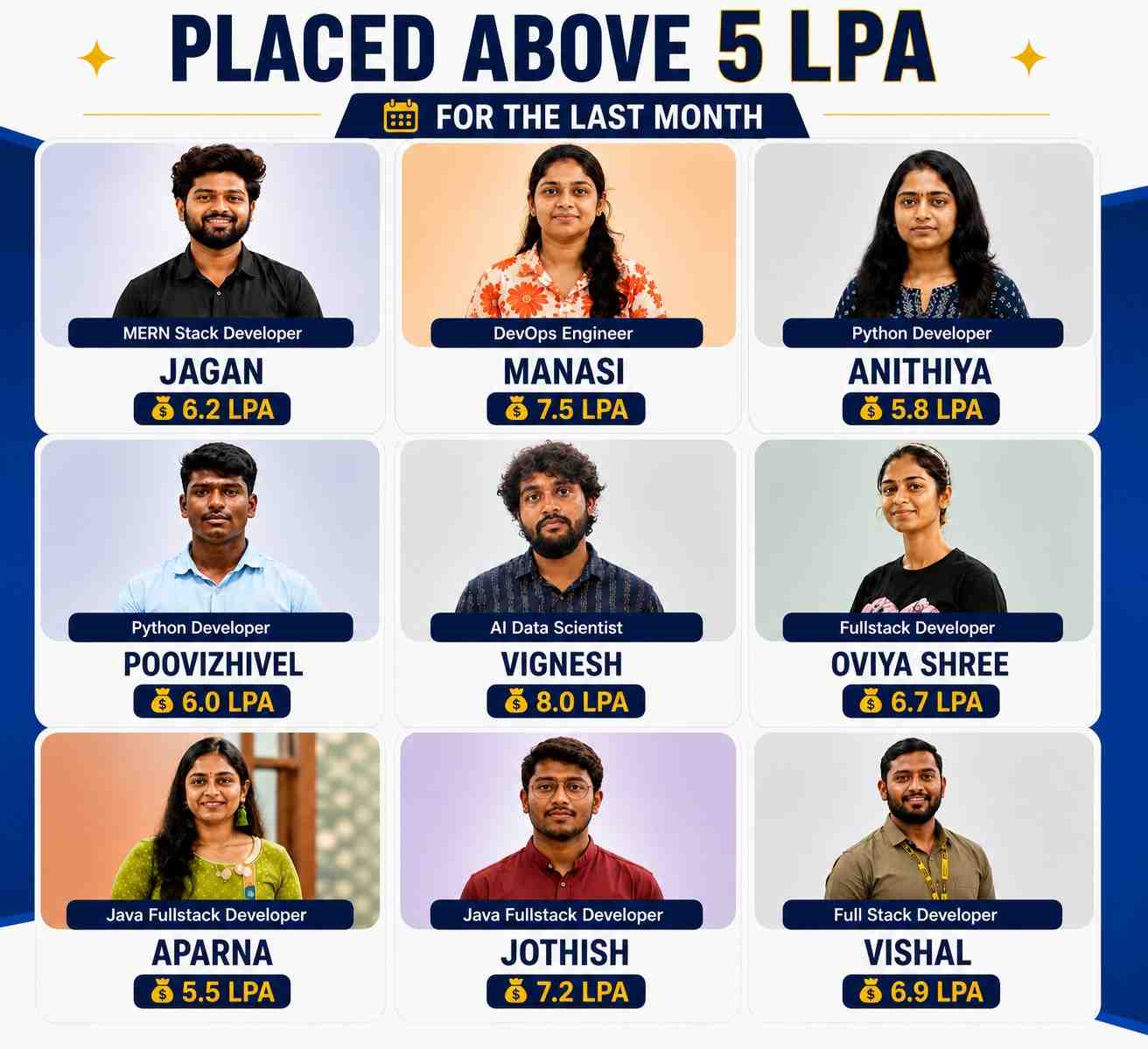
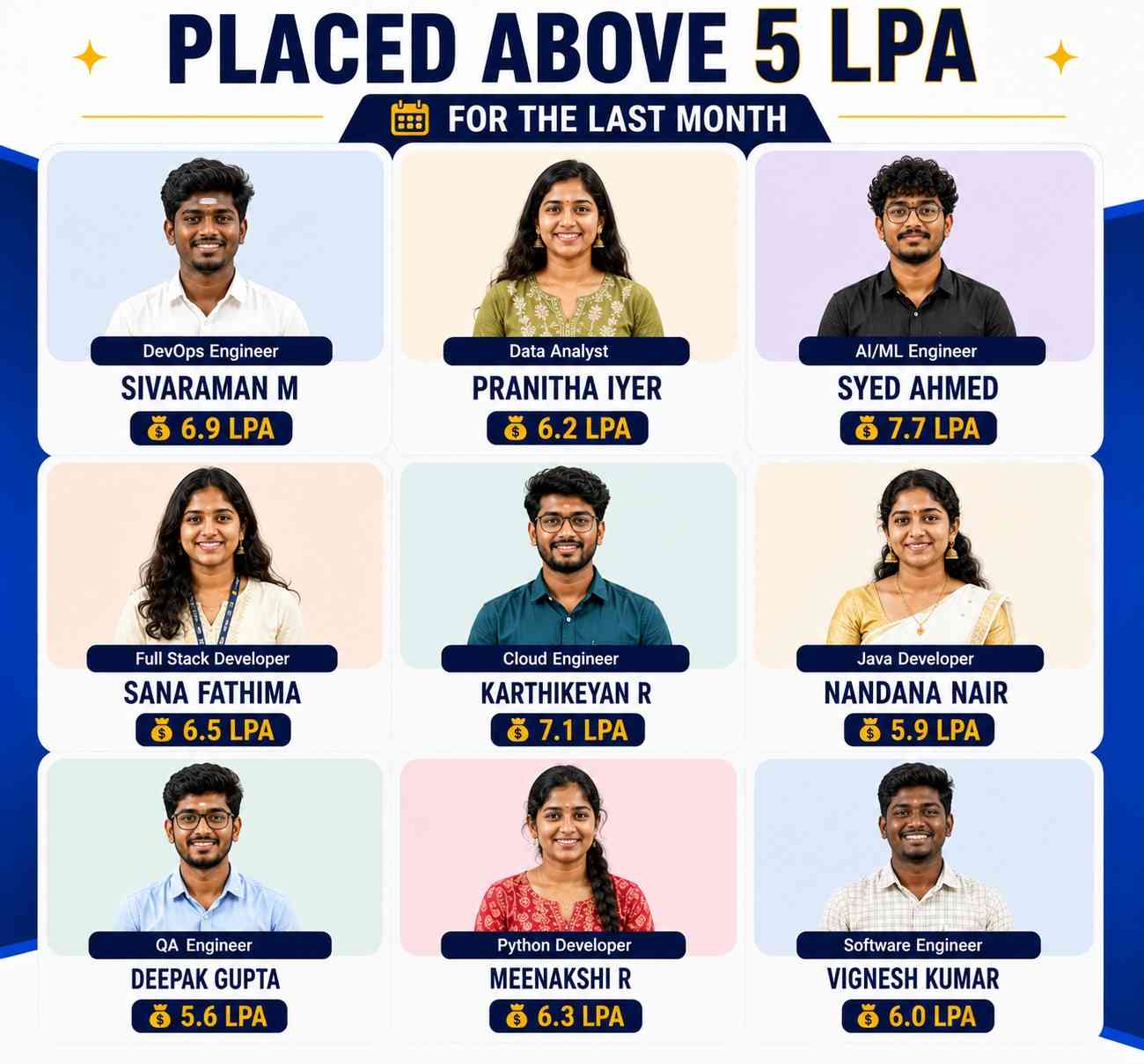
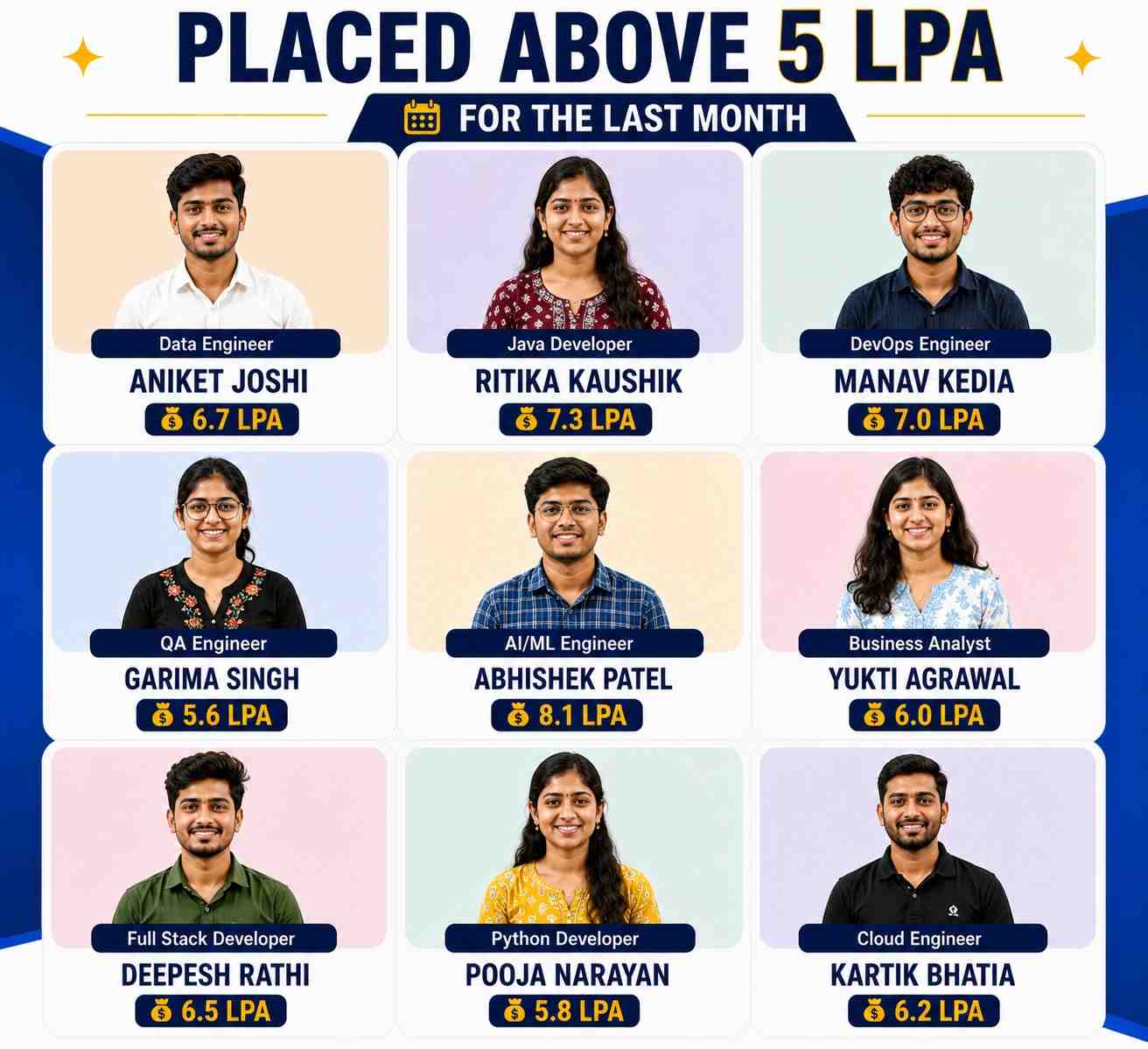
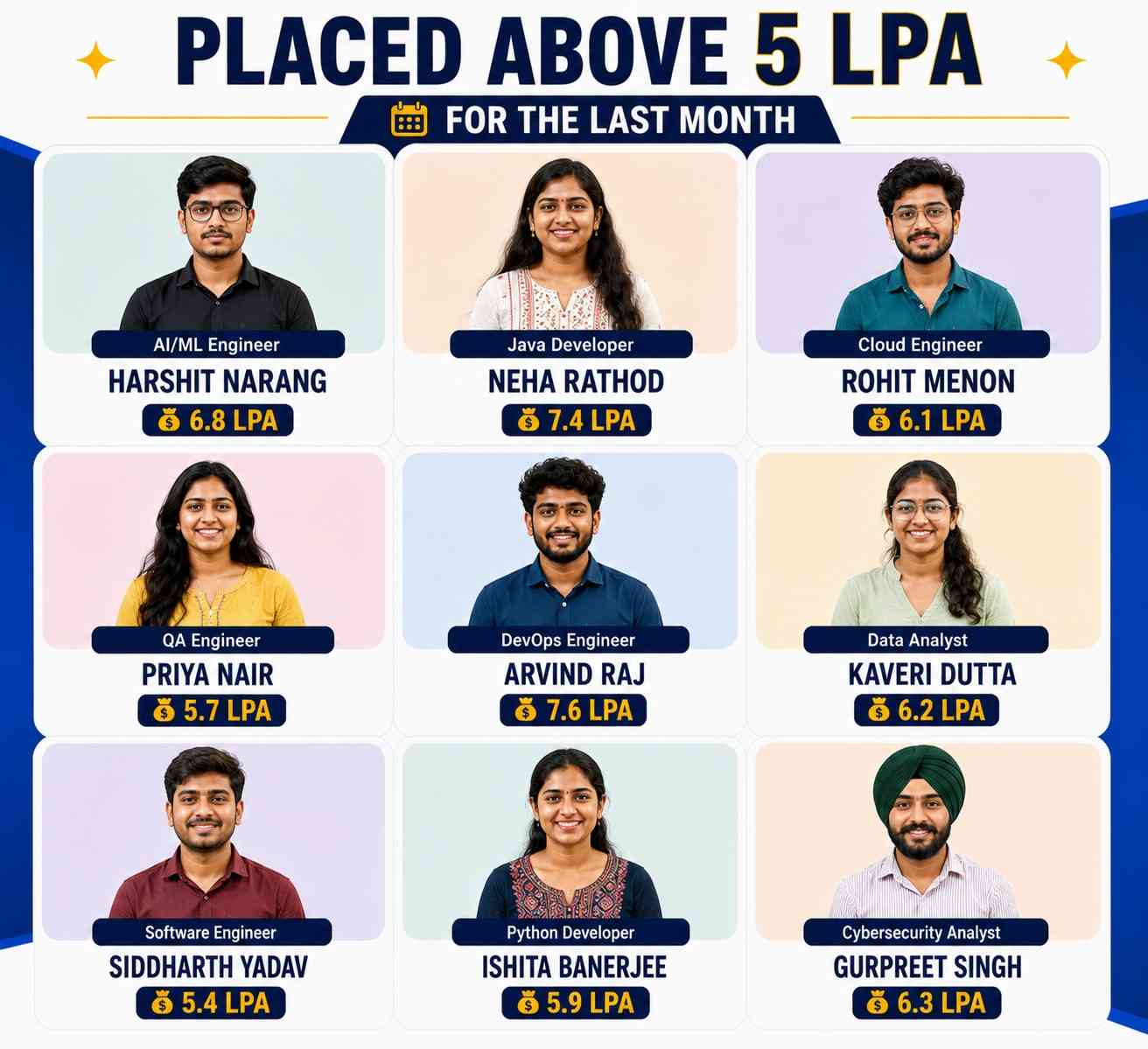
Best AI and Machine Learning Training in Thiruvanmiyur | AI and ML Course | Updated 2025

AI and Machine Learning Training for All Graduates, NON-IT, Diploma & Career Gaps — Starting From ₹16,500/- only.

Download Brouchure
Join Our 100% Job Guaranteed

AI and Machine Learning Training in Thiruvanmiyur

  • JoinAI and Machine Learning Training Institute in Thiruvanmiyur to Gain AI Skills.
  • Our AI and Machine Learning Course in Thiruvanmiyur Covers Python Programming, NLP.
  • Gain Hands-on Experience by Working on Live Industry Projects Under the Skilled Mentors.
  • Earn a Globally Recognized Certification in Ai and Machine Learning With Career Support.
  • Receive Mentoring for Resume Building, Interview Preparation, and Career Growth.
  • Choose Flexible Learning Options With Weekday, Weekend, and Fast-track Batch Schedules.

WANT IT JOB

Become a AI/ML Developer in 3 Months

Freshers Salary

3 LPA

To

8 LPA

Quality Training With Affordable Fees in Thiruvanmiyur!

⭐ Fees Starts From

INR 36,000
INR 16,500

11278+

(Placed)
Freshers To IT

5875+

(Placed)
NON-IT TO IT

7859+

(Placed)
Career Gap

4192+

(Placed)
Less Then 60%

Our Hiring Partners

Overview of the AI and Machine Learning Course

Our AI and Machine Learning Training in Thiruvanmiyur is thoughtfully structured for beginners who want to build a solid foundation and progress toward advanced AI and ML expertise. The AI and Machine Learning Course includes Python programming, data analysis, neural networks, and hands-on projects to deliver practical, real-world learning. Learners gain access to AI and Machine Learning internship opportunities, enabling them to work on live projects and develop job-ready skills. We offer complete AI and Machine Learning placement assistance, including interview preparation and career guidance, to help you secure positions with leading organizations. Upon successful completion, you will earn a globally recognized AI and Machine Learning certification that validates your skills.

What You'll Learn From AI and Machine Learning Certification Course

Build a strong foundation in AI and Machine Learning, including Python programming, data analysis, and neural networks.

Learn core machine learning algorithms, data preprocessing methods, and model evaluation through easy-to-follow, practical sessions.

Gain hands-on exposure by working on real-world projects and industry-based case studies.

Explore advanced topics such as deep learning, natural language processing (NLP), computer vision, and AI model deployment.

Complete the AI and Machine Learning Training in Thiruvanmiyur to develop job-ready skills and applied expertise.

Enhance your analytical thinking and problem-solving abilities while earning a globally recognized AI and Machine Learning certification.

Additional Info

Course Highlights

  • Gain mastery in AI and Machine Learning through comprehensive training in Python, TensorFlow, data modeling, neural networks, and real-time hands-on AI projects.
  • Receive dedicated placement assistance for AI and Machine Learning roles with leading companies seeking skilled professionals.
  • Join a community of successful learners trained and placed through our strong network of 300+ industry partners and experienced mentors.
  • Learn from certified trainers with over 10 years of expertise in AI, Machine Learning, and Data Science.
  • Benefit from beginner-friendly instruction, practical projects, and end-to-end career guidance to help you advance with confidence.
  • Enjoy flexible batch schedules, cost-effective fees, and AI and Machine Learning internship opportunities in Thiruvanmiyur, along with an industry-recognized certification.

Benefits You Gain from AI and Machine Learning Training

  • Automation : AI and Machine Learning enable the automation of repetitive and time-intensive tasks, improving speed, accuracy, and productivity. By minimizing manual effort and errors, professionals can focus on strategic and creative responsibilities. Automation enhances workflows across industries such as healthcare, finance, and IT while supporting faster, data-driven operations.
  • Smarter Decision-Making : AI and Machine Learning process large volumes of data to identify patterns and insights that are difficult to recognize manually. This empowers organizations to make informed, data-driven decisions. Predictive models help forecast customer behavior, market trends, and business outcomes with greater accuracy.
  • Cost Efficiency : AI-driven solutions optimize processes, reduce errors, and lower operational costs. Automated systems perform tasks efficiently, cutting down rework and waste. Businesses also gain improved resource utilization, including better management of inventory, energy, and supply chains.
  • Personalization : AI enables personalized experiences by analyzing user preferences and behavior. From tailored recommendations to targeted marketing campaigns, AI improves customer engagement, satisfaction, and retention through relevant and meaningful interactions.
  • Innovation and Career Growth : AI and Machine Learning fuel innovation by powering intelligent applications such as chatbots, robotics, and autonomous systems. These technologies open new opportunities across industries, create competitive advantages for organizations, and offer strong career growth for professionals pursuing roles in the AI and ML domain.

Important Tools Covered in the AI and Machine Learning Course

  • Python : Python is a versatile programming language widely used in AI and Machine Learning due to its simplicity and extensive libraries. With frameworks like TensorFlow, Keras, and PyTorch, learners can easily build, train, and deploy AI models. Python also supports data analysis, visualization, and predictive modeling, making it ideal for beginners and advanced professionals alike. Its strong community and abundant learning resources accelerate skill development.
  • TensorFlow : TensorFlow, developed by Google, is an open-source framework for creating advanced AI and deep learning models. It is extensively used in image recognition, natural language processing (NLP), and neural network development. TensorFlow’s scalability makes it essential for building high-performance, real-world AI applications.
  • PyTorch : PyTorch is a popular open-source library known for flexibility and dynamic computation. It allows developers to efficiently create and train neural networks while experimenting with AI models. Widely used in both research and industry, PyTorch helps transform AI concepts into practical, production-ready solutions.
  • Jupyter Notebook : Jupyter Notebook provides an interactive platform to write and execute Python code. Combining code, documentation, and visualizations in a single interface, it simplifies experimentation with AI and Machine Learning models. Learners can test models, visualize results, and track outcomes effectively in a hands-on environment.
  • Scikit-learn : Scikit-learn is a powerful Python library for Machine Learning and data analysis. It offers pre-built algorithms for classification, regression, clustering, and model evaluation. Scikit-learn enables learners to train models, assess performance, and understand core Machine Learning concepts, making it perfect for building real-world AI solutions.

Top Frameworks Every AI and Machine Learning Professional Should Know

  • TensorFlow : Developed by Google, TensorFlow is a widely used open-source framework for building AI and Machine Learning models. It excels in deep learning tasks like image recognition, natural language processing (NLP), and predictive analytics. With strong Python integration and scalability for large projects, TensorFlow is ideal for beginners and advanced learners alike.
  • PyTorch : PyTorch is a flexible open-source framework known for its dynamic computation and ease of use. It enables developers to efficiently build and train neural networks and is popular in research areas such as computer vision and speech recognition. PyTorch’s robust community support and pre-trained models make it perfect for hands-on AI projects.
  • Keras : Keras is a high-level deep learning framework built on TensorFlow, designed to simplify neural network development. Its intuitive APIs and pre-built modules allow beginners to quickly design and train models without dealing with complex mathematical implementations. Keras is widely used in image processing, text analysis, and rapid experimentation.
  • Scikit-learn : Scikit-learn is a Python-based Machine Learning framework for data analysis and model building. It provides ready-to-use algorithms for classification, regression, clustering, and model evaluation. Known for its simplicity and reliability, Scikit-learn is used in both academic learning and real-world AI applications.
  • Microsoft Cognitive Toolkit (CNTK) : Microsoft Cognitive Toolkit (CNTK) is an open-source deep learning framework designed for large-scale AI model development. It is suitable for tasks like speech recognition, image processing, and predictive analytics. With GPU acceleration and multi-language support, CNTK is ideal for advanced AI development and enterprise-level projects.

Essential Skills You’ll Learn in an AI and Machine Learning Certification Course

  • Python Programming : Python is the leading programming language for AI and Machine Learning. You’ll learn to write efficient code for data processing, algorithm development, and AI model creation. Using libraries like TensorFlow, Keras, and PyTorch, Python allows faster experimentation, visualization, and development of real-world AI applications.
  • Data Analysis : Data analysis involves collecting, cleaning, and interpreting data to extract meaningful insights. You’ll work with tools like Pandas and Matplotlib to prepare datasets, visualize trends, and ensure high-quality inputs for Machine Learning models. These skills are crucial for building accurate and reliable AI solutions.
  • Machine Learning Algorithms : Gain a strong understanding of core Machine Learning algorithms such as classification, regression, clustering, and recommendation systems. Learn to select, train, and evaluate the right algorithms to enhance model performance and solve practical business challenges.
  • Deep Learning and Neural Networks : Deep Learning enables AI systems to recognize complex patterns and mimic human intelligence. You’ll learn to design and train neural networks for applications like image recognition, speech processing, and natural language understanding using frameworks such as TensorFlow, Keras, and PyTorch. These skills prepare you for advanced AI roles.
  • Problem-Solving and Critical Thinking : AI and Machine Learning require strong analytical and logical thinking. You’ll develop the ability to break down complex problems, debug models, interpret results, and optimize performance skills essential for designing intelligent, real-world AI solutions.

Key Roles and Responsibilities Covered in the AI and Machine Learning Course

  • Machine Learning Engineer : Machine Learning Engineers design, build, and deploy AI models that learn from data. They prepare and preprocess datasets, select suitable algorithms, and train models for various applications. Optimizing models for accuracy, performance, and scalability is a core responsibility. They collaborate closely with data scientists and software teams to ensure AI solutions are production-ready.
  • Data Scientist : Data Scientists analyze large datasets to uncover patterns, trends, and actionable insights. They build predictive models to guide business decisions and enhance operational efficiency. Creating visualizations and reports to communicate findings is essential. They work alongside engineering teams to turn raw data into practical, data-driven solutions.
  • AI Research Scientist : AI Research Scientists develop and experiment with innovative algorithms and techniques to advance AI technologies. They conduct research in areas like computer vision, natural language processing (NLP), and deep learning. Their work contributes to innovation, publications, and new industry applications in collaboration with academic and corporate research teams.
  • Business Intelligence (BI) Developer : BI Developers leverage AI and Machine Learning to build dashboards, reports, and analytical tools for data-driven decision-making. They integrate data from multiple sources to deliver actionable business insights. By automating reporting and tracking performance trends, BI Developers help organizations enhance efficiency and align data strategies with business objectives.
  • AI Product Manager : AI Product Managers oversee the development and delivery of AI-powered products. They define product vision, prioritize features, and coordinate between technical teams and business stakeholders. Monitoring performance metrics and ensuring AI solutions meet user needs helps deliver scalable, market-ready products.

Why AI and Machine Learning Are the Ideal Choice for Freshers

  • Soaring Demand for Skills : AI and Machine Learning are among the fastest-growing technology domains. Companies across industries are actively seeking professionals who can design intelligent systems, creating abundant opportunities for freshers. Gaining these skills gives you a competitive edge, with demand expected to grow as AI adoption expands.
  • Attractive Salary Packages : Careers in AI and Machine Learning often offer some of the highest starting salaries in tech. Employers highly value individuals who can develop and deploy AI solutions, and compensation increases steadily with experience and specialization, making this a financially rewarding career path.
  • Opportunity to Work on Cutting-Edge Technologies : Entering AI and Machine Learning allows you to work with advanced technologies like deep learning, computer vision, and natural language processing (NLP). Projects often have real-world impact, providing a dynamic, creative, and continuously evolving work environment.
  • Versatility Across Industries : AI and Machine Learning skills are in demand across healthcare, finance, retail, education, entertainment, and more. This versatility allows professionals to engage in diverse projects and explore multiple career paths that align with their interests.
  • Future-Proof Career : AI and Machine Learning are shaping the future of work. Developing expertise in this field ensures long-term career relevance, adaptability to emerging technologies, and continuous learning opportunities, offering a stable and rewarding professional journey.

Landing Remote Jobs with AI and Machine Learning Skills

  • Global Demand for Expertise : AI and Machine Learning skills are highly sought after worldwide. Remote opportunities allow professionals to work with international companies without relocating. Mastery of AI tools, frameworks, and model-building makes candidates highly competitive, capable of handling projects independently, and opens doors to numerous remote roles across industries.
  • Flexible Work Options : Many AI tasks such as coding, data analysis, and model training can be performed from anywhere with a computer and internet connection. This flexibility enables professionals to manage projects efficiently without being tied to a physical office. Increasingly, companies are offering remote tech roles, combining freedom with career growth.
  • Collaborate on Global Projects : Remote AI professionals can contribute to projects for clients and organizations worldwide. Exposure to diverse industries and workflows enhances practical knowledge and skill sets. Virtual collaboration with international teams improves communication, problem-solving, and overall professional credibility.
  • High Earning Potential : Remote AI roles often come with competitive salaries due to the high demand for skilled professionals. Freelance projects and specialized positions allow individuals to earn based on expertise and project complexity, providing financial stability while enjoying flexible work arrangements and diverse experiences.
  • Continuous Learning and Career Advancement : Remote AI work exposes professionals to emerging technologies, tools, and methodologies. Collaborating with global teams fosters self-learning, adaptability, and networking. These experiences support continuous skill development, ensuring long-term career growth and keeping professionals aligned with industry trends.

What to Expect in Your First AI and Machine Learning Job

  • Hands-On Data Experience : In your first AI and Machine Learning role, you’ll spend significant time cleaning, organizing, and preprocessing datasets for model training. Understanding data patterns and preparing it accurately is essential for reliable results. Freshers often dive deep into analyzing data before building models, gaining a strong foundation for advanced AI projects.
  • Learning and Applying AI Tools : Beginner roles provide practical experience with popular AI frameworks and tools such as Python, TensorFlow, PyTorch, and Keras. Initial projects usually involve guided tasks that help bridge theory with real-world applications. Mentorship from experienced colleagues strengthens technical skills and builds confidence in using these tools effectively.
  • Team Collaboration : AI projects require close coordination with engineers, data scientists, and business teams. Effective communication ensures you understand project requirements and deliver successful solutions. Freshers often engage in discussions, code reviews, and team meetings, developing both technical expertise and interpersonal skills.
  • Testing and Optimizing Models : Evaluating models for accuracy and performance is a key responsibility. You’ll learn to fine-tune parameters, test predictions, and improve efficiency. Iterative testing helps you understand the strengths and limitations of different algorithms, ensuring models perform well in real-world applications while sharpening problem-solving skills.
  • Exposure to Real-World Projects : Your first job offers opportunities to work on practical business problems, such as predictive analytics, recommendation engines, or image and speech recognition. Applying theoretical knowledge to real-world challenges helps you manage large datasets, understand deployment considerations, and gain insights into actual AI applications, building a solid foundation for a long-term career in AI and Machine Learning.

Top Companies Hiring AI and Machine Learning Professionals

  • Google : As a global leader in technology and AI research, Google applies AI and Machine Learning in products like search engines, Google Assistant, and autonomous vehicle projects. Professionals work on deep learning, natural language processing (NLP), and computer vision. Freshers get the opportunity to contribute to cutting-edge AI innovations while enjoying a strong learning and growth environment.
  • Microsoft : Microsoft integrates AI across platforms such as Azure, Office 365, and Cortana. Employees develop solutions for cloud computing, business analytics, and automation. The company fosters innovation, providing access to advanced tools and frameworks. AI professionals engage in large-scale, real-world projects while benefiting from structured training and career development programs.
  • Amazon : Amazon uses AI in recommendation engines, Alexa, supply chain optimization, and fraud detection. Professionals design intelligent algorithms to enhance customer experiences and manage big data projects. Freshers gain hands-on experience in a fast-paced environment where AI applications have direct business impact.
  • IBM : IBM drives AI initiatives through its Watson platform and enterprise solutions. Professionals explore AI applications in healthcare, finance, and cloud computing, focusing on deep learning, NLP, and predictive analytics. The company provides structured mentorship and learning programs, giving freshers exposure to both research and practical AI implementations.
  • Meta (Facebook) : Meta leverages AI and Machine Learning to power social media, content recommendations, and virtual reality experiences. Employees work on machine vision, natural language processing, and large-scale AI systems. Freshers benefit from innovative, collaborative projects that impact millions of users worldwide.
Show More

Upcoming Batches For Classroom and Online

Weekdays
26 - Jan - 2026
08:00 AM & 10:00 AM
Weekdays
28 - Jan - 2026
08:00 AM & 10:00 AM
Weekends
31 - Jan - 2026
(10:00 AM - 01:30 PM)
Weekends
01 - Feb - 2026
(09:00 AM - 02:00 PM)
Can't find a batch you were looking for?
INR ₹16500
INR ₹36000

OFF Expires in

Who Should Take a AI and ML Course in Thiruvanmiyur

IT Professionals

Non-IT Career Switchers

Fresh Graduates

Working Professionals

Diploma Holders

Professionals from Other Fields

Salary Hike

Graduates with Less Than 60%

Show More

Job Roles For AI And Machine Learning Training

Machine Learning Engineer

Data Scientist

AI Research Scientist

Deep Learning Engineer

Computer Vision Engineer

NLP Engineer

AI Product Manager

Data Engineer (AI/ML focus)

Show More

Tools Covered For AI And ML Training

TensorFlow PyTorch Keras Scikit-learn Hugging Face OpenAI APIs Google Vertex AI Azure Machine Learning

What’s included ?

Convenient learning format

📊 Free Aptitude and Technical Skills Training

  • Learn basic maths and logical thinking to solve problems easily.
  • Understand simple coding and technical concepts step by step.
  • Get ready for exams and interviews with regular practice.
Dedicated career services

🛠️ Hands-On Projects

  • Work on real-time projects to apply what you learn.
  • Build mini apps and tools daily to enhance your coding skills.
  • Gain practical experience just like in real jobs.
Learn from the best

🧠 AI Powered Self Interview Practice Portal

  • Practice interview questions with instant AI feedback.
  • Improve your answers by speaking and reviewing them.
  • Build confidence with real-time mock interview sessions.
Learn from the best

🎯 Interview Preparation For Freshers

  • Practice company-based interview questions.
  • Take online assessment tests to crack interviews
  • Practice confidently with real-world interview and project-based questions.
Learn from the best

🧪 LMS Online Learning Platform

  • Explore expert trainer videos and documents to boost your learning.
  • Study anytime with on-demand videos and detailed documents.
  • Quickly find topics with organized learning materials.

AI and Machine Learning Course Curriculum

  • 🏫 Classroom Training
  • 💻 Online Training
  • 🚫 No Pre Request (Any Vertical)
  • 🏭 Industrial Expert

Our AI and Machine Learning Training in Thiruvanmiyur offers a comprehensive curriculum for beginners and aspiring data professionals. The course covers essential concepts in AI and Machine Learning, Python programming, data modeling, report generation, and interactive dashboard development. Emphasizing practical, hands-on learning, the program includes real-time projects and internship opportunities. Students also gain expertise in data cleaning, visualization techniques, and integrating multiple data sources equipping them with industry-ready skills for real-world AI applications in our AI and Machine Learning Course in Thiruvanmiyur.

  • Programming Foundations – Start with the basics of AI and Machine Learning, covering syntax, variables, data types, and object-oriented concepts.
  • Advanced Concepts & Frameworks – Enhance your skills with advanced programming topics such as decorators and file handling, while learning frameworks.
  • Hands-On Projects – Gain practical experience by building real-world projects, including data-driven dashboards.
  • Tools & Deployment – Learn to deploy AI and Machine Learning programs effectively using tools like PyCharm, Git, Jupyter, and cloud platforms.
Introduction to AI and Machine Learning
Data Preprocessing and Analysis
Machine Learning Algorithms
Deep Learning and Neural Networks
Natural Language Processing (NLP)
AI Tools and Frameworks
Model Evaluation and Optimization

Explore the Fundamentals of AI and Machine Learning, programming and key concepts:

  • Python Fundamentals – Learn syntax, variables, data types and loops for AI programming
  • Mathematics for AI – Understand linear algebra, statistics and probability for model building
  • Data Handling – Work with libraries like Pandas and NumPy for data manipulation
  • AI Concepts – Introduction to supervised and unsupervised learning, classification and regression

Learn how to clean, process and analyze data for AI models:

  • Data Cleaning – Handle missing values, duplicates and outliers using Pandas
  • Data Transformation – Apply normalization, scaling and encoding techniques
  • Exploratory Data Analysis – Use Matplotlib and Seaborn to visualize data patterns
  • Feature Selection – Learn techniques to select important variables for better model performance

Learn essential algorithms to build predictive AI models:

  • Regression – Linear and logistic regression using scikit-learn
  • Classification – Decision trees, random forest and support vector machines
  • Clustering – K-means, hierarchical clustering for data segmentation
  • Model Evaluation – Metrics like accuracy, precision, recall and confusion matrix

Learn advanced AI techniques using neural networks:

  • Artificial Neural Networks (ANN) – Understand layers, neurons and activation functions
  • Deep Learning Frameworks – Work with TensorFlow and PyTorch
  • CNN & RNN – Learn Convolutional Neural Networks for images and Recurrent Neural Networks for sequences
  • Optimization Techniques – Backpropagation, gradient descent and model tuning

Learn to work with text data and language-based AI models:

  • Text Preprocessing – Tokenization, stemming and lemmatization using NLTK and SpaCy
  • Word Embeddings – Learn techniques like Word2Vec and GloVe
  • Sentiment Analysis – Build models to analyze opinions and emotions from text
  • Text Classification – Use machine learning and deep learning for categorizing text

Learn the most used tools and frameworks in AI development:

  • Jupyter Notebook – Interactive coding and visualization environment
  • Git and GitHub – Version control for AI projects
  • Google Colab – Cloud-based platform for AI model training
  • System Logs – Learn to interpret OS and server logs

Learn to improve AI models for better performance:

  • Hyperparameter Tuning – Grid search and random search for model optimization
  • Cross-Validation – Techniques to avoid overfitting
  • Ensemble Methods – Bagging, boosting and stacking for improved accuracy
  • Performance Metrics – Evaluate models with RMSE, F1-score, AUC-ROC

🎁 Free Addon Programs

Aptitude, Spoken English.

🎯 Our Placement Activities

Daily Task, Soft Skills, Projects, Group Discussions, Resume Preparation, Mock Interview.

Get Hands-on Experience in AI and Machine Learning Projects

Placement Support Overview

Today's Top Job Openings for AI and Machine Learning Course in Thiruvanmiyur

Junior Machine Learning Engineer

Company Code: TEH189

Chennai, Tamil Nadu

₹35,000 – ₹55,000 per month

B.E./B.Tech in Computer Science, Data Science or related field

Exp 0–2 years

  • We are hiring a Junior Machine Learning Engineer to work on data‑driven model development. The role involves cleaning datasets, building simple prediction models using Python and scikit‑learn, and collaborating with senior engineers on model evaluation and tuning.
  • Easy Apply

    Data Scientist (Entry Level)

    Company Code: DTA310

    Chennai, Tamil Nadu

    ₹25,000 – ₹30,000 per month

    B.E./B.Tech or B.Sc. in Computer Science, Mathematics or Data Science

    Exp 0–2 years

  • Now accepting applications for a Data Scientist role tasks include analyzing business data, performing exploratory data analysis, using pandas and NumPy for data manipulation, and building basic classification or regression models to derive actionable insights.
  • Easy Apply

    AI/ML Developer

    Company Code: VSS620

    Chennai, Tamil Nadu

    ₹25,000 – ₹35,000 per month

    B.E./B.Tech in Computer Science or related or M.Sc. in AI/ML

    Exp 0–2 yearS

  • We are seeking AI/ML Developers to help implement machine learning solutions for company products. Work includes writing Python code, using TensorFlow or PyTorch for model building, and integrating ML models into backend services or APIs.
  • Easy Apply

    NLP Engineer (Junior)

    Company Code: NVS357

    Chennai, Tamil Nadu

    ₹30,000 – ₹45,000 per month

    B.E./B.Tech or B.Sc. in Computer Science, Computational Linguistics or related

    Exp 0–2 years

  • We are hiring a Junior NLP Engineer to work on text‑based AI projects. Responsibilities include preprocessing text data, using NLP libraries (like NLTK or spaCy), building text classification/sentiment models, and assisting in deployment of language‑based AI features.
  • Easy Apply

    Computer Vision Engineer (Entry Level)

    Company Code: VIC836

    Chennai, Tamil Nadu

    ₹30,000 – ₹45,000 per month

    B.E./B.Tech in Computer Science, Electronics & Communication or related field

    Exp 0–2 yearS

  • We are looking for freshers with interest in image processing to join as Computer Vision Engineers. The role involves working with OpenCV, building convolutional neural networks using TensorFlow/PyTorch, and applying object detection/recognition for real‑world use cases.
  • Easy Apply

    ML Backend Engineer

    Company Code: CST254

    Chennai, Tamil Nadu

    ₹40,000 – ₹50,000 per month

    B.E./B.Tech in Computer Science or similar

    Exp 0–2 years

  • Now hiring ML Backend Engineers to develop and maintain backend pipelines for machine learning systems. Tasks include data preprocessing scripts, model deployment using REST APIs or microservices, using Git for version control, and integrating ML models with databases or cloud infrastructure.
  • Easy Apply

    AI Research Assistant (Junior)

    Company Code: NXG134

    Chennai, Tamil Nadu

    ₹45,000 – ₹65,000 per month

    B.E./B.Tech / M.Sc. in Computer Science, AI/ML or related

    Exp 0–2 years

  • We are seeking a Junior AI Research Assistant to support research projects tasks include reading literature, experimenting with new ML algorithms using frameworks like PyTorch/TensorFlow, evaluating model performance, and helping in preparing reports or proofs‑of‑concept.
  • Easy Apply

    Data Analyst with ML Focus

    Company Code: BDA778

    Chennai, Tamil Nadu

    ₹38,000 – ₹55,000 per month

    B.Sc./B.E. in Statistics, Computer Science, Mathematics or Data Science

    Exp 0–2 year

  • We are hiring a Data Analyst with interest in ML to analyze datasets, generate reports using Python, SQL, and Pandas, perform initial data cleaning and visualization, and assist ML team by providing cleaned data and basic predictive insights.
  • Easy Apply

    Highlights for AI and Machine Learning Internship in Thiruvanmiyur

    Real-Time Projects

    • 1. Gain hands-on experience by working on live industry-based applications.
    • 2. Understand real-world problem-solving through AI and Machine Learning scenarios.
    Book Session

    Skill Development Workshops

    • 1. Participate in focused sessions on trending technologies and tools.
    • 2. Learn directly from industry experts through guided practical exercises.
    Book Session

    Employee Welfare

    • 1. Enjoy benefits like health coverage, flexible hours, and wellness programs.
    • 2. Companies prioritize mental well-being and work-life balance for all employees.
    Book Session

    Mentorship & Peer Learning

    • 1. Learn under experienced mentor guide your technical and career growth.
    • 2. Collaborate with peers to enhance learning through code reviews and group projects.
    Book Session

    Soft Skills & Career Readiness

    • 1. Improve communication, teamwork, and time management skills.
    • 2. Prepare for interviews and workplace dynamics with mock sessions and guidance.
    Book Session

    Certification

    • 1. Earn recognized credentials to validate your AI and Machine Learning skills.
    • 2. Boost your resume with course or project completion certificates from reputed platforms.
    Book Session

    Sample Resume for AI and Machine Learning (Fresher)

    • 1. Simple and Neat Resume Format

      – Use a clean layout with clear sections like summary, skills, education, and projects.

    • 2. List of Technologies You Know

      – Mention skills like Python, TensorFlow, Scikit-learn, NumPy, Pandas, and Neural Networks.

    • 3. Real-Time Projects and Achievements

      – Add 1–2 real-time projects with a short description and the tools used.

    Top AI and Machine Learning Tricky Interview Questions and Answers (2026 Guide)

    Ans:

    Reinforcement learning trains an agent to make decisions by interacting with its environment, receiving rewards for correct actions and penalties for mistakes. Used in robotics, games, and autonomous systems.

    Ans:

    Supervised learning uses labeled data for classification or prediction, while unsupervised learning finds patterns or clusters in unlabeled data. Choice depends on whether output labels exist.

    Ans:

    Challenges include vanishing gradients, slowing learning in early layers, and overfitting. Solutions include dropout, batch normalization, and proper weight initialization.

    Ans:

    Bias is a systematic error causing predictions to consistently deviate from reality, often from non-representative data. Reduce bias via diverse datasets, better feature selection, and suitable models.

    Ans:

    Transfer learning adapts a pre-trained model for a related task, saving time, reducing labeled data needs, and improving accuracy. Common in computer vision, NLP, and speech tasks.

    Ans:

    Feature engineering creates, selects, or transforms variables to enhance model performance, helping algorithms detect patterns efficiently and improve accuracy.

    Ans:

    A confusion matrix compares predicted vs. actual outcomes in classification tasks, showing true/false positives and negatives, enabling calculation of accuracy, precision, recall, and F1-score.

    Ans:

    Gradient descent iteratively updates model weights to minimize errors, moving parameters toward the lowest loss point, crucial in neural networks and deep learning.

    Ans:

    Ensemble learning combines multiple models to reduce errors and improve stability. Techniques like bagging and boosting enhance generalization and reliability.

    Ans:

    Deep learning uses multi-layered neural networks to learn complex features from raw data automatically, while traditional ML relies on manual feature extraction. Ideal for images, text, and audio.

    Company-Specific Interview Questions from Top MNCs

    1. How do supervised and unsupervised learning differ?

    Ans:

    Supervised learning uses labeled datasets, where each input has a known output, allowing the model to learn patterns for predictions. Unsupervised learning works with unlabeled data to discover hidden structures, clusters, or relationships. The choice depends on whether output labels are available and the type of insights needed.

    2. What is overfitting, and how can it be prevented?

    Ans:

    Overfitting occurs when a model memorizes the training data, including noise, causing poor performance on new data. It can be prevented by simplifying the model, using L1/L2 regularization, increasing training data, or applying cross-validation. Reducing model complexity and careful feature selection also help.

    3. How is a confusion matrix used?

    Ans:

    A confusion matrix evaluates classification models by comparing predicted labels with actual outcomes. It shows true positives, true negatives, false positives, and false negatives. This allows calculation of metrics like accuracy, precision, recall, and F1-score to assess overall model performance.

    4. What is an SVM, and when is it used?

    Ans:

    Support Vector Machine (SVM) is a supervised learning algorithm primarily used for classification tasks. It finds the optimal hyperplane that separates classes with the largest margin. Kernel functions allow SVM to handle non-linear data by mapping it into higher-dimensional spaces.

    5. How does deep learning differ from classical ML?

    Ans:

    Traditional machine learning relies on manual feature extraction and works well for simpler tasks using algorithms like decision trees or linear regression. Deep learning uses multi-layered neural networks to automatically learn complex features from raw data. It is especially effective for images, audio, and text.

    6. Which Python libraries are key for AI/ML?

    Ans:

    Pandas and NumPy are essential for data manipulation and numerical calculations. Scikit-learn provides a wide range of classical ML algorithms, while TensorFlow and PyTorch are used for building and training deep learning models. Together, they streamline preprocessing, modeling, and deployment.

    7. How should missing or inconsistent data be handled?

    Ans:

    Missing or corrupted data can be addressed by deleting affected rows, imputing with mean, median, or mode, or using predictive imputation. After cleaning, data may be normalized, scaled, and encoded. Proper preprocessing ensures the model learns effectively without bias from poor data.

    8. What is cross-validation, and why is it important?

    Ans:

    Cross-validation splits the dataset into multiple folds, training the model on some folds and testing on others in rotation. This reduces the risk of overfitting and provides a more reliable estimate of how the model will perform on unseen data. It ensures model generalization.

    9. How do precision and recall differ?

    Ans:

    Precision measures the proportion of predicted positives that are actually correct, while recall measures the proportion of actual positives correctly identified. Both are important because high precision avoids false positives, and high recall avoids missing important cases. A balance is key for performance.

    10. How is an ML model deployed in real-world applications?

    Ans:

    After training and validation, models are deployed using frameworks like Flask, FastAPI, or REST APIs on servers or cloud platforms. They receive input data and provide real-time predictions. Continuous monitoring and version control ensure reliability and maintain performance over time.

    1. What is the role of a classification model in machine learning, and how does it function?

    Ans:

    A classification model categorizes input data into predefined groups. It learns from labeled examples during training and predicts the category for unseen data. For instance, it can distinguish spam emails from legitimate messages using learned patterns.

    2. How do bagging and boosting differ in ensemble learning techniques?

    Ans:

    Bagging builds several independent models of the same type and averages their outputs to reduce variance. Boosting, in contrast, constructs models sequentially, where each new model focuses on correcting the mistakes of prior ones, reducing bias and improving accuracy on difficult data.

    3. How are predictive and pattern-discovery learning approaches different?

    Ans:

    Predictive (supervised) learning uses labeled data to forecast outcomes, ideal for classification or regression tasks. Pattern-discovery (unsupervised) learning analyzes unlabeled data to identify clusters, trends, or hidden structures. The choice depends on whether the goal is prediction or understanding patterns.

    4. What does the bias-variance balance indicate in model development?

    Ans:

    The bias-variance balance describes the tradeoff between underfitting and overfitting. High bias results in overly simplistic models that miss patterns, while high variance causes sensitivity to noise in training data. A good model minimizes both to generalize well.

    5. How do KNN and K-Means differ in their approach to data?

    Ans:

    K-Nearest Neighbors (KNN) is a supervised technique predicting labels based on the closest labeled neighbors. K-Means is unsupervised and partitions data into clusters based on similarity. KNN relies on labeled datasets, whereas K-Means works with unlabeled data.

    6. What is model overfitting, and what methods reduce it?

    Ans:

    Overfitting occurs when a model memorizes training data, including noise, leading to poor generalization. Techniques to avoid overfitting include cross-validation, L1/L2 regularization, simplifying the model, or increasing the size and diversity of the dataset.

    7. Which programming tools and libraries are preferred for AI and ML projects?

    Ans:

    Python is widely favored for its readability and ecosystem. Pandas and NumPy simplify data manipulation, scikit-learn provides classical ML algorithms, and TensorFlow/PyTorch support deep learning. Together, they streamline preprocessing, training, and deployment of models.

    8. How does a confusion matrix help in evaluating classification models?

    Ans:

    A confusion matrix compares predicted outcomes with actual results, showing true positives, true negatives, false positives, and false negatives. It is essential for calculating metrics like accuracy, precision, recall, and F1-score to measure model effectiveness.

    9. What are the primary categories of machine learning, and where are they applied?

    Ans:

    The main categories include supervised learning, unsupervised learning, and reinforcement learning. Supervised learning predicts outputs from labeled data, unsupervised learning detects patterns in unlabeled data, and reinforcement learning trains agents through rewards and penalties.

    10. How do you decide which machine learning method to use for a given problem?

    Ans:

    Algorithm selection depends on the nature of the data, its size, and the task type (classification, regression, clustering). Linear models work for simple patterns, tree-based or ensemble models handle complex relationships, and deep learning is ideal for images, text, or unstructured datasets.

    1. How does a classification model function in machine learning?

    Ans:

    A classification model categorizes input data into predefined groups by learning from labeled datasets. It predicts the category for new, unseen data based on these learned patterns. For example, a spam email detector uses past examples to identify and filter unwanted messages.

    2. What are the differences between bagging and boosting in ensemble methods?

    Ans:

    Bagging trains multiple independent models on random subsets of data and averages their outputs to reduce variance. Boosting, however, builds models sequentially, where each focuses on correcting the mistakes of the previous ones, reducing bias and often improving overall prediction accuracy.

    3. How does predictive learning differ from pattern-finding learning?

    Ans:

    Predictive learning (supervised) relies on labeled data to forecast outputs from given inputs. Pattern-finding learning (unsupervised) works with unlabeled data to uncover clusters, trends, or hidden structures. The approach depends on whether the goal is prediction or understanding underlying patterns.

    4. What does the bias-variance tradeoff signify in model training?

    Ans:

    The bias-variance tradeoff balances underfitting and overfitting. High bias results in overly simple models missing patterns, while high variance leads to models overly sensitive to noise. The aim is a model that generalizes well while accurately capturing important data features.

    5. What is a Support Vector Machine (SVM) and when should it be used?

    Ans:

    SVM is a supervised learning algorithm that identifies the optimal hyperplane separating classes. Kernel functions allow it to manage non-linear boundaries. It is effective for datasets with clear or complex separation, performing well on small to medium-sized data.

    6. What is overfitting, and how can it be minimized?

    Ans:

    Overfitting happens when a model memorizes training data, including noise, and fails to perform on new data. It can be minimized by simplifying models, applying regularization (L1/L2), using cross-validation, adding more training data, or stopping training early.

    7. Which programming languages and libraries are best for AI/ML, and why?

    Ans:

    Python is widely preferred for its simplicity and rich ecosystem. Pandas and NumPy aid in data handling, scikit-learn provides traditional ML algorithms, and TensorFlow/PyTorch are used for deep learning. Together, they simplify preprocessing, modeling, and deployment.

    8. How is a confusion matrix applied in evaluating models?

    Ans:

    A confusion matrix compares predicted labels with actual labels in classification tasks. It tracks true positives, true negatives, false positives, and false negatives, helping compute metrics like accuracy, precision, recall, and F1-score for model evaluation.

    9. How should incomplete or noisy data be handled before modeling?

    Ans:

    Missing or corrupted data can be managed by removing rows, imputing with mean/median/mode, or predictive methods like KNN imputation. Normalization, scaling, and encoding categorical variables prepare the dataset for effective model training.

    10. What factors influence the choice of a machine learning algorithm?

    Ans:

    Algorithm selection depends on data type, task (classification, regression, clustering), dataset size, available resources, and interpretability. Simple models like decision trees suit structured data, while deep learning models excel with complex inputs such as images or text.

    1. How do predictive and pattern-discovery learning differ?

    Ans:

    Predictive learning (supervised) uses labeled data, pairing inputs with known outputs to forecast results. Pattern-discovery learning (unsupervised) works on unlabeled data to uncover hidden structures, clusters, or trends. Essentially, supervised predicts outcomes, while unsupervised explores underlying patterns.

    2. What is overfitting, and how can it be mitigated?

    Ans:

    Overfitting occurs when a model memorizes the training data, including noise, resulting in poor performance on new data. It can be controlled by simplifying the model, applying L1/L2 regularization, using cross-validation, increasing training data, or stopping training early to prevent memorization.

    3. How is a confusion matrix applied in model evaluation?

    Ans:

    A confusion matrix compares predicted outcomes with actual labels for classification problems. It shows true positives, true negatives, false positives, and false negatives, allowing calculation of accuracy, precision, recall, and F1-score to assess model performance comprehensively.

    4. What is a Support Vector Machine (SVM) and when should it be used?

    Ans:

    SVM is a supervised learning algorithm that identifies the optimal boundary separating classes with maximum margin. Kernel functions allow it to handle non-linear relationships. It is best suited for classification tasks with clear or complex decision boundaries.

    5. How does traditional machine learning differ from deep learning?

    Ans:

    Traditional ML relies on manually engineered features and works well on structured datasets. Deep learning uses multi-layer neural networks to automatically extract complex features from raw data, making it ideal for unstructured inputs like images, text, and audio.

    6. Which Python libraries are most useful for AI/ML, and why?

    Ans:

    Python is widely used for AI/ML due to its simplicity and rich ecosystem. Pandas and NumPy facilitate data manipulation, scikit-learn provides classical ML algorithms, and TensorFlow or PyTorch handle deep learning, making preprocessing, modeling, and evaluation more efficient.

    7. How should incomplete or inconsistent data be handled before modeling?

    Ans:

    Missing or corrupted data can be handled by removing affected records, imputing values using mean, median, or mode, or using predictive methods. Scaling and encoding features afterward ensures the dataset is clean and ready for effective model training.

    8. What is cross-validation, and why is it important?

    Ans:

    Cross-validation splits data into multiple folds, training the model on some folds and testing on others in rotation. It helps prevent overfitting, ensures better generalization, and provides a more reliable estimate of model performance on unseen data.

    9. How do precision and recall differ, and why are both metrics necessary?

    Ans:

    Effective product launches require meticulous planning and coordination across all teams involved. A detailed launch plan is created, outlining timelines, responsibilities, and risk mitigation strategies. Post-launch evaluations review performance, capture lessons learned, and inform improvements for future releases, ensuring continuous refinement of processes.

    10. How can a machine learning model be deployed in practical applications?

    Ans:

    Trained models can be deployed using REST APIs or frameworks like Flask and FastAPI on servers or cloud platforms. Applications send input data to the model for real-time predictions, while monitoring ensures consistent performance and accuracy over time.


    1. How is a confusion matrix used, and why is it important?

    Ans:

    A confusion matrix compares predicted labels against actual labels in classification tasks. It tracks true positives, true negatives, false positives, and false negatives, allowing calculation of accuracy, precision, recall, and F1-score for a comprehensive evaluation of model performance.

    2. How should incomplete or inconsistent data be addressed before training a model?

    Ans:

    Missing or corrupted data can skew predictions if not handled. Common approaches include removing affected rows or columns, imputing values using mean, median, or mode, or applying predictive imputation. Scaling and encoding features afterward ensures the dataset is ready for modeling.

    3. What does the bias-variance tradeoff mean, and why is it important?

    Ans:

    The bias-variance tradeoff reflects the balance between underfitting and overfitting. High bias causes the model to miss patterns, while high variance makes it sensitive to noise. Achieving balance ensures the model generalizes well to unseen data.

    4. When should simpler algorithms be preferred over complex neural networks?

    Ans:

    Simpler models like linear/logistic regression or basic decision trees are ideal for small datasets, easily interpretable features, or faster training requirements. Neural networks are better suited for large datasets with complex, high-dimensional patterns.

    5. How does cross-validation improve the reliability of model evaluation?

    Ans:

    Cross-validation splits the dataset into multiple folds, training on some and testing on others iteratively. This approach reduces overfitting and provides a more accurate estimate of a model’s performance on unseen data compared to a single train-test split.

    6. What is feature engineering, and why is it critical in machine learning?

    Ans:

    Feature engineering involves creating, transforming, or selecting input variables to improve model learning. Examples include encoding categorical variables, scaling numeric values, or generating interaction features. Proper feature engineering often improves performance more than changing the algorithm.

    7. What is overfitting, and what techniques help prevent it?

    Ans:

    Overfitting occurs when a model memorizes training data, including noise, and fails on new data. It can be mitigated by simplifying the model, applying L1/L2 regularization, using cross-validation, increasing dataset size, or applying dropout in neural networks.

    8. When are tree-based models preferred over linear regression?

    Ans:

    Tree-based models, such as decision trees or random forests, handle non-linear relationships and feature interactions more effectively than linear regression. They also manage categorical variables and missing data efficiently, making them suitable for complex datasets.

    9. How does regularization improve machine learning models?

    Ans:

    Regularization reduces overfitting by penalizing overly complex models. L1 (Lasso) and L2 (Ridge) limit weight magnitudes during training, decreasing variance while slightly increasing bias. This enhances the model’s ability to generalize to unseen data.

    10. What factors determine the choice of a machine learning algorithm for a task?

    Ans:

    Choosing an algorithm depends on problem type (classification, regression, clustering), data type, dataset size, computational resources, and interpretability. Simple models handle straightforward patterns, while tree-based models or neural networks suit complex, high-dimensional datasets.

    Disclaimer Note:

    The details mentioned here are for supportive purposes only. There are no tie-ups or links with the corresponding PGs.

    Ladies PG Accommodation

      Velachery
    • Sanz Live Women's PG : 72007 19990
    • Krishnaveni Castle : 90801 95007
    • Anna Nagar
    • Pentos Women's PG : 93427 57797
    • Women's Nest - Ladies PG : 94451 25894
    • OMR
    • MSR Luxury PG : 89399 91922
    • Porur
    • Sree Shakthi Ladies Hostel : 90031 98767
    • Friends Ladies Hostel : 73389 19836
    • Tambaram
    • CK HIVE Girls Ladies PG90948 58303
    • Layaa Women’s Hostel63797 00573

    Mens PG Accommodation

      Velachery
    • Stayflix PG for Men's : 96000 45088
    • DJ Men's PG Velachery : 90803 19242
    • Anna Nagar
    • Stay Inn Men's Hostel(PG) : 94454 87884
    • Brights Boys Hostel : 88387 88921
    • OMR
    • Sree Siddhi Vinayaka Mens PG : 95577 95579
    • Rudhra Men’s PG : 93636 45199
    • Porur
    • SIDDHANS Men's PG : 88259 71908
    • Jaswanth Raaj Mens PG : 89255 15888
    • Tambaram
    • Sri Sai Grn Men's PG : 81228 24076
    • Rolexx Men's PG : 80988 84848

    Top AI and Machine Learning Job Opportunities for Freshers

    • 1. AI/ML Developer Jobs at Startups and IT Companies
    • 2. Campus Placements and IT Service Jobs
    • 3. Internship-to-Job Programs
    • 4. Apply Through Job Portals
    • 5. Skills That Help You Get Hired

    Getting Started With AI and Machine Learning Certification Course

    Easy Coding
    8 Lakhs+ CTC
    No Work Pressure
    WFH Jobs (Remote)

    Why AI and ML is the Ultimate Career Choice

    High Demand

    Companies prefer multi-skilled professionals can handle entire project cycles.

    Global Opportunities

    Open doors to remote and international job markets.

    High Salary

    Enjoy competitive salaries and rapid career advancement.

    Flexible Career Path

    Explore roles such as developer, architect, freelancer, or entrepreneur.

    Future-Proof Career

    Stay relevant with skills that are consistently in demand in the evolving tech landscape.

    Versatility Across Industries

    Work in various domains like e-commerce, healthcare, finance, and more.

    Career Support

    Placement Assistance

    Exclusive access to ACTE Job portal

    Mock Interview Preparation

    1 on 1 Career Mentoring Sessions

    Career Oriented Sessions

    Resume & LinkedIn Profile Building

    Get Advanced AI and Machine Learning Certification

    You'll receive a certificate proving your industry readiness.Just complete your projects and pass the pre-placement assessment.This certification validates your skills and prepares you for real-world roles.

    • Entry-Level AI and ML Badge
    • AI and Machine Learning Professional Credential
    • Advanced Deep Learning and Neural Networks Certification
    • Natural Language Processing (NLP) Expert Certificate
    • Data Science and ML Practitioner Accreditation

    We provide placement assistance, and our AI/ML certifications guarantee employment. By completing our programs, you gain not only advanced technical skills in AI and machine learning but also hands-on experience with real-world projects. Our certifications are recognized by top employers, ensuring that you are fully prepared to step into professional roles and contribute effectively to AI and ML initiatives from day one.

    The time required to finish a certification depends on the course’s depth and your learning pace. Introductory programs can usually be completed in 6 to 8 weeks with consistent study. More advanced certifications focusing on deep learning, NLP, or specialized AI domains typically take 3 to 6 months. Intensive bootcamp-style courses can be wrapped up in about 8 to 12 weeks, while self-directed study schedules vary entirely based on personal commitment and flexibility.

    • Establishes credibility and demonstrates expertise in AI and ML.
    • Opens up international career opportunities and access to higher-paying roles.
    • Increases confidence in your technical skills and abilities.
    • Strengthens your resume and enhances your professional online presence.
    • Provides hands-on experience through practical projects and real-world datasets.
    • Enroll in structured training programs guided by experienced mentors.
    • Regularly practice programming and machine learning tasks using Python, TensorFlow, and PyTorch.
    • Review official certification materials and attempt practice tests to gauge readiness.
    • Work on real-world AI/ML projects to develop practical problem-solving skills.
    • Engage in AI/ML communities, attend webinars, and participate in workshops for networking and continuous learning.

    Complete Your Course

    A Downloadable Certificate in PDF Format, Immediately Available to You When You Complete Your Course.

    Get Certified

    A Physical Version of Your Officially Branded and Security-Marked Certificate.

    Get Certified

    Lowest AI and Machine Learning Course Fees

    Affordable, Quality Training for Freshers to Launch IT Careers & Land Top Placements.

    Call Course Advisor

    How is ACTE's AI and ML Training in Thiruvanmiyur Different?

    Feature

    ACTE Technologies

    Other Institutes

    Affordable Fees

    Competitive Pricing With Flexible Payment Options.

    Higher AI and Machine Learning Course Fees With Limited Payment Options.

    Industry Experts

    Well Experienced Trainer From a Relevant Field With Practical AI and Machine Learning Training

    Theoretical Class With Limited Practical

    Updated Syllabus

    Updated and Industry-relevant AI and Machine Learning Course Curriculum With Hands-on Learning.

    Outdated Curriculum With Limited Practical Training.

    Hands-on projects

    Real-world AI and Machine Learning Projects With Live Case Studies and Collaboration With Companies.

    Basic Projects With Limited Real-world Application.

    Certification

    Industry-recognized AI and Machine Learning Certifications With Global Validity.

    Basic AI and Machine Learning Certifications With Limited Recognition.

    Placement Support

    Strong Placement Support With Tie-ups With Top Companies and Mock Interviews.

    Basic Placement Support

    Industry Partnerships

    Strong Ties With Top Tech Companies for Internships and Placements

    No Partnerships, Limited Opportunities

    Batch Size

    Small Batch Sizes for Personalized Attention.

    Large Batch Sizes With Limited Individual Focus.

    LMS Features

    Lifetime Access Course video Materials in LMS, Online Interview Practice, upload resumes in Placement Portal.

    No LMS Features or Perks.

    Training Support

    Dedicated Mentors, 24/7 Doubt Resolution, and Personalized Guidance.

    Limited Mentor Support and No After-hours Assistance.

    AI and ML Course FAQs

    1. What background knowledge is helpful to start a career in AI and ML?

    A basic understanding of computers, logical thinking, and problem-solving is sufficient. Interest in algorithms, data analysis, and critical thinking accelerates learning, while prior programming experience is helpful but not mandatory.
    AI and ML skills are increasingly sought after across IT, healthcare, finance, e-commerce, and other tech-driven industries. Professionals capable of building intelligent systems and analyzing large datasets enjoy strong career growth and long-term opportunities.
    Courses cover data preprocessing, model building, evaluation metrics, and performance optimization. Participants learn tools like Python, R, TensorFlow, and Scikit-learn, along with data visualization, feature engineering, and introductory neural networks.
    Students work on tasks such as predictive modeling, data cleaning, algorithm implementation, and model fine-tuning. These activities develop problem-solving skills and prepare learners to apply AI and ML knowledge to real-world scenarios.
    Programs provide mentorship, resume assistance, interview preparation, and portfolio building. This guidance equips learners with confidence and practical skills to secure AI and ML roles in professional environments.
    Courses welcome students, recent graduates, IT professionals, and even non-technical individuals. Programs start with fundamentals and progress to advanced topics, making them suitable for motivated learners of all backgrounds.
    No formal degree is necessary. Skill-based learning, practical projects, and certifications often outweigh formal education in AI and ML careers, allowing beginners to succeed through hands-on experience.
    Basic computer literacy, logical reasoning, and analytical thinking are enough. Curiosity about data, algorithms, and automation, along with teamwork and problem-solving abilities, helps learners grasp concepts faster.
    Prior programming or data science experience is advantageous but not essential. Training begins with coding basics and introductory ML techniques, enabling beginners to build skills progressively.

    1. What type of job assistance is provided after the training?

    Support includes resume building, mock interviews, mentorship, and job referrals. Institutes often connect learners with companies seeking AI and ML talent, facilitating smooth employment transitions.

    2. Which project experiences are offered to strengthen resumes?

    Projects include predictive analytics, recommendation systems, and automation solutions. Completing these projects provides practical experience and prepares learners for technical interviews.

    3. How can learners approach top IT and tech firms?

    Certified learners with completed projects can target IT companies, multinational corporations, and technology organizations. Employers value candidates who can analyze data, implement ML models, and build intelligent solutions.

    4. How is placement support helpful for freshers with no prior work experience?

    Freshers benefit from hands-on projects, portfolio creation, and mentorship. These opportunities build confidence and practical expertise, preparing learners for entry-level AI and ML roles.
    Participants receive a completion certificate verifying their skills in AI and ML. This credential enhances resumes and can serve as a foundation for internationally recognized certifications.
    Professional training increases employability, career growth, and earning potential. Certified skills open global opportunities in IT, analytics, and data-driven industries.
    Most courses have no strict prerequisites. Basic computer knowledge and logical thinking are sufficient, making programs suitable for beginners and professionals seeking upskilling.
    Certification demonstrates competence in AI, ML, and data analytics. It increases employability, opens opportunities as AI engineers, data scientists, or ML specialists, and can lead to higher salaries.
    Learners develop expertise in algorithms, data preprocessing, and model creation. They also gain hands-on experience with Python and TensorFlow, complete real-world projects, and strengthen problem-solving skills.

    1. Is job placement included in AI and ML training?

    Yes, most programs include placement assistance such as resume building, mock interviews, portfolio development, and job referrals through hiring partners.
    Differences in curriculum depth, teaching methods, practical exercises, tools, and additional support services cause variations in fees. Programs with extensive hands-on training may charge more.
    Yes, programs are designed to be cost-effective. Flexible payment plans, installments, and student discounts make training accessible while offering strong career value.
    Fees are generally similar across major locations like Chennai, Bangalore, or Hyderabad, ensuring comparable quality and accessibility nationwide.
    Master (AI Essentials + ML Models + Data Science Tools + Predictive Analytics + TensorFlow & Scikit-learn + Model Tuning) starting from just ₹16,500/- Only.
    Acte Technologies WhatsApp

    AI and Machine Learning Training for All Graduates, NON-IT, Diploma & Career Gaps — Starting From ₹16,500/- only.

    Download Brouchure