No.1 Gen AI Course in Adyar | Gen AI Training in Adyar Learn & Get Certified With Full Placement Support | Updated 2025

Gen AI Course in Adyar for All Graduates, Non-IT Professionals, Diploma Holders & Career Gap Aspirants — ₹22,000/- only.

Download Brouchure
Join Our 100% Job Guaranteed

Gen AI Course in Adyar

  • Join Our Leading Gen AI Training Institute in Adyar and Build Strong AI & Enterprise Skills.
  • Our Gen AI Course in Adyar Guides You From Basics To Advanced Deployment.
  • Pick the Learning Schedule That Fits You Best Weekday, Weekend, or Fast-Track Batches.
  • Gain Practical Gen AI Expertise Through Real-Time Projects Led by Skilled Mentors.
  • Earn a Reputed Gen AI Certification Backed by Complete Job Placement Support.
  • Get Expert Help With Crafting a Strong Resume and Acing Your Interview Preparation.

WANT IT JOB

Become a Generative AI Engineer in 3 Months

Freshers Salary

3 LPA

To

8 LPA

Quality Training With Affordable Fees in Adyar!
INR ₹23000
INR ₹22000

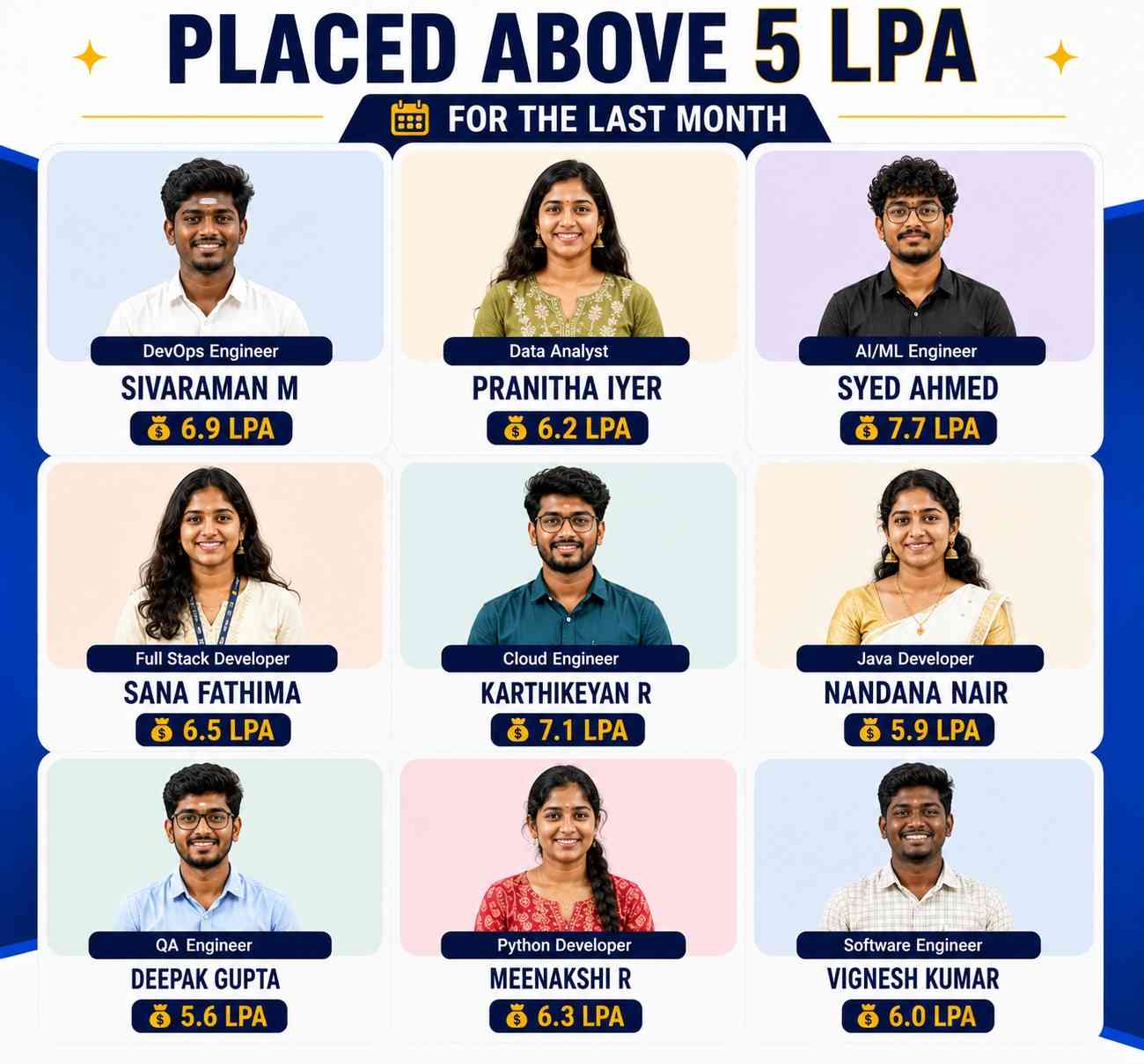
11279+

(Placed)
Freshers To IT

6156+

(Placed)
NON-IT to IT

8044+

(Placed)
Career Gap

4269+

(Placed)
Less Then 60%

Our Hiring Partners

Overview of Gen AI Course

Our Gen AI Course in Adyar gives you a structured, no-nonsense roadmap from core AI basics to mastering advanced generative models. You’ll build real-time, hands-on projects using top tools like OpenAI, Hugging Face, LangChain, PyTorch, TensorFlow, and essential MLOps stacks. This training prepares you to design, deploy, and fine-tune AI-driven solutions that elevate enterprise performance. By the end, you’ll be ready for roles like Gen AI Engineer, AI Developer, or AI Consultant, backed by a globally recognized certification that strengthens your resume and opens the door to high-value career opportunities.

What You'll Learn From Gen AI Training

The Gen AI Training in Adyar is designed for both freshers and working professionals who want to establish a strong foundation in artificial intelligence and enterprise solutions.

Throughout the training, learners will gain practical exposure to core AI domains such as Natural Language Processing, Computer Vision, Large Language Models, and Automation.

You’ll work on Gen AI modules like Prompt Engineering, Model Fine-Tuning, AI Security, Multimodal Apps, and MLOps, building skills in API integration, IaC, and CI/CD pipelines.

The Course includes interactive workshops, live projects, and hands-on assignments, all guided by expert mentors with proven industry experience.

By the end, you will be proficient in implementing AI solutions for real-world business scenarios and receive a recognized certification that validates your expertise.

This comprehensive program equips you for roles in AI Development, Gen AI Engineering, AI Consulting, and MLOps Engineering.

Additional Info

Course Highlights

  • Kickstart Your AI Career with Expert Training in Generative AI, Prompt Engineering, LLMs, Security, Computer Vision, MLOps, and NLP.
  • Receive dedicated job placement support with opportunities from leading companies hiring skilled AI professionals.
  • Join a community of over 11,000 students successfully trained and placed through 350+ trusted hiring partners.
  • Learn from seasoned instructors with 10+ years of real-world AI and machine learning implementation experience.
  • Enjoy beginner-friendly lessons, hands-on project work, and complete career support throughout your learning journey.
  • Take advantage of affordable fees, flexible schedules, and 100% placement assistance perfect for both freshers and working professionals.
  • Develop solid AI skills and gain practical industry exposure to confidently step into Generative AI and enterprise solutions.

Exploring the Benefits of Gen AI Training in Offline

  • Simple and Easy to Learn: Gen AI focuses on creating AI-driven solutions, making it beginner-friendly even for those new to IT. Its intuitive tools and comprehensive resources help reduce the learning curve, ideal for both students and professionals.
  • Widely Used Across Industries: Gen AI is essential across IT, healthcare, finance, retail, telecom, and logistics, transforming how modern industries operate and innovate. Its massive versatility opens up wide career paths, from AI engineering and MLOps to automation, data strategy, AI product roles, and countless emerging opportunities that keep growing every year.
  • Strong Community and Resources: With a large global AI ecosystem, learners have access to abundant resources such as Hugging Face libraries, forums, tutorials, webinars, and case studies. Continuous updates ensure you stay current and inspired.
  • High Demand and Attractive Salaries: Skilled Gen AI professionals are highly sought after. Companies prioritize AI expertise to innovate, optimize operations, and enhance customer experience, leading to better job opportunities, faster career growth, and competitive pay.
  • Great for Problem-Solving and Automation: Gen AI equips professionals to solve real business problems by designing intelligent chatbots, content generation systems, predictive models, and scalable AI workflows.

Essential Tools for Gen AI Training in Adyar

  • Gen AI Platforms: Learn OpenAI, Hugging Face, and Anthropic tools for building intelligent AI applications. Get hands-on experience with chatbots, text-to-image models, and multimodal workflows.
  • LangChain and Vector Databases: Master LangChain and Pinecone for building LLM-powered applications with context-aware memory and retrieval. Develop real-world projects integrating vector search for smarter AI solutions.
  • MLOps Tools: Work with MLflow, Kubeflow, and Vertex AI for deploying and managing AI models at scale. Gain practical experience automating pipelines and ensuring reliable model performance in production.
  • Core AI Frameworks: Hands-on training with PyTorch, TensorFlow, and Keras for building, training, and fine-tuning AI models across multiple domains. Apply frameworks to real datasets for end-to-end AI solution development.
  • Integration Tools and APIs: Learn to connect AI with applications, deploy serverless workflows, and manage hybrid integrations. Develop skills to ensure seamless communication between AI and enterprise systems.

Top Modules Every Gen AI Professional Should Know

  • AI Fundamentals: Understand the fundamentals of AI, machine learning, and neural networks. Build a strong foundation to confidently create scalable solutions for varied enterprise applications.
  • Prompt Engineering and LLMs: Design effective prompts and optimize interactions with large language models for real-world use cases. Learn advanced techniques for fine-tuning and custom AI development.
  • AI DevOps and MLOps: Explore CI/CD pipelines, infrastructure as code, and automation tools for AI efficiency. Develop proficiency in automating deployments, monitoring, and scaling AI workloads.
  • AI Security and Compliance: Implement ethical AI practices, model governance, and auditing for enterprise-grade compliance. Understand regulatory requirements and best practices for responsible AI.
  • AI Analytics and Insights: Learn how to generate business insights using AI-powered tools like GPT APIs, transformers, and generative analytics. Gain the ability to analyze large datasets for actionable decisions.

Must-Have Skills You Will Gain in Gen AI Training in Adyar

  • AI and Machine Learning Fundamentals: Understand ML concepts, neural networks, and generative models for enterprise AI operations. Build confidence in designing and managing AI solutions efficiently.
  • Infrastructure and Automation: Gain hands-on expertise in deploying AI infrastructure, managing workloads, and automating repetitive tasks. Learn to implement scalable, resilient, and optimized AI environments.
  • Generative Applications: Build AI-powered chatbots, text-to-image solutions, and multimodal applications for real-world use cases. Develop solutions that reduce manual effort and maximize cost-efficiency.
  • Analytics and Monitoring: Develop skills in monitoring AI performance using MLflow, TensorBoard, and cloud monitoring tools. Ensure proactive issue resolution and continuous improvement.
  • Collaboration and Deployment: Learn best practices for deploying LLMs, version control, and MLOps workflows. Effectively coordinate with teams to deliver AI projects faster and with higher quality.

Roles and Responsibilities After Gen AI Training

  • Gen AI Engineer: Design and implement AI-powered solutions like chatbots, recommendation systems, and generative workflows. Collaborate with stakeholders to align AI solutions with business goals.
  • AI Developer: Build applications, automate workflows, and deploy generative models in production environments. Write efficient code and optimize AI models for scalability and cost.
  • AI Consultant: Advise enterprises on AI adoption, cost optimization, and best practices for generative solutions. Provide training and guidance for smooth AI transitions and operations.
  • MLOps Engineer: Implement CI/CD pipelines, manage AI infrastructure, and monitor generative model operations. Ensure seamless integration between development and operations teams.
  • AI Security Specialist: Ensure ethical AI practices, compliance, and risk management for AI models and data. Conduct audits, vulnerability assessments, and implement proactive safeguards.

The Benefits of Gen AI for Recent Graduates as a Career Option

  • Easy to Learn and Use: Gen AI’s guided tools and frameworks enable graduates to quickly grasp AI concepts and contribute to real projects. Hands-on practice accelerates skill development and builds confidence in AI technologies.
  • High Demand Across Industries: Gen AI skills are highly valued in IT, healthcare, finance, and logistics. Employers seek professionals who can implement AI-driven solutions. This demand translates into faster career growth and attractive salary packages.
  • Strong Community and Learning Resources: Gen AI provides global documentation, forums, webinars, and tutorials for continuous learning. Engagement with community resources allows learners to solve problems and stay updated.
  • Aligned with Emerging Technologies: Gen AI integrates with robotics, AR/VR, analytics, and cloud tools, keeping skills relevant in a rapidly evolving market. Graduates gain experience working with cutting-edge technologies.
  • Freelance and Remote Work Flexibility: Gen AI skills enable remote or freelance work on AI projects globally. This flexibility allows professionals to manage multiple projects and gain international exposure.

How Gen AI Skills Help You Get Remote Jobs

  • Widely Used in Remote-Friendly Roles: Gen AI professionals can design, deploy, and manage AI solutions remotely. Global companies hire AI experts for distributed teams. This flexibility allows professionals to work across time zones and diverse industries.
  • High Demand on Freelance Platforms: Gen AI engineers, developers, and consultants are in strong demand on Upwork, Fiverr, and Toptal. Freelancers can build portfolios and client networks. Strong Gen AI skills help command premium rates and long-term projects.
  • Built for Virtual Collaboration: Gen AI tools support remote collaboration, dashboards, and workflow management, enabling global teamwork. They ensure seamless communication across distributed teams for faster and more efficient project delivery.
  • Efficiency Through Automation: Gen AI professionals use automation, pre-trained models, and reusable components to optimize workflows. This is highly valued in remote roles. Automation also reduces errors and accelerates deployment cycles.
  • Access to Global Communities: Learners connect with international forums, webinars, and projects, building portfolios and visibility for global opportunities. Networking provides collaboration chances with experts and access to global job markets.

What to Expect in Your First Gen AI Job

  • Hands-On Model Practice: Work with LLMs, transformers, diffusion models, and full generative pipelines in real-world projects, building solid hands-on expertise. Gain the confidence to solve business challenges with powerful AI-driven solutions that actually deliver results.
  • Exposure to Tools and Workflows: Work with LangChain, Hugging Face, MLflow, and robust CI/CD pipelines for complete end-to-end AI management. Gain practical, real-world experience deploying scalable models, automating complex AI workflows, and building production-ready systems that companies can trust.
  • Reviews and Feedback: Mentors review your work to ensure accuracy, efficiency, and real industry standards, helping you refine both technical and problem-solving skills with clarity. Receive personalized, step-by-step guidance to elevate project quality, sharpen your decision-making, and design AI solutions that are genuinely impactful and production-ready.
  • Collaborative Teamwork: Collaborate with data scientists, developers, and business analysts across dynamic AI-driven projects, learning how real teams operate. Build strong communication, coordination, and cross-functional teamwork skills to deliver high-impact, business-ready AI solutions that hold up in real-world scenarios and fast-paced environments.
  • Steady Skill Development: Begin with foundational AI models and steadily advance to cutting-edge generative architectures, full-scale MLOps systems, and real-world AI consulting challenges. Build the strategic thinking, technical mastery, and decision-making skills needed to step confidently into leadership positions and senior-level AI roles that actually drive impact.

Top Companies Hiring Gen AI Professionals

  • Google DeepMind: Employs Gen AI experts for advanced AI research and enterprise AI solutions. Provides continuous learning opportunities and global projects. Encourages collaboration across multidisciplinary teams to solve complex AI challenges.
  • Microsoft: Hires AI professionals for cloud AI, generative applications, and enterprise adoption of AI solutions. Offers structured career growth and global exposure. Enables hands-on experience with Azure AI services and large-scale enterprise deployments.
  • OpenAI: Recruits AI engineers for large-scale generative model projects, offering cutting-edge research and innovation opportunities. Supports contributing to state-of-the-art AI models and publishing impactful research findings.
  • Accenture: Provides roles for AI developers, engineers, and consultants to implement generative AI across industries. Supports career enhancement through workshops and certifications.
  • Infosys: Employs AI professionals for enterprise consulting, generative solutions, and automation initiatives with international exposure. Offers opportunities to work on cutting-edge AI projects and cross-functional global teams.
Show More

Upcoming Batches For Classroom and Online

Weekdays
22 - Dec - 2025
08:00 AM & 10:00 AM
Weekdays
24 - Dec - 2025
08:00 AM & 10:00 AM
Weekends
27 - Dec - 2025
(10:00 AM - 01:30 PM)
Weekends
28 - Dec - 2025
(09:00 AM - 02:00 PM)
Can't find a batch you were looking for?
INR ₹22000
INR ₹23000

OFF Expires in

Who Should Take a Gen AI Course

IT Professionals

Non-IT Career Switchers

Fresh Graduates

Working Professionals

Diploma Holders

Professionals from Other Fields

Salary Hike

Graduates with Less Than 60%

Show More

Job Roles For Gen AI Course

Gen AI Engineer

AI Developer

AI Consultant

MLOps Engineer

AI Security Specialist

Gen AI Architect

AI Infrastructure Manager

AI Insights Specialist

Show More

Tools Covered For Gen AI Course

OpenAI GPT Models Google Gemini Anthropic Claude Microsoft Copilot Amazon Bedrock Hugging Face Transformers Stability AI MidJourney

What’s included ?

Convenient learning format

📊 Free Aptitude and Technical Skills Training

  • Learn basic maths and logical thinking to solve problems easily.
  • Understand simple coding and technical concepts step by step.
  • Get ready for exams and interviews with regular practice.
Dedicated career services

🛠️ Hands-On Projects

  • Work on real-time projects to apply what you learn.
  • Build mini apps and tools daily to enhance your coding skills.
  • Gain practical experience just like in real jobs.
Learn from the best

🧠 AI Powered Self Interview Practice Portal

  • Practice interview questions with instant AI feedback.
  • Improve your answers by speaking and reviewing them.
  • Build confidence with real-time mock interview sessions.
Learn from the best

🎯 Interview Preparation For Freshers

  • Practice company-based interview questions.
  • Take online assessment tests to crack interviews
  • Practice confidently with real-world interview and project-based questions.
Learn from the best

🧪 LMS Online Learning Platform

  • Explore expert trainer videos and documents to boost your learning.
  • Study anytime with on-demand videos and detailed documents.
  • Quickly find topics with organized learning materials.

Gen AI Course Syllabus

  • 🏫 Classroom Training
  • 💻 Online Training
  • 🚫 No Pre Request (Any Vertical)
  • 🏭 Industrial Expert

Enrolling in a Gen AI Training program in Adyar sets you up with the exact skills needed to break into fast-growing AI careers that match your long-term goals. The course prepares you for high-demand roles across leading industries and companies. With flexible learning paths, you can dive deeper into areas like Prompt Engineering, MLOps, or AI Security, all while mastering how to design, fine-tune, and deploy powerful enterprise-level Generative AI solutions.

  • Gen AI Key Concepts: Learn AI fundamentals, best practices, and generative model basics.
  • Gen AI Model Administration & Management: Configure AI workflows, manage datasets, and automate pipelines.
  • Gen AI Development & Application Building: Build chatbots, automate processes, and deploy generative applications.
  • Gen AI Tools & Analytics: Use LangChain, MLflow, dashboards, and integration services for monitoring and insights.
Introduction to Gen AI
Core Gen AI Services
Gen AI Administration Training
Gen AI Development Training
AI Automation & MLOps
Gen AI Analytics & Monitoring
Gen AI Strategy & Real-Time Projects

This module provides foundational knowledge of Generative AI:

  • Importance of Gen AI: Benefits, industry adoption, and business impact.
  • Core Concepts: Natural Language Processing, Computer Vision, Large Language Models, Automation, and Multimodal AI.
  • Key Platforms: Overview of OpenAI APIs, Hugging Face, LangChain, TensorFlow, and PyTorch.
  • Career Paths: Roles such as Gen AI Engineer, AI Developer, MLOps Engineer, and AI Security Specialist.

This module covers essential Gen AI tools and functionalities:

  • AI Administration: Managing datasets, model versions, pipelines, and resource allocation.
  • Data Management: Configuring embeddings, vector databases, training datasets, and ensuring data quality.
  • Model Configuration: Fine-tuning LLMs, setting up workflows with LangChain, and automating deployments.
  • Monitoring & Analytics: MLflow dashboards, logs, and performance metrics for AI system insights.

Learn to configure and manage Gen AI environments effectively:

  • Admin Interface: Navigation through Hugging Face Hub, OpenAI Playground, and AI pipelines.
  • Automation Tools: MLflow, Kubeflow, and infrastructure-as-code for AI workflows.
  • Security & Access: Role-based permissions, API key management, ethical AI practices, and compliance.
  • Performance Tracking: Monitoring accuracy, drift, logs, and generative model utilization.

This module provides hands-on learning for Gen AI application development:

  • Generative Development: Chatbots, text-to-image models, summarization tools, and automation workflows.
  • UI & Application Components: Deploying AI-driven dashboards, conversational apps, and multimodal interfaces.
  • App Building: Designing scalable generative applications, reusable prompts, and automation scripts.
  • Testing & Deployment: Using staging environments, CI/CD pipelines, and version-controlled AI deployments.

Learn to integrate and automate AI workflows using Gen AI :

  • MLOps Modules: CI/CD pipelines, infrastructure automation, and configuration management for AI.
  • Serverless & Automation: Automating model pipelines, orchestration with LangChain, and scheduled triggers.
  • Integration: Connecting AI with APIs, enterprise systems, and hybrid environments.
  • Automation Tools Overview: MLflow, Kubeflow, Vertex AI, and Python SDK workflows.

Understand how to track performance and optimize AI operations:

  • Dashboards & Monitoring: MLflow dashboards, model logs, metrics, and alerting.
  • Performance Analytics: Accuracy trends, cost optimization, and latency analysis.
  • KPIs & Metrics: Response time, efficiency, accuracy, scalability, and model drift.
  • Data Management Tools: Vector databases, ETL pipelines, AI data preprocessing, and generative analytics.

Apply Gen AI skills to real-world AI scenarios:

  • Project Planning: Define use cases, goals, and timelines for AI implementations.
  • Live Projects: Work on real Gen AI solutions, conversational apps, and multimodal workflows.
  • Performance Review: Analyze dashboards, logs, and output quality for improvements.
  • Capstone Project: Build end-to-end Gen AI solutions including automation, generative applications, and monitoring dashboards.

🎁 Free Addon Programs

Aptitude, Spoken English

🎯 Our Placement Activities

Daily Task, Soft Skills, Projects, Group Discussions, Resume Preparation, Mock Interview

Gain Hands-On Experience with Real-World Gen AI Projects

Placement Support Overview

Today's Top Job Openings for Gen

Gen AI Engineer

Company Code : GAI452

Chennai, Tamilnadu

₹40,000 – ₹55,000 a month

Any Degree

Exp 0-2 yrs

  • We’re hiring a Gen AI Engineer to build chatbots, fine-tune models, and automate workflows. Candidates should be familiar with LLMs, embeddings, dashboards, and Gen AI model administration.
  • Easy Apply

    Gen AI Developer

    Company Code : LLM739

    Chennai, Tamilnadu

    ₹55,000 – ₹85,000 a month

    B.Tech

    Exp 1-3yr

  • Join us as a Gen AI Developer to design, train, test, and deploy generative applications. Proficiency in Python, LangChain, Prompt Engineering, and model integration is required.
  • Easy Apply

    Gen AI Consultant

    Company Code : VEC621

    Chennai, Tamilnadu

    ₹60,000 – ₹95,000 a month

    Any Degree

    Exp 2-4 yrs

  • Seeking a Gen AI Consultant to analyze business use cases, implement AI-driven solutions, and optimize workflows. Strong communication and problem-solving skills are essential for successful client engagement.
  • Easy Apply

    Gen AI Architect

    Company Code : ARC884

    Chennai, Tamilnadu

    ₹65,000 – ₹75,000 a month

    B.E. in Computer Science

    Exp 3–6 yrs

  • We’re looking for a Gen AI Architect to design scalable AI solutions, oversee integrations, and ensure alignment with business goals. Expertise in AI models, security, and system architecture is required.
  • Easy Apply

    Gen AI Business Analyst

    Company Code : BAN537

    Chennai, Tamilnadu

    ₹50,000 – ₹80,000 a month

    Any Degree

    Exp 1-3 yrs

  • Become a Gen AI Business Analyst to gather requirements, document AI-driven processes, and translate them into Gen AI solutions. Collaborate with stakeholders to ensure accurate implementation and optimized workflows.
  • Easy Apply

    Gen AI Specialist

    Company Code : SPC269

    Chennai, Tamilnadu

    ₹65,000 – ₹95,000 a month

    Any Degree

    Exp 2–4 yrs

  • We’re hiring a Gen AI Specialist to manage AI-driven processes, monitor performance, and implement best practices across chatbots, content generation, and automation. Expertise in LLMs and reporting is preferred.
  • Easy Apply

    Gen AI Project Manager

    Company Code : PMG418

    Chennai, Tamilnadu

    ₹50,000 – ₹70,000 a month

    Any Degree

    Exp 3–5 yrs

  • Join us as a Gen AI Project Manager to plan, execute, and monitor AI projects. Responsible for timelines, budgets, and stakeholder communication while ensuring successful deployment of Gen AI solutions.
  • Easy Apply

    Gen AI Implementation Specialist

    Company Code : IMP562

    Chennai, Tamilnadu

    ₹70,000 – ₹80,000 a month

    Any Degree

    Exp 2–4 yrs

  • We are looking for a Gen AI Implementation Specialist to deploy generative solutions, configure pipelines, automate workflows, and provide user training. Strong knowledge of AI best practices and integrations is required.
  • Easy Apply

    Internship Highlights for Gen AI

    Real-Time Projects

    • 1. Gain hands-on experience by working on live Gen AI applications and automation use cases.
    • 2. Learn real-world problem-solving through chatbot, content generation, and workflow integration scenarios.
    Book Session

    Skill Development Workshops

    • 1. Participate in focused sessions on trending Gen AI tools and frameworks.
    • 2. Learn directly from industry experts through guided practical exercises on prompts, pipelines, and models.
    Book Session

    Employee Welfare

    • 1. Enjoy benefits like health coverage, flexible hours, and wellness programs during internships or training.
    • 2. Companies prioritize mental well-being and work-life balance for all employees in Gen AI teams.
    Book Session

    Mentorship & Peer Learning

    • 1. Learn under experienced Gen AI mentors to guide your technical and career growth.
    • 2. Collaborate with peers to enhance learning through scenario-based exercises and group projects.
    Book Session

    Soft Skills & Career Readiness

    • 1. Improve communication, teamwork, and time management skills for professional AI roles.
    • 2. Prepare for interviews and workplace dynamics with mock sessions, case studies, and expert guidance.
    Book Session

    Certification

    • 1. Earn recognized credentials to validate your Gen AI skills.
    • 2. Boost your resume with course or project completion certificates from reputed Gen AI training platforms.
    Book Session

    Sample Resume for Gen AI (Fresher)

    • 1. Simple and Neat Resume Format

      – Use a clean layout with clear sections such as summary, Gen AI skills, certifications, education, and projects.

    • 2. List of Gen AI Skills You Know

      – Highlight skills like Prompt Engineering, LLM Fine-Tuning, LangChain, Vector Databases, Workflow Automation, Model Deployment, Dashboards, and AI-Powered Applications.

    • 3. Real-Time Projects and Achievements

      – Include 1–2 Gen AI projects with a brief description, tools used, and key outcomes or achievements.

    Top Gen AI Tricky Interview Questions and Answers (2025 Guide)

    Ans:

    Generative AI is a branch of AI that creates new content like text, images, or audio using models such as GPT or Stable Diffusion. It is used for automation, personalization, and innovation across industries.

    Ans:

    I start by identifying the use case and business requirements. Then, I prepare datasets, fine-tune or integrate LLMs, design workflows with LangChain, test outputs, and collaborate with stakeholders for deployment.

    Ans:

    Key tools include OpenAI APIs, Hugging Face Transformers, LangChain for orchestration, PyTorch or TensorFlow for model building, MLflow for tracking, and vector databases like Pinecone or Weaviate.

    Ans:

    I gather requirements, prototype quickly, and conduct user acceptance testing. I focus on prompt optimization, intuitive interfaces, reliable outputs, and feedback loops to ensure high usability and accuracy.

    Ans:

    An LLM is a deep learning model trained on massive datasets to understand and generate human-like text. It is used in chatbots, summarization, code generation, and knowledge retrieval applications.

    Ans:

    I analyze the issue, review prompts and data pipelines, test different model configurations, and apply best practices. Clear documentation, error handling, and collaboration ensure smooth resolution without delays.

    Ans:

    Prompt Engineering is the process of designing effective inputs for AI models to achieve desired outputs. It is important because it improves accuracy, reduces errors, and enhances the reliability of AI solutions.

    Ans:

    I follow AI research papers, attend webinars, explore Hugging Face and OpenAI updates, and engage in developer communities. Continuous learning helps me adopt the latest models and frameworks effectively.

    Ans:

    AI dashboards visualize metrics such as accuracy, cost, response time, and drift. I use them to monitor performance, ensure model reliability, and provide actionable insights for decision-making.

    Ans:

    I align solutions with business goals while ensuring ethical AI, cost efficiency, and scalability. Following MLOps practices and governance ensures maintainable, compliant, and effective AI implementations.

    Company-Specific Interview Questions from Top MNCs

    1. How is Generative AI defined and what is its role?

    Ans:

    Generative AI is branch of artificial intelligence that creates new and original content, including text, images, audio and code using advanced models like GPT, BERT or Stable Diffusion. It is valuable for automating creative tasks, generating innovative outputs and enhancing business processes with intelligent solutions.

    2. What principles are important for successful Gen AI implementation?

    Ans:

    Effective implementation relies on clean, high-quality data, clear prompt design and automated workflows while maintaining oversight. Continuous performance monitoring, adherence to ethical norms and alignment with company goals are critical for ensuring AI systems' efficiency, dependability and trustworthiness.

    3. How can project requirements be gathered effectively for Gen AI?

    Ans:

    Requirements are collected by engaging stakeholders, analyzing existing workflows and identifying challenges through surveys, interviews and process mapping. These insights guide decisions about model selection, data preparation and deployment strategies that meet business objectives and project goals.

    4. What factors contribute to designing user-friendly Gen AI solutions?

    Ans:

    User-centric design includes intuitive interfaces, easy prompt entry and clear output presentation. Include accessibility features, provide usage examples, integrate with current tools and ensure explainable AI outputs to increase usability and overall user experience.

    5. What is a Large Language Model (LLM) and how does it work?

    Ans:

    A Large Language Model (LLM) is a neural network trained on extensive textual data to understand and generate human-like language. LLMs are applied in tasks like text summarization, translation, code generation and conversational AI, delivering context-aware and coherent outputs.

    6. How should a Gen AI monitoring dashboard be developed?

    Ans:

    A monitoring dashboard should highlight key metrics such as accuracy, latency and cost efficiency. Visual tools like graphs and charts make insights easy to interpret, while tracking model drift and collecting user feedback enables continuous optimization and improvement of AI performance.

    7. What does Gen AI Automation involve?

    Ans:

    Gen AI Automation refers to creating workflows and systems where AI generates content, trains models or performs repetitive tasks automatically. Automation increases speed, accuracy and consistency helping organizations boost productivity and implement innovative solutions more effectively.

    8. What are the main stages in executing a Gen AI project?

    Ans:

    A Gen AI project follows stages including requirement analysis, architectural design, model configuration and fine-tuning and quality testing. The process concludes with deployment and continuous monitoring to ensure accuracy, performance and user satisfaction throughout the project lifecycle.

    9. How can the performance of a Gen AI system be validated?

    Ans:

    Performance validation involves measuring outputs using metrics such as accuracy, F1 score and real-world testing. Stakeholder feedback and prompt optimization are used to ensure the system’s results meet both technical standards and business expectations, maintaining reliability and quality.

    10. How is consistency maintained across multiple Gen AI projects?

    Ans:

    Consistency is ensured by standardizing workflows, prompt structures and documentation practices. Implementing version control, naming conventions, reusable templates and conducting regular audits helps maintain uniformity and reliability across all AI implementations.

    1. How is Generative AI defined and what makes it different from traditional AI?

    Ans:

    Generative AI is branch of artificial intelligence that focuses on creating original outputs such as text, images, music or code using models like GPT, DALL·E or Stable Diffusion. Unlike traditional AI, which mainly performs predictions or classifications, Generative AI produces creative content, enabling automation, innovation and new possibilities across multiple industries.

    2. What essential skills are required for a Generative AI professional?

    Ans:

    A proficient Gen AI professional should have knowledge of large language models, multimodal AI systems and frameworks like PyTorch or TensorFlow. Skills in prompt engineering, model fine-tuning and pipeline automation are crucial. Additionally, Python programming, API integration, analytical thinking and effective collaboration are important for building reliable AI solutions.

    3. How should a new Generative AI project be approached and executed?

    Ans:

    A new Gen AI project starts with defining objectives, understanding user requirements and identifying challenges through stakeholder discussions. Relevant datasets are then collected, models fine-tuned and AI workflows designed. Continuous testing, iterative feedback and optimization ensure smooth deployment and accurate, reliable outcomes.

    4. What is Large Language Model (LLM) and why is it important?

    Ans:

    A Large Language Model is neural network trained on vast text datasets to understand and generate human-like language. LLMs enable tasks such as text summarization, code generation, translation and conversational AI. They form the foundation for many modern Gen AI applications, providing intelligent, context-aware outputs.

    5. How can Generative AI systems be made user-friendly and accessible?

    Ans:

    Designing accessible Gen AI solutions involves creating intuitive interfaces with structured prompts and consistent outputs. Adding tooltips, examples, error-handling features and accessibility options like screen-reader support improves usability. These measures ensure users can interact with AI efficiently, regardless of experience level.

    6. Which tools and frameworks are commonly used in Generative AI projects?

    Ans:

    Generative AI development commonly uses OpenAI APIs and Hugging Face for pre-trained models, while LangChain helps in building automated pipelines. Tools like MLflow and TensorBoard assist in model tracking and performance evaluation. Python, SDKs and vector databases like Pinecone or Weaviate enable integrations and semantic search functionality.

    7. Why are dashboards and monitoring systems important in Gen AI projects?

    Ans:

    Dashboards provide real-time insights into model performance, including accuracy, latency and data drift. Monitoring tools help teams identify issues early, analyze trends and optimize models. Continuous tracking ensures AI outputs remain consistent, reliable and aligned with organizational objectives.

    8. How should feedback and issues be handled during AI deployment?

    Ans:

    Effective feedback management involves collecting input from stakeholders and users, analyzing gaps and adjusting prompts, data pipelines or configurations accordingly. Transparent communication and ethical considerations ensure that updates improve system performance while maintaining scalability and reliability.

    9. What are the recommended testing methods for Generative AI solutions?

    Ans:

    Testing includes user acceptance checks, sandbox testing, regression and performance validation to ensure stable and accurate outputs. Iterative feedback sessions allow continuous improvement and maintain consistency across updates, ensuring AI solutions function efficiently in real-world scenarios.

    10. How can professionals stay updated with Generative AI trends and innovations?

    Ans:

    Keeping up with Gen AI requires reading research papers, attending webinars and participating in communities like OpenAI and Hugging Face. Hands-on experimentation with new tools and frameworks, along with networking with AI experts, helps maintain practical skills and awareness of emerging trends in the field.


    1. How does a Generative AI Engineer differ from a Developer?

    Ans:

    A Generative AI Engineer primarily focuses on building and managing AI workflows, pipelines and automation, ensuring system scalability and infrastructure efficiency. In contrast a Generative AI Developer writes code, integrates APIs and customizes models to implement features. Engineers handle the overall system, while developers optimize model performance and application functionality.

    2. Why is gathering business requirements crucial in a Generative AI project?

    Ans:

    Collecting requirements involves analyzing workflows, conducting interviews and reviewing organizational goals. This process ensures AI solutions align with user expectations and business objectives. Clear requirements prevent unnecessary complexity and guide the project toward delivering impactful, relevant outcomes.

    3. What best practices should be followed in implementing Generative AI solutions?

    Ans:

    Effective Gen AI implementation involves using high-quality datasets, automating workflows and following standardized naming conventions. Employing scalable dashboards, structured testing and continuous validation ensures reliability. These practices help deliver accurate, consistent and high-performing AI systems.

    4. Which tools are commonly used for developing and deploying Gen AI applications?

    Ans:

    Tools like OpenAI and Hugging Face APIs provide access to pre-trained models, while LangChain manages automated workflows. Python and SDKs allow custom integrations, MLflow and TensorBoard track performance metrics and vector databases such as Pinecone or Weaviate store embeddings. Docker or Kubernetes facilitate scalable deployment.

    5. Why is data security important in Generative AI projects?

    Ans:

    Data security safeguards sensitive information during training, testing and deployment. Measures like encryption, secure API management and controlled access prevent breaches and unauthorized use. Strong security protocols ensure compliance, maintain trust and protect organizational integrity.

    6. How can AI pipelines and datasets be built and utilized efficiently?

    Ans:

    Creating efficient AI pipelines begins with defining project objectives and expected outcomes. Clean and relevant datasets are collected, processed and applied for training or fine-tuning models. Structured workflows, validation steps and monitoring ensure consistent performance and accurate AI outputs.

    7. What are the main stages of implementing a Generative AI project?

    Ans:

    A Gen AI project starts with requirement analysis and identifying data needs, followed by workflow design and model selection. The next stages include data preparation, model fine-tuning and pipeline construction. Testing and validation confirm usability and deployment involves ongoing monitoring and optimization for performance.

    8. How should stakeholder feedback be handled during a Gen AI project?

    Ans:

    Managing feedback involves documenting suggestions, prioritizing them and refining prompts or models accordingly. Transparent communication keeps stakeholders informed of changes, while iterative testing ensures the final AI solution meets both user requirements and business objectives effectively.

    9. What practices ensure the success of Generative AI solutions?

    Ans:

    Successful projects rely on using reliable pre-trained models, maintaining structured datasets and avoiding excessive hardcoding. Consistent documentation, ongoing validation and model monitoring help sustain accuracy. Following these practices promotes scalable, maintainable and efficient AI implementations.

    10. How can professionals stay updated in the evolving field of Generative AI?

    Ans:

    Keeping up involves reading AI publications, blogs and industry newsletters, attending webinars and conferences and participating in communities like OpenAI or Hugging Face. Practical experimentation with new tools and earning relevant certifications helps maintain knowledge and hands-on expertise in the rapidly evolving AI landscape.

    1. How does the role of a Generative AI Engineer differ from a Developer?

    Ans:

    A Generative AI Engineer focuses on building AI workflows, managing datasets and automating processes to ensure smooth operations and scalability without heavy coding. In contrast a Generative AI Developer writes code, integrates APIs and fine-tunes models to create customized AI applications. Engineers handle system infrastructure, while developers enhance functionality and performance through programming.

    2. How are requirements gathered in a Generative AI project?

    Ans:

    Requirements are gathered through interviews, surveys and workshops to understand business goals and user expectations. This process defines crucial elements like data preparation, model selection and workflow structure. Properly collected requirements ensure that AI solutions align with organizational objectives and produce measurable, effective results.

    3. Which tools and frameworks are widely used for Generative AI development?

    Ans:

    Popular tools include OpenAI and Hugging Face APIs for accessing and fine-tuning models, while LangChain supports workflow automation. Python and SDKs facilitate custom scripting and MLflow or TensorBoard track performance metrics. Vector databases like Pinecone or Weaviate aid semantic search and dashboards provide real-time monitoring for informed decision-making.

    4. What is Large Language Model (LLM) and how is it applied in projects?

    Ans:

    A Large Language Model is an advanced AI system trained on massive datasets to understand and generate human-like language. LLMs are applied in chatbots, summarization tools, recommendation systems and code generation. Fine-tuning and prompt engineering ensure outputs meet user needs and business objectives accurately.

    5. How can Generative AI systems be secured while remaining user-friendly?

    Ans:

    Security measures include access controls, encrypted data handling and secure API management. User-friendliness is achieved by designing clear interfaces, structured prompts and consistent outputs. Testing across multiple platforms ensures the system is accessible, inclusive and easy to navigate for a wide range of users.

    6. How are AI dashboards and monitoring systems developed?

    Ans:

    AI dashboards are created by identifying key metrics such as accuracy, latency and cost efficiency. Visualization elements like graphs and charts simplify data interpretation. Iterative improvements and feedback from users make dashboards effective in delivering actionable insights and guiding optimization decisions.

    7. How are Generative AI solutions validated and tested before deployment?

    Ans:

    Validation includes sandbox testing, user acceptance evaluation and regression checks to ensure output quality and stability. Feedback sessions help refine the models, while continuous monitoring confirms accuracy and relevance. These steps guarantee reliable, high-performing AI systems in production environments.

    8. What guiding principles ensure effective Generative AI implementation?

    Ans:

    Effective Gen AI relies on clean, high-quality datasets, well-documented pipelines and scalable workflows. Leveraging pre-trained models saves time and resources, while standardized naming conventions and automated processes maintain stability. Following these practices ensures efficient, maintainable and accurate AI deployment.

    9. How should conflicting stakeholder feedback be managed?

    Ans:

    Conflicting feedback is addressed by carefully documenting input, analyzing its impact and prioritizing changes based on business value and feasibility. Transparent communication ensures stakeholders understand trade-offs, while a balanced approach aligns the project with organizational goals without compromising performance or quality.

    10. What are the best ways to stay current with Generative AI trends?

    Ans:

    Keeping up-to-date involves reading research papers, following OpenAI and Hugging Face updates and attending webinars or conferences. Participation in professional communities and experimenting with new tools strengthens practical skills. Certifications and hands-on experience help maintain expertise and adapt to emerging AI technologies.

    1. What distinguishes a Gen AI Engineer from a Gen AI Developer?

    Ans:

    A Gen AI Engineer primarily focuses on building AI infrastructures, managing data pipelines, automating workflows and ensuring scalable model deployment. In contrast, a Gen AI Developer emphasizes coding, API integration and fine-tuning models to create functional AI applications. Engineers optimize systems for reliability, while developers implement features and enhance model performance.

    2. How are features prioritized when designing a Gen AI solution for multiple requirements?

    Ans:

    Feature prioritization is guided by business objectives, user needs and the potential impact on performance. Evaluating stakeholder feedback, analyzing process efficiency and estimating productivity gains help ensure that the most critical and high-value features are implemented first.

    3. What steps are involved in designing and deploying a new Gen AI solution?

    Ans:

    Developing a new Gen AI solution begins with understanding business needs and preparing clean, relevant datasets. Appropriate models are selected and pipelines are created, followed by testing in sandbox environments. Iterative refinement based on feedback ensures the solution is ready for real-time deployment and continuous monitoring.

    4. How is security and accessibility maintained in Gen AI systems?

    Ans:

    Security is ensured through encryption, controlled access and API authentication, protecting sensitive data during model training and deployment. Accessibility is achieved by designing intuitive prompts, consistent outputs and user-friendly interfaces that work seamlessly across platforms for diverse users.

    5. What metrics are used to evaluate the effectiveness of a Gen AI implementation?

    Ans:

    Effectiveness is measured using KPIs such as model accuracy, response latency, user engagement and cost efficiency. Real-time dashboards and feedback mechanisms monitor system performance, helping to align AI solutions with business objectives and ensuring continuous improvement.

    6. Can you describe a challenging Gen AI problem and how it was solved?

    Ans:

    A notable challenge involved inconsistent outputs from a fine-tuned large language model. By analyzing the dataset, refining prompts and introducing contextual templates, model consistency improved. Ongoing evaluation and optimization enhanced both accuracy and user satisfaction.

    7. Which tools and platforms are commonly used for Gen AI development and management?

    Ans:

    Development and deployment rely on OpenAI and Hugging Face APIs for pre-trained models, LangChain for automating pipelines and Python SDKs for custom integration. MLflow and TensorBoard track performance, while vector databases such Pinecone and Weaviate manage embeddings effectively.

    8. How is conflicting stakeholder feedback handled in a Gen AI project?

    Ans:

    Differing opinions are evaluated against business priorities and technical feasibility. Each concern is documented and communicated transparently, allowing informed trade-offs. Decisions are made based on data-driven insights to ensure alignment between stakeholder expectations and project capabilities.

    9. Why is data so important in Generative AI projects?

    Ans:

    Data forms the backbone of any Gen AI solution, directly impacting model training, inference and output quality. Clean and relevant datasets enhance performance, while ongoing monitoring ensures reliability and ethical outcomes. Proper data practices lead to trustworthy and actionable AI results.

    10. How do professionals keep advancing in the field of Gen AI?

    Ans:

    Continuous growth comes from studying research papers, attending webinars and engaging with online AI communities. Hands-on experimentation with new frameworks, tools and models along with pursuing certifications, helps maintain expertise and adaptability in the rapidly evolving AI landscape.

    Disclaimer Note:

    The details mentioned here are for supportive purposes only. There are no tie-ups or links with the corresponding PGs.

    Ladies PG Accommodation

      Velachery
    • Sanz Live Women's PG : 72007 19990
    • Krishnaveni Castle : 90801 95007
    • Anna Nagar
    • Pentos Women's PG : 93427 57797
    • Women's Nest - Ladies PG : 94451 25894
    • OMR
    • MSR Luxury PG : 89399 91922
    • Porur
    • Sree Shakthi Ladies Hostel : 90031 98767
    • Friends Ladies Hostel : 73389 19836
    • Tambaram
    • CK HIVE Girls Ladies PG90948 58303
    • Layaa Women’s Hostel63797 00573

    Mens PG Accommodation

      Velachery
    • Stayflix PG for Men's : 96000 45088
    • DJ Men's PG Velachery : 90803 19242
    • Anna Nagar
    • Stay Inn Men's Hostel(PG) : 94454 87884
    • Brights Boys Hostel : 88387 88921
    • OMR
    • Sree Siddhi Vinayaka Mens PG : 95577 95579
    • Rudhra Men’s PG : 93636 45199
    • Porur
    • SIDDHANS Men's PG : 88259 71908
    • Jaswanth Raaj Mens PG : 89255 15888
    • Tambaram
    • Sri Sai Grn Men's PG : 81228 24076
    • Rolexx Men's PG : 80988 84848

    Top Gen AI Job Opportunities for Freshers

    • 1. Gen AI Roles at Startups and Tech Companies
    • 2. Campus Placements and AI Research Jobs
    • 3. Internship-to-Job Programs
    • 4. Apply Through Job Portals
    • 5. Skills That Help You Get Hired

    Getting Started With Gen AI Course in Adyar

    Easy Coding
    8 Lakhs+ CTC
    No Work Pressure
    WFH Jobs (Remote)

    Why Gen AI is the Ultimate Career Choice

    High Demand

    Companies prefer multi-skilled professionals can handle entire project cycles.

    Global Opportunities

    Open doors to remote and international job markets.

    High Salary

    Enjoy competitive salaries and rapid career advancement.

    Flexible Career Path

    Explore roles such as developer, architect, freelancer, or entrepreneur.

    Future-Proof Career

    Stay relevant with skills that are consistently in demand in the evolving tech landscape.

    Versatility Across Industries

    Work in various domains like e-commerce, healthcare, finance, and more.

    Career Support

    Placement Assistance

    Exclusive access to ACTE Job portal

    Mock Interview Preparation

    1 on 1 Career Mentoring Sessions

    Career Oriented Sessions

    Resume & LinkedIn Profile Building

    Get Advanced Gen AI Certification

    You'll receive a certificate proving your industry readiness.Just complete your projects and pass the pre-placement assessment.This certification validates your skills and prepares you for real-world roles.

    • Certified Gen AI Practitioner (CGAP)
    • Gen AI Developer Certification
    • Gen AI Engineer Certification
    • Gen AI Specialist in NLP & Machine Learning
    • Professional Gen AI Architect Certification

    Earning a Gen AI certification proves your expertise in AI and machine learning, giving you a strong advantage in today’s job market. When this is paired with real hands-on projects, solid problem-solving skills, and the ability to apply AI in real business tasks, you’re fully prepared for career success. With our 100% job placement support, securing the right role becomes a realistic and achievable outcome.

    The duration depends on the certification level and study plan. Entry-level certifications like Gen AI Practitioner can take 6–8 weeks of focused preparation, while advanced certifications such as Gen AI Developer or Professional Architect may require 3–6 months of study. Bootcamps typically run 8–12 weeks, while self-paced learning depends on consistency.

    • Globally recognized validation of your AI and machine learning skills
    • Unlocks career opportunities in AI, NLP, and automation with higher salary potential
    • Builds confidence and professional credibility in emerging technologies
    • Enhances your resume and LinkedIn profile visibility
    • Provides practical exposure through real-world Gen AI projects and use cases
    • Enroll in a structured Gen AI training program
    • Practice regularly using AI platforms, APIs, and live projects
    • Study official certification guides and attempt mock tests
    • Work on real or simulated AI projects for hands-on learning
    • Join AI communities, forums, and events to share knowledge and stay motivated

    Complete Your Course

    A Downloadable Certificate in PDF Format, Immediately Available to You When You Complete Your Course

    Get Certified

    A Physical Version of Your Officially Branded and Security-Marked Certificate.

    Get Certified

    Lowest Gen AI Training Fees in Adyar

    Affordable, Quality Training for Freshers to Launch IT Careers & Land Top Placements.

    Call Course Advisor

    How is ACTE's Gen AI Training in Adyar Different?

    Feature

    ACTE Technologies

    Other Institutes

    Affordable Fees

    Competitive Pricing With Flexible Payment Options.

    Higher Gen AI Fees With Limited Payment Options.

    Industry Experts

    Well Experienced Trainer From a Relevant Field With Practical Gen AI Training

    Theoretical Class With Limited Practical

    Updated Syllabus

    Updated and Industry-relevant Gen AI Course Curriculum With Hands-on Learning.

    Outdated Curriculum With Limited Practical Training.

    Hands-on projects

    Real-world Gen AI Projects With Live Case Studies and Collaboration With Companies.

    Basic Projects With Limited Real-world Application.

    Certification

    Industry-recognized Gen AI Certifications With Global Validity.

    Basic Gen AI Certifications With Limited Recognition.

    Placement Support

    Strong Placement Support With Tie-ups With Top Companies and Mock Interviews.

    Basic Placement Support

    Industry Partnerships

    Strong Ties With Top Tech Companies for Internships and Placements

    No Partnerships, Limited Opportunities

    Batch Size

    Small Batch Sizes for Personalized Attention.

    Large Batch Sizes With Limited Individual Focus.

    LMS Features

    Lifetime Access Course video Materials in LMS, Online Interview Practice, upload resumes in Placement Portal.

    No LMS Features or Perks.

    Training Support

    Dedicated Mentors, 24/7 Doubt Resolution, and Personalized Guidance.

    Limited Mentor Support and No After-hours Assistance.

    Gen AI Course FAQs

    1. What Are the Requirements for Becoming a Gen AI Professional?

    Basic computer knowledge, logical reasoning, and analytical thinking are sufficient to start. A curiosity for AI technologies, eagerness to learn Gen AI tools, and problem-solving skills are essential. Prior coding experience is helpful but not mandatory, as most Gen AI training programs in Adyar begin at the beginner level.
    Gen AI is increasingly adopted across industries such as IT, healthcare, finance, retail, and manufacturing. The demand for AI Engineers, AI Developers, and Generative AI Specialists is growing rapidly as organizations implement automation, AI-powered workflows, and innovative solutions.
    • Gen AI Fundamentals
    • AI Model Development & Fine-Tuning
    • Natural Language Processing & Computer Vision
    • Automation & Workflow Integration with AI APIs
    • Monitoring & Analytics of AI Systems
    Yes, hands-on projects are integral to Gen AI training. Learners work on scenarios such as AI model building, prompt engineering, chatbot development, automated content generation, and workflow automation. Real-time projects help develop practical skills, problem-solving abilities, and a strong AI portfolio.
    Yes, Gen AI training programs in Adyar include resume and portfolio guidance tailored for AI roles. Support emphasizes certifications, live projects, and technical expertise. Many institutes also conduct mock interviews and career counseling to prepare learners for opportunities in leading AI companies.
    Gen AI training is open to anyone aiming to build a career in AI technologies. Students, fresh graduates, IT professionals, or non-technical learners can enroll. Courses start with AI basics, so no prior technical background is required.
    No formal degree is mandatory. What matters most are Gen AI certifications, hands-on project experience, and a strong portfolio. Many professionals successfully enter AI careers without a degree by gaining practical skills through training and certifications.
    Basic computer skills and logical reasoning are sufficient. Programming knowledge is an advantage for developer or AI engineering tracks but not essential for general AI roles. Curiosity about AI, automation, and emerging technologies will help learners excel.
    No, coding is not required to begin Gen AI training. Many modules focus on using AI tools, APIs, and no-code/low-code platforms. Programming skills can be learned gradually during advanced modules for model customization and automation.

    1. What Kind of Placement Support Is Provided After Gen AI Training?

    Institutes offer complete placement support, including resume preparation, interview practice, job referrals, and career mentoring. Training centers collaborate with AI hiring partners, startups, and tech firms to connect learners with Gen AI-related roles.

    2. Will I Get Access to Real-Time Projects for My Resume?

    Yes, Gen AI training includes live projects for your resume. Projects may involve AI model development, automated workflows, chatbot creation, and content generation, giving learners strong hands-on experience to showcase to recruiters.

    3. Can I Apply for Jobs in Top IT and AI Companies After Completing the Course?

    Absolutely! With Gen AI certifications and practical training, learners can apply for roles in leading IT firms, AI startups, and product companies. Companies like TCS, Infosys, Wipro, Accenture, Capgemini, and global AI innovators actively hire Gen AI-certified professionals.

    4. Is Placement Support Available for Freshers with No Experience?

    Yes, training institutes provide specialized support for freshers. Programs focus on job readiness through projects, resume building, interview preparation, and mock tests, enabling even non-IT learners to secure entry-level AI roles.
    Yes, upon completing Gen AI training in Adyar, learners receive a course completion certificate validating their skills. Institutes also guide students for official Gen AI certifications, such as AI Developer, AI Engineer, or NLP Specialist.
    Yes, Gen AI is an emerging technology with global demand. Certified professionals enjoy competitive salaries, diverse career opportunities, and high demand across IT, fintech, healthcare, and digital industries.
    No strict prerequisites exist. Basic computer knowledge and logical thinking are sufficient. Courses are structured for beginners as well as experienced professionals, ensuring steady growth in AI skills.
    Gen AI certification enhances technical expertise and opens roles such as AI Developer, AI Engineer, NLP Specialist, and AI Automation Consultant. It boosts employability, increases salary potential, and prepares learners for advanced AI careers.
    Learners gain expertise in AI model building, prompt engineering, automation, NLP, computer vision, and analytics. Training includes hands-on projects for developing AI workflows, content generation tools, and real-world AI applications.

    1. Will I Receive Job Placement Support After Completing the Course?

    Yes, most Gen AI institutes provide strong placement support, including resume reviews, portfolio development, interview practice, and job referrals. Industry partnerships ensure access to real AI job opportunities.
    Gen AI course fees vary based on trainer expertise, course duration, learning mode (online/offline), and additional services like certification guidance or placement support. Institutes offering live projects and one-on-one mentoring may charge higher fees.
    Yes, Gen AI training in Adyar is designed to be cost-effective. Many institutes provide flexible payment options, EMI plans, and discounts for students and freshers. Considering career growth, the course offers excellent value for investment.
    Yes, Gen AI training fees are generally consistent across cities. Institutes maintain standard pricing, ensuring learners receive quality training whether in Chennai, Bangalore, or Hyderabad. Students can expect the same structured curriculum and practical learning outcomes.
    Learn (Generative AI, Prompt Engineering, LLMs, MLOps, NLP, Computer Vision, and AI-Powered Applications) at just 22,000/- Only.
    Acte Technologies WhatsApp

    Gen AI Course in Adyar for All Graduates, Non-IT Professionals, Diploma Holders & Career Gap Aspirants — ₹22,000/- only.

    Download Brouchure