No.1 Artificial Intelligence Training In Anna Nagar Get Certified | Updated 2025

Artificial Intelligence Course for All Graduates, NON-IT, Diploma & Career Gaps — ₹30,680/- only.

Download Brouchure
Join Our 100% Job Guaranteed

Artificial Intelligence Training in Anna Nagar

  • Enroll Artificial Intelligence Training Institute In Anna Nagar Master AI & ML Technologies.
  • Our Artificial Intelligence Course In Anna Nagar Covers Python, Machine Learning, And Deep Learning From Scratch.
  • Gain Real-Time Project Experience And Expert-Led Training To Build Practical Skills.
  • Pick A Learning Mode That Fits You Weekday, Weekend, Or Fast-Track Batches.
  • Earn A Globally Recognized AI Certification In Anna Nagar With 100% Placement Support.
  • Get Career Support Including Portfolio Creation, Interview Prep, And Placement Help.

WANT IT JOB

Become a AI Developer in 3 Months

Freshers Salary

3 LPA

To

8 LPA

Quality Training With Affordable Fees in Anna Nagar!
INR ₹33000
INR ₹30680

11452+

(Placed)
Freshers To IT

6464+

(Placed)
NON-IT To IT

8992+

(Placed)
Career Gap

5432+

(Placed)
Less Then 60%

Our Hiring Partners

Overview of Artificial Intelligence Course

The Artificial Intelligence Training in Anna Nagar is an ideal choice for freshers eager to begin a career in AI and Machine Learning. Our Artificial Intelligence Course in Anna Nagar introduces every concept step by step, using real-world examples and beginner-friendly methods. You’ll gain a solid understanding of core topics such as Machine Learning, Deep Learning, and essential AI tools in a clear, simplified way. With expert trainers and hands-on sessions, we’ll help you get fully prepared for the Artificial Intelligence Certification. Plus, our complete placement support ensures you land your first AI job with confidence. This is your opportunity to develop in-demand, future-ready skills and kickstart a successful career in Artificial Intelligence.

What You'll Learn From Artificial Intelligence Training

Our Artificial Intelligence Training in Anna Nagar helps you step into the world of AI by covering essential concepts such as algorithms, data processing, and intelligent system design.

Gain practical experience by developing real-time AI models capable of analyzing data, identifying patterns, and making smart decisions.

Master key programming tools like Python along with popular libraries such as NumPy, Pandas, and TensorFlow that power today’s AI innovations.

Learn to build complete machine learning workflows from the ground up from data preprocessing and model training to fine-tuning for better accuracy.

Engage in hands-on projects that mirror real business challenges, giving you valuable industry exposure across different AI applications.

Train under expert mentors and earn a recognized AI certification that boosts your professional credibility and opens doors to top tech careers.

Additional Info

Course Highlights

  • Kickstart Your AI Career! Learn ML, Deep Learning, Neural Networks, And AI Tools In A Beginner-Friendly Program.
  • Get full-fledged job support, including placement opportunities with top companies actively hiring AI and ML professionals.
  • Join our thriving community of 11,000+ learners successfully trained and placed through 350+ trusted hiring partners.
  • Gain insights directly from experienced AI experts with over a decade of hands-on knowledge in artificial intelligence and data science.
  • Work on real-time projects, participate in interactive learning sessions, and receive personalized career guidance every step of the way.
  • Enjoy flexible class schedules, budget-friendly course fees, and 100% placement assistance perfect for both freshers and professionals looking to switch careers.

Key Advantages of Taking an Artificial Intelligence Course

  • Faster Decision-Making - AI processes massive amounts of data with incredible speed and precision, helping individuals and businesses make smarter decisions in less time. By reducing uncertainty and highlighting key opportunities, AI enables faster, more confident choices leading to improved efficiency and success.
  • Automates Repetitive Tasks - AI takes over routine, repetitive tasks without the need for constant human input. This frees people to focus on creative and high-value work while minimizing errors and speeding up workflows. Automation powered by AI boosts productivity and streamlines day-to-day operations.
  • Enhances Customer Experience - AI allows businesses to deliver personalized support through chatbots, smart recommendations, and instant responses. By understanding customer behavior and needs, AI ensures faster service and improved satisfaction helping brands connect with users on a deeper level.
  • Reduces Time and Costs - AI performs tasks efficiently and tirelessly, cutting down on labor costs and minimizing human errors. With smoother processes and fewer mistakes to correct, companies save both time and money making operations leaner and more cost-effective in the long run.
  • Improves Data Analysis - AI uncovers patterns and insights hidden within complex data sets that humans might overlook. It helps predict future trends, optimize strategies, and transform raw data into actionable intelligence. With AI, data-driven decisions become faster, clearer, and more impactful.

Popular Tools Taught in Artificial Intelligence Course in Anna Nagar

  • Python - Python is the most popular programming language for artificial intelligence due to its simplicity and ease of learning. It offers powerful libraries such as Scikit-learn and TensorFlow that streamline AI model development. With its clear syntax and vast ecosystem, Python makes building AI applications faster and more efficient. Its flexibility and strong community support make it the go-to choice for AI professionals.
  • TensorFlow - Developed by Google, TensorFlow is an open-source framework designed for creating machine learning and deep learning models. It enables computers to learn from data and make intelligent predictions. TensorFlow is suitable for both beginners and experienced developers, making it ideal for large-scale AI projects like image and speech recognition systems.
  • Keras - Keras is a high-level, user-friendly library built on top of TensorFlow that simplifies the creation of neural networks. It allows developers to design, train, and test deep learning models quickly without complicated coding. Thanks to its clean and intuitive interface, Keras is a favorite among beginners who want to develop AI systems efficiently and with minimal effort.
  • IBM Watson - IBM Watson is a robust AI platform that provides pre-built tools for natural language processing, data analytics, and machine learning. It helps businesses integrate AI-driven solutions such as chatbots and data insights without requiring deep programming expertise. Watson is widely used across industries to enhance customer service, optimize operations, and solve complex real-world challenges.
  • Scikit-learn - Scikit-learn is a popular Python library that simplifies the application of machine learning techniques such as classification, regression, and clustering. It offers easy-to-use tools for analyzing data and building predictive models efficiently. Ideal for beginners, researchers, and professionals alike, Scikit-learn turns raw data into actionable insights with minimal complexity.

Must-Know Frameworks for Aspiring Artificial Intelligence Developer

  • TensorFlow – TensorFlow is a powerful open-source AI framework developed by Google, designed to simplify building and training machine learning and deep learning models. It’s beginner-friendly yet advanced enough for experts, offering flexible tools and strong community support. Many organizations rely on TensorFlow to create AI solutions like speech recognition, image analysis, and predictive systems.
  • PyTorch – Developed by Facebook, PyTorch is an open-source AI framework known for its simplicity, flexibility, and high performance. It allows developers to build neural networks effortlessly while offering dynamic computation for real-time insights. Loved by researchers and learners alike, PyTorch is widely used in both academic experiments and production-level AI applications.
  • Keras – Keras is a beginner-friendly framework that makes deep learning model creation quick and straightforward. Built on top of TensorFlow, it enables users to design and test neural networks with minimal coding. Thanks to its clean interface and modular design, Keras is perfect for newcomers who want to experiment and innovate with AI efficiently.
  • Caffe – Caffe is a high-speed deep learning framework focused on modularity and performance. It’s especially popular for computer vision applications like image classification, object detection, and segmentation. Known for its efficiency and real-time processing capabilities, Caffe remains a top choice among AI researchers and developers working on visual data projects.
  • Microsoft Cognitive Toolkit (CNTK) – The Microsoft Cognitive Toolkit, or CNTK, is an open-source AI framework designed for deep learning and neural network development. Built for scalability and speed, it supports both CPU and GPU environments, making it ideal for large datasets and complex AI tasks. Many companies leverage CNTK for advanced applications such as natural language understanding and speech recognition.

Essential Skills You’ll Learn in an Artificial Intelligence Course

  • Machine Learning – Machine Learning is the foundation of Artificial Intelligence, enabling computers to learn from data and make decisions without explicit programming. You’ll gain the skills to build models that improve through experience, helping solve real-world problems such as predicting trends, detecting patterns, and recognizing images accurately.
  • Data Processing – Data Processing involves gathering, cleaning, and organizing data to make it ready for AI applications. You’ll master techniques to handle large datasets efficiently and ensure accuracy in AI outcomes. Since AI performance relies heavily on data quality, strong data processing skills are crucial for building reliable models.
  • Programming with Python – Python is the most widely used programming language in AI, known for its simplicity and extensive libraries. You’ll learn to write efficient code for implementing algorithms and developing AI models. Python seamlessly connects data, tools, and AI frameworks, making it an essential skill for anyone pursuing a career in Artificial Intelligence.
  • Neural Networks and Deep Learning – Neural Networks replicate the way the human brain processes information, helping AI interpret complex data patterns. You’ll explore how to design and train deep learning models for image recognition, speech processing, and natural language understanding. This expertise is key to creating cutting-edge AI systems like autonomous vehicles and virtual assistants.
  • Problem-Solving and Critical Thinking – AI training sharpens your ability to break down complex challenges and develop innovative solutions. You’ll learn to experiment, refine models, and apply logical thinking to enhance AI performance. Strong problem-solving and analytical skills empower you to adapt AI solutions across industries and lead meaningful advancements in the field.

Key Roles and Responsibilities of Artificial Intelligence Course

  • AI Engineer – An AI Engineer designs, develops, and implements AI models to address real-world challenges. They write code, train machine learning algorithms, and evaluate their performance. Their role also involves optimizing AI systems to ensure high accuracy, efficiency, and smooth functionality across various applications.
  • Data Scientist – Data Scientists gather, clean, and analyze vast datasets to uncover meaningful insights and trends. Using AI and machine learning tools, they build predictive models that support smarter business decisions. They transform raw, unstructured data into actionable reports that drive growth and innovation.
  • Machine Learning Engineer – Machine Learning Engineers specialize in developing algorithms that enable computers to learn and make predictions without manual programming. They build, train, and fine-tune models to improve AI performance. Their work includes data preparation, model deployment, and ensuring scalability and efficiency in real-world environments.
  • AI Research Scientist – AI Research Scientists focus on advancing the field of artificial intelligence by creating new models, algorithms, and technologies. They conduct experiments, explore innovative concepts, and publish research that pushes the limits of what AI can achieve. Most work in academic institutions, R&D centers, or high-tech labs.
  • AI Consultant – AI Consultants help businesses integrate AI solutions to enhance operations and overcome challenges. They assess organizational needs, design AI strategies, and recommend suitable tools. Their responsibilities include guiding project implementation and ensuring smooth adoption of AI technologies that align with business goals.

Why Artificial Intelligence Is the Smart Choice for Freshers

  • High Demand for AI Professionals – Companies across industries are actively seeking skilled AI professionals to implement smart technologies and drive innovation. For freshers, this means abundant job opportunities and quick hiring potential. With demand soaring in fields like healthcare, finance, and IT, starting a career in AI sets you up for long-term success and stability.
  • Excellent Salary and Career Growth – AI careers offer impressive salary packages, even at entry level. As you gain hands-on experience and expertise, your earnings can grow rapidly. Since AI is a booming field, there’s immense scope for advancement, learning new tools, and climbing the career ladder. Investing in AI training is a solid move toward a lucrative and future-proof career.
  • Work on Innovative and Impactful Projects – AI gives you the opportunity to work on fascinating projects such as developing robots, smart assistants, or autonomous vehicles. These technologies tackle real-world challenges and push the boundaries of innovation. For freshers, it’s a thrilling way to gain experience while contributing to cutting-edge advancements that make a real difference.
  • Gain Highly Valuable Technical Skills – AI training equips you with essential technical skills like programming, data analysis, and machine learning. These are in-demand skills not just in AI, but across the broader tech landscape. Learning AI builds a strong foundation for multiple career paths, empowering freshers to become versatile and job-ready tech professionals.
  • Endless Learning and Growth Opportunities – Artificial Intelligence is constantly evolving, ensuring continuous learning and discovery. This dynamic environment keeps your career engaging and forward-focused. For freshers, it’s a chance to grow consistently, stay ahead of tech trends, and nurture a lifelong passion for innovation and learning.

Landing Remote Jobs with Artificial Intelligence Skills

  • High Global Demand for AI Professionals – AI talent is in demand across the world, giving you access to remote job opportunities with international companies. Your AI expertise makes you a valuable asset to global teams collaborating online. By mastering AI, you can work beyond geographical limits and secure remote roles with top organizations worldwide.
  • Ability to Work Independently – AI projects often require analytical thinking, focus, and self-discipline traits that align perfectly with remote work. With strong AI skills, you can manage tasks independently and deliver results without constant supervision. Employers value this autonomy, making AI professionals highly trusted for remote positions.
  • Access to Cloud-Based AI Tools – AI development relies heavily on cloud platforms and web-based tools that can be used from anywhere. You don’t need to be in an office to build, train, or test AI models. With expertise in these technologies, you can collaborate efficiently online and contribute seamlessly to remote AI projects.
  • Flexible and Diverse Work Options – AI skills open doors to flexible freelance, contract, and part-time roles across industries. Many companies prefer hiring remote AI experts for project-based work, allowing you to design a schedule that fits your lifestyle. This flexibility makes remote AI careers ideal for maintaining a healthy work-life balance.
  • Enhanced Communication and Collaboration – AI enables smarter communication through automated reporting, data dashboards, and visualization tools. These help remote teams stay connected and informed in real time. With your AI expertise, you can simplify complex insights and strengthen collaboration making you an indispensable part of any remote team.

What to Expect in Your First Artificial Intelligence Job

  • Continuous Learning on the Job – In your first AI role, you’ll constantly discover new tools, frameworks, and techniques. Working with real-world data and live projects will help sharpen your practical skills. Challenges are a natural part of the learning curve, but with guidance from your mentors and teammates, you’ll keep improving every day.
  • Teamwork and Collaboration – AI projects thrive on collaboration between data scientists, engineers, and business professionals. You’ll brainstorm ideas, solve problems collectively, and contribute to building smart AI solutions. Strong communication and teamwork skills are essential they not only boost project success but also accelerate your professional growth.
  • Working with Real-World Data – Expect to handle massive datasets that are often unstructured or messy. Cleaning, processing, and analyzing this data will be a key responsibility. Understanding data patterns and quality will help you build accurate, high-performing AI models. This hands-on experience forms the backbone of your AI career.
  • Designing and Testing AI Models – You’ll spend time developing machine learning models and evaluating their performance. Learning to fine-tune these models for better accuracy and reliability will become second nature. Testing and refining models is a continuous process that builds your attention to detail and persistence.
  • Solving Complex Problems – In AI, every project brings new challenges that demand creativity and critical thinking. You’ll experiment with different methods, learn from mistakes, and find smarter solutions. Each problem you solve strengthens your analytical mindset, confidence, and technical expertise key traits of a successful AI professional.

Leading Companies are Hiring for Artificial Intelligence Professionals

  • Google – Google is a global leader in AI innovation and research, driving advancements in areas like machine learning, deep learning, and automation. AI powers many of Google’s products, including Search, Maps, and Google Assistant. The company offers AI professionals the chance to work on groundbreaking projects that shape real-world solutions and redefine technology on a global scale.
  • Microsoft – Microsoft seamlessly integrates AI into its products and services, from Azure cloud computing to Office applications. The company focuses heavily on AI-driven innovation in business, healthcare, and enterprise solutions. For AI professionals, Microsoft provides exciting opportunities to create intelligent systems while fostering a culture of creativity, learning, and collaboration.
  • IBM – IBM has been a pioneer in artificial intelligence, with its Watson platform revolutionizing data analysis and automation. AI specialists at IBM work on advanced models and applications across industries like healthcare, finance, and customer service. It’s an excellent choice for professionals who want to apply AI in solving complex, real-world business problems.
  • Amazon – Amazon applies AI across every level of its operations from personalized shopping recommendations and Alexa’s voice capabilities to logistics and warehouse automation. The company offers AI professionals diverse challenges in optimizing large-scale systems. Working at Amazon means contributing to AI solutions that power one of the world’s most innovative and customer-focused companies.
  • Meta – Meta harnesses AI to enhance user experiences across social media, virtual reality, and digital advertising platforms. Its AI teams work on cutting-edge projects in computer vision, natural language processing, and content personalization. For AI professionals, Meta offers the opportunity to build technologies that impact billions of people globally while shaping the future of digital interaction.
Show More

Upcoming Batches For Classroom and Online

Weekdays
01 - Dec - 2025
08:00 AM & 10:00 AM
Weekdays
03 - Dec - 2025
08:00 AM & 10:00 AM
Weekends
06 - Dec - 2025
(10:00 AM - 01:30 PM)
Weekends
07 - Dec - 2025
(09:00 AM - 02:00 PM)
Can't find a batch you were looking for?
INR ₹30680
INR ₹33000

OFF Expires in

Who Should Take an Artificial Intelligence Course

IT Professionals

Non-IT Career Switchers

Fresh Graduates

Working Professionals

Diploma Holders

Professionals from Other Fields

Salary Hike

Graduates with Less Than 60%

Show More

Job Roles For Artificial Intelligence Course in Offline

Machine Learning Engineer

Data Scientist

AI Research Scientist

Computer Vision Engineer

Natural Language Processing (NLP) Engineer

Robotics Engineer

AI Product Manager

Deep Learning Engineer

Show More

Tools Covered For Artificial Intelligence Training

TensorFlow PyTorch Keras Scikit-learn OpenAI GPT APIs IBM Watson Microsoft Cognitive Services Google AI Platform

What’s included ?

Convenient learning format

📊 Free Aptitude and Technical Skills Training

  • Learn basic maths and logical thinking to solve problems easily.
  • Understand simple coding and technical concepts step by step.
  • Get ready for exams and interviews with regular practice.
Dedicated career services

🛠️ Hands-On Projects

  • Work on real-time projects to apply what you learn.
  • Build mini apps and tools daily to enhance your coding skills.
  • Gain practical experience just like in real jobs.
Learn from the best

🧠 AI Powered Self Interview Practice Portal

  • Practice interview questions with instant AI feedback.
  • Improve your answers by speaking and reviewing them.
  • Build confidence with real-time mock interview sessions.
Learn from the best

🎯 Interview Preparation For Freshers

  • Practice company-based interview questions.
  • Take online assessment tests to crack interviews
  • Practice confidently with real-world interview and project-based questions.
Learn from the best

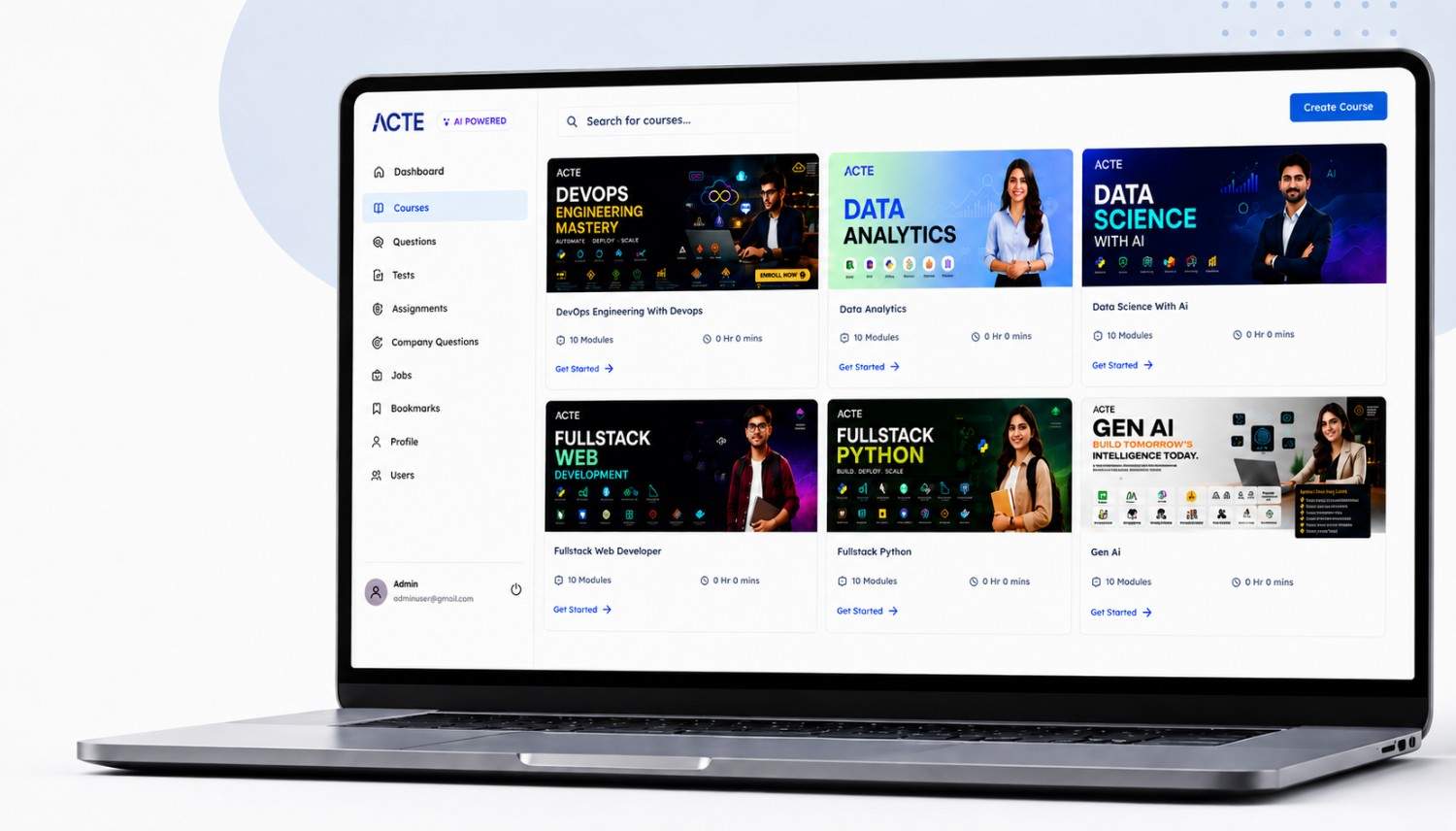
🧪 LMS Online Learning Platform

  • Explore expert trainer videos and documents to boost your learning.
  • Study anytime with on-demand videos and detailed documents.
  • Quickly find topics with organized learning materials.

Artificial Intelligence course Syllabus

  • 🏫 Classroom Training
  • 💻 Online Training
  • 🚫 No Pre Request (Any Vertical)
  • 🏭 Industrial Expert

Our Artificial Intelligence Training in Anna Nagar features a comprehensive curriculum tailored for beginners and aspiring AI professionals. Through this Artificial Intelligence Course in Anna Nagar, you’ll master key concepts in AI, including machine learning, deep learning, natural language processing, and computer vision. The program also covers leading AI tools and frameworks to help you develop real-world applications. Students gain practical exposure through Artificial Intelligence Internships in Anna Nagar and hands-on live projects. In addition, our dedicated Artificial Intelligence Placement support provides guidance in resume building, interview preparation, and long-term career advancement.

  • Introduction to AI Concepts – Start with basics like machine learning, data types and algorithms to build a strong foundation.
  • Advanced Techniques and Tool – Learn deep learning, neural networks and work with AI frameworks like TensorFlow and PyTorch.
  • Practical Project Work – Gain hands-on experience by building AI models, chatbots and image recognition systems.
  • Deployment and Tools – Discover how to deploy AI solutions using tools such Jupyter, Git and cloud platforms.
Artificial Intelligence and Python Basics
Data Preprocessing and EDA
Supervised Learning
Unsupervised Learning and Clustering
Neural Networks and Deep Learning
Natural Language Processing
Model Deployment and Ethics

Build strong foundation in AI principles and programming fundamentals:

  • AI Overview – Learn AI history, concepts and real world applications
  • Python Basics – Variables, data types, control flow and functions
  • Jupyter Notebook – Interactive coding environment setup and navigation
  • Libraries for AI – Introduction to NumPy and Pandas for data handling

Prepare and explore data effectively for AI models:

  • Data Cleaning – Handling missing values, duplicates and outliers
  • Feature Scaling – Normalization and standardization techniques
  • Data Visualization – Using Matplotlib and Seaborn libraries
  • Statistical Summaries – Correlation and distribution analysis

Understand machine learning basics and build predictive models:

  • Training and Testing – Concepts of overfitting and underfitting
  • Linear and Logistic Regression – Building and evaluating models
  • Decision Trees and Random Forests – Ensemble learning methods
  • Evaluation Metrics – Accuracy, precision, recall and F1-score

Discover hidden patterns in unlabeled data:

  • Unsupervised Learning Basics – Key concepts and applications
  • K-Means Clustering – Algorithm and practical implementation
  • Hierarchical Clustering – Dendrograms and linkage criteria
  • Dimensionality Reduction – Principal Component Analysis (PCA)

Discover the fundamentals of neural networks and deep learning:

  • Neural Network Architecture – Neurons, layers and activation functions
  • TensorFlow and Keras – Setting up deep learning frameworks
  • Building Neural Networks – Forward and backward propagation
  • Training Deep Models – Loss functions, optimizers and evaluation

Discover the ways in which machines interpret and analyze human language:

  • Text Preprocessing – Tokenization, stemming and lemmatization
  • Vectorization – Bag of Words and TF-IDF methods
  • Word Embeddings – Word2Vec and GloVe models
  • NLP Applications – Sentiment analysis and text classification

Deploy AI models and ensure ongoing performance:

  • Model Serialization – Saving and loading trained models
  • Deployment Tools – Basics of Flask and FastAPI frameworks
  • Monitoring Models – Tracking performance and retraining
  • Ethical AI – Understanding bias and fairness in AI systems

🎁 Free Addon Programs

Aptitude, Spoken English.

🎯 Our Placement Activities

Daily Task, Soft Skills, Projects, Group Discussions, Resume Preparation, Mock Interview.

Get Hands-on Experience in Artificial Intelligence Projects

Placement Support Overview

Today's Top Job Openings for Artificial Intelligence Professionals

Chatbot Developer

Company Code: TXS234

Chennai, Tamil Nadu

₹20,000 to ₹55,000 per month

B.E./B.Tech in CSE

Exp 0–2 years

  • We’re looking for freshers experienced with Dialogflow or Microsoft Bot Framework to build smart chatbots. You'll implement NLP techniques, integrate with REST APIs and continuously optimize conversational flows for enhanced user interactions.
  • Easy Apply

    Junior Machine Learning Engineer

    Company Code: GSC142

    Chennai, Tamil Nadu

    ₹20,000 – ₹40,000 per month

    B.Tech/B.E. in AI, ML,

    Exp 0–2 years

  • We’re hiring early-career engineers to assist in training and maintaining ML models. Tasks include preprocessing datasets, running experiments and collaborating with data teams to support scalable AI solutions.
  • Easy Apply

    Machine Learning Engineer

    Company Code: EMI368

    Chennai, Tamil Nadu

    ₹50,000 – ₹70,000 per month

    B.Tech/B.E. in AI, Computer Science, or related

    Exp 0–2 yearS

  • We’re seeking freshers to conduct ML tests, build predictive models and work on transforming prototypes into production-level applications aligned with business needs.
  • Easy Apply

    AI Developer

    Company Code: KTL587

    Chennai, Tamil Nadu

    ₹16,667 – ₹50,000 per month

    B.Tech/B.E. in CSE, AI, or related

    Exp 0–2 yearS

  • We are looking for freshers to develop AI-powered products with an emphasis on flexibility and work-life balance. You will collaborate with cross-functional teams, design AI logic and deploy features.
  • Easy Apply

    Junior AI/ML Developer

    Company Code: SSW764

    Chennai, Tamil Nadu

    ₹16,667 – ₹66,667 per month

    B.Tech/B.E. in AI, ML, CS, or related

    Exp 0–2 yearS

  • We’re looking for freshers to support AI workflows using LLMs and Retrieval Augmented Generation. Expect hands on work with LangChain, Llama Index and OpenAI APIs.
  • Easy Apply

    Python AI Developer

    Company Code: NXT823

    Chennai, Tamil Nadu

    ₹41,667 – ₹83,333 per month

    B.Tech in CSE or AI

    Exp 0–2 years

  • We’re seeking fresh graduates skilled in Python to develop ML models, perform data preprocessing and implement feature engineering using popular frameworks and libraries.
  • Easy Apply

    Data Scientist

    Company Code: CDM954

    Chennai, Tamil Nadu

    ₹50,000 – ₹80,000 per month

    B.Tech/M.Tech in AI, ML, CS, or related

    Exp 0–2 years

  • We’re seeking freshers with foundational experience in TensorFlow, PyTorch, or scikit‑learn to build and deploy ML models, support data science workflows and collaborate on AI-driven projects.
  • Easy Apply

    AI/ML Developer (Voice-Based Applications)

    Company Code: WMS489

    Chennai, Tamil Nadu

    ₹30,000 – ₹50,000 per month

    B.Tech/B.E. in CSE, AI, or related

    Exp 0–2 year

  • We’re hiring freshers focused on voice-based AI applications. Responsibilities include developing analytic tools, troubleshooting AI behavior and improve interaction with analytical voice models.
  • Easy Apply

    Highlights for Artificial Intelligence Internships in Anna Nagar

    Real Time Projects

    • 1. Gain hands-on experience by working on live Artificial Intelligence-based applications.
    • 2. Understand real-world problem-solving through scenarios.
    Book Session

    Skill Development Workshops

    • 1. Participate in focused sessions on trending technologies and tools.
    • 2. Learn directly from industry experts through guided practical exercises.
    Book Session

    Employee Welfare

    • 1. Enjoy benefits like health coverage, flexible hours, and wellness programs.
    • 2. Companies prioritize mental well-being and work-life balance for all employees.
    Book Session

    Mentorship & Peer Learning

    • 1. Learn under experienced mentors who guide your technical and career growth.
    • 2. Collaborate with peers to enhance learning through code reviews and group projects.
    Book Session

    Soft Skills & Career Readiness

    • 1. Improve communication, teamwork, and time management skills.
    • 2. Prepare for interviews and workplace dynamics with mock sessions and guidance.
    Book Session

    Certification

    • 1. Earn recognized credentials to validate your Artificial Intelligence skills.
    • 2. Boost your resume with course or project completion certificates from reputed platforms.
    Book Session

    Sample Resume for Artificial Intelligence (Fresher)

    • 1. Simple and Neat Resume Format

      – Use a clean layout with clear sections like summary, skills, education, and projects.

    • 2. List of Technologies You Know

      – Mention skills like Machine Learning, Data Preprocessing, Neural Networks, Deep Learning, Natural Language Processing (NLP), Computer Vision, Model Evaluation, Feature Engineering, AI Algorithm Optimization.

    • 3. Real-Time Projects and Achievements

      – Add 1–2 real-time projects with a short description and the tools used.

    Top Artificial Intelligence Interview Questions and Answers (2025 Guide)

    Ans:

    By engaging with its surroundings and getting feedback based on its behaviors an agent can learn through reinforcement learning. Positive feedback or rewards encourage the agent to repeat beneficial behaviors, while penalties discourage mistakes. Over time the agent refines its strategy to maximize total rewards. This trial and error learning process is useful in applications like robotics and game playing, where decision-making evolves through experience.

    Ans:

    Using datasets where inputs are coupled with known outputs, supervised learning trains models to make correct predictions. Unsupervised learning, on the other hand analyzes unlabeled data to identify basic frameworks or patterns without predetermined answers. While supervised learning is typically used for classification and regression unsupervised learning finds use in clustering and feature extraction tasks to reveal underlying data relationships.

    Ans:

    Problems include overfitting, in which the model matches the training data too closely but does not generalize and vanishing gradients, which slow down learning in early layers, can make training deep neural networks challenging. Solutions like proper weight initialization, batch normalization and dropout techniques help stabilize training and improve generalization. Balancing these factors is important to optimize network performance for various applications.

    Ans:

    Bias refers to systematic errors that cause a model to consistently deviate from the true values, often due to oversimplified assumptions or insufficient representation of the data. Managing bias is essential to ensure predictions are both accurate and fair. Techniques such as enriching datasets, adjusting model complexity and employing data augmentation help reduce bias and improve the reliability of machine learning outcomes.

    Ans:

    A model trained on one job can use what it has learnt to do a related but distinct task thanks to transfer learning. Using pre-trained models as a starting point reduces the need for large amounts of labeled data and speeds up training. Fine-tuning these models on specific datasets helps adapt them to new problems, making transfer learning a valuable approach to improving efficiency and performance across diverse applications.

    Ans:

    Activation functions introduce non-linearity into neural networks, enabling them to learn complex patterns that linear functions cannot capture. Functions like ReLU transform input signals and allow networks to approximate intricate relationships in the data. This non-linearity is vital for tasks such as image recognition and natural language processing, where diverse and subtle features must be modeled effectively.

    Ans:

    Explainable AI focuses on creating models that provide clear, understandable reasons for predictions which is critical for trust and transparency, especially in sensitive fields like healthcare and finance Methods such as LIME and SHAP offer insights into complex models make decisions help users to regulators verify and rely on AI outputs Explainability supports ethical AI deployment and fosters user confidence.

    Ans:

    The attention mechanism models focus selectively on the most relevant parts of input data rather than processing everything equally This dynamic weighting improves understanding in sequence based tasks like translation and image captioning, enabling more accurate and context aware predictions. By emphasizing important features, attention mechanisms significantly boost the effectiveness of neural networks.

    Ans:

    Recurrent neural networks can comprehend context and temporal patterns since they are built to handle sequences by retaining recollection of prior inputs. This capability makes RNNs well-suited for applications like speech recognition and time-series forecasting. However they can struggle with long-term dependencies due to vanishing gradients which advanced variants like LSTM and GRU are designed to overcome.

    Ans:

    While deep neural networks and other more intricate models can offer greater accuracy can also be challenging to understand Simpler models like decision trees offer transparency but might lack predictive power Finding the right balance depends on the problem context where interpretability is crucial for trust and compliance while accuracy is needed for performance Techniques like feature importance analysis manage this trade-off effectively.

    Company-Specific Interview Questions from Top MNCs

    1. How would you define reinforcement learning and its significance?

    Ans:

    Reinforcement learning is an AI technique where an agent interacts with its surroundings and gains or loses incentives to learn to make judgments This feedback loop the agent discover the actions over time through trial and error. It mimics learning from experience and is especially useful in areas like robotics and gaming where sequential decision making is critical.

    2. What differentiates supervised learning from unsupervised learning?

    Ans:

    Supervised learning relies on labeled data, training models to predict outcomes based on input-output pairs. Unsupervised learning however works with unlabeled data to identify hidden structures or clusters without explicit guidance. While supervised learning is ideal for classification and regression tasks unsupervised methods are used for exploratory analysis and pattern discovery.

    3. What are the common challenges faced when training deep neural networks?

    Ans:

    Training deep neural networks often encounters issues like vanishing gradients, which slow down learning in earlier layers and overfitting, where the model memorizes training data but performs poorly on new data. Techniques such as dropout, batch normalization and proper weight initialization mitigate these problems and improve the model’s generalization capabilities.

    4. How is bias understood in the context of machine learning models?

    Ans:

    Bias refers to systematic errors that cause models to consistently make inaccurate predictions, often due to oversimplified assumptions or imbalanced training data. Reducing bias is essential for fairness and accuracy. This can be achieved by enhancing dataset diversity, adjusting model complexity and employing methods like data augmentation.

    5. Why is transfer learning beneficial for deep learning models?

    Ans:

    Transfer learning boosts efficiency by reusing knowledge gained from training on one task and applying it to another related task. Models that have already been trained offer a solid basis that may be improved with less data and resources, speeding up the training process and enhancing performance on particular tasks.

    6. What purpose does an activation function serve in neural networks?

    Ans:

    Activation functions introduce non-linear transformations in neural networks, enabling them to model complex patterns beyond linear relationships. Functions like ReLU help the network capture intricate data features, which are crucial for tasks such as image recognition and natural language processing.

    7. Can you explain what explainable AI (XAI) is and why it matters?

    Ans:

    Explainable AI aims to make AI models’ decisions transparent and understandable to humans. This transparency is essential in high stakes industries where accountability and trust are required like healthcare or finance. Techniques like LIME and SHAP help provide insights into model behavior, fostering user confidence and ethical AI use.

    8. How does the attention mechanism improve neural network outcomes?

    Ans:

    Attention mechanisms allow neural networks to focus selectively on the most relevant parts of input data, dynamically weighting different elements. This capability is especially effective in sequence based tasks such as translation and image captioning, leading to more precise and context-aware predictions.

    9. What role do recurrent neural networks (RNNs) play in processing sequential data?

    Ans:

    By preserving memory of prior inputs, RNNs are made to process sequential data and aid in the capture of temporal dependencies. This makes them suitable for language processing and time series analysis. However, challenges like vanishing gradients exist, which advanced versions such as LSTM and GRU address to improve long-term sequence learning.

    10. How do experts in machine learning strike a balance between interpretability and model complexity?

    Ans:

    Complex models often achieve higher accuracy but are harder to interpret while simpler models are easier to understand but might sacrifice predictive power. Depending on the particular use case, striking the correct balance may be crucial for compliance and trust. Methods like feature importance can help close this gap.

    1) What is Artificial Intelligence and how is it applied in businesses today?

    Ans:

    Artificial intelligence is development of machines that can mimic human intellect, including thinking, learning and problem solving. In business, AI automates processes, enhances data analysis and improves customer service. It helps organizations make smarter decisions and optimize operations across various industries.

    2. How is AI integrated into digital transformation efforts?

    Ans:

    AI is frequently used alongside with cloud computing and automation technologies to enhance client experiences and expedite procedures. It supports tasks such as predictive maintenance, fraud detection and document processing, making operations more efficient and intelligent. This integration accelerates innovation and business agility.

    3. How does machine learning relate to artificial intelligence and what is it?

    Ans:

    A particular type of artificial intelligence called machine learning uses data to find patterns without the need for explicit programming. It enables continuous improvement through experience and is fundamental to many AI applications. ML helps in building predictive models and data-driven decision making tools.

    4. Can you provide instances to illustrate the distinction between supervised and unsupervised learning?

    Ans:

    Supervised learning uses labeled datasets where the model learns to predict outcomes, such as identifying spam emails. Unsupervised learning works with unlabeled data and looks for hidden patterns such as classifying clients based on their behavior. Both methods are vital for solving different AI problems.

    5. What is Intelligent Automation and how does it differ from traditional automation?

    Ans:

    Intelligent Automation combines AI with robotic process automation to handle complex, decision-driven tasks. Unlike traditional automation that follows fixed rules, it can adapt, learn and process unstructured data. This makes workflows smarter and more flexible.

    6. What is Natural Language Processing (NLP) and where is it commonly used?

    Ans:

    Text and speech analysis is made feasible by NLP, which gives machines the ability to comprehend and produce human language. Common applications include chatbots, sentiment analysis and automated document processing. NLP helps organizations extract insights from unstructured data like emails and reports.

    7. How do you make sure an AI model in production is accurate and dependable?

    Ans:

    Ensuring accuracy involves using evaluation metrics like precision, recall and F1-score during testing. Continuous monitoring post-deployment is necessary to detect model drift with periodic retraining on new data. Proper governance and lifecycle management are essential for maintaining model performance.

    8. What is bias in AI and how can it be addressed?

    Ans:

    Bias occurs when models produce unfair or skewed results due to prejudiced training data or flawed design. To reduce bias, its important to use diverse datasets, perform fairness testing and apply transparent development practices. Addressing bias is critical to creating ethical and trustworthy AI systems.

    9. How is unstructured data handled in AI projects?

    Ans:

    Natural language processing (NLP) and computer vision are two techniques used to process unstructured data, including text, images and audio. Tools like Optical Character Recognition (OCR) and deep learning models help convert this data into structured formats, enabling analysis and decision-making based on complex information sources.

    10. What motivates you to work in the field of Artificial Intelligence?

    Ans:

    Working in AI offers the chance to solve impactful, real-world problems through technology. The constant evolution of AI provides opportunities for learning and innovation. Contributing to AI driven transformation that enhances business outcomes and society is a strong professional motivator.

    1. What is Artificial Intelligence and how is it transforming industries?

    Ans:

    Machines can learn, reason and adapt to simulate human intelligence thanks to artificial intelligence. It is transforming industries by automating repetitive tasks, analyzing massive datasets, enhancing customer experiences and making faster decisions. From healthcare to finance, AI helps optimize operations and drive innovation.

    2. How is Machine Learning different from traditional programming?

    Ans:

    In traditional programming, rules and logic are explicitly coded. On the other hand, machine learning enables algorithms to identify patterns in data and base their judgments on those findings. This makes ML more flexible and effective for tasks like prediction, recommendation and pattern recognition in complex, data-rich environments.

    3. What are some common types of Machine Learning and where are they used?

    Ans:

    The three primary classifications are reinforcement learning, unsupervised learning and supervised learning. Credit scoring and spam detection both use supervised learning. Unsupervised learning helps in customer segmentation. Reinforcement learning is used in robotics or game AI. Each type serves different problem solving needs based on data availability.

    4. What are neural networks and how do they work?

    Ans:

    Neural networks are algorithms made up of layers of interconnected nodes (neurons) that are modeled after the structure of the human brain. They travel through activation functions, process incoming data, apply weights and produce predictions. They excel at tasks like audio processing, image recognition and natural language processing.

    5. What is the difference between AI, Machine Learning and Deep Learning?

    Ans:

    The goal of the broad field of artificial intelligence is to create the machines that are capable of carrying out tasks are call for intelligence similar to that of humans. Enabling machines to learn from data and make defensible conclusions is the main goal of machine learning within artificial intelligence. Deep learning is a advanced kind of machine learning, uses layered neural networks to identify complex patterns, particularly in domains such image processing and natural language understanding.

    6. What is Natural Language Processing and how is it applied in business?

    Ans:

    Natural Language Processing (NLP) allows machines to understand, interpret and generate human language. It is used in chatbots, document classification, sentiment analysis and voice assistants. Businesses use NLP to automate support, extract insights from text data and improve communication with users.

    7. How is a machine learning model's performance assessed?

    Ans:

    The model's performance has been assessed utilizing metrics such as MSE and MAE for regression or accuracy, precision, recall and F1 score for classification tasks. Its also important to check for overfitting or underfitting and to use cross validation to ensure the model generalizes well to new, unseen data.

    8. What steps do you take to prevent overfitting in a model?

    Ans:

    To prevent overfitting, I use techniques like regularization (L1 or L2), dropout in neural networks and early stopping during training. Cross-validation is also useful. Additionally, simplifying the model or increasing the training data can help improve generalization to real-world inputs.

    9. What are some ethical concerns related to AI?

    Ans:

    AI can raise concerns such as bias, privacy, lack of transparency and job displacement. Bias in training data may lead to unfair outcomes. Ethical AI development involves using diverse datasets, building explainable models, ensuring accountability and following data privacy regulations.

    10. Why are you interested in working in the field of Artificial Intelligence?

    Ans:

    AI attracts to me because it can address practical issues and improve people's lives in variety of sectors. It combines technical challenge with practical impact. I want to contribute to building intelligent systems that are ethical, reliable and aligned with business goals while continuously learning in this fast-evolving field.


    1. What is Artificial Intelligence and why is it important today?

    Ans:

    Artificial intelligence makes it possible for robots to carry out cognitively demanding tasks like learning and decision making. Its importance lies in automating processes, improving accuracy and driving innovation across industries like healthcare, finance and customer service.

    2. How does Machine Learning support Artificial Intelligence?

    Ans:

    Enabling systems to see patterns in data and make improvements without explicit programming is the goal of machine learning, a branch of AI. It forms the backbone of many AI applications such as predictive analytics, recommendation systems and anomaly detection.

    3. What does the term "supervised" and "unsupervised" learning mean?

    Ans:

    Supervised learning uses labeled data to train models to predict outputs based on input features. Unsupervised learning works with unlabeled data to discover hidden patterns or groupings, useful in customer segmentation and anomaly detection.

    4. What is the difference between a classification and a regression problem?

    Ans:

    Classification predicts discrete categories or classes, like identifying spam emails. Regression predicts continuous values, such as forecasting sales figures. Both approaches address different types of predictive modeling challenges.

    5. What is Deep Learning and how is it used in real-world applications?

    Ans:

    Deep Learning uses multilayered neural networks to model complex patterns in large datasets. Applications include image and speech recognition, language translation and autonomous vehicles, leveraging its power to handle unstructured data.

    6. What are some use cases of Natural Language Processing in business?

    Ans:

    Machines can comprehend and produce human language thanks to natural language processing. Businesses use NLP for chatbots, sentiment analysis, automated document processing and voice assistants, enhancing customer interaction and data insights.

    7. How do you select the right algorithm for a Machine Learning problem?

    Ans:

    Algorithm selection depends on the problem type, dataset size and quality, interpretability needs and computational resources. Starting with simpler models and iterating to more complex ones helps balance performance with efficiency.

    8. What difficulties arise when putting AI models into practice?

    Ans:

    Some of the toughest hurdles in deploying intelligent systems include dealing with changes in data over time, keeping models accurate and making sure they work smoothly with existing infrastructure. Its also important to make their decisions understandable to others.

    9. What steps help ensure AI models are ethical and fair?

    Ans:

    Ensuring fairness involves detecting and mitigating bias in training data, using balanced datasets and applying explainability techniques. Regular audits and adherence to ethical standards support responsible AI development.

    10. Why pursue a career in Artificial Intelligence?

    Ans:

    Artificial intelligence is powerful field that opens doors to tackling tough challenges and driving change across various industries. By working in AI you get the chance to develop meaningful solutions that streamline processes, support smarter decisions and enhance everyday life for people around the world.

    1. What is Artificial Intelligence and how does it impact businesses today?

    Ans:

    Artificial intelligence makes it possible for machines to carry out tasks like learning and problem solving that have historically required human intelligence. It impacts businesses by automating processes, improving decision-making and enhancing customer experiences, leading to greater efficiency and innovation.

    2. Explain the relationship between Artificial Intelligence, Machine Learning and Deep Learning.

    Ans:

    Artificial Intelligence is the broad field focused on building intelligent systems. One form of artificial intelligence that enables systems to learn from data is machine learning. Multi layered neural networks are used in deep learning, a specialized type of machine learning, to process complicated input such as speech and images.

    3. What are the differences between supervised, unsupervised and reinforcement learning?

    Ans:

    Supervised learning uses labeled data to train models for prediction. Unsupervised learning finds patterns in unlabeled data without predefined outcomes. Reinforcement learning trains agents to make decisions by rewarding desired actions through trial and error in an environment.

    4. How can overfitting be prevented in machine learning models?

    Ans:

    Overfitting occurs when a model learns noise from training data, reducing generalization. Prevention methods include regularization, cross-validation, early stopping, dropout in neural networks and increasing the size or quality of training data.

    5. What is Natural Language Processing and where is it applied?

    Ans:

    Machines can understand and produce human language using natural language processing. It is applied in chatbots, sentiment analysis, language translation and automated document processing, helping businesses automate communication and extract insights from text.

    6. Describe the process of training a neural network.

    Ans:

    Training a neural network involves feeding input data through layers of neurons, calculating output, comparing it to the actual label and adjusting weights using backpropagation to minimize error. Until the model is able to produce reliable predictions, this process is repeated iteratively.

    7. What metrics are commonly used to evaluate classification models?

    Ans:

    Common metrics include accuracy, precision, recall and F1-score. Accuracy measures overall correctness, precision evaluates true positive predictions, recall assesses the ability to find all positives and F1-score balances precision and recall, especially in imbalanced datasets.

    8. How do ethical considerations influence AI development?

    Ans:

    Ethical AI development addresses issues like bias, privacy, transparency and accountability. It ensures models are fair, data is handled responsibly, decisions are explainable and negative societal impacts are minimized, which is critical for building trust and compliance.

    9. What is reinforcement learning and provide an example of its use?

    Ans:

    In machine learning technique known as reinforcement learning, an agent gains decision making skills by interacting with its surroundings and earning rewards or punishments. Examples include training robots to navigate or algorithms learning to play games such chess or Go.

    10. What motivates working in Artificial Intelligence?

    Ans:

    Artificial Intelligence offers the opportunity to solve complex, real world problems using technology. It enables innovation across industries, improving efficiency and quality of life. The continuous learning and evolving nature of AI make it an exciting and impactful field to work in.

    Disclaimer Note:

    The details mentioned here are for supportive purposes only. There are no tie-ups or links with the corresponding PGs.

    Ladies PG Accommodation

      Velachery
    • Sanz Live Women's PG : 72007 19990
    • Krishnaveni Castle : 90801 95007
    • Anna Nagar
    • Pentos Women's PG : 93427 57797
    • Women's Nest - Ladies PG : 94451 25894
    • OMR
    • MSR Luxury PG : 89399 91922
    • Porur
    • Sree Shakthi Ladies Hostel : 90031 98767
    • Friends Ladies Hostel : 73389 19836
    • Tambaram
    • CK HIVE Girls Ladies PG90948 58303
    • Layaa Women’s Hostel63797 00573

    Mens PG Accommodation

      Velachery
    • Stayflix PG for Men's : 96000 45088
    • DJ Men's PG Velachery : 90803 19242
    • Anna Nagar
    • Stay Inn Men's Hostel(PG) : 94454 87884
    • Brights Boys Hostel : 88387 88921
    • OMR
    • Sree Siddhi Vinayaka Mens PG : 95577 95579
    • Rudhra Men’s PG : 93636 45199
    • Porur
    • SIDDHANS Men's PG : 88259 71908
    • Jaswanth Raaj Mens PG : 89255 15888
    • Tambaram
    • Sri Sai Grn Men's PG : 81228 24076
    • Rolexx Men's PG : 80988 84848

    Top Artificial Intelligence Job Opportunities for Freshers

    • 1. AI Developer Jobs at Startups and IT Companies
    • 2. Campus Placements and IT Service Jobs
    • 3. Internship-to-Job Programs
    • 4. Apply Through Job Portals
    • 5. Skills That Help You Get Hired

    Getting Started With Artificial Intelligence Training in Anna Nagar

    Easy Coding
    8 Lakhs+ CTC
    No Work Pressure
    WFH Jobs (Remote)

    Why Artificial Intelligence is the Ultimate Career Choice

    High Demand

    Companies prefer multi-skilled professionals who can handle entire project cycles.

    Global Opportunities

    Open doors to remote and international job markets.

    High Salary

    Enjoy competitive salaries and rapid career advancement.

    Flexible Career Path

    Explore roles such as developer, architect, freelancer, or entrepreneur.

    Future-Proof Career

    Stay relevant with skills that are consistently in demand in the evolving tech landscape.

    Versatility Across Industries

    Work in various domains like e-commerce, healthcare, finance, and more.

    Career Support

    Placement Assistance

    Exclusive access to ACTE Job portal

    Mock Interview Preparation

    1 on 1 Career Mentoring Sessions

    Career Oriented Sessions

    Resume & LinkedIn Profile Building

    Get Artificial Intelligence Certification

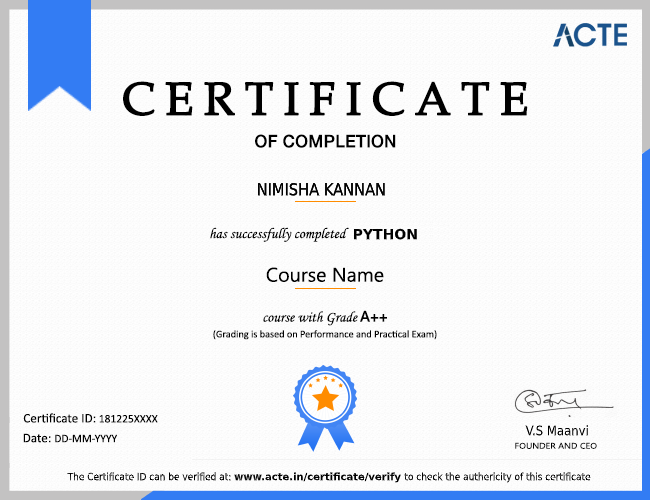
    You'll receive a certificate proving your industry readiness.Just complete your projects and pass the pre-placement assessment.This certification validates your skills and prepares you for real-world roles.

    You can earn widely recognized Artificial Intelligence certifications such as:

    • Microsoft Certified: Azure AI Engineer Associate
    • Google Professional Machine Learning Engineer
    • IBM AI Engineering Professional Certificate
    • TensorFlow Developer Certificate

    An AI certification is your gateway to a secure and high-demand career in Artificial Intelligence. It proves your hands-on expertise in AI tools and technologies, giving you a strong edge in the job market. With our comprehensive training and 100% placement support, you’re fully equipped to land a rewarding AI role right after completing the course turning your certification into a guaranteed career opportunity.

    The time to get AI certified depends on your prior knowledge and study habits. Beginners might need around 3 to 6 months of consistent learning and practice. Those with some experience can prepare in a shorter time, like 1 to 3 months. Practicing with real datasets and projects helps a lot.

    Earning an AI certification:

    • Proves your expertise in AI and machine learning
    • Opens more job opportunities in tech, healthcare, finance and more
    • Can result in greater incomes and quicker professional advancement.
    • Builds your professional credibility with employers and clients
    • Equips with hands on skills to build and deploy AI solutions effectively
    • Study official exam topics and understand key AI concepts
    • Practice coding AI models and working with datasets regularly
    • Utilize practice exams for measuring your understanding and advance.
    • Join study groups or training classes to get support and insights
    • Work on real-world AI projects to build practical experience and confidence

    Complete Your Course

    A Downloadable Certificate in PDF Format, Immediately Available to You When You Complete Your Course.

    Get Certified

    A Physical Version of Your Officially Branded and Security-Marked Certificate.

    Get Certified

    Lowest AI Course Fees In Anna Nagar

    Affordable, Quality Training for Freshers to Launch IT Careers & Land Top Placements.

    Call Course Advisor

    How is ACTE's Artificial Intelligence Course Different?

    Feature

    ACTE Technologies

    Other Institutes

    Affordable Fees

    Competitive Pricing With Flexible Payment Options.

    Higher Artificial Intelligence Fees With Limited Payment Options.

    Industry Experts

    Well Experienced Trainer From a Relevant Field With Practical Artificial Intelligence Training

    Theoretical Class With Limited Practical

    Updated Syllabus

    Updated and Industry-relevant Artificial Intelligence Course Curriculum With Hands-on Learning.

    Outdated Curriculum With Limited Practical Training.

    Hands-on projects

    Real-world Artificial Intelligence Projects With Live Case Studies and Collaboration With Companies.

    Basic Projects With Limited Real-world Application.

    Certification

    Industry-recognized Artificial Intelligence Certifications With Global Validity.

    Basic Artificial Intelligence Certifications With Limited Recognition.

    Placement Support

    Strong Placement Support With Tie-ups With Top Companies and Mock Interviews.

    Basic Placement Support

    Industry Partnerships

    Strong Ties With Top Tech Companies for Internships and Placements

    No Partnerships, Limited Opportunities

    Batch Size

    Small Batch Sizes for Personalized Attention.

    Large Batch Sizes With Limited Individual Focus.

    LMS Features

    Lifetime Access Course video Materials in LMS, Online Interview Practice, upload resumes in Placement Portal.

    No LMS Features or Perks.

    Training Support

    Dedicated Mentors, 24/7 Doubt Resolution, and Personalized Guidance.

    Limited Mentor Support and No After-hours Assistance.

    Artificial Intelligence Course FAQs

    1. What basic knowledge should you have before starting advanced Artificial Intelligence training?

    Before starting advanced AI, its helpful to know basic programming (like Python), some math including algebra and statistics and have an idea of what AI is about. These basics make understanding complex AI concepts much easier. Without this foundation, learning advanced topics can be overwhelming.
    Advanced AI skills open up many job opportunities in industries like technology, healthcare, finance, marketing and robotics. Employers want people who can build smart systems, analyze data and automate tasks. These abilities make you a desirable candidate for positions such as machine learning specialist, data scientist and AI engineer.
    Advanced courses in artificial intelligence dive into key areas such machine learning, deep learning, neural networks, computer vision, reinforcement learning and natural language. Alongside the technical content they also explore the ethical challenges that come with developing intelligent systems. Learning these topics equips you with knowledge and skills to create smart technologies that can solve real world problems.
    Yes, most AI courses include practical projects to help you apply what you learn. Projects might involve creating chatbots, image recognition programs, or predictive models. This hands on experience is important for understanding how AI works in real life.
    Many AI courses help you build a portfolio by guiding you to showcase your projects and code samples. This portfolio acts as proof of your skills and can impress potential employers. Having a portfolio is especially useful when applying for AI-related jobs.
    Anyone with some programming and math basics who wants to learn AI can join advanced AI training. This includes students, working professionals and those looking to switch careers. The key is willingness to learn and improve AI skills.
    Most advanced AI courses don’t require formal degrees. Instead, they expect you to understand basic programming and math concepts. Some courses also provide a quick review to help all students start on the same level.
    Previous AI experience is not necessary for many advanced courses because they often include beginner refreshers. These help you learn the basics before moving to more difficult topics. This way, even those new to AI can catch up.
    Complete beginners are usually advised to start with basic AI or programming courses first. However, some advanced courses accept beginners if they do some preparation or quick self-study. Starting with foundational courses is generally better.

    1. What kind of job help do Artificial Intelligence course provide?

    Many AI courses offer job assistance like resume writing help, interview preparation and connecting students with companies looking for AI talent. This support increases your chances of finding a good AI-related job after completing the course.

    2. Are the projects from the Artificial Intelligence course useful for job applications?

    Yes, the projects you complete during the course demonstrate your practical skills to employers. Adding these projects to your resume or portfolio shows that you can build AI applications and solve real problems, making you stand out in job interviews.

    3. Can I get jobs at big companies after advanced Artificial Intelligence training?

    Completing advanced AI training improves your chances of getting hired by top companies, especially in tech, finance and healthcare. These businesses seek applicants who can effectively manage challenging AI jobs and foster innovation.

    4. Do Artificial Intelligence courses help fresh graduates or career changers find jobs?

    Yes, many courses provide special support for fresh graduates and people switching careers. This includes interview coaching, career counseling and tips on how to highlight your AI skills to impress employers, making your job search easier.
    Yes, most advanced AI courses award a certificate when you complete the training. This certificate shows employers that you have gained important AI skills. It can be added to your resume or LinkedIn profile to boost your job prospects.
    Absolutely! An AI certification proves you can handle complex AI problems and helps you stand out in the job market. These companies look for candidates who can manage demanding AI tasks and promote creativity.
    Before enrolling, you should know basic programming and math and be eager to learn about AI technologies. Even if you lack professional AI experience, many courses start with foundational lessons to prepare you for advanced topics.
    An advanced AI course teaches you how to analyze data, build AI models and automate tasks, which are highly valuable skills. These abilities make you a stronger candidate for jobs requiring problem-solving and innovation, helping your career advance.
    You’ll learn how to use machine learning algorithms, build neural networks, process language and images and automate workflows with AI tools. You will also understand AI ethics and data visualization, essential for making smart business decisions.

    1. Does the Artificial Intelligence course fee include job placement help?

    Most advanced AI courses include job placement assistance as part of the fee. This may cover resume reviews, interview preparation and career counseling to help you find an AI-related job after the course.
    Course fees vary because of factors like the instructor’s experience, the depth of course material, additional resources and personalized support. More expensive courses often offer extra benefits such as one-on-one mentoring or lifelong access.
    Many AI training providers offer courses at reasonable prices with flexible payment options to help beginners join. Sometimes, scholarships or discounts are available to make learning more affordable and accessible.
    No, we charge the same fee for every location. Whether you live in a big city or a small town, the cost is the same. This ensures everyone has equal access to quality AI training without any extra charges based on location.
    Learn (ML & DL + NLP + Computer Vision + AI Algorithms + Data Preprocessing + Model Evaluation + Feature Engineering) at 30,680/- Only.
    Acte Technologies WhatsApp

    Artificial Intelligence Course for All Graduates, NON-IT, Diploma & Career Gaps — ₹30,680/- only.

    Download Brouchure