Sun Solaris Administration Training & Certification Course Online - ACTE | Updated 2025
Home » OS & Server Maintenance Courses Online » Solaris Online Training

Solaris Online Training

Rated #1 Recognized as the No.1 Institute for TOGAF 9 Training

Rated as the Best Sun Solaris Administration Training Institute, Empowering Students and Professionals to Gain Expertise in Solaris Administration and Secure Lucrative Careers in System Administration.

Enrolling in the Top sun solaris administration certification With Placement Support Ensures Exceptional Training and Career Advancement. We Offer Comprehensive Coaching in Our Solaris Certification Program, Meeting Industry Standards.

  • Renowned Sun Solaris Administration Online Training.
  • Adapt Countless Career Opportunities With Leading Organizations.
  • Comprehensive and Affordable Curriculum With Placement Assistance.
  • Trusted by Over 300 Companies and 10,000+ Certified Solaris Administrators.
  • Trained by Industry Experts With Over 10 Years of Solaris Administration Experience.
  • Guided by Experts With 10+ Years of Experience in Sun Solaris Administration Certification Training and Placement.

Job Assistance

1,200+ Enrolled

In collaboration with

65+ Hrs.

Duration

Online/Offline

Format

LMS

Life Time Access

Quality Training With Affordable Fee

⭐ Fees Starts From

INR 38,000
INR 18,500
Get Training Quote for Free

      Our Hiring Partners

      Learn From Experts, Practice On Projects & Get Placed in IT Company

      • 100% Guaranteed Placement Support for Freshers & Working Professionals.
      • You will not only gain knowledge of Solaris and advanced concepts, but also gain exposure to Industry best practices.
      • Experienced Trainers and Lab Facility.
      • Solaris System Administration certification Guidance Support with Exam Dumps.
      • Practical oriented / Job oriented Training. Practice on Real Time project scenarios.
      • We have designed an in-depth course so meet job requirements and criteria.
      • Resume & Interviews Preparation Support.
      • Concepts: Solaris 10 System Administration – Part I, Boot procedures, Startup and Shutdown procedures, Service management facility, Installing the solaris operating system, Software package administration, Managing processes, Maintenance of patches, Disk management, File system management, File security and acls, Backup and recovery, Managing the print environment, Solaris 10 System Administration – Part II, Naming services, NFS/CACHE FS, Automount, Solaris volume manager (SVM), Managing swap space, Live upgrade overview, Dump file configuration, Role-based access Control (RBAC), Zones.
      • START YOUR CAREER WITH Solaris COURSE THAT GETS YOU A JOB OF UPTO 5 TO 12 LACS IN JUST 60 DAYS!

      Your IT Career Starts Here

      550+ Students Placed Every Month!

      Get inspired by their progress in the Career Growth Report.

      Other Categories Placements
      • Non-IT to IT (Career Transition) 2371+
      • Diploma Candidates3001+
      • Non-Engineering Students (Arts & Science)3419+
      • Engineering Students3571+
      • CTC Greater than 5 LPA4542+
      • Academic Percentage Less than 60%5583+
      • Career Break / Gap Students2588+

      Upcoming Batches For Classroom and Online

      Weekdays
      01 - Dec - 2025
      08:00 AM & 10:00 AM
      Weekdays
      03 - Dec - 2025
      08:00 AM & 10:00 AM
      Weekends
      06 - Dec - 2025
      (10:00 AM - 01:30 PM)
      Weekends
      07 - Dec - 2025
      (09:00 AM - 02:00 PM)
      Can't find a batch you were looking for?
      INR 18,500
      INR 38,000

      OFF Expires in

      What’s included ?

      Convenient learning format

      📊 Free Aptitude and Technical Skills Training

      • Learn basic maths and logical thinking to solve problems easily.
      • Understand simple coding and technical concepts step by step.
      • Get ready for exams and interviews with regular practice.
      Dedicated career services

      🛠️ Hands-On Projects

      • Work on real-time projects to apply what you learn.
      • Build mini apps and tools daily to enhance your coding skills.
      • Gain practical experience just like in real jobs.
      Learn from the best

      🧠 AI Powered Self Interview Practice Portal

      • Practice interview questions with instant AI feedback.
      • Improve your answers by speaking and reviewing them.
      • Build confidence with real-time mock interview sessions.
      Learn from the best

      🎯 Interview Preparation For Freshers

      • Practice company-based interview questions.
      • Take online assessment tests to crack interviews
      • Practice confidently with real-world interview and project-based questions.
      Learn from the best

      🧪 LMS Online Learning Platform

      • Explore expert trainer videos and documents to boost your learning.
      • Study anytime with on-demand videos and detailed documents.
      • Quickly find topics with organized learning materials.

      Curriculum

      Syllabus of Solaris Online Training Course
      Solaris 10 System Administration – Part I
      Module 1 : INTRODUCTION
      • Introduction to UNIX
      • What is Kernel – Shell – File System – Client/Server
      • Hardware Requirements – Sparc vs Intel
      • Basic Unix commands
      Module 2 : BOOT PROCEDURES
      • Openboot interface
      • Openboot parameters
      • Device names and aliases
      • Boot Options
      • Booting with GRUB
      Module 3 : STARTUP AND SHUTDOWN PROCEDURES
      • Boot Phases
      • init
      • System run levels
      • inittab file
      • Run control scripts
      • Adding a run control script
      • Disabling a run control script
      • The shutdown command
      • The init command
      • The halt/poweroff commands
      • The reboot command
      • The stop-a command
      Module 4 : SERVICE MANAGEMENT FACILITY
      • Basic Features
      • SMF Environment
      • SMF and Booting
      • SMF Environmental Structures
      • Service States
      • Managing Services
      • Listing Services with svcs and inetadm
      • Managing the State of a Service with svcadm
      • Configuring a Service with svccfg
      • Managing the State of inetd Network Services with inetadm
      Module 5 : INSTALLING THE SOLARIS OPERATING SYSTEM
      • Installation requirements
      • Partitions and multiple disks
      • Packages, Clusters and Groups
      • Configuration cluster
      • Definition of Installation methods
      • Interactive Installation Process
      Module 6 : SOFTWARE PACKAGE ADMINISTRATION
      • Documentation Packages
      • Configuration clusters
      • Displaying current software package information
      • Checking the installation of a package
      • Adding software packages
      • Removing software packages
      • Package logfiles & Troubleshooting tips
      Module 7 : MANAGING PROCESSES
      • Introduction to Process Management
      • The ps command
      • The prstat command
      • The kill command
      • Using the cron processes
      • Creating crontab entries
      • Crontab command options
      • The at command
      Module 8 : MAINTENANCE OF PATCHES
      • Maintenance of patches and patch clusters
      • Verification of currently installed patches
      • Installing a patch on the system
      • Removing a patch from the system Patch logfiles
      Module 9 : DISK MANAGEMENT
      • Displaying disk information
      • Partitions/Slices
      • Naming conventions
      • Physical device names
      • Instance name
      • Logical device names
      • Block and character devices
      • Configuring new disk devices
      • Partitioning the disk with the format command and Solaris
      • Management Console
      • Making a new partition
      Module 10 : FILE SYSTEM MANAGEMENT
      • Disk based file systems
      • Main root sub-directories
      • Pseudo file systems
      • Components of a ufs file system
      • Boot block
      • Superblocks
      • Inodes
      • Data disk blocks
      • Ulimit parameter
      • File types
      • Symbolic and Hard links
      • Creating file systems
      • The newfs command
      • The mount command
      • The umount command
      • The vfstab file
      • The mnttab file
      • Filesystem checking
      • Determining if a file system needs checking
      • Running fsck manually
      • The lost+found directories
      • Automounting CDs and floppies (Volume Management)
      • Checking free disk space
      • The df command
      • The quot command
      • The du command
      • Freeing disk space
      • Freeing up disk space with compression utilities
      • Rotating files with logadm
      • ZFS
      • ZFS – A Basic Description
      • Main Features
      • ZFS Tools
      • Managing ZFS Pools with zpool
      • Pool Configuration Features
      • Creating and Deleting (‘Destroying Pools’)
      • Managing File Systems with ZFS
      • Creating and Destroying a File System
      Module 11 : FILE SECURITY AND ACLS
      • ACLs (Access Control Lists)
      • The setfacl command
      • The getfacl command
      • The ACL mask
      • USER MANAGEMENT
      • User accounts
      • Files used in creating a user – the passwd, group and shadow files
      • Adding a user
      • Changing user details
      • Deleting a user
      • User group maintenance
      • Password administration
      • Local Login control
      • Remote Login control
      • Login logs
      • The wall command
      • The message of the day
      • Controlling the amount of disk space accessible to users using quotas
      Module 12 : BACKUP AND RECOVERY
      • Backup overview
      • Backup and restore utilities overview
      • Tape device names
      • The mt utility – retentsion, rewind, space forward or backward and status
      • The ufsdump and ufsrestore utilities
      • ufs snapshots
      Module 13 : MANAGING THE PRINT ENVIRONMENT
      • The print service
      • Print service files
      • Printer configuration with lpadmin
      • Line printer commands – lpshut, lpsched, accept, reject, enable, disable, lpmove lpusers, lpstat, lp, cancel
      Solaris 10 System Administration – Part II
      Module 14 : NAMING SERVICES
      • DNS Server and Client Setup
      • NIS Servers and Clients
      • Setting up NIS Servers and Clients
      • NIS+ Overview
      • LDAP Overview and Setting up an LDAP Client
      • The Name Service Switch Configuration Files
      • Name Service Cache Daemon
      Module 15 : NFS/CACHE FS
      • Network File System (NFS)
      • NFS Server
      • NFS Client
      • /etc/dfs/dfstab File
      • NFS Client Configuration
      • Troubleshooting NFS
      • Cache File System (Cachefs)
      • Creating a Cache File System
      • Adding/Removing Cache File System
      • NFS Logging – user access
      Module 16 : AUTOMOUNT
      • Automount Maps
      • Registering Changes for Automount
      • automount -v
      Module 17 : SOLARIS VOLUME MANAGER (SVM)
      • RAID
      • Volume Management Operations
      • metadevices
      • State Database Replicas
      • SVM Commands and Files
      • Creating State Database Replicas
      • Creating a Disk Concatenation
      • Creating a Concatenation of two disk slices
      • Creating and Managing Mirrors
      • Creating File Systems on Volumes
      • Deleting a Metadevice
      • Dynamically Growing Existing File Systems
      Module 18 : MANAGING SWAP SPACE
      • Configuring Swap Space
      • Adding a Swap File on an Existing File System
      • Disabling Swap Space
      Module 19 : JUMPSTART
      • Automatic Installation
      • Principles of JumpStart
      • Server Setup for JumpStart
      • Configuring NIS to Support JumpStart
      • Configuring Non NIS Server for JumpStart
      • Rules File
      • Class File
      • Check Utility
      • Setting up DHCP for Intel clients
      • Jumpstart troubleshooting
      Module 20 : LIVE UPGRADE OVERVIEW
      • Live Upgrade description
      • Basic procedures
      • lucreate and luupdate commands
      • lucativate an lustatus commands
      • Live Upgrade Example
      Module 21: DUMP FILE CONFIGURATION
      • Dump File Definition
      • System Crash Dumps
      • Core Dump Configuration
      • SYSLOG
      • syslog Configuration
      • The M4 Utility
      • Editing the syslog.conf File
      • Logging Telnet, FTP and other Networking Daemon
      • Testing syslogd Logging
      Module 22 : ROLE-BASED ACCESS CONTROL (RBAC)
      • Traditional Unix Security vs RBAC
      • The RBAC Security Model
      • Configuring RBAC Examples
      Module 23 : ZONES
      • Zone Configuration Settings and Characteristics
      • Creating Zones
      • Managing the Zone State
      • Zone System Processes
      Show More
      Show Less

      About Solaris Online Training Course

      ACTE provides students with the skills necessary to administer Sun systems running Solaris 10 in a network environment. Learners will gain the knowledge necessary to maintain, configure and troubleshoot the Network File System (NFS); Setup custom Jumpstart environment; configure the Network Information Service (NIS) environment and manage Solaris Zones. our furthermore online course is a much needed one for the aspirants out there in the market. We have course details and furthermore some demo sessions for you to try out. 

      Benefits

      Solaris also supported Sun Rays, but they became available on Linux too. Focused enhancements across CPU, memory, file system, I/O, networking, and security deliver the best database, middleware, and application performance for Oracle workloads. That made it popular with schools, governments, enterprises, and other large organizations, which used Solaris as a platform to develop their own proprietary software -- software which still exists today. In short, Sun Solaris is used to run legacy applications built for Solaris.

      Most Job Oriented Solaris Modules Online Topics Covered
      • Installations

        Configuring & system services

        Managing users and groups

      • Boot Environments

        Performing Basic ZFS Administration

        Managing Disk Devices

      • Configuring Solaris Zones

        Service Management Facility

        Configuring Networking

      What is Solaris used for?

      Solaris is the best enterprise operating system for Oracle Database and Java applications. Focused enhancements across CPU, memory, file system, I/O, networking, and security deliver the best database, middleware, and application performance for Oracle workloads.
        • Administrative commands – The cryptoadm command provides a list subcommand to list the available providers and their capabilities. Ordinary users can run the cryptoadm list and the cryptoadm --help commands.
      All other cryptoadm subcommands require you to assume a role that includes the Crypto Management rights profile, or to become superuser. Subcommands such as disable, install, and uninstall are available for administering the framework. For more information, see the cryptoadm(1M) man page. The svcadm command is used to manage the kcfd daemon, and to refresh cryptographic policy in the kernel. For more information, see the svcadm(1M) man page.
      • User-level commands – The digest and mac commands provide file integrity services. The encrypt and decrypt commands protect files from eavesdropping. To use these commands, see Protecting Files With the Solaris Cryptographic Framework (Task Map).
      • Binary signatures for third-party providers – The elfsign command enables third parties to sign binaries for use within the framework. Binaries that can be added to the framework are PKCS #11 libraries, kernel algorithm modules, and hardware device drivers. To use the elfsign command, see Appendix F, Packaging and Signing Cryptographic Providers, in Solaris Security for Developers Guide.
      • To reboot the system to the state that is defined by the initdefault entry in the /etc/inittab file, type the following command: # init 6.
      • To reboot the system to a multiuser state, type the following command: # init 2.
      We are happy and proud to say that we have strong relationship with over 700+ small, mid-sized and MNCs. Many of these companies have openings for Solaris analyst. Moreover, we have a very active placement cell that provides 100% placement assistance to our students. The cell also contributes by training students in mock interviews and discussions even after the course completion.
      Solaris Application Programming (Solaris Series) eBook: Gove, Darryl: and optimization or an experienced developer searching for the most efficient ways .In addition, you will learn how to use the rich set of developer tools to identify
      There is no prerequisite to learn.Anyone can learn.
      Solaris 11.4 contains support for the C11 programming language standard: "ISO/IEC 9899:2011 Information technology - Programming languages - C". The C11 standard is a compatible revision of the C99 standard. Historically, the C programming language standard has been part of the Single UNIX Specification.
      Our courseware is designed to give a hands-on approach to the students in Solaris . The course is made up of theoretical classes that teach the basics of each module followed by high-intensity practical sessions reflecting the current challenges and needs of the industry that will demand the students’ time and commitment.
      Among the many advantages the Solaris operating environment provides are portability, scalability, interoperability, and compatibility.
      That made it popular with schools, governments, enterprises, and other large organizations, which used Solaris as a platform to develop their own proprietary software - software which still exists today. In short, Solaris is used to run legacy applications built for Solaris.

      What are the Advantages of Solaris ?

      • Delivers near-linear performance gains: 92 percent for database applications, and 88 percent for Java platform applications.
      • Speeds up Web workload processing by 47 percent on SPARC platforms with four processors over Solaris 9, and more than 80 percent over Solaris 8.
      • Increases Web workloads on x86 architecture systems, delivering up to 43 percent improvement over Solaris 9 with two processors.
      • Increases Secure Sockets Layer (SSL) Data Encryption Standard (DES) performance by 77 percent; performance for 3DES increases by 130 percent over Solaris 9.
      • Improves performance up to 38 percent for Solaris 10 over Linux on dual-processor Sun Fire systems from Oracle.
      • Outperforms commercial distributions of Linux on x64 systems.
      • Sets performance and price/performance world records on multiple platforms.

      Sun Considering Solaris For Power

      • Solaris is SunOS packaged with a number of additional tools and a graphical user interface (GUI) environment. Since Sun Microsystems did not offer Solaris until SunOS 4, SunOS and Solaris have different version conventions (e.g., Solaris 1 includes SunOS 4, while Solaris 2 includes SunOS 5).
      • To further confuse the naming scheme, Sun now refers to Solaris by just its point release (e.g., Solaris 7, 8, or 9 instead of 2.7, 2.8, or 2.9).
      • Sun Microsystems Inc. is considering a port of its Solaris version of the Unix operating system to two new processor architectures designed by chip rivals IBM Corp. and Intel Corp., a company executive said Tuesday.
      • The SunOS name is usually only used to refer to versions 1.0 to 4.1.4, which were based on BSD, while versions 5.0 and later are based on UNIX System V Release 4, and are marketed under the brand name Solaris.
      • The comments came during Sun’s quarterly earnings conference call with press and financial analysts on Tuesday, when Sun president and chief operating officer Jonathan Schwartz mentioned IBM’s Power and Intel’s Itanium processors while contrasting Sun’s Unix strategy to that of other Unix vendors.

      “Unlike IBM, who obviously is really narrowly deploying AIX onto one of their system families, we’ve also begun looking at delivering Solaris on Power, as well as Solaris on Itanium, as ways of really driving incremental volume,” Schwartz said.

      Schwartz was quickly cut off by Sun’s chief executive officer, Scott McNealy, who said, “That’s not a product announcement,” and Sun representatives declined to comment on when, if ever, such products might be released.

      • The idea of running Solaris on Intel’s Itanium processors — which compete with Sun’s own UltraSparc chips — is not a new one.
      • In 2001, Sun actually completed a port of Solaris to Itanium, which was never brought to market because of low demand for Itanium systems, according to Sun.
      • A year after the Itanium port, Sun also terminated support for Solaris on Intel’s other chip architecture, x86, but that decision was reversed several months later after Solaris x86 users blasted the move.
      • Now, judging from Schwartz’s comments, the company is having second thoughts about the Itanium port.
      • A Solaris port to IBM’s Power architecture would be a surprise, said Nathan Brookwood, principal with industry research firm Insight64, in Saratoga, Calif.

      “The question is, would people purchasing Power platforms from IBM be interested in Solaris as opposed to either Linux or AIX, and that doesn’t seem like a real strong likelihood,” he said.

      • Though Sun has promised to release Solaris under an open-source license, Sun will have a nearly impossible task in convincing independent software vendors and hardware vendors such as IBM or Hewlett-Packard Co. to provide technical support, performance tuning or marketing resources for Solaris on these new platforms when they have already committed to Linux, Brookwood said.

      “Solaris is a Sun product, and therefore the likelihood that an IBM is going to put any effort into making Solaris run better on Power systems or that HP would put any effort into making it run better on Itanium systems is pretty close to zero,” he said. “One of the big issues is not the open-sourcing. It is the vendor neutrality.”

      • Still, Sun has made some headway recently with Solaris on x86. The company added 15 Solaris original equipment manufacturers and 54 independent software vendors in the last quarter, and the Sun has now certified 220 systems — including those made by Dell Inc., HP, and IBM — as compatible with Solaris, Schwartz said.

      “Solaris is broader than simply Sun’s hardware,” he said. We are very comfortable with our operating system strategy and the flexibility it gives us in creating disruptive pricing models, like subscriptions to an operating system that include free hardware.

      Show More

      Need customized curriculum?

      Hands-on Real Time Solaris Projects

      Our Top Hiring Partner for Placements

      ACTE offers placement opportunities as add-on to every student / professional who completed our classroom or online training. Some of our students are working in these companies listed below.
      • We are associated with top organizations like HCL, Wipro, Dell, Accenture, Google, CTS, TCS, IBM etc. It make us capable to place our students in top MNCs across the globe
      • We have separate student’s portals for placement, here you will get all the interview schedules and we notify you through Emails.
      • After completion of 70% Solaris training course content, we will arrange the interview calls to students & prepare them to F2F interaction
      • Solaris Trainers assist students in developing their resume matching the current industry needs
      • We have a dedicated Placement support team wing that assist students in securing placement according to their requirements
      • We will schedule Mock Exams and Mock Interviews to find out the GAP in Candidate Knowledge

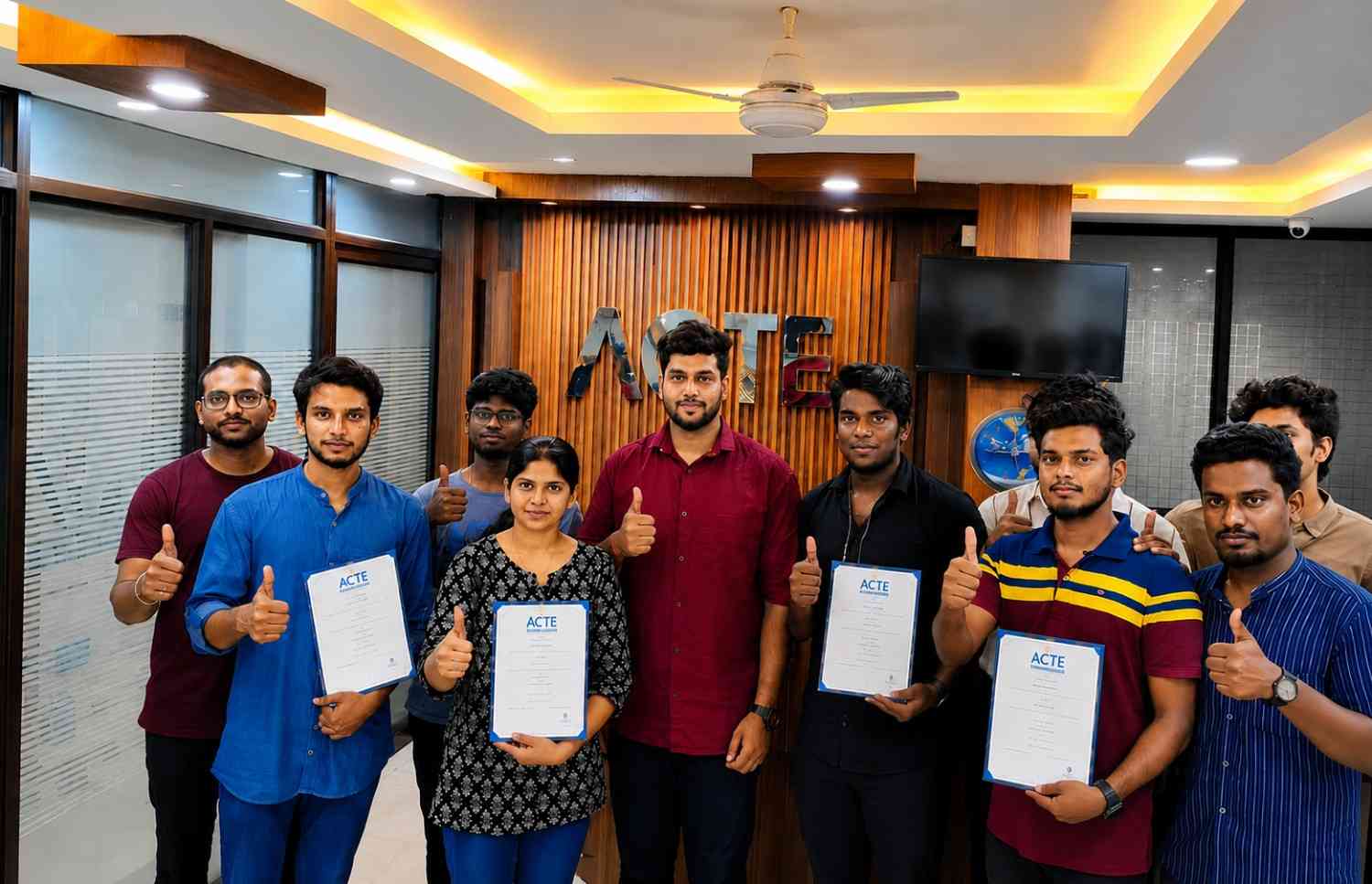
      Get Certified By Solaris & Industry Recognized ACTE Certificate

      Acte Certification is Accredited by all major Global Companies around the world. We provide after completion of the theoretical and practical sessions to fresher's as well as corporate trainees. Our certification at Acte is accredited worldwide. It increases the value of your resume and you can attain leading job posts with the help of this certification in leading MNC's of the world. The certification is only provided after successful completion of our training and practical based projects.

      Complete Your Course

      a downloadable Certificate in PDF format, immediately available to you when you complete your Course

      Get Certified

      a physical version of your officially branded and security-marked Certificate.

      Get Certified

      About Experienced Solaris Trainer

      • Our Solaris Training in . Trainers are certified professionals with 7+ years of experience in their respective domain as well as they are currently working with Top MNCs.
      • As all Trainers are Solaris domain working professionals so they are having many live projects, trainers will use these projects during training sessions.
      • All our Trainers are working with companies such as Cognizant, Dell, Infosys, IBM, L&T InfoTech, TCS, HCL Technologies, etc.
      • Trainers are also help candidates to get placed in their respective company by Employee Referral / Internal Hiring process.
      • Our trainers are industry-experts and subject specialists who have mastered on running applications providing Best Solaris training to the students.
      • We have received various prestigious awards for Solaris Training in from recognized IT organizations.

      Authorized Partners

      ACTE TRAINING INSTITUTE PVT LTD is the unique Authorised Oracle Partner, Authorised Microsoft Partner, Authorised Pearson Vue Exam Center, Authorised PSI Exam Center, Authorised Partner Of AWS .
      Get Training Quote for Free

            Career Support

            Placement Assistance

            Exclusive access to ACTE Job portal

            Mock Interview Preparation

            1 on 1 Career Mentoring Sessions

            Career Oriented Sessions

            Resume & LinkedIn Profile Building

            We Offer High-Quality Training at The Lowest Prices.

            Affordable, Quality Training for Freshers to Launch IT Careers & Land Top Placements.

            What Makes ACTE Training Different?

            Feature

            ACTE Technologies

            Other Institutes

            Affordable Fees

            Competitive Pricing With Flexible Payment Options.

            Higher Fees With Limited Payment Options.

            Industry Experts

            Well Experienced Trainer From a Relevant Field With Practical Training

            Theoretical Class With Limited Practical

            Updated Syllabus

            Updated and Industry-relevant Course Curriculum With Hands-on Learning.

            Outdated Curriculum With Limited Practical Training.

            Hands-on projects

            Real-world Projects With Live Case Studies and Collaboration With Companies.

            Basic Projects With Limited Real-world Application.

            Certification

            Industry-recognized Certifications With Global Validity.

            Basic Certifications With Limited Recognition.

            Placement Support

            Strong Placement Support With Tie-ups With Top Companies and Mock Interviews.

            Basic Placement Support

            Industry Partnerships

            Strong Ties With Top Tech Companies for Internships and Placements

            No Partnerships, Limited Opportunities

            Batch Size

            Small Batch Sizes for Personalized Attention.

            Large Batch Sizes With Limited Individual Focus.

            LMS Features

            Lifetime Access Course video Materials in LMS, Online Interview Practice, upload resumes in Placement Portal.

            No LMS Features or Perks.

            Training Support

            Dedicated Mentors, 24/7 Doubt Resolution, and Personalized Guidance.

            Limited Mentor Support and No After-hours Assistance.

            Solaris Course FAQs

            Looking for better Discount Price?

            Call now: +91-7669 100 251 and know the exciting offers available for you!
            • ACTE is the Legend in offering placement to the students. Please visit our Placed Students List on our website
            • We have strong relationship with over 700+ Top MNCs like SAP, Oracle, Amazon, HCL, Wipro, Dell, Accenture, Google, CTS, TCS, IBM etc.
            • More than 3500+ students placed in last year in India & Globally
            • ACTE conducts development sessions including mock interviews, presentation skills to prepare students to face a challenging interview situation with ease.
            • 85% percent placement record
            • Our Placement Cell support you till you get placed in better MNC
            • Please Visit Your Student Portal | Here FREE Lifetime Online Student Portal help you to access the Job Openings, Study Materials, Videos, Recorded Section & Top MNC interview Questions
              ACTE Gives Certificate For Completing A Course
            • Certification is Accredited by all major Global Companies
            • ACTE is the unique Authorized Oracle Partner, Authorized Microsoft Partner, Authorized Pearson Vue Exam Center, Authorized PSI Exam Center, Authorized Partner Of AWS
            • The entire Solaris training has been built around Real Time Implementation
            • You Get Hands-on Experience with Industry Projects, Hackathons & lab sessions which will help you to Build your Project Portfolio
            • GitHub repository and Showcase to Recruiters in Interviews & Get Placed
            All the instructors at ACTE are practitioners from the Industry with minimum 9-12 yrs of relevant IT experience. They are subject matter experts and are trained by ACTE for providing an awesome learning experience.
            No worries. ACTE assure that no one misses single lectures topics. We will reschedule the classes as per your convenience within the stipulated course duration with all such possibilities. If required you can even attend that topic with any other batches.
            We offer this course in “Class Room, One to One Training, Fast Track, Customized Training & Online Training” mode. Through this way you won’t mess anything in your real-life schedule.

            Why Should I Learn Solaris Course At ACTE?

            • Solaris Course in ACTE is designed & conducted by Solaris experts with 10+ years of experience in the Solaris domain
            • Only institution in India with the right blend of theory & practical sessions
            • In-depth Course coverage for 60+ Hours
            • More than 50,000+ students trust ACTE
            • Affordable fees keeping students and IT working professionals in mind
            • Course timings designed to suit working professionals and students
            • Interview tips and training
            • Resume building support
            • Real-time projects and case studies
            Yes We Provide Lifetime Access for Student’s Portal Study Materials, Videos & Top MNC Interview Question.
            You will receive ACTE globally recognized course completion certification Along with project experience, job support, and lifetime resources.
            We have been in the training field for close to a decade now. We set up our operations in the year 2009 by a group of IT veterans to offer world class IT training & we have trained over 50,000+ aspirants to well-employed IT professionals in various IT companies.
            We at ACTE believe in giving individual attention to students so that they will be in a position to clarify all the doubts that arise in complex and difficult topics. Therefore, we restrict the size of each Solaris batch to 5 or 6 members
            Our courseware is designed to give a hands-on approach to the students in Solaris . The course is made up of theoretical classes that teach the basics of each module followed by high-intensity practical sessions reflecting the current challenges and needs of the industry that will demand the students’ time and commitment.
            You can contact our support number at +91 76691 00251 / Directly can do by ACTE.in's E-commerce payment system Login or directly walk-in to one of the ACTE branches in India
            Show More

            Job Opportunities in Sun solaris

            More than 35% of Coporates prefer Sun solaris, recognizing it as the most popular and sought-after programming tool in the tech industry.