LMS

Last updated on 02nd Oct 2026| 4696

AI And Machine Learning Are Becoming Important Technologies Across Modern IT And Business Applications. Infosys Provides Opportunities For Freshers To Work With Artificial Intelligence, Machine Learning, Data Analytics, Automation, And Emerging Technologies. AI/ML Engineer Interviews Generally Evaluate Knowledge Of Python, Statistics, Machine Learning Algorithms, Deep Learning, Data Preprocessing, And Model Evaluation. Candidates May Also Be Asked About Real-Time AI/ML Projects, Problem-Solving Approaches, And Practical Model Development. Understanding Concepts Such As Supervised Learning, Unsupervised Learning, Neural Networks, NLP, Generative AI, And MLOps Can Help Candidates Prepare Effectively. This Collection Of 35+ Real-Time AI/ML Engineer Interview Questions For Freshers At Infosys Covers Technical Concepts And Practical Topics To Support Focused Interview Preparation.
1. What Is Artificial Intelligence?
Ans:
Artificial Intelligence Is A Technology That Enables Machines To Perform Tasks That Normally Require Human Intelligence. It Includes Learning, Reasoning, Problem-Solving, Decision-Making, And Language Understanding. AI Systems Can Analyze Data And Identify Patterns To Produce Useful Results. It Is Commonly Used In Automation, Recommendation Systems, Chatbots, And Predictive Applications.
2. What Is Machine Learning?
Ans:
- Machine Learning Is A Branch Of Artificial Intelligence That Enables Systems To Learn Patterns From Data Without Being Explicitly Programmed For Every Task.
- Models Are Trained Using Historical Data To Make Predictions Or Decisions.
- Machine Learning Includes Supervised, Unsupervised, And Reinforcement Learning. It Is Widely Used In Classification, Regression, Recommendation, And Forecasting Applications.
3. What Is The Difference Between AI And ML?
Ans:
| Aspect | AI | ML |
|---|---|---|
| Definition | AI Is The Broader Concept Of Creating Machines That Perform Intelligent Tasks. | ML Is A Subfield Of AI That Enables Systems To Learn From Data. |
| Approach | AI Can Use Rules, Logic, Knowledge, Learning, And Reasoning. | ML Primarily Uses Data And Algorithms To Identify Patterns. |
| Examples | Chatbots, Expert Systems, Robotics, And Autonomous Systems. | Classification, Regression, Recommendation, And Prediction Models |
4. What Is Supervised Learning?
Ans:
Supervised Learning Is A Machine Learning Approach Where A Model Is Trained Using Labeled Data. Each Training Example Contains Input Features Along With The Expected Output. The Model Learns The Relationship Between Inputs And Outputs To Make Predictions On New Data. Classification And Regression Are The Two Common Types Of Supervised Learning.on.
5. What Is Unsupervised Learning?
Ans:
Unsupervised Learning Uses Data That Does Not Have Predefined Output Labels. The Algorithm Attempts To Discover Hidden Patterns, Groups, Or Relationships Within The Dataset. Clustering And Dimensionality Reduction Are Common Unsupervised Learning Techniques. It Is Useful For Customer Segmentation, Anomaly Detection, And Exploratory Data Analysis.
6. What Is Reinforcement Learning?
Ans:
Reinforcement Learning Is A Machine Learning Technique Where An Agent Learns By Interacting With An Environment. The Agent Receives Rewards For Good Actions And Penalties For Unfavorable Actions. Over Time, It Learns A Strategy That Attempts To Maximize The Total Reward. It Is Commonly Used In Robotics, Games, Optimization, And Autonomous Systems.
7. What Is Classification In Machine Learning?
Ans:
- Classification Is A Supervised Learning Technique Used To Predict Discrete Categories Or Classes.
- The Model Learns From Labeled Examples And Assigns New Data To One Of The Available Classes.
- Algorithms Such As Logistic Regression, Decision Trees, SVM, And Random Forest Can Perform Classification.
8. What Is Regression In Machine Learning?
Ans:
Regression Is A Supervised Learning Technique Used To Predict Continuous Numerical Values. The Model Learns The Relationship Between Input Variables And A Numerical Target Variable. Linear Regression, Decision Tree Regression, And Random Forest Regression Are Common Examples. Regression Can Be Used For Price Prediction, Sales Forecasting, And Demand Estimation.
9. What Is Overfitting?
Ans:
Overfitting Occurs When A Machine Learning Model Learns The Training Data Too Closely, Including Its Noise And Irregularities. Such A Model May Perform Very Well On Training Data But Poorly On Unseen Data. Regularization, Cross-Validation, Data Augmentation, And Simpler Models Can Help Reduce Overfitting. The Main Goal Is To Improve Generalization To New Data.
10. What Is Underfitting?
Ans:
Underfitting Occurs When A Model Is Too Simple To Capture Important Patterns In The Training Data. It Usually Results In Poor Performance On Both Training And Testing Datasets. Increasing Model Complexity, Adding Useful Features, Or Reducing Excessive Regularization Can Help Address Underfitting. Proper Feature Engineering And Model Selection Are Also Important.
11. What Is Cross-Validation?
Ans:
Cross-Validation Is A Technique Used To Evaluate How Well A Machine Learning Model Generalizes To Unseen Data. In K-Fold Cross-Validation, The Dataset Is Divided Into K Parts And The Model Is Trained And Tested Multiple Times. Each Part Is Used As Validation Data In One Iteration. The Results Are Combined To Provide A More Reliable Performance Estimate.
12. What Is Feature Engineering?
Ans:
Feature Engineering Is The Process Of Creating, Transforming, Or Selecting Input Variables To Improve Machine Learning Performance. It Can Include Encoding Categorical Values, Scaling Numerical Features, Extracting Dates, And Creating Derived Variables. Good Features Can Help Models Identify Important Patterns More Effectively. Feature Engineering Is Especially Important When Raw Data Does Not Directly Represent Useful Information.
13. What Is Feature Scaling
Ans:
Feature Scaling Is The Process Of Bringing Numerical Features To Comparable Ranges. It Prevents Features With Large Numerical Values From Unnecessarily Dominating Certain Algorithms. Standardization And Normalization Are Common Scaling Methods. Scaling Is Particularly Important For Algorithms Such As KNN, SVM, K-Means, And Neural Networks.
14. What Is Normalization?
Ans:
- Normalization Is A Feature Scaling Technique That Usually Transforms Values Into A Specific Range, Commonly Between Zero And One.
- It Can Be Useful When Features Have Different Units Or Magnitudes. Min-Max Scaling Is A Common Normalization Method.
- It Is Often Applied Before Algorithms That Depend On Distance Or Feature Magnitude.
15. What Is Standardization?
Ans:
Standardization Transforms A Numerical Feature So That It Generally Has A Mean Of Zero And A Standard Deviation Of One. The Transformation Uses The Feature’s Mean And Standard Deviation. It Is Commonly Used With Algorithms Such As Logistic Regression, SVM, And K-Means. Standardization Can Improve Model Stability When Features Have Different Scales
16. What Is A Confusion Matrix?
Ans:
A Confusion Matrix Is A Table Used To Evaluate The Performance Of A Classification Model. It Contains True Positives, True Negatives, False Positives, And False Negatives. These Values Help Calculate Metrics Such As Accuracy, Precision, Recall, And F1-Score. A Confusion Matrix Is Especially Useful When Understanding Different Types Of Classification Errors.
17. What Is Precision?
Ans:
Precision Measures How Many Of The Samples Predicted As Positive Are Actually Positive. It Is Calculated As True Positives Divided By The Sum Of True Positives And False Positives. High Precision Means The Model Produces Fewer False Positive Predictions. Precision Is Important In Applications Such As Spam Filtering And Fraud Detection.
18. What Is Recall?
Ans:
Recall Measures How Many Actual Positive Samples Are Correctly Identified By The Model. It Is Calculated As True Positives Divided By The Sum Of True Positives And False Negatives. High Recall Means The Model Misses Fewer Actual Positive Cases. Recall Is Particularly Important In Medical Diagnosis And Safety-Critical Applications..
19. What Is F1-Score?
Ans:
F1-Score Is A Classification Metric That Combines Precision And Recall Into A Single Measure. It Is Calculated As The Harmonic Mean Of Precision And Recall. F1-Score Is Useful When Both False Positives And False Negatives Are Important. It Can Be Especially Helpful When The Dataset Has Imbalanced Classes.
20. What Is A Decision Tree?
Ans:
A Decision Tree Is A Supervised Machine Learning Algorithm That Makes Predictions Using A Tree-Like Structure. Internal Nodes Represent Feature-Based Decisions, Branches Represent Outcomes, And Leaf Nodes Represent Predictions. Decision Trees Can Be Used For Both Classification And Regression. They Are Easy To Understand But Can Overfit If The Tree Becomes Too Complex.
21. What Is Random Forest?
Ans:
Random Forest Is An Ensemble Machine Learning Algorithm That Combines Multiple Decision Trees. Each Tree Is Trained Using Randomized Data And Feature Selection, Which Helps Reduce Overfitting. The Final Prediction Is Produced By Combining The Predictions Of Individual Trees. Random Forest Is Commonly Used For Classification, Regression, Feature Importance, And Anomaly Detection.
22. What Is Support Vector Machine?
Ans:
- Support Vector Machine Is A Supervised Learning Algorithm Used Mainly For Classification And Also For Regression.
- It Attempts To Find An Optimal Boundary That Separates Different Classes. The Algorithm Can Use Kernel Functions To Handle Non-Linear Relationships.
- SVM Works Well For Certain High-Dimensional Datasets But Can Become Computationally Expensive With Large Datasets.
23. What Is K-Means Clustering?
Ans:
K-Means Is An Unsupervised Learning Algorithm Used To Divide Data Into A Predefined Number Of Clusters. It Assigns Data Points To The Nearest Cluster Center And Repeatedly Updates Those Centers. The Process Continues Until The Cluster Assignments Stabilize. K-Means Is Commonly Used For Customer Segmentation And Pattern Discovery.
24. What Is PCA?
Ans:
Principal Component Analysis Is A Dimensionality Reduction Technique Used To Represent High-Dimensional Data With Fewer Variables. It Creates New Components That Capture As Much Variance In The Original Data As Possible. PCA Can Reduce Computational Complexity And Remove Some Redundancy. It Is Often Used For Visualization, Feature Reduction, And Preprocessing..
25. What Is Deep Learning?
Ans:
Deep Learning Is A Subfield Of Machine Learning That Uses Multi-Layer Neural Networks To Learn Complex Patterns From Data. Deep Learning Models Can Automatically Learn Representations From Images, Text, Audio, And Other Data Types. Convolutional Neural Networks And Transformer Models Are Common Deep Learning Architectures. Deep Learning Is Widely Used In Computer Vision, NLP, Speech, And Generative AI.
26. What Is A Neural Network?
Ans:
Dimensionality Reduction Reduces The Number Of Features In A Dataset. It Helps Simplify Models And Improve Performance. Reducing Dimensions Can Lower Computational Costs. It Also Helps Remove Noise And Redundancy. Common Techniques Include PCA And t-SNE. Visualization Becomes Easier With Fewer Dimensions. It Improves Training Efficiency. It Is Valuable For Large Datasets.
27. What Is A CNN?
Ans:
- A Convolutional Neural Network Is A Deep Learning Architecture Commonly Used For Processing Image And Spatial Data.
- CNNs Use Convolutional Filters To Detect Features Such As Edges, Shapes, And Textures. Pooling Layers Can Reduce Spatial Dimensions And Computational Requirements.
- CNNs Are Commonly Used In Image Classification, Object Detection, And Facial Recognition.
28. What Is NLP?
Ans:
Natural Language Processing Is A Field Of AI That Enables Computers To Understand, Process, And Generate Human Language. NLP Techniques Can Be Used For Text Classification, Sentiment Analysis, Translation, Summarization, And Question Answering. Modern NLP Applications Frequently Use Transformer-Based Models. NLP Helps Businesses Automate Large-Scale Text And Communication Tasks.
29. What Is Generative AI?
Ans:
Generative AI Refers To AI Systems That Can Create New Content Based On Patterns Learned From Training Data. It Can Generate Text, Images, Audio, Video, Code, And Other Forms Of Content. Large Language Models Are A Major Example Of Generative AI. Is Used In Chatbots, Content Creation, Coding Assistance, Search, And Enterprise Automation.
30. What Is A Large Language Model?
Ans:
A Large Language Model Is An AI Model Trained On Large Amounts Of Text Data To Understand And Generate Human-Like Language. LLMs Learn Statistical Patterns And Relationships Between Tokens During Training. Transformer Architectures Are Commonly Used To Build Modern LLMs. They Can Support Tasks Such As Question Answering, Summarization, Translation, And Code Generation.
31. What Is RAG In Generative AI?
Ans:
Retrieval-Augmented Generation Combines Information Retrieval With Generative AI. A RAG System Retrieves Relevant Information From External Sources And Provides That Information To A Language Model As Context. This Can Help Generate More Relevant And Grounded Responses. RAG Is Useful For Enterprise Knowledge Bases, Documentation Search, Customer Support, And Question Answering.
32. What Is Fine-Tuning?
Ans:
Fine-Tuning Is The Process Of Further Training A Pretrained Machine Learning Or AI Model On A Specific Dataset Or Task. It Helps Adapt The Model To Domain-Specific Requirements And Examples. Fine-Tuning Can Improve Performance For Specialized Classification, Generation, Or Instruction-Following Tasks. The Training Data And Configuration Must Be Carefully Managed To Avoid Overfitting.
33. What Is Model Deployment?
Ans:
Model Deployment Is The Process Of Making A Trained Machine Learning Model Available For Real-World Use. The Model Can Be Exposed Through An API, Application, Cloud Service, Or Embedded System. Deployment Also Requires Monitoring, Versioning, Security, And Performance Management. A Successful Deployment Ensures That Predictions Are Reliable And Available To End Users
34. What Is MLOps?
Ans:
MLOps Combines Machine Learning Development With Software Engineering And Operations Practices. It Covers Data Management, Model Training, Testing, Deployment, Monitoring, Version Control, And Model Maintenance. MLOps Helps Organizations Automate And Standardize The Machine Learning Lifecycle. It Also Helps Maintain Model Reliability As Data And Business Requirements Change.
35. What Is Model Monitoring?
Ans:
- Model Monitoring Is The Process Of Tracking A Machine Learning Model After Deployment. It Can Monitor Prediction Quality, Latency, Errors, Data Changes, And Resource Usage.
- Monitoring Can Help Identify Problems Such As Data Drift And Model Performance Degradation.
- Regular Monitoring Allows Teams To Retrain Or Update Models When Necessary.
36. What Is Data Preprocessing?
Ans:
Data Preprocessing Is The Process Of Preparing Raw Data Before Feeding It Into A Machine Learning Model. It Can Include Handling Missing Values, Removing Duplicates, Encoding Categories, Scaling Features, And Treating Outliers. Proper Preprocessing Improves Data Quality And Can Improve Model Performance. The Steps Depend On The Dataset, Algorithm, And Business Objective..
37. How Does Handle Missing Values?
Ans:
Missing Values Can Be Handled Using Techniques Such As Removing Rows, Removing Columns, Or Imputing Appropriate Values. Numerical Values Can Often Be Replaced Using Mean, Median, Or Model-Based Methods. Categorical Values Can Be Replaced Using The Mode Or A Separate Category. The Best Approach Depends On The Amount Of Missing Data And Its Meaning Within The Dataset.
38. What Is Data Leakage?
Ans:
- Data Leakage Occurs When Information That Should Not Be Available During Training Is Accidentally Used By The Model.
- This Can Cause Artificially High Evaluation Performance But Poor Real-World Results. Leakage Can Happen Through Incorrect Feature Engineering, Data Splitting, Or Target-Related Information.
- Preventing Leakage Requires Careful Separation Of Training And Testing Information.
39. What Is Imbalanced Data?
Ans:
Imbalanced Data Occurs When Some Classes Have Significantly More Samples Than Other Classes. A Model Trained On Such Data May Favor The Majority Class And Perform Poorly On Minority Classes. Techniques Such As Oversampling, Undersampling, SMOTE, And Class Weights Can Help Address The Problem. Precision, Recall, F1-Score, And ROC-AUC Can Provide Better Evaluation Than Accuracy Alone.
40. What Is SMOTE?
Ans:
SMOTE Stands For Synthetic Minority Over-Sampling Technique And Is Used To Handle Imbalanced Datasets. It Creates Synthetic Examples For Minority Classes Instead Of Simply Duplicating Existing Samples. The New Samples Are Generated By Using Relationships Between Existing Minority-Class Observations. SMOTE Can Help Improve Model Learning When The Minority Class Has Too Few Training Examples..
41. What Is Bias In Machine Learning?
Ans:
Bias Refers To The Error Introduced When A Model Makes Oversimplified Assumptions About The Relationship Between Features And The Target. A High-Bias Model May Be Unable To Capture Important Patterns In The Data. This Can Lead To Underfitting And Poor Performance On Both Training And Testing Data. Choosing A Suitable Model Complexity Can Help Reduce Excessive Bias.

42. What Is Variance In Machine Learning?
Ans:
Variance Represents How Much A Model’s Predictions Change When It Is Trained On Different Training Data. A High-Variance Model Can Learn Noise And Small Details From The Training Dataset. This Often Leads To Overfitting And Poor Generalization On New Data. Regularization, More Training Data, And Ensemble Methods Can Help Reduce Variance..
43. What Is The Bias-Variance Tradeoff?
Ans:
- The Bias-Variance Tradeoff Describes The Balance Between A Model Being Too Simple And Too Sensitive To Training Data.
- High Bias Can Cause Underfitting, While High Variance Can Cause Overfitting. A Good Machine Learning Model Attempts To Find An Appropriate Balance Between These Two Sources Of Error.
- Cross-Validation And Model Evaluation Help Identify A Suitable Level Of Complexity.
44. What Is Hyperparameter Tuning?
Ans:
Hyperparameter Tuning Is The Process Of Finding Suitable Configuration Values For A Machine Learning Algorithm. Examples Include Learning Rate, Tree Depth, Number Of Estimators, And Regularization Strength. Techniques Such As Grid Search, Random Search, And Bayesian Optimization Can Be Used. Proper Tuning Can Improve Model Performance Without Changing The Fundamental Algorithm.
45. What Is Grid Search?
Ans:
Grid Search Is A Hyperparameter Optimization Technique That Tests Different Combinations Of Predefined Parameter Values. Each Combination Is Evaluated Using A Selected Performance Metric. The Combination Producing The Best Validation Performance Is Usually Selected. Grid Search Can Be Effective But May Become Computationally Expensive When Many Parameters Are Included.
46. What Is Random Search?
Ans:
Random Search Selects Random Combinations Of Hyperparameter Values From Defined Search Spaces. It Can Explore A Large Parameter Space More Efficiently Than Exhaustively Testing Every Combination. Random Search Is Particularly Useful When Only A Few Hyperparameters Have A Strong Impact On Model Performance. It Is Commonly Combined With Cross-Validation For Reliable Evaluation.
47. What Is Gradient Descent?
Ans:
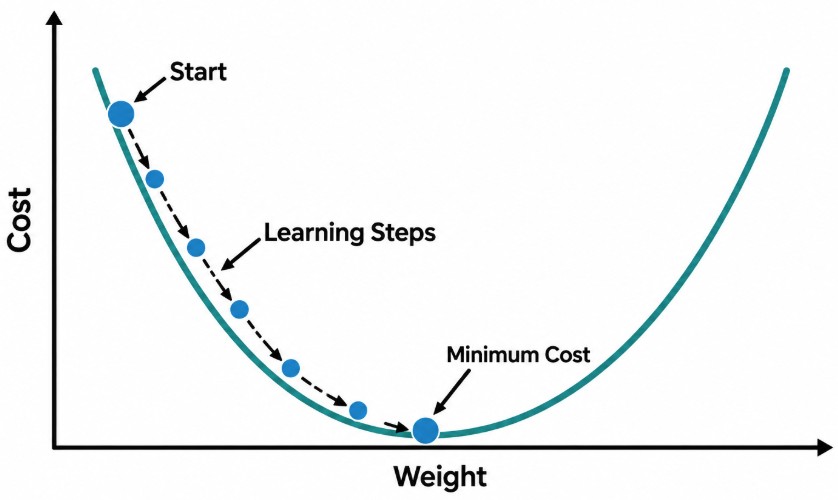
Gradient Descent Is An Optimization Algorithm Used To Minimize A Model’s Loss Function. It Calculates The Direction In Which The Loss Changes And Updates Model Parameters Accordingly. The Learning Rate Controls The Size Of Each Parameter Update. Gradient Descent Is Widely Used To Train Linear Models And Neural Networks.
48. What Is Learning Rate?
Ans:
- Learning Rate Is A Hyperparameter That Controls How Much A Model’s Parameters Are Updated During Training.
- A Very Large Learning Rate Can Cause Training To Overshoot The Optimal Solution.
- A Very Small Learning Rate Can Make Training Extremely Slow. Choosing An Appropriate Learning Rate Is Important For Efficient And Stable Model Trainin
49. What Is An Epoch In Deep Learning?
Ans:
- An Epoch Represents One Complete Pass Through The Entire Training Dataset During Model Training.
- A Neural Network Usually Requires Multiple Epochs To Learn Useful Patterns From The Data.
- Too Few Epochs May Result In Underfitting, While Too Many Can Cause Overfitting. Validation Performance Can Be Used To Determine When Training Should Stop.
50. What Is Batch Size?
Ans:
Batch Size Represents The Number Of Training Samples Processed Before The Model Updates Its Parameters. Smaller Batches Can Provide More Frequent Updates And May Require Less Memory. Larger Batches Can Improve Computational Efficiency But May Require More Memory. The Appropriate Batch Size Depends On The Dataset, Model Architecture, Hardware, And Training Requirements.
51. What Is A Vector Database?
Ans:
A Vector Database Stores High-Dimensional Embeddings Efficiently. It Enables Fast Similarity Searches. Vector Databases Are Important In Generative AI Systems. They Support Semantic Search Applications. Embeddings Represent Text, Images, Or Audio Data. The Database Finds Closely Related Vectors Quickly. It Improves Information Retrieval Performance. Vector Databases Are Common In RAG Systems.
52. What Is An Activation Function?
Ans:
An Activation Function Determines The Output Of A Neural Network Node Based On Its Input. It Introduces Non-Linearity, Allowing Neural Networks To Learn Complex Relationships. Common Activation Functions Include ReLU, Sigmoid, And Tanh. The Choice Of Activation Function Can Affect Training Speed, Stability, And Model Performance.
53. What Is ReLU?
Ans:
- ReLU Stands For Rectified Linear Unit And Is A Common Activation Function In Deep Neural Networks.
- It Returns The Input Value When The Input Is Positive And Zero When The Input Is Negative. ReLU Is Computationally Simple And Helps Neural Networks Learn Non-Linear Patterns.
- However, Some Neurons Can Become Permanently Inactive When They Consistently Receive Negative Inputs.
54. What Is Dropout?
Ans:
Dropout Is A Regularization Technique Used In Neural Networks To Reduce Overfitting. During Training, Randomly Selected Neurons Are Temporarily Ignored In Each Training Step. This Encourages The Network To Learn More Robust Representations Instead Of Depending Too Heavily On Particular Neurons. Dropout Is Normally Disabled During Model Evaluation And Prediction.
55. What Is Batch Normalization?
Ans:
Batch Normalization Is A Technique Used To Normalize Intermediate Activations During Neural Network Training. It Can Help Make Training More Stable And Sometimes Allows Models To Converge Faster. Batch Normalization Can Also Provide A Regularization Effect In Some Situations. It Is Commonly Used In Deep Learning Architectures Such As CNNs.
56. What Is Transfer Learning?
Ans:
Transfer Learning Uses Knowledge Learned By A Model On One Task Or Dataset To Improve Performance On Another Related Task. A Pretrained Model Can Be Adapted To A New Dataset Instead Of Training Everything From Scratch. This Can Reduce Training Time And Data Requirements. Transfer Learning Is Widely Used In Computer Vision And Natural Language Processing.
57. Write A Program To Calculate The Factorial Of A Number.
Ans:
This Program Calculates The Factorial Of A Number Using A Loop. A Factorial Is The Product Of All Positive Integers Up To The Given Number.
- num = 5
- fact = 1
- for i in range(1, num + 1):
- fact *= i
- print(fact)
58. What Are Word Embeddings?
Ans:
Word Embeddings Are Numerical Representations Of Words Or Tokens In A Continuous Vector Space. They Capture Semantic And Linguistic Relationships Between Words. Similar Words Can Have Similar Vector Representations Based On Their Contexts. Embeddings Are Widely Used In Search, Recommendation Systems, NLP, And Retrieval-Augmented Generation.
59. What Is A Transformer Model?
Ans:
A Transformer Is A Neural Network Architecture Designed To Process Sequential And Contextual Information Efficiently. It Uses Attention Mechanisms Instead Of Relying Only On Traditional Recurrent Processing. Transformers Form The Foundation Of Many Modern NLP And Generative AI Models. They Are Used For Translation, Text Generation, Summarization, Question Answering, And Other AI Tasks.
60. What Is The Difference Between Overfitting And Underfitting?
Ans:
| Feature | Overfitting | Underfitting |
|---|---|---|
| Definition | Occurs When A Model Learns Training Data Too Closely, Including Noise And Irrelevant Patterns. | Occurs When A Model Fails To Learn Important Patterns From The Training Data. |
| Model Complexity | Usually Caused By An Overly Complex Model. | Usually Caused By An Overly Simple Model. |
| Training Accuracy | Very High Training Accuracy. | Low Training Accuracy. |
| Testing Accuracy | Low Testing Accuracy Due To Poor Generalization. | Low Testing Accuracy Because The Model Has Not Learned Enough. |
61. What Is Computer Vision?
Ans:
Computer Vision Is A Field Of AI That Enables Computers To Understand And Analyze Visual Information. It Uses Techniques From Image Processing, Machine Learning, And Deep Learning To Extract Meaning From Images And Videos. Applications Include Image Classification, Object Detection, Face Recognition, And Medical Image Analysis. CNNs And Vision Transformers Are Commonly Used In Computer Vision.

Get JOB Oriented AI Course By MNC Experts
- Instructor-led Sessions
- Real-life Case Studies
- Assignments
62. What Is Object Detection?
Ans:
Object Detection Is A Computer Vision Task That Identifies Objects In An Image And Determines Their Locations. The Output Usually Includes Object Classes Along With Bounding Boxes Around Detected Objects. Models Such As YOLO, Faster R-CNN, And SSD Can Perform Object Detection. It Is Used In Autonomous Systems, Surveillance, Retail, And Industrial Automation.
63. What Is Image Classification?
Ans:
Image Classification Is The Process Of Assigning One Or More Categories To An Image. A Machine Learning Or Deep Learning Model Learns Visual Patterns From Labeled Training Images. CNNs And Vision Transformer Models Are Commonly Used For This Task. Applications Include Medical Diagnosis, Product Recognition, And Automated Quality Inspection.
64. What Is Data Augmentation?
Ans:
Data Augmentation Creates Additional Training Examples By Applying Transformations To Existing Data. For Images, Transformations Can Include Rotation, Cropping, Flipping, And Scaling. For Text, Appropriate Techniques Can Include Paraphrasing Or Controlled Text Transformations. Data Augmentation Can Improve Generalization And Reduce Overfitting When Training Data Is Limited.
65. What Is Anomaly Detection?
Ans:
Pandas Is A Python Library Used For Data Manipulation And Analysis. It Provides DataFrames For Structured Data Handling. Missing Values Can Be Managed Easily. Pandas Supports Filtering And Aggregation Operations. It Simplifies Data Cleaning Tasks. Integration With Other Libraries Is Strong. Analysts Use It Extensively. Pandas Is A Core Tool In Data Science.
66. What Is A Recommendation System?
Ans:
A Recommendation System Predicts Items Or Content That May Be Relevant To A User. It Can Use User Behavior, Item Characteristics, Ratings, Or A Combination Of These Signals. Collaborative Filtering And Content-Based Filtering Are Common Approaches. Recommendation Systems Are Widely Used In E-Commerce, Streaming Platforms, Advertising, And Content Applications.
67. What Is Collaborative Filtering?
Ans:
Collaborative Filtering Generates Recommendations By Using Interaction Patterns Between Users And Items. It Can Identify Users With Similar Preferences And Recommend Items Based On Their Previous Behavior. It Does Not Necessarily Require Detailed Information About The Items. However, Cold-Start And Sparse Interaction Data Can Create Challenges.
68. What Is AUC-ROC?
Ans:
- AUC-ROC Is A Metric Used To Evaluate Binary Classification Models Across Different Classification Thresholds.
- The ROC Curve Represents The Relationship Between True Positive Rate And False Positive Rate. AUC Represents The Area Under This Curve And Provides A General Measure Of Ranking Performance.
- A Higher AUC Generally Indicates Better Ability To Distinguish Between Classes.
69. What Is Mean Squared Error?
Ans:
Mean Squared Error Is A Common Evaluation Metric For Regression Models. It Calculates The Average Of The Squared Differences Between Actual And Predicted Values. Squaring The Errors Gives Greater Weight To Larger Prediction Errors. Lower MSE Generally Indicates Better Prediction Performance On The Evaluation Dataset.
70. What Is Mean Absolute Error?
Ans:
Mean Absolute Error Measures The Average Absolute Difference Between Actual And Predicted Values. Unlike Mean Squared Error, It Does Not Square The Errors. This Makes MAE Easier To Interpret In The Same Units As The Target Variable. Lower MAE Indicates That Predictions Are, On Average, Closer To The Actual Values.
71. How Does Select A Machine Learning Algorithm?
Ans:
- Algorithm Selection Depends On The Problem Type, Dataset Size, Feature Characteristics, Interpretability Requirements, And Available Computing Resources.
- Classification Problems Can Use Algorithms Such As Logistic Regression, Decision Trees, SVM, Or Neural Networks.
- Regression And Clustering Problems Require Different Algorithm Choices. Model Performance Should Be Compared Using Suitable Validation Metrics Before Final Selection.
72. How Does Build An AI/ML Project?
Ans:
An AI/ML Project Usually Begins By Defining The Business Problem And Identifying The Required Data. The Data Is Then Collected, Cleaned, Explored, And Prepared For Training. Suitable Features And Algorithms Are Selected, Followed By Model Training, Evaluation, And Hyperparameter Tuning. Finally, The Model Can Be Deployed, Monitored, And Improved Based On Real-World Performance.
73. How Does Handle Outliers?
Ans:
Outliers Are Extreme Observations That Differ Significantly From The Majority Of Data. They Can Be Identified Using Methods Such As IQR, Z-Score, Visualization, Or Domain-Specific Rules. Depending On The Context, Outliers Can Be Removed, Transformed, Capped, Or Retained. The Decision Should Consider Whether The Outlier Represents An Error Or A Meaningful Real-World Event.
74. What Is Exploratory Data Analysis?
Ans:
Exploratory Data Analysis Is The Process Of Understanding A Dataset Before Building A Machine Learning Model. It Includes Examining Distributions, Missing Values, Relationships, Outliers, Correlations, And Class Balance. Visualization And Statistical Summaries Are Commonly Used During EDA. Effective EDA Helps Identify Data Quality Problems And Supports Better Modeling Decisions.
75. What Is Correlation?
Ans:
Correlation Measures The Degree To Which Two Variables Move Together In A Statistical Relationship. Positive Correlation Means Variables Tend To Increase Together, While Negative Correlation Means One Tends To Increase When The Other Decreases. Correlation Does Not Automatically Mean That One Variable Causes Another. It Can Be Useful For Feature Analysis And Identifying Redundant Variables.
76. What Is Multicollinearity?
Ans:
Multicollinearity Occurs When Two Or More Input Features Are Highly Related To Each Other. It Can Make Some Statistical Models Difficult To Interpret And Can Increase The Instability Of Estimated Coefficients. Correlation Analysis And Variance Inflation Factor Can Help Identify Multicollinearity. Feature Removal, Transformation, Or Regularization Can Help Reduce Its Impact.
77. What Is A Confusion Matrix Used For In An AI Project?
Ans:
- A Confusion Matrix Helps Analyze How A Classification Model Performs Across Different Prediction Categories.
- It Shows Correct Predictions And Different Types Of Incorrect Predictions.
- From It, Metrics Such As Precision, Recall, And F1-Score Can Be Calculated
78. What Is Model Interpretability?
Ans:
Model Interpretability Refers To How Easily Humans Can Understand Why A Machine Learning Model Produces A Particular Prediction. Simple Models Such As Decision Trees And Linear Models Can Often Be Easier To Interpret. Complex Models Can Use Techniques Such As SHAP Or LIME To Explain Predictions. Interpretability Is Important In Areas Where Transparency And Trust Are Required..
79. What Is Explainable AI?
Ans:
Explainable AI Focuses On Making AI System Decisions Easier For Humans To Understand. It Helps Identify Which Features Or Inputs Contributed To A Model’s Prediction. Techniques Such As SHAP, LIME, Feature Importance, And Partial Dependence Can Support Explanations. Explainability Can Improve Trust, Debugging, Compliance, And Responsible AI Practices.
80. Write A Program To Count The Number Of Vowels In A String.
Ans:
This Program Counts The Number Of Vowels Present In A String. It Iterates Through Each Character And Checks Whether It Is A Vowel.
- text = “Artificial Intelligence”
- count = 0
- for ch in text.lower():
- if ch in “aeiou”:
- count += 1
- print(count)
81. What Is AI Bias?
Ans:
AI Bias Occurs When An AI System Produces Systematically Unfair Or Skewed Results For Certain Groups Or Situations. Bias Can Enter Through Training Data, Feature Selection, Labeling, Model Design, Or Deployment Practices. Identifying And Measuring Bias Is Important Before And After Deployment. Better Data, Fairness Evaluation, Monitoring, And Human Review Can Help Reduce Unwanted Bias.
82. What Is Model Drift?
Ans:
Model Drift Occurs When A Deployed Model’s Performance Changes Because The Data Or Underlying Patterns Have Changed Over Time. Data Drift Happens When Input Data Distributions Change, While Concept Drift Occurs When Relationships Between Inputs And Outputs Change. Continuous Monitoring Can Help Detect These Changes. Retraining Or Updating The Model May Be Required To Maintain Performance.
83. What Is Data Drift?
Ans:
- Data Drift Refers To A Change In The Statistical Distribution Of Input Data Between Training And Production Environments.
- For Example, Customer Behavior Or Product Usage Patterns May Change Over Time.
- Significant Drift Can Reduce Model Accuracy Even If The Model Itself Has Not Changed
84. What Is Cloud AI?
Ans:
Cloud AI Refers To Artificial Intelligence Services And Infrastructure Provided Through Cloud Computing Platforms. Cloud Providers Offer Services For Machine Learning Training, Model Deployment, Data Processing, AI APIs, And Generative AI. Cloud AI Allows Organizations To Scale Computing Resources Based On Demand. It Can Reduce The Need To Maintain All AI Infrastructure Locally.
85. How Can Python Be Used In AI/ML?
Ans:
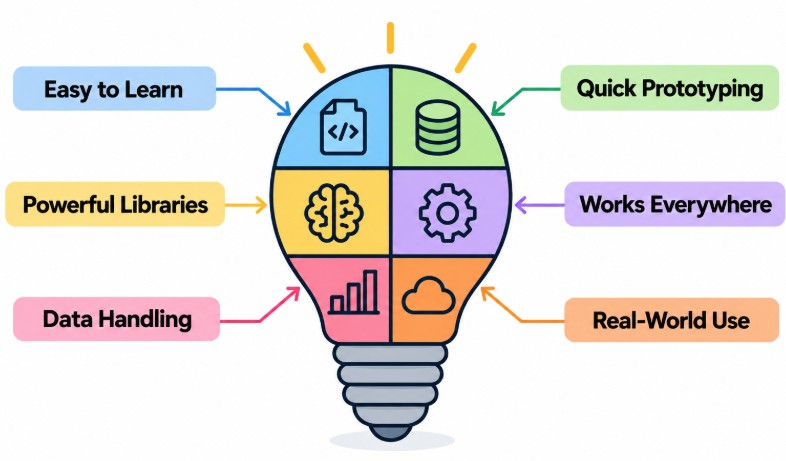
Python Is Widely Used In AI And Machine Learning Because It Provides A Large Ecosystem Of Libraries And Frameworks. Libraries Such As NumPy And Pandas Support Numerical Computing And Data Processing. Scikit-Learn Supports Traditional Machine Learning, While TensorFlow And PyTorch Support Deep Learning. Python Can Also Be Used For Data Visualization, Model Deployment, Automation, And AI Application Development.
86. What Is The Role Of SQL In AI/ML?
Ans:
SQL Is Used To Retrieve, Filter, Transform, And Analyze Structured Data Stored In Databases. AI/ML Engineers Often Use SQL To Prepare Training Datasets And Investigate Data Quality. Complex Queries Can Combine Data From Multiple Tables And Generate Useful Features. Strong SQL Knowledge Helps AI Engineers Work Effectively With Real-World Enterprise Data.
87. Explain An AI/ML Project In An Infosys Interview?
Ans:
An AI/ML Project Should Be Explained By Clearly Describing The Problem, Dataset, Objective, Approach, And Final Result. The Explanation Should Cover Data Preprocessing, Feature Engineering, Model Selection, Training, Evaluation, And Important Metrics. Challenges Faced During Development And The Steps Taken To Solve Them Should Also Be Discussed. A Clear Explanation Demonstrates Both Technical Knowledge And Practical Problem-Solving Ability.
88. How Does Improve The Performance Of A Machine Learning Model?
Ans:
Model Performance Can Be Improved By Understanding The Data And Identifying Problems Such As Missing Values, Outliers, Imbalanced Classes, And Poor Features. Feature Engineering, Algorithm Selection, Hyperparameter Tuning, And Cross-Validation Can Further Improve Results. Ensemble Methods Or Advanced Deep Learning Models Can Be Considered When Appropriate.
89. How Does Prepare For An AI/ML Engineer Interview At Infosys?
Ans:
Preparation Should Cover Python, SQL, Statistics, Machine Learning Algorithms, Deep Learning, NLP, And Basic Generative AI Concepts. Candidates Should Understand Important Metrics, Data Preprocessing, Model Evaluation, Feature Engineering, And Common ML Algorithms. Practical Projects Should Be Reviewed Carefully So That Dataset Choices, Algorithms, Results, And Challenges Can Be Explained Clearly. Coding Practice.
90. Write A Program To Find The Sum Of Elements In A List
Ans:
This Program Calculates The Sum Of All Elements In A List Using The Built-In Sum Function. The Function Adds Every Value And Returns The Total
- numbers = [10, 20, 30, 40]
- total = sum(numbers)
- print(total)