LMS
Last updated on 27th Oct 2026| 4820

Must-Prepare Agentic AI Interview Questions For Freshers helps candidates prepare for interviews covering the fundamentals, architecture, tools, and real-time applications of Agentic Artificial Intelligence. These questions explain how AI agents understand goals, plan tasks, make decisions, use external tools, and perform multi-step workflows with minimal human intervention. Key topics include Large Language Models (LLMs), AI agents, prompt engineering, memory management, reasoning, planning, Retrieval-Augmented Generation (RAG), and multi-agent systems. The preparation guide also covers popular frameworks such as LangChain, LangGraph, and AutoGen, along with Python programming, API integration, tool calling, and agent evaluation. Freshers can strengthen their technical knowledge, understand practical implementation scenarios, and build confidence for Agentic AI interviews at leading technology companies.
1. What Is Agentic AI?
Ans:
Agentic AI refers to artificial intelligence systems that can work toward defined goals by planning tasks, making decisions, and taking actions. These systems often use large language models to understand instructions and determine suitable next steps. They may interact with external tools, APIs, databases, and other software systems. Agentic AI can adapt its actions based on observations and task results. It is commonly used to automate complex workflows that require multiple steps.
2. What Is An AI Agent?
Ans:
An AI agent is a software system that observes its environment, processes information, and takes actions to achieve a goal. It can receive instructions, analyze available context, and select appropriate actions. Some agents use predefined rules, while others use machine learning or large language models. AI agents may access tools, retrieve information, and maintain memory across tasks. Their design depends on the task, environment, autonomy level, and safety requirements.
3. What Is The Difference Between Agentic AI And Generative AI?
Ans:
Generative AI primarily creates content such as text, images, code, and summaries in response to prompts. Agentic AI focuses on completing goals through planning, decision-making, and action execution. A generative AI model may answer a question, while an agentic system can research the question, retrieve information, and prepare a report. Agentic AI often uses generative models as one component of its architecture. Both approaches can be combined to build intelligent applications that generate content and perform tasks.
4. What Are The Main Components Of An AI Agent?
Ans:
The main components of an AI agent include a reasoning engine, task planner, memory, tools, and an execution mechanism. The reasoning engine interprets instructions and selects suitable actions. The planner divides a complex objective into smaller tasks. Memory stores relevant context, while tools enable interaction with external systems. An observation and feedback mechanism helps the agent evaluate results and decide what to do next.
5. How Does An Agentic AI System Work?
Ans:
- An Agentic AI system begins by receiving a goal or instruction from a user or another application.
- It analyzes the request and creates a plan containing one or more tasks. The system selects tools, performs actions, and observes the resulting information.
- Based on the feedback, it may revise the plan or continue with the next step. The process ends when the goal is achieved, a stopping condition is reached, or human intervention is required.
6. What Is The Role Of Large Language Models In Agentic AI?
Ans:
Large language models help AI agents understand natural-language instructions, reason about tasks, and generate plans or tool arguments. They can summarize retrieved information, interpret tool outputs, and produce user-friendly responses. An LLM may also decide which available tool is appropriate for a particular task. However, an LLM alone does not automatically provide reliable memory, unrestricted external access, or safe action execution. These capabilities require supporting components, permissions, and control mechanisms.
7. What Is Autonomous Decision-Making In Agentic AI?
Ans:
- Autonomous decision-making allows an AI agent to select actions toward a goal without requiring human approval at every step.
- The agent evaluates the available context, possible actions, and expected outcomes before proceeding.
- Its autonomy can be limited by rules, permissions, confidence thresholds, and predefined boundaries.
8. What Is Task Planning In Agentic AI?
Ans:
Task planning is the process of converting a high-level objective into a sequence of manageable actions. For example, an agent asked to prepare a market report may gather information, organize the data, analyze trends, and draft a summary. Each task should have a clear purpose and an identifiable result. The plan may change when new information becomes available or an action fails. Good task planning improves efficiency, reduces unnecessary tool calls, and makes agent behavior easier to evaluate.
9. What Is Tool Calling In Agentic AI?
Ans:
Tool calling allows an AI agent to request actions from external functions, APIs, databases, or applications. The model identifies a suitable tool and provides arguments in a predefined format. The application validates the request, executes the tool, and returns the result to the model. The agent then uses that result to continue its workflow or respond to the user. Tool permissions, input validation, error handling, and access controls are essential for safe tool calling.
10. What Is The Difference Between An AI Agent And A Traditional Chatbot?
Ans:
| Aspect | AI Agent | Traditional Chatbot |
|---|---|---|
| Definition | An AI Agent Can Understand Goals, Make Decisions, And Perform Actions To Complete Tasks. | A Traditional Chatbot Primarily Responds To User Queries Using Predefined Rules Or Scripted Responses. |
| Purpose | Designed To Solve Problems, Complete Tasks, And Achieve Specific Goals With Varying Levels Of Autonomy. | Designed To Answer Questions And Handle Common Conversations Or Frequently Asked Questions. |
| Capabilities | Can Plan Steps, Use Tools, Retrieve Information, And Interact With External Systems When Properly Configured. | Typically Follows Predefined Conversation Flows And Has Limited Ability To Perform Actions Beyond Its Design. |
| Focus | Focuses On Goal Achievement, Decision-Making, And Task Execution With Appropriate Oversight. | Focuses On Responding To User Messages And Providing Information Within Defined Conversation Boundaries. |
11. What Is The Difference Between Agentic AI And Traditional AI?
Ans:
Traditional AI often performs specific tasks such as classification, prediction, recommendation, or pattern recognition. Agentic AI focuses on achieving goals by combining reasoning, planning, and action execution. Traditional AI may predict customer demand, while an agentic system could analyze demand, retrieve inventory information, and recommend replenishment actions. Agentic systems can combine multiple AI models and software tools. The main distinction is goal-oriented action rather than prediction or content generation alone.
12. What Is The Observe-Think-Act Cycle?
Ans:
The Observe-Think-Act cycle describes how an agent gathers information, reasons about the current situation, and performs an action. Observation provides context from users, tools, or the environment. The thinking stage evaluates the information and determines an appropriate next step. The action stage executes the selected operation and produces a result. The agent can repeat the cycle until the task is completed or a stopping condition is reached.
13. What Is Memory In Agentic AI?
Ans:
Memory enables an AI agent to retain and retrieve information needed for its tasks. Short-term memory maintains current conversation context, intermediate results, and active task details. Long-term memory can preserve selected information across sessions when the system supports it. Memory may use databases, documents, vector stores, or structured records. Appropriate memory management improves continuity while reducing irrelevant context and privacy risks.
14. What Is Short-Term Memory In AI Agents?
Ans:
- Short-term memory stores information required during an active conversation or task. It may include user instructions, previous messages, intermediate calculations, and recent tool outputs.
- This information helps the agent maintain context across multiple reasoning steps. Short-term memory is often limited by the model’s context window or application configuration.
- Older or unnecessary details may be summarized or removed to control processing costs.
15. What Is Long-Term Memory In Agentic AI?
Ans:
Long-term memory stores useful information that may be needed across multiple sessions or future tasks. It can include approved user preferences, task history, knowledge records, and previously learned facts. Databases and vector stores can support persistent storage and retrieval. The agent retrieves relevant memories when they help complete a new request.
16. What Is The Role Of Reasoning In Agentic AI?
Ans:
Reasoning helps an AI agent interpret a goal, compare possible actions, and determine an appropriate course of action. It may involve breaking problems into smaller parts, evaluating constraints, and considering available evidence. Language models can provide reasoning capabilities, while external code or rule engines can handle specific calculations and validations.
17. What Is Prompt Engineering In Agentic AI?
Ans:
Prompt engineering involves designing instructions that guide an AI model toward useful and consistent outputs. Effective prompts define the agent’s role, objective, constraints, available tools, and expected response format. Clear instructions can reduce ambiguity and improve task execution. Structured prompts may also specify how to handle missing information or failed tool calls.
18. What Is A System Prompt?
Ans:
A system prompt provides high-level instructions that define an AI agent’s behavior, responsibilities, and constraints. It may specify the agent’s role, response style, tool usage rules, and safety requirements. For example, a customer support agent may be instructed to answer using approved company information. System prompts help establish consistent behavior across user requests.
19. What Is Context Management In Agentic AI?n?
Ans:
- Context management involves selecting and organizing the information an AI model needs to perform a task.
- Context may include user instructions, conversation history, retrieved documents, tool outputs, and current task status.
- Excessive context can increase costs and introduce irrelevant information. Summarization, selective retrieval, and context-window management help maintain efficiency.
20. What Is A Multi-Step Workflow In Agentic AI?
Ans:
A multi-step workflow consists of connected actions that collectively achieve a larger objective. An agent may first collect information, then analyze it, generate a draft, and validate the result. Each step can depend on the output of an earlier step. The workflow may follow a fixed sequence or adapt dynamically to new observations. Clear dependencies, checkpoints, error handling, and completion criteria help make multi-step workflows reliable..
21. What Is ReAct In Agentic AI?
Ans:
ReAct stands for Reasoning and Acting, a prompting approach that combines reasoning with actions and observations. An agent uses the available context to decide whether it needs an external tool or another step. It then observes the tool result and uses the new information to continue. This process is useful for tasks requiring external knowledge or multiple operations.
22. What Is Retrieval-Augmented Generation (RAG)?
Ans:
- Retrieval-Augmented Generation combines information retrieval with generative AI to produce responses grounded in external information.
- Relevant documents are retrieved from a knowledge source and provided to the language model as context.
- The model uses that context to formulate an answer, often with supporting references. RAG can improve access to current or domain-specific information without retraining the model for every document update
23. How Does RAG Support Agentic AI?
Ans:
RAG allows an AI agent to retrieve relevant knowledge before making decisions or generating responses. An agent can search company documents, retrieve policies, and use the results to complete a task. It may also refine a search when the initial results are incomplete. Retrieved information can help ground the agent’s actions in approved knowledge.
24. What Is The Difference Between RAG And Fine-Tuning?
Ans:
RAG supplies relevant external information to a model at inference time, while fine-tuning updates model parameters using additional training examples. RAG is useful when information changes frequently or must be traceable to documents. Fine-tuning can help adapt a model’s behavior, style, or performance on specific tasks. The approaches solve different problems and can be combined when appropriate.
25. What Is Function Calling In Large Language Models?
Ans:
Function calling enables a language model to request a predefined function using structured arguments. The application receives the request, validates its parameters, and executes the function if permitted. The function’s output is then returned to the model for further processing. This mechanism helps connect language models to calculators, search services, databases, and business applications.
26. What Are APIs, And Why Are They Important For AI Agent
Ans:
An API, or Application Programming Interface, allows software systems to communicate through defined requests and responses. AI agents use APIs to access services such as search engines, calendars, databases, and business applications. An API may retrieve information or perform an authorized operation
27. What Is The Role Of Python In Agentic AI?
Ans:
- Python is widely used to develop Agentic AI applications because it supports machine learning, API integration, data processing, and workflow automation.
- Libraries can connect language models to tools, vector databases, and external services. Python also helps developers implement task planners, memory systems, and evaluation pipelines.
- Its readable syntax makes experimentation and prototyping easier for beginners. Production applications still require testing, security controls, dependency management, and reliable deployment practices.
28. What Is LangChain?
Ans:
LangChain is a development framework that helps developers build applications powered by large language models. It provides components for prompts, model integration, retrieval, tool calling, and workflow construction. Developers can use these components to connect an AI model with external data sources and services. LangChain can support agentic applications, although the framework alone does not guarantee autonomous or reliable behavior
29. What Is LangGraph?
Ans:
LangGraph is a framework for building stateful, multi-step AI workflows and agents using graph-based execution. Nodes represent operations, while edges determine how control moves between them. It supports patterns such as conditional routing, persistent state, human approval, and recovery from interruptions. This structure is useful for applications that require more control than a simple linear chain.
30. What Is AutoGen In Agentic AI?
Ans:
AutoGen is a framework associated with building applications in which AI agents can collaborate and interact with tools or humans. Developers can define agents with different roles and communication patterns. For example, one agent may research a topic while another reviews the resulting information. Such collaboration can divide complex tasks into smaller responsibilities
31. What Is CrewAI?
Ans:
CrewAI is a framework designed to organize AI agents into role-based teams that work on assigned tasks. Developers can define agent roles, goals, tools, and task dependencies. A research agent might collect information while a writing agent prepares a report from the findings. This structure can make multi-agent workflows easier to organize and understand.
32. What Is A Multi-Agent System?
Ans:
A multi-agent system consists of two or more agents that interact to solve a problem or complete a workflow. Each agent may have a specialized role, tool set, or knowledge source. Agents can collaborate, delegate tasks, review results, or exchange messages. This architecture can help manage complex problems that benefit from specialization.
33. What Is The Difference Between Single-Agent And Multi-Agent Systems?
Ans:
A single-agent system uses one agent to manage a task, including its planning and tool interactions. A multi-agent system distributes work across several agents with potentially different responsibilities. Single-agent designs are often simpler to develop, monitor, and debug. Multi-agent designs may improve modularity when tasks naturally divide into independent specialties
34. What Is Agent Orchestration?
Ans:
Agent orchestration coordinates the tasks, tools, and interactions involved in an AI workflow. It determines which agent or component should act, when an action should occur, and how results move between steps. Orchestration may use sequential workflows, conditional routing, parallel execution, or supervisor-based coordination
35. What Is An Agent Supervisor?
Ans:
An agent supervisor coordinates the work of multiple specialized agents or components. It interprets the overall goal and assigns tasks to appropriate workers. The supervisor can examine intermediate results, request revisions, and decide when the workflow is complete. It may also enforce execution limits and escalate uncertain cases to a human
36. What Is Human-In-The-Loop AI?
Ans:
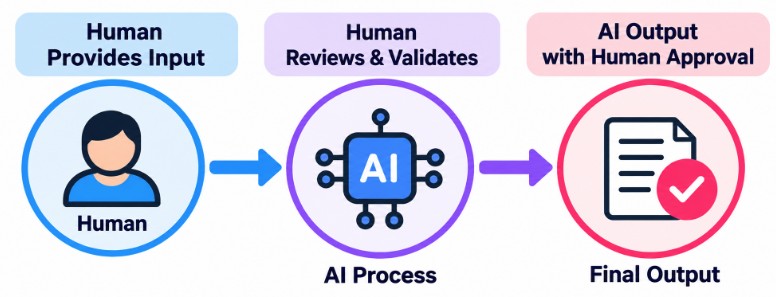
Human-in-the-loop AI includes human review or intervention in an AI system’s decision-making process. A human may approve sensitive actions, correct inaccurate outputs, or resolve ambiguous cases. For example, an agent could prepare a refund recommendation but require an authorized employee to approve the payment. This approach improves oversight and helps manage high-impact decisions.
37. Why Is Human Approval Important In Agentic AI?
Ans:
- Human approval is important when an agent’s actions could affect money, privacy, security, or important business decisions.
- It allows a qualified person to review the proposed action before execution. Approval checkpoints can also help catch incorrect assumptions, incomplete evidence, and unexpected consequences.
- Low-risk, reversible tasks may require less intervention than high-risk operations. The approval process should define who can authorize an action and how decisions are recorded.
38. What Is A Feedback Loop In Agentic AI?
Ans:
- A feedback loop allows an agent to use the results of its actions to guide subsequent decisions. The agent compares observed outcomes with the expected results and adjusts its next step.
- For example, an agent may revise a search query when the initial results are irrelevant. Feedback can come from tools, automated validators, environmental observations, or human reviewers.
- Reliable feedback should be measurable and trustworthy because incorrect feedback can reinforce poor decisions.
39. What Is Self-Reflection In AI Agents?
Ans:
Self-reflection is a technique in which an AI agent reviews its previous output or actions to identify possible errors and improvements. It may compare the result against task requirements or a checklist. The agent can then revise its response or repeat a step when appropriate. Reflection may improve quality for tasks that support clear verification.
40. What Is The Difference Between Planning And Reasoning?
Ans:
| Aspect | Planning | Reasoning |
|---|---|---|
| Definition | Planning Is The Process Of Defining Goals, Tasks, Resources, And Steps To Achieve An Objective. | Reasoning Is The Process Of Analyzing Information, Evaluating Options, And Drawing Logical Conclusions. |
| Purpose | Determines How To Achieve A Desired Goal Efficiently. | Helps Understand Problems, Evaluate Evidence, And Select Appropriate Solutions. |
| Process | Involves Setting Objectives, Prioritizing Tasks, Allocating Resources, And Creating A Timeline. | Involves Examining Facts, Identifying Relationships, Comparing Alternatives, And Making Inferences. |
| Focus | Focuses On Future Actions, Resources, And The Steps Required To Complete A Task. | Focuses On Understanding Information, Solving Problems, And Determining Logical Outcomes. |
41. What Is Goal Decomposition In Agentic AI?
Ans:
Goal decomposition is the process of breaking a complex objective into smaller tasks that are easier to manage. An agent can identify dependencies and determine which tasks must be completed first. For example, creating a business report may require data collection, data cleaning, analysis, and report generation

42. What Is Zero-Shot Prompting?
Ans:
Zero-shot prompting asks an AI model to perform a task without providing examples of the desired output. The prompt describes the task and may specify relevant constraints or formatting requirements. For example, an agent can be instructed to classify customer feedback as positive, negative, or neutral. This approach is useful when the task is straightforward and the model already understands the required pattern
43. What Is Few-Shot Prompting?
Ans:
- Few-shot prompting provides a small number of examples to demonstrate the expected task and output format. These examples help guide the model toward a consistent response pattern.
- An agent might receive sample customer queries with their correct categories before classifying new queries.
- Few-shot prompting can improve performance on tasks that benefit from clear demonstrations. The examples should be representative, accurate, and diverse enough to avoid encouraging unwanted patterns.
44. What Is Chain-Of-Thought Prompting?
Ans:
Chain-of-thought prompting is a technique intended to encourage a model to work through intermediate reasoning when solving a problem. It can be useful for complex tasks that involve multiple logical steps. In agentic applications, structured plans, intermediate results, and explicit verification steps can help make workflows easier to evaluate. A model’s generated reasoning is not guaranteed to be accurate or a faithful explanation of its internal processes.
45. What Is Structured Output In Agentic AI?
Ans:
Structured output requires an AI model to return information in a predefined format, such as JSON or a specified schema. It allows applications to process model responses more consistently. For example, an agent may return a task name, status, and result in separate fields. Schema validation can detect missing fields, invalid types, or incorrectly formatted values.
46. What Is JSON, And How Is It Used In AI Agents?
Ans:
JSON stands for JavaScript Object Notation and is a format for representing structured data. AI agents use JSON to exchange information between models, tools, APIs, and applications. A tool request might contain fields such as a search query, date, or customer identifier. Valid JSON makes data easier for software systems to parse and validate. Developers should also check field types, allowed values, permissions, and required fields before executing requested operations.
47. What Is Semantic Search?
Ans:
Semantic search retrieves information based on meaning rather than relying only on exact keyword matches. It commonly uses embeddings to represent queries and documents as numerical vectors. A search system compares these representations to identify content that is conceptually relevant. AI agents can use semantic search to find relevant knowledge even when the user’s wording differs from the source documents…
48. What Are Embeddings In Agentic AI?
Ans:
- Embeddings are numerical representations of text, images, or other data that capture useful patterns and relationships.
- Text embeddings can represent sentences or documents as vectors in a mathematical space. Similar meanings may produce vectors that are close under an appropriate similarity measure.
- AI agents use embeddings for semantic search, retrieval, clustering, and memory lookup. Embedding quality depends on the model, data, and task, so retrieval results should be evaluated rather than assumed correct.
49. What Is A Vector Database?
Ans:
A vector database stores and searches vector representations, often called embeddings. It can retrieve items based on similarity between a query vector and stored vectors. In Agentic AI, vector databases are frequently used to search documents, knowledge bases, and long-term memory. They may support metadata filtering and scalable retrieval operations
50. What Is Cosine Similarity?
Ans:
Cosine similarity measures the similarity between two vectors by comparing the angle between them. It is commonly used to compare text embeddings during semantic search. Values closer to 1 indicate a smaller angle and stronger directional similarity, while values around 0 indicate orthogonality. A value near -1 indicates opposite directions when the embedding space and vectors allow such interpretation.
51. What Is Tool Selection In Agentic AI?
Ans:
Tool selection is the process of choosing the most appropriate available tool for a task. An agent may select a calculator for arithmetic, a search API for current information, or a database query for business records. Tool descriptions, input schemas, task context, and access permissions can guide this decision. Poor selection can produce irrelevant results or unnecessary processing. Tool usage should be evaluated for correctness, cost, security, and task relevance.
52. How Should An AI Agent Handle Tool Errors?
Ans:
An AI agent should identify the error, determine whether it can safely recover, and decide on the next step. Temporary network failures may justify a limited retry, while invalid inputs may require correction. If a tool remains unavailable, the agent should use an approved alternative or explain the limitation. Repeated retries should be restricted to prevent excessive costs and endless loops
53. What Is Idempotency In Agentic AI?
Ans:
- Idempotency means that repeating the same operation produces the same intended effect as performing it once.
- It is especially important when agents interact with payment systems, booking services, and business APIs.
- For example, retrying a payment request should not accidentally charge a customer twice. Developers can use idempotency keys, transaction identifiers, and duplicate-request checks. These controls make automated workflows safer when network failures or uncertain responses occur.
54. What Is State Management In AI Agents?
Ans:
State management tracks information about the current task, including completed steps, intermediate results, pending actions, and execution status. It allows an agent to continue a workflow without losing essential context. State may be stored in memory, a database, or a workflow checkpoint. Clear state transitions help the application recover from interruptions and avoid repeating completed work.
55. What Is Checkpointing In Agentic AI?
Ans:
Checkpointing saves the state of a workflow at selected points during execution. If the process fails or is interrupted, the system can resume from a saved checkpoint instead of restarting the entire task. A checkpoint may contain completed steps, intermediate outputs, and pending operations. This approach is useful for long-running or complex workflows
56. What Is Observability In Agentic AI?
Ans:
Observability is the ability to understand an agent’s behavior by examining its logs, traces, metrics, and execution results. It helps developers identify slow tool calls, repeated failures, incorrect decisions, and unexpected costs. Useful metrics may include task completion rate, latency, token usage, and tool error frequency. Observability also supports debugging and production monitoring
57. What Is Evaluation In Agentic AI?
Ans:
Evaluation measures how effectively and reliably an AI agent completes its assigned tasks. It can examine answer accuracy, task completion, tool selection, response time, cost, and compliance with constraints. Evaluations may use test datasets, simulated environments, automated validators, or human reviewers. Both successful and unsuccessful scenarios should be included in testing.
58. What Is The Task Success Rate?
Ans:
Task success rate measures the proportion of attempted tasks that meet predefined success criteria. It is generally calculated by dividing the number of successful tasks by the total number of evaluated tasks and multiplying by 100. For example, 90 successful tasks out of 100 attempts produce a success rate of 90%. The result depends on how success is defined and measured. It should be considered alongside cost, safety, latency, and the severity of failures.
59. What Is Latency In Agentic AI?
Ans:
- Latency is the time taken for an AI system to produce a response or complete an operation.
- Agentic workflows can experience latency from model inference, retrieval, API requests, and sequential tool execution.
- Multiple dependent steps may increase the total completion time. Caching, efficient models, parallel execution of independent tasks, and reduced unnecessary tool calls can help lower latency. Optimization should preserve accuracy and safety rather than focusing only on speed.
60. How Can The Cost Of An Agentic AI System Be Reduced?
Ans:
The cost of an agentic AI system can be reduced by choosing suitable models, controlling token usage, and avoiding unnecessary tool calls. Shorter prompts, relevant retrieval, caching, and reusable results can reduce repeated processing. Simple tasks may use smaller models, while complex tasks can use more capable models when necessary. Execution limits and efficient workflows help prevent loops and excessive retries. Cost optimization should be evaluated alongside task quality, latency, and reliability.
61. What Is Hallucination In Agentic AI?
Ans:
- Hallucination occurs when an AI model generates information that is incorrect, unsupported, or fabricated.
- In agentic systems, hallucinations can affect planning, tool arguments, summaries, and final decisions. Retrieval from reliable sources, schema validation, independent checks, and grounded responses can reduce the risk.
- High-impact outputs should be verified before any consequential action is taken. Hallucinations cannot be eliminated completely, so systems need safeguards and appropriate human oversight.

Get JOB Oriented AI Course By MNC Experts
- Instructor-led Sessions
- Real-life Case Studies
- Assignments
62. What Is Prompt Injection?
Ans:
Prompt injection is an attack in which malicious instructions attempt to manipulate an AI model into ignoring its intended task or safety constraints. Such instructions may appear in user input, retrieved documents, emails, or web pages. An agent could be tricked into revealing sensitive information or attempting an unauthorized action. Defenses include treating external content as untrusted, enforcing permissions outside the model, and validating tool calls.
63. What Is Data Leakage In Agentic AI?
Ans:
Data leakage occurs when sensitive information is exposed to users, models, tools, or systems that should not access it. An agent might unintentionally include confidential customer records in a response or send private data to an external API. Access controls, data minimization, secure storage, and output filtering help reduce this risk
64. What Is Responsible AI?
Ans:
Responsible AI involves developing and deploying AI systems that are fair, secure, transparent where appropriate, and accountable. It includes considering privacy, potential bias, reliability, human oversight, and the consequences of automated decisions. Agentic AI requires additional attention because systems may take actions through external tools. Developers should establish clear permissions, evaluate risks, and monitor behavior after deployment.
65. What Is The Role Of Guardrails In Agentic AI?
Ans:
Guardrails are controls that restrict or validate an AI system’s inputs, outputs, and actions. They may check content, enforce tool permissions, validate structured data, or block prohibited operations. For example, a guardrail can prevent an agent from issuing a refund above its authorized limit. Effective guardrails combine model-level instructions with deterministic application controls.
66. What Is Least-Privilege Access For AI Agents?
Ans:
Least-privilege access means granting an agent only the permissions necessary to perform its assigned tasks. A reporting agent may need read-only access to approved datasets but not permission to delete records. Limiting access reduces the damage that can occur if the agent makes a mistake or is manipulated. Permissions should be checked by the application or external service during each relevant operation
67. What Is AI Agent Testing?
Ans:
AI agent testing checks whether an agent behaves correctly across expected, unexpected, and adversarial scenarios. It evaluates planning, tool calls, response quality, error recovery, security, and task completion. Unit tests can validate individual components, while integration tests examine interactions between models, APIs, and databases.
68. What Is Regression Testing For AI Agents?
Ans:
- Regression testing checks whether changes to an AI application cause previously working behavior to fail.
- Developers may update a model, prompt, retrieval method, or tool integration and then rerun a collection of test cases.
- Results can be compared using accuracy, task success, latency, cost, and safety metrics. Because model outputs may vary, evaluations may need repeated runs and appropriate tolerances. Regression testing helps identify unexpected changes before they affect production users.
69. What Is A Benchmark In Agentic AI?
Ans:
A benchmark is a standardized dataset, task collection, or evaluation procedure used to measure system performance. Agentic AI benchmarks may assess tool use, reasoning, task completion, coding, or interaction with simulated environments. They can help compare models or agent designs under defined conditions. However, benchmark performance may not represent real-world performance in every application.
70. What Is The Difference Between Deterministic And Probabilistic Systems?
Ans:
Model Quantization Reduces The Precision Used To Represent A deterministic system produces the same output for the same input and state when its execution conditions are unchanged. A probabilistic system can produce different outputs because it uses randomness or uncertainty during processing. Traditional rule-based tools are often deterministic, while language model outputs can vary with settings and context. Agentic systems commonly combine both types of components
71. What Is A Workflow Automation Agent?
Ans:
A workflow automation agent uses AI and software tools to complete a sequence of business tasks. It may read incoming emails, classify requests, retrieve records, and prepare responses. The agent follows defined rules while adapting selected steps to the available information. Integrations with APIs and business applications allow it to perform authorized actions
72. How Can Agentic AI Be Used In Customer Support?
Ans:
Agentic AI can assist customer support by understanding customer requests, searching knowledge bases, retrieving account information, and preparing relevant responses. It may classify tickets, summarize conversations, and recommend solutions. With suitable authorization, an agent can also update ticket status or initiate approved workflows. Complex, sensitive, or unresolved cases should be transferred to a human representative
73. How Can Agentic AI Be Used In Software Development?
Ans:
Agentic AI can support software development by analyzing requirements, generating code, writing tests, and investigating errors. A coding agent may inspect relevant files, propose changes, execute tests, and revise its implementation based on test results. Version control and code review help developers track and validate changes.
74. How Can Agentic AI Be Used In Data Analysis?
Ans:
Agentic AI can assist with data analysis by identifying relevant datasets, generating SQL queries, cleaning data, and preparing summaries. An agent may use Python or visualization tools to calculate metrics and identify trends. It can then explain findings in language suitable for business users. Data quality checks and independent validation are necessary because generated queries and interpretations can be incorrec
75. How Can Agentic AI Be Used In Healthcare?
Ans:
Model Monitoring Tracks The Behavior And Performance Of An AI Agentic AI can support healthcare workflows by organizing medical documents, retrieving clinical guidelines, summarizing information, and assisting with administrative tasks. For example, an authorized system may help prepare appointment summaries or identify missing documentation. Clinical decisions require appropriate professional oversight and validated evidence. Patient information must be protected through strict privacy and access controls.
76. What Is The Role Of Agentic AI In Cybersecurity?
Ans:
Agentic AI can assist cybersecurity teams by reviewing security alerts, correlating logs, summarizing incidents, and recommending investigation steps. An agent may retrieve threat intelligence and prioritize suspicious events for analyst review. Carefully controlled systems can also automate predefined, low-risk response actions. Security-sensitive operations require strict permissions, audit trails, and approval mechanisms.
77. What Is An AI Agent’s Environment?
Ans:
- An AI agent’s environment includes the systems, data, users, and external conditions with which it interacts.
- It may include web applications, databases, APIs, simulated worlds, or physical devices. The agent observes the environment through inputs and acts through available tools or interfaces.
- Changes in the environment can affect whether a planned action remains appropriate. Understanding environmental constraints helps developers define valid actions, expected outcomes, and safe operating boundaries.
78. What Is The Difference Between Reactive And Proactive AI Agents?
Ans:
Reactive agents respond to inputs or events as they occur, typically selecting actions based on the current situation. Proactive agents can pursue goals by identifying upcoming tasks and initiating suitable actions within their permissions. For example, a reactive agent may answer a support request, while a proactive agent may identify an approaching deadline and prepare a reminder. Proactive behavior requires clear goals, reliable context, and appropriate triggers.
79. What Is A Planning Algorithm In AI?
Ans:
A planning algorithm determines a sequence of actions that can move a system from an initial state toward a desired goal. Traditional AI planning methods may use search strategies, state-space representations, or optimization techniques. In agentic applications, planning can also be performed by language models or combined with formal algorithms. The chosen method depends on task complexity, constraints, and available information.
80. What Is Reinforcement Learning, And How Does It Relate To Agentic AI?
Ans:
Reinforcement learning is a machine learning approach in which an agent learns to select actions by interacting with an environment and receiving rewards or penalties. The learning process aims to improve a policy that determines which actions to take in different situations. Agentic AI does not necessarily require reinforcement learning because it may use language models, rules, or predefined workflows. However, reinforcement learning can support agents operating in suitable environments
81. What Is Model Context Protocol (MCP)?
Ans:
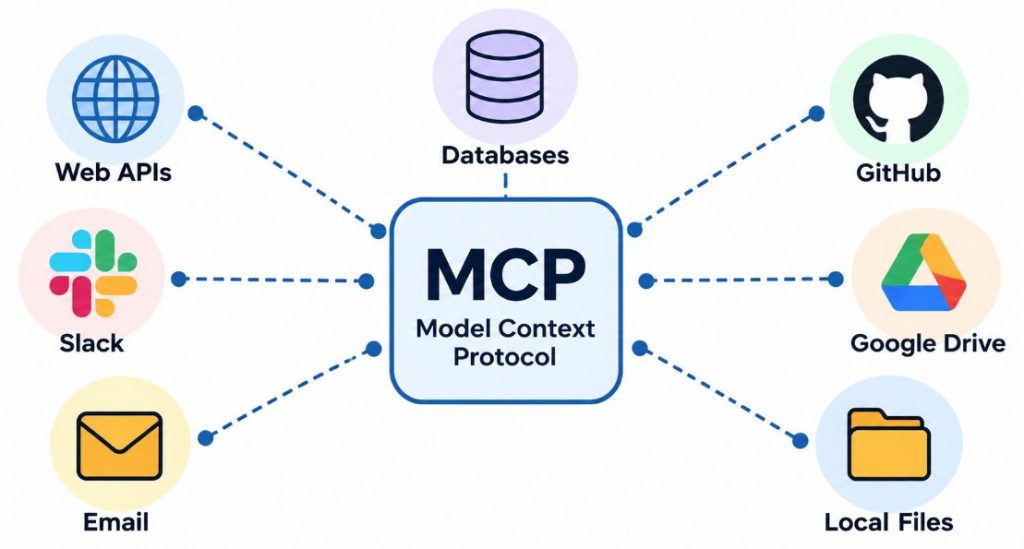
The First Step Is To Identify Common Customer Questions, Model Context Protocol, commonly called MCP, is an open protocol for connecting AI applications with external tools and contextual resources through a standardized interface. MCP servers can expose capabilities such as tools, resources, and prompts to compatible clients. An AI application can use these capabilities to access approved services without implementing a completely different integration for each one.
82. What Is A Tool Registry In Agentic AI?
Ans:
A tool registry is a catalog of available tools and their associated descriptions, input requirements, and execution details. It helps an agent or orchestration layer discover which capabilities are available for a task. For example, a registry may contain search, calculator, reporting, and database-query tools. Clear descriptions and schemas improve tool selection and reduce invalid requests.
83. What Is A Digital Assistant Powered By Agentic AI?
Ans:
- An agentic digital assistant can help users achieve goals by combining conversational interaction with planning and tool execution.
- It may organize schedules, retrieve information, prepare documents, or coordinate approved workflows.
- Unlike a simple question-answering assistant, it can handle multiple dependent steps when the necessary integrations are available. The assistant should communicate important assumptions and request clarification when required. User consent, permissions, and confirmation for consequential actions are essential.
84. How Does Design A Simple Agentic AI Application?
Ans:
A simple agentic application can begin with a clear user goal, an LLM, a limited set of tools, and a basic execution loop. The application receives an instruction, determines the next action, executes an approved tool call, and evaluates the result. It continues until a defined completion condition is met. Input validation, execution limits, error handling, and logging should be included from the beginning.
85. How Does Build An Agent That Answers Questions From Company Documents?
Ans:
The application would first collect approved company documents and divide them into manageable text chunks. Embeddings could be generated and stored in a vector database for semantic retrieval. When a user asks a question, the system retrieves relevant chunks and provides them to the language model as context. The agent generates an answer grounded in the retrieved material and can provide source references
86. How Does Debug An AI Agent That Repeats The Same Action?
Ans:
The first step is to inspect execution logs and traces to identify why the agent keeps repeating an action. The problem may involve unclear completion criteria, missing state updates, incorrect tool responses, or ineffective stopping rules. A maximum iteration limit and duplicate-action detection can prevent endless execution.
87. How Does Handle Incorrect Information Returned By An AI Agent?
Ans:
Incorrect information should be investigated by checking the original user input, retrieved sources, model response, and tool outputs. Reliable source retrieval and independent validation can help identify where the error occurred. Numerical results should be checked using deterministic calculations when possible. If the evidence is insufficient, the agent should communicate uncertainty rather than inventing an answer.
88. What Are The Main Challenges Of Agentic AI?
Ans:
Major challenges include unreliable reasoning, hallucinations, prompt injection, tool failures, data privacy risks, and unpredictable execution costs. Long workflows can amplify small errors when later steps depend on incorrect intermediate results. Multi-agent systems may introduce additional communication overhead and coordination difficulties. Evaluation is also challenging because successful task completion can involve many possible action sequences
89. What Skills Are Required For An Entry-Level Agentic AI Developer?
Ans:
An entry-level Agentic AI developer should understand Python programming, basic machine learning, large language models, prompt engineering, and API integration. Knowledge of JSON, databases, embeddings, RAG, and tool calling is useful for building practical applications. Familiarity with frameworks such as LangChain or LangGraph can help with workflow development.
90. What Is The Future Scope Of Agentic AI?
Ans:
Agentic AI is expected to play an increasing role in workflow automation, software engineering, enterprise search, customer support, research assistance, and business operations. Organizations are exploring systems that can coordinate tools and complete multi-step tasks with less manual intervention. Adoption will depend on reliability, security, cost, governance, and measurable business value.