LMS
Last updated on 27th Oct 2026| 13133

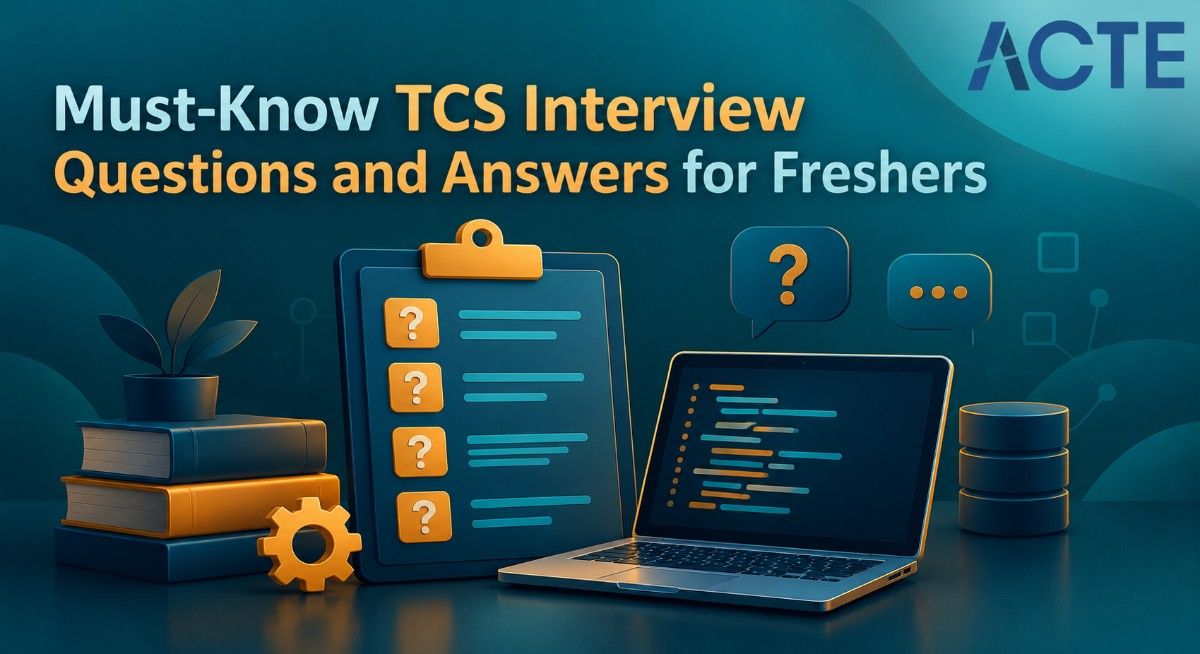
Must-Know TCS Interview Questions And Answers For Freshers is a comprehensive preparation guide designed to help candidates get ready for Tata Consultancy Services (TCS) recruitment. It covers important technical questions, programming concepts, data structures, SQL queries, operating systems, computer networks, software testing, and human resources (HR) interview topics. The guide includes frequently discussed questions with clear, beginner-friendly answers to strengthen technical knowledge and problem-solving skills. Freshers can use these questions to revise core computer science fundamentals, practice explaining concepts confidently, and prepare for coding assessments and technical discussions. The HR section also helps candidates prepare for questions about strengths, career goals, teamwork, and motivation for joining TCS. Regular practice with these questions can improve interview readiness and help candidates approach the TCS selection process with greater confidence.
1. What Is TCS?
Ans:
Tata Consultancy Services (TCS) is a leading global IT services, consulting, and business solutions company. It is part of the Tata Group and provides technology solutions to businesses across various industries. TCS offers services in software development, cloud computing, artificial intelligence, cybersecurity, and data analytics. The company operates in multiple countries and serves clients worldwide. Freshers can explore career opportunities in software development, testing, IT support, and consulting.
2. What Are The Different Programming Languages?
Ans:
Programming languages are used to develop software applications, websites, and computer systems. Popular programming languages include C, C++, Java, Python, JavaScript, and C#. Each language has different features and applications. Java is widely used for enterprise applications, while Python is popular for automation, data science, and artificial intelligence. Selecting a programming language depends on project requirements, performance needs, and development objectives.
3. What Is Object-Oriented Programming?
Ans:
Object-oriented programming (OOP) is a programming approach based on classes and objects. It organizes code into reusable components that represent real-world entities. The four main principles of OOP are encapsulation, inheritance, polymorphism, and abstraction. Languages such as Java and C++ support object-oriented programming concepts. OOP improves code maintainability, reusability, and organization in large software applications.
4. What Is A Class In Java?
Ans:
A class in Java is a blueprint used to create objects. It defines the data members and methods that describe an object’s properties and behavior. A class can contain variables, constructors, methods, and nested classes. Objects created from the same class can maintain different values for their instance variables. Classes support code organization, reusability, and object-oriented application development.
5. What Is An Object In Java?
Ans:
An object is an instance of a class that represents an entity with state and behavior. Its state is defined by variables, while its behavior is represented by methods. Objects are generally created using the new keyword in Java. Multiple objects can be created from one class, and each object can maintain its own instance data. Objects are fundamental to implementing object-oriented programming concepts.
6. What Is Inheritance In Java?
Ans:
- Inheritance is an OOP concept that allows one class to acquire accessible properties and methods from another class.
- The existing class is called the parent class, while the derived class is called the child class. Java supports class inheritance through the extends keyword.
- Inheritance promotes code reuse and helps establish relationships between related classes.
7. What Is Polymorphism?
Ans:
Polymorphism means the ability of an object or method to take different forms. Java supports compile-time polymorphism through method overloading and runtime polymorphism through method overriding. Method overloading allows multiple methods with the same name but different parameter lists. Method overriding enables a subclass to provide its own implementation of an inherited method. Polymorphism improves flexibility and simplifies the development of extensible applications.
8. What Is Encapsulation?
Ans:
Encapsulation is the process of combining data and methods within a single class while controlling access to internal details. In Java, encapsulation is commonly implemented using private variables and public getter and setter methods. This approach prevents unauthorized modification of an object’s internal state. It improves data security, maintainability, and control over application behavior. Encapsulation is one of the four fundamental principles of object-oriented programming.
9. What Is Abstraction?
Ans:
Abstraction is the process of hiding implementation details and exposing only essential functionality. Java supports abstraction through abstract classes and interfaces. An abstract class can contain both abstract and implemented methods. Interfaces define contracts that implementing classes must fulfill, with support for certain implemented methods as well. Abstraction reduces complexity and helps developers build modular and maintainable applications.
10. What Is The Difference Between C And Java?
Ans:
| Aspect | C | Java |
|---|---|---|
| Programming Type | Primarily a procedural programming language. | Primarily an object-oriented programming language. |
| Platform Dependency | Compiled into machine code for a target platform. | Compiled into bytecode that runs on a Java Virtual Machine (JVM). |
| Memory Management | Memory is managed manually using functions such as malloc() and free(). | Automatic garbage collection manages most object memory. |
| Pointers | Supports pointers and direct memory manipulation. | Does not support direct pointer manipulation. |
11. What Is The Difference Between C++ And Java?
Ans:
C++ supports procedural and object-oriented programming, while Java is designed around classes and objects, with primitive types as an exception. C++ supports pointers and multiple inheritance through classes, whereas Java restricts direct pointer manipulation and class-based multiple inheritance. Java uses automatic garbage collection, while C++ provides deterministic resource management through features such as destructors and RAII.
12. What Is A Constructor In Java?
Ans:
A constructor is a special class member used to initialize objects when they are created. It has the same name as the class and does not declare a return type. Java supports no-argument and parameterized constructors. Constructors can initialize instance variables and establish the initial state of an object. If no constructor is explicitly declared, Java provides a default constructor under the applicable language rules.
13. What Is Method Overloading?
Ans:
- Method overloading occurs when multiple methods in the same class share a name but have different parameter lists.
- The differences can involve the number, types, or order of parameters. It allows similar operations to be represented through a common method name.
- Return type alone cannot distinguish overloaded methods. Method overloading is an example of compile-time polymorphism in Java.
14. What Is Method Overriding?
Ans:
Method overriding occurs when a subclass provides a compatible implementation of an inherited instance method. It enables runtime polymorphism because the executed implementation can depend on the actual object type. The overriding method must follow Java’s rules for method signatures and access permissions. The @Override annotation helps identify the programmer’s intention and allows the compiler to detect mistakes.
15. What Is An Interface In Java?
Ans:
An interface defines a contract that implementing classes agree to follow. It can declare abstract methods, constants, default methods, static methods, and certain private methods. A class uses the implements keyword to implement an interface. Java allows a class to implement multiple interfaces, supporting flexible type relationships. Interfaces are useful for abstraction, loose coupling, and designing interchangeable components
16. What Is An Abstract Class?
Ans:
An abstract class is a class declared with the abstract keyword that cannot be instantiated directly. It can contain abstract methods, concrete methods, constructors, and instance variables. Subclasses extend the abstract class and implement its abstract methods unless they are also abstract. Abstract classes are useful when related classes share common behavior and state. They provide a foundation for creating specialized implementations.
17. What Is Exception Handling In Java?
Ans:
Exception handling is a mechanism for managing errors and unexpected conditions during program execution. Java provides try, catch, finally, throw, and throws for handling exceptions. A try block contains code that may produce an exception, while a catch block handles a matching exception. The finally block is generally used for cleanup operations. Proper exception handling improves application reliability and prevents avoidable program failures.
18. What Is The Difference Between Checked And Unchecked Exceptions?
Ans:
Checked exceptions are verified by the compiler and must generally be caught or declared using throws. Examples include IOException and SQLException. Unchecked exceptions are subclasses of RuntimeException and do not require mandatory handling at compile time. Examples include NullPointerException and ArithmeticException. Understanding these categories helps developers design suitable error-handling strategies.
19. What Is The Difference Between An Array And An ArrayList?
Ans:
- An array has a fixed length after creation, whereas an ArrayList can grow or shrink dynamically.
- Arrays can store primitive values directly, while ArrayList stores objects and uses wrapper classes for primitive values.
- Arrays provide indexed access, and ArrayList offers additional methods for insertion, deletion, and searching.
20. What Is A String In Java?
Ans:
A string is a sequence of characters represented by the String class in Java. Strings are immutable, meaning their contents cannot be changed after an object is created. Operations that appear to modify a string produce a new string or return an existing one. Java provides methods such as length(), substring(), equals(), and contains(). Strings are widely used for processing text, user input, and application data.
21. What Is The Difference Between String And StringBuilder?
Ans:
The String class represents immutable character sequences, whereas StringBuilder supports mutable character sequences. Repeated string modifications can create multiple intermediate objects when ordinary string concatenation is used. StringBuilder can append, insert, delete, and replace characters without creating a new object for every modification. It is generally useful for repeated text manipulation within a single thread.
22. What Is A Linked List?
Ans:
A linked list is a linear data structure made up of nodes connected through references. Each node typically stores data and a reference to the next node, while a doubly linked list also stores a previous reference. Unlike arrays, linked lists do not require contiguous memory locations. Insertion and deletion can be efficient when the relevant node position is already known. Linked lists are useful for implementing dynamic collections, queues, and other data structures.
23. What Is A Stack?
Ans:
- A stack is a linear data structure that follows the Last In, First Out (LIFO) principle. The last element inserted is the first element removed.
- Common stack operations include push, pop, and peek. Stacks are used in function calls, expression evaluation, undo operations, and backtracking algorithms.
- They can be implemented using arrays, linked lists, or suitable library classes.
24. What Is A Queue?
Ans:
A queue is a linear data structure that generally follows the First In, First Out (FIFO) principle. The first element inserted is the first element removed. Common operations include enqueue, dequeue, and front-element inspection. Queues are used in task scheduling, request processing, breadth-first search, and buffering systems. Java provides the Queue interface and several implementations for different processing requirements.
25. What Is A Binary Tree?
Ans:
A binary tree is a hierarchical data structure in which each node has at most two children. These children are commonly referred to as the left child and right child. Binary trees support operations such as insertion, searching, deletion, and traversal. Common traversal techniques include inorder, preorder, postorder, and level-order traversal. Binary trees are used in expression evaluation, searching structures, and hierarchical data representation
26. What Is Binary Search?
Ans:
Binary search is an efficient searching algorithm that repeatedly divides a sorted search range into smaller sections. It compares the target value with the middle element and eliminates the half that cannot contain the target. The process continues until the value is found or the search range becomes empty. Its time complexity is O(n), making it efficient for large sorted datasets
27. What Is Linear Search?
Ans:
- Linear search checks elements one by one until the target value is found or all elements have been examined.
- It can be used with both sorted and unsorted collections. The algorithm is easy to implement and requires no additional sorting step.
- Its worst-case time complexity is O(n), where n represents the number of elements. Linear search is useful for small datasets and simple search operations.
28. What Is Sorting In Programming?
Ans:
Sorting is the process of arranging data in a specified order, such as ascending or descending order. Common sorting algorithms include bubble sort, selection sort, insertion sort, merge sort, and quicksort. Different algorithms offer different time complexities, memory requirements, and performance characteristics. Sorting makes searching, comparing, and analyzing data easier.
29. What Is The Difference Between Bubble Sort And Quick Sort?
Ans:
Bubble sort repeatedly compares adjacent elements and swaps them when they are in the wrong order. Its average and worst-case time complexity is O(n2), although optimized bubble sort can perform well on already sorted data. Quicksort partitions elements around a pivot and recursively sorts the resulting sections. Quicksort has average time complexity O(nn), but its worst case is O(n2). Quicksort is generally more suitable for larger arrays when a good pivot strategy is used.
30. What Is Recursion?
Ans:
Recursion is a programming technique in which a function calls itself to solve smaller versions of a problem. A recursive function needs a base case that stops further calls. Each recursive call should move closer to that base case. Recursion is commonly used in tree traversal, factorial calculation, divide-and-conquer algorithms, and backtracking. Incorrect recursion can cause excessive stack usage or a stack overflow error.
31. What Is An Algorithm?
Ans:
An algorithm is a finite sequence of well-defined steps used to solve a problem or perform a computation. It accepts inputs, processes them according to specified rules, and produces an output when appropriate. A good algorithm should be correct, understandable, and reasonably efficient. Time and space complexity are commonly used to evaluate its performance. Algorithms form the foundation of programming, data processing, and software problem-solving.
32. What Is Time Complexity?
Ans:
Time complexity describes how an algorithm’s running time grows as the input size increases. It is commonly expressed using Big O notation, such as O(1), O(n), and O(n2). Constant-time operations do not grow with input size, while linear operations grow proportionally to the input. Time complexity helps compare algorithms independently of particular hardware measurements. It is important when developing scalable applications and solving coding interview problems.
33. What Is Space Complexity?
Ans:
Space complexity describes how an algorithm’s memory requirements grow with input size. It can include auxiliary memory used for variables, temporary data structures, and recursive calls. An algorithm with constant auxiliary space uses O(1) extra memory, while one that stores a collection proportional to input size may use O(n). Space complexity helps developers balance memory consumption against execution speed.
34. What Is The Difference Between An Array And A Linked List?
Ans:
An array stores elements in indexed positions and generally provides constant-time access by index. A linked list stores elements in separate nodes connected through references. Arrays can offer better cache locality, while linked lists can support efficient insertion and deletion when the relevant position is known. Inserting into the middle of an array may require shifting elements. The choice depends on access patterns, memory requirements, and update frequency.
35. What Is a Hash Table?
Ans:
A hash table stores data using keys that are converted into positions through a hash function. It typically supports efficient insertion, retrieval, and deletion, with average-case time complexity close to O(1). Different keys can produce the same hash position, creating a collision that must be handled. Common collision-resolution techniques include chaining and open addressing. Hash tables are used in dictionaries, caches, indexing systems, and database implementations
36. What Is A Database?
Ans:
- A database is an organized collection of data that can be stored, retrieved, updated, and managed efficiently. Databases support applications such as banking systems, e-commerce platforms, customer management, and inventory tracking.
- A Database Management System (DBMS) provides tools to create structures, enforce rules, and control data access.
- Common database systems include MySQL, PostgreSQL, Oracle Database, and Microsoft SQL Server
37. What Is SQL?
Ans:
Structured Query Language (SQL) is used to manage and query data in relational database systems. It supports operations such as selecting records, inserting rows, updating values, and deleting data. SQL also provides features for joins, grouping, sorting, and aggregating information. Common relational database systems include MySQL, PostgreSQL, Oracle Database, and SQL Server. SQL is an important skill for software development, data analysis, and database administration roles.
38. What Is The Difference Between DELETE, DROP, And TRUNCATE?
Ans:
DELETE removes selected rows from a table and can use a WHERE condition. TRUNCATE removes all rows while retaining the table structure, subject to database-specific behavior and restrictions. DROP removes the table object itself, including its definition. Transaction and rollback behavior differs across database systems and storage engines. These commands should be selected carefully to avoid unintended data loss.
39. What Is A Primary Key?
Ans:
A primary key is a column or combination of columns that uniquely identifies each row in a relational table. It must contain unique values and cannot contain NULL values. A table can have only one primary key constraint, although that key may contain multiple columns. Primary keys help maintain entity integrity and support relationships with other tables. They are frequently referenced by foreign keys in relational database design.
40. What Is A Foreign Key?
Ans:
A foreign key is a column or group of columns that references a primary key or another eligible unique key in a related table. It helps maintain referential integrity by preventing invalid relationships according to the configured constraints. Foreign keys can also define actions for updates and deletions, depending on the database design. For example, an orders table may reference a customer table through a customer identifier. Foreign keys support consistent relational data and reduce orphaned records.

41. What Is Normalization In DBMS?
Ans:
- Normalization is the process of organizing relational tables to reduce unnecessary data duplication and prevent modification anomalies.
- First Normal Form requires appropriate atomic values and the absence of repeating groups.
- Second Normal Form addresses partial dependencies on candidate keys, while Third Normal Form addresses certain transitive dependencies.
42. What Is A JOIN In SQL?
Ans:
A JOIN combines related records from two or more tables using a specified relationship or condition. An INNER JOIN returns matching rows, while a LEFT JOIN retains every row from the left table and includes matching data from the right table. A RIGHT JOIN retains every row from the right table, and a FULL OUTER JOIN returns matched and unmatched rows from both sides where supported. CROSS JOIN produces combinations of rows from both tables. Joins are essential for retrieving meaningful information from relational database
43. What Is The Difference Between WHERE And HAVING?
Ans:
| Aspect | WHERE Clause | HAVING Clause |
|---|---|---|
| Definition | Filters individual rows before grouping and aggregation. | Filters groups after grouping and aggregation. |
| Usage | Used to specify conditions on individual records. | Used to specify conditions on grouped results. |
| Aggregate Functions | Generally cannot directly filter using aggregate functions such as COUNT() or SUM(). | Can filter using aggregate functions such as COUNT() or SUM(). |
| Example | SELECT * FROM Employees WHERE Salary > 30000; | SELECT Department, COUNT(*) FROM Employees GROUP BY Department HAVING COUNT(*) > 5; |
44. What Is An Operating System?
Ans:
An operating system is system software that manages computer hardware and provides services for applications. It handles processes, memory, files, devices, security, and user interactions. Common operating systems include Windows, Linux, macOS, Android, and iOS. It enables applications to use hardware resources without directly managing every low-level operation. Operating systems are essential for efficient and reliable computer operation.
45. What Is The Difference Between Process And Thread?
Ans:
A process is an executing program with its own address space and operating-system-managed resources. A thread is an execution unit within a process that typically shares the process’s memory and resources with other threads. Processes usually provide stronger isolation, whereas threads can communicate efficiently through shared memory. Thread synchronization is important to prevent race conditions and inconsistent data. Both processes and threads support concurrent execution and application performance
46. What Is Multithreading?
Ans:
Multithreading is a programming technique that allows multiple threads to execute within the same process. Threads can perform separate tasks while sharing resources such as memory. It can improve responsiveness and throughput, especially for I/O-bound applications. However, shared data requires suitable synchronization to prevent race conditions and inconsistent results. Java provides thread-related classes, synchronization mechanisms, executors, and concurrent utilities for implementing multithreaded applications.

47. What Is Deadlock?
Ans:
Deadlock occurs when two or more processes or threads wait indefinitely for resources held by one another. The four classic necessary conditions are mutual exclusion, hold and wait, no preemption, and circular wait. For example, one thread may hold a lock on resource A while waiting for resource B, while another thread holds B and waits for A. Deadlocks can be reduced through consistent lock ordering, careful resource allocation, and appropriate timeout strategies.
48. What Is Virtual Memory?
Ans:
- Virtual memory is a memory-management technique that provides each process with a virtual address space.
- The operating system and hardware translate virtual addresses into physical memory addresses. Some memory pages may be stored on secondary storage when they are not currently resident in physical memory.
- This technique allows programs to use an address space larger than available physical RAM, although excessive paging can reduce performance
49. What Is Computer Networking?
Ans:
Computer networking connects computers and other devices so that they can exchange information and share resources. Networks may use wired technologies such as Ethernet or wireless technologies such as Wi-Fi. Networking involves addressing, routing, communication protocols, and security mechanisms. Common network types include Local Area Networks (LANs) and Wide Area Networks (WANs).
50. What Is The Difference Between TCP And UDP?
Ans:
TCP is a connection-oriented transport protocol that provides reliable, ordered delivery of data. UDP is connectionless and does not guarantee delivery, ordering, or duplicate protection. TCP is commonly used for web communication, file transfers, and other applications requiring reliable data delivery. UDP is useful for real-time audio, video, gaming, and other latency-sensitive applications
51. What Is An IP Address?
Ans:
An IP address is a logical network address used to identify an interface and route packets across IP networks. IPv4 uses 32-bit addresses, while IPv6 uses 128-bit addresses. An address may be public or private depending on its allocation and network usage. IP addresses help devices communicate through local networks and the internet. Network configuration, routing, and troubleshooting commonly require understanding IP addressing.
52. What Is DNS?
Ans:
The Domain Name System (DNS) translates domain names into information such as IP addresses and other service records. It allows users to access services through readable names rather than memorizing numerical addresses. DNS resolution can involve local caches, recursive resolvers, and authoritative name servers. Records such as A, AAAA, CNAME, and MX support different naming and service functions
53. What Is HTTP And HTTPS?
Ans:
- HTTP is an application-layer protocol used for communication between web clients and servers. HTTPS uses HTTP over a secure connection protected by Transport Layer Security (TLS).
- TLS helps provide encryption, integrity, and server authentication when certificates are properly validated.
- HTTP is commonly used to transfer webpages, API requests, and application data, while HTTPS protects the communication channel.
54. What Is The OSI Model?
Ans:
The OSI model describes network communication through seven conceptual layers. These layers are Physical, Data Link, Network, Transport, Session, Presentation, and Application. Each layer represents different responsibilities, ranging from transmitting bits to supporting application communication. The model helps explain protocols, troubleshoot connectivity issues, and understand how network functions interact.
55. What Is Agile Methodology?
Ans:
Agile is an approach to software development that emphasizes iterative delivery, collaboration, adaptability, and continuous feedback. Work is divided into smaller increments so teams can evaluate results and respond to changing requirements. Scrum and Kanban are commonly used frameworks or methods associated with Agile practices. Agile teams often collaborate with stakeholders to prioritize features and resolve problems quickly
56. What Is The Software Development Life Cycle?
Ans:
The Software Development Life Cycle (SDLC) is a structured process used to plan, build, test, deploy, and maintain software. Its common phases include requirement analysis, design, development, testing, deployment, and maintenance. Different SDLC models organize these activities in different ways. Following an appropriate process helps teams manage scope, quality, risks, and delivery timelines. SDLC knowledge is important for understanding how software projects progress from requirements to production.
57. What Is The Difference Between SDLC And STLC?
Ans:
SDLC covers the complete software development process, including requirements, design, coding, testing, deployment, and maintenance. STLC focuses specifically on software testing activities. Its typical phases include requirement analysis, test planning, test-case development, environment setup, test execution, and test closure. STLC operates within the broader software delivery process and supports product quality.
58. What Is Software Testing?
Ans:
- Software testing is the process of evaluating an application to identify defects and verify whether it meets specified requirements.
- It can involve manual execution, automated checks, reviews, and other validation techniques.
- Functional testing checks expected behavior, while non-functional testing evaluates aspects such as performance, usability, and security.
59. What Is The Difference Between Manual Testing And Automation Testing?
Ans:
Manual testing involves a tester executing test steps and evaluating results without relying on automation to perform the test actions. Automation testing uses scripts and tools to execute checks and compare actual results with expected results. Manual testing is useful for exploratory testing, usability evaluation, and scenarios requiring human judgment. Automation is valuable for repetitive regression checks and frequent test execution. Many software projects combine both approaches to improve coverage and efficiency.
60. What Is Unit Testing?
Ans:
Unit testing verifies small, isolated parts of an application, such as individual functions, methods, or classes. Developers commonly write unit tests to confirm that these components behave as expected. Tests should cover normal inputs, boundary conditions, and relevant error cases. Frameworks such as JUnit support unit testing in Java applications. Early unit testing helps identify defects before they spread into larger components.

Get JOB Oriented Full Stack Training for Beginners By MNC Experts
- Instructor-led Sessions
- Real-life Case Studies
- Assignments
61. What Is Integration Testing?
Ans:
Integration testing verifies whether multiple modules or components work correctly when combined. It focuses on issues such as incorrect interfaces, data exchange failures, and communication errors. Common approaches include top-down, bottom-up, and incremental integration testing. For example, testing whether an application correctly communicates with a database service is an integration-testing activity
62. What Is Regression Testing?
Ans:
Regression testing checks whether recent code changes have unintentionally affected existing functionality. It is especially important after bug fixes, feature additions, configuration changes, and system updates. Regression tests may be performed manually or through automated test suites. Frequently executed regression tests are strong candidates for automation. This testing helps maintain application stability as the software evolves.
63. What Is Black-Box Testing?
Ans:
Black-box testing evaluates software functionality without requiring knowledge of its internal implementation. Testers provide inputs and compare observed outputs with expected behavior. Techniques include equivalence partitioning, boundary-value analysis, decision-table testing, and state-transition testing. This approach can be applied to user interfaces, APIs, and complete application workflows.
64. What Is White-Box Testing?
Ans:
- White-box testing examines a program’s internal structure, logic, and execution paths. Testers use knowledge of the code to develop tests for statements, branches, conditions, and paths.
- Developers commonly perform white-box testing during unit testing and code-level validation. It can uncover logical errors and untested decision branches.
- Effective white-box testing complements black-box testing by examining internal behavior as well as external results.
65. What Is The Difference Between Verification And Validation?
Ans:
Verification checks whether software work products conform to specified requirements and design expectations. It often includes activities such as reviews, inspections, and static analysis. Validation evaluates whether the developed software meets user needs and intended use. It commonly involves executing software through testing and evaluating its behavior. Both activities contribute to quality assurance, but they address different aspects of correctness
66. What Is A Test Case?
Ans:
A test case is a documented set of conditions, inputs, actions, and expected results used to verify specific software behavior. It may include a test-case identifier, prerequisites, execution steps, test data, and pass-or-fail criteria. Well-written test cases should be clear, repeatable, and traceable to requirements. They help testers execute checks consistently across different environments. Test cases also support regression testing and defect investigation.
67. What Is A Bug In Software Testing?
Ans:
A bug is a defect or flaw in software that can cause behavior to differ from the expected result. It may arise from incorrect logic, misunderstood requirements, integration problems, or configuration errors. When a bug is identified, testers typically record steps to reproduce it, expected behavior, actual behavior, and supporting evidence. Developers investigate the issue, implement a correction, and request retesting
68. What Is The Difference Between Severity And Priority?
Ans:
Severity describes the technical impact of a defect on system functionality or reliability. Priority describes how urgently the defect should be addressed from a business or delivery perspective. A system crash may have both high severity and high priority, while a minor visual issue on a rarely used page may have lower values. However, a minor defect on a critical public-facing page can receive high priority. Teams assess both factors to make informed bug-fixing decisions.
69. What Is API Testing?
Ans:
API testing evaluates whether an application’s programming interfaces behave correctly under specified conditions. It checks request methods, parameters, authentication, response status codes, response bodies, and error handling. Tools such as Postman and automated testing frameworks can help execute API tests. API testing is useful for validating backend services independently of user-interface behavior. It helps identify integration, data-processing, and security-related problems early.
70. What Is Continuous Integration And Continuous Deployment?
Ans:
- Continuous Integration (CI) is the practice of frequently integrating code changes and automatically running checks such as builds and tests.
- Continuous Delivery keeps software ready for release through an automated delivery pipeline, while Continuous Deployment automatically releases qualifying changes to production.
- These practices help teams detect integration problems early and reduce manual release work. Tools such as Jenkins and GitHub Actions support CI/CD workflows
71. What Is Python?
Ans:
- Python is a high-level programming language known for its readable syntax and extensive standard library.
- It supports procedural, object-oriented, and functional programming styles. Python is widely used in web development, automation, data analysis, artificial intelligence, and machine learning.
- Its ecosystem includes libraries such as NumPy, pandas, and scikit-learn. Python is a useful language for freshers because it supports rapid development and straightforward problem-solving.
72. What Is The Difference Between A List And A Tuple In Python?
Ans:
A list is a mutable sequence, meaning its elements can be added, removed, or changed. A tuple is an immutable sequence whose structure cannot be modified after creation. Lists use square brackets, while tuples are commonly written with parentheses. Lists are useful for collections that change during execution, whereas tuples suit fixed collections of values. A tuple can be used as a dictionary key only when all its elements are hashable.
73. What Is A Dictionary In Python?
Ans:
A dictionary is a collection that stores data as key-value pairs. It supports efficient lookup, insertion, updating, and deletion using keys. Dictionary keys must be hashable, while values can be objects of different types. Dictionaries are useful for representing structured records, counting items, and mapping identifiers to information. Python dictionaries preserve insertion order in modern Python versions.
74. What Is The Difference Between A Set And A List In Python?
Ans:
A list is an ordered sequence that allows duplicate elements, while a set stores distinct elements without guaranteeing a meaningful positional order. Lists support indexed access, whereas sets are commonly used for membership checks and set operations. Sets provide operations such as union, intersection, and difference. Lists are suitable when order and duplicates matter. Sets are useful when uniqueness and efficient membership testing are important.
75. What Is A Function In Python?
Ans:
A function is a reusable block of code designed to perform a particular task. Functions are defined using the def keyword and can accept parameters and return results. They help divide complex programs into smaller, manageable components. Functions can improve readability, reduce repeated code, and simplify testing. Python also supports anonymous functions through lambda expressions for suitable short operations.
76. What Is The Difference Between Local And Global Variables?
Ans:
A local variable is defined within a function and is normally accessible only within its relevant scope. A global variable is defined at module level and can be accessed from functions in that module, subject to scope rules. The global keyword allows a function to rebind a module-level variable. Overusing global variables can make programs harder to maintain and test. Passing values through function parameters and return values often creates clearer code.
77. What Is Exception Handling In Python?
Ans:
Exception handling in Python allows a program to respond to runtime errors without necessarily terminating unexpectedly. The try block contains code that may raise an exception, and except blocks handle matching exception types. The finally block can perform cleanup, while else runs when the try block completes without an exception. The raise statement can explicitly trigger an exception
78. How Can A String Be Reversed In Python?
Ans:
- A string can be reversed in Python using slicing with a step of negative one. For example, text[::-1] returns the characters in reverse order.
- Another approach is to use reversed() and join the resulting characters into a new string. Strings are immutable, so reversing a string creates a result rather than changing the original object.
- Reversing strings is a common beginner coding exercise that tests indexing and sequence handling.
79. How Can Duplicate Elements Be Removed From A List?
Ans:
Duplicate elements can be removed from a Python list by converting it to a set, although this does not preserve a guaranteed sequence order in the general approach. To preserve the original order, list(dict.fromkeys(items)) is a concise option for hashable elements. A loop with a separate set can also track which values have already appeared. The best method depends on whether element order must be maintained
80. How Can The Factorial Of A Number Be Calculated?
Ans:
The factorial of a non-negative integer is the product of all positive integers up to that number. It is represented by n!, with 0!=1. An iterative solution starts with a result of one and multiplies it by each integer from one through the input value. A recursive solution uses the relationship n!=n(n-1)! with a base case at zero or one. Factorial problems test loops, recursion, boundary conditions, and basic mathematical reasoning.
91. What Is Cloud Computing?
Ans:
Cloud computing is the delivery of computing services such as servers, storage, databases, networking, and software over the internet. It allows organizations to access resources without maintaining all the underlying infrastructure themselves. The three major service models are Infrastructure as a Service (IaaS), Platform as a Service (PaaS), and Software as a Service (SaaS). Popular cloud platforms include Amazon Web Services, Microsoft Azure, and Google Cloud.Regular Security Testing Can Help Identify And Correct SQL Injection Vulnerabilities.
82. What Is Artificial Intelligence?
Ans:
Artificial Intelligence (AI) is a branch of computer science that enables machines to perform tasks requiring capabilities associated with human intelligence. These tasks include understanding language, recognizing patterns, solving problems, and making predictions. AI systems use techniques such as machine learning, deep learning, and natural language processing.
83. What Is Machine Learning?
Ans:
Machine learning is a branch of AI that enables computer systems to learn patterns from data and make predictions or decisions. It includes supervised learning, unsupervised learning, and reinforcement learning. Supervised learning uses labeled examples, while unsupervised learning identifies patterns in unlabeled data.
84. What Is Git And Why Is It Used?
Ans:
- Git is a distributed version control system used to track changes in source code and other files. It allows developers to maintain project history, create branches, and collaborate on changes.
- Common Git commands include git init, git add, git commit, git pull, and git push.
- Platforms such as GitHub and GitLab provide hosting and collaboration features for Git repositories.

85. What Is The Difference Between Frontend And Backend Development?
Ans:
- Frontend development focuses on the parts of an application that users see and interact with. It commonly uses HTML, CSS, JavaScript, and frameworks such as React or Angular.
- Backend development handles server-side logic, databases, authentication, APIs, and business operations.
- Technologies such as Java, Python, Node.js, and SQL are frequently used for backend development. Both areas work together to deliver complete, functional, and secure applications.
86. What Is An API?
Ans:
An Application Programming Interface (API) defines how different software components communicate and exchange information. It allows applications to request services or data without needing to understand the internal implementation of another system. Web APIs commonly use HTTP methods such as GET, POST, PUT, and DELETE. Data may be exchanged in formats such as JSON or XML. APIs are essential for integrating applications, connecting frontend and backend systems, and accessing external services.
87. What Is Cybersecurity?
Ans:
Cybersecurity involves protecting computer systems, networks, applications, and data from unauthorized access and digital attacks. It includes practices such as access control, encryption, vulnerability management, secure coding, and incident response. Common threats include phishing, malware, ransomware, and data breaches. Organizations use security policies and monitoring tools to reduce risks and protect sensitive information.
88. What Is The Difference Between Compiler And Interpreter?
Ans:
A compiler translates source code into another form, commonly machine code or intermediate code, before the resulting program is executed. An interpreter executes program instructions through an interpretation process, although modern language implementations may also compile code internally. Compiled programs can offer efficient execution, depending on the language and runtime environment. Interpreted execution can support convenient development and interactive testing.
89. How Does Debug A Program?
Ans:
Debugging is the process of identifying, analyzing, and correcting errors in a program. The first step is to reproduce the issue and understand the difference between expected and actual behavior. Next, the relevant code, input data, logs, and error messages should be examined to locate the root cause. Debugging tools, breakpoints, and step-by-step execution can help identify incorrect logic or unexpected variable values.
90. Why Should TCS Hire As A Fresher?
Ans:
A fresher can highlight strong programming fundamentals, willingness to learn, analytical thinking, and the ability to work effectively in a team. Academic projects and coding practice can demonstrate problem-solving skills and an understanding of software development concepts. Adaptability is important when learning new technologies and working with changing project requirements.n Their Threat Environment And Security Posture