LMS
LMS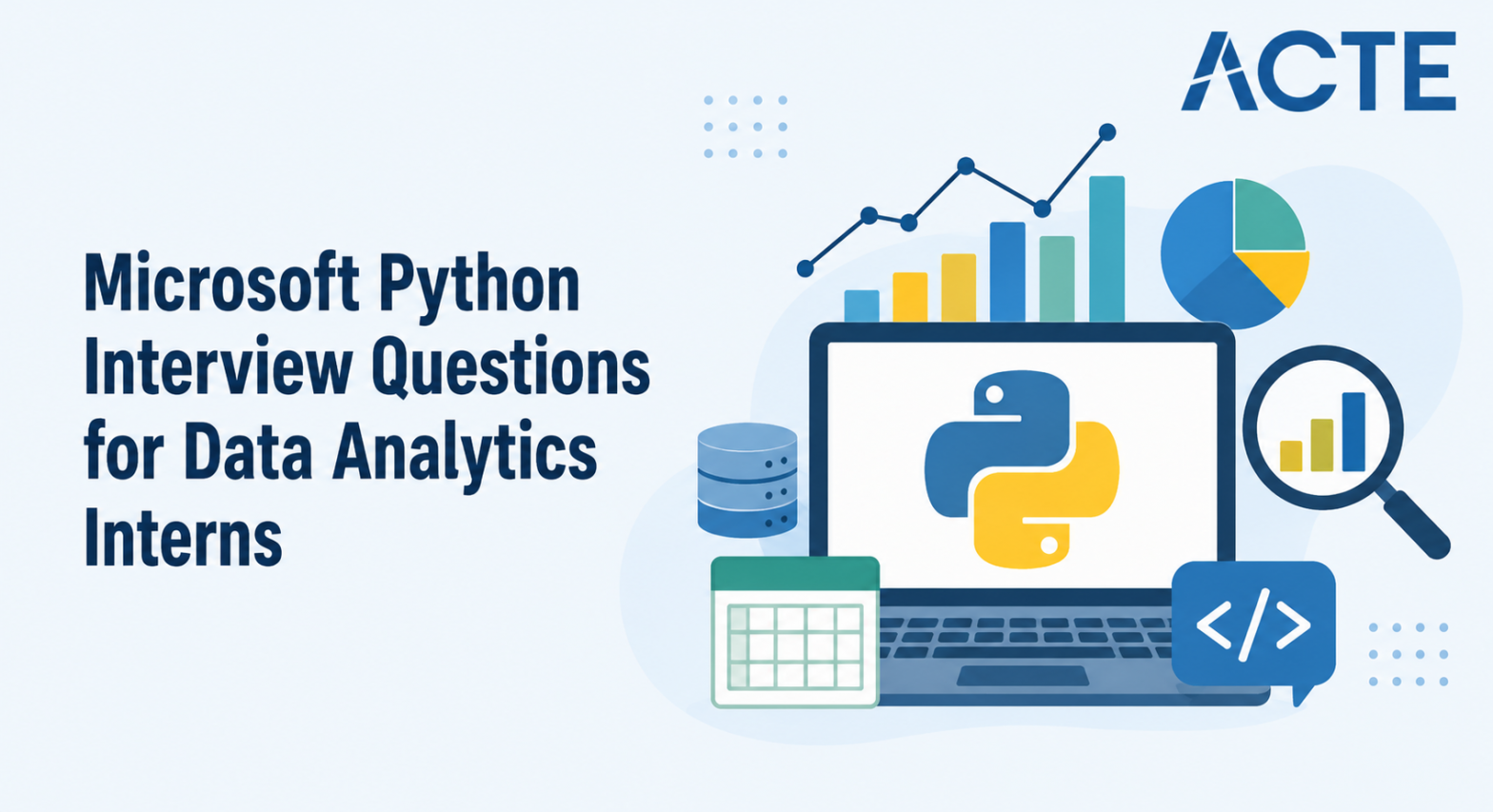
Last updated on 24th Jul 2026| 7635

Preparing for a Microsoft Python Data Analytics Internship requires a strong understanding of Python programming, data analysis techniques, and problem-solving skills. Microsoft interviewers typically assess candidates on Python fundamentals, data structures, algorithms, object-oriented programming, and analytical thinking. Candidates are also expected to demonstrate proficiency in popular Python libraries such as Pandas, NumPy, Matplotlib, and Seaborn, along with SQL and basic statistics. In addition to technical knowledge, interview rounds often include coding challenges, data manipulation tasks, and scenario-based questions that evaluate logical reasoning and real-world analytical skills. Practicing frequently asked interview questions helps improve coding efficiency, confidence, and the ability to explain solutions clearly. This collection of 100 Microsoft Python Interview Questions and Answers for Data Analytics Interns is designed to help beginners and aspiring data analysts strengthen their technical foundation and prepare effectively for internship interviews.
1. What Is Python And Why Is It Popular In Data Analytics?
Ans:
Python is a high-level programming language that is widely used for data analytics because of its simple syntax and readability. It provides powerful libraries such as Pandas, NumPy, and Matplotlib for handling, analyzing, and visualizing data efficiently. Python supports automation, statistical analysis, and machine learning, making it a complete solution for data professionals. It can process large datasets quickly while reducing manual effort. The language is platform-independent and has strong community support. Microsoft frequently uses Python for analytics, AI, and cloud-based data solutions.
2. What Are The Main Features Of Python That Benefit Data Analysts?
Ans:
Python offers simple syntax that allows analysts to focus on solving business problems rather than complex programming concepts. It supports object-oriented, functional, and procedural programming styles. Built-in libraries reduce development time and improve productivity. Python integrates easily with databases, cloud platforms, and visualization tools. It provides excellent support for data cleaning, transformation, and reporting. The language is open-source and continuously updated by a large developer community. These features make Python one of the most preferred languages for analytics.
3. What Is The Difference Between A List And A Tuple In Python?
Ans:
A list is a mutable collection that allows elements to be added, removed, or modified after creation. A tuple is immutable, meaning its values cannot be changed once defined. Lists use square brackets, while tuples use parentheses. Lists are suitable for dynamic datasets that change frequently. Tuples are useful for storing fixed values that should remain constant. Tuples generally consume less memory and offer slightly better performance. Choosing between them depends on whether data modification is required.
4. What Are Variables In Python?
Ans:
- Variables are named locations used to store data values during program execution. Python automatically determines the data type based on the assigned value. Variables can store integers, strings, floats, lists, dictionaries, and many other objects.
- Meaningful variable names improve code readability and maintenance. Variables can be updated whenever necessary during execution.
- Proper naming conventions help teams understand the purpose of stored data. Variables are fundamental for performing calculations and data manipulation.
5. What Are Python Data Types?
Ans:
Python provides several built-in data types for storing different kinds of information. Common types include integers, floating-point numbers, strings, booleans, lists, tuples, dictionaries, and sets. Each data type supports specific operations suitable for different analytical tasks. Selecting the correct type improves performance and reduces programming errors. Data types also determine how memory is allocated and managed. Python allows easy conversion between compatible data types. Understanding data types is essential for writing reliable analytical programs.
6. What Is The Difference Between == And = In Python?
Ans:
The equals sign (=) is an assignment operator used to assign a value to a variable. The double equals operator (==) compares two values to determine whether they are equal. Assignment changes the stored value of a variable. Comparison returns either True or False based on the evaluation. Confusing these operators can lead to logical errors in programs. Comparison operators are commonly used inside conditions and loops. Understanding their difference is important for writing accurate Python code.
7. What Is A Dictionary In Python??
Ans:
A dictionary is a collection of key-value pairs used for storing related information efficiently. Each key is unique and maps to a corresponding value. Dictionaries are mutable, allowing additions, updates, and deletions. They provide fast data retrieval using keys instead of indexes. Dictionaries are widely used in JSON processing and API responses. They help organize structured information clearly and efficiently. Data analysts frequently use dictionaries to store configuration settings and summarized data.
8. What Is A Set In Python?
Ans:
A set is an unordered collection that stores only unique elements. Duplicate values are automatically removed when inserted into a set. Sets support mathematical operations such as union, intersection, and difference. They are useful for identifying unique records within datasets. Sets provide efficient membership testing compared to lists. They cannot contain mutable objects like lists. Sets simplify many data-cleaning and validation tasks in analytics.
9. What Is A Function In Python?
Ans:
- A function is a reusable block of code designed to perform a specific task. Functions reduce code duplication and improve maintainability.
- They can accept input parameters and return output values. Built-in functions like len() and sum() simplify common operations.
- Custom functions help organize large analytical projects effectively. Functions make programs easier to read, test, and debug. Microsoft values modular programming because it improves software quality.
10. What Are Arguments And Parameters In Python?
Ans:
Parameters are variables defined in a function declaration that specify expected inputs. Arguments are the actual values passed when calling the function. Functions may have required, optional, default, or keyword parameters. Proper parameter design improves flexibility and code reuse. Arguments allow the same function to process different datasets. Clear parameter names improve readability and maintenance. Understanding this concept is essential for building reusable analytical functions.
11. What Is A Loop In Python?
Ans:
A loop repeatedly executes a block of code until a condition changes or all items are processed. Python mainly uses for loops and while loops. For loops iterate through sequences like lists and strings. While loops continue execution while a condition remains true. Loops automate repetitive analytical tasks efficiently. Proper loop control prevents unnecessary execution and improves performance. They are widely used for processing datasets and generating reports.
12. What Is The Difference Between For Loop And While Loop?
Ans:
A for loop is used when the number of iterations is known or when iterating through a collection. A while loop continues until a specified condition becomes false. For loops are commonly used with lists, tuples, and ranges. While loops are suitable for condition-based processing. Incorrect while loop conditions may cause infinite loops. Choosing the correct loop improves readability and efficiency. Both loops are essential for data processing tasks.
13. What Are Conditional Statements In Python?
Ans:
Conditional statements control program execution based on logical conditions. Python uses if, elif, and else statements for decision-making. Conditions evaluate expressions that return True or False. These statements help filter data and validate inputs. Conditional logic supports business rules in analytical applications. Proper indentation is required because Python defines blocks using whitespace. Effective use of conditions improves program accuracy.
14. What Is Exception Handling In Python?
Ans:
- Exception handling manages runtime errors without abruptly terminating the program. Python uses try, except, else, and finally blocks for handling exceptions.
- Proper error handling improves application stability and user experience. It allows programs to recover from unexpected situations gracefully.
- Analysts use exception handling when reading files or connecting to databases. Logging errors helps identify and fix issues efficiently. Robust programs always include appropriate exception handling.
15. What Is NumPy In Python?
Ans:
NumPy is a powerful Python library designed for numerical computing. It provides fast multidimensional arrays and mathematical functions. NumPy performs calculations much faster than standard Python lists. It supports vectorized operations that improve performance significantly. Many data science libraries depend on NumPy internally. Analysts use it for statistical analysis, matrix operations, and scientific computing. It forms the foundation of many Python analytics applications.
16. What Is Pandas In Python?
Ans:
Pandas is an open-source library used for data manipulation and analysis. It introduces DataFrame and Series data structures for handling structured data. Pandas simplifies reading CSV, Excel, SQL, and JSON files. It supports filtering, grouping, sorting, merging, and aggregation operations. Missing values can be identified and handled efficiently. Analysts use Pandas for cleaning and preparing datasets before analysis. It is one of the most important libraries for data analytics.
17. What Is A DataFrame In Pandas?
Ans:
A DataFrame is a two-dimensional tabular data structure consisting of rows and columns. Each column can store a different data type independently. DataFrames resemble spreadsheet tables or SQL database tables. They support filtering, sorting, grouping, and aggregation operations. Large datasets can be manipulated efficiently using DataFrame methods. DataFrames integrate easily with visualization and machine learning libraries. They are the primary structure used in Python-based data analytics.
18. What Is A Series In Pandas?
Ans:
A Series is a one-dimensional labeled data structure capable of storing any data type. Each value has an associated index for easy access. A Series can represent a single column from a DataFrame. Mathematical and statistical operations can be performed directly on Series objects. Missing values are handled efficiently using built-in methods. Series provide fast data processing capabilities. They serve as the foundation for constructing DataFrames.
19. How Does Read A CSV File Using Pandas?
Ans:
Pandas reads CSV files using the read_csv() function. The function automatically detects column names and loads data into a DataFrame. Analysts can specify delimiters, encoding, and missing value handling options. Large files can be processed efficiently with additional parameters. After loading, data can be explored using methods like head() and info(). Proper file handling ensures accurate data analysis. Reading CSV files is one of the most common tasks in analytics.
20. Why Is Python Preferred At Microsoft For Data Analytics Projects?
Ans:
- Python provides a rich ecosystem of analytical libraries that simplify complex data processing tasks. It integrates seamlessly with Azure services, SQL databases, and machine learning frameworks.
- Python enables automation, visualization, predictive analytics, and reporting within a single language. Strong community support ensures continuous improvements and extensive documentation.
- The language supports scalable cloud-based analytics solutions. Its simplicity allows faster development and easier collaboration among teams. These advantages make Python an excellent choice for Microsoft data analytics projects.
21. What Is Data Cleaning In Python?
Ans:
Data cleaning is the process of identifying and correcting inaccurate, incomplete, or inconsistent data before analysis. Python provides powerful libraries like Pandas to remove duplicates, handle missing values, and correct formatting issues. Clean data improves the accuracy of reports and predictive models. Analysts often standardize column names and convert data types during cleaning. Proper validation ensures that incorrect records do not affect business decisions. Automated cleaning saves time compared to manual corrections. Data cleaning is one of the most important steps in any analytics project.
22. How Does Handle Missing Values In Pandas?
Ans:
Missing values can be detected using functions such as isnull() or isna() in Pandas. Analysts may remove incomplete records using dropna() when appropriate. Missing values can also be replaced with meaningful values using fillna(). Common replacement strategies include mean, median, mode, or a fixed default value. The chosen method depends on the dataset and business requirements. Proper handling prevents errors during analysis and machine learning. Managing missing values improves the reliability of analytical results.
23. What Is The Difference Between Loc And Iloc In Pandas?
Ans:
| Feature | loc | iloc |
|---|---|---|
| Selection Method | Selects rows and columns using labels (index names). | Selects rows and columns using integer-based index position |
| Range Behavior | The ending label in a range is included | The ending index in a range is excluded (Python slicing rule). |
| Example | df.loc[0:2, ‘Name’:’Salary’] selects rows by labels and columns by names. | df.iloc[0:2, 0:2] selects the first two rows and first two columns by position. |
24. What Is Data Filtering In Pandas?
Ans:
- Data filtering is the process of selecting only the records that satisfy specific conditions. Pandas allows filtering using comparison operators and Boolean expressions.
- Analysts filter datasets to examine relevant business information efficiently. Multiple conditions can be combined using logical operators such as & and |.
- Filtering reduces unnecessary data processing and improves performance. It is commonly used in reporting and dashboard creation. Accurate filtering helps answer business questions effectively.
25. What Is GroupBy In Pandas?
Ans:
The groupby() function groups data based on one or more columns before performing calculations. Analysts use it to summarize data using functions like sum, average, count, maximum, and minimum. Grouping simplifies the creation of business reports and performance metrics. It supports multi-level grouping for complex datasets. The grouped results can be aggregated or transformed as needed. GroupBy operations improve analytical efficiency. This feature is widely used in sales, finance, and customer analytics.
26. What Is Data Aggregation In Python?
Ans:
Data aggregation combines multiple records into summarized information using mathematical operations. Common aggregation functions include sum, mean, count, minimum, maximum, and standard deviation. Aggregation helps identify trends and patterns within datasets. Analysts use aggregation to prepare executive reports and dashboards. It reduces large datasets into meaningful summaries. Pandas provides built-in aggregation methods for efficient processing. Aggregated data supports better business decision-making.
27. What Is Sorting In Pandas?
Ans:
Sorting arranges data in ascending or descending order based on selected columns. Pandas uses the sort_values() method for sorting records. Sorting helps analysts identify top-performing products, highest sales, or lowest expenses. Multiple columns can be sorted simultaneously for advanced analysis. Proper sorting improves readability and report presentation. Sorted data simplifies further filtering and visualization. It is a common preprocessing step in analytics.
28. What Is Merging In Pandas?
Merging combines two or more DataFrames based on common columns or indexes. It is similar to SQL JOIN operations used in relational databases. Analysts merge customer, sales, and product datasets to perform comprehensive analysis. Pandas supports inner, left, right, and outer joins. Proper merging ensures accurate relationships between datasets. Incorrect join keys may produce duplicate or missing records. Merging is essential for integrating multiple data sources.
29. What Is Concatenation In Pandas?
Ans:
- Concatenation combines DataFrames either vertically or horizontally into a single structure. It is performed using the concat() function in Pandas.
- Vertical concatenation adds rows, while horizontal concatenation adds columns. Analysts use concatenation when combining monthly or yearly datasets. Consistent column structures improve concatenation accuracy.
- This method simplifies data preparation for analysis. Concatenation is commonly used in ETL processes.
30. What Is A Lambda Function In Python?
Ans:
A lambda function is a small anonymous function defined without using the def keyword. It is typically used for short operations that require only one expression. Lambda functions improve code readability in mapping, filtering, and sorting tasks. They are commonly used with functions such as map(), filter(), and apply(). Lambda expressions reduce unnecessary code for simple calculations. They are especially useful in data transformation tasks. Analysts frequently use lambda functions in Pandas operations.
31. What Is The Map Function In Python?
Ans:
The map() function applies a specified function to every item in an iterable. It returns an iterator containing the transformed values. Analysts use map() to perform consistent transformations across datasets. It improves code efficiency compared to manual loops. Custom or built-in functions can be passed to map(). This approach simplifies repetitive data processing tasks. It is useful when applying identical operations to multiple records.
32. What Is The Filter Function In Python?
Ans:
The filter() function selects elements from an iterable based on a specified condition. It returns only the values that satisfy the given criteria. Analysts use it to remove unwanted records efficiently. The filtering logic is usually implemented with a lambda or custom function. It reduces manual coding and improves readability. Filtered datasets are easier to analyze and visualize. This function supports efficient data preprocessing.
33. What Is List Comprehension In Python?
Ans:
List comprehension provides a concise way to create new lists from existing iterables. It combines iteration and conditional logic into a single readable statement. Analysts use it for transforming and filtering data efficiently. List comprehensions often execute faster than traditional loops. They reduce code length while maintaining clarity. Complex transformations can be performed with minimal syntax. This feature is widely appreciated in Python programming.
34. What Is A Python Module?
Ans:
A module is a Python file containing reusable functions, classes, and variables. Modules help organize code into manageable and maintainable components. Python includes many built-in modules for mathematical operations, file handling, and system tasks. Custom modules allow developers to reuse project-specific functionality. Importing modules reduces duplicate code across applications. Modular programming improves collaboration among development teams. Modules are fundamental for scalable software development.
35. What Is A Python Package?
Ans:
A package is a collection of related Python modules organized within a directory. Packages help structure large applications into logical components. They improve code organization and simplify maintenance. An initialization file identifies a directory as a package. Analysts often use packages such as NumPy, Pandas, and Scikit-learn. Packages encourage code reuse across projects. They are essential for managing complex Python applications.
36. What Is File Handling In Python?
Ans:
- File handling allows Python programs to create, read, update, and delete files. Built-in functions support working with text, CSV, JSON, and other file formats.
- Analysts frequently import datasets from external files for analysis. Proper file handling includes opening, processing, and closing files correctly.
- Exception handling helps manage file-related errors gracefully. Efficient file operations improve automation workflows. File handling is a basic requirement for data analytics.
37. How Does Read An Excel File In Python?
Ans:
Python reads Excel files using the read_excel() function provided by the Pandas library. The data is loaded directly into a DataFrame for analysis. Analysts can specify sheet names, column ranges, and header positions. Multiple worksheets can be imported when required. Data types can be inspected after loading the file. Excel integration simplifies reporting and business analytics. Reading Excel files is a common task in Microsoft-based environments.
38. What Is Data Visualization In Python?
Ans:
Data visualization represents information graphically to make patterns and trends easier to understand. Python libraries such as Matplotlib and Seaborn create charts, graphs, and dashboards. Visualizations help stakeholders interpret analytical findings quickly. Common chart types include bar charts, line charts, pie charts, and scatter plots. Effective visualizations improve communication and decision-making. Analysts choose chart types based on the nature of the data. Visualization is an essential skill for presenting analytical results.
39. What Is Matplotlib In Python?
Ans:
Matplotlib is a popular Python library used for creating static, animated, and interactive visualizations. It supports numerous chart types suitable for business reporting. Analysts customize titles, labels, legends, and axes for better presentation. Matplotlib integrates seamlessly with NumPy and Pandas. High-quality visual outputs can be generated for dashboards and reports. It provides extensive customization options for professional charts. The library is widely used in data analytics and scientific computing.
40. What Is Seaborn In Python?
Ans:
Seaborn is a statistical visualization library built on top of Matplotlib. It provides attractive default styles and simplified syntax for creating advanced charts. Analysts use Seaborn to visualize distributions, relationships, and categorical data. It integrates directly with Pandas DataFrames for efficient plotting. Built-in themes improve chart readability and presentation quality. Seaborn supports heatmaps, box plots, violin plots, and pair plots. It is commonly used to explore and communicate analytical insights.
41. What Is NumPy Array And How Is It Different From A Python List?
Ans:
A NumPy array is a high-performance data structure designed for numerical computing. It stores elements of the same data type in contiguous memory, making calculations much faster than Python lists. Python lists can store multiple data types but consume more memory. NumPy arrays support vectorized operations without explicit loops. They are widely used in scientific computing, machine learning, and data analytics. Large datasets can be processed efficiently using NumPy arrays. Microsoft data analysts frequently use NumPy for numerical analysis and data manipulation.

Learn Advanced Data Analytics Certification Training Course to Build Your Skills
Weekday / Weekend BatchesSee Batch Details42. What Is The Difference Between Shallow Copy And Deep Copy In Python?
Ans:
- A shallow copy creates a new object but shares references to nested objects with the original. A deep copy creates a completely independent copy of both the object and all nested objects. Changes made to nested elements affect both objects in a shallow copy.
- Deep copies prevent unintended modifications between copies. Python provides the copy() and deepcopy() methods through the copy module.
- Understanding these concepts helps avoid bugs in complex applications. Choosing the appropriate copy type depends on the project requirements.
43. What Is Object-Oriented Programming In Python?
Ans:
Object-Oriented Programming (OOP) is a programming approach based on objects and classes. It helps organize code into reusable and maintainable components. The main concepts include encapsulation, inheritance, polymorphism, and abstraction. OOP improves scalability and simplifies software maintenance. Python fully supports object-oriented programming features. Large analytics applications often use OOP for better code organization. Microsoft values OOP because it promotes modular and reusable software development.
44. What Is A Class In Python?
Ans:
A class is a blueprint used to create objects with similar properties and behaviors. It defines attributes to store data and methods to perform operations. Multiple objects can be created from a single class. Classes improve code reuse and reduce duplication. They make large applications easier to maintain and extend. Python classes support inheritance and polymorphism for flexible design. Classes are fundamental to object-oriented programming.
45. What Is An Object In Python?
Ans:
An object is an instance of a class that contains actual data and behavior. Each object has its own attributes and methods defined by its class. Objects interact with one another to perform application tasks. Multiple objects created from the same class can hold different values. Objects improve modularity and simplify program design. Python automatically manages object memory using garbage collection. Objects are the building blocks of object-oriented applications.
46. What Is Inheritance In Python?
Ans:
Inheritance allows one class to acquire the properties and methods of another class. The existing class is called the parent class, while the new class is called the child class. This feature promotes code reuse and reduces redundancy. Child classes can extend or override parent class functionality. Inheritance simplifies maintenance of large applications. It supports hierarchical relationships between classes. Data analytics applications often use inheritance for reusable components.
47. What Is Polymorphism In Python?
Ans:
Polymorphism allows different classes to use methods with the same name while performing different actions. It enables flexible and reusable code without modifying existing implementations. Method overriding is a common example of polymorphism. Python supports polymorphism through inheritance and duck typing. This concept improves scalability in software development. Programs become easier to extend with new functionality. Polymorphism is widely used in enterprise applications.
48. What Is Encapsulation In Python?
Ans:
- Encapsulation is the process of combining data and methods within a single class. It restricts direct access to internal data by using controlled interfaces.
- Private and protected members improve data security and integrity. Encapsulation prevents accidental modification of sensitive information.
- It enhances code maintainability and reliability. Large software systems benefit greatly from encapsulation. This principle is one of the foundations of object-oriented programming.
49. What Is Abstraction In Python?
Ans:
Abstraction hides implementation details while exposing only essential functionality to users. It simplifies interaction with complex systems by providing clear interfaces. Python supports abstraction through abstract classes and methods. Developers can focus on functionality instead of internal complexity. Abstraction improves code readability and maintainability. Enterprise applications frequently rely on abstraction for scalable architecture. It is another core principle of object-oriented programming.
50. What Is The Difference Between Append() And Extend() In Python?
Ans:
The append() method adds a single element to the end of a list. The extend() method adds all elements from another iterable individually into the list. Using append() with another list creates a nested list. Using extend() merges both lists into one continuous list. Both methods modify the original list directly. Choosing the correct method depends on the desired list structure. Understanding this difference helps prevent unexpected results.
51. What Is The Difference Between Remove(), Pop(), And Del In Python?
Ans:
The remove() method deletes the first occurrence of a specified value from a list. The pop() method removes and returns an element based on its index. The del statement deletes elements, slices, or entire variables. remove() searches by value, while pop() works by position. del provides greater flexibility for deleting objects. Each method serves different list management purposes. Selecting the correct method improves code clarity.
52. What Is String Slicing In Python?
Ans:
String slicing extracts a portion of a string using index positions. The syntax specifies the starting and ending positions along with an optional step value. Slicing creates a new string without modifying the original one. Negative indexes allow access from the end of the string. Analysts frequently use slicing to process text data efficiently. It simplifies extraction of meaningful information from datasets. String slicing is a commonly used Python feature.
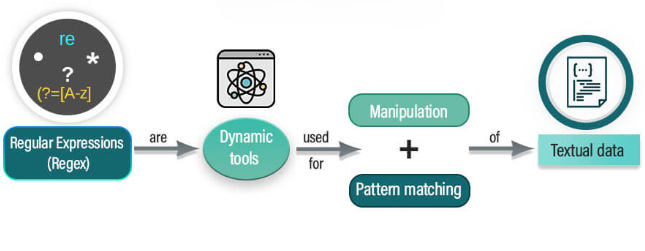
53. What Is Regular Expression (Regex) In Python?
Ans:
Regular expressions are patterns used to search, validate, and manipulate text. Python provides the re module for working with regular expressions. Regex simplifies finding email addresses, phone numbers, dates, and other patterns. It supports searching, replacing, splitting, and validating text. Analysts use regex extensively during data cleaning. Proper pattern design improves processing accuracy. Regex is a valuable skill for handling unstructured data.
54. What Is The Zip() Function In Python?
Ans:
The zip() function combines multiple iterables into a single iterator of tuples. Each tuple contains corresponding elements from the input iterables. It stops when the shortest iterable is exhausted. Analysts use zip() to process related datasets together. The function improves readability and reduces manual indexing. It is useful for pairing values during analysis. Zip simplifies simultaneous iteration over multiple collections.
55. What Is Enumeration In Python?
Ans:
- The enumerate() function returns both the index and value while iterating through an iterable. It eliminates the need to maintain a manual counter variable.
- Enumerate improves readability and simplifies loop implementation. Analysts use it when row positions are required during processing.
- The starting index can also be customized if needed. It is commonly used with lists and tuples. Enumerate makes iteration more efficient and organized.
56. What Is The Difference Between Break, Continue, And Pass?
Ans:
The break statement immediately terminates the current loop. The continue statement skips the current iteration and proceeds to the next one. The pass statement performs no action and serves as a placeholder. These statements provide better control over loop execution. They help implement complex business logic efficiently. Proper usage improves program readability and maintainability. Understanding loop control statements is essential for Python programming.
57. What Is A Generator In Python?
Ans:
A generator is a special function that produces values one at a time using the yield keyword. It generates values only when requested, reducing memory usage. Generators are ideal for processing large datasets efficiently. They improve performance by avoiding unnecessary storage of all values. Analysts use generators in data pipelines and streaming applications. Multiple values can be produced sequentially without loading everything into memory. Generators are highly efficient for scalable analytics.
58. What Is The Yield Keyword In Python?
Ans:
The yield keyword pauses function execution and returns a value to the caller. Unlike return, it preserves the function’s state for future execution. Functions containing yield become generators automatically. Yield enables lazy evaluation, improving memory efficiency. It is particularly useful for processing large files and data streams. The function resumes execution when the next value is requested. Yield is an important feature for efficient Python programming.
59. What Is Iteration In Python?
Ans:
Iteration is the process of accessing each element in a collection one by one. Python supports iteration through loops, iterators, and generators. Collections such as lists, tuples, dictionaries, and sets are iterable. Iteration simplifies processing large datasets efficiently. Built-in functions make iteration concise and readable. Analysts use iteration for data transformation, validation, and aggregation. Efficient iteration improves application performance.
60. What Is An Iterator In Python?
Ans:
An iterator is an object that enables sequential access to elements in a collection. It implements the __iter__() and __next__() methods internally. The next() function retrieves one element at a time until no elements remain. Iterators improve memory efficiency by generating values as needed. They are widely used with loops and generators. Large datasets can be processed without loading all data into memory. Understanding iterators is essential for writing efficient Python applications.
61. What Is The Difference Between Read_Csv() And Read_Excel() In Pandas?
Ans:
| Feature | read_csv() | read_excel() |
|---|---|---|
| File Format | Reads Comma-Separated Values (.csv) files. | Reads Microsoft Excel (.xls, .xlsx) files. |
| Library Requirement | Works directly with Pandas and does not require an Excel engine for CSV files | May require an engine such as openpyxl or xlrd depending on the Excel file format. |
| Usage & Performance | Generally faster and preferred for large text-based datasets used in data analytics | Supports multiple worksheets, formatted data, and Excel-specific features, but is usually slower than read_csv() |
62. What Is The Describe() Function In Pandas?
Ans:
The describe() function generates summary statistics for numerical and categorical data in a DataFrame. It displays count, mean, standard deviation, minimum, maximum, and percentile values. Analysts use it to quickly understand the distribution of a dataset. The function helps identify missing values and unusual data patterns. It is commonly used during exploratory data analysis. The output provides valuable insights before applying advanced analytics. This function saves significant time during initial data exploration.

Get JOB Oriented Data Analytics Training for Beginners By MNC Experts
- Instructor-led Sessions
- Real-life Case Studies
- Assignments
63. What Is The Info() Function In Pandas?
Ans:
- The info() function provides a concise summary of a DataFrame’s structure. It displays the number of rows, columns, data types, non-null values, and memory usage.
- Analysts use it to verify whether the data has been loaded correctly. It helps identify missing values and incorrect data types.
- The output assists in planning data cleaning activities. This function is frequently used before performing transformations. It is an essential tool for understanding dataset characteristics.
64. What Is Exploratory Data Analysis (EDA)?
Ans:
Exploratory Data Analysis is the process of examining datasets to understand their structure and discover meaningful patterns. It involves summarizing, visualizing, and cleaning data before building predictive models. Analysts use statistical measures and graphical techniques to identify trends and anomalies. EDA helps detect missing values, duplicates, and outliers. It improves the quality of analytical decisions. Proper exploration leads to more accurate and reliable models. EDA is a critical first step in every data analytics project.
65. What Are Outliers In Data Analytics?
Ans:
Outliers are data points that differ significantly from the rest of the dataset. They may occur due to measurement errors, incorrect data entry, or genuine rare events. Outliers can affect averages, correlations, and predictive models. Analysts identify them using box plots, scatter plots, and statistical techniques. Depending on the business context, outliers may be removed or investigated further. Proper handling improves analytical accuracy. Detecting outliers is an important part of data preprocessing.
66. What Is Correlation In Data Analytics?
Ans:
Correlation measures the strength and direction of the relationship between two variables. Positive correlation indicates that both variables increase together, while negative correlation means one decreases as the other increases. A correlation close to zero suggests little or no relationship. Analysts use correlation to identify meaningful associations in datasets. Correlation does not imply causation between variables. Visualization tools often support correlation analysis. Understanding correlation helps improve business insights and predictive modeling.
67. What Is Data Transformation In Python?
Ans:
Data transformation is the process of converting raw data into a suitable format for analysis. It includes changing data types, normalizing values, creating new columns, and formatting text. Python libraries like Pandas simplify these operations. Transformation improves consistency across datasets. Analysts perform transformations before visualization and machine learning. Properly transformed data enhances model accuracy. This step is a key part of data preparation.
68. What Is Data Normalization?
Ans:
Data normalization scales numerical values into a common range without changing their relationships. It prevents variables with larger values from dominating analytical models. Common normalization techniques include Min-Max Scaling and Z-score Standardization. Normalized data improves machine learning performance. Analysts use normalization when comparing variables with different units. Python libraries provide built-in functions for normalization. It is an important preprocessing technique for predictive analytics.
69. What Is Feature Engineering?
Ans:
Feature engineering is the process of creating new variables from existing data to improve model performance. Analysts combine, modify, or transform features based on business knowledge. Good feature engineering helps machine learning models identify meaningful patterns. It may involve extracting dates, categorizing values, or calculating ratios. High-quality features often improve prediction accuracy. Python provides several tools for feature creation. Feature engineering is a valuable skill for data analysts and data scientists.
70. What Is A Pivot Table In Pandas?
Ans:
- A pivot table summarizes data by grouping rows and columns into meaningful reports. It allows analysts to calculate totals, averages, counts, and other aggregations.
- Pivot tables simplify the analysis of large datasets. Multiple dimensions can be analyzed simultaneously. Pandas provides the pivot_table() function for creating flexible summaries.
- Business reports often rely on pivot tables for decision-making. They improve the readability of analytical results.
71. What Is The Difference Between Apply() And ApplyMap() In Pandas?
Ans:
The apply() function applies a function to an entire row or column of a DataFrame. The applymap() function applies a function to each individual element of a DataFrame. apply() is commonly used for column-wise transformations. applymap() is useful for formatting or modifying every value. Both methods simplify custom data processing tasks. Choosing the appropriate method improves performance and readability. These functions are widely used in data transformation workflows.
72. What Is The Value_Counts() Function In Pandas?
Ans:
The value_counts() function counts the frequency of unique values in a column. It helps analysts understand the distribution of categorical variables. The results are automatically sorted in descending order by default. Analysts use this function to identify dominant categories and detect unusual values. It supports quick exploratory data analysis. Missing values can also be included if required. Value frequency analysis is common in business reporting.
73. What Is Boolean Indexing In Pandas?
Ans:
Boolean indexing filters data based on logical conditions that return True or False. Analysts use comparison operators to select only relevant records. Multiple conditions can be combined using logical operators. Boolean indexing improves data exploration efficiency. It eliminates unnecessary records before analysis. This method is widely used for business reporting and dashboard preparation. It provides a flexible approach to dataset filtering.
74. What Is The Difference Between Merge() And Join() In Pandas?
Ans:
The merge() function combines DataFrames using one or more common columns. The join() function primarily combines DataFrames based on their indexes. Merge offers greater flexibility for different join operations. Join is simpler when working with indexed datasets. Both support inner, left, right, and outer joins in different scenarios. Analysts use these functions to integrate data from multiple sources. Selecting the appropriate method depends on the dataset structure..
75. What Is SQL And Why Is It Important For Python Data Analysts?
Ans:
SQL is a language used to store, retrieve, update, and manage data in relational databases. Python integrates with SQL databases to perform data extraction and analysis. Analysts often retrieve business data using SQL queries before processing it with Pandas. SQL efficiently handles large datasets stored in enterprise systems. Combining SQL and Python creates powerful analytics solutions. Microsoft frequently expects data analysts to understand both technologies. Knowledge of SQL significantly enhances analytical capabilities.
76. How Does Python Connect To SQL Databases?
Ans:
- Python connects to SQL databases using libraries such as SQLAlchemy, PyODBC, and database-specific connectors. These libraries establish secure communication between applications and databases.
- SQL queries can be executed directly from Python programs. Retrieved data is commonly loaded into Pandas DataFrames for analysis. Database connections support automation and reporting workflows.
- Proper connection management improves application reliability. Python and SQL integration is widely used in enterprise analytics.
77. What Is An API And How Is It Used In Python?
Ans:
An API, or Application Programming Interface, enables software applications to exchange information. Python uses libraries like requests to send HTTP requests and receive responses. APIs provide access to live business, financial, weather, and social media data. Responses are commonly returned in JSON format. Analysts process API data using Pandas for reporting and visualization. APIs support automation and real-time analytics. Understanding APIs is valuable for modern data analytics roles.
78. What Is JSON In Python?
Ans:
JSON, or JavaScript Object Notation, is a lightweight format for storing and exchanging structured data. Python provides the json module to read and write JSON data. Many APIs return responses in JSON format. JSON data can be converted into Python dictionaries and DataFrames for analysis. It is easy to read and platform-independent. Analysts frequently use JSON when integrating external data sources. It is one of the most common data exchange formats.
79. What Is Time Complexity And Why Is It Important?
Ans:
Time complexity measures how the execution time of an algorithm increases as the input size grows. It helps evaluate the efficiency of different solutions. Common complexities include O(1), O(log n), O(n), O(n log n), and O(n²). Efficient algorithms process large datasets more quickly. Analysts should consider time complexity when optimizing Python code. Better performance reduces processing time and resource consumption. Understanding algorithm efficiency is important during technical interviews.
80. Why Does Microsoft Ask Python Questions In Data Analytics Interviews?
Ans:
Microsoft evaluates Python skills because the language is widely used for data analysis, automation, cloud services, and machine learning. Interview questions assess problem-solving ability, coding fundamentals, and knowledge of analytical libraries. Candidates are expected to understand data manipulation, visualization, and database integration. Strong Python skills demonstrate the ability to work efficiently with business data. Practical coding knowledge is often more important than memorizing syntax. Interviewers also evaluate logical thinking and clean coding practices. Solid Python proficiency significantly improves success in Microsoft Data Analytics Intern interviews.
81. What Is Scikit-Learn In Python?
Ans:
Scikit-learn is an open-source Python library used for machine learning and predictive analytics. It provides algorithms for classification, regression, clustering, and dimensionality reduction. The library integrates seamlessly with NumPy and Pandas. Analysts use Scikit-learn to build, train, and evaluate machine learning models efficiently. It also includes tools for data preprocessing and model selection. Simple syntax and extensive documentation make it beginner-friendly. Microsoft frequently uses Scikit-learn in AI and data analytics projects.
82. What Is A Machine Learning Model?
Ans:
- A machine learning model is a mathematical representation that learns patterns from historical data to make predictions or decisions. The model is trained using labeled or unlabeled datasets depending on the learning approach.
- Analysts evaluate model accuracy before deployment. Well-trained models help automate business decisions and identify trends.
- Python libraries simplify model development and testing. Continuous evaluation improves model performance over time. Machine learning models are widely used in Microsoft analytics solutions.
83. What Is The Difference Between Supervised And Unsupervised Learning?
Ans:
Supervised learning trains models using labeled datasets where the expected output is already known. Unsupervised learning identifies hidden patterns from unlabeled data without predefined answers. Classification and regression belong to supervised learning. Clustering and association belong to unsupervised learning. Analysts choose the learning technique based on business objectives. Both approaches support predictive analytics and customer insights. Understanding these concepts is important for data analytics interviews.
84. What Is Data Visualization And Why Is It Important?
Ans:
Data visualization converts numerical information into charts, graphs, and dashboards for easier understanding. Visual representations help identify trends, patterns, and outliers quickly. Python libraries such as Matplotlib and Seaborn simplify chart creation. Interactive dashboards improve business decision-making. Good visualization communicates insights clearly to technical and non-technical audiences. Analysts choose chart types based on data characteristics. Effective visualization enhances the impact of analytical reports.
85. What Is A Dashboard In Data Analytics?
Ans:
A dashboard is a visual interface that displays key performance indicators and business metrics in one place. It combines charts, tables, and filters to present real-time information. Dashboards support quick monitoring of organizational performance. Python-generated data is often published in Power BI or Tableau dashboards. Interactive dashboards help users explore information easily. Businesses rely on dashboards for strategic decisions. Microsoft commonly uses dashboards for reporting and analytics.
86. Why Is Version Control Important For Python Projects?
Ans:
Version control tracks changes made to source code throughout development. It allows multiple developers to collaborate without overwriting each other’s work. Git is the most widely used version control system for Python projects. Analysts can restore previous versions if errors occur. Version control improves code quality and project management. It also simplifies teamwork during software development. Microsoft development teams extensively use Git for collaboration.
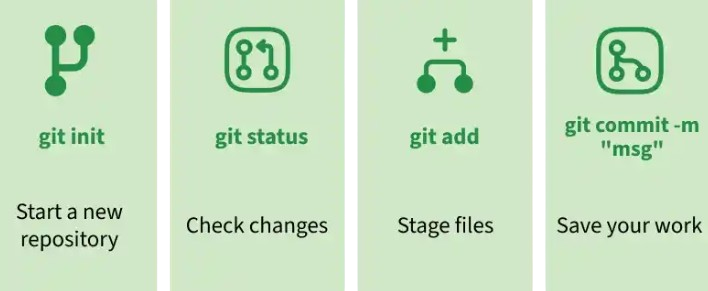
87. What Is Git And How Is It Used?
Ans:
Git is a distributed version control system used to manage source code efficiently. It records every modification made to project files. Developers create repositories to store project history. Git supports branching and merging for parallel development. Analysts use Git to collaborate on data analytics projects. Platforms like GitHub and Azure DevOps integrate with Git. Knowledge of Git is valuable during Microsoft interviews.
88. What Is Jupyter Notebook?
Ans:
- Jupyter Notebook is an interactive development environment widely used for Python programming and data analytics. It allows code, text, charts, and outputs to appear in a single document.
- Analysts use notebooks for exploratory data analysis and machine learning experiments. Visualizations are displayed immediately after execution. Notebook files support collaboration and documentation.
- Python libraries integrate seamlessly with Jupyter. It is one of the most popular tools among data professionals.
89. What Is Microsoft Azure And How Does Python Support It?
Ans:
Microsoft Azure is a cloud computing platform that provides services for storage, analytics, artificial intelligence, and application development. Python integrates with Azure services through SDKs and APIs. Analysts use Python to automate cloud workflows and process large datasets. Azure Machine Learning supports Python-based model development. Python also connects with Azure SQL Database and Azure Data Lake. Cloud integration enables scalable analytics solutions. Knowledge of Azure strengthens Microsoft interview performance.
90. What Skills Should A Microsoft Data Analytics Intern Have In Python?
Ans:
A Microsoft Data Analytics Intern should understand Python fundamentals, data structures, functions, and object-oriented programming. Strong knowledge of NumPy and Pandas is essential for data manipulation. Experience with Matplotlib and Seaborn helps create visual reports. SQL knowledge complements Python for database analysis. Familiarity with Git, Jupyter Notebook, and Azure is advantageous. Good analytical thinking and problem-solving abilities are highly valued. Effective communication skills also contribute to success in analytics roles.
91. What Interview Tips Help Crack A Microsoft Python Data Analytics Interview?
Ans:
Candidates should strengthen Python fundamentals before practicing analytical libraries. Regular coding practice improves confidence in technical rounds. Understanding SQL, data visualization, and basic machine learning concepts provides an advantage. Mock interviews help improve communication and problem-solving speed. Reviewing previous projects demonstrates practical experience. Writing clean and efficient code leaves a positive impression. Consistent preparation significantly increases interview success.
92. How Should A Candidate Prepare For Python Coding Interviews?
Ans:
Preparation should begin with Python syntax, loops, functions, and data structures. Candidates should practice solving coding problems on arrays, strings, dictionaries, and files. Data manipulation using Pandas should be performed regularly. Basic SQL queries and NumPy operations should also be reviewed. Time management is important during coding assessments. Explaining the solution clearly is as valuable as writing the code. Continuous practice builds confidence for Microsoft interviews.
93. Why Is Problem-Solving Important In Data Analytics?
Ans:
- Problem-solving enables analysts to convert raw business data into meaningful insights. Strong analytical thinking helps identify the root cause of business issues.
- Python provides tools for cleaning, transforming, and analyzing complex datasets. Logical reasoning improves the efficiency of coding solutions. Employers evaluate both technical and analytical abilities during interviews.
- Effective problem-solving contributes to better decision-making. It is one of the most valuable skills for a Microsoft Data Analytics Intern.
94. Write A Python Program To Find The Largest Number In A List
Ans:
- numbers = [12, 45, 7, 89, 34]
- largest = max(numbers)
- print(“Largest Number:”, largest)
95. Write A Python Program To Count The Frequency Of Each Word In A Sentence.
Ans:
The sentence is split into individual words. A dictionary stores each word as a key and counts its occurrences. This technique is frequently used in text analytics.
- sentence = “python is easy and python is powerful”
- words = sentence.split()
- frequency = {}
- for word in words:
- frequency[word] = frequency.get(word, 0) + 1
- print(frequency)
96. Write A Python Program To Read A CSV File Using Pandas.
Ans:
The read_csv() function imports data from a CSV file into a DataFrame. The head() function displays the first five rows for quick inspection.
- import pandas as pd
- df = pd.read_csv(“employees.csv”)
- print(df.head())
97. Write A Python Program To Remove Duplicate Rows From A DataFrame
Ans:
- import pandas as pd
- data = {
- “Name”: [“John”, “Mary”, “John”],
- “Age”: [25, 30, 25]
- }
- df = pd.DataFrame(data)
- df = df.drop_duplicates()
- print(df)
The drop_duplicates() method removes repeated rows from a DataFrame. Data cleaning often begins by eliminating duplicate records before analysis.
98. Write A Python Program To Find The Average Salary From A DataFrame.
Ans:
The mean() function calculates the arithmetic average of a numeric column. This operation is commonly used in business reporting and employee salary analysis.
- import pandas as pd
- data = {
- “Employee”: [“A”, “B”, “C”]
- “Salary”: [50000, 60000, 70000]
- }
- df = pd.DataFrame(data)
- average_salary = df[“Salary”].mean()
- print(“Average Salary:”, average_salary)
99. Write A Python Program To Filter Employees Whose Salary Is Greater Than 50000.
Ans:
Boolean indexing filters rows that satisfy a condition. This approach is frequently used to generate reports based on business rules or performance criteria.
- import pandas as pd
- data = {
- “Employee”: [“A”, “B”, “C”],
- “Salary”: [45000, 60000, 75000]
- }
- df = pd.DataFrame(data)
- result = df[df[“Salary”] > 50000]
- print(result)
100. Write A Python Program To Group Employees By Department And Calculate The Average Salary.
Ans:
The groupby() function groups records by department, and mean() calculates the average salary for each group. This is one of the most common Python coding questions asked in Microsoft Data Analytics Intern interviews because it demonstrates data aggregation and reporting skills..
- import pandas as pd
- data = {
- “Department”: [“HR”, “IT”, “HR”, “IT”, “Sales”],
- “Salary”: [40000, 70000, 50000, 80000, 60000]
- }
- df = pd.DataFrame(data)
- result = df.groupby(“Department”)[“Salary”].mean()
- print(result)