LMS
LMS
Last updated on 10th Aug 2026| 7618

Cognizant Aptitude Test Questions And Answers Help Candidates Prepare For The Quantitative, Logical, Analytical, Data Interpretation, And Verbal Ability Sections Commonly Included In Placement Assessments. This Preparation Covers Important Topics Such As Pattern Recognition, Mathematical Reasoning, Logical Deductions, Arrangement-Based Problems, Decision-Making, Tables, Bar Graphs, Line Graphs, Pie Charts, Caselets, Percentage-Based Data, And Comparison Of Data. The Questions Are Designed To Improve Numerical Accuracy, Logical Thinking, Data Analysis, Problem-Solving Ability, And Time Management. Candidates Can Also Practice Verbal Ability Topics Such As Reading Comprehension, Synonyms And Antonyms, Sentence Correction, And Grammar. For Technical Assessments, Basic Programming Topics Such As Arrays, Strings, Loops, Functions, Recursion, And Sorting Can Also Be Practiced. Regular Practice With Aptitude Questions And Step-By-Step Solutions Helps Build Confidence And Improve Performance In Cognizant Placement Tests.
1. Find The LCM Of 15 And 20.
Ans:
The LCM (Least Common Multiple) is the smallest number that is divisible by both numbers. The prime factors of 15 are 3 × 5, and the prime factors of 20 are 2 × 2 × 5. Multiply each prime factor using the highest power: 2 × 2 × 3 × 5 = 60. LCM questions check knowledge of multiples and prime factorization. These questions commonly appear in placement aptitude exams.
- 15 = 3 × 5
- 20 = 2 × 2 × 5
- LCM = 2 × 2 × 3 × 5
- Answer = 60
2. Find The HCF Of 48 And 72
Ans:
The HCF (Highest Common Factor) is the greatest number that divides both numbers exactly. The factors of 48 include 1, 2, 3, 4, 6, 8, 12, 16, 24, and 48. The factors of 72 include 1, 2, 3, 4, 6, 8, 9, 12, 18, 24, 36, and 72. The greatest common factor is 24. Therefore, the HCF of 48 and 72 is 24.
- 48 = 2 × 2 × 2 × 2 × 3
- 72 = 2 × 2 × 2 × 3 × 3
- Common Factors = 2 × 2 × 2 × 3
- HCF = 24
- Answer = 24
3. Find The Remainder When 125 Is Divided By 7.
Ans:
To find the remainder, divide 125 by 7 and identify the value left after the largest possible multiple of 7 is subtracted. The largest multiple of 7 less than 125 is 119. Subtracting 119 from 125 gives 6. Therefore, the remainder is 6. Remainder-based questions test basic division concepts and frequently appear in aptitude tests..
- 125 ÷ 7
- Largest Multiple Of 7 Below 125 = 119
- 125 − 119 = 6
- Remainder = 6
- Answer = 6
4. Find 20% Of 450.
Ans:
Percentage means a value expressed out of 100. To calculate 20% of 450, multiply 450 by 20 and divide the result by 100. The calculation gives 90. Therefore, 20% of 450 is 90. Percentage questions are important because they are also used in profit, loss, interest, and data interpretation problems.
- 20% Of 450 = 450 × 20 ÷ 100
- 450 × 20 = 9000
- 9000 ÷ 100 = 90
- Answer = 90
5. A Number Is Increased From 200 To 250. Find The Percentage Increase.
Ans:
Percentage increase is calculated by dividing the increase by the original value and multiplying by 100. The increase from 200 to 250 is 50. Dividing 50 by 200 and multiplying by 100 gives 25%. Therefore, the percentage increase is 25%. Such questions are commonly asked in placement aptitude examinations
- Increase = 250 − 200
- Increase = 50
- Percentage Increase = 50 ÷ 200 × 100
- Percentage Increase = 25%
- Answer = 25%
6. A Student Scores 360 Marks Out Of 500. Find The Percentage.
Ans:
Percentage is calculated by dividing the marks obtained by the total marks and multiplying by 100. The student has scored 360 out of 500 marks. Dividing 360 by 500 gives 0.72, and multiplying by 100 gives 72%. Therefore, the student’s percentage is 72%.
- Percentage = Marks Obtained ÷ Total Marks × 100
- Percentage = 360 ÷ 500 × 100
- 360 ÷ 500 = 0.72
- 0.72 × 100 = 72%
- Answer = 72%
7. An Item Is Bought For ₹800 And Sold For ₹1,000. Find The Profit Percentage.
Ans:
Profit is the difference between the selling price and the cost price. Here, the cost price is ₹800 and the selling price is ₹1,000, so the profit is ₹200. Profit percentage is calculated by dividing the profit by the cost price and multiplying by 100. Therefore, the profit percentage is 25%.
- Cost Price = ₹800
- Selling Price = ₹1000
- Profit = ₹1000 − ₹800 = ₹200
- Profit Percentage = ₹200 ÷ ₹800 × 100
- Profit Percentage = 25%
- Answer = 25%
8. An Article Is Bought For ₹1,500 And Sold For ₹1,200. Find The Loss Percentage.
Ans:
Loss occurs when the selling price is less than the cost price. The loss is ₹300 because ₹1,500 − ₹1,200 equals ₹300. Loss percentage is calculated by dividing the loss by the cost price and multiplying by 100. Therefore, the loss percentage is 20%.
- Cost Price = ₹1500
- Selling Price = ₹1200
- Loss = ₹1500 − ₹1200 = ₹300
- Loss Percentage = ₹300 ÷ ₹1500 × 100
- Loss Percentage = 20%
- Answer = 20%
9. Divide ₹600 In The Ratio 2:3.
Ans:
To divide an amount in a given ratio, first add the ratio values. Here, 2 + 3 gives 5 parts. One part is obtained by dividing ₹600 by 5, which gives ₹120. The first share is 2 × ₹120 = ₹240, and the second share is 3 × ₹120 = ₹360. Therefore, the two shares are ₹240 and ₹360.
- Ratio = 2:3
- Total Parts = 2 + 3 = 5
- One Part = ₹600 ÷ 5 = ₹120
- First Share = 2 × ₹120 = ₹240
- Second Share = 3 × ₹120 = ₹360
- Answer = ₹240 And ₹360
10. If 4 Pens Cost ₹60, What Is The Cost Of 10 Pens?
Ans:
This is a direct proportion problem because the cost increases as the number of pens increases. The cost of one pen is ₹60 divided by 4, which is ₹15. Therefore, the cost of 10 pens is 10 × ₹15, giving ₹150. Proportion questions test the relationship between quantities.
- 4 Pens = ₹60
- Cost Of 1 Pen = ₹60 ÷ 4 = ₹15
- Cost Of 10 Pens = 10 × ₹15
- Cost Of 10 Pens = ₹150
- Answer = ₹150
11. Find The Average Of 10, 20, 30, 40, And 50.
Ans:
Average is calculated by adding all the values and dividing the total by the number of values. The sum of the five numbers is 150. Since there are five numbers, divide 150 by 5. The result is 30. Therefore, the average of the given numbers is 30.
- Sum = 10 + 20 + 30 + 40 + 50
- Sum = 150
- Number Of Values = 5
- Average = 150 ÷ 5
- Average = 30
- Answer = 30
12. The Average Of 6 Numbers Is 25. Find Their Total.
Ans:
When the average and number of values are known, the total can be found by multiplying the average by the number of values. Here, the average is 25 and there are 6 numbers. Multiplying 25 by 6 gives 150. Therefore, the total of the six numbers is 150.
- Average = 25
- Number Of Values = 6
- Total = Average × Number Of Values
- Total = 25 × 6
- Total = 150
- Answer = 150
13. Find The Simple Interest On ₹5,000 At 10% Per Year For 2 Years.
Ans:
Simple Interest is calculated based on the principal amount, rate of interest, and time period. The principal is ₹5,000, the rate is 10%, and the time is 2 years. Applying the simple interest calculation gives ₹1,000. Therefore, the simple interest is ₹1,000. These questions test basic interest calculations.
- Principal = ₹5000
- Rate = 10%
- Time = 2 Years
- Simple Interest = P × R × T ÷ 100
- SI = 5000 × 10 × 2 ÷ 100
- SI = ₹1000
- Answer = ₹1000
14. Find The Compound Interest On ₹2,000 At 10% Per Year For 2 Years.
Ans:
Compound Interest is calculated by applying interest to the principal as well as the accumulated interest. After the first year, ₹2,000 becomes ₹2,200. During the second year, 10% interest is calculated on ₹2,200, resulting in ₹2,420. The total compound interest is therefore ₹420. Compound interest questions are common in quantitative aptitude tests.
- Principal = ₹2000
- First Year Amount = ₹2000 + 10% Of ₹2000 = ₹2200
- Second Year Interest = 10% Of ₹2200 = ₹220
- Final Amount = ₹2200 + ₹220 = ₹2420
- Compound Interest = ₹2420 − ₹2000
- Compound Interest = ₹420
- Answer = ₹420
15. . A Can Complete A Work In 10 Days. What Fraction Of The Work Is Completed In One Day?
Ans:
If a person completes an entire work in 10 days, the work completed in one day is one divided by 10. Therefore, the daily work rate is 1/10 of the total work. Time and work questions use the concept of work rate. This concept is also useful when two or more people work together.
- A Completes The Work In = 10 Days
- Total Work = 1
- One Day’s Work = 1 ÷ 10
- One Day’s Work = 1/10
- Answer = 1/10 Of The Work
16. A Can Complete A Work In 12 Days And B Can Complete It In 18 Days. How Many Days Will They Take Together?
Ans:
A completes 1/12 of the work in one day, while B completes 1/18 of the work in one day. Their combined work rate is 1/12 + 1/18. Taking 36 as the common denominator gives 3/36 + 2/36 = 5/36. Therefore, the total time required is 36/5 days, which is 7.2 days.
- A’s One Day Work = 1/12
- B’s One Day Work = 1/18
- Combined Work = 1/12 + 1/18
- Combined Work = 3/36 + 2/36 = 5/36
- Time = 36/5 Days
- Time = 7.2 Days
- Answer = 7.2 Days
17. A Car Travels At 60 Km/H. How Far Will It Travel In 3 Hours?
Ans:
Distance is calculated by multiplying speed by time. The car travels at 60 km/h and continues for 3 hours. Multiplying 60 by 3 gives 180 kilometers. Therefore, the car will travel a distance of 180 kilometers. Time, speed, and distance questions are frequently included in aptitude tests.
- Speed = 60 Km/H
- Time = 3 Hours
- Distance = Speed × Time
- Distance = 60 × 3
- Distance = 180 Km
- Answer = 180 Km
18. A Train Travels 240 Km In 4 Hours. Find Its Speed.
Ans:
Speed is calculated by dividing the distance travelled by the time taken. The train covers 240 kilometers in 4 hours. Dividing 240 by 4 gives 60 kilometers per hour. Therefore, the speed of the train is 60 km/h. This type of question tests the basic relationship between distance, speed, and time.
- Distance = 240 Km
- Time = 4 Hours
- Speed = Distance ÷ Time
- Speed = 240 ÷ 4
- Speed = 60 Km/H
- Answer = 60 Km/H
19. A Person Walks At 5 Km/H For 2 Hours. Find The Distance Covered.
Ans:
Distance can be calculated by multiplying speed by time. The walking speed is 5 km/h and the person walks for 2 hours. Multiplying these values gives 10 kilometers. Therefore, the person covers a distance of 10 kilometers. Such direct formula-based questions can be solved quickly during aptitude tests.
- Speed = 5 Km/H
- Time = 2 Hours
- Distance = Speed × Time
- Distance = 5 × 2
- Distance = 10 Km
- Answer = 10 Km
20. The Present Age Of A Father Is 40 Years And His Son Is 10 Years. What Will Be Their Age Ratio After 5 Years?
Ans:
After 5 years, the father’s age will become 45 years and the son’s age will become 15 years. The ratio will therefore be 45:15. Dividing both values by 15 simplifies the ratio to 3:1. Age problems require careful attention to the same time period being added to or subtracted from all ages.
- Father’s Present Age = 40 Years
- Son’s Present Age = 10 Years
- Father’s Age After 5 Years = 45 Years
- Son’s Age After 5 Years = 15 Years
- Ratio = 45:15
- Simplified Ratio = 3:1
- Answer = 3:1
21. A Is 8 Years Older Than B. If B Is 12 Years Old, Find A’s Age.
Ans:
The age difference between A and B is 8 years. Since B is currently 12 years old, A’s age can be found by adding 8 years to B’s age. Therefore, A is 20 years old. Age difference questions are among the simpler problems in quantitative aptitude.
- B’s Age = 12 Years
- A Is 8 Years Older Than B
- A’s Age = 12 + 8
- A’s Age = 20 Years
- Answer = 20 Years
22. What Is The Probability Of Getting A Head When A Fair Coin Is Tossed Once?
Ans:
A fair coin has two equally likely outcomes: Head and Tail. The total number of possible outcomes is therefore 2. Only one outcome is favorable for getting a Head. Probability is calculated by dividing favorable outcomes by total possible outcomes. Therefore, the probability of getting a Head is 1/2
- Total Outcomes = 2
- Possible Outcomes = Head, Tail
- Favorable Outcomes = 1
- Probability = Favorable Outcomes ÷ Total Outcomes
- Probability = 1 ÷ 2
- Answer = 1/2
23. A Die Is Rolled Once. What Is The Probability Of Getting An Even Number?
Ans:
A standard die contains six possible outcomes: 1, 2, 3, 4, 5, and 6. The even numbers are 2, 4, and 6, giving three favorable outcomes. Therefore, the probability is 3 divided by 6, which simplifies to 1/2. Probability questions test the ability to identify favorable and total outcomes.
- Total Outcomes = 6
- Even Numbers = 2, 4, 6
- Favorable Outcomes = 3
- Probability = 3 ÷ 6
- Probability = 1/2
- Answer = 1/2
24. In How Many Ways Can 3 Different Books Be Arranged On A Shelf?
Ans:
When all different objects are arranged in different orders, permutation is used. Three different books can be arranged in 3 factorial ways. The calculation is 3 × 2 × 1, which equals 6. Therefore, the three books can be arranged in 6 different ways.
- Number Of Books = 3
- Permutation = 3!
- 3! = 3 × 2 × 1
- 3! = 6
- Answer = 6 Ways
25. In How Many Ways Can 2 Students Be Selected From A Group Of 5 Students?
Ans:
Selection problems where order does not matter are solved using combinations. Here, 2 students must be selected from 5 students. The number of possible selections is calculated using 5C2. This gives 5 × 4 divided by 2 × 1, resulting in 10. Therefore, 2 students can be selected in 10 ways.
- Total Students = 5
- Students To Be Selected = 2
- Combination = 5C2
- 5C2 = 5 × 4 ÷ (2 × 1)
- 5C2 = 10
- Answer = 10 Ways
26. A Company Sold 100, 150, 200, And 250 Units In Four Months. Find The Total Sales.
Ans:
To find the total sales, add the number of units sold in all four months. The values are 100, 150, 200, and 250. Their total is 700 units. Data interpretation questions require accurate reading and basic arithmetic operations on tables, charts, or graphs.
- Month 1 = 100 Units
- Month 2 = 150 Units
- Month 3 = 200 Units
- Month 4 = 250 Units
- Total = 100 + 150 + 200 + 250
- Total = 700 Units
- Answer = 700 Units
27. A Store Sold 500 Items In January And 600 Items In February. Find The Percentage Increase
Ans:
The increase in sales is 100 items because 600 − 500 equals 100. To find the percentage increase, divide the increase by the January sales and multiply by 100. The calculation gives 20%. Therefore, the store’s sales increased by 20% from January to February.
- January Sales = 500 Units
- February Sales = 600 Units
- Increase = 600 − 500 = 100 Units
- Percentage Increase = 100 ÷ 500 × 100
- Percentage Increase = 20%
- Answer = 20%
28. The Sales Of A Product Are 120 Units On Monday And 180 Units On Tuesday. Find The Average Sales.
Ans:
Average sales are found by adding the sales for both days and dividing the total by the number of days. The total sales are 120 + 180, which equals 300 units. Dividing 300 by 2 gives 150 units. Therefore, the average daily sales are 150 units.
- Monday Sales = 120 Units
- Tuesday Sales = 180 Units
- Total Sales = 120 + 180 = 300 Units
- Number Of Days = 2
- Average = 300 ÷ 2
- Average = 150 Units
- Answer = 150 Units
29. A Company Has 400 Employees, Of Which 240 Are Male. Find The Percentage Of Female Employees.
Ans:
The number of female employees is obtained by subtracting the number of male employees from the total employees. Therefore, there are 160 female employees. Dividing 160 by the total of 400 employees and multiplying by 100 gives 40%. Therefore, female employees represent 40% of the total workforce.
- Total Employees = 400
- Male Employees = 240
- Female Employees = 400 − 240 = 160
- Female Percentage = 160 ÷ 400 × 100
- Female Percentage = 40%
- Answer = 40%
30. A Shop’s Monthly Sales Are ₹20,000, ₹25,000, ₹30,000, And ₹25,000. Find The Average Monthly Sales.
Ans:
Average monthly sales are calculated by adding the sales of all four months and dividing the total by four. The total sales are ₹20,000 + ₹25,000 + ₹30,000 + ₹25,000, which equals ₹1,00,000. Dividing this amount by 4 gives ₹25,000. Therefore, the average monthly sales are ₹25,000.
- Sales = ₹20,000 + ₹25,000 + ₹30,000 + ₹25,000
- Total Sales = ₹1,00,000
- Number Of Months = 4
- Average = ₹1,00,000 ÷ 4
- Average = ₹25,000
- Answer = ₹25,000
31. Find The Missing Number: 2, 6, 12, 20, 30, ?
Ans:
The Given Number Series Follows A Pattern Based On Increasing Differences Between Consecutive Numbers. The Differences Are 4, 6, 8, And 10, Which Increase By 2 At Each Step. Therefore, The Next Difference Should Be 12. Adding 12 To The Previous Number 30 Gives 42. The Pattern Can Also Be Represented As 1×2, 2×3, 3×4, 4×5, And 5×6, So The Next Term Is 6×7. Therefore, The Missing Number In The Series Is 42. Correct Answer: 42.

32. Find The Missing Number: 3, 9, 27, 81, ?
Ans:
The Given Number Series Follows A Simple Multiplication Pattern. Each Number Is Multiplied By 3 To Obtain The Next Number In The Series. Starting With 3, Multiplying By 3 Gives 9, Then 9×3 Gives 27, And 27×3 Gives 81. Continuing The Same Pattern, 81×3 Gives 243. There Is No Change In The Multiplication Rule Throughout The Series. Therefore, The Missing Number Is 243. Correct Answer: 243.
33. If CAT Is Coded As DBU, How Is DOG Coded?
Ans:
- The Given Coding Pattern Changes Each Letter Into The Immediately Following Letter In The Alphabet. In CAT, C Becomes D, A Becomes B, And T Becomes U, Resulting In DBU.
- Applying The Same Rule To DOG, D Becomes E, O Becomes P, And G Becomes H. Therefore, The Letters Of DOG Are Shifted One Position Forward. T
- his Produces The Coded Word EPH. The Coding Rule Is Consistent For Every Letter. Correct Answer: EPH.
34. If BOOK Is Written As CPPL, How Is PEN Written?
Ans:
The Coding Pattern Used In BOOK To CPPL Is Based On Moving Every Letter One Position Forward In The Alphabet. B Becomes C, O Becomes P, O Becomes P, And K Becomes L, Producing CPPL. Applying The Same Pattern To PEN, P Becomes Q, E Becomes F, And N Becomes O. Therefore, PEN Is Converted Into QFO. Each Letter Is Shifted Exactly One Position Forward. Hence, The Required Coded Word Is QFO. Correct Answer: QFO..
35. Pointing To A Man, Ravi Says, “He Is The Son Of My Mother’s Only Son.” Who Is The Man?
Ans:
The Statement Can Be Solved By Identifying Ravi’s Mother’s Only Son. Since Ravi Is The Speaker And Is Described As The Only Son Of His Mother, The Phrase “My Mother’s Only Son” Refers To Ravi Himself. The Man Being Pointed To Is Therefore The Son Of Ravi. This Means The Person Is Ravi’s Son. The Relationship Can Be Found By Breaking The Statement Into The Mother’s Son And His Son. Hence, The Man Is Ravi’s Son. Correct Answer: Ravi’s Son.
36. A Is The Brother Of B. B Is The Sister Of C. How Is A Related To C?
Ans:
A Is The Brother Of B, Which Establishes That A Is Male And B Is A Sibling Of A. B Is The Sister Of C, Meaning B And C Are Also Siblings. Therefore, A And C Are Siblings Through B. Since A Is Male, A Must Be The Brother Of C. The Exact Gender Of C Does Not Affect A’s Relationship With C. Thus, A Is Related To C As A Brother. Correct Answer: Brother.
37. A Person Walks 5 Km North, Then 3 Km East. In Which Direction Is The Person From The Starting Point?
Ans:
The Person Initially Moves 5 Km Toward The North From The Starting Point. After Reaching That Position, The Person Moves 3 Km Toward The East. The Final Position Is Therefore Located Above And To The Right Of The Starting Point. A Position Combining North And East Is Described As North-East. The Question Asks Only For The Direction, So The Exact Distance From The Starting Point Is Not Necessary. Therefore, The Person Is In The North-East Direction From The Starting Point. Correct Answer: North-East.
38. Ravi Walks 10 Meters South And Then Turns Left And Walks 5 Meters. Which Direction Is He Facing?
Ans:
- Ravi Initially Walks In The South Direction. After Walking South, He Turns Left. When A Person Is Facing South, A Left Turn Changes The Direction Toward East.
- Therefore, Ravi Walks East After Making The Left Turn. The Distance Of 10 Meters Or 5 Meters Does Not Affect The Direction Being Asked.
- The Important Point Is That A Left Turn From South Leads To East. Hence, Ravi Is Facing East After The Turn. Correct Answer: East.
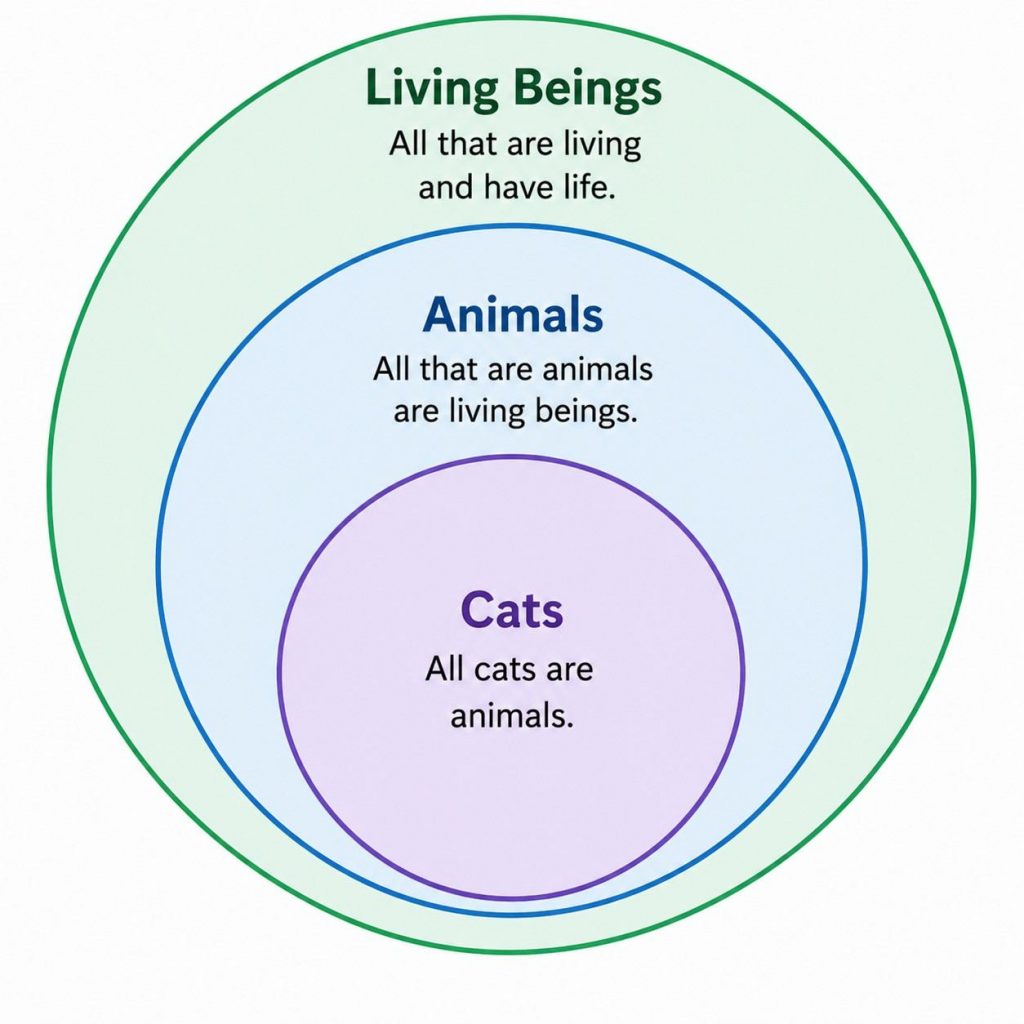
39. Statements: All Cats Are Animals. All Animals Are Living Beings. Conclusion: All Cats Are Living Beings. Is The Conclusion Correct?
Ans:
The First Statement Says That All Cats Belong To The Category Of Animals. The Second Statement Says That All Animals Belong To The Category Of Living Beings. Therefore, If Every Cat Is An Animal And Every Animal Is A Living Being, Every Cat Must Also Be A Living Being. The Conclusion Directly Follows From The Two Statements. No Additional Information Is Required To Establish This Relationship. Therefore, The Given Conclusion Is Logically Valid. Correct Answer: Conclusion Follows.
40. Statements: All Pens Are Books. Some Books Are Bags. Conclusion: Some Pens Are Bags. Is The Conclusion Correct?
Ans:
The First Statement Establishes That All Pens Belong To The Category Of Books. The Second Statement States That Some Books Are Bags, But It Does Not Specify That Those Books Include Any Pens. Therefore, It Cannot Be Concluded That Some Pens Are Bags. The Conclusion Requires Additional Information Connecting Pens With The Books That Are Bags. Since Such Information Is Not Provided, The Conclusion Is Not Guaranteed. Therefore, The Given Conclusion Does Not Follow From The Statements. Correct Answer: Conclusion Does Not Follow.
41. Five Persons A, B, C, D, And E Sit In A Row. A Sits At The Left End And E At The Right End. B Sits Next To A. Who Sits In The Middle?
Ans:
There Are Five Positions In The Row, With A Fixed At The First Position And E Fixed At The Fifth Position. Since B Must Sit Next To A, B Occupies The Second Position. This Leaves The Third And Fourth Positions For C And D. The Third Position Is The Middle Position In A Row Of Five People. Since Either C Or D Can Occupy The Third Position, The Middle Person Cannot Be Determined Uniquely. Therefore, Either C Or D Can Sit In The Middle. Correct Answer: C Or D.
42. Four Persons P, Q, R, And S Sit In A Row. P Sits To The Left Of Q, And R Sits To The Right Of Q. Where Can S Be Placed?
Ans:
The Given Conditions Establish That P Must Be Somewhere To The Left Of Q And R Must Be Somewhere To The Right Of Q. Therefore, The Relative Order Of P, Q, And R Must Be Maintained. Person S Is Not Given Any Specific Relationship With The Other Three People. As A Result, S Can Occupy Any Remaining Position That Does Not Violate The Given Conditions. Several Arrangements Are Possible Based On The Position Of S. Therefore, The Exact Position Of S Cannot Be Determined From The Information Provided. Correct Answer: Position Of S Cannot Be Uniquely Determined.
43. A, B, C, And D Have Different Heights. A Is Taller Than B. C Is Taller Than A. D Is Shorter Than B. Who Is The Tallest?
Ans:
The Given Information States That A Is Taller Than B, So A Has A Greater Height Than B. It Also States That C Is Taller Than A, Which Means C Is Taller Than Both A And B. D Is Shorter Than B, So D Is Shorter Than A And C As Well. Therefore, The Height Order From Tallest To Shortest Is C, A, B, D. Since C Is Taller Than Every Other Person In The Group, C Is The Tallest. Correct Answer: C.
44. In A Class, 40 Students Like Cricket, 30 Like Football, And 10 Like Both. How Many Students Like Cricket Or Football?
Ans:
- There Are 40 Students Who Like Cricket And 30 Students Who Like Football. Among These Students, 10 Like Both Cricket And Football, So These 10 Students Are Counted Twice When The Two Groups Are Added.
- To Avoid Double Counting, The Common Group Of 10 Must Be Subtracted Once. Therefore, The Total Number Of Students Who Like Cricket Or Football Is 40 + 30 − 10.
- This Gives A Total Of 60 Students. Hence, 60 Students Like At Least One Of The Two Sports. Correct Answer: 60 Students.
45. Find The Odd One Out: Apple, Mango, Banana, Carrot
Ans:
LineApple, Mango, And Banana Are Generally Classified As Fruits. Carrot, On The Other Hand, Is Commonly Classified As A Vegetable. Therefore, Three Items In The List Belong To The Same General Category, While Carrot Belongs To A Different Category. The Question Requires Identifying The Item That Does Not Match The Classification Of The Others. Since Carrot Is The Only Vegetable Among The Listed Items, It Is The Odd One Out. Therefore, Carrot Is The Correct Choice. Correct Answer: Carrot.
46. Find The Odd One Out: 16, 25, 36, 49, 63
Ans:
The Numbers 16, 25, 36, And 49 Follow A Perfect Square Pattern. The Number 16 Is 4², 25 Is 5², 36 Is 6², And 49 Is 7². The Next Number Following This Pattern Would Be 64, Which Is 8². However, 63 Is Not A Perfect Square Of A Whole Number. Therefore, 63 Does Not Follow The Pattern Of The Other Numbers. Hence, 63 Is The Odd Number In The Given Series. Correct Answer: 63.
47. Doctor : Hospital :: Teacher : ?
Ans:
The Given Analogy Connects A Profession With The Place Where The Professional Commonly Works. A Doctor Is Associated With A Hospital Because A Hospital Is A Common Workplace For Doctors. Similarly, A Teacher Is Associated With A School Because A School Is A Common Workplace For Teachers. Therefore, The Same Relationship Must Be Applied To The Second Pair. The Appropriate Place Associated With A Teacher Is A School. Hence, The Missing Word In The Analogy Is School. Correct Answer: School.
48. Bird : Nest :: Lion : ?
Ans:
The Analogy Connects An Animal With Its Common Shelter Or Living Place. A Bird Lives Or Builds Its Shelter In A Nest. Similarly, A Lion Is Commonly Associated With A Den As Its Shelter. Therefore, The Relationship Between Bird And Nest Should Be Applied To Lion And Its Shelter. Among The Possible Relationships, Den Best Matches The Pattern. Hence, The Correct Word For The Analogy Is Den. Correct Answer: Den.
49. What Is The Value Of X? Statement 1: X + 5 = 15. Statement 2: X Is A Positive Number.
Ans:
Statement 1 Provides A Direct Equation, X + 5 = 15, Which Can Be Solved To Find The Exact Value Of X. Subtracting 5 From Both Sides Gives X = 10. Therefore, Statement 1 Alone Is Sufficient To Determine The Value Of X. Statement 2 Only States That X Is Positive And Does Not Give Enough Information To Determine Its Exact Value. Thus, Statement 2 Alone Is Insufficient. Therefore, Statement 1 Alone Is Sufficient To Answer The Question. Correct Answer: Statement 1 Alone Is Sufficient
50. What Is The Age Of A? Statement 1: A Is 5 Years Older Than B. Statement 2: B Is 20 Years Old.
Ans:
- Statement 1 States That A Is 5 Years Older Than B, But It Does Not Provide B’s Exact Age. Statement 2 States That B Is 20 Years Old, But It Does Not Directly Provide A’s Age.
- When Both Statements Are Combined, A’s Age Can Be Calculated By Adding 5 Years To B’s Age. Therefore, A’s Age Is 20 + 5, Which Equals 25 Years.
- Neither Statement Alone Is Sufficient To Determine A’s Exact Age. Hence, Both Statements Together Are Sufficient. Correct Answer: Both Statements Together Are Sufficient; A Is 25 Years Old.
51. What Is Pattern Recognition In Aptitude Tests?
Ans:
Pattern Recognition In Aptitude Tests Involves Identifying A Repeated Rule Or Relationship In Given Data. The Data May Appear As Numbers, Symbols, Shapes, Letters, Or Sequences, And The Main Objective Is To Identify The Rule Connecting Different Elements. For Example, A Number Series May Increase By 3, 6, 9, And So On, Creating A Recognizable Pattern. Recognizing The Pattern Helps Predict The Next Element Quickly And Accurately. Common Questions Include Number Patterns, Letter Patterns, And Figure Patterns. Regular Practice Helps Improve Observation Skills, Logical Thinking, And Solving Speed.
52. How Can A Number Pattern Be Identified?
Ans:
A Number Pattern Can Be Identified By Comparing Consecutive Numbers And Looking For A Consistent Mathematical Relationship. The Difference Between Consecutive Terms Should Usually Be Checked First, And If The Differences Are Not Constant, Multiplication, Division, Or Another Operation May Be Involved. Squares, Cubes, Prime Numbers, And Alternating Patterns May Also Appear In Number Series. For Example, 2, 4, 8, 16 Follows A Multiplication-by-2 Pattern. Checking Multiple Relationships Helps Avoid Incorrect Assumptions And Improves Accuracy. Systematic Observation And Regular Practice Make Number Pattern Questions Easier To Solve.
53. What Is A Missing Number Pattern?
Ans:
A Missing Number Pattern Contains One Or More Unknown Values In A Sequence, And The Available Numbers Provide Clues About The Relationship Between The Terms. Differences, Ratios, Multiplication, Addition, And Alternating Operations Should Be Checked To Identify The Correct Rule. For Example, 5, 10, 15, ?, 25 Has A Constant Difference Of 5, So The Missing Number Is 20. Some Questions May Combine More Than One Mathematical Operation, Making Careful Analysis Necessary. The Sequence Should Be Examined From Different Angles Before Selecting An Answer. Careful Pattern Analysis Helps Determine The Correct Missing Value Quickly And Accurately.

Learn Software Testing Training Course to Build Your Skills
Weekday / Weekend BatchesSee Batch Details54. What Is Data Analysis?
Ans:
Data Analysis Is The Process Of Examining Information To Identify Useful Results And Relationships. Aptitude Questions May Provide Numbers, Tables, Charts, Graphs, Or Written Information That Must Be Compared And Interpreted. Common Calculations Include Totals, Averages, Percentages, Ratios, And Differences. Attention Should Be Given To Units And The Exact Requirement Of The Question Before Starting Calculations. Unnecessary Calculations Should Be Avoided Because They Can Consume Valuable Examination Time. Correct Interpretation Of The Given Information Is As Important As Mathematical Calculation. Strong Data Analysis Skills Improve Accuracy, Efficiency, And Performance In Aptitude Tests.
55. How Is An Average Calculated From Given Data?
Ans:
An Average Is Calculated By Dividing The Total Of All Given Values By The Number Of Values In The Dataset. First, All The Values Should Be Added Carefully To Obtain The Total. Next, The Number Of Values Included In The Dataset Should Be Identified. The Total Is Then Divided By That Count To Obtain The Average. For Example, The Average Of 10, 20, And 30 Is 20. Average-Based Questions May Also Involve Missing Values, Changed Data, Or Additional Conditions. Understanding The Basic Average Calculation Helps Solve These Questions Quickly And Accurately.
56. What Is Logical Deduction?
Ans:
- Logical Deduction Means Reaching A Valid Conclusion From Given Information, Statements, Conditions, Or Relationships. Each Statement Must Be Considered Carefully Without Adding Any Unstated Assumptions.
- The Given Facts Are Used To Determine What Must Be True Or What Can Logically Follow From Them. Syllogisms, Statements And Conclusions, And Logical Puzzles Commonly Test This Ability.
- Logical Deduction Requires Careful Reading, Structured Thinking, And Step-by-Step Reasoning. Conclusions Should Always Be Based On The Information Provided In The Question. Regular Practice Helps Improve Accuracy In Complex Logical Reasoning Questions.
57. How Are Statements And Conclusions Solved?
Ans:
Statements And Conclusions Questions Provide Facts Followed By One Or More Possible Conclusions. Each Conclusion Should Be Checked Against The Information Provided In The Statements Without Using Personal Knowledge Or Outside Information. A Conclusion Should Be Selected Only When It Logically Follows From The Given Facts. If A Conclusion Cannot Be Confirmed From The Statements, It Should Not Be Considered Correct. Keywords Such As All, Some, None, And Only Can Significantly Change The Meaning Of A Statement. Careful Logical Evaluation Is Required To Distinguish Between A Definite Conclusion And An Assumption. This Approach Helps Select The Correct Conclusion With Greater Accuracy.
58. What Is Mathematical Reasoning?
Ans:
Mathematical Reasoning Uses Mathematical Relationships To Reach Logical Answers And Solve Problems. It Combines Basic Arithmetic With Analytical Thinking, Logical Understanding, And Problem-Solving Skills. Questions May Involve Numbers, Equations, Ratios, Percentages, Sequences, Or Other Mathematical Relationships. The Correct Formula Or Relationship Should First Be Identified Before Substituting The Given Values. Calculations Should Then Be Performed Systematically To Avoid Mistakes. Approximation Can Sometimes Be Used When An Exact Calculation Is Not Necessary Or When Answer Options Are Clearly Different. Regular Practice Improves Both Calculation Speed And Logical Accuracy.
59. How Can Mathematical Reasoning Questions Be Solved Quickly?
Ans:
Mathematical Reasoning Questions Can Be Solved Quickly By First Reading The Question Carefully And Identifying The Required Quantity. Important Numbers And Conditions Should Then Be Separated From Unnecessary Information. A Suitable Formula Or Mathematical Relationship Should Be Selected Before Beginning The Calculation. Simple Calculations Should Be Performed Before Attempting More Complex Operations. Approximation Can Be Useful When The Answer Options Are Widely Different And Exact Calculation Is Unnecessary. Answer Choices Can Also Be Used To Verify The Calculated Result Or Eliminate Incorrect Options. This Structured Approach Reduces Errors And Saves Valuable Time During The Aptitude Test.
60. What Are Arrangement-Based Problems?
Ans:
Arrangement-Based Problems Require Objects Or People To Be Placed According To Specific Conditions And Relationships. The Arrangement May Be Linear, Circular, Or Based On Particular Positions. Conditions May Specify Relative Positions, Neighbors, Directions, Order, Or Restrictions. A Diagram Or Position Table Can Make The Information Easier To Organize And Understand. Fixed Positions Or Strong Conditions Should Usually Be Identified Before Filling The Remaining Positions. After Creating The Arrangement, Every Given Condition Should Be Checked To Confirm That It Is Satisfied. Logical Arrangement Skills Are Important For Solving These Aptitude Questions Efficiently.
61. How Are Linear Seating Arrangement Questions Solved?
Ans:
Linear Seating Arrangement Problems Involve People Sitting In A Straight Row According To Given Conditions. The Number Of Positions And The Direction In Which People Are Facing Should First Be Identified. Fixed Or Strong Conditions Should Be Used Before Flexible Conditions To Build The Arrangement More Efficiently. If Everyone Faces The Same Direction, Left And Right Can Usually Be Assigned Normally, While Opposite-Facing People Require Careful Interpretation. A Simple Row Diagram Helps Prevent Position-Related Mistakes And Makes Relationships Easier To Track. Every Given Condition Should Be Verified After Completing The Arrangement. This Method Helps Reach The Correct Answer With Better Accuracy.
62. What Is A Circular Arrangement Problem?
Ans:
- Circular Arrangement Problems Require People Or Objects To Be Positioned Around A Circle According To Specific Conditions. The Arrangement May Involve People Facing Either Inside Or Outside The Circle, Which Affects The Interpretation Of Left And Right.
- One Person Can Usually Be Fixed At A Reference Position To Simplify The Arrangement Process. The Remaining People Can Then Be Positioned According To The Given Conditions.
- Neighboring And Opposite Positions Should Be Identified Carefully During The Arrangement. A Circular Diagram Makes The Relationships Between Different Positions Easier To Understand. Drawing The Arrangement Clearly Usually Makes These Questions Faster And Easier To Solve.
63. What Is Decision-Making In Aptitude Tests?
Ans:
Decision-Making Questions Test The Ability To Select The Best Choice From A Given Set Of Conditions And Requirements. The Question Usually Provides Rules, Restrictions, Requirements, Or Multiple Possible Actions That Need To Be Evaluated. Each Option Should Be Checked Against All The Conditions Provided In The Question. An Option That Violates Even One Important Mandatory Condition May Need To Be Eliminated. The Best Decision Is Generally The Option That Satisfies The Required Criteria Most Completely. Decisions Should Be Based On The Given Information Rather Than Personal Preference Or Assumptions. Systematic Elimination Helps Reach The Correct Decision Efficiently And Accurately.
64. How Are Decision-Making Questions Solved?
Ans:
Decision-Making Questions Should First Be Read Carefully To Understand The Requirements And Conditions. Important Restrictions Should Be Listed Or Mentally Organized Before Evaluating The Options. Each Available Option Should Then Be Compared Against The Requirements Given In The Question. Options That Violate Mandatory Conditions Should Be Eliminated Immediately. The Remaining Options Can Then Be Compared Using Secondary Conditions Or Additional Requirements. This Process Reduces The Number Of Choices That Need Detailed Analysis And Makes The Question Easier To Manage. The Final Option Should Satisfy All Essential Conditions Specified In The Question.
65. What Is Data Interpretation?
Ans:
Data Interpretation Means Understanding, Analyzing, And Drawing Conclusions From Numerical Information. The Information May Be Presented Through Tables, Charts, Graphs, Or Caselets. Questions Usually Ask For Totals, Differences, Ratios, Percentages, Comparisons, Or Trends Based On The Given Data. The Data Should Be Read Carefully Before Starting Any Calculation To Understand The Exact Requirement. Units Such As Thousands, Lakhs, Percentages, Or Millions Must Be Noticed Before Performing Calculations. Approximation May Be Used When Exact Values Are Not Required And The Answer Choices Allow It. Efficient Data Interpretation Improves Both Speed And Accuracy In Aptitude Tests..
66. How Are Table-Based Data Interpretation Questions Solved?
Ans:
Table-Based Data Interpretation Questions Present Numerical Information In Rows And Columns. The Required Row Or Column Should First Be Located Carefully According To The Question. Values Should Be Read According To The Exact Year, Category, Or Variable Mentioned. Calculations May Include Addition, Subtraction, Average, Ratio, Percentage, Or Difference. Comparing Unrelated Rows Or Columns Can Lead To Incorrect Answers, So The Question Should Be Matched With The Correct Data. Writing Down Important Values Can Reduce Calculation Errors And Make Multi-Step Problems Easier. Careful Reading Combined With Basic Arithmetic Is Usually Enough To Solve Table-Based Questions Effectively.
67. What Is A Bar Graph In Data Interpretation?
Ans:
A Bar Graph Represents Numerical Data Using Rectangular Bars Whose Length Or Height Corresponds To The Given Values. Bar Graphs May Present A Single Category Of Data Or Compare Multiple Categories. Questions Commonly Ask For Maximum, Minimum, Difference, Total, Ratio, Or Percentage Change. The Scale On The Horizontal Or Vertical Axis Must Be Checked Before Reading Any Value. Values Should Be Compared Only After Understanding The Units And Categories Represented By The Graph. Different Graphs May Use Different Scales, So Direct Visual Comparison Without Checking The Scale Can Be Misleading. Practice With Different Bar Graph Formats Improves Speed And Accuracy.
68. How Can Bar Graph Questions Be Solved Quickly?
Ans:
Bar Graph Questions Can Be Solved Quickly By First Identifying The Title, Categories, And Information Represented By The Graph. The Scale Of The Vertical Or Horizontal Axis Should Then Be Checked Carefully To Understand The Numerical Values. The Values Required For The Question Should Be Extracted From The Relevant Bars. Simple Addition Or Subtraction Can Answer Many Questions Directly Without Complicated Calculations. Percentage Or Ratio Questions Require Additional Calculation Using The Extracted Values. Only The Relevant Bars Should Be Considered To Avoid Wasting Time On Unnecessary Information. Careful Scale Reading Is The Most Important Step In Solving Bar Graph Problems Correctly.
69. What Is A Line Graph?
Ans:
- A Line Graph Shows How A Quantity Changes Across Different Points Or Periods By Connecting Data Points With Lines. Line Graphs Are Commonly Used To Represent Sales, Production, Population, Performance, Or Other Changing Data.
- Questions May Ask About Increases, Decreases, Maximum Values, Minimum Values, Differences, Or Percentage Changes. The Horizontal Axis Usually Represents Time Or Another Ordered Variable, While The Vertical Axis Represents The Measured Quantity.
- The Direction Of The Line Helps Show Whether The Data Is Increasing, Decreasing, Or Fluctuating. The Magnitude Of Change Between Data Points Can Also Be Calculated. Understanding The Overall Trend Helps Solve Line Graph Questions More Effectively.
70. How Are Line Graph Questions Solved?
Ans:
Line Graph Questions Should First Be Studied By Identifying The Horizontal And Vertical Axes. The Scale Of The Graph Should Then Be Carefully Observed To Understand The Values Represented By Each Division. Required Data Points Should Be Read According To Their Exact Positions On The Graph. Changes Between Two Periods Can Be Found By Subtracting The Earlier Value From The Later Value. Percentage Change Can Be Calculated When The Question Specifically Requires It. The Highest And Lowest Points Can Be Compared Directly After Reading Their Values Correctly. Careful Reading Of The Scale Helps Avoid Most Errors In Line Graph Questions..
71. What Is A Pie Chart?
Ans:
A Pie Chart Represents Different Parts Of A Whole Using Circular Sectors. Each Sector Represents A Category And Shows Its Share Of The Total Dataset. The Complete Circle Represents The Entire Dataset Or Total Quantity, While Larger Sectors Represent Larger Contributions. Questions Based On Pie Charts May Ask For Percentage, Quantity, Ratio, Difference, Or Comparison Between Sectors. Angles Can Also Be Used To Determine The Share Of A Particular Category. The Relationship Between Each Sector And The Complete Circle Is Important For Accurate Interpretation. Understanding Part-To-Whole Relationships Makes Pie Chart Questions Easier To Solve.

Get JOB Oriented Software TestingI Training for Beginners By MNC Experts
- Instructor-led Sessions
- Real-life Case Studies
- Assignments
72. How Are Pie Chart Questions Solved?
Ans:
Pie Chart Questions Should First Be Solved By Identifying The Total Quantity Or Total Percentage Represented By The Complete Circle. The Relevant Sector And Its Percentage Or Angle Should Then Be Located Carefully. If A Percentage Is Given, The Corresponding Quantity Can Be Calculated From The Total. If An Angle Is Given, It Can Be Compared With The Complete Circle To Determine The Relevant Share. Ratios Can Be Found By Comparing The Values Of Two Different Sectors. Only The Categories Relevant To The Question Need Detailed Calculation. Careful Reading Of Sector Labels And Values Helps Avoid Incorrect Interpretation.
73. What Are Caselet-Based Data Interpretation Questions?
Ans:
Caselet-Based Data Interpretation Questions Present Numerical Information Through A Short Paragraph Instead Of A Direct Table Or Chart. The Paragraph May Contain Information About Sales, Employees, Production, Expenses, Or Other Numerical Categories. Important Facts Must Be Extracted From The Written Description Before Performing Any Calculation. The Extracted Values Can Be Organized Into A Small Table To Make Relationships Easier To Understand. Questions May Ask For Totals, Ratios, Percentages, Differences, Or Comparisons. Careful Reading Is Important Because Relevant Information May Be Distributed Across Different Sentences. Converting The Caselet Into Structured Data Makes Calculations Easier And More Accurate.
74. How Can Percentage-Based Data Questions Be Solved?
Ans:
Percentage-Based Data Questions Usually Require Finding A Part, Whole, Increase, Decrease, Or Percentage Relationship. The Question Should First Be Examined To Determine Whether The Percentage Is Based On The Original Value Or The New Value. For Percentage Increase, The Change Is Compared With The Original Value, While A Percentage Decrease Uses The Original Value As The Reference. Successive Percentage Changes Should Not Usually Be Added Directly Because Each Change May Have A Different Base. Answer Options Can Sometimes Be Used To Verify The Final Calculation And Eliminate Incorrect Choices. Identifying The Correct Base Value Is The Most Important Step In Percentage-Based Questions. Careful Interpretation Of The Question Helps Produce The Correct Answer.
75. What Is Comparison Of Data?
Ans:
- Comparison Of Data Means Evaluating Two Or More Values To Identify Their Relationship. The Comparison May Involve Difference, Ratio, Percentage, Ranking, Growth, Or Decline. The Same Units Must Be Used Before Comparing Different Values, Such As Converting Thousands And Lakhs Into Compatible Units.
- Percentage Comparison Requires Careful Selection Of The Reference Value Because Different Reference Values Can Produce Different Results. Questions May Ask For The Largest, Smallest, Highest Growth, Lowest Growth, Or Greatest Difference.
- All Relevant Values Should Be Read Carefully Before Making A Comparison. Accurate Comparison Depends On Correctly Reading, Understanding, And Interpreting The Given Data.
76. How Is Percentage Difference Between Two Values Calculated?
Ans:
Percentage Difference Questions Begin By Identifying The Two Values That Need To Be Compared. The Difference Between The Two Values Should Then Be Calculated Carefully. The Appropriate Reference Or Original Value Must Be Determined From The Wording Of The Question. The Difference Is Then Compared Against The Correct Reference Value To Obtain The Percentage. The Final Result Is Expressed As A Percentage According To The Required Format. Care Should Be Taken Because Percentage Change And Percentage Difference Can Have Different Meanings And Reference Methods. Reading The Question Carefully And Identifying The Correct Base Prevents Common Calculation Errors.
77. How Can Data From Two Charts Be Compared?
Ans:
Data From Two Charts Can Be Compared By First Studying The First Chart And Identifying The Required Values. The Same Categories, Years, Or Periods Should Then Be Located In The Second Chart. The Relevant Values Can Be Compared Using Difference, Ratio, Percentage, Or Ranking According To The Question. Both Charts Must Be Checked For Compatible Units And Scales Before Any Calculation Is Performed. If Different Units Are Used, Appropriate Conversion Should Be Completed First. Only The Information Required For The Question Should Be Extracted To Save Time And Reduce Errors. Organized Comparison Of The Relevant Values Helps Solve Multiple-Chart Questions More Efficiently.
78. What Is Trend Analysis In Data Interpretation?
Ans:
Trend Analysis Identifies The General Direction Of Data Over A Period Of TMulti-Step Data Interpretation Questions Require More Than One Calculation Before The Final Answer Can Be Determined. The Question Should First Be Divided Into Smaller Calculation Steps To Make The Process Easier To Follow. Relevant Values Should Be Extracted From The Table, Chart, Or Caselet Before Beginning The Calculations. The First Calculation Should Be Completed And Checked Before Moving To The Next Step. Intermediate Results Should Be Verified To Avoid Carrying An Earlier Error Into The Final Answer. Unnecessary Calculations Should Be Avoided Because They Increase Both Time And The Possibility Of Mistakes. A Step-By-Step Approach Makes Complex Data Interpretation Questions More Manageable And Accurate.
79. How Are Multi-Step Data Interpretation Questions Solved?
Ans:
Multi-Step Data Interpretation Questions Require More Than One Calculation Before The Final Answer Can Be Determined. The Question Should First Be Divided Into Smaller Calculation Steps To Make The Process Easier To Follow. Relevant Values Should Be Extracted From The Table, Chart, Or Caselet Before Beginning The Calculations. The First Calculation Should Be Completed And Checked Before Moving To The Next Step. Intermediate Results Should Be Verified To Avoid Carrying An Earlier Error Into The Final Answer. Unnecessary Calculations Should Be Avoided Because They Increase Both Time And The Possibility Of Mistakes. A Step-By-Step Approach Makes Complex Data Interpretation Questions More Manageable And Accurate.
80. What Is The Best Strategy For Data Interpretation Questions?
Ans:
- The Best Strategy For Data Interpretation Questions Is To Read The Question First Instead Of Immediately Studying Every Data Point. The Required Categories, Years, Values, Or Comparisons Should Be Identified Before Examining The Entire Dataset.
- The Chart Scale, Units, Labels, And Categories Should Then Be Checked Carefully. Only Relevant Data Should Be Extracted For The Required Calculation To Save Time. Simple Arithmetic Should Be Preferred Over Lengthy Calculations Whenever Possible.
- Answer Options Can Be Used To Verify Results And Eliminate Clearly Incorrect Choices. Regular Timed Practice Improves Speed, Accuracy, Confidence, And Overall Performance In Data Interpretation Questions.
81. What Is Reading Comprehension?
Ans:
Reading Comprehension Tests The Ability To Understand And Interpret A Given Passage. The Questions Usually Focus On The Main Idea, Supporting Details, Inferences, Vocabulary, Tone, Or Conclusions Presented In The Passage. The Passage Should Be Read Carefully To Understand The Author’s Meaning And Purpose. Important Facts And Keywords Should Be Identified While Reading. Answers Should Be Based On The Information Provided In The Passage Rather Than Personal Opinions Or Outside Knowledge. Careful Reading Helps Avoid Confusion Between Directly Stated Information And Inferred Ideas. Regular Practice With Different Types Of Passages Improves Reading Speed, Vocabulary, And Accuracy.

82. What Are Synonyms And Antonyms?
Ans:
Synonyms Are Words That Have Similar Or Nearly Similar Meanings, While Antonyms Are Words That Have Opposite Meanings. Vocabulary Questions May Ask Candidates To Select A Word With A Meaning Similar To Or Opposite Of The Given Word. Understanding The Context Of A Word Is Important Because Some Words Can Have Different Meanings In Different Situations. Common Synonyms And Antonyms Can Be Learned Through Regular Reading And Vocabulary Practice. Eliminating Clearly Incorrect Options Can Also Help When The Meaning Is Not Immediately Known. Strong Vocabulary Knowledge Improves Performance In Verbal Ability And Reading Comprehension Questions. Regular Exposure To Newspapers, Articles, Books, And Practice Tests Can Further Strengthen Word Knowledge.
83. What Is Sentence Correction?
Ans:
Sentence Correction Questions Test Grammar, Vocabulary, Sentence Structure, And Correct Usage Of Language. A Sentence May Contain Errors In Subject-Verb Agreement, Tenses, Articles, Prepositions, Pronouns, Or Word Usage. The Sentence Should Be Read Carefully To Identify The Part That Sounds Grammatically Incorrect Or Inconsistent. The Correct Option Should Preserve The Intended Meaning While Improving Grammatical Accuracy. Special Attention Should Be Given To Verb Forms, Singular And Plural Subjects, And Appropriate Prepositions. Understanding Common Grammar Rules Helps Solve Sentence Correction Questions More Quickly. Regular Practice With Incorrect And Correct Sentences Improves Accuracy In Verbal Ability Tests.
84. What Is Grammar In Verbal Ability Tests?
Ans:
- Grammar Questions Evaluate Knowledge Of The Rules Used To Form Correct And Meaningful Sentences. Common Topics Include Tenses, Articles, Prepositions, Conjunctions, Pronouns, Adjectives, Adverbs, And Subject-Verb Agreement.
- Questions May Ask Candidates To Identify Errors, Complete Sentences, Or Select The Grammatically Correct Option. Understanding Sentence Structure Helps Identify Mistakes More Quickly. Context Should Also Be Considered Because The Correct Grammar Choice Must Fit The Meaning Of The Sentence.
- Regular Practice With Grammar Rules And Example Sentences Improves Accuracy And Confidence. Strong Grammar Skills Are Useful For Both Verbal Ability Tests And Professional Communication.
85. Reverse A Number
Ans:
- #include
- int main() {
- int n = 1234, rev = 0;
- while(n > 0) {
- rev = rev * 10 + n % 10;
- n /= 10;
- }
- printf(“%d”, rev);
- return 0;
- }
.
Ans:
86.Check Whether A String Is A Palindrome?
Ans:
A palindrome is a string or sequence that reads the same forward and backward. The string can be reversed and compared with the original string to determine whether it is a palindrome
- text = “madam”
- if text == text[::-1]:
- print(“Palindrome”)
- else:
- print(“Not Palindrome”)
87. Find The Factorial Of A Number?
Ans:
The factorial of a non-negative integer is the product of all positive integers from that number down to one. For example, the factorial of 5 is calculated as 5 × 4 × 3 × 2 × 1, which produces 120
- n = 5
- factorial = 1
- for i in range(1, n + 1):
- factorial *= i
- print(factorial)
88. Generate A Fibonacci Series?
Ans:
The Fibonacci series is a sequence in which each number is generally obtained by adding the previous two numbers. A common sequence begins with 0 and 1, followed by 1, 2, 3, 5, 8, and so on.
- n = 10
- a, b = 0, 1
- for i in range(n):
- print(a, end=” “)
- a, b = b, a + b
89. Check Whether A Number Is Prime?
Ans:
A prime number is a positive integer greater than 1 that has exactly two positive divisors: 1 and itself. To check whether a number is prime, the number can be tested for divisibility by integers starting from 2.
- n = 29
- is_prime = True
- if n < 2:
- is_prime = False
- else:
- for i in range(2, int(n ** 0.5) + 1):
- if n % i == 0:
- is_prime = False
- break
- print(“Prime” if is_prime else “Not Prime”)
90. Find The Largest And Smallest Element In An Array?
Ans:
The largest and smallest elements in an array can be found by traversing every element and comparing it with the current maximum and minimum values.
- numbers = [10, 5, 25, 8, 15]
- largest = numbers[0]
- smallest = numbers[0]
- for num in numbers:
- if num > largest:
- largest = num
- if num < smallest:
- smallest = num
- print(“Largest:”, largest)
- print(“Smallest:”, smallest)



![Top 40+ [Real – Time] Most Asked Zoho Aptitude Questions and Answers Interview Questions](https://www.acte.in/wp-content/uploads/2026/07/ChatGPT-Image-Jul-23-2026-12_19_05-PM-400x218.png)