LMS
LMS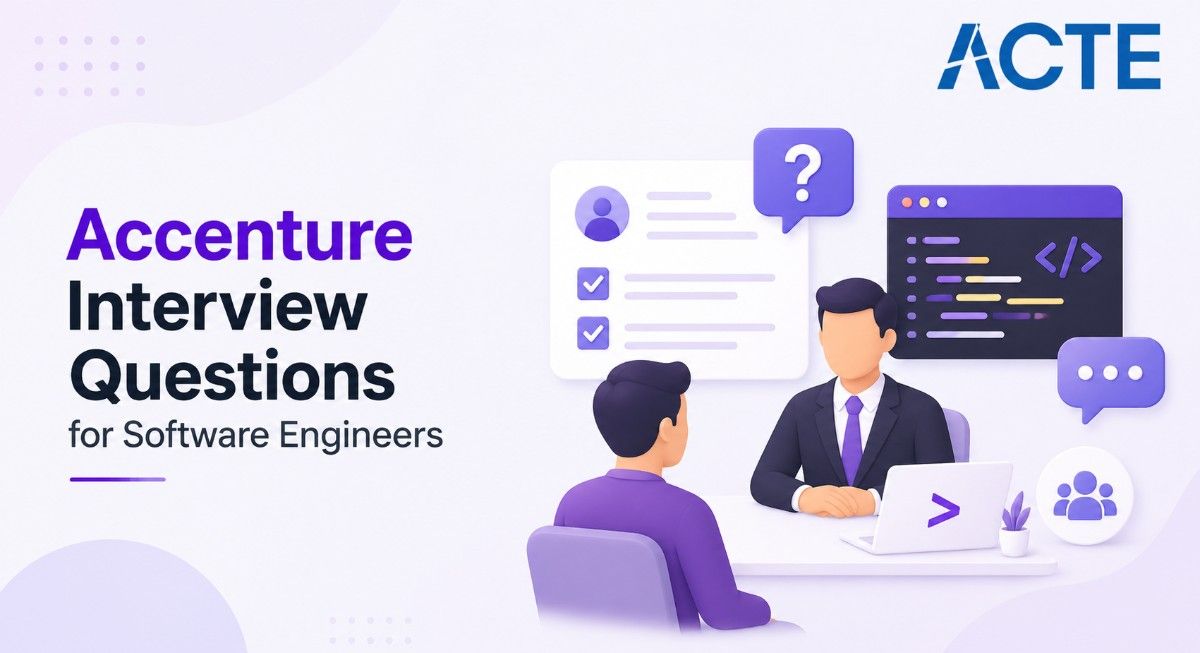
Last updated on 14th Aug 2026| 7527

Accenture Interview Questions For Software Engineers Are Designed To Evaluate Technical Knowledge, Programming Skills, Problem-Solving Ability, And Understanding Of Software Development Concepts. The Interview Process Commonly Covers Topics Such As Programming Languages, Object-Oriented Programming, Data Structures, Algorithms, Databases, Operating Systems, Computer Networks, And Software Testing. Candidates May Also Be Asked Coding Questions To Assess Logical Thinking And Implementation Skills. Questions On SQL, Git, APIs, Cloud Computing, Agile, And Software Development Life Cycle Can Help Evaluate Practical Development Knowledge. Strong Understanding Of Core Computer Science Concepts Can Help Candidates Approach Technical Rounds With Greater Confidence. This Collection Of 100 Accenture Interview Questions And Answers Provides A Structured Way To Revise Important Software Engineering Topics And Prepare For Technical Interviews.
1. What Is Object-Oriented Programming?
Ans:
Object-Oriented Programming Is A Programming Approach Based On Objects And Classes. It Helps Organize Software Into Reusable, Maintainable, And Structured Components. The Main Concepts Of OOP Include Encapsulation, Inheritance, Polymorphism, And Abstraction. Objects Contain Data And Methods That Operate On That Data. OOP Promotes Code Reusability And Helps Reduce Duplicate Implementation. Languages Such As Java, C++, And C# Strongly Support Object-Oriented Programming. OOP Is An Important Concept Frequently Asked In Software Engineering Interviews At Accenture.
2. What Is A Class?
Ans:
A Class Is A Blueprint Or Template Used To Create Objects In Object-Oriented Programming. It DefinesVariables Represent The State Or Properties Of An Object. Methods Define The Behavior Or Operations That An Object Can Perform. Multiple Objects Can Be Created From A Single Class With Different Values. For Example, A Student Class Can Be Used To Create Multiple Student Objects With Different Names And Roll Numbers. Classes Help Organize, Reuse, And Structure Code In Large Software Applications.
3. What Is An Object?
Ans:
An Object Is An Instance Of A Class Created During Program Execution. It Represents A Real-World Or Logical Entity Within A Software Application. An Object Generally Contains State, Behavior, And Identity. The State Is Represented Through Variables Or Properties Associated With The Object. The Behavior Is Represented Through Methods Defined In Its Class. For Example, A Car Object Can Have Properties Such As Color, Model, And Speed, Along With Methods Such As Start And Stop. Objects Are Fundamental Building Blocks Of Object-Oriented Programming.
4. What Is Encapsulation?
Ans:
- Encapsulation Means Combining Data And Methods Within A Single Unit, Usually A Class. It Also Helps Restrict Direct Access To The Internal Data Of An Object. Access Modifiers Such As Private, Public, And Protected Are Commonly Used To Implement Encapsulation.
- Private Variables Can Be Accessed Through Controlled Methods Such As Getters And Setters. This Approach Helps Protect Data From Unwanted Or Invalid Modification.
- Encapsulation Improves Security, Maintainability, Modularity, And Code Organization. It Is One Of The Four Major Principles Of Object-Oriented Programming.
5. What Is Inheritance?
Ans:
Inheritance Is An OOP Feature That Allows One Class To Acquire Properties And Methods From Another Class. The Existing Class Is Commonly Called The Parent Class, Superclass, Or Base Class. The New Class Is Called The Child Class, Subclass, Or Derived Class. Inheritance Promotes Code Reusability And Reduces Duplicate Implementation. A Child Class Can Add New Features Or Override Existing Methods According To Application Requirements. In Java, Class Inheritance Is Commonly Implemented Using The extends Keyword. Inheritance Is Useful When Classes Have A Natural Hierarchical Relationship.
6. What Is Polymorphism?
Ans:
Polymorphism Means The Ability Of One Interface, Method, Or Reference To Represent Different Behaviors. It Allows The Same Method Name Or Interface To Perform Different Operations Depending On The Situation. Compile-Time Polymorphism Is Commonly Achieved Through Method Overloading. Runtime Polymorphism Is Commonly Achieved Through Method Overriding. Polymorphism Improves Flexibility, Extensibility, And Maintainability In Software Design. It Also Allows A Parent Class Reference To Refer To An Object Of A Child Class. Polymorphism Is An Important OOP Concept Frequently Asked In Software Engineering Interviews.
7. What Is Abstraction?
Ans:
Abstraction Means Hiding Internal Implementation Details And Showing Only The Essential Features To The User. It Helps Developers Focus On What An Object Does Instead Of How The Object Performs Its Operations. Abstract Classes And Interfaces Are Commonly Used To Implement Abstraction In Object-Oriented Programming. For Example, A Payment Interface Can Define Payment Operations Without Revealing The Internal Processing Of Each Payment Method. Abstraction Helps Reduce Complexity In Large Applications. It Also Improves Maintainability, Flexibility, And Code Organization. Abstraction Is One Of The Four Fundamental Principles Of OOP.
8. What Is Method Overloading?
Ans:
Method Overloading Means Defining Multiple Methods With The Same Name But Different Parameter Lists Within A Class. The Difference Can Be Based On The Number, Type, Or Order Of Parameters. The Return Type Alone Cannot Be Used To Overload A Method. Method Overloading Is Generally Resolved By The Compiler During Compile Time. It Allows A Method To Perform Similar Operations With Different Types Or Numbers Of Inputs. For Example, An add() Method Can Be Defined To Accept Two Integers Or Three Integers. Method Overloading Is Also Known As Compile-Time Polymorphism.
9. What Is Method Overriding?
Ans:
Method Overriding Occurs When A Child Class Provides Its Own Implementation Of A Method Already Defined In Its Parent Class. The Method Name And Parameter List Generally Remain The Same During Overriding. It Allows A Subclass To Provide Specialized Behavior For An Inherited Method. Method Overriding Is Associated With Runtime Polymorphism Because The Method Implementation Is Determined During Runtime. The Actual Object Type Determines Which Overridden Method Is Executed. In Java, The @Override Annotation Is Commonly Used To Indicate An Overridden Method. Method Overriding Is Widely Used In Object-Oriented And Enterprise Applications.
10. What Is The Difference Between Overloading And Overriding?
Ans:
- Method Overloading Uses The Same Method Name With Different Parameter Lists, While Method Overriding Uses The Same Method Signature In A Child Class.
- Overloading Is Mainly Associated With Compile-Time Polymorphism, Whereas Overriding Is Associated With Runtime Polymorphism. Overloaded Methods Usually Exist Within The Same Class, While Overridden Methods Require A Parent-Child Relationship.
- Overloading Provides Different Ways To Perform A Similar Operation Based On Input Parameters. Overriding Allows A Child Class To Provide A Specific Implementation Of Parent Class Behavior. Both Concepts Improve Flexibility And Reusability In Object-Oriented Programming.
11. What Is A Constructor?
Ans:
A Constructor Is A Special Member Used To Initialize An Object When It Is Created. In Java, A Constructor Usually Has The Same Name As The Class And Does Not Have A Return Type. It Is Automatically Invoked When An Object Is Created Using The new Keyword. Constructors Can Be Used To Assign Initial Values To Instance Variables. A Class Can Have Multiple Constructors With Different Parameter Lists Through Constructor Overloading. Common Types Include Default Constructors And Parameterized Constructors. Constructors Help Ensure That Objects Are Properly Initialized Before They Are Used.
12. What Is Exception Handling?
Ans:
Exception Handling Is A Mechanism Used To Detect And Manage Errors That Occur During Program Execution. It Prevents Unexpected Runtime Problems From Abruptly Terminating The Application. Java Provides Keywords Such As try, catch, finally, throw, And throws For Handling Exceptions. The try Block Contains Code That May Generate An Exception, While The catch Block Handles The Exception. The finally Block Is Commonly Used For Cleanup Operations Such As Closing Resources. Exception Handling Helps Applications Continue Or Fail Gracefully When Unexpected Conditions Occur. Effective Exception Handling Improves Software Reliability, Maintainability, And User Experience.
13. What Is The Difference Between Checked And Unchecked Exceptions?
Ans:
| Aspect | Checked Exceptions | Unchecked Exceptions |
|---|---|---|
| Meaning | Checked By The Compiler During Compilatio | Occur Mainly During Runtime. |
| Handling | Must Be Handled Or Declared Using try-catch Or throws. | Handling Is Not Mandatory At Compile Time. |
| Examples | IOException, SQLException, FileNotFoundException. | NullPointerException, ArithmeticException, ArrayIndexOutOfBoundsException |
| Purpose | Usually Represent Conditions That Can Be Anticipated And Handled | Often Indicate Programming Errors Or Invalid Runtime Conditions. |
14. What Is A String?
Ans:
A String Is A Sequence Of Characters Used To Represent Text In A Program. In Java, String Is A Class And Not A Primitive Data Type. Java Strings Are Immutable, Which Means Their Contents Cannot Be Changed After A String Object Has Been Created. String Objects Can Be Created Using String Literals Or The new Keyword. Common String Operations Include Concatenation, Comparison, Searching, Splitting, And Conversion. Classes Such As StringBuilder And StringBuffer Can Be Used When Frequent String Modifications Are Required
15. Why Is String Immutable In Java?
Ans:
String Immutability Means That The Contents Of A String Object Cannot Be Changed After The Object Is Created. When A String Operation Appears To Modify An Existing String, A New String Object Is Generally Created Instead. Immutability Improves Security Because Important Values Cannot Be Changed Unexpectedly After Creation. It Also Makes Strings Safer To Share Between Multiple Threads. Immutable Strings Can Be Stored And Reused Efficiently Through The String Pool. They Are Also Suitable For Use As Keys In Hash-Based Collections Because Their Value Does Not Change. These Advantages Make String Immutability An Important Feature Of Java.
16. What Is An Array?
Ans:
An Array Is A Data Structure Used To Store Multiple Elements Of The Same Data Type In An Indexed Collection. Each Element Can Be Accessed Directly Using Its Index, Which Usually Starts From Zero In Languages Such As Java And C. Arrays Provide Fast Access To Individual Elements Because Their Positions Are Directly Addressable. A Traditional Java Array Has A Fixed Size That Is Determined When The Array Is Created. Arrays Are Useful When The Number Of Elements Is Known Or Does Not Need To Change Frequently. They Are Commonly Used In Searching, Sorting, Traversal, And Other Algorithmic Operations. Arrays Are One Of The Most Fundamental Data Structures In Programming.
17. What Is A Linked List?
Ans:
A Linked List Is A Linear Data Structure Made Up Of A Collection Of Nodes Connected Through References. Each Node Usually Contains Data And A Reference To Another Node. In A Singly Linked List, Each Node Points To The Next Node In The Sequence. In A Doubly Linked List, Each Node Contains References To Both The Previous And Next Nodes. Unlike Traditional Arrays, Linked Lists Can Grow Or Shrink Dynamically During Program Execution. Insertion And Deletion Can Be Efficient When The Appropriate Node Or Position Is Already Known. Linked Lists Are Useful When Frequent Changes To The Structure Of A Collection Are Required.
18. What Is A Stack?
Ans:
- A Stack Is A Linear Data Structure That Follows The Last-In-First-Out Principle, Commonly Called LIFO. This Means The Most Recently Added Element Is The First Element To Be Removed.
- The Main Stack Operations Are Push For Adding An Element, Pop For Removing An Element, And Peek For Viewing The Top Element. A Stack Can Be Implemented Using An Array, Linked List, Or Other Data Structures.
- Stacks Are Commonly Used In Function Calls, Recursion, Expression Evaluation, And Parentheses Matching.
19. What Is A Queue?
Ans:
A Queue Is A Linear Data Structure That Follows The First-In-First-Out Principle, Commonly Called FIFO. This Means The First Element Added To The Queue Is The First Element Removed. Adding An Element Is Called Enqueue, While Removing An Element Is Called Dequeue. Queues Can Be Implemented Using Arrays, Linked Lists, Or Specialized Queue Data Structures. They Are Commonly Used In Scheduling, Task Processing, Resource Management, And Request Handling. Queues Are Also Used In Breadth-First Search Algorithms For Traversing Graphs And Trees. Operating Systems, Networking Applications, And Distributed Systems Frequently Use Queue-Based Processing..
20. What Is A Hash Table?
Ans:
A Hash Table Is A Data Structure That Stores Data Using Key-Value Relationships And A Hashing Mechanism. A Hash Function Converts A Key Into A Hash Value That Helps Determine Where The Associated Data Should Be Stored. This Allows Lookup, Insertion, And Deletion To Be Performed In O(1) Average Time Under Suitable Conditions. Hash Collisions Can Occur When Different Keys Produce The Same Hash Location. Common Collision-Handling Techniques Include Chaining And Open Addressing. Hash Tables Are Widely Used In Maps, Dictionaries, Caches, Symbol Tables, And Database-Related Applications. In Java, HashMap Is A Common Implementation Based On Hashing For Key-Value Storage.
21. What Is A Binary Tree?
Ans:
A Binary Tree Is A Hierarchical Data Structure In Which Each Node Can Have At Most Two Children. The Two Children Are Commonly Referred To As The Left Child And Right Child. Binary Trees Are Used To Represent Hierarchical Relationships And Organize Data Efficiently. Common Traversal Techniques Include Inorder, Preorder, Postorder, And Level-Order Traversal. A Binary Search Tree Is A Special Type Of Binary Tree That Follows Specific Ordering Rules. Balanced Binary Trees Can Provide Efficient Searching, Insertion, And Deletion Operations. Binary Trees Are Frequently Asked In Data Structures And Algorithms Interviews.
22. What Is A Binary Search Tree?
Ans:
A Binary Search Tree Is A Special Type Of Binary Tree That Maintains An Ordering Property Among Its Nodes. Values In The Left Subtree Are Generally Smaller Than The Value Of The Parent Node, While Values In The Right Subtree Are Generally Greater. This Ordering Allows Searching, Insertion, And Deletion To Be Performed Efficiently In A Balanced Tree. An Inorder Traversal Of A Valid Binary Search Tree Produces Values In Sorted Order. However, If The Tree Becomes Highly Unbalanced, Its Performance Can Degrade To O(N). Balanced Trees Help Maintain Efficient Operations By Keeping The Tree Height Relatively Small. Binary Search Trees Are Commonly Used In Searching And Data Organization Problems.
23. What Is Recursion?
Ans:
Recursion Is A Programming Technique In Which A Function Calls Itself To Solve A Problem. A Recursive Function Must Have A Base Condition That Determines When The Recursive Calls Should Stop. Without A Proper Base Condition, The Function May Continue Calling Itself Indefinitely And Cause A Stack Overflow. Each Recursive Call Generally Reduces The Problem Into A Smaller Or Simpler Subproblem. Recursion Is Commonly Used In Tree Traversals, Graph Algorithms, Divide-And-Conquer Algorithms, And Backtracking. Factorial, Fibonacci, And Tree Traversal Problems Are Common Examples Of Recursion. Although Recursion Can Simplify Certain Problems, Excessive Recursive Calls Can Consume Significant Stack Memory.
24. What Is Time Complexity?
Ans:
- Time Complexity Describes How The Execution Time Of An Algorithm Changes As The Size Of The Input Increases. It Helps Developers Compare Algorithms And Select More Efficient Solutions.
- Big O Notation Is Commonly Used To Represent The Upper-Bound Growth Rate Of An Algorithm. Common Complexities Include O(1), O(Log N), O(N), O(N Log N), And O(N²). An O(1) Operation Takes Approximately Constant Time, While An O(N) Algorithm Grows Linearly With The Input Size.
- Algorithms With O(N²) Complexity Can Become Slow When Processing Large Datasets. Understanding Time Complexity Is Important For Designing Efficient Programs And Solving Coding Problems.
25. What Is Space Complexity?
Ans:
Space Complexity Measures The Amount Of Additional Memory An Algorithm Requires As The Input Size Increases. It Helps Determine How Much Memory May Be Needed During Program Execution. Auxiliary Space Specifically Refers To The Extra Memory Used By An Algorithm Apart From The Input Data. An Algorithm That Uses Only A Fixed Number Of Variables May Have O(1) Auxiliary Space. Creating An Additional Array Of Size N Generally Requires O(N) Additional Space. Recursive Algorithms May Also Consume Stack Memory Because Each Function Call Creates An Additional Stack Frame.
26. What Is Binary Search?
Ans:
Binary Search Is An Efficient Searching Algorithm Used To Find An Element In A Sorted Collection. The Algorithm Compares The Target Value With The Middle Element Of The Current Search Range. If The Target Is Smaller, The Search Continues In The Left Half, While A Larger Target Causes The Search To Continue In The Right Half. Each Step Eliminates Approximately Half Of The Remaining Search Space. Because Of This Repeated Division, Binary Search Has A Time Complexity Of O(Log N).
27. What Is Linear Search?
Ans:
Linear Search Is A Simple Searching Algorithm That Checks Elements Sequentially Until The Required Element Is Found Or The Collection Ends. It Can Be Used On Both Sorted And Unsorted Data. The Algorithm Starts From The First Element And Compares Each Element With The Target Value. If A Matching Element Is Found, Its Position Can Be Returned. The Worst-Case Time Complexity Of Linear Search Is O(N), Where N Represents The Number Of Elements. It Requires Very Little Additional Memory And Is Easy To Implement. Linear Search Is Suitable For Small Collections Or Situations Where The Data Is Not Sorted.
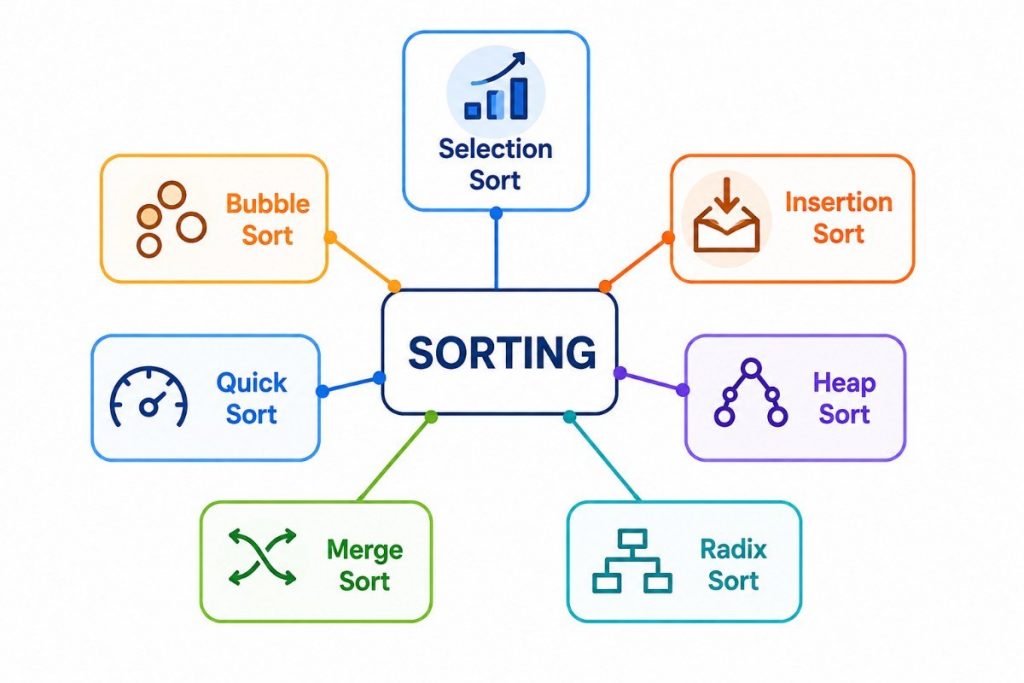
28. What Is Sorting?
Ans:
Sorting Is The Process Of Arranging Data Elements In A Specific Order, Usually Ascending Or Descending. It Makes Data Easier To Search, Analyze, Compare, And Process. Common Sorting Algorithms Include Bubble Sort, Selection Sort, Insertion Sort, Merge Sort, Quick Sort, And Heap Sort. Each Algorithm Has Different Time And Space Complexity Characteristics. Simple Algorithms Such As Bubble Sort May Be Suitable For Learning But Are Usually Inefficient For Large Datasets. More Efficient Algorithms Such As Merge Sort And Quick Sort Are Commonly Used For Larger Inputs. The Choice Of Sorting Algorithm Depends On Factors Such As Input Size, Memory Requirements, Stability, And Performance Needs.
29. What Is Bubble Sort?
Ans:
Bubble Sort Is A Simple Comparison-Based Sorting Algorithm That Repeatedly Compares Adjacent Elements. If Two Adjacent Elements Are In The Wrong Order, They Are Swapped. After Each Complete Pass Through The Collection, One Of The Largest Unsorted Elements Moves Toward Its Correct Position. The Process Continues Until The Entire Collection Is Sorted. The Average And Worst-Case Time Complexity Of Bubble Sort Is O(N²), Making It Inefficient For Large Datasets.
30. What Is Merge Sort?
Ans:
Merge Sort Is A Divide-And-Conquer Sorting Algorithm That Divides A Collection Into Smaller Parts Before Sorting And Combining Them. The Input Is Repeatedly Divided Into Smaller Subarrays Until Each Part Contains A Single Element Or Becomes Trivially Sorted. These Smaller Parts Are Then Merged In Sorted Order To Produce The Final Result. Merge Sort Has A Time Complexity Of O(N Log N) In The Best, Average, And Worst Cases. When Applied To Arrays, It Generally Requires O(N) Additional Space For The Merging Process. Merge Sort Is Particularly Useful For Large Datasets And Can Also Be Efficiently Applied To Linked Lists. Its Predictable O(N Log N) Performance Makes It An Important Sorting Algorithm For Technical Interviews.
31. What Is Quick Sort?
Ans:
- Quick Sort Is A Divide-And-Conquer Sorting Algorithm That Is Used To Arrange Elements In A Specific Order. It Selects An Element As A Pivot And Partitions The Collection Around That Pivot.
- Elements Smaller Than The Pivot Are Generally Placed On One Side, While Larger Elements Are Placed On The Other Side. The Same Partitioning Process Is Then Applied Recursively To The Smaller Subarrays.
- Quick Sort Has An Average Time Complexity Of O(N Log N) Under Good Partitioning Conditions. Its Worst-Case Time Complexity Can Become O(N²) When Poor Pivot Choices Produce Highly Unbalanced Partitions.
32. What Is A Database?
Ans:
A Database Is An Organized Collection Of Data That Allows Information To Be Stored, Retrieved, Updated, And Managed Efficiently. Databases Help Applications Maintain Large Amounts Of Structured Or Unstructured Information In A Systematic Manner. They Can Generally Be Classified As Relational And Non-Relational Databases Based On Their Data Models. Relational Databases Store Data In Tables Consisting Of Rows And Columns, While NoSQL Databases Can Use Models Such As Documents, Key-Value Pairs, Or Graphs. Popular Relational Database Systems Include MySQL, PostgreSQL, Oracle, And SQL Server.
33. What Is SQL?
Ans:
SQL Stands For Structured Query Language And Is Used To Communicate With Relational Database Management Systems. It Allows Developers To Store, Retrieve, Modify, And Delete Data From Database Tables. Common SQL Commands Include SELECT, INSERT, UPDATE, And DELETE. SQL Also Supports Filtering, Sorting, Grouping, Aggregation, And Joining Data From Multiple Tables. Database Structures Can Be Created And Modified Using Commands Such As CREATE, ALTER, And DROP. SQL Commands Are Commonly Classified Into Categories Such As DDL, DML, DCL, And TCL. SQL Is A Frequently Tested Skill In Software Engineering And Accenture Technical Interviews.
34. What Is A Primary Key?
Ans:
A Primary Key Is A Column Or Combination Of Columns Used To Uniquely Identify Each Record In A Database Table. Each Primary Key Value Must Be Unique So That Individual Records Can Be Distinguished From One Another. A Primary Key Generally Does Not Allow NULL Values Because Every Record Needs A Valid Identifier. A Table Can Have Only One Primary Key Constraint, Although That Constraint Can Contain Multiple Columns In The Case Of A Composite Key. Primary Keys Help Maintain Entity Integrity And Prevent Duplicate Identification Of Records.
35. What Is A Foreign Key?
Ans:
A Foreign Key Is A Column Or Set Of Columns In One Table That References A Key, Usually A Primary Key, In Another Table. It Is Used To Establish And Maintain Relationships Between Related Database Tables. Foreign Keys Help Enforce Referential Integrity By Preventing Invalid References Between Related Records. For Example, An Employee Table Can Contain A Department ID That References The Department ID In A Department Table. Unlike A Primary Key, A Foreign Key Does Not Necessarily Need To Contain Unique Values.
36. What Is Normalization?
Ans:
Normalization Is A Database Design Technique Used To Organize Data And Reduce Unnecessary Data Redundancy. It Divides Large Tables Into Smaller Related Tables Based On Logical Relationships Between Data Elements. Normalization Helps Prevent Insert, Update, And Delete Anomalies That Can Occur When The Same Information Is Repeated In Multiple Places. Common Normal Forms Include First Normal Form, Second Normal Form, And Third Normal Form. Each Normal Form Introduces Additional Rules For Organizing And Structuring Database Information
37. What Is Denormalization?
Ans:
Denormalization Is A Database Design Approach That Intentionally Introduces Some Data Redundancy To Improve Query Performance. It May Combine Related Data Or Store Repeated Information So That Fewer Joins Are Required During Read Operations. This Approach Can Improve Read Performance In Applications That Frequently Retrieve Large Amounts Of Related Data. However, Denormalization Can Increase Storage Requirements And Make Data Consistency More Difficult To Maintain
38. What Is A SQL Join?
Ans:
A SQL Join Is Used To Combine Related Rows From Two Or More Tables Based On A Specified Relationship Or Condition. Common Types Of Joins Include INNER JOIN, LEFT JOIN, RIGHT JOIN, And FULL OUTER JOIN. An INNER JOIN Returns Rows That Have Matching Values In Both Tables. A LEFT JOIN Returns All Rows From The Left Table Along With Matching Rows From The Right Table. A RIGHT JOIN Performs The Opposite Operation By Preserving Rows From The Right Table..
39. What Is An Index In A Database?
Ans:
- A Database Index Is A Data Structure Created To Improve The Speed Of Data Retrieval Operations. It Allows The Database Management System To Locate Relevant Rows More Efficiently Instead Of Scanning Every Row In A Table.
- Indexes Can Be Created On One Column Or Multiple Columns Depending On Query Requirements. They Can Significantly Improve The Performance Of Frequently Used SELECT Queries.
- However, Indexes Require Additional Storage And Must Be Maintained When Data Is Inserted, Updated, Or Deleted.
40. What Is A Stored Procedure?
Ans:
- A Stored Procedure Is A Predefined Group Of SQL Statements Stored And Executed Within A Database System. It Can Accept Input Parameters, Perform Multiple Database Operations, And Return Results Or Status Information.
- Stored Procedures Help Reduce Repeated SQL Code And Can Encapsulate Complex Database Logic. They May Also Improve Security By Restricting Direct Access To Certain Tables And Providing Controlled Operations.
- Executing Complex Operations Through A Stored Procedure Can Sometimes Reduce Network Communication Between An Application And Database.

Learn Advanced Software Testing Certification Training Course to Build Your Skills
Weekday / Weekend BatchesSee Batch Details41. What Is Operating System?
Ans:
An Operating System Is System Software That Acts As An Interface Between Computer Hardware And Application Software. It Manages Important Resources Such As Processes, Memory, Files, Input And Output Devices, And System Security. The Operating System Also Controls How Different Applications Access And Share Hardware Resources. Examples Of Operating Systems Include Windows, Linux, Unix, And macOS. It Provides Services Such As Process Scheduling, Memory Management, File Management, And Device Management.
42. What Is A Process?
Ans:
A Process Is A Program That Is Currently Being Executed By An Operating System. It Has Its Own Address Space, Program Counter, Execution State, And Allocated System Resources. A Process Can Contain One Or More Threads That Perform Different Tasks. The Operating System Creates, Schedules, Suspends, And Terminates Processes According To System Requirements. Processes Can Communicate With Each Other Through Inter-Process Communication Mechanisms Such As Pipes, Shared Memory, And Message Queues
43. What Is A Thread?
Ans:
A Thread Is A Smallest Common Unit Of Execution Within A Process. A Single Process Can Contain Multiple Threads That Execute Different Parts Of The Program Concurrently. Threads Within The Same Process Usually Share Resources Such As Heap Memory And Open Files. Multithreading Can Improve Application Responsiveness And Allow Multiple Tasks To Make Progress At The Same Time. However, Shared Data Must Be Carefully Managed To Avoid Race Conditions And Data Inconsistency.
44. What Is Multithreading?
Ans:
- Multithreading Is A Programming Technique In Which Multiple Threads Execute Within A Single Process. It Allows Different Tasks To Make Progress Concurrently And Can Improve Application Responsiveness And Resource Utilization.
- Multithreading Is Commonly Used In Servers, Background Processing, User Interfaces, And Applications Handling Multiple Tasks.
- Threads Within The Same Process Can Share Memory, Which Makes Communication Faster But Also Creates Synchronization Challenges.
45. What Is Deadlock?
Ans:
Deadlock Is A Situation In Which Two Or More Processes Or Threads Wait Indefinitely For Resources Held By One Another. As A Result, The Involved Processes Cannot Continue Their Execution. Deadlock Commonly Occurs When Multiple Processes Compete For Multiple Shared Resources Without Proper Resource Management. Four Necessary Conditions For Deadlock Are Mutual Exclusion, Hold And Wait, No Preemption, And Circular Wait. Operating Systems Can Use Deadlock Prevention, Avoidance, Detection, And Recovery Techniques To Manage This Problem
46. What Is Virtual Memory?
Ans:
Virtual Memory Is A Memory Management Technique That Allows A System To Use Disk Storage As An Extension Of Physical RAM. It Provides Each Process With A Virtual Address Space That Can Be Larger Than The Available Physical Memory. The Operating System Maps Virtual Addresses To Physical Memory Locations Using Memory Management Mechanisms. When Required, Pages Of Memory Can Be Moved Between RAM And Disk Through A Process Commonly Known As Paging. Virtual Memory Helps Provide Process Isolation, Efficient Memory Utilization, And Support For Large Applications.
47. What Is A Computer Network?
Ans:
A Computer Network Is A Group Of Connected Devices That Communicate With Each Other And Share Data Or Resources. Networked Devices Can Include Computers, Servers, Smartphones, Routers, Printers, And Other Connected Systems. Communication Can Take Place Through Wired Technologies Such As Ethernet Or Wireless Technologies Such As Wi-Fi. Networks Use Communication Protocols To Define How Data Is Transmitted, Addressed, Routed, And Received. Common Network Types Include LAN, WAN, MAN, And PAN Based On Their Coverage And Purpose
48. What Is TCP/IP?
Ans:
TCP/IP Is A Collection Of Networking Protocols Used To Enable Communication Between Devices Over Computer Networks. IP, Or Internet Protocol, Handles Addressing And Routing Packets Between Different Networks. TCP, Or Transmission Control Protocol, Provides Reliable, Ordered, And Error-Checked Delivery Of Data Between Applications. TCP Establishes A Connection Before Data Transmission And Uses Mechanisms To Detect Lost Or Corrupted Data. The TCP/IP Model Organizes Network Communication Into Different Layers, With Each Layer Performing Specific Responsibilities.
49. What Is HTTP?
Ans:
HTTP Stands For Hypertext Transfer Protocol And Is A Communication Protocol Used Between Clients And Web Servers. It Defines How Requests Are Sent From Clients And How Responses Are Returned By Servers. Common HTTP Methods Include GET, POST, PUT, PATCH, And DELETE, Each Typically Representing A Different Type Of Operation. GET Is Commonly Used To Retrieve Information, While POST Is Often Used To Submit New Data. PUT And PATCH Are Commonly Used For Updating Resources, While DELETE Is Used To Remove Resources.
50. What Is An API?
Ans:
- API Stands For Application Programming Interface And Defines A Set Of Rules Through Which Different Software Components Can Communicate. An API Allows One Application To Request Data Or Services From Another Application Without Knowing Its Internal Implementation.
- Web APIs Commonly Use HTTP Methods And Data Formats Such As JSON For Communication. REST APIs Are A Popular Type Of Web API Used In Websites, Mobile Applications, And Cloud Services.
- APIs Can Provide Functions Such As User Authentication, Payment Processing, Data Retrieval, And External Service Integration.
51. What Is REST API?
Ans:
REST Stands For Representational State Transfer And Describes An Architectural Style For Designing Network-Based Services. A REST API Uses HTTP Methods To Perform Operations On Resources Represented Through Endpoints. Common Methods Include GET For Retrieving Data, POST For Creating Resources, PUT Or PATCH For Updating Resources, And DELETE For Removing Resources. REST Services Are Generally Stateless, Meaning Each Request Contains The Information Required For Processing It. JSON Is A Common Representation Format Used For REST API Requests And Responses. REST APIs Are Relatively Simple, Scalable, And Widely Supported Across Programming Languages And Platforms.
52. What Is JSON?
Ans:
JSON Stands For JavaScript Object Notation And Is A Lightweight Format Used To Represent And Exchange Structured Data. It Represents Information Using Objects, Arrays, Strings, Numbers, Boolean Values, And Null. JSON Is Easy For Humans To Read And Can Be Easily Parsed By Programming Languages. It Is Frequently Used In REST API Requests And Responses Between Clients And Servers. JSON Is Language-Independent Even Though Its Syntax Was Inspired By JavaScript Object Notation
53. What Is Git?
Ans:
Git Is A Distributed Version Control System Used To Track And Manage Changes In Source Code And Other Files. It Allows Developers To Maintain Different Versions Of A Project And Review Changes Made Over Time. Git Supports Important Features Such As Branching, Merging, Committing, And Collaboration. Developers Can Create Local Copies Of Repositories And Work Independently Before Sharing Changes With A Remote Repository. Common Git Commands Include clone, add, commit, push, pull, branch, And merge.
54. What Is GitHub?
Ans:
GitHub Is A Web-Based Platform Used To Host, Manage, And Collaborate On Git Repositories. It Provides Features Such As Repository Management, Branches, Pull Requests, Code Reviews, Issues, And Project Collaboration. Developers Can Create Separate Branches To Work On Features Without Directly Modifying The Main Codebase. Pull Requests Allow Team Members To Review And Discuss Code Before Changes Are Merged. GitHub Also Provides Automation Features Through Tools Such As GitHub Actions.
55. What Is Version Control?
Ans:
Version Control Is A System Used To Track Changes Made To Files And Source Code Over Time. It Allows Developers To Maintain Different Versions Of A Project And Review How The Code Has Changed. Changes Can Be Compared, Reverted, Or Restored When Necessary. Version Control Also Supports Collaboration By Allowing Multiple Developers To Work On The Same Project. Branches Can Be Created So That New Features Or Fixes Can Be Developed Independently. Git Is One Of The Most Widely Used Distributed Version Control Systems..
56. What Is Agile Methodology?
Ans:
- Agile Is A Software Development Approach Based On Iterative Development, Continuous Feedback, And Incremental Delivery. Instead Of Developing The Entire Application In One Long Cycle, Work Is Divided Into Smaller And Manageable Iterations.
- Agile Encourages Frequent Communication Between Developers, Testers, Product Owners, And Business Stakeholders.
- Requirements Can Be Reviewed And Adjusted As The Project Progresses. Scrum Is One Of The Most Common Frameworks Used To Implement Agile Principles.
57. What Is Scrum?
Ans:
Scrum Is An Agile Framework Used To Manage Software Development And Other Complex Projects. Work Is Organized Into Fixed-Length Iterations Called Sprints, During Which The Team Works On Selected Product Backlog Items. Common Scrum Accountabilities Include The Product Owner, Scrum Master, And Developers. The Product Backlog Contains Features, Improvements, Fixes, And Other Work Required For The Product.
58. What Is SDLC?
Ans:
SDLC Stands For Software Development Life Cycle And Represents A Structured Process For Developing, Testing, Deploying, And Maintaining Software. Common SDLC Phases Include Requirement Analysis, System Design, Development, Testing, Deployment, And Maintenance. Different Development Models Such As Waterfall, Agile, Spiral, And V-Model Organize These Activities In Different Ways. Each Phase Has Specific Objectives, Activities, And Expected Deliverables
59. What Is Software Testing?
Ans:
Software Testing Is The Process Of Evaluating An Application To Identify Defects And Verify That It Meets Its Requirements. Testing Helps Determine Whether The Software Produces The Expected Results Under Different Conditions. It Can Be Performed Manually Or Through Automated Testing Tools And Frameworks. Common Testing Levels Include Unit Testing, Integration Testing, System Testing, And Acceptance Testing. Test Cases Should Cover Normal Scenarios, Boundary Conditions, Invalid Inputs, And Other Important Situations.
60. What Is Unit Testing?
Ans:
Unit Testing Is A Software Testing Technique Used To Verify Individual Units Or Components Of An Application In Isolation. A Unit Can Be A Method, Function, Class, Or Small Module Depending On The Application Design. The Main Goal Is To Confirm That Each Unit Produces The Expected Result For Different Inputs And Conditions. Developers Commonly Create Unit Tests During The Development Process To Detect Defects At An Early Stage.
61. What Is Integration Testing?
Ans:
Integration Testing Is A Software Testing Technique Used To Verify That Multiple Software Components Work Correctly When Combined. It Focuses On The Interactions Between Modules, Services, APIs, And Other Integrated Components. Individual Components May Work Correctly Independently But Can Still Fail When They Communicate With Each Other. Integration Testing Helps Identify Interface Problems, Data Transfer Errors, Communication Failures, And Incorrect Dependencies

Get JOB Oriented Software Testing Training for Beginners By MNC Experts
- Instructor-led Sessions
- Real-life Case Studies
- Assignments
62. What Is Black-Box Testing?
Ans:
Black-Box Testing Is A Software Testing Approach In Which The Tester Evaluates The Application Without Knowing Its Internal Code Or Implementation Details. The Testing Process Mainly Focuses On Providing Inputs And Checking Whether The Actual Outputs Match The Expected Results. Internal Program Logic, Code Structure, And Implementation Details Are Not Required For Designing The Tests. Functional Requirements Are Commonly Used To Prepare Test Cases For Black-Box Testing.
63. What Is White-Box Testing?
Ans:
- White-Box Testing Is A Testing Approach That Examines The Internal Logic, Structure, And Implementation Of Software. The Tester Or Developer Needs Knowledge Of The Source Code To Design Tests Based On Internal Program Behavior.
- Test Cases Can Be Created To Cover Conditions, Branches, Statements, And Different Execution Paths. White-Box Testing Helps Identify Logical Errors, Incorrect Conditions, Uncovered Code, And Implementation Problems.
- Code Coverage Metrics Are Commonly Used To Measure How Much Of The Code Has Been Exercised By Tests.
64. What Is Debugging??
Ans:
Debugging Is The Process Of Finding, Analyzing, And Fixing Errors Or Defects In Software. Developers Usually Begin By Reproducing The Problem To Understand Its Behavior And Conditions. Tools Such As Logs, Debuggers, Stack Traces, And Test Cases Can Help Identify Where And Why The Problem Occurs. The Root Cause Should Be Identified Instead Of Only Correcting The Visible Symptoms Of The Error
65. What Is The Difference Between Compiler And Interpreter?
Ans:
| Aspect | Compiler | Interpreter |
|---|---|---|
| Translation | Translates The Entire Program Before Execution. | Translates And Executes The Program Step By Step. |
| Execution Speed | Generally Faster After Compilation. | Generally Slower Due To Runtime Translation. |
| Error Handling | Reports Errors After Compilation Of The Program. | Usually Reports Errors During Execution. |
66. What Is Java Virtual Machine?
Ans:
JVM Stands For Java Virtual Machine And Is A Runtime Environment Used To Execute Java Bytecode. Java Source Code Is Compiled Into Bytecode, Which Can Then Be Executed By A JVM. The JVM Provides Platform Independence Because The Same Bytecode Can Run On Different Operating Systems That Have Compatible JVM Implementations. It Manages Important Runtime Activities Such As Memory Management, Garbage Collection, And Program Execution. Major JVM Components Include Class Loaders And Execution Engines That Help Load And Execute Java Classes. Different Operating Systems Have Their Own JVM Implementations Designed For Their Platforms. JVM Knowledge Is Important For Understanding Java Application Execution And Performance In Software Engineering Interviews.
67. What Is Garbage Collection?
Ans:
Garbage Collection Is An Automatic Memory Management Process Used By Languages Such As Java To Reclaim Memory. It Identifies Objects That Are No Longer Reachable Or Needed By The Application. The JVM Can Then Reclaim The Memory Occupied By Those Objects For Future Use. Garbage Collection Reduces The Need For Developers To Manually Deallocate Memory. Different Garbage Collectors Use Different Strategies And Provide Different Performance Characteristics. Even With Automatic Garbage Collection, Poorly Designed Applications Can Experience Memory Problems When Unnecessary References Remain Active
68. What Is The Difference Between Stack And Heap Memory?
Ans:
Stack Memory Generally Stores Method Calls, Local Variables, And Execution Frames Associated With Program Execution. Heap Memory Generally Stores Objects And Dynamically Allocated Data Created During Application Runtime. Stack Allocation Is Closely Associated With Method Or Function Execution, While Heap Objects Can Remain Available Beyond A Single Method Call When References To Them Still Exist. Stack Memory Is Typically Faster To Manage But Is More Limited In Size.n.
69. What Is A Memory Leak?
Ans:
- A Memory Leak Occurs When Memory That Is No Longer Needed Remains Occupied And Cannot Be Effectively Reused. In Garbage-Collected Languages Such As Java, Unnecessary References To Objects Can Prevent Those Objects From Being Collected.
- As More Memory Remains Occupied Over Time, The Application’s Memory Consumption Can Continuously Increase. This Can Lead To Performance Slowdowns, Excessive Garbage Collection, Or Out-Of-Memory Errors.
- Proper Reference Management And Resource Handling Can Help Prevent Memory-Related Problems.
70. What Is Multithreading Synchronization?
Ans:
Multithreading Synchronization Is A Technique Used To Control Access To Shared Resources When Multiple Threads Execute Concurrently. It Helps Prevent Multiple Threads From Modifying Shared Data In An Unsafe Or Unexpected Manner. Synchronization Mechanisms Such As Locks, Synchronized Methods, And Other Concurrency Controls Can Protect Critical Sections Of Code. Without Proper Synchronization, Race Conditions And Data Inconsistency May Occur. However, Excessive Synchronization Can Reduce Concurrency And Negatively Affect Application Performance. Developers Should Therefore Protect Only The Critical Sections That Actually Require Synchronization. Correct Synchronization Is Important For Building Reliable And Thread-Safe Software.
71. What Is A Race Condition?
Ans:
A Race Condition Occurs When The Result Or Behavior Of A Program Depends On The Timing Or Ordering Of Multiple Concurrent Operations. It Commonly Happens When Multiple Threads Access Or Modify Shared Data Without Proper Synchronization. For Example, Two Threads May Read The Same Value And Attempt To Update It At Nearly The Same Time, Producing An Unexpected Result. Race Conditions Can Cause Inconsistent, Incorrect, Or Difficult-To-Reproduce Application Behavior. Synchronization Mechanisms Such As Locks And Atomic Operations Can Help Prevent These Problems.
72. What Is Cloud Computing?
Ans:
Cloud Computing Is A Technology Model That Provides Computing Resources Through Network-Based Services Instead Of Requiring Direct Ownership Of Physical Infrastructure. Cloud Resources Can Include Servers, Storage, Databases, Networking, Software, And Other Computing Services. Organizations Can Provision And Scale These Resources Based On Their Application Requirements. Cloud Platforms Support Flexible Resource Usage And Can Reduce The Need To Maintain Physical Hardware Directly.
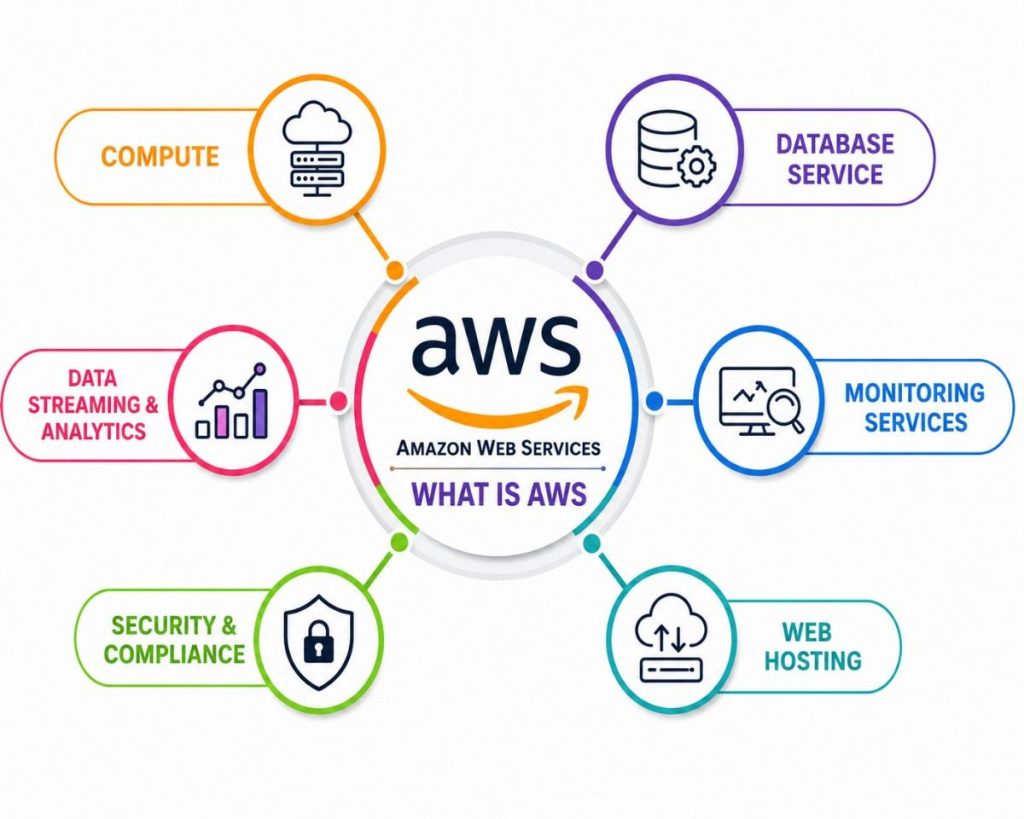
73. What Is AWS?
Ans:
AWS Stands For Amazon Web Services And Is A Cloud Computing Platform That Provides A Wide Range Of Infrastructure And Application Services. It Offers Services For Computing, Storage, Databases, Networking, Security, Monitoring, And Other Cloud Requirements. Amazon EC2 Provides Virtual Compute Capacity For Running Applications And Workloads. Amazon S3 Provides Object Storage For Files, Data, Backups, And Other Objects. Amazon RDS Provides Managed Relational Database Services, While AWS Lambda Supports Serverless Function Execution
74. What Is Docker?
Ans:
- Docker Is A Platform Used To Build, Package, And Run Applications Inside Containers. A Container Packages An Application Along With Its Required Dependencies, Libraries, And Configuration Needed For Execution.
- This Helps Maintain Consistent Application Environments Across Development, Testing, And Deployment Systems.
- Docker Images Act As Templates From Which Containers Are Created. Dockerfiles Contain Instructions Used To Build Docker Images Automatically.
75. What Is Kubernetes?
Ans:
Kubernetes Is An Open-Source Platform Used For Automating The Deployment, Scaling, And Management Of Containerized Applications. It Helps Organizations Manage Applications Running Across Multiple Machines Or Cloud Infrastructure. Kubernetes Uses Objects Such As Pods, Deployments, And Services To Define And Manage Application Workloads. A Pod Is The Smallest Deployable Unit In Kubernetes And Can Contain One Or More Related Containers. Deployments Help Manage Application Replicas, Updates, And Desired State..
76. What Is CI/CD?
Ans:
CI/CD Stands For Continuous Integration And Continuous Delivery Or Continuous Deployment. Continuous Integration Involves Frequently Integrating Code Changes Into A Shared Repository And Automatically Building And Testing Those Changes. Automated Builds And Tests Help Identify Integration Problems Early In The Development Process. Continuous Delivery Keeps Software In A Release-Ready State So That Validated Changes Can Be Deployed When Required. Continuous Deployment Can Automatically Release Successfully Validated Changes To Production Without Manual Deployment Steps.
77. What Is Microservices Architecture?
Ans:
Microservices Architecture Is A Software Architecture Style That Divides An Application Into Small, Independently Deployable Services. Each Service Generally Focuses On A Specific Business Capability Or Functional Responsibility. Services Can Communicate With Each Other Through APIs, Messaging Systems, Or Other communication mechanisms. Individual Services Can Potentially Use Different Technologies, Programming Languages, Or Databases Based On Their Requirements. Microservices Can Support Independent Scaling, Deployment, Development, And Maintenance Of Application Components.
78. What Is Monolithic Architecture?
Ans:
Monolithic Architecture Is A Software Architecture In Which Most Or All Major Application Components Are Packaged Into A Single Deployable Unit. Presentation Logic, Business Logic, And Data Access Components Are Often Developed And Deployed Together. This Architecture Can Be Relatively Simple To Develop, Test, And Deploy During The Early Stages Of A Project. However, As The Application Grows, The Entire System May Become More Difficult To Maintain And Scale.
79. What Is A Software Design Pattern?
Ans:
A Software Design Pattern Is A Reusable General Solution To A Common Software Design Problem. It Provides A Proven Approach Or Structure That Developers Can Adapt To A Specific Application Requirement. Design Patterns Do Not Usually Provide Complete Application Code But Instead Describe How Components Can Be Organized And Interact. Common Design Patterns Include Singleton, Factory, Observer, Adapter, And Strategy. Using Appropriate Patterns Can Improve Code Maintainability, Flexibility, And Communication Among Development Teams.
80. What Is Singleton Pattern?
Ans:
- The Singleton Pattern Is A Design Pattern That Restricts A Class To One Intended Instance And Provides A Common Access Point To That Instance.
- It Can Be Useful When An Application Requires Controlled Access To A Shared Resource Or Configuration Object. When Implementing A Singleton In A Multithreaded Environment, Thread Safety Must Be Carefully Considered To Prevent Multiple Instances From Being Created.
- Poorly Designed Singleton Implementations Can Introduce Global State And Make Unit Testing More Difficult.
81. Write A Program To Find The Second Largest Element
Ans:
The Second Largest Element Problem Requires Finding The Largest And Second Largest Values Without Necessarily Sorting The Entire Array.
- public class Main {
- public static void main(String[] args) {
- int[] arr = {10, 25, 7, 45, 18};
- int largest = Integer.MIN_VALUE;
- int secondLargest = Integer.MIN_VALUE;
- for (int num : arr) {
- if (num > largest) {
- secondLargest = largest;
- largest = num;
- } else if (num > secondLargest && num != largest) {
- secondLargest = num;
- }
- }
- System.out.println(“Second Largest: ” + secondLargest);
- }
- }
82. Write A Program To Reverse An Array
Ans:
Reversing An Array Means Arranging Its Elements In The Opposite Order. The Program Can Use Two Pointers, One Starting At The Beginning And The Other Starting At The End
- public static void main(String[] args) {
- int[] arr = {1, 2, 3, 4, 5};
- int left = 0;
- int right = arr.length – 1;
- while (left < right) {
- int temp = arr[left];
- arr[left] = arr[right];
- arr[right] = temp;
- left++;
- right–;
- }
- for (int num : arr) {
- System.out.print(num + ” “);
- }
- }
- }
83. What Is The Factory Design Pattern?
Ans:
The Factory design pattern is a creational design pattern that creates objects without exposing the object creation logic to the client. Instead of directly instantiating classes, the client requests objects through a factory method. This approach reduces tight coupling between classes and improves code flexibility. Factory Pattern makes applications easier to maintain, extend, and test. It is widely used in frameworks and enterprise software development. Google frequently asks Factory Pattern questions to assess software architecture and object-oriented programming knowledge.
84. Write A Program To Reverse A String.
Ans:
This program reverses a string using Python slicing. The slice [::-1] starts from the end of the string and moves backward one character at a time. It creates a new reversed string without modifying the original.
- def reverse_string(text):
- return text[::-1]
- text = “Google”
- print(reverse_string(text))
85. Write A Program To Check Whether A Number Is Prime.
Ans:
The program checks divisibility only up to the square root of the number. If any divisor is found, the number is not prime. Otherwise, it is prime. This optimization reduces unnecessary iterations compared to checking all numbers. The time complexity is O(√n). Google frequently asks prime number problems.
- def is_prime(n):
- if n < 2:
- return False
- for i in range(2, int(n**0.5) + 1):
- if n % i == 0:
- return False
- return True
- print(is_prime(29))
86. Write A Program To Find The Fibonacci Series.
Ans:
The program generates Fibonacci numbers iteratively. Each new number is the sum of the previous two numbers. Using iteration avoids recursion overhead and improves performance. The algorithm runs in O(n) time and O(1) extra space
- def fibonacci(n):
- a, b = 0, 1
- for _ in range(n):
- print(a, end=” “)
- a, b = b, a + b
87. Write A Program To Check Whether A String Is A Palindrome.
Ans:
A palindrome reads the same forward and backward. The program compares the original string with its reversed version. If both are equal, it returns True. Otherwise, it returns False. The solution is simple, efficient, and has O(n) time complexity.
- def is_palindrome(text):
- return text == text[::-1]
- print(is_palindrome(“madam”))
88. Write A Program To Find The Largest Element In A List.
Ans:
The program uses Python built-in max() function to find the largest value in the list. It scans all elements and returns the maximum number. This solution is efficient and easy to understand. The time complexity is O(n).
- numbers = [12, 45, 67, 23, 89, 34]
- largest = max(numbers)
- print(largest)
89. Write A Program To Count The Frequency Of Each Character In A String.
Ans:
The program uses a dictionary to store the count of each character. It iterates through the string and updates the frequency for every character. The get() method provides a default value of zero if the character is not already present. The algorithm runs in O(n) time.
- text = “google”
- frequency = {}
- for char in text:
- frequency[char] = frequency.get(char, 0) + 1
- print(frequency)
90. Write A Program To Find Whether Two Strings Are Anagrams.
Ans:
The program sorts both strings and compares the sorted results. If both sorted strings are identical, they are anagrams. This approach is simple and effective for interview problems. The time complexity is O(n log n) due to sorting.
- def are_anagrams(str1, str2):
- return sorted(str1) == sorted(str2)
- print(are_anagrams(“listen”, “silent”))