LMS
LMS
Last updated on 23rd May 2026| 6694

Wipro Coding Interview Questions For Internships help candidates prepare for technical assessments, coding rounds, and internship selection processes. These questions are designed to evaluate programming knowledge, logical thinking, problem-solving abilities, and coding efficiency. Common topics include data structures, algorithms, arrays, strings, loops, recursion, and object-oriented programming concepts. Candidates may also encounter debugging exercises, aptitude-based coding challenges, and real-world programming scenarios. Practicing coding problems regularly helps improve accuracy, speed, and confidence during interviews. A strong understanding of fundamental programming concepts, combined with effective communication and analytical skills, can significantly increase the chances of securing a Wipro internship opportunity.
1. What Is A Variable In Programming?
Ans:
A variable is a named storage location used to hold data in a program. It allows programmers to store values that can be modified during execution. Variables help manage and manipulate information efficiently. Different programming languages support various data types for variables. Common data types include integers, floating-point numbers, characters, and strings. Variables improve code readability and maintainability. Proper variable naming conventions make programs easier to understand and debug.
2. What Is The Difference Between An Integer And A Float?
Ans:
An integer is a numeric data type that stores whole numbers without decimal points. A float is a data type that stores numbers with fractional or decimal values. Integers are commonly used for counting and indexing operations. Floats are useful for calculations involving precision and measurements. Memory usage may differ between integers and floats depending on the language. Mathematical operations can be performed on both types. Choosing the correct type improves performance and accuracy.
3. What Is A Conditional Statement?
Ans:
A conditional statement allows a program to make decisions based on specific conditions. It evaluates an expression that returns true or false. If the condition is true, a particular block of code executes. Otherwise, an alternative block may run. Common conditional statements include if, else if, and else. These statements help control the program’s flow. They are essential for implementing business logic and decision-making processes.
4. What Is A Loop In Programming?
Ans:
A loop is a programming construct used to execute a block of code repeatedly. It reduces code duplication and improves efficiency. Loops continue running until a specified condition becomes false. Common loop types include for, while, and do-while loops. They are often used for traversing arrays and processing data. Proper loop control prevents infinite execution. Loops are fundamental to solving repetitive programming tasks.
5. What Is An Array?
Ans:
An array is a collection of elements stored in contiguous memory locations. All elements in an array typically have the same data type. Arrays allow efficient storage and retrieval of multiple values. Each element is accessed using an index. Arrays simplify data management in programs. They are widely used in searching and sorting algorithms. Understanding arrays is essential for coding interviews and software development.
6. What Is The Difference Between Compile-Time And Run-Time Errors?
Ans:
Compile-time errors occur when the compiler detects syntax or semantic issues before execution. These errors prevent the program from compiling successfully. Run-time errors occur while the program is executing. Examples include division by zero and null pointer exceptions. Compile-time errors are easier to identify because they provide error messages. Run-time errors may require debugging and testing. Handling both types effectively improves software reliability.
7. What Is A Function In Programming?
Ans:
- A function is a reusable block of code designed to perform a specific task. Functions help organize code into smaller and manageable sections.
- They improve readability and maintainability. Functions can accept inputs called parameters and return outputs. Reusing functions reduces redundancy in programs.
- Most programming languages provide built-in and user-defined functions. Functions are essential for modular programming and software development.
8.What Is Recursion?
Ans:
Recursion is a technique where a function calls itself to solve a problem. It breaks complex problems into smaller subproblems. Every recursive function must have a base case. The base case prevents infinite function calls. Recursion is commonly used in tree traversal and divide-and-conquer algorithms. It can simplify code for certain problems. However, excessive recursion may increase memory consumption.
9. What Is Object-Oriented Programming?
Ans:
- Object-Oriented Programming is a programming paradigm based on objects and classes. It helps organize software into reusable components.
- The main principles include encapsulation, inheritance, polymorphism, and abstraction. Objects contain both data and methods.
- OOP improves code reusability and scalability. Languages such as Java, C++, and Python support OOP concepts. It is widely used in enterprise application development.
10. What Is The Difference Between Stack And Queue?
Ans:
A stack is a linear data structure that follows the Last In, First Out principle. The most recently added element is removed first. A queue follows the First In, First Out principle. The first inserted element is removed before others. Stacks are used in function calls and expression evaluation. Queues are commonly used in scheduling and buffering systems. Both structures are important in data management and algorithm design.
11. 11. What Is A String In Programming?
Ans:
A string is a sequence of characters used to represent text data in a program. It can contain letters, numbers, symbols, and spaces. Strings are widely used for storing names, messages, and user input. Most programming languages provide built-in functions for string manipulation. Common operations include concatenation, searching, and substring extraction. Efficient string handling improves application performance. Understanding strings is important for solving coding and interview problems
12. What Is The Difference Between == And Equals()?
Ans:
The == operator is commonly used to compare primitive values or object references. It checks whether two references point to the same memory location. The equals() method compares the actual content of objects. In Java, strings are often compared using equals(). Using == for string content comparison may produce incorrect results. Understanding the difference prevents logical errors in programs. Proper comparison techniques improve code accuracy and reliability.
13. What Is A Data Structure?
Ans:
A data structure is a method of organizing and storing data efficiently. It enables faster access, modification, and processing of information. Common data structures include arrays, linked lists, stacks, queues, and trees. Each structure has specific advantages and use cases. Choosing the right structure improves algorithm performance. Data structures are essential in software development and problem-solving. They form the foundation of efficient programming.
14. What Is A Linked List?
Ans:
A linked list is a linear data structure consisting of connected nodes. Each node contains data and a reference to the next node. Unlike arrays, linked lists do not require contiguous memory allocation. They allow efficient insertion and deletion operations. Traversing a linked list requires visiting nodes sequentially. Variants include singly, doubly, and circular linked lists. Linked lists are commonly used in dynamic memory management.
15. Write A Program To Check Whether A Number Is Even Or Odd.
Ans:
This program checks whether a number is divisible by 2. If the remainder is zero, the number is even. Otherwise, the number is odd.
- int n = 10;
- if(n % 2 == 0)
- System.out.println(“Even”);
- else
- System.out.println(“Odd”);
16. What Is An Object?
Ans:
- An object is an instance of a class in object-oriented programming. It contains both data and methods defined by the class.
- Objects interact with each other to perform tasks. They represent real-world entities in software applications.
- Object creation allows programs to model complex systems effectively. Encapsulation protects object data from unauthorized access. Objects improve code organization and maintainability.
17. What Is Encapsulation?
Ans:
Encapsulation is the process of bundling data and methods within a class. It restricts direct access to internal object details. Access modifiers such as private and public help implement encapsulation. This principle improves security and data integrity. Encapsulation reduces dependencies between program components. It makes code easier to maintain and modify. It is one of the core principles of object-oriented programming.
18. What Is Inheritance?
Ans:
Inheritance is an object-oriented programming concept that allows one class to acquire properties from another class. The existing class is called the parent class. The new class is called the child class. Inheritance promotes code reuse and reduces duplication. Child classes can add new features or modify existing behavior. It helps create hierarchical relationships between classes. Inheritance improves software maintainability and scalability.
19. What Is Polymorphism?
Ans:
- Polymorphism allows objects to take multiple forms in object-oriented programming. It enables methods to behave differently based on the object type.
- Method overloading and method overriding are common examples. Polymorphism increases flexibility and code reusability.
- It simplifies complex programming tasks. Programs become easier to extend and maintain. This concept is widely used in enterprise software development.
20. What Is The Difference Between BFS And DFS?
Ans:
| Feature | BFS (Breadth First Search) | DFS (Depth First Search) |
|---|---|---|
| Full Form | Breadth First Search | Depth First Search |
| Traversal Method | Visits nodes level by leve | Visits nodes deeply before backtracking |
| Data Structure Used | Queue | Stack or Recursion |
| Search Pattern | Explores all neighboring nodes first | Explores one branch completely before moving to another |
21. What Is A Constructor?
Ans:
A constructor is a special method used to initialize objects when they are created. It has the same name as the class. Constructors do not have a return type. They help assign initial values to object attributes. Constructors can be default or parameterized. They simplify object creation and setup. Proper constructor usage improves code organization and reliability.
22. What Is Method Overloading?
Ans:
- Method overloading occurs when multiple methods share the same name but have different parameters. It provides flexibility in method usage.
- The compiler determines which method to execute based on arguments. Overloading improves code readability and usability.
- It reduces the need for multiple method names. This feature supports compile-time polymorphism. It is commonly used in object-oriented programming.
23. What Is Method Overriding?
Ans:
Method overriding allows a child class to provide its own implementation of a parent class method. The method signature remains the same. It supports runtime polymorphism. Overriding enables specialized behavior in derived classes. It improves flexibility and extensibility. The @Override annotation is commonly used in Java. This concept is essential in inheritance-based programming.
24. Write A Program To Find The Largest Of Two Numbers.
Ans:
This program compares two numbers and prints the greater value. The if condition checks whether the first number is larger than the second. If true, it displays the first number; otherwise, it displays the second. Comparison operations are fundamental in coding interviews. .
- int a = 15, b = 20;
- if(a > b)
- System.out.println(a);
- else
- System.out.println(b);
25. What Is Exception Handling?
Ans:
Exception handling is a mechanism used to manage runtime errors gracefully. It prevents program crashes due to unexpected situations. Common keywords include try, catch, finally, and throw. Exceptions help identify and resolve issues effectively. Proper handling improves application reliability. Developers can create custom exceptions when needed. Exception handling is essential for robust software development.
26. What Is A Database?
Ans:
A database is an organized collection of data stored electronically. It enables efficient storage, retrieval, and management of information. Databases support applications ranging from websites to enterprise systems. Common database types include relational and NoSQL databases. SQL is often used to interact with databases. Proper database design improves performance and scalability. Databases are essential components of modern software systems.
27. What Is SQL?
Ans:
SQL stands for Structured Query Language and is used to manage relational databases. It allows users to create, retrieve, update, and delete data. SQL supports complex queries and data analysis. Common commands include SELECT, INSERT, UPDATE, and DELETE. It ensures efficient data manipulation and retrieval. Most enterprise applications rely on SQL databases. SQL knowledge is valuable for coding interviews.
28. What Is A Primary Key?
Ans:
- A primary key is a unique identifier for records in a database table. It ensures that each row can be uniquely identified.
- Primary keys cannot contain duplicate values. They improve data integrity and consistency. Database relationships often rely on primary keys.
- Proper key selection enhances query performance. Primary keys are fundamental in relational database design.
29. What Is A Foreign Key?
Ans:
A foreign key is a field that links one table to another in a database. It establishes relationships between tables. Foreign keys help maintain referential integrity. They prevent invalid data references. This relationship improves data consistency across databases. Foreign keys are widely used in relational database systems. Understanding them is essential for database management.
30. What Is Normalization?
Ans:
- Normalization is the process of organizing database tables to reduce redundancy. It improves data integrity and consistency.
- Normalization divides large tables into smaller related tables. Different normal forms address specific design issues.
- Proper normalization minimizes duplication and update anomalies. It enhances database efficiency and maintainability. Database designers commonly use normalization techniques.
31. What Is A Join In SQL?
Ans:
A join is an SQL operation used to combine data from multiple tables based on a related column. It helps retrieve meaningful information stored across different tables. Common types include INNER JOIN, LEFT JOIN, RIGHT JOIN, and FULL JOIN. Joins reduce data duplication and improve database organization. They allow developers to generate comprehensive reports efficiently. Proper join conditions ensure accurate results. Understanding joins is essential for database-related coding interviews.
32. What Is An Index In A Database?
Ans:
An index is a database object that improves the speed of data retrieval operations. It works similarly to an index in a book by helping locate information quickly. Indexes reduce the time required for query execution. They are especially useful for large tables. However, excessive indexing can increase storage requirements. Indexes must be managed carefully for optimal performance. They play a significant role in database optimization.
33. What Is A Transaction In A Database?
Ans:
- A transaction is a sequence of database operations treated as a single unit of work. It ensures that all operations either succeed or fail together.
- Transactions maintain data consistency and integrity. They are commonly used in banking and financial applications.
- Database systems provide transaction control mechanisms. Proper transaction management prevents data corruption. Transactions are essential for reliable database operations.
34. What Are ACID Properties?
Ans:
ACID stands for Atomicity, Consistency, Isolation, and Durability. These properties ensure reliable transaction processing in databases. Atomicity guarantees that transactions are completed fully or not at all. Consistency maintains valid data states before and after transactions. Isolation prevents interference between concurrent transactions. Durability ensures committed changes remain permanent. ACID properties are crucial for database reliability and integrity.
35. What Is An Operating System?
Ans:
An operating system is software that manages computer hardware and software resources. It acts as an interface between users and hardware components. Operating systems handle memory management, process scheduling, and file management. Examples include Windows, Linux, and macOS. They provide a platform for running applications. Efficient operating systems improve system performance and usability. Understanding operating systems is important for technical interviews.
36. What Is A Process?
Ans:
A process is an instance of a program that is currently executing. It contains program code, data, and system resources. Each process operates independently in memory. Operating systems manage processes through scheduling mechanisms. Multiple processes can run simultaneously on modern systems. Processes provide isolation and security between applications. They are fundamental concepts in operating systems.
37. What Is A Thread?
Ans:
A thread is the smallest unit of execution within a process. Multiple threads can exist within a single process. Threads share process resources such as memory and files. They improve application responsiveness and performance. Multithreaded applications can execute tasks concurrently. Proper synchronization is necessary to avoid conflicts. Threads are widely used in modern software development.
38. What Is Multithreading?
Ans:
Multithreading is the ability of a program to execute multiple threads concurrently. It improves resource utilization and application performance. Multithreading allows tasks to run simultaneously within a process. It is commonly used in gaming, web servers, and real-time systems. Synchronization mechanisms help manage shared resources safely. Improper implementation can cause race conditions. Understanding multithreading is valuable for coding interviews.
39. What Is Synchronization?
Ans:
.
- Synchronization is a technique used to control access to shared resources in multithreaded environments.
- It prevents data inconsistencies caused by concurrent execution. Synchronization ensures that only one thread accesses critical sections at a time. Common mechanisms include locks, mutexes, and semaphores.
- Proper synchronization improves program reliability. It helps avoid race conditions and data corruption. Synchronization is essential in concurrent programming.
40. What Is A Deadlock?
Ans:
A deadlock occurs when two or more processes wait indefinitely for resources held by each other. As a result, none of the processes can continue execution. Deadlocks commonly occur in concurrent systems. Resource allocation and synchronization issues often cause them. Prevention and detection techniques help manage deadlocks. Proper resource management reduces deadlock risks. Understanding deadlocks is important in operating system concepts
41. What Is A Computer Network?
Ans:
A computer network is a collection of interconnected devices that communicate with each other. Networks enable data sharing and resource access. Common network types include LAN, WAN, and MAN. Networking supports internet connectivity and distributed computing. Communication occurs through standardized protocols. Networks improve collaboration and information exchange. They are fundamental to modern computing environments.
42. What Is TCP/IP?
Ans:
TCP/IP is a suite of communication protocols used for data transmission over networks. TCP ensures reliable and ordered delivery of data packets. IP handles addressing and routing between devices. Together they form the foundation of the internet. TCP/IP supports communication between different hardware and software platforms. It enables efficient and scalable networking. Understanding TCP/IP is essential for networking interviews.
43. What Is HTTP?
Ans:
HTTP stands for HyperText Transfer Protocol and is used for web communication. It enables data exchange between clients and servers. HTTP follows a request-response model. Browsers use HTTP to access websites and web applications. It is a stateless protocol by design. HTTP supports various methods such as GET and POST. It is a fundamental protocol of the World Wide Web.
44. What Is HTTPS?
Ans:
HTTPS is the secure version of HTTP that uses encryption for communication. It protects sensitive information during transmission. HTTPS relies on SSL or TLS protocols for security. It prevents unauthorized access and data interception. Most modern websites use HTTPS by default. Secure communication increases user trust and privacy. HTTPS is essential for online transactions and authentication.
45. What Is DNS?
Ans:
DNS stands for Domain Name System and translates domain names into IP addresses. It allows users to access websites using readable names instead of numeric addresses. DNS servers store and manage mapping information. The process improves usability and navigation on the internet. DNS plays a critical role in web communication. Without DNS, users would need to remember IP addresses. It is often referred to as the internet’s phonebook.
46. What Is An API?
Ans:
- An API, or Application Programming Interface, enables communication between software applications.
- It defines rules and protocols for data exchange. APIs allow developers to integrate external services easily. They improve software interoperability and functionality. Modern applications heavily rely on APIs.
- REST and SOAP are common API architectures. APIs accelerate development and system integration.
47. What Is REST?
Ans:
REST stands for Representational State Transfer and is an architectural style for web services. It uses standard HTTP methods for communication. RESTful APIs are lightweight and scalable. Resources are identified using URLs. REST supports data exchange in formats such as JSON and XML. It simplifies communication between distributed systems. REST is widely used in modern web development.
48. What Is JSON?
Ans:
JSON stands for JavaScript Object Notation and is a lightweight data exchange format. It is easy for humans to read and write. Machines can parse and generate JSON efficiently. JSON represents data using key-value pairs. APIs commonly use JSON for communication. It supports structured and hierarchical data representation. JSON has become a standard format in web development.
49. What Is An Algorithm?
Ans:
An algorithm is a step-by-step procedure used to solve a problem or perform a task. Algorithms define the logic behind software solutions. They help process data efficiently and accurately. Good algorithms optimize time and resource usage. Sorting and searching are common algorithm categories. Algorithm design is a core aspect of programming. Strong algorithm knowledge improves coding interview performance.
50. Write A Program To Reverse A Number.
Ans:
This program reverses the digits of a number using a loop. The last digit is extracted and added to the reversed number. The process continues until all digits are processed.
- int n = 123, rev = 0;
- while(n > 0){
- rev = rev * 10 + n % 10;
- n /= 10;
- }
- System.out.println(rev);
51. What Is Space Complexity?
Ans:
Space complexity measures the memory required by an algorithm during execution. It includes both input storage and auxiliary memory usage. Efficient algorithms balance time and space requirements. Big O notation is also used to represent space complexity. Minimizing memory consumption improves scalability. Developers analyze space complexity when optimizing programs. It is an important factor in software performance.
52. What Is Binary Search?
Ans:
Binary search is an efficient searching algorithm used on sorted data. It repeatedly divides the search range into halves. The algorithm compares the target value with the middle element. This approach significantly reduces search time. Binary search has O(log n) time complexity. It is much faster than linear search for large datasets. Understanding binary search is crucial for coding interviews.
53. What Is Linear Search?
Ans:
Linear search is a simple searching technique that checks elements sequentially. It starts from the beginning of a collection. Each element is compared with the target value. The search continues until a match is found or the collection ends. Linear search works on both sorted and unsorted data. Its time complexity is O(n). It is easy to implement but less efficient for large datasets.
54. What Is Bubble Sort?
Ans:
Bubble sort is a basic sorting algorithm that repeatedly swaps adjacent elements if they are in the wrong order.Larger values gradually move toward the end of the list. The process continues until no swaps are required. Bubble sort is simple to understand and implement. However, it is inefficient for large datasets. Its average time complexity is O(n²). It is mainly used for educational purposes.
55. What Is Selection Sort?
Ans:
- Selection sort is a sorting algorithm that repeatedly selects the smallest element and places it in the correct position.
- The algorithm divides the list into sorted and unsorted portions. Each iteration expands the sorted section. Selection sort performs fewer swaps than bubble sort. Its time complexity is O(n²).
- It is easy to understand but not suitable for large datasets. It is often taught in introductory programming courses.
56. What Is Merge Sort?
Ans:
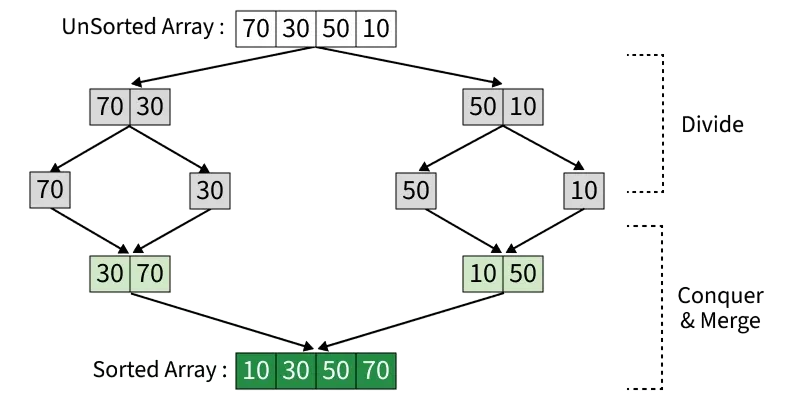
Merge sort is a divide-and-conquer sorting algorithm that divides an array into smaller subarrays. Each subarray is sorted independently and then merged together. The merging process combines sorted portions into a fully sorted array. Merge sort guarantees consistent performance for large datasets. Its time complexity is O(n log n) in all cases. Additional memory is required during the merging process. It is widely used because of its efficiency and stability.
57. What Is Quick Sort?
Ans:
Quick sort is a highly efficient sorting algorithm based on the divide-and-conquer approach. It selects a pivot element and partitions the array around it. Elements smaller than the pivot move to one side, while larger elements move to the other. The process is repeated recursively for each partition. Quick sort performs very well in practical applications. Its average time complexity is O(n log n). It is one of the most commonly used sorting algorithms
58. What Is A Hash Table?
Ans:
A hash table is a data structure used to store key-value pairs efficiently. It uses a hash function to calculate an index for storing data. Hash tables provide fast insertion, deletion, and retrieval operations. Their average time complexity is O(1) for most operations. Collisions may occur when multiple keys map to the same index. Collision handling techniques include chaining and open addressing. Hash tables are widely used in databases and caching systems.
59. Write A Program To Find The Factorial Of A Number.
Ans:
This program calculates the factorial of a number using a loop. Factorial is the product of all positive integers from 1 to the given number. It is commonly used in mathematics and algorithm problems.
- int n = 5, fact = 1;
- for(int i = 1; i <= n; i++)
- fact *= i;
- System.out.println(fact);
60. What Is The Difference Between Interface And Abstract Class?
Ans:
| Feature | Interface | Abstract Class |
|---|---|---|
| Definition | A blueprint that defines a set of methods a class must implement. | A class that cannot be instantiated and may contain both abstract and concrete methods. |
| Purpose | Achieves complete abstraction and defines a contract for classes. | Provides a common base with shared functionality and partial abstraction. |
| Method Implementation | Methods are typically abstract (except default and static methods in Java). | Can contain both abstract and implemented methods. |
| Variables | Can contain constants (public, static, final by default). | Can contain instance variables, static variables, and constants. |
61. What Is A Binary Search Tree?
Ans:
A binary search tree is a special type of binary tree with ordered nodes. Values smaller than a node are stored in the left subtree. Values larger than a node are stored in the right subtree. This property enables efficient searching and insertion. The average search time complexity is O(log n). Balanced binary search trees provide better performance. They are widely used in databases and indexing systems.
62. What Is Graph Data Structure?
Ans:
- A graph is a collection of vertices connected by edges. Graphs are used to model relationships between objects.
- They can be directed or undirected depending on edge direction. Graphs are widely used in social networks and navigation systems. Common graph operations include traversal and pathfinding.
- Efficient graph algorithms solve complex real-world problems. Graphs are essential topics in coding interviews.
63. What Is Breadth First Search (BFS)?
Ans:
Breadth First Search is a graph traversal algorithm that explores nodes level by level. It starts from a source node and visits all neighboring nodes first. BFS uses a queue data structure for traversal. It guarantees the shortest path in unweighted graphs. The algorithm is useful in networking and pathfinding applications. BFS systematically explores all reachable nodes. It is a common interview topic for graph problems.
64. What Is Depth First Search (DFS)?
Ans:
Depth First Search is a graph traversal algorithm that explores nodes deeply before backtracking. It follows one path until no further progress is possible. DFS uses recursion or a stack data structure. It is useful for solving connectivity and cycle detection problems. DFS can traverse all nodes in a graph efficiently. The algorithm is widely used in tree and graph operations. Understanding DFS is important for technical interviews.
65. What Is Dynamic Programming?
Ans:
Dynamic programming is an optimization technique used to solve complex problems efficiently. It breaks problems into smaller overlapping subproblems. Solutions to subproblems are stored and reused. This approach avoids repeated computations. Dynamic programming significantly improves performance for certain algorithms. Examples include Fibonacci and knapsack problems. It is a popular topic in coding interviews.
66. What Is A Greedy Algorithm?
Ans:
A greedy algorithm makes the best possible choice at each step. It aims to find an optimal solution through local decisions. Greedy algorithms are often simple and efficient. They do not always guarantee the global optimum solution. Examples include activity selection and Huffman coding. Their effectiveness depends on problem characteristics. Greedy techniques are widely used in optimization problems.
67. What Is Software Testing?
Ans:
Software testing is the process of evaluating software to identify defects and verify functionality. It ensures that applications meet specified requirements. Testing improves software quality and reliability. Different testing methods include manual and automated testing. Proper testing reduces production issues and maintenance costs. It helps deliver better user experiences. Testing is an essential part of software development.
68. What Is Unit Testing?
Ans:
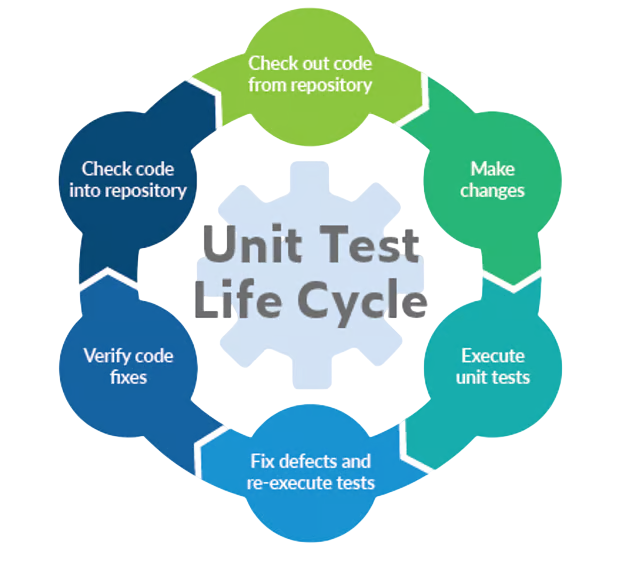
Unit testing involves testing individual components or functions of an application. It verifies that each unit works as expected. Unit tests are typically written by developers. Automated testing frameworks simplify execution and maintenance. Early defect detection reduces debugging efforts. Unit testing improves code quality and confidence. It is a key practice in modern software development.
69. What Is Integration Testing?
Ans:
- Integration testing verifies the interaction between different software modules. It ensures that integrated components work correctly together.
- This testing phase identifies communication and interface issues. Integration testing is performed after unit testing.
- It validates data flow across modules. Proper integration testing improves system stability. It is important for complex applications.
70. What Is System Testing?
Ans:
System testing evaluates the complete software application as a whole. It verifies that all requirements are satisfied. Testing is conducted in an environment similar to production. Functional and non-functional aspects are examined. System testing identifies issues affecting overall application behavior. It ensures readiness before deployment. This phase is essential for software quality assurance.
71. What Is SDLC?
Ans:
SDLC stands for Software Development Life Cycle. It is a structured process for developing software applications. Common phases include planning, analysis, design, development, testing, and deployment. SDLC helps manage project complexity effectively. It improves software quality and project control. Different SDLC models exist for various project needs. Understanding SDLC is important for software engineering roles.
72. What Is The Waterfall Model?
Ans:
The Waterfall Model is a sequential software development approach. Each phase must be completed before moving to the next. Requirements are defined early in the project. The model is easy to understand and manage. Changes are difficult to implement once development begins. It is suitable for projects with stable requirements. Waterfall remains a foundational SDLC model.
73. Write A Program To Check Whether A String Is A Palindrome.
Ans:
This program checks whether a string reads the same forward and backward. It creates a reversed version of the string and compares it with the original. If both are equal, the string is a palindrome.
- String s = “madam”;
- String rev = new StringBuilder(s).reverse().toString();
- System.out.println(s.equals(rev) ? “Palindrome” : “Not Palindrome”);
74. What Is Scrum?
Ans:
Scrum is an Agile framework used to manage software projects. Work is organized into short cycles called sprints. Scrum emphasizes teamwork and continuous improvement. Roles include Product Owner, Scrum Master, and Development Team. Regular meetings help track project progress. Scrum improves transparency and collaboration. It is one of the most popular Agile frameworks.
75. What Is Version Control?
Ans:
Version control is a system used to track changes in source code. It allows multiple developers to work collaboratively. Previous versions can be restored when necessary. Version control improves project management and code quality. It helps resolve conflicts during development. Systems like Git are widely used. Version control is essential for modern software teams.
76. What Is Git?
Ans:
Git is a distributed version control system used to manage source code changes. It allows developers to work independently and merge contributions later. Git tracks modifications efficiently. Branching and merging are important Git features. It supports collaboration across development teams. Git improves productivity and project organization. It is one of the most widely used development tools.
77. What Is GitHub?
Ans:
GitHub is a cloud-based platform for hosting Git repositories. It provides collaboration tools for software development. Developers can share code and track project changes. GitHub supports pull requests and issue tracking. It facilitates teamwork in open-source and enterprise projects. Integration with development tools improves workflow. GitHub is widely used in the software industry.
78. What Is CI/CD?
Ans:
.
- CI/CD stands for Continuous Integration and Continuous Deployment. It automates software build, testing, and deployment processes.
- Continuous Integration ensures frequent code integration. Continuous Deployment delivers updates quickly and reliably.
- Automation reduces manual effort and errors. CI/CD improves software quality and release speed. It is a key DevOps practice.
79. What Is Cloud Computing?
Ans:
Cloud computing provides on-demand access to computing resources over the internet. Resources include servers, storage, and networking services. Cloud platforms offer scalability and flexibility. Organizations pay only for the resources they use. Cloud computing reduces infrastructure management costs. Popular providers include AWS, Azure, and Google Cloud. It has transformed modern application development..
80. What Is Virtualization?
Ans:
Virtualization is the creation of virtual versions of computing resources. It allows multiple operating systems to run on a single physical machine. Virtualization improves hardware utilization and flexibility. It simplifies testing and deployment environments. Virtual machines operate independently of each other. This technology supports cloud computing infrastructures. It enhances scalability and resource management.
81. What Is Docker?
Ans:
Docker is a platform used to develop and deploy applications in containers. Containers package applications and dependencies together. Docker ensures consistency across environments. It simplifies deployment and scaling processes. Containers are lightweight compared to virtual machines. Docker improves development efficiency and portability. It is widely used in DevOps workflows.
82. What Is Kubernetes?
Ans:
Kubernetes is a container orchestration platform that manages containerized applications. It automates deployment, scaling, and monitoring tasks. Kubernetes improves application availability and reliability. It supports load balancing and resource management. Large-scale cloud-native applications commonly use Kubernetes. The platform simplifies container operations. It is an important technology in modern infrastructure management.
83. What Is Cybersecurity?
Ans:
- Cybersecurity involves protecting systems, networks, and data from digital threats. It helps prevent unauthorized access and cyberattacks.
- Security measures include encryption, authentication, and firewalls. Organizations invest heavily in cybersecurity practices.
- Strong security protects sensitive information and business operations. Cybersecurity awareness reduces vulnerabilities. It is a critical aspect of technology management.
84. What Is Authentication?
Ans:
Authentication is the process of verifying a user’s identity. It ensures that only authorized individuals access systems. Common methods include passwords, biometrics, and OTPs. Authentication strengthens application security. Multi-factor authentication provides additional protection. Proper authentication reduces security risks. It is a fundamental security mechanism.
85. What Is Authorization?
Ans:
Authorization determines what actions an authenticated user can perform. It controls access to resources and functionalities. Authorization occurs after successful authentication. Role-based access control is a common approach. Proper authorization protects sensitive data. It ensures compliance with security policies. Authorization is essential for secure application design.
86. What Is Debugging?
Ans:
Debugging is the process of identifying and fixing software defects. Developers analyze program behavior to locate issues. Debugging tools assist in examining execution flow. Effective debugging improves software quality. It requires logical thinking and problem-solving skills. Debugging reduces application failures and maintenance costs. It is an essential development activity.
87. What Is A Design Pattern?
Ans:
- A design pattern is a reusable solution to a common software design problem. Patterns provide proven approaches for structuring code.
- Examples include Singleton, Factory, and Observer patterns. Design patterns improve maintainability and scalability.
- They promote best practices in software development. Developers use patterns to solve recurring challenges efficiently. Understanding patterns is valuable for interviews.
88. What Is The Singleton Pattern?
Ans:
The Singleton Pattern ensures that a class has only one instance throughout the application. It provides a global access point to that instance. Singleton is useful for configuration and logging services. It helps manage shared resources efficiently. Careful implementation is required in multithreaded environments. The pattern reduces unnecessary object creation. It is one of the most common design patterns.
89. What Is The Factory Pattern?
Ans:
The Factory Pattern provides an interface for creating objects without exposing creation logic. It promotes loose coupling between components. Clients request objects from a factory rather than creating them directly. This approach improves flexibility and maintainability. Factories simplify object management in large systems. The pattern supports scalable application design. It is widely used in object-oriented programming.
90. What Is The Observer Pattern?
Ans:
The Observer Pattern establishes a one-to-many relationship between objects. When one object changes state, dependent objects are notified automatically. This pattern supports event-driven programming. It reduces tight coupling between components. Observer is commonly used in GUI applications. The pattern improves flexibility and maintainability. It is a popular design pattern in software development.
91. Write A Program To Find The Sum Of Elements In An Array.
Ans:
This program calculates the total of all elements in an array. It iterates through each element and adds it to a sum variable. After processing all elements, the final sum is displayed.
- int arr[] = {1,2,3,4,5}, sum = 0;
- for(int n : arr)
- sum += n;
- System.out.println(sum);
92. What Is Garbage Collection?
Ans:
Garbage collection is an automatic memory management process. It identifies and removes objects that are no longer needed. This frees memory for future use. Garbage collection reduces manual memory handling. It helps prevent memory leaks and related issues. Languages such as Java use built-in garbage collectors. Proper understanding improves application performance.
93. What Is A Memory Leak?
Ans:
A memory leak occurs when allocated memory is not released properly. As a result, memory consumption increases over time. Memory leaks can degrade application performance. They may eventually cause application crashes. Detecting leaks requires monitoring and analysis tools. Good coding practices help prevent leaks. Memory management is critical for reliable software.
94. What Is Scalability?
Ans:
Scalability refers to a system’s ability to handle increasing workloads effectively. Scalable systems maintain performance as demand grows. Horizontal and vertical scaling are common approaches. Scalability is important for growing applications and businesses. Proper architecture supports future expansion. Cloud computing often enhances scalability. It is a key consideration in system design.
95. What Is Load Balancing?
Ans:
Load balancing distributes incoming requests across multiple servers. It prevents any single server from becoming overloaded. Load balancing improves performance and availability. It enhances fault tolerance in distributed systems. Traffic distribution can be managed using hardware or software solutions. Efficient load balancing supports scalability. It is widely used in web applications.
96. What Is A Microservice?
Ans:
- A microservice is a small, independent service designed to perform a specific business function. Multiple microservices work together to form an application.
- Each service can be developed and deployed independently. Microservices improve scalability and maintainability. They support flexible technology choices.
- Communication often occurs through APIs. This architecture is widely used in cloud-native applications.
97. What Is Monolithic Architecture?
Ans:
- Monolithic architecture structures an application as a single unified unit. All components are tightly integrated within one codebase.
- Development and deployment are relatively simple initially. However, scaling large monolithic systems can be challenging.
- Changes may affect unrelated components. Maintenance becomes difficult as complexity increases. Monolithic architecture contrasts with microservices architecture.
98. How Does Optimize Code Performance?
Ans:
Code performance optimization involves improving execution speed and resource utilization. Developers analyze bottlenecks using profiling tools. Efficient algorithms and data structures improve performance. Reducing unnecessary computations enhances responsiveness. Memory usage should also be optimized. Continuous testing validates performance improvements. Optimization helps create scalable and efficient applications.
99. How Does Handle A Challenging Coding Problem?
Ans:
- Handling a challenging coding problem begins with understanding requirements clearly. Breaking the problem into smaller parts simplifies analysis.
- Appropriate data structures and algorithms should be selected. Multiple solutions can be evaluated for efficiency.
- Testing validates correctness and edge cases. Debugging helps resolve unexpected issues. A structured approach improves problem-solving effectiveness.
100. Why Should Hire For A Wipro Internship?
Ans:
Possesses strong programming fundamentals and a passion for learning new technologies. Enjoys solving coding problems and continuously improving technical skills. An academic background provides a solid foundation in computer science concepts. Works effectively both independently and in team environments. Demonstrates adaptability, responsibility, and enthusiasm for contributing to real-world projects. An internship at Wipro would provide valuable professional growth opportunities while contributing to organizational success. Committed to continuous learning and delivering high-quality results.