LMS
LMS![Top 40+ [Real – Time] Most Asked Zoho Aptitude Questions and Answers Interview Questions](https://www.acte.in/wp-content/uploads/2026/07/ChatGPT-Image-Jul-23-2026-12_19_05-PM-1568x853.png)
Last updated on 01st Jul 2026| 4967

Preparing For The Zoho Aptitude Test Is An Important Step For Freshers Who Want To Start Their Career At Zoho. The Aptitude Round Evaluates Logical Reasoning, Quantitative Aptitude, Analytical Thinking, Verbal Ability, And Basic Problem-Solving Skills. The Questions Are Designed To Test Accuracy, Speed, And Decision-Making Under Time Constraints.This Collection Of Most Asked Zoho Aptitude Questions And Answers Covers Frequently Repeated Topics Such As Percentages, Profit And Loss, Time And Work, Time And Distance, Probability, Number Series, Puzzles, Blood Relations, Coding-Decoding, Calendar, Clocks, And Data Interpretation. Practicing These Questions Will Help You Understand The Exam Pattern And Improve Your Confidence.
1. What Is Aptitude?
Ans:
Aptitude Is The Ability To Learn And Solve Problems Quickly. It Measures Logical Thinking And Analytical Skills. Companies Use Aptitude Tests To Evaluate Candidates. These Tests Assess Numerical, Verbal, And Reasoning Abilities. Strong Aptitude Helps In Making Better Decisions. It Is Important For Technical And Non-Technical Roles. Aptitude Preparation Improves Overall Problem-Solving Skills.
2. Why Does Zoho Conduct Aptitude Tests?
Ans:
- Zoho Conducts Aptitude Tests To Assess A Candidate’s Thinking Ability. The Test Evaluates Logical And Numerical Skills.
- It Helps Identify Candidates With Strong Analytical Capabilities. Aptitude Tests Also Measure Accuracy And Speed.
- They Ensure Candidates Can Handle Workplace Challenges. Performance In The Test Impacts Selection Chances. Good Preparation Improves Success Rates.
3. A Student Obtained 360 Marks Out Of 450. What Is The Percentage?
Ans:
Use The Formula (Obtained Marks ÷ Total Marks) × 100. The Calculation Is (360 ÷ 450) × 100. The Result Is 80%. Percentage Problems Are Common In Aptitude Tests. They Help Assess Numerical Ability. Such Questions Improve Calculation Speed. Percentage = 80%. The Student Scored 80 Percent Marks. This Represents Good Academic Performance. It Shows Strong Academic Achievement.
- (Obtained Marks ÷ Total Marks) × 100
- =(450/360)×100
- =0.8×100
- =80%
4. A Student Obtained 405 Marks Out Of 500. What Is The Percentage?
Ans:
Use The Formula (Obtained Marks ÷ Total Marks) × 100. The Calculation Is (405 ÷ 500) × 100. The Result Is 81%. Percentage Questions Frequently Appear In Placement Exams. They Test Basic Arithmetic Skills. They Improve Accuracy In Calculations. Percentage = 81%. The Student Scored 81 Percent Marks. This Indicates Excellent Academic Performance. It Reflects Consistent Learning.
- (Obtained Marks ÷ Total Marks) × 100
- =(405 ÷ 500) × 100
- =0.81 × 100
- =81%
5. A Student Obtained 315 Marks Out Of 420. What Is The Percentage?
Ans:
Use The Formula (Obtained Marks ÷ Total Marks) × 100. The Calculation Is (315 ÷ 420) × 100. The Result Is 75%. Percentage Problems Measure Numerical Ability. They Are Easy To Solve With Practice. They Improve Mental Calculations. Percentage = 75%. The Student Scored 75 Percent Marks. This Indicates Good Academic Performance. It Shows A Strong Understanding Of Subjects.
- (Obtained Marks ÷ Total Marks) × 100
- =(315 ÷ 420) × 100
- =0.75 × 100
- =75%
6. A Student Obtained 432 Marks Out Of 480. What Is The Percentage
Ans:
- Use The Formula (Obtained Marks ÷ Total Marks) × 100. The Calculation Is (432 ÷ 480) × 100. The Result Is 90%. Percentage Questions Are Frequently Asked In Aptitude Tests.
- They Evaluate Calculation Skills. They Enhance Problem-Solving Ability. Percentage = 90%. The Student Scored 90 Percent Marks.
- This Represents Outstanding Academic Performance. It Reflects Excellent Preparation.
- (Obtained Marks ÷ Total Marks) × 100
- =(432 ÷ 480) × 100
- =0.9 × 100
- =90%
7. A Student Obtained 255 Marks Out Of 300. What Is The Percentage?
Ans:
Use The Formula (Obtained Marks ÷ Total Marks) × 100. The Calculation Is (255 ÷ 300) × 100. The Result Is 85%. Percentage Calculations Are Important In Competitive Exams. They Improve Numerical Confidence. Regular Practice Helps Solve Them Faster. Percentage = 85%. The Student Scored 85 Percent Marks. This Shows Very Good Academic Achievement. It Reflects Consistent Effort.
- (Obtained Marks ÷ Total Marks) × 100
- =(255 ÷ 300) × 100
- =0.85 × 100
- =85%
8. A Student Obtained 294 Marks Out Of 350. What Is The Percentage?
Ans:
Use The Formula (Obtained Marks ÷ Total Marks) × 100. The Calculation Is (294 ÷ 350) × 100. The Result Is 84%. Percentage Questions Test Arithmetic Accuracy. They Are Common In Placement Tests. Practice Improves Speed And Confidence. Percentage = 84%. The Student Scored 84 Percent Marks. This Indicates Strong Academic Performance. It Demonstrates Good Subject Knowledge.
- (Obtained Marks ÷ Total Marks) × 100
- =(294 ÷ 350) × 100
- =0.84 × 100
- =84%
9. A Student Obtained 288 Marks Out Of 360. What Is The Percentage?
Ans:
Use The Formula (Obtained Marks ÷ Total Marks) × 100. The Calculation Is (288 ÷ 360) × 100. The Result Is 80%. Percentage Problems Strengthen Mathematical Skills. They Are Frequently Asked During Recruitment Tests. They Build Confidence In Calculations. Percentage = 80%. The Student Scored 80 Percent Marks. This Reflects Good Academic Progress. It Shows Consistent Performance.
- (Obtained Marks ÷ Total Marks) × 100
- =(288 ÷ 360) × 100
- =0.8 × 100
- =80%
10. A Student Obtained 198 Marks Out Of 220. What Is The Percentage?
Ans:
Use The Formula (Obtained Marks ÷ Total Marks) × 100. The Calculation Is (198 ÷ 220) × 100. The Result Is 90%. Percentage Questions Improve Numerical Thinking. They Help Assess Mathematical Ability. They Are Easy With Formula-Based Practice. Percentage = 90%. The Student Scored 90 Percent Marks. This Indicates Excellent Academic Success. It Reflects Hard Work And Dedication.
- (Obtained Marks ÷ Total Marks) × 100
- =(198 ÷ 220) × 100
- =0.9 × 100
- =90%
11. A Student Obtained 368 Marks Out Of 460. What Is The Percentage?
Ans:
Use The Formula (Obtained Marks ÷ Total Marks) × 100. The Calculation Is (368 ÷ 460) × 100. The Result Is 80%. Percentage Problems Are Common In Aptitude Assessments. They Improve Speed And Accuracy. They Strengthen Basic Mathematics. Percentage = 80%. The Student Scored 80 Percent Marks. This Represents Good Academic Achievement. It Shows Strong Learning Skills.
- (Obtained Marks ÷ Total Marks) × 100
- =(368 ÷ 460) × 100
- =0.8 × 100
- =80%
12. A Student Obtained 522 Marks Out Of 600. What Is The Percentage?
Ans:
- Use The Formula (Obtained Marks ÷ Total Marks) × 100. The Calculation Is (522 ÷ 600) × 100. The Result Is 87%. Percentage Questions Are Essential In Competitive Exams.
- They Test Numerical Aptitude. Regular Practice Improves Performance. Percentage = 87%. The Student Scored 87 Percent Marks.
- This Reflects Excellent Academic Performance. It Demonstrates Strong Preparation And Consistency.
- (Obtained Marks ÷ Total Marks) × 100
- =(522 ÷ 600) × 100
- =0.87 × 100
- =87%
13. What Is The Angle Between The Hour Hand And Minute Hand At 3:00?
Ans:
At 3:00, The Minute Hand Is At 12 And The Hour Hand Is At 3. The Angle Between Them Is Calculated As 3 × 30° = 90°. Clock Problems Test Logical And Mathematical Skills. They Frequently Appear In Aptitude Tests. 90°. The Angle Between The Hands Is A Right Angle. This Is One Of The Most Common Clock Questions. Understanding Basic Clock Angles Helps Solve Similar Aptitude Problems Quickly.
14. What Is The Angle Between The Hour Hand And Minute Hand At 6:00?
Ans:
At 6:00, The Minute Hand Is At 12 And The Hour Hand Is At 6. The Distance Between Them Is 6 × 30° = 180°. Clock Aptitude Questions Measure Time-Based Reasoning. They Improve Calculation Speed. 180°. The Hands Form A Straight Line. This Represents A Straight Angle. Knowing Standard Clock Angles Makes Problem Solving Faster In Competitive Exams.
15. What Is The Angle Between The Hour Hand And Minute Hand At 9:00?
Ans:
At 9:00, The Minute Hand Is At 12 And The Hour Hand Is At 9. The Difference Is 3 Hour Marks × 30° = 90°. Clock Questions Frequently Appear In Placement Exams. They Test Analytical Thinking. 90°. The Hands Form A Right Angle. This Is A Frequently Asked Aptitude Question. Learning These Basic Angles Improves Accuracy In Clock-Based Questions.
16. How Many Times Do The Hands Of A Clock Coincide In A Day?
Ans:
- The Hour Hand And Minute Hand Coincide 11 Times In 12 Hours. Therefore, In 24 Hours, They Coincide 22 Times.
- This Is A Common Clock Aptitude Concept. It Tests Logical Understanding. 22 Times. The Hands Overlap Twenty-Two Times In One Day.
- This Is An Important Interview Question. Remembering This Standard Result Saves Time During Exams.
17. How Many Times Do The Hands Of A Clock Form A Right Angle In A Day?
Ans:
The Hands Of A Clock Form A Right Angle 22 Times In 12 Hours. Therefore, They Form A Right Angle 44 Times In 24 Hours. Clock Problems Require Careful Observation. They Improve Logical Reasoning Skills. 44 Times. The Hands Form A 90-Degree Angle Forty-Four Times In A Day. This Is A Standard Aptitude Question. This Formula-Based Fact Is Frequently Asked In Placement Tests.
18. At What Time Between 4 And 5 O’Clock Will The Hands Coincide?
Ans:
Use The Formula (60 × Hour) ÷ 11 Minutes. The Calculation Is (60 × 4) ÷ 11 = 21 9/11 Minutes Past 4. Coincidence Questions Test Mathematical Accuracy. They Frequently Appear In Competitive Exams. 4:21 9/11. The Hands Meet At Approximately 4:21:49. This Is A Common Clock Aptitude Problem. Applying The Standard Coincidence Formula Gives The Correct Answer Quickly.
19. At What Time Between 7 And 8 O’Clock Will The Hands Be At Right Angles For The First Time?
Ans:
- Use The Clock Angle Formula To Calculate The Required Time. The First Right Angle Occurs At Approximately 7:05 5/11.
- These Questions Test Time And Angle Concepts. Regular Practice Improves Speed. 7:05 5/11. The Hands Form A 90-Degree Angle Shortly After 7 O’Clock.
- This Is A Frequently Asked Placement Question. Mastering Clock Formulas Helps Solve Such Problems With Confidence.
20. At What Time Between 2 And 3 O’Clock Will The Hands Coincide?
Ans:
Use The Formula (60 × Hour) ÷ 11 Minutes. The Calculation Is (60 × 2) ÷ 11 = 10 10/11 Minutes Past 2. Coincidence Problems Are Common In Aptitude Tests. They Improve Analytical Thinking. 2:10 10/11. The Hands Meet At Approximately 2:10:55. This Is An Important Clock Aptitude Question. Regular Practice Of Clock Problems Enhances Speed And Accuracy In Competitive Exams.
21. Find The HCF Of 18 And 24.
Ans:
The Factors Of 18 Are 1, 2, 3, 6, 9, 18. The Factors Of 24 Are 1, 2, 3, 4, 6, 8, 12, 24. The Greatest Common Factor Is 6. HCF Questions Test Basic Number Concepts. They Frequently Appear In Aptitude Tests. HCF = 6. The Highest Common Factor Of 18 And 24 Is 6. Understanding Factors Makes HCF Problems Easy To Solve. Regular Practice Improves Speed And Accuracy In Finding HCF..
- Factors Of 18 = 1, 2, 3, 6, 9, 18
- Factors Of 24 = 1, 2, 3, 4, 6, 8, 12, 24
- Greatest Common Factor = 6
- HCF = 6
22. Find The LCM Of 12 And 18.
Ans:
Write The Prime Factors: 12 = 2 × 2 × 3 And 18 = 2 × 3 × 3. Take The Highest Powers Of All Prime Factors. LCM = 2 × 2 × 3 × 3 = 36. LCM Questions Measure Arithmetic Skills. They Are Common In Competitive Exams. LCM = 36. The Least Common Multiple Of 12 And 18 Is 36. Prime Factorization Is The Easiest Method To Find LCM. Learning Prime Factors Helps Solve LCM Questions More Efficiently.
- 12 = 2 × 2 × 3
- 18 = 2 × 3 × 3
- LCM = 2 × 2 × 3 × 3
- = 36
23. Find The HCF Of 36 And 48.
Ans:
- The Factors Of 36 Are 1, 2, 3, 4, 6, 9, 12, 18, 36. The Factors Of 48 Are 1, 2, 3, 4, 6, 8, 12, 16, 24, 48. The Greatest Common Factor Is 12.
- HCF Problems Improve Logical Thinking. They Help Build Strong Mathematical Skills. HCF = 12. The Highest Common Factor Of 36 And 48 Is 12.
- Finding Common Factors Simplifies The Solution. HCF Is Widely Used In Mathematics And Competitive Examinations.
- Factors Of 36 = 1, 2, 3, 4, 6, 9, 12, 18, 36
- Factors Of 48 = 1, 2, 3, 4, 6, 8, 12, 16, 24, 48
- Greatest Common Factor = 12
- HCF = 12
24. Find The LCM Of 15 And 20.
Ans:
- Write The Prime Factors: 15 = 3 × 5 And 20 = 2 × 2 × 5. Take The Highest Powers Of Each Prime Factor. LCM = 2 × 2 × 3 × 5 = 60. LCM Questions Are Frequently Asked In Placement Tests.
- They Test Numerical Ability. LCM = 60. The Least Common Multiple Of 15 And 20 Is 60.
- Using Prime Factorization Ensures Accurate Results. Mastering LCM Concepts Helps Solve Many Aptitude Problems Quickly.
.
- 15 = 3 × 5
- 20 = 2 × 2 × 5
- LCM = 2 × 2 × 3 × 5
- = 60
25. Find The HCF And LCM Of 16 And 24.
Ans:
- Write The Prime Factors: 16 = 2 × 2 × 2 × 2 And 24 = 2 × 2 × 2 × 3. The Common Prime Factors Give HCF = 2 × 2 × 2 = 8. The Highest Powers Of All Prime Factors Give LCM = 2 × 2 × 2 × 2 × 3 = 48.
- These Questions Test Both HCF And LCM Concepts Together. They Frequently Appear In Aptitude And Placement Exams.
- HCF = 8 And LCM = 48. The Highest Common Factor Is 8 And The Least Common Multiple Is 48. Practicing Both Concepts Improves Speed And Accuracy In Exam
- 16 = 2 × 2 × 2 × 2
- 24 = 2 × 2 × 2 × 3
- HCF = 2 × 2 × 2 = 8
- LCM = 2 × 2 × 2 × 2 × 3 = 48
26. A Train 180 Meters Long Crosses A Pole In 12 Seconds. What Is The Speed Of The Train?
Ans:
Use The Formula Speed = Distance ÷ Time. The Distance Is 180 Meters And The Time Is 12 Seconds. The Speed Is 180 ÷ 12 = 15 M/S = 54 Km/H. Train Problems Test Speed And Distance Concepts. They Frequently Appear In Aptitude Tests. 54 Km/H. The Speed Of The Train Is 54 Kilometers Per Hour. Practicing Train Problems Improves Calculation Speed. Learning Unit Conversion Helps Solve Train Problems Faster. Regular Practice Enhances Accuracy In Competitive Exams.
- Speed = Distance ÷ Time
- = 180 ÷ 12
- = 15 M/S
- = 15 × 3.6 = 54 Km/H
27. A Train Travels At 72 Km/H. How Much Distance Does It Cover In 20 Seconds?
Ans:
Convert 72 Km/H Into 20 M/S. Distance = 20 × 20 = 400 Meters. Train Questions Improve Speed And Distance Skills. They Are Common In Placement Exams. 400 Meters. The Train Covers 400 Meters In 20 Seconds. Unit Conversion Is Essential In Train Problems. Understanding The Relationship Between Speed, Distance, And Time Makes Calculations Easier. These Questions Frequently Appear In Placement Tests.
- 72 Km/H = 20 M/S
- Distance = Speed × Time
- = 20 × 20
- = 400 Meters
28. A Train 240 Meters Long Crosses A Platform 360 Meters Long In 30 Seconds. Find The Speed Of The Train.
Ans:
Total Distance = 240 + 360 = 600 Meters. Speed = 600 ÷ 30 = 20 M/S = 72 Km/H. Train Problems Test Logical Thinking. They Improve Mathematical Accuracy. 72 Km/H. The Speed Of The Train Is 72 Kilometers Per Hour. Remember To Add Train And Platform Lengths. Correct Formula Application Ensures The Right Answer. Practice Helps Solve Similar Questions Quickly.
- Total Distance = 240 + 360 = 600 Meters
- Speed = Distance ÷ Time
- = 600 ÷ 30 = 20 M/S
- = 20 × 3.6 = 72 Km/H
29. A Father Is 45 Years Old And His Son Is 15 Years Old. What Is Their Present Age Ratio?
Ans:
Present Ages Are 45 And 15. Ratio = 45 : 15 = 3 : 1. Age Problems Measure Numerical Ability. They Frequently Appear In Aptitude Tests. 3 : 1. The Father’s Age Is Three Times The Son’s Age. Simplifying Ratios Makes Age Problems Easy. Age Ratio Questions Improve Logical Thinking Skills. Always Reduce Ratios To Their Simplest Form.Checking Whether The Ratio Can Be Simplified Helps Avoid Calculation Errors.
- Present Age Ratio = 45 : 15
- Divide By 15
- = 3 : 1
- Answer = 3 : 1
30. A Mother’s Age Is 36 Years And Her Daughter’s Age Is 12 Years. What Is Their Age Ratio?
Ans:
- Present Ages Are 36 And 12. Ratio = 36 : 12 = 3 : 1. Age Questions Improve Logical Thinking. They Are Common In Competitive Exams. 3 : 1.
- The Mother Is Three Times Older Than Her Daughter. Age Ratios Help Solve Future Age Problems. Understanding Ratios Makes Age Calculations Easier.
- These Questions Test Basic Mathematical Skills. Expressing The Ratio In Its Lowest Form Makes The Answer Clear And Accurate.
- Present Age Ratio = 36 : 12
- Divide By 12
- = 3 : 1
- Answer = 3 : 1
31. Five Years Ago, Ravi Was 20 Years Old. What Is His Present Age?
Ans:
Present Age = 20 + 5 = 25 Years. Age Questions Test Basic Arithmetic Skills. They Improve Logical Reasoning. 25 Years. Ravi’s Present Age Is 25 Years. Always Read The Time Reference Carefully. Past And Future Age Problems Require Careful Interpretation. Regular Practice Improves Accuracy In Solving Age Questions.Adding The Time Difference To The Past Age Gives The Correct Present Age.
- Past Age = 20 Years
- Years Passed = 5
- Present Age = 20 + 5
- = 25 Years
32. Ten Years From Now, A Person Will Be 40 Years Old. What Is The Present Age?
Ans:
Present Age = 40 − 10 = 30 Years. Future Age Problems Frequently Appear In Aptitude Tests. They Test Calculation Accuracy. 30 Years. The Present Age Is 30 Years. Understanding Time Difference Simplifies Age Questions. Always Work Backwards In Future Age Problems. These Questions Enhance Logical Reasoning Skills. Subtracting Future Years From The Given Age Helps Find The Present Age Correctly.
- Future Age = 40 Years
- Future Years = 10
- Present Age = 40 − 10
- = 30 Years
33. A Invests ₹20,000 And B Invests ₹30,000. The Total Profit Is ₹25,000. Find B’s Share.
Ans:
- Investment Ratio = 2 : 3. B’s Share = (3 ÷ 5) × 25,000 = ₹15,000. Partnership Questions Test Ratio Concepts. They Are Common In Placement Exams.
- ₹15,000. B Receives ₹15,000 As Profit. Profit Is Shared According To Investment Ratio. Investment Duration Also Matters In Some Partnership Problems.
- Practice Helps Solve Partnership Questions Quickly. Always Divide The Total Profit According To The Investment Ratio.
- Investment Ratio = 2 : 3
- B’s Share = (3 ÷ 5) × 25,000
- = 15,000
- = ₹15,000
34. A Invests ₹40,000 And B Invests ₹60,000. The Total Profit Is ₹50,000. Find A’s Share.
Ans:
Investment Ratio = 2 : 3. A’s Share = (2 ÷ 5) × 50,000 = ₹20,000. Partnership Problems Improve Numerical Skills. They Frequently Appear In Competitive Exams. ₹20,000. A Receives ₹20,000 As Profit. Investment Ratio Determines Profit Distribution. Profit Is Divided Based On The Ratio Of Investments. Regular Practice Improves Speed In Partnership Calculations.Equal Investment Periods Mean Profit Depends Only On The Amount Invested.
- Investment Ratio = 2 : 3
- A’s Share = (2 ÷ 5) × 50,000
- = 20,000
- = ₹20,000
35. Three Partners Invest ₹10,000, ₹20,000 And ₹30,000. Find Their Profit Ratio.
Ans:
Investment Ratio = 10 : 20 : 30 = 1 : 2 : 3. Partnership Questions Measure Arithmetic Skills. They Improve Ratio Calculations. 1 : 2 : 3. The Profit Is Shared In The Ratio Of Their Investments. Simplifying Ratios Makes Calculations Easier. Equal Investment Periods Mean Profit Depends Only On Investment Amount. Partnership Questions Frequently Appear In Aptitude And Placement Exams.
- Investment Ratio = 10 : 20 : 30
- Simplify Ratio
- = 1 : 2 : 3
- Profit Ratio = 1 : 2 : 3
36. A Boat Travels At 18 Km/H In Still Water And The Stream Speed Is 4 Km/H. Find The Downstream Speed.
Ans:
- Downstream Speed = 18 + 4 = 22 Km/H. Boats And Streams Questions Test Speed Concepts. They Frequently Appear In Aptitude Tests. 22 Km/H.
- The Boat Travels At 22 Km/H Downstream. Downstream Speed Is Always Higher Than Still Water Speed. The Stream Increases The Boat’s Speed While Moving Downstream.
- Remember The Formula: Downstream Speed = Boat Speed + Stream Speed. Regular Practice Improves Accuracy In Boats And Streams Problems.
- Boat Speed = 18 Km/H
- Stream Speed = 4 Km/H
- Downstream Speed = 18 + 4
- = 22 Km/H
37. A Boat Travels At 20 Km/H In Still Water And The Stream Speed Is 5 Km/H. Find The Upstream Speed.
Ans:
Upstream Speed = 20 − 5 = 15 Km/H. Boats And Streams Problems Improve Numerical Skills. They Test Basic Arithmetic. 15 Km/H. The Boat Travels At 15 Km/H Upstream. Upstream Speed Is Always Less Than Still Water Speed. The Stream Opposes The Boat’s Movement While Traveling Upstream. Remember The Formula: Upstream Speed = Boat Speed − Stream Speed. These Questions Frequently Appear In Placement Tests.
- Boat Speed = 20 Km/H
- Stream Speed = 5 Km/H
- Upstream Speed = 20 − 5
- = 15 Km/H
38. A Boat Covers 60 Km Downstream At 20 Km/H. How Much Time Does It Take?
Ans:
Time = Distance ÷ Speed = 60 ÷ 20 = 3 Hours. Time And Speed Questions Frequently Appear In Competitive Exams. They Improve Calculation Speed. 3 Hours. The Boat Takes 3 Hours To Cover The Distance. Apply The Basic Speed Formula Carefully. Time Is Calculated By Dividing Distance By Speed. Learning Basic Formulas Makes Such Questions Easy To Solve.
- Distance = 60 Km
- Speed = 20 Km/H
- Time = 60 ÷ 20
- = 3 Hours
39. A Boat Covers 45 Km Upstream At 15 Km/H. Find The Time Taken.
Ans:
Time = 45 ÷ 15 = 3 Hours. Boats And Streams Questions Test Analytical Skills. They Improve Problem-Solving Ability. 3 Hours. The Boat Takes 3 Hours To Travel Upstream. Correct Formula Application Ensures Accuracy. Always Use Time = Distance ÷ Speed For Such Problems. Regular Practice Helps Solve Questions Faster In Exams.
- Distance = 45 Km
- Speed = 15 Km/H
- Time = 45 ÷ 15
- = 3 Hours
40. The Speed Of A Boat In Still Water Is 16 Km/H And The Stream Speed Is 2 Km/H. Find The Difference Between Downstream And Upstream Speeds.
Ans:
- Downstream = 18 Km/H. Upstream = 14 Km/H. Difference = 4 Km/H. Boats And Streams Questions Improve Logical Thinking.
- They Are Frequently Asked In Placement Tests. 4 Km/H. The Difference Between Downstream And Upstream Speeds Is 4 Km/H.
- Stream Speed Directly Affects Boat Speed. Understanding Both Upstream And Downstream Concepts Is Important. These Questions Improve Numerical Reasoning Skills.
- Downstream Speed = 16 + 2 = 18 Km/H
- Upstream Speed = 16 − 2 = 14 Km/H
- Difference = 18 − 14
- = 4 Km/H
41. A Train 300 Meters Long Crosses A Pole In 15 Seconds. Find Its Speed.
Ans:
72 Km/H. The Speed Is 300 ÷ 15 = 20 M/S = 72 Km/H. Train Questions Frequently Appear In Aptitude Exams. Practice Improves Accuracy. Convert Meters Per Second Into Kilometers Per Hour By Multiplying By 3.6. Always Use Speed = Distance ÷ Time. Regular Practice Helps Solve Train Problems Quickly. Understanding Unit Conversion Reduces Mistakes In Speed And Distance Problems.
- Speed = Distance ÷ Time
- = 300 ÷ 15
- = 20 M/S
- = 20 × 3.6 = 72 Km/H
42. A Father’s Present Age Is 50 Years And His Son’s Age Is 25 Years. What Is Their Age Ratio?
Ans:
2 : 1. The Father’s Age Is Twice The Son’s Age. Ratio Questions Are Easy With Simplification. Divide Both Ages By Their Highest Common Factor. Age Ratio Problems Test Logical Thinking Skills. They Frequently Appear In Competitive Examinations. Learning Ratio Simplification Helps Solve Age Problems More Efficiently.Always Express The Final Ratio In Its Simplest Form For Accuracy.
- Father’s Age = 50
- Son’s Age = 25
- 50 : 25 = 2 : 1
- Age Ratio = 2 : 1
43. A Invests ₹25,000 And B Invests ₹75,000. The Profit Is ₹40,000. Find B’s Share.
Ans:
₹30,000. Investment Ratio = 1 : 3. B Receives (3/4) × ₹40,000 = ₹30,000. Partnership Problems Are Based On Investment Ratios. Profit Is Shared According To The Investment Ratio. Higher Investment Receives A Higher Profit Share. Partnership Questions Frequently Appear In Aptitude Tests. Understanding Ratio Concepts Makes Partnership Calculations Simple And Accurate.
- Investment Ratio = 25,000 : 75,000 = 1 : 3
- Total Ratio Parts = 4
- B’s Share = (3 ÷ 4) × ₹40,000
- = ₹30,000
44. A Boat Speed In Still Water Is 25 Km/H And Stream Speed Is 5 Km/H. Find The Downstream Speed.
Ans:
30 Km/H. Downstream Speed = 25 + 5 = 30 Km/H. This Is A Frequently Asked Aptitude Question. Downstream Speed Is Always Greater Than Still Water Speed. Apply The Formula Boat Speed + Stream Speed. Understanding This Concept Makes Boats And Streams Problems Easier. Regular Practice Improves Speed In Solving Stream-Related Questions.
- Boat Speed = 25 Km/H
- Stream Speed = 5 Km/H
- Downstream Speed = 25 + 5
- = 30 Km/H
45. A Train Travels At 90 Km/H. How Far Does It Travel In 40 Seconds?
Ans:
- 1,000 Meters. Convert Speed To 25 M/S. Distance = 25 × 40 = 1,000 Meters. Unit Conversion Is Important. Always Convert Km/H Into M/S Before Solving.
- Distance Is Calculated Using Speed × Time. This Is A Frequently Asked Train Aptitude Question.
- Memorizing Basic Conversion Formulas Saves Time During Exams. Practice Speed Conversion Regularly To Solve Train Problems More Quickly.
- 90 Km/H = 25 M/S
- Distance = Speed × Time
- = 25 × 40
- = 1,000 Meters
46. Eight Years Ago, Meena Was 18 Years Old. What Is Her Present Age?
Ans:
26 Years. Present Age = 18 + 8 = 26 Years. Past Age Questions Test Logical Thinking. Read The Question Carefully To Identify Past Or Present Age. Add The Given Number Of Years To Find The Current Age. Age Problems Improve Logical Reasoning Skills. Careful Reading Prevents Errors In Past And Future Age Calculations.Always Verify Whether The Question Refers To The Past, Present, Or Future Before Calculating. .
- Past Age = 18 Years
- Years Passed = 8
- Present Age = 18 + 8
- = 26 Years
47. A Invests ₹30,000 And B Invests ₹20,000. The Total Profit Is ₹25,000. Find A’s Share.
Ans:
₹15,000. Investment Ratio = 3 : 2. A Receives (3/5) × ₹25,000 = ₹15,000. Partnership Questions Improve Ratio Skills. Profit Distribution Depends On The Investment Ratio. Simplify The Ratio Before Calculating Profit. Practice Helps Improve Speed In Partnership Problems. Investment-Based Questions Frequently Appear In Placement And Banking Exams.Always Divide The Total Profit According To The Investment Ratio.
- Investment Ratio = 30,000 : 20,000 = 3 : 2
- Total Ratio Parts = 5
- A’s Share = (3 ÷ 5) × ₹25,000
- = ₹15,000
48. A Boat Travels 72 Km Downstream At 24 Km/H. Find The Time Taken.
Ans:
3 Hours. Time = 72 ÷ 24 = 3 Hours. Apply The Formula Time = Distance ÷ Speed. Always Check That Distance And Speed Are In The Same Units. Boats And Streams Questions Improve Calculation Skills. These Questions Frequently Appear In Placement Exams. Using The Correct Formula Ensures Fast And Accurate Answers. Carefully Identify Whether The Boat Is Moving Upstream Or Downstream Before Solving.
- Time = Distance ÷ Speed
- = 72 ÷ 24
- = 3 Hours
- Answer = 3 Hours
49. A Train 250 Meters Long Crosses A Platform 350 Meters Long In 24 Seconds. Find The Speed.
Ans:
- 90 Km/H. Total Distance = 600 Meters. Speed = 600 ÷ 24 = 25 M/S = 90 Km/H. Add Train And Platform Lengths Before Calculating.
- Always Add Both Lengths When Crossing A Platform. Convert The Final Speed Into Km/H If Required. Train Problems Test Speed And Distance Concepts.
- These Questions Strengthen Mathematical And Analytical Thinking Skills. Remember That The Total Distance Includes Both The Train Length And The Platform Length.
- Total Distance = 250 + 350 = 600 Meters
- Speed = 600 ÷ 24
- = 25 M/S
- = 25 × 3.6 = 90 Km/H
50. A Father Is 42 Years Old And His Daughter Is 14 Years Old. What Is Their Present Age Ratio?
Ans:
3 : 1. The Father’s Age Is Three Times The Daughter’s Age. Age Ratio Questions Are Frequently Asked In Aptitude And Placement Tests. Simplify The Ratio By Dividing Both Ages By Their Highest Common Factor. Age Problems Strengthen Logical And Numerical Skills. Regular Practice Improves Accuracy In Competitive Exams. Mastering Age Ratios Makes Complex Age Problems Easier To Solve.
- Father’s Age = 42
- Daughter’s Age = 14
- 42 : 14 = 3 : 1
- Present Age Ratio = 3 : 1
51. What Is The Probability Of Getting A Head When A Coin Is Tossed Once?
Ans:
A Coin Has Two Possible Outcomes: Head And Tail. The Number Of Favorable Outcomes Is 1. The Probability Is 1 ÷ 2 = 1/2. Probability Questions Test Logical And Mathematical Skills. They Frequently Appear In Aptitude Tests. 1/2. The Probability Of Getting A Head Is One Half. Understanding Basic Probability Helps Solve Competitive Exam Questions. Probability Values Always Range Between 0 And 1.
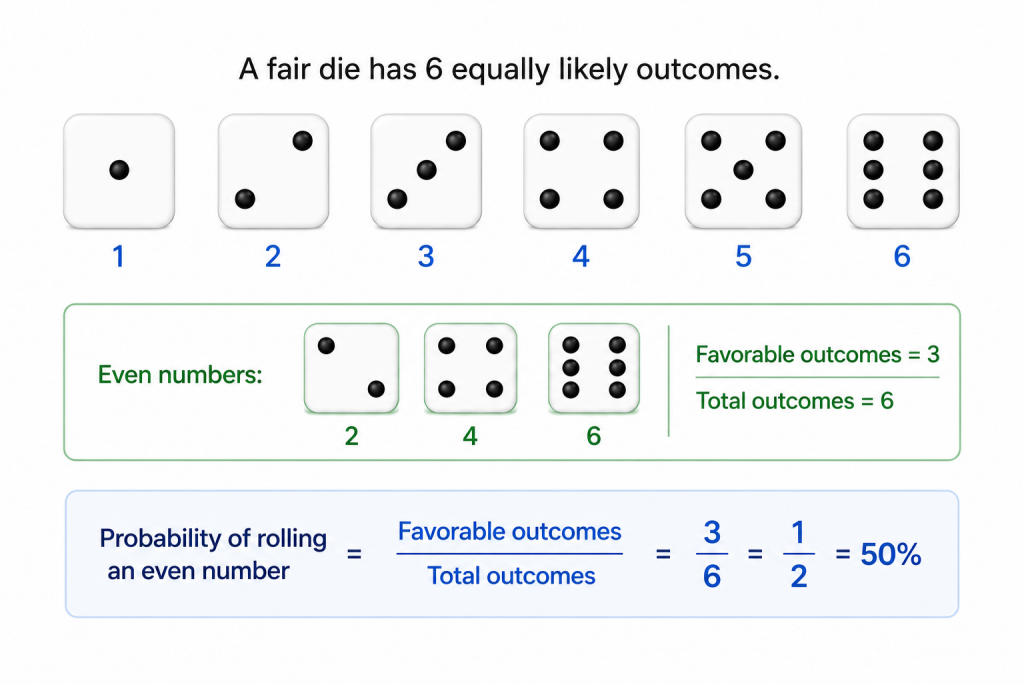
52. What Is The Probability Of Rolling An Even Number On A Fair Die?
Ans:
A Die Has 6 Outcomes. The Even Numbers Are 2, 4, And 6. Probability = 3 ÷ 6 = 1/2. Probability Questions Improve Numerical Thinking. They Are Common In Placement Exams. 1/2. The Probability Of Rolling An Even Number Is One Half. Practice Improves Accuracy In Probability Problems. Knowing Favorable And Total Outcomes Makes Probability Questions Easier.
53. What Is The Probability Of Drawing An Ace From A Standard Deck Of 52 Cards?
Ans:
A Standard Deck Contains 4 Aces. Total Cards = 52. Probability = 4 ÷ 52 = 1/13. Card Probability Questions Frequently Appear In Aptitude Tests. They Test Basic Probability Concepts. 1/13. The Probability Of Drawing An Ace Is One Thirteenth. Understanding Card-Based Probability Makes Similar Questions Easy. Memorizing Standard Card Values Helps Solve Such Questions Quickly..
54. What Is The Probability Of Getting A Number Greater Than 4 On A Die?
Ans:
- Numbers Greater Than 4 Are 5 And 6. Favorable Outcomes = 2. Total Outcomes = 6. Probability = 2 ÷ 6 = 1/3. Probability Questions Improve Logical Reasoning.
- They Frequently Appear In Competitive Exams. 1/3. The Probability Of Getting A Number Greater Than Four Is One Third. L
- earn To Count Favorable Outcomes Carefully. Correct Counting Is The Key To Solving Probability Problems.
55. In How Many Ways Can The Letters Of The Word “CAT” Be Arranged?
Ans:
- The Word CAT Has 3 Different Letters. Number Of Arrangements = 3! = 3 × 2 × 1 = 6. Permutation Questions Test Arrangement Skills.
- They Improve Analytical Thinking. 6 Ways. The Letters Can Be Arranged In Six Different Ways. Permutation Questions Are Common In Aptitude Tests.
- Factorial Formulas Are Widely Used In Arrangement Problems. The Formula n! Is Used When All Letters Are Different And Distinct.
56. In How Many Ways Can 4 Students Stand In A Line?
Ans:
Number Of Students = 4. Number Of Arrangements = 4! = 24. Permutation Questions Measure Logical Ability. They Frequently Appear In Placement Exams. 24 Ways. Four Students Can Stand In Twenty-Four Different Ways. Factorial Concepts Are Important In Permutations. The Order Of Arrangement Is Important In Permutation Questions. Changing The Position Of Even One Student Creates A Different Arrangement.
57. How Many Ways Can 2 Students Be Selected From 5 Students?
Ans:
Use The Combination Formula. ⁵C₂ = (5 × 4) ÷ (2 × 1) = 10. Combination Questions Test Selection Skills. They Frequently Appear In Competitive Exams. 10 Ways. Two Students Can Be Selected In Ten Different Ways. Combinations Are Used When Order Does Not Matter. Selection Questions Are Solved Using The Combination Formula.Always Use Combinations When Only Selection Is Required And Not Arrangement.
58. How Many Ways Can 3 Books Be Chosen From 6 Books?
Ans:
Use The Combination Formula. ⁶C₃ = 20. Combination Problems Improve Logical Thinking. They Test Basic Mathematical Skills. 20 Ways. Three Books Can Be Selected In Twenty Different Ways. Selection Problems Frequently Appear In Aptitude Tests. Combination Is Used Whenever The Order Of Selection Is Not Important.Combination Formulas Help Solve Selection Problems Quickly And Accurately.
59. In How Many Ways Can The Letters Of The Word “BOOK” Be Arranged?
Ans:
The Word BOOK Has 4 Letters, With O Repeated Twice. Number Of Arrangements = 4! ÷ 2! = 12. Permutation Questions Test Arrangement Concepts. They Improve Numerical Skills. 12 Ways. The Letters Can Be Arranged In Twelve Different Ways. Repeated Letters Reduce The Total Number Of Arrangements. Always Divide By The Factorial Of Repeated Letters.This Method Avoids Counting Duplicate Arrangements More Than Onc
60. How Many Ways Can 2 Cards Be Selected From 4 Cards?
Ans:
Use The Combination Formula. ⁴C₂ = 6. Combination Questions Improve Calculation Skills. They Frequently Appear In Placement Tests. 6 Ways. Two Cards Can Be Selected In Six Different Ways. Order Is Not Considered In Combination Problems. Understanding Combination Formulas Improves Problem-Solving Speed In Exams.Combination Questions Focus Only On Selection And Ignore The Order Of Choice.
61. Simplify: (25 × 16) ÷ 8
Ans:
- Multiply 25 × 16 = 400. Divide 400 ÷ 8 = 50. Simplification Questions Test Basic Arithmetic Skills. They Improve Calculation Speed. 50.
- Simplifying Expressions Quickly Saves Time In Competitive Exams. Always Follow The Correct Order Of Operations.
- Practice Simplification Daily To Improve Calculation Speed. Strong Arithmetic Skills Help In Solving Aptitude Questions Quickly.
- 25 × 16 = 400
- 400 ÷ 8 = 50
- Answer = 50
62. Simplify: 240 ÷ 12 × 5
Ans:
First Calculate 240 ÷ 12 = 20. Then Multiply 20 × 5 = 100. Follow The BODMAS Rule. Simplification Questions Improve Numerical Accuracy. 100. Solve Division Before Multiplication From Left To Right. Always Perform Division And Multiplication In Sequence From Left To Right. BODMAS Helps Avoid Calculation Errors. Regular Practice Improves Speed And Accuracy.
- 240 ÷ 12 = 20
- 20 × 5 = 100
- Answer = 100
63. Simplify: (18 + 12) × 5
Ans:
First Add 18 + 12 = 30. Then Multiply 30 × 5 = 150. Simplification Questions Test Arithmetic Skills. They Frequently Appear In Aptitude Tests. 150. Always Solve Brackets Before Multiplication. Brackets Have The Highest Priority In BODMAS. Correct Order Of Operations Ensures Accurate Answers. Practicing Similar Questions Builds Confidence. Applying BODMAS Correctly Helps Avoid Common Calculation Mistakes.
- 18 + 12 = 30
- 30 × 5 = 150
- Answer = 150
64. Simplify: 144 ÷ 12 + 18
Ans:
First Divide 144 ÷ 12 = 12. Then Add 12 + 18 = 30. Apply The BODMAS Rule Correctly. 30. Following The Correct Order Of Operations Prevents Mistakes. Division Must Be Completed Before Addition. Careful Calculation Improves Accuracy In Exams. Simplification Questions Enhance Mental Math Skills. Always Complete Division Before Performing Addition According To BODMAS.
- 144 ÷ 12 = 12
- 12 + 18 = 30
- Answer = 30
65. Simplify: (40 − 16) ÷ 4
Ans:
Subtract 40 − 16 = 24. Divide 24 ÷ 4 = 6. Simplification Problems Improve Speed And Accuracy. 6. Solve The Expression Step By Step For Correct Results. Complete The Operation Inside Brackets First. Apply Division Only After Simplifying The Brackets. Regular Practice Helps Reduce Calculation Errors.Breaking The Problem Into Smaller Steps Makes It Easier To Solve.
- 40 − 16 = 24
- 24 ÷ 4 = 6
- Answer = 6
66. Simplify: (15 × 8) + 20
Ans:
Multiply 15 × 8 = 120. Add 120 + 20 = 140. Arithmetic Questions Test Basic Mathematical Skills. 140. Multiplication Is Performed Before Addition. Always Follow The Correct Mathematical Order. Strong Multiplication Skills Improve Simplification Speed. These Questions Frequently Appear In Competitive Exams.Understanding BODMAS Ensures Fast And Accurate Calculations.
- 15 × 8 = 120
- 120 + 20 = 140
- Answer = 140
67. Simplify: 300 − (45 × 4)
Ans:
Multiply 45 × 4 = 180. Subtract 300 − 180 = 120. Simplification Questions Test BODMAS Knowledge. 120. Always Evaluate The Brackets First. Multiplication Inside Brackets Must Be Solved Before Subtraction. Correct Application Of BODMAS Gives Accurate Results. Practice Improves Mental Calculation Speed.Understanding BODMAS Ensures Fast And Accurate Calculations.
- 45 × 4 = 180
- 300 − 180 = 120
- Answer = 120
68. Simplify: 84 ÷ 7 + 16
Ans:
Divide 84 ÷ 7 = 12. Add 12 + 16 = 28. Simplification Questions Improve Mental Calculations. 28. Division Is Completed Before Addition. Following The Correct Sequence Prevents Mistakes. Simplification Questions Test Basic Arithmetic Knowledge. Regular Practice Increases Speed And Confidence. Performing Operations In The Correct Order Produces The Right Answer Every Time.
- 84 ÷ 7 = 12
- 12 + 16 = 28
- Answer = 28
69. Simplify: (90 + 30) ÷ 6
Ans:
Add 90 + 30 = 120. Divide 120 ÷ 6 = 20. These Questions Improve Numerical Speed. 20. Following BODMAS Gives The Correct Answer. Solve The Brackets Before Division. Understanding BODMAS Is Essential For Aptitude Exams. Practice Makes Simplification Easier And Faster. Always Simplify Expressions Step By Step For Better Accuracy.
- 90 + 30 = 120
- 120 ÷ 6 = 20
- Answer = 20
.
70. Simplify: 50 × 4 − 75
Ans:
Multiply 50 × 4 = 200. Subtract 200 − 75 = 125. Simplification Problems Frequently Appear In Placement Exams. 125. Solve Multiplication Before Subtraction. Follow The BODMAS Rule For Correct Results. Careful Step-By-Step Calculation Reduces Errors. Regular Practice Strengthens Arithmetic And Problem-Solving Skills.Strong Mental Math Skills Help Solve Simplification Questions Quickly.
- 50 × 4 = 200
- 200 − 75 = 125
- Answer = 125
71. What Is The Probability Of Getting An Odd Number On A Fair Die?
Ans:
Odd Numbers Are 1, 3, And 5. Probability = 3 ÷ 6 = 1/2. 1/2. There Are Three Favorable Outcomes Out Of Six Total Outcomes. A Fair Die Has Six Equally Likely Outcomes. Probability Is Calculated As Favorable Outcomes Divided By Total Outcomes. Understanding Basic Probability Improves Logical Thinking. These Questions Frequently Appear In Aptitude And Placement Tests.Always Count The Total Possible Outcomes Before Calculating Probability
- Favorable Outcomes = 3 (1, 3, And 5)
- Total Outcomes = 6
- Probability = 3 ÷ 6
- = 1/2
72. In How Many Ways Can 5 Different Books Be Arranged On A Shelf?
Ans:
Permutation = 5! = 120. 120 Ways. Arrangement Questions Use The Permutation Concept. Permutation Is Used When The Order Of Arrangement Matters. Factorial Notation Simplifies Permutation Calculations. Practicing Factorial Problems Improves Speed And Accuracy. Permutation Questions Are Common In Competitive Exams.. The Formula n! Is Used When All Objects Are Distinct.
- Number Of Books = 5
- Permutation = 5!
- = 5 × 4 × 3 × 2 × 1
- = 120 Ways
73. How Many Ways Can 3 Students Be Selected From 7 Students?
Ans:
Combination = ⁷C₃ = 35. 35 Ways. Selection Questions Use Combination Instead Of Permutation. Combination Is Used When Order Does Not Matter. Apply The Combination Formula To Solve Selection Problems. Understanding This Concept Makes Aptitude Questions Easier. These Questions Frequently Appear In Placement Tests.Always Use Combination When Only Selection Is Required.
- Combination = ⁷C₃
- = 7! ÷ (3! × 4!)
- = 35
- Answer = 35 Ways
74. Simplify: (64 ÷ 8) × 9
Ans:
64 ÷ 8 = 8, Then 8 × 9 = 72. 72. Follow The Order Of Operations Carefully. Division Should Be Performed Before Multiplication In This Expression. Applying BODMAS Ensures Accurate Answers. Simplification Questions Improve Mental Calculation Speed. Regular Practice Helps Reduce Calculation Errors. Accurate Step-By-Step Calculation Leads To The Correct Result.
- 64 ÷ 8 = 8
- 8 × 9 = 72
- Answer = 72
- Follow BODMAS Rule
75. What Is The Probability Of Drawing A King From A Deck Of Cards?
Ans:
There Are 4 Kings In 52 Cards. Probability = 4/52 = 1/13. 1/13. Card Probability Questions Frequently Appear In Aptitude Tests. A Standard Deck Contains Four Kings. Probability Is Found By Dividing Favorable Outcomes By Total Outcomes. Memorizing Card Distribution Makes Such Questions Easier. Practice Improves Accuracy In Card-Based Probability Problems. Knowing The Number Of Each Type Of Card Simplifies Probability Calculations.
- Favorable Outcomes = 4 Kings
- Total Cards = 52
- Probability = 4 ÷ 52
- = 1/13
76. In How Many Ways Can The Letters Of “DOG” Be Arranged?
Ans:
Permutation = 3! = 6. 6 Ways. All Letters Are Different, So Use The Factorial Formula. Since No Letters Are Repeated, No Division Is Required. Permutation Is Used Because The Order Of Letters Changes. Factorial Concepts Are Essential For Arrangement Problems. These Questions Are Common In Aptitude Exams.Each Different Arrangement Is Counted As A Unique Permutation.
- Number Of Letters = 3
- Permutation = 3!
- = 3 × 2 × 1
- = 6 Ways
77. How Many Ways Can 4 Students Be Selected From 8 Students?
Ans:
Combination = ⁸C₄ = 70. 70 Ways. Combination Is Used When Order Does Not Matter. Selection Problems Always Use Combination Concepts. Apply The Formula Carefully To Avoid Mistakes. Combination Questions Test Logical And Mathematical Skills. Regular Practice Improves Problem-Solving Ability. Selection Questions Focus Only On Choosing, Not Arranging.
- Combination = ⁸C₄
- = 8! ÷ (4! × 4!)
- = 70
- Answer = 70 Ways
78. Simplify: (96 ÷ 12) + 15
Ans:
96 ÷ 12 = 8, Then 8 + 15 = 23. 23. Solve Division Before Addition. Follow The BODMAS Rule For Correct Calculations. Performing Operations In The Correct Sequence Prevents Errors. Simplification Questions Improve Numerical Ability. They Frequently Appear In Competitive Examinations.Careful Application Of BODMAS Ensures Correct Answers Every Time.
- 96 ÷ 12 = 8
- 8 + 15 = 23
- Answer = 23
- Apply BODMAS Rule
79. What Is The Probability Of Drawing A Red Card From A Deck Of 52 Cards?
Ans:
There Are 26 Red Cards. Probability = 26/52 = 1/2. 1/2. Half The Cards In A Standard Deck Are Red. A Deck Contains 13 Hearts And 13 Diamonds. Red Cards Total Twenty-Six Out Of Fifty-Two Cards. Card Probability Questions Test Basic Probability Concepts. Understanding Card Distribution Helps Solve Similar Questions Quickly.A Standard Deck Always Contains An Equal Number Of Red And Black Cards.
- Favorable Outcomes = 26 Red Cards
- Total Cards = 52
- Probability = 26 ÷ 52
- = 1/2
80. Simplify: (125 ÷ 5) × 4
Ans:
125 ÷ 5 = 25, Then 25 × 4 = 100. 100. Apply Division Before Multiplication According To BODMAS Rules. Perform The Operations Step By Step For Accuracy. Simplification Questions Improve Arithmetic And Logical Skills. Regular Practice Helps Increase Speed In Competitive Exams. Strong BODMAS Knowledge Reduces Calculation Mistakes.Following The Correct Order Of Operations Prevents Calculation Errors.
- 125 ÷ 5 = 25
- 25 × 4 = 100
- Answer = 100
- Follow BODMAS Rule
81. What Day Of The Week Will It Be 7 Days After Monday?
Ans:
- A Week Has 7 Days. After Exactly 7 Days, The Day Remains The Same. Calendar Questions Test Logical And Analytical Skills. They Frequently Appear In Aptitude Tests.
- Monday. Seven Days Make One Complete Week. Adding Multiples Of Seven Does Not Change The Day.
- Calendar Questions Improve Logical Reasoning Skills. Understanding The Weekly Cycle Makes Such Questions Easy To Solve.
82. What Day Of The Week Was Yesterday If Today Is Friday?
Ans:
Today Is Friday. The Previous Day Is Thursday. Calendar Questions Improve Observation And Reasoning Skills. They Frequently Appear In Placement Exams. Thursday. Yesterday Was Thursday. Knowing The Order Of Days Helps Solve Calendar Problems Quickly. Regular Practice Improves Accuracy In Calendar Questions. These Questions Test Basic Logical Thinking.
83. What Day Of The Week Will It Be 14 Days After Wednesday?
Ans:
14 Days = 2 Complete Weeks. Therefore, The Day Remains The Same. Calendar Questions Test Basic Date Calculations. They Are Common In Competitive Exams. Wednesday. Fourteen Days Equal Two Full Weeks. Multiples Of Seven Always Result In The Same Day. Understanding This Rule Simplifies Calendar Problems. Practice Makes Calendar Calculations Faster.
84. How Many Odd Days Are There In A Leap Year?
Ans:
A Leap Year Has 366 Days. 366 ÷ 7 = 52 Weeks And 2 Odd Days. Calendar Questions Test Arithmetic And Logical Skills. They Frequently Appear In Aptitude Tests. 2 Odd Days. A Leap Year Contains Two Odd Days. Remember That February Has Twenty-Nine Days In A Leap Year. This Is An Important Calendar Aptitude Concept. . Understanding Odd Days Helps Solve Calendar-Based Questions Quickly.
85. How Many Odd Days Are There In An Ordinary Year?
Ans:
An Ordinary Year Has 365 Days. 365 ÷ 7 = 52 Weeks And 1 Odd Day. Calendar Questions Improve Logical Thinking. They Frequently Appear In Competitive Exams. 1 Odd Day. An Ordinary Year Contains One Odd Day. February Has Twenty-Eight Days In An Ordinary Year. This Concept Is Frequently Asked In Placement Tests.Knowing The Difference Between Leap And Ordinary Years Is Essential.
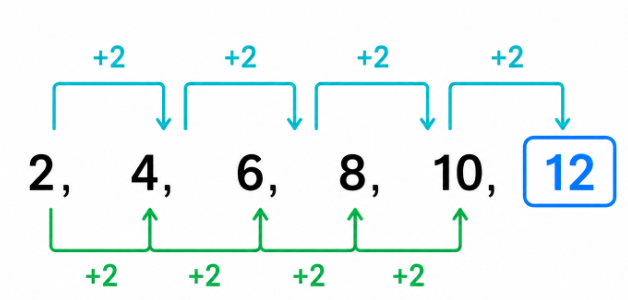
86. Find The Next Number: 2, 4, 6, 8, 10, ?
Ans:
The Pattern Increases By 2 Each Time. The Next Number Is 10 + 2 = 12. Number Series Questions Test Pattern Recognition Skills. They Frequently Appear In Aptitude Tests. 12. The Series Follows Consecutive Even Numbers. Identifying The Common Difference Helps Solve The Series Quickly. Practice Improves Pattern Recognition Skills.Regular Observation Makes Number Series Questions Easier To Solve.
87. Find The Next Number: 5, 10, 15, 20, 25, ?
Ans:
Each Number Increases By 5. The Next Number Is 25 + 5 = 30. Number Series Questions Improve Logical Thinking. They Frequently Appear In Placement Exams. 30. The Series Follows Multiples Of Five. Finding The Common Pattern Makes The Answer Easy. Regular Practice Improves Numerical Ability.Recognizing Simple Patterns Saves Time During Exams.
88. Find The Next Number: 3, 6, 12, 24, 48, ?
Ans:
Each Number Is Multiplied By 2. The Next Number Is 48 × 2 = 96. Number Series Questions Measure Analytical Skills. They Frequently Appear In Competitive Exams. 96. The Pattern Is Based On Doubling Each Number. Recognizing Multiplication Patterns Helps Solve Such Questions Faster. These Questions Strengthen Logical Reasoning.Careful Observation Helps Identify The Correct Pattern Quickly.
89. Find The Next Number: 1, 4, 9, 16, 25, ?
Ans:
These Numbers Are Perfect Squares: 1², 2², 3², 4², 5². The Next Number Is 6² = 36. Number Series Questions Improve Mathematical Thinking. They Frequently Appear In Aptitude Tests. 36. The Series Follows Square Numbers. Memorizing Square Numbers Helps Solve Similar Questions Quickly. Practice Enhances Calculation Speed.Square Number Patterns Are Common In Competitive Examinations.
90. Find The Next Number: 2, 3, 5, 7, 11, ?
Ans:
The Series Contains Prime Numbers. The Next Prime Number After 11 Is 13. Number Series Questions Test Observation Skills. They Frequently Appear In Competitive Exams. 13. The Series Follows Prime Numbers. Knowing Prime Numbers Makes Such Questions Easier. Regular Practice Improves Accuracy In Number Series.Memorizing Prime Numbers Helps Solve Aptitude Questions Faster.
91. Find The Next Number: 10, 20, 30, 40, 50, ?
Ans:
Each Number Increases By 10. The Next Number Is 50 + 10 = 60. Number Series Questions Improve Numerical Skills. They Frequently Appear In Placement Tests. 60. The Series Follows Multiples Of Ten. Identifying The Common Difference Simplifies The Solution. These Questions Improve Mental Calculations.Consistent Practice Builds Strong Pattern Recognition Skills.
92. Find The Next Number: 100, 90, 80, 70, 60, ?
Ans:
Each Number Decreases By 10. The Next Number Is 60 − 10 = 50. Number Series Questions Test Pattern Recognition. They Improve Logical Thinking. 50. The Series Follows A Descending Pattern. Observing The Common Difference Helps Find The Correct Answer. Regular Practice Increases Speed And Accuracy. Descending Series Questions Frequently Appear In Aptitude Tests.
93. Find The Next Number: 1, 1, 2, 3, 5, 8, ?
Ans:
This Is The Fibonacci Series. Each Number Is The Sum Of The Previous Two Numbers. The Next Number Is 5 + 8 = 13. Number Series Questions Frequently Appear In Aptitude And Placement Exams. 13. The Series Follows The Fibonacci Pattern. Understanding Common Number Patterns Makes Such Questions Easy. Practicing Number Series Improves Analytical And Logical Thinking Skills. .
94. Find The Largest Element In An Array
Ans:
- #include
- int main() {
- int arr[]={12,45,7,89,34,56,23,10};
- int i,max=arr[0];
- for(i=1;i<8;i++)
- if(arr[i]>max)
- max=arr[i];
- printf(“%d”,max);
- return 0;
- }
95. Find Missing Number In An Array
Ans:
- #include
- int main() {
- int arr[] = {1, 2, 3, 5, 6};
- int n = 6, sum = 0;
- for(int i = 0; i < n - 1; i++)
- sum += arr[i];
- printf(“%d”, (n * (n + 1)) / 2 – sum);
- return 0;
- }
96. Print A Star Pattern
Ans:
- #include
- int main() {
- int i, j;
- for(i = 1; i <= 5; i++) {
- for(j = 1; j <= i; j++) {
- printf(“*”);
- }
- printf(“\n”);
- }
- return 0;
- }
97. Find The First Non-Repeating Character
Ans:
- #include
- #include
- int main() {
- char str[] = “swiss”;
- int freq[256] = {0};
- for(int i = 0; str[i] != ‘\0’; i++)
- freq[str[i]]++;
- for(int i = 0; str[i] != ‘\0’; i++) {
- if(freq[str[i]] == 1) {
- printf(“%c”, str[i]);
- break;
- }
- }
98. Find Frequency Of Elements
Ans:
- int main() {
- int arr[] = {1, 2, 2, 3, 4, 3, 2, 1};
- int visited[8] = {0};
- for(int i = 0; i < 8; i++) {
- if(visited[i] == 1)
- continue;
- int count = 1;
- for(int j = i + 1; j < 8; j++) {
- if(arr[i] == arr[j]) {
- count++;
- visited[j] = 1;
- }
- }
- printf(“%d -> %d\n”, arr[i], count);
- }
- return 0;
- }
99. Count Vowels In A String (C Program)
Ans:
- #include
- int main() {
- char str[]=”Education”; int i,count=0;
- for(i=0;str[i]!=’\0′;i++)
- if(str[i]==’a’||str[i]==’e’||str[i]==’i’||str[i]==’o’||str[i]==’u’||str[i]==’A’||str[i]==’E’||str[i]==’I’||str[i]==’O’||str[i]==’U’) count++;
- printf(“%d”,count);
- }
100. Why Is Aptitude Important In Zoho Recruitment?
Ans:
- Aptitude Is Important In Zoho Recruitment Because It Measures Problem-Solving And Analytical Skills. It Helps Assess A Candidate’s Ability To Learn Quickly.
- Aptitude Tests Evaluate Logical And Numerical Abilities. Strong Aptitude Improves Workplace Performance. Zoho Uses These Tests To Identify Potential Talent. Practice Improves Confidence And Accuracy.
- Good Aptitude Skills Increase Selection Chances. Aptitude Supports Career Growth And Success. It Helps Recruit Candidates Who Can Handle Real-World Challenges Effectively.