LMS
LMS
Last updated on 18th Apr 2026| 7476

Top Coding Questions Asked in Microsoft Interviews is a helpful resource for candidates preparing to crack technical rounds at Microsoft. It includes commonly asked coding problems focused on data structures, algorithms, problem-solving techniques, and real-time scenarios, along with clear explanations and approaches. This guide helps candidates improve their coding skills, understand question patterns, and gain the confidence needed to perform well in technical interviews and coding assessments.
1. What is Two Sum problem?
Ans:
Two Sum problem involves finding two numbers in an array that add up to a specific target value using efficient search techniques. It tests understanding of arrays, hashing, and optimization compared to brute-force nested loops. Efficient solutions typically use hash maps to reduce time complexity from quadratic to linear time. Handling duplicates and ensuring correct index return is important for correctness. This problem is fundamental for understanding lookup optimization in coding interviews.
2. How to solve Two Sum efficiently?
Ans:
- Using a hash map to store visited elements allows quick lookup of complement values, reducing time complexity significantly compared to brute-force approaches. Hash maps provide constant-time average lookup in most implementations. This makes the solution efficient for large arrays.
- Iterating through the array once while checking if the complement exists ensures linear time complexity and optimal performance. Single traversal reduces unnecessary repeated comparisons greatly. This is preferred in coding interviews.
- Careful handling of edge cases such as duplicate numbers and negative values improves robustness of the solution. Real test cases often contain tricky inputs that break weak logic. Strong handling increases correctness.
- Returning indices instead of values requires proper tracking of positions while storing elements in the hash structure. Many interview versions specifically ask for indices only. Position management is therefore important.
3. What is Reverse Linked List problem?
Ans:
Reverse Linked List problem involves reversing the direction of pointers in a singly linked list to produce the reversed structure. It tests understanding of pointers, memory handling, and iterative or recursive approaches. Efficient solutions require updating links without losing references to remaining nodes. Both iterative and recursive methods are commonly evaluated in interviews. This problem builds strong fundamentals for pointer manipulation in data structures.
4. What are approaches to reverse a linked list?
Ans:
- Iterative approach involves maintaining previous, current, and next pointers to reverse links step by step efficiently. This method uses constant extra space and is widely preferred. It is practical for interviews.
- Recursive approach uses function calls to reverse the remaining list and adjusts pointers during backtracking. It provides elegant logic with shorter code in many languages. Recursion tests conceptual understanding.
- Handling edge cases such as empty list or single node ensures correctness of implementation. These cases are commonly used to test careful thinking. Proper checks prevent runtime issues.
- Maintaining pointer safety is critical to avoid losing reference to nodes during reversal process. Losing node references can break the entire list structure. Pointer discipline is essential.
5. What is Binary Search problem?
Ans:
Binary Search is an efficient algorithm used to find an element in a sorted array by repeatedly dividing the search space. It reduces time complexity significantly compared to linear search methods. The algorithm works by comparing the middle element with the target value and adjusting boundaries accordingly. Correct implementation requires careful handling of indices and conditions. Binary search is a fundamental concept for optimization in coding interviews.
6. How to implement Binary Search?
Ans:
- Using two pointers representing left and right boundaries helps narrow down the search range efficiently. Boundaries shrink after each comparison logically. This gives logarithmic performance.
- Calculating the middle index correctly prevents overflow issues in large datasets. Safe formulas are preferred in production-level coding. Correct middle calculation is important.
- Adjusting search boundaries based on comparisons ensures correct traversal of sorted array. Each comparison removes half of the remaining space. This is the core strength of binary search.
- Handling edge cases such as element absence or duplicate values ensures robust implementation. Interviewers often test these scenarios carefully. Strong handling improves reliability.
7. What is Merge Two Sorted Lists problem?
Ans:
Merge Two Sorted Lists involves combining two sorted linked lists into a single sorted list efficiently. It tests understanding of linked list traversal and pointer manipulation. Efficient solutions avoid creating extra nodes and reuse existing ones. The algorithm ensures sorted order while merging elements step by step. This problem is important for mastering list merging techniques.
8. What is the difference between array and linked list?
Ans:
| Criteria | Array | Linked List |
|---|---|---|
| Memory | Stored in contiguous memory locations. | Stored in non-contiguous nodes. |
| Access | Fast random access using index. | Sequential access through pointers. |
| Insertion | Costly in middle positions. | Efficient with pointer updates. |
| Size | Usually fixed or predefined. | Dynamic and flexible size. |
9. What is Maximum Subarray problem?
Ans:
Maximum Subarray problem involves finding the contiguous subarray with the largest sum in an array. It tests understanding of dynamic programming and optimization techniques. Kadane’s Algorithm is commonly used for efficient linear-time solution. Handling negative numbers and edge cases is important for correctness. This problem is widely asked for testing optimization skills.
10. What is Kadane’s Algorithm?
Ans:
- Kadane’s Algorithm maintains a running sum and resets it when it becomes negative to ensure optimal subarray selection. Negative prefixes cannot help future sums. This makes the algorithm efficient.
- It efficiently computes maximum subarray sum in linear time without using extra space. Only a few variables are needed during traversal. This gives strong optimization.
- Comparing current sum with maximum sum helps track best result during iteration. Continuous updates ensure no better answer is missed. Tracking is simple and effective.
- Handling all-negative arrays requires careful initialization for correctness. Wrong initialization may produce invalid zero answers. Proper setup is essential.
11. What is Valid Parentheses problem?
Ans:
Valid Parentheses problem checks whether a string of brackets is properly balanced and correctly nested. It tests understanding of stacks and matching conditions. Efficient solutions use stack data structure to track opening brackets. Correct matching of pairs ensures validity of expression. This problem is essential for understanding stack-based parsing techniques.
12. How to validate parentheses using stack?
Ans:
- Using a stack to store opening brackets helps track unmatched elements during traversal. Opening symbols wait until matching pairs appear later. This models nesting naturally.
- Popping stack elements when matching closing brackets ensures correct pairing logic. Each closing bracket must match the latest opener. LIFO order is important.
- Checking for empty stack at the end confirms validity of the expression. Remaining items indicate unmatched opening brackets. Final validation is necessary.
- Handling invalid cases such as mismatched brackets ensures robust solution. Early detection improves efficiency and correctness greatly. Strong checks are valuable.
13. What is Longest Substring Without Repeating Characters?
Ans:
This problem involves finding the length of the longest substring without repeating characters. It tests understanding of sliding window technique and hash sets. Efficient solutions maintain a dynamic window while tracking characters. Handling duplicates correctly ensures accuracy of result. This problem is widely used to evaluate string manipulation skills.
14. How to solve using sliding window?
Ans:
- Using two pointers helps maintain a dynamic window that expands and shrinks based on duplicates. This avoids checking every substring separately. Efficiency improves significantly.
- Hash set or map is used to track characters within the current window efficiently. Fast membership checks support quick updates. Hashing is highly useful here.
- Updating window boundaries ensures no repeated characters exist in substring. Correct movement of pointers preserves validity. Window maintenance is critical.
- Tracking maximum length during iteration ensures optimal result. Best answer is updated whenever longer valid windows appear. This guarantees correctness.
15. What is Climbing Stairs problem?
Ans:
Climbing Stairs problem involves finding the number of ways to reach the top using steps of one or two at a time. It tests understanding of dynamic programming and recurrence relations. The problem follows Fibonacci sequence pattern. Efficient solutions use iterative or DP approach for optimization. This problem helps build strong DP fundamentals.
16. Write a program to print Fibonacci series.
Ans:
This program prints Fibonacci series up to 10 terms.
- #include <stdio.h>
- int main() {
- int a=0,b=1,c,i;
- printf(“%d %d “,a,b);
- for(i=3;i<=10;i++){
- c=a+b;
- printf(“%d “,c);
- a=b;
- b=c;
- }
- return 0;
- }
In this example, output starts as 0 1 1 2 3 5 ….
17. What is Tree Traversal problem?
Ans:
Tree Traversal involves visiting all nodes in a tree in a specific order such as inorder, preorder, or postorder. It tests understanding of recursion and tree structures. Traversal methods help in processing hierarchical data efficiently. Both recursive and iterative approaches are important. This concept is fundamental in tree-based problems.
18. What are types of tree traversal?
Ans:
- Inorder traversal visits left subtree, root, and right subtree, commonly used for BST sorted output. This order is important in binary search trees. It returns sorted values.
- Preorder traversal visits root first, then subtrees, useful for tree copying and structure representation. Parent nodes are processed before children. This helps serialization tasks.
- Postorder traversal processes children before root, useful in deletion operations. Child nodes are cleared first safely. This is practical in cleanup tasks.
- Level order traversal uses queue to process nodes level by level efficiently. Breadth-first processing is useful for shortest level problems. Queues make traversal natural.
19. What is Lowest Common Ancestor problem?
Ans:
Lowest Common Ancestor involves finding the deepest node that is an ancestor of two given nodes in a tree. It tests understanding of tree traversal and recursion. Efficient solutions use DFS or parent tracking techniques. Handling edge cases such as missing nodes is important. This problem is widely asked in interviews.
20. How to find LCA efficiently?
Ans:
- Using recursion to traverse tree and return nodes helps identify common ancestor effectively. Recursive returns naturally combine subtree information. This is a common approach.
- Tracking paths from root to nodes allows comparison for finding ancestor. Shared prefixes reveal the common parent clearly. Path methods are intuitive.
- Handling null cases ensures robustness of solution. Missing children or absent nodes must be considered carefully. Safe logic prevents errors.
- Optimizing using binary lifting improves performance for large trees. Preprocessing enables faster repeated ancestor queries significantly. This is useful in advanced problems.
21. What is Graph Traversal problem?
Ans:
Graph traversal involves visiting nodes in a graph using algorithms like DFS and BFS. It tests understanding of graph representation and traversal techniques. Efficient traversal ensures coverage of all nodes. Handling cycles and visited nodes is important. This concept is fundamental for graph problems.
22. What are BFS and DFS?
Ans:
- BFS uses queue and explores nodes level by level ensuring shortest path in unweighted graphs. It is highly useful when nearest distance is required clearly. Breadth-first traversal is systematic and efficient.
- DFS uses stack or recursion to explore nodes deeply before backtracking. This method is useful for path exploration and component discovery significantly. It is common in recursive problems.
- Both methods require visited tracking to avoid infinite loops. Cyclic graphs can cause repeated traversal without proper marking. Visited arrays or sets are essential.
- Choice depends on problem requirements such as shortest path or deep exploration. Selecting the correct method improves solution efficiency naturally. Strategy matters in interviews.
23. What is Detect Cycle in Graph problem?
Ans:
Detect Cycle problem checks whether a graph contains a cycle using traversal techniques. It tests understanding of DFS, BFS, and union-find methods. Cycle detection is important for dependency resolution problems. Handling directed and undirected graphs differs in approach. This problem is commonly asked in interviews.
24. What is the difference between DFS and BFS?
Ans:
| Criteria | DFS | BFS |
|---|---|---|
| Traversal | Explores depth first before backtracking. | Explores level by level. |
| Data Structure | Uses stack or recursion. | Uses queue. |
| Best Use | Path finding and cycle detection. | Shortest path in unweighted graph. |
| Memory | Usually lower for sparse graphs. | May use more memory. |
25. What is Dynamic Programming concept?
Ans:
Dynamic Programming is an optimization technique used to solve problems by breaking them into overlapping subproblems. It avoids redundant computations by storing intermediate results. DP improves efficiency significantly compared to brute-force approaches. It requires understanding of recurrence relations and state transitions. Dynamic programming is essential for solving complex problems efficiently.
26. What is Recursion?
Ans:
Recursion is a programming technique where a function calls itself repeatedly to solve smaller instances of the same problem until a base condition is reached. It helps simplify complex problems by breaking them into manageable subproblems with identical structure and behavior. Correct implementation requires defining a clear base case and ensuring termination to avoid infinite recursion. Recursion is widely used in tree traversal, backtracking, and divide-and-conquer algorithms. Understanding recursion is essential for solving many advanced coding interview problems efficiently.
27. What are key components of recursion?
Ans:
- A base case is required to stop recursive calls and prevent infinite execution, ensuring that the function eventually terminates correctly. Without a base case recursion never ends. Proper stopping logic is critical.
- Recursive case defines how the function calls itself with a smaller or simpler input to gradually approach the base condition. Each call should move closer to termination clearly. This creates correct progression.
- Proper stack management is important because each recursive call consumes memory, which can lead to stack overflow if not handled carefully. Deep recursion may fail on large inputs significantly. Memory awareness is necessary.
- Optimization techniques such as memoization can be applied to recursion to improve performance by avoiding repeated calculations. Cached results reduce duplicate work greatly. This is common in dynamic programming.
28. What is Backtracking?
Ans:
Backtracking is an algorithmic technique used to solve problems by exploring all possible solutions and undoing choices that do not lead to a valid result. It is commonly used in problems like permutations, combinations, and constraint satisfaction scenarios. The approach builds solutions incrementally and removes invalid paths through recursion. Backtracking ensures all possibilities are considered while pruning unnecessary computations. This technique is essential for solving complex combinatorial problems in interviews.
29. What are applications of backtracking?
Ans:
- Solving permutation and combination problems where all possible arrangements must be explored efficiently using recursive exploration techniques. These are classic interview problems. Backtracking handles them naturally.
- Handling constraint satisfaction problems such as Sudoku or N-Queens where invalid states are eliminated early to reduce computation. Early pruning improves performance significantly. This saves time greatly.
- Generating subsets and solving decision-based problems where multiple outcomes need to be evaluated systematically. Exhaustive search with control is highly useful here. Structured exploration improves clarity.
- Optimizing search space by pruning invalid paths improves efficiency and reduces unnecessary recursive calls. Smart pruning can transform difficult problems greatly. Efficiency matters in interviews.
30. What is Divide and Conquer?
Ans:
Divide and Conquer is a strategy that breaks a problem into smaller subproblems, solves them independently, and combines results to form the final solution. It is widely used in algorithms like merge sort and quick sort for efficient computation. This approach reduces complexity and improves performance compared to brute-force methods. Proper division and merging logic are essential for correct implementation. Divide and conquer is a fundamental concept in algorithm design and optimization.
31. What are examples of divide and conquer algorithms?
Ans:
- Merge sort divides arrays into halves recursively and merges them in sorted order, ensuring efficient sorting performance. It guarantees stable O(n log n) behavior. This is a standard example.
- Quick sort partitions elements around a pivot and recursively sorts partitions, achieving average-case optimal complexity. It performs very well in practice significantly. Partitioning is the key idea.
- Binary search divides search space repeatedly to locate elements efficiently in sorted data structures. Each step halves remaining possibilities clearly. This gives logarithmic speed.
- Strassen’s matrix multiplication uses divide and conquer to optimize matrix operations beyond naive approaches. It reduces multiplication work intelligently. This is an advanced example.
32. Write a program to implement Binary Search.
Ans:
This program searches an element in a sorted array using Binary Search.
- #include <stdio.h>
- int main() {
- int arr[6]={2,4,6,8,10,12};
- int low=0, high=5, mid, key=10;
- while(low<=high){
- mid=(low+high)/2;
- if(arr[mid]==key){ printf(“Found”); break; }
- else if(key>arr[mid]) low=mid+1;
- else high=mid-1;
- }
- return 0;
- }
In this example, the program searches value 10 successfully.
33. What are types of heaps?
Ans:
- Min heap ensures that the smallest element is always at the root, making it useful for priority queue implementations. Fast minimum access improves many scheduling tasks clearly. It is widely used.
- Max heap ensures that the largest element is at the root, commonly used in scheduling and resource allocation problems. Maximum retrieval becomes efficient significantly. This suits ranking tasks.
- Binary heap is the most common implementation using array representation for efficient indexing. Parent-child relationships are easy to compute. It is practical in interviews.
- Fibonacci heap provides improved amortized performance for certain operations in advanced algorithms. It is mainly useful in theoretical optimization contexts. Advanced knowledge adds value.
34. What is Trie data structure?
Ans:
Trie is a tree-like data structure used for storing strings efficiently, especially for prefix-based searching. Each node represents a character and paths represent words stored in the structure. It is commonly used in autocomplete and dictionary applications. Trie improves search efficiency compared to standard string matching techniques. Understanding trie is important for solving string-related problems in interviews.
35. What are applications of Trie?
Ans:
- Autocomplete systems use trie to provide fast suggestions based on prefix matching efficiently. Prefix traversal quickly finds matching words. This improves user experience.
- Spell checking applications use trie for quick lookup and correction suggestions. Dictionary search becomes faster significantly. This is common in text tools.
- Storing dictionaries and performing prefix-based searches improves performance significantly. Large word collections benefit from trie organization. Retrieval becomes efficient.
- Trie is used in IP routing and pattern matching problems for efficient lookup operations. Hierarchical prefix logic fits these use cases naturally. Specialized systems use it widely.
36. What is Sliding Window technique?
Ans:
Sliding window is a technique used to process a range of elements in an array or string efficiently. It reduces time complexity by avoiding repeated computations of overlapping subarrays. The window expands and shrinks dynamically based on problem conditions. It is widely used in substring and subarray problems. Sliding window is essential for optimizing many coding problems.
37. What are advantages of sliding window?
Ans:
- It reduces time complexity from quadratic to linear by eliminating redundant computations effectively. Reusing previous window work saves large effort clearly. This is a major advantage.
- It provides efficient handling of continuous subarray or substring problems with dynamic boundaries. Many interview problems depend on this pattern significantly. It is highly practical.
- It simplifies logic for problems involving fixed or variable window sizes. Structured pointer movement makes coding easier. Simplicity improves debugging.
- It improves performance significantly in large datasets compared to brute-force methods. Better scalability matters in real applications naturally. Efficiency is valuable.
38. What is Greedy Algorithm?
Ans:
Greedy algorithm makes the optimal choice at each step to find a global optimum solution. It is used in problems where local optimal choices lead to overall optimal solution. Examples include activity selection and coin change problems. Greedy approach is efficient but does not always guarantee optimal results. Understanding greedy algorithms is important for optimization problems.
39. What are characteristics of greedy algorithms?
Ans:
- Greedy choice property ensures that local optimal decisions lead to global optimal solution in specific problems. This property must be proven before using greedy methods. It is fundamental.
- Optimal substructure allows problems to be broken into smaller parts that can be solved independently. Combined smaller solutions form final answer clearly. Many optimization problems use this.
- Simple implementation makes greedy algorithms efficient and easy to understand. Fewer states are often required significantly. This improves coding speed.
- Limitation exists as not all problems can be solved optimally using greedy approach. Some require dynamic programming or exhaustive search. Correct technique selection matters.
40. What is Hashing?
Ans:
Hashing is a technique used to map data to fixed-size values using hash functions. It enables fast data retrieval and storage in constant time complexity. Hash tables are widely used in dictionaries and caches. Handling collisions is an important aspect of hashing. Understanding hashing is essential for efficient data lookup problems.
41. What are collision handling techniques?
Ans:
- Separate chaining uses linked lists to store multiple elements in the same hash bucket efficiently. Each bucket can hold several values without overwriting data. This method is simple and commonly used.
- Open addressing resolves collisions by finding alternative positions within the hash table. Elements remain inside the table structure itself. This saves extra linked list memory.
- Linear probing checks sequential slots for empty space to insert elements. It is easy to implement and fast in many cases. However clustering can occur.
- Double hashing uses a second hash function to reduce clustering and improve distribution. Better spread of keys increases lookup efficiency significantly. This is a stronger probing method.
42. What is Stack data structure?
Ans:
Stack is a linear data structure that follows Last In First Out (LIFO) principle. Elements are added and removed from the top of the stack. It is used in function calls, expression evaluation, and backtracking. Stack operations include push, pop, and peek. Understanding stack is important for solving many algorithmic problems.
43. What are applications of stack?
Ans:
- Expression evaluation and parsing use stack for handling operators and operands efficiently. Compilers and calculators rely on this concept frequently. It helps maintain correct order.
- Function call management uses stack to maintain execution context in programming languages. Return addresses and local variables are stored carefully. This enables nested calls.
- Backtracking algorithms use stack to store states and revert decisions. Problems like maze solving use this pattern often. State recovery becomes easier.
- Undo and redo operations in applications use stack to track changes. Editors commonly use this mechanism for user actions. It improves usability greatly.
44. What is Queue data structure?
Ans:
Queue is a linear data structure that follows First In First Out (FIFO) principle. Elements are inserted at the rear and removed from the front. It is widely used in scheduling and buffering applications. Queue operations include enqueue and dequeue. Understanding queue is essential for solving traversal and scheduling problems.
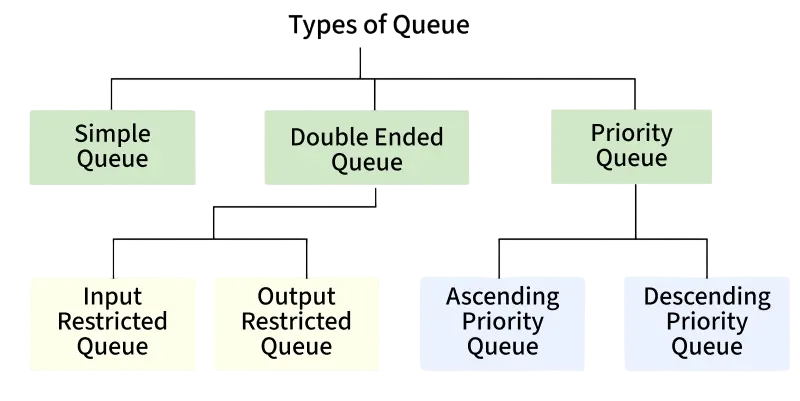
45. What are types of queues?
Ans:
- Simple queue follows FIFO principle for basic operations in scheduling systems. The earliest inserted element leaves first. This is the standard queue model.
- Circular queue connects end to beginning to optimize space utilization efficiently. Freed positions can be reused without shifting elements. This improves memory usage.
- Priority queue assigns priorities to elements for processing based on importance. Higher priority items are served earlier than normal items. It is useful in scheduling.
- Deque allows insertion and deletion from both ends, providing flexibility. It supports both stack-like and queue-like behavior. Many sliding window problems use deque.
46. What is Graph data structure?
Ans:
Graph is a collection of nodes connected by edges representing relationships between entities. It is used in network modeling, pathfinding, and dependency analysis. Graphs can be directed or undirected based on edge direction. Traversal techniques like DFS and BFS are used to explore graphs. Understanding graphs is crucial for solving complex problems in interviews.
47. What is the difference between adjacency matrix and adjacency list?
Ans:
| Criteria | Adjacency Matrix | Adjacency List |
|---|---|---|
| Storage | Uses 2D array to store edges. | Uses list of neighbors for each node. |
| Memory | Consumes more memory for sparse graphs. | Efficient for sparse graphs. |
| Edge Check | Fast edge lookup. | Slower lookup by traversal. |
| Best Use | Dense graphs. | Sparse graphs. |
48. What is Topological Sorting?
Ans:
Topological sorting is used to order nodes in a directed acyclic graph such that dependencies are maintained. It is used in scheduling tasks and resolving dependencies. Algorithms include DFS-based and Kahn’s algorithm. Topological sort exists only for DAGs. Understanding this concept is important for dependency problems.
49. How to perform topological sorting?
Ans:
- Using DFS approach involves visiting nodes recursively and pushing them to stack after processing dependencies. Reverse finishing order gives a valid sequence. This method is widely known.
- Kahn’s algorithm uses indegree calculation and queue to process nodes with zero dependencies. Nodes are removed level by level efficiently. It is intuitive and practical.
- Ensuring graph is acyclic is necessary for valid topological order. Cycles create impossible dependency chains. DAG property is mandatory.
- Handling multiple valid orders requires understanding dependency constraints. More than one correct sequence may exist. Interviewers may ask about this.
50. What is Shortest Path problem?
Ans:
Shortest path problem involves finding minimum distance between nodes in a graph. Algorithms include Dijkstra and Bellman-Ford. It is used in navigation and network routing. Handling weighted and unweighted graphs differs in approach. Understanding shortest path is essential for graph-based problems.
51. What is Dijkstra’s Algorithm?
Ans:
Dijkstra’s Algorithm is used to find the shortest path from a source node to all other nodes in a weighted graph with non-negative edge weights. It works by selecting the node with the smallest tentative distance and updating distances of its neighboring nodes iteratively. A priority queue is commonly used to optimize the selection of minimum distance nodes efficiently. The algorithm ensures optimal shortest paths in graphs without negative weights. Understanding Dijkstra’s Algorithm is essential for solving graph-based optimization problems.
52. What are steps of Dijkstra’s Algorithm?
Ans:
- Initialize all node distances as infinity except the source node, which is set to zero to begin shortest path calculations effectively. This establishes the starting condition clearly. Correct initialization is essential.
- Use a priority queue to repeatedly extract the node with the minimum distance and process its neighbors for updates. Fast minimum selection improves efficiency greatly. Queues are commonly used here.
- Update distances of adjacent nodes if a shorter path is found through the current node during traversal. This relaxation step improves path estimates progressively. It is the heart of the algorithm.
- Continue the process until all nodes are processed, ensuring shortest paths are determined correctly. Final distances become optimal after completion. This gives reliable answers.
53. What is Bellman-Ford Algorithm?
Ans:
Bellman-Ford Algorithm is used to find shortest paths in graphs that may contain negative weight edges. It works by relaxing all edges repeatedly for a number of iterations equal to the number of vertices minus one. The algorithm can also detect negative weight cycles in the graph. It is slower than Dijkstra’s Algorithm but more flexible in handling negative weights. Understanding Bellman-Ford is important for solving complex graph problems.
54. What are features of Bellman-Ford Algorithm?
Ans:
- Ability to handle graphs with negative weight edges makes it useful for a wider range of applications. Some real systems include such edges. This increases flexibility.
- Detecting negative cycles ensures correctness of solutions in graphs with special conditions. Infinite decreasing paths must be identified clearly. Cycle detection is valuable.
- Repeated edge relaxation helps gradually update shortest paths across all nodes. Improvements propagate over iterations step by step. This guarantees correctness.
- Higher time complexity compared to Dijkstra’s Algorithm requires careful use in performance-sensitive applications. It may be slower on large graphs. Algorithm choice matters.
55. What is Floyd-Warshall Algorithm?
Ans:
Floyd-Warshall Algorithm is used to find shortest paths between all pairs of nodes in a graph. It uses dynamic programming to update distances by considering intermediate nodes. The algorithm works efficiently for dense graphs. It handles both positive and negative weights but not negative cycles. Understanding this algorithm is essential for solving all-pairs shortest path problems.
56. What are applications of Floyd-Warshall Algorithm?
Ans:
- Finding shortest paths between all pairs of nodes is useful in network routing and connectivity analysis. Global distance information becomes available efficiently. This helps planning systems.
- Solving transitive closure problems helps determine reachability between nodes efficiently. It shows whether paths exist between pairs. Reachability is important in graphs.
- Used in graph-based optimization problems requiring global distance calculations. Many planning tasks need all-pairs information. This algorithm is suitable there.
- Helps analyze relationships and dependencies in weighted graphs effectively. Multi-node interactions can be studied clearly. It supports deeper analysis.
57. What is Minimum Spanning Tree?
Ans:
Minimum Spanning Tree is a subset of edges in a graph that connects all nodes with minimum total weight. It ensures no cycles are formed while maintaining connectivity. Common algorithms include Kruskal’s and Prim’s algorithms. MST is used in network design and optimization problems. Understanding MST is essential for solving graph optimization problems.
58. What are MST algorithms?
Ans:
- Kruskal’s Algorithm sorts edges and selects smallest edges while avoiding cycles using union-find technique. It is effective when edges are easy to sort. This method is popular.
- Prim’s Algorithm grows the tree from a starting node using a priority queue for efficient edge selection. It expands one connected component gradually. This suits dense graphs often.
- Both algorithms ensure minimum total weight while connecting all nodes. Final trees are optimal when applied correctly. They solve the same core problem.
- Choosing the appropriate algorithm depends on graph representation and constraints. Input size and density influence performance greatly. Selection matters in practice.
59. What is Kruskal’s Algorithm?
Ans:
Kruskal’s Algorithm is used to find Minimum Spanning Tree by selecting edges in increasing order of weight. It uses union-find data structure to avoid cycles while adding edges. Edges are processed in sorted order based on weight. The algorithm ensures optimal solution for MST. Understanding Kruskal’s Algorithm is important for graph optimization.
60. Write a program to count set bits in a number.
Ans:
This program counts number of 1s in binary representation.
- #include <stdio.h>
- int main() {
- int n=13, count=0;
- while(n>0){
- if(n&1) count++;
- n=n>>1;
- }
- printf(“%d”, count);
- return 0;
- }
In this example, output will be 3 because 13 = 1101.
61. What is Union-Find data structure?
Ans:
Union-Find is a data structure used to manage disjoint sets efficiently. It supports union and find operations for grouping elements. It is commonly used in cycle detection and MST algorithms. Path compression improves performance significantly. Understanding Union-Find is important for graph-related problems.
62. What are operations in Union-Find?
Ans:
- Find operation determines the root or representative of a set efficiently. It identifies which group an element belongs to. This is frequently used.
- Union operation merges two sets into one while maintaining structure. Separate groups become connected logically. This supports grouping problems.
- Path compression optimizes find operation by flattening tree structure. Future lookups become faster significantly. This improves performance greatly.
- Union by rank improves efficiency by attaching smaller tree under larger tree. Balanced trees reduce search depth naturally. This is a common optimization.
63. What is Bit Manipulation?
Ans:
Bit manipulation involves performing operations directly on binary representations of numbers. It improves efficiency and reduces memory usage in certain problems. Common operations include AND, OR, XOR, and shifting. It is widely used in optimization and low-level programming. Understanding bit manipulation is important for solving tricky interview problems.
64. What are common bit operations?
Ans:
- Bitwise AND is used to check specific bits and perform masking operations efficiently. It helps isolate required binary positions. This is widely used.
- Bitwise OR helps set bits and combine binary values effectively. Required bits can be turned on easily. This is simple and useful.
- Bitwise XOR is useful for finding unique elements and swapping values. Equal bits cancel out naturally. XOR appears in many coding problems.
- Bit shifting operations help multiply or divide numbers by powers of two efficiently. Left and right shifts are fast operations. They are useful in optimization.
65. What is String Matching problem?
Ans:
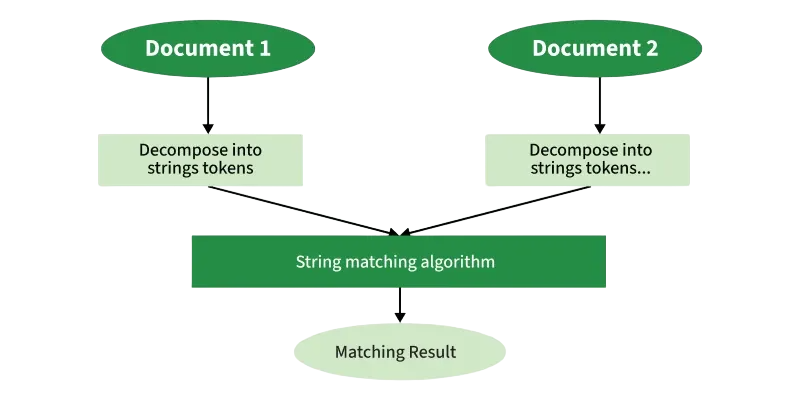
String matching involves finding occurrences of a pattern within a larger text efficiently. It tests understanding of algorithms and pattern searching techniques. Efficient algorithms include KMP and Rabin-Karp. Handling large strings requires optimized approaches. This problem is important for text processing applications.
66. What are string matching algorithms?
Ans:
- Naive approach compares pattern with text at each position, resulting in higher time complexity. It is simple to understand and useful for learning basics clearly. However, it becomes slow for large inputs.
- KMP algorithm uses prefix table to avoid redundant comparisons and improve efficiency. Previously matched information is reused intelligently during search. This gives linear time performance.
- Rabin-Karp uses hashing for pattern matching, reducing comparison operations. Hash values help compare substrings quickly before character checks. It is useful in multiple pattern scenarios.
- Boyer-Moore algorithm improves performance by skipping unnecessary comparisons. Smart shift rules reduce repeated checks significantly. It performs well in many practical cases.
67. What is KMP Algorithm?
Ans:
KMP Algorithm improves string matching by avoiding redundant comparisons. It uses prefix function to identify repeating patterns. It ensures linear time complexity for pattern searching. It is efficient for large datasets. Understanding KMP is essential for advanced string problems.
68. What is Rabin-Karp Algorithm?
Ans:
- Rabin-Karp uses hashing to compare pattern with substrings efficiently. Equal hashes suggest possible matches quickly before detailed checks. This saves time in many cases.
- Rolling hash technique reduces computation for repeated checks. Hash values are updated incrementally instead of recalculating fully. This improves performance greatly.
- It is useful for multiple pattern matching scenarios. Hashing supports searching many patterns with good efficiency. This is practical in text processing.
- Handling hash collisions is important for accuracy. Equal hashes do not always guarantee equal strings. Final verification is required.
69. What is Longest Common Subsequence?
Ans:
Longest Common Subsequence finds the longest sequence present in two strings in same order. It uses dynamic programming for efficient solution. It helps in text comparison and bioinformatics. Handling overlapping subproblems is important. Understanding LCS is essential for DP problems.
70. How to solve LCS?
Ans:
- Using DP table helps store results of subproblems efficiently. Reusing stored answers avoids repeated recursive work clearly. This is core dynamic programming logic.
- Comparing characters and updating table ensures correct solution. Matching characters extend subsequence length logically. Non-matching cases use maximum values.
- Backtracking helps reconstruct subsequence. Table values guide which characters belong to final answer. This is useful when sequence output is required.
- Optimizing space improves performance. Only required rows or columns can be stored in some versions. This reduces memory usage.
71. What is Edit Distance problem?
Ans:
Edit Distance measures minimum operations required to convert one string into another. Operations include insertion, deletion, and substitution. It uses dynamic programming for efficient solution. It is used in spell checking and NLP. Understanding edit distance is important for string problems.
72. What are operations in Edit Distance?
Ans:
- Insertion adds characters to match target string efficiently. Missing symbols are introduced at needed positions clearly. This helps alignment.
- Deletion removes characters to adjust string length. Extra symbols are removed when not needed anymore. This reduces mismatch.
- Substitution replaces characters to match target string. One incorrect symbol is changed into correct value efficiently. This is common in spelling corrections.
- Combining operations ensures minimal transformation cost. Dynamic programming chooses the cheapest sequence of steps naturally. Optimization is important.
73. What is Knapsack problem?
Ans:
Knapsack problem involves selecting items with maximum value within weight constraints. It is solved using dynamic programming. It has variations like 0/1 and fractional knapsack. It tests optimization and decision-making skills. Understanding knapsack is important for DP problems.
74. What is the difference between 0/1 Knapsack and Fractional Knapsack?
Ans:
| Criteria | 0/1 Knapsack | Fractional Knapsack |
|---|---|---|
| Selection | Item is either fully taken or rejected. | Item can be taken partially. |
| Approach | Usually solved using dynamic programming. | Usually solved using greedy method. |
| Optimality | Greedy may not always work. | Greedy gives optimal solution. |
| Use Case | Discrete item selection problems. | Divisible resource allocation problems. |
75. What is Coin Change problem?
Ans:
Coin Change problem involves finding minimum coins required to make a given amount. It is solved using dynamic programming. It tests understanding of combinations and optimization. Handling large inputs requires efficient solutions. This problem is commonly asked in interviews.
76. What is Combination Sum problem?
Ans:
Combination Sum problem involves finding all unique combinations of numbers that add up to a given target using recursion and backtracking techniques. It tests understanding of decision trees, pruning conditions, and efficient exploration of possible solutions. Handling duplicates and ensuring unique combinations is an important aspect of the problem. The solution typically uses depth-first search with backtracking to explore all valid paths. Understanding this problem is essential for mastering recursive and combinatorial problem-solving techniques.
77. How to solve Combination Sum?
Ans:
- Using backtracking allows exploration of all possible combinations while pruning paths that exceed the target value efficiently. Invalid branches are stopped early to save time. This improves performance.
- Sorting input helps optimize the search process and avoid duplicate combinations during recursion. Ordered values simplify pruning logic clearly. Sorting is often beneficial.
- Maintaining a temporary list helps track current combination while exploring different paths. Elements are added and removed during recursion naturally. This stores active choices.
- Proper base conditions ensure termination of recursion when target is reached or exceeded. Correct stopping rules prevent infinite exploration. Base cases are essential.
78. What is Subsets problem?
Ans:
Subsets problem involves generating all possible subsets of a given set using recursion or iterative methods. It tests understanding of combinatorial logic and recursion tree exploration. Each element has a choice to be included or excluded in the subset. The solution ensures all possible combinations are generated systematically. This problem is important for understanding power set generation.
79. What are approaches to generate subsets?
Ans:
- Using recursion helps explore inclusion and exclusion choices for each element efficiently. Every item creates two branches in decision tree clearly. This is intuitive and common.
- Bit manipulation can be used to generate subsets by representing inclusion using binary numbers. Each bit decides whether an element is selected. This is compact and efficient.
- Iterative approach builds subsets incrementally by adding elements to existing subsets. New subsets are formed from previous results naturally. This avoids recursion.
- Handling duplicates requires careful logic to avoid repeated subsets. Sorting and skipping repeated values are common methods. Correctness depends on this.
80. What is Permutations problem?
Ans:
Permutations problem involves generating all possible arrangements of elements in a list. It tests understanding of recursion and swapping techniques. The solution explores all possible orders using backtracking. Ensuring unique permutations when duplicates exist is important. This problem is fundamental for combinatorial algorithms.
81. How to generate permutations?
Ans:
- Using backtracking with swapping helps generate permutations efficiently without extra space. Elements are rearranged in-place during recursion clearly. This is a popular method.
- Recursive exploration ensures all possible arrangements are considered systematically. Every position gets each candidate one by one. This guarantees coverage.
- Handling duplicates requires sorting and skipping repeated elements. Duplicate checks prevent repeated answers significantly. This improves result quality.
- Maintaining current path and reverting changes ensures correct generation. State restoration after recursion is very important. Backtracking depends on it.
82. What is Matrix traversal problem?
Ans:
Matrix traversal involves visiting elements of a matrix in a specific order such as row-wise, column-wise, or spiral order. It tests understanding of indexing and boundary conditions. Efficient traversal avoids redundant visits and ensures correct coverage. Handling edge cases like empty matrix is important. This problem is essential for understanding grid-based algorithms.
83. What are types of matrix traversal?
Ans:
- Row-wise traversal processes elements sequentially across rows for simple matrix operations. It follows natural memory layout in many languages clearly. This is basic traversal.
- Column-wise traversal iterates through columns, useful in certain transformations. Some matrix problems specifically need column processing. This expands flexibility.
- Spiral traversal processes elements in circular layers, commonly asked in interviews. Boundaries shrink after each layer logically. It tests careful control.
- Diagonal traversal accesses elements along diagonals for pattern-based problems. Many matrix puzzles use this movement style frequently. It improves indexing skill.
84. What is Rotating Matrix problem?
Ans:
Rotating Matrix problem involves rotating a matrix by 90 degrees clockwise or counterclockwise in-place. It tests understanding of matrix manipulation and indexing. Efficient solutions avoid extra space and perform operations in layers. Transpose and reverse operations are commonly used techniques. This problem is widely asked for testing array manipulation skills.
85. How to rotate a matrix efficiently?
Ans:
- Transposing the matrix swaps rows and columns, forming the basis for rotation operations. This converts orientation in a useful intermediate step clearly. It is widely used.
- Reversing rows or columns completes the rotation depending on direction. Final reversal determines clockwise or anticlockwise result. This is efficient.
- Performing operations in-place reduces space complexity and improves efficiency. No extra matrix storage is needed in common solutions. Memory usage stays low.
- Handling edge cases like odd-sized matrices ensures correct implementation. Center elements and boundaries need careful treatment. Testing is important.
![Top Informatica Interview Questions & Answers – [UPDATED] Interview Question](https://www.acte.in/wp-content/uploads/2020/05/4-img-acte-1-400x218.jpeg)