LMS
LMS
Last updated on 23rd May 2026| 6653

Preparing For A Wipro HR Interview Requires Strong Communication Skills, Confidence, And A Clear Understanding Of Professional Workplace Expectations. HR Interview Questions Are Designed To Evaluate Personality, Attitude, Teamwork, Leadership Potential, Adaptability, And Career Goals. Candidates Are Often Assessed On Their Ability To Handle Challenges, Work Collaboratively, And Align With Company Values. Practicing Common Wipro HR Interview Questions Helps Improve Response Quality And Interview Performance. Freshers Can Benefit By Understanding Frequently Asked Topics Such As Strengths, Weaknesses, Career Objectives, And Problem-Solving Approaches. Well-Prepared Answers Demonstrate Professionalism, Positive Attitude, And Readiness For Corporate Responsibilities. These Top 90 Wipro HR Interview Questions And Answers Serve As A Valuable Resource For Successful Interview Preparation.
1. What Is Java?
Ans:
Java is a popular object-oriented programming language used for developing applications. It follows the principle of “Write Once, Run Anywhere” through the Java Virtual Machine. Java supports platform independence and strong security features. It provides automatic memory management through garbage collection. The language is widely used in web, desktop, mobile, and enterprise applications. Java offers rich libraries and frameworks for development. Its reliability and scalability make it a preferred choice in the IT industry.
2. What Is Object-Oriented Programming?
Ans:
Object-Oriented Programming is a programming paradigm based on objects and classes. It helps organize code into reusable and manageable structures. The four main principles are encapsulation, inheritance, polymorphism, and abstraction. OOP improves code reusability and maintainability. It allows developers to model real-world entities effectively. Most modern programming languages support OOP concepts. The approach simplifies complex software development projects.
3. What Is The Difference Between Compiler And Interpreter?
Ans:
A compiler translates the entire source code into machine code before execution. An interpreter translates and executes code line by line during runtime. Compiled programs generally execute faster than interpreted programs. Interpreters make debugging easier because errors are identified immediately. Languages such as C use compilers, while Python uses interpreters. Both approaches convert human-readable code into executable instructions. Their usage depends on application requirements and performance needs.
4. What Is A Data Structure?
Ans:
A data structure is a method of organizing and storing data efficiently. It enables faster access, modification, and processing of information. Common data structures include arrays, linked lists, stacks, queues, and trees. Choosing the right data structure improves application performance. Data structures are essential in algorithm implementation. They help manage large amounts of data effectively. Efficient data handling is a key aspect of software development.
5. What Is An Array?
Ans:
An array is a collection of elements stored in contiguous memory locations. All elements in an array are usually of the same data type. Arrays allow quick access using index values. They are commonly used for storing and processing multiple values. The size of an array is generally fixed during declaration. Arrays simplify data management in programming. They are among the most fundamental data structures.
6. What Is A Linked List?
Ans:
- A linked list is a linear data structure consisting of connected nodes. Each node contains data and a reference to the next node.
- Unlike arrays, linked lists do not require contiguous memory allocation. They allow dynamic memory usage and flexible resizing. Insertions and deletions are efficient compared to arrays.
- Linked lists are widely used in memory management and dynamic applications. Different types include singly, doubly, and circular linked lists.
7. What Is A Stack?
Ans:
A stack is a linear data structure that follows the Last In First Out principle. The most recently added element is removed first. Common operations include push, pop, and peek. Stacks are used in function calls, expression evaluation, and recursion. They help manage execution flow efficiently. Stack implementation can be done using arrays or linked lists. It is one of the most commonly used abstract data types.
8. What Is A Queue?
Ans:
A queue is a linear data structure that follows the First In First Out principle. Elements are inserted from the rear and removed from the front. Queues are commonly used in scheduling and resource management. Operations include enqueue, dequeue, and peek. They help process tasks in the order they arrive. Variations include circular queues and priority queues. Queues are essential in operating systems and networking.
9. What Is Database Management System?
Ans:
A Database Management System is software used to store and manage data. It provides efficient methods for data retrieval and modification. DBMS ensures data security, consistency, and integrity. Examples include MySQL, Oracle, PostgreSQL, and SQL Server. It supports multiple users accessing data simultaneously. Database systems reduce redundancy and improve reliability. They are critical components of modern applications.
10. What Is SQL?
Ans:
SQL stands for Structured Query Language. It is used to communicate with relational databases. SQL helps create, retrieve, update, and delete data. Common commands include SELECT, INSERT, UPDATE, and DELETE. It supports data definition and manipulation operations. SQL is widely used in enterprise and web applications. Database administrators and developers rely heavily on SQL for data management.
11. What Is The Difference Between Primary Key And Foreign Key?
Ans:
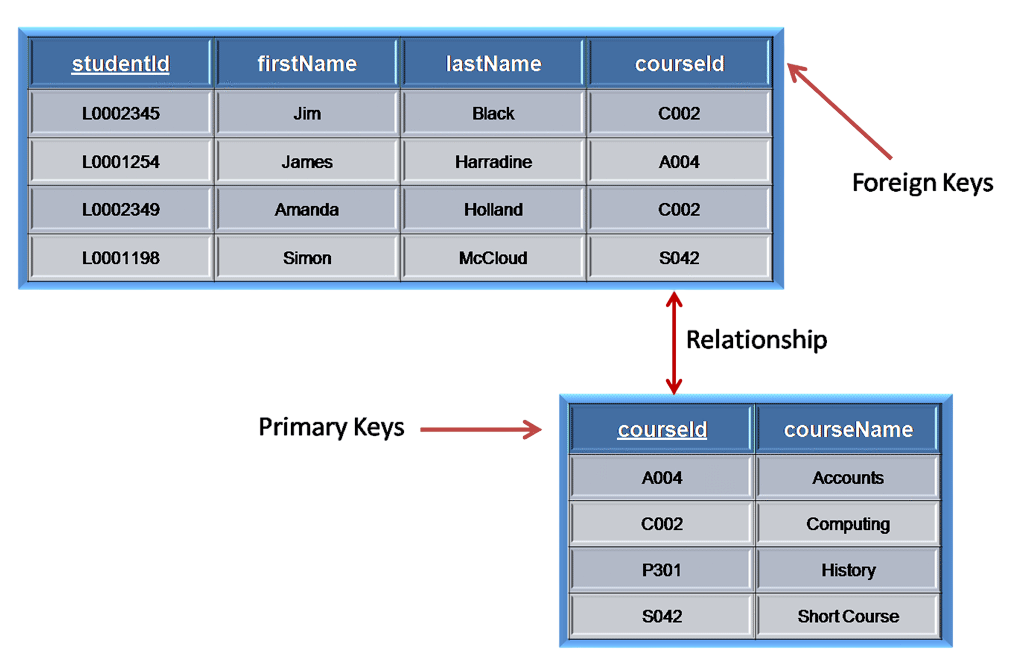
A primary key uniquely identifies each record in a table. It does not allow duplicate or null values. A foreign key creates a relationship between two tables. It references the primary key of another table. Primary keys maintain uniqueness within a table. Foreign keys ensure referential integrity across tables. Together they help organize relational databases efficiently.
12. What Is Normalization?
Ans:
Normalization is the process of organizing data to reduce redundancy. It divides large tables into smaller related tables. The goal is to improve database efficiency and consistency. Common normal forms include 1NF, 2NF, and 3NF. Normalization minimizes data duplication. It also simplifies maintenance and updates. Proper normalization leads to a well-structured database design.
13. What Is An Operating System
Ans:
- An operating system is system software that manages computer hardware and software resources. It acts as an interface between users and hardware.
- Functions include process management, memory management, and file handling. Examples include Windows, Linux, and macOS.
- The operating system ensures efficient resource utilization. It provides security and user interaction capabilities. Every computer requires an operating system to function properly.
14. What Is Process Scheduling?
Ans:
Process scheduling is the method used by an operating system to allocate CPU time. It determines which process runs at a given moment. Scheduling improves system efficiency and responsiveness. Common algorithms include FCFS, Round Robin, and Priority Scheduling. The scheduler balances resource utilization among processes. Effective scheduling reduces waiting and turnaround times. It is a crucial function of modern operating systems.
15. Write A Program To Check Whether A Number Is Even Or Odd
Ans:
This program checks whether a number is even or odd. A number is even when it is divisible by 2 without any remainder. The modulus operator (%) is used to find the remainder. If the remainder is zero, the number is even; otherwise, it is odd. This is one of the most basic programming concepts. It helps in understanding conditional statements and decision-making logic. Even and odd number checks are commonly used in coding interviews and aptitude-based programming questions.
- int n = 10;
- if(n % 2 == 0)
- System.out.println(“Even”);
- else
- System.out.println(“Odd”);
16. What Is Computer Network?
Ans:
A computer network is a collection of interconnected devices that communicate with each other. Networks enable data sharing and resource access. Common types include LAN, MAN, and WAN. Communication occurs through networking protocols. Networks support internet connectivity and business operations. They improve collaboration and information exchange. Modern organizations depend heavily on networking technologies.
17. What Is IP Address?
Ans:
An IP address is a unique identifier assigned to a device on a network. It enables communication between connected devices. IP addresses can be IPv4 or IPv6. They help route data packets to the correct destination. Every internet-connected device requires an IP address. Network administrators use IP addresses for management and troubleshooting. They are fundamental components of networking.
18. What Is HTTP And HTTPS?
Ans:
HTTP stands for HyperText Transfer Protocol and is used for web communication. HTTPS is the secure version of HTTP. HTTPS encrypts data using SSL or TLS protocols. This protects information from unauthorized access. Most websites use HTTPS to ensure privacy and security. Secure communication is especially important for online transactions. HTTPS improves user trust and data protection.
19. What Is Cloud Computing?
Ans:
Cloud computing delivers computing services over the internet. These services include storage, servers, databases, and software. Cloud platforms provide scalability and flexibility. Organizations can access resources without maintaining physical infrastructure. Popular cloud providers include AWS, Azure, and Google Cloud. Cloud computing reduces operational costs and improves efficiency. It has become a key technology in modern IT environments.
20. Difference Between Wipro HR Interview Questions And Technical Interview Questions?
Ans:
| Aspect | Wipro HR Interview Questions | Wipro Technical Interview Questions |
|---|---|---|
| Purpose | Evaluate communication skills, attitude, confidence, and cultural fit. | Evaluate technical knowledge, coding skills, and problem-solving ability. |
| Focus Area | Personality, teamwork, leadership, adaptability, and career goals. | Programming, databases, operating systems, networking, and technical concepts. |
| Question Type | Behavioral, situational, and personal development questions. | Concept-based, coding, debugging, and technical problem-solving questions |
| Assessment Criteria | Communication, interpersonal skills, and professional attitude. | Technical expertise, logical thinking, and analytical skills. |
21. What Is Software Testing?
Ans:
Software testing is the process of evaluating an application to identify defects and ensure quality. It verifies whether the software meets specified requirements. Testing helps improve reliability, performance, and security. Different testing methods include manual and automated testing. Common types are unit, integration, system, and acceptance testing. Effective testing reduces the risk of failures in production. It is a critical phase of the software development lifecycle. Testing also helps improve user satisfaction by ensuring smooth functionality. High-quality testing contributes to the successful deployment of software products.
22. What Is Unit Testing?
Ans:
- Unit testing focuses on testing individual components or modules of an application. It ensures that each unit functions correctly in isolation. Developers usually perform unit testing during coding.
- Frameworks such as JUnit and TestNG support automated testing. Unit tests help identify bugs early in development. They improve code quality and maintainability. Regular unit testing reduces debugging efforts later.
- It supports continuous integration and faster software delivery. Well-tested code is easier to modify and extend in future projects.
23. What Is Debugging?
Ans:
Debugging is the process of finding and fixing errors in a program. It helps identify the root cause of unexpected behavior. Developers use debugging tools to inspect variables and execution flow. Common errors include syntax, runtime, and logical errors. Effective debugging improves software reliability. It is an essential skill for programmers. Debugging ensures that applications perform as intended. Proper debugging reduces system failures and maintenance costs. It contributes significantly to software quality and stability.
24. What Is An Algorithm?
Ans:
An algorithm is a step-by-step procedure used to solve a problem. It provides a logical sequence of instructions for execution. Algorithms should be efficient, clear, and finite. They form the foundation of computer programming. Different algorithms are designed for searching, sorting, and optimization tasks. Performance is measured using time and space complexity. Efficient algorithms improve application speed and resource usage. Good algorithms enhance scalability for large applications. They play a crucial role in solving real-world computing challenges.
25. What Is Time Complexity?
Ans:
Time complexity measures the amount of time an algorithm requires to execute. It helps evaluate algorithm efficiency as input size increases. Big O notation is commonly used to represent complexity. Examples include O(1), O(n), and O(log n). Lower complexity generally indicates better performance. Understanding time complexity helps optimize code. It is an important concept in problem-solving and programming. Developers use it to compare different algorithms effectively. Efficient algorithms save processing time and system resources.
26. What Is Space Complexity?
Ans:
Space complexity measures the memory required by an algorithm during execution. It considers variables, data structures, and recursion usage. Efficient memory utilization improves application performance. Algorithms with lower space complexity are preferred in memory-constrained environments. Space complexity is also represented using Big O notation. Balancing time and space complexity is often necessary. It helps create scalable software solutions. Proper memory management improves overall system efficiency. Space optimization is important in large-scale applications.
27. What Is Binary Search?
Ans:
Binary search is an efficient searching algorithm used on sorted data. It repeatedly divides the search range into halves. The algorithm compares the target value with the middle element. If the target is smaller, the left half is searched. Otherwise, the right half is examined. Binary search has a time complexity of O(log n). It is faster than linear search for large datasets. The algorithm significantly reduces the number of comparisons required. It is commonly used in database and search applications.
28. What Is Linear Search?
Ans:
Linear search checks each element sequentially until the target is found. It works on both sorted and unsorted data. The algorithm is simple and easy to implement. However, it may be slow for large datasets. Its worst-case time complexity is O(n). Linear search is suitable for small collections of data. It is often used when simplicity is more important than speed. The method requires no special data arrangement. It is commonly taught as a basic searching technique
29. What Is Recursion?
Ans:
Recursion is a technique where a function calls itself to solve a problem. It breaks a large problem into smaller subproblems. Recursive functions require a base condition to stop execution. Without a base case, infinite recursion may occur. Recursion is commonly used in tree traversal and divide-and-conquer algorithms. It simplifies certain programming tasks. Proper implementation ensures efficient performance. Recursive solutions can make code more readable and elegant. Understanding recursion helps in solving complex algorithmic problems.
30. What Is Inheritance?
Ans:
- Inheritance is an object-oriented programming concept that allows one class to acquire properties of another class. It promotes code reusability and extensibility.
- The parent class provides common functionality. The child class can add or modify features. Inheritance reduces duplication in code. It supports hierarchical relationships between classes. This concept is widely used in software design.
- It simplifies application maintenance and development. Inheritance helps build scalable and organized software architectures.
31. What Is Polymorphism?
Ans:
Polymorphism allows objects to take multiple forms in object-oriented programming. It enables the same method to behave differently based on context. Compile-time polymorphism is achieved through method overloading. Runtime polymorphism is achieved through method overriding. Polymorphism improves flexibility and scalability. It supports code reuse and maintainability. This feature is a core principle of OOP. It simplifies application development by reducing code duplication. Polymorphism makes software systems more adaptable to changing requirements.
32. Write A Program To Find The Largest Of Three Numbers
Ans:
This program finds the largest value among three numbers. The Math.max() method compares two numbers and returns the greater value. By using nested comparisons, the largest number is identified.
- int a = 10, b = 20, c = 15;
- int max = Math.max(a, Math.max(b, c));
- System.out.println(max);
33. What Is Abstraction?
Ans:
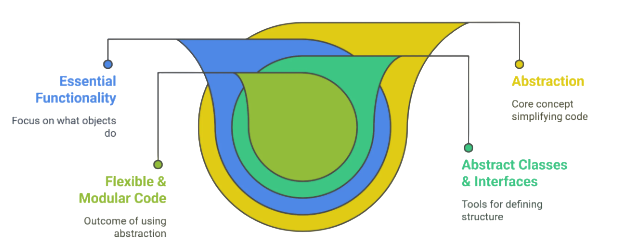
Abstraction hides implementation details and exposes only essential features. It helps reduce complexity in software systems. Users interact with simplified interfaces without knowing internal workings. Abstract classes and interfaces support abstraction in programming. This concept improves maintainability and scalability. Developers can modify implementations without affecting users. Abstraction is a key feature of object-oriented programming. It allows developers to focus on important functionality. Abstraction simplifies the development of large applications.
34. What Is Method Overloading?
Ans:
Method overloading occurs when multiple methods have the same name but different parameters. It is a form of compile-time polymorphism. The compiler determines which method to execute. Overloading improves readability and flexibility. Different parameter types or counts distinguish methods. It simplifies code organization. Method overloading is widely used in Java and other OOP languages. It reduces the need for multiple method names. Overloading improves program clarity and usability..
35. What Is Method Overriding?
Ans:
- Method overriding allows a subclass to provide a specific implementation of a parent class method. It supports runtime polymorphism.
- The overridden method must have the same signature. Overriding enables customized behavior in child classes. It enhances flexibility in object-oriented applications. Dynamic method dispatch determines the method executed.
- This concept is essential for inheritance-based designs. It allows applications to support specialized functionality. Method overriding improves extensibility in software systems.
36. What Is Exception Handling?
Ans:
- Exception handling manages runtime errors without terminating a program abruptly. It uses constructs such as try, catch, and finally.
- Exceptions help identify and recover from unexpected situations. Proper handling improves application stability. Developers can provide meaningful error messages to users. Exception handling enhances reliability and maintainability.
- It is an important feature of modern programming languages. Proper error management improves user experience significantly. Exception handling helps build robust and fault-tolerant applications.
37. What Is JVM?
Ans:
JVM stands for Java Virtual Machine. It provides an environment for executing Java bytecode. JVM enables platform independence by translating bytecode into machine code. It manages memory and garbage collection. Security features are built into the JVM architecture. It plays a vital role in Java application execution. JVM makes Java programs portable across platforms. It ensures consistent behavior on different operating systems. JVM is the backbone of the Java ecosystem.
38. What Is JDK?
Ans:
JDK stands for Java Development Kit. It provides tools required for developing Java applications. The JDK includes the compiler, JVM, and standard libraries. Developers use it to write, compile, and run programs. It supports debugging and documentation generation. The JDK is essential for Java software development. It serves as the complete development environment. The toolkit simplifies application creation and testing. JDK is required for professional Java development projects.
39. What Is JRE?
Ans:
JRE stands for Java Runtime Environment. It provides the necessary components to run Java applications. The JRE includes the JVM and supporting libraries. Unlike the JDK, it does not contain development tools. Users install the JRE to execute Java programs. It ensures compatibility across systems. The JRE is a subset of the JDK. It provides the runtime support needed for applications. JRE enables smooth execution of Java-based software..
40. What Is Garbage Collection?
Ans:
- Garbage collection is the automatic process of freeing unused memory in Java. It removes objects that are no longer referenced.
- This helps prevent memory leaks and improves efficiency. The JVM manages garbage collection automatically. Developers do not need to manually release memory. Effective garbage collection enhances application performance.
- It is an important feature of Java memory management. Efficient memory handling improves system stability. Garbage collection simplifies development and reduces errors.
41. What Is HTML?
Ans:
HTML stands for HyperText Markup Language. It is used to create the structure of web pages. HTML defines elements such as headings, paragraphs, and links. Browsers interpret HTML to display content. It works together with CSS and JavaScript. HTML is easy to learn and widely adopted. It forms the foundation of web development. Every website relies on HTML for content organization. Understanding HTML is essential for web developers.
42. What Is CSS?
Ans:
CSS stands for Cascading Style Sheets. It is used to control the appearance of web pages. CSS defines colors, layouts, fonts, and animations. It separates design from content structure. This improves maintainability and consistency. CSS supports responsive web design. It enhances the visual appeal of websites. Modern websites depend on CSS for attractive interfaces. CSS improves user engagement and accessibility.
43. What Is JavaScript?
Ans:
- JavaScript is a scripting language used to create interactive web pages. It runs directly in web browsers. JavaScript can manipulate HTML and CSS dynamically.
- It supports event handling and form validation. Modern frameworks use JavaScript extensively. It is an essential technology for frontend development. JavaScript enables rich user experiences on websites.
- It also supports backend development through Node.js. JavaScript remains one of the most popular programming languages.
44. What Is DOM?
Ans:
DOM stands for Document Object Model. It represents the structure of an HTML document as objects. JavaScript can access and modify DOM elements dynamically. The DOM enables interactive web functionality. Developers use it to update content without reloading pages. It acts as a bridge between HTML and scripting languages. Understanding the DOM is crucial for web development. It enables dynamic user interface updates. DOM manipulation is widely used in modern web applications.
45. What Is AJAX?
Ans:
AJAX stands for Asynchronous JavaScript And XML. It allows web pages to communicate with servers without reloading. AJAX improves user experience by updating content dynamically. It enables faster and more responsive applications. Data is commonly exchanged using JSON format. AJAX is widely used in modern web development. It supports seamless interactions between clients and servers. The technology reduces unnecessary page refreshes. AJAX contributes to smoother and faster web applications.
46. What Is JSON?
Ans:
JSON stands for JavaScript Object Notation. It is a lightweight data exchange format. JSON is easy for humans to read and write. It is also easy for machines to parse and generate. APIs commonly use JSON for communication. JSON supports structured data representation. It is widely used in web and mobile applications. JSON improves interoperability between different systems. Its simplicity makes data exchange highly efficient.
47. Write A Program To Reverse A String
Ans:
This program reverses a given string. The loop starts from the last character and moves toward the first character. Each character is added to a new string in reverse order
- String s = “Wipro”;
- String rev = “”;
- for(int i = s.length() – 1; i >= 0; i–)
- rev += s.charAt(i);
- System.out.println(rev);
48. What Is Git?
Ans:
Git is a distributed version control system used for source code management. It tracks changes made to files over time. Git supports collaboration among multiple developers. Features such as branching and merging simplify development. It helps maintain project history and backups. Git improves code management and productivity. It is widely used in software development projects. Developers can easily revert to previous versions when needed. Git is an essential tool for modern software teams.
49. What Is GitHub?
Ans:
- GitHub is a cloud-based platform for hosting Git repositories. It enables developers to collaborate on projects. GitHub provides version control and code review features. Teams can manage issues and project workflows.
- It supports open-source and private repositories. GitHub integrates with many development tools. It is one of the most popular platforms for software development.
- The platform encourages collaboration and knowledge sharing. GitHub is widely used by organizations and developers worldwide.
50. What Is Agile Methodology?
Ans:
Agile is a software development methodology focused on iterative progress. It promotes collaboration between teams and stakeholders. Development is divided into small increments called sprints. Agile enables quick adaptation to changing requirements. Continuous feedback improves product quality. It emphasizes customer satisfaction and teamwork. Agile is widely used in modern software projects. The methodology supports faster delivery of valuable features. Agile improves project flexibility and responsiveness..
51. What Is Scrum?
Ans:
Scrum is an Agile framework used for managing software development projects. It divides work into short iterations called sprints. Scrum promotes collaboration among team members. Roles include Product Owner, Scrum Master, and Development Team. Daily stand-up meetings help track progress. Scrum improves transparency and adaptability in projects. It focuses on delivering value continuously. Teams can quickly respond to changing business needs. Scrum is widely used in modern software development organizations.
52. What Is SDLC?
Ans:
- SDLC stands for Software Development Life Cycle. It is a structured process for developing software applications. The phases include planning, analysis, design, development, testing, deployment, and maintenance.
- SDLC helps ensure quality and efficiency. Different models include Waterfall, Agile, and Spiral. It provides a systematic approach to software creation.
- SDLC reduces project risks and improves outcomes. Proper implementation ensures timely project delivery. It is essential for successful software engineering.
53. What Is Waterfall Model?
Ans:
The Waterfall Model is a linear software development approach. Each phase must be completed before moving to the next. It includes requirement gathering, design, implementation, testing, and maintenance. The model is simple and easy to understand. Changes are difficult once development progresses. It is suitable for projects with stable requirements. Documentation is a major strength of the Waterfall Model. The approach provides clear project milestones. It is commonly used in traditional software projects.
54. What Is A Database?
Ans:
A database is an organized collection of related data. It allows efficient storage, retrieval, and management of information. Databases support multiple users and applications. They ensure data consistency and security. Common database types include relational and non-relational databases. Organizations use databases for managing business operations. Databases are essential for modern software systems. They help process large volumes of information efficiently. Proper database design improves application performance.
55. What Is SQL JOIN?
Ans:
SQL JOIN is used to combine data from multiple tables. It retrieves related information based on common columns. Common JOIN types include INNER JOIN, LEFT JOIN, RIGHT JOIN, and FULL JOIN. JOIN operations reduce data redundancy. They improve data analysis and reporting capabilities. SQL JOIN is widely used in relational databases. It helps establish relationships between tables. Efficient JOIN queries improve database performance. Understanding JOIN operations is crucial for database developers.
56. What Is A Transaction In DBMS?
Ans:
A transaction is a sequence of database operations treated as a single unit. Transactions ensure data consistency and integrity. They follow ACID properties for reliable processing. If one operation fails, the entire transaction can be rolled back. Transactions are essential in banking and financial systems. They prevent incomplete or incorrect updates. Proper transaction management improves reliability. It ensures accurate processing of critical business data. Transactions are fundamental in database systems.
57. What Are ACID Properties?
Ans:
- ACID stands for Atomicity, Consistency, Isolation, and Durability. These properties ensure reliable database transactions. Atomicity guarantees that all operations complete successfully or none do.
- Consistency maintains valid data states. Isolation prevents conflicts between concurrent transactions. Durability ensures committed changes remain permanent. ACID properties improve database reliability and integrity.
- They are essential for secure transaction processing. Most relational databases implement ACID principles.
58. What Is A Primary Key?
Ans:
- A primary key uniquely identifies each record in a database table. It prevents duplicate entries. Primary keys cannot contain null values.
- They help maintain data integrity and consistency. Every table should have a primary key whenever possible. Primary keys improve query performance and indexing. They are essential in relational database design.
- Relationships between tables often depend on primary keys. Proper use of primary keys enhances database efficiency.
59. What Is A Foreign Key?
Ans:
A foreign key is a field that references the primary key of another table. It establishes relationships between tables. Foreign keys maintain referential integrity. They prevent invalid or orphaned records. Database normalization often uses foreign key relationships. They help organize data logically. Foreign keys improve consistency across related tables. They support efficient data retrieval and management. Relational databases rely heavily on foreign keys.
60. What Is The Difference Between Array And Linked List?
Ans:
| Feature | Array | Linked List |
|---|---|---|
| Definition | An array is a collection of elements stored in contiguous memory locations. | A linked list is a collection of nodes connected through pointers |
| Memory Allocation | Memory is allocated in a continuous block. | Memory is allocated dynamically and can be scattered. |
| Size | Size is usually fixed once declared. | Size can grow or shrink dynamically during execution. |
| Access Time | Elements can be accessed directly using an index in O(1) time. | Elements must be traversed sequentially, requiring O(n) time. |
61. What Is Denormalization?
Ans:
Denormalization is the process of combining tables to improve query performance. It intentionally introduces redundancy. Denormalization reduces the number of JOIN operations required. It is commonly used in reporting systems. Faster data retrieval is the main advantage. However, it may increase storage requirements. Denormalization should be applied carefully. It balances performance and data consistency. Large-scale applications often use denormalized structures.
62. What Is A Network Protocol?
Ans:
- A network protocol is a set of rules governing communication between devices. Protocols ensure reliable data transmission.
- Examples include TCP, IP, HTTP, and FTP. They define message formats and communication procedures. Protocols enable interoperability among different systems. Network communication depends on protocol standards.
- They ensure accurate and secure data exchange. Protocols are fundamental to internet functionality. Modern networking relies heavily on standardized protocols.
63. What Is TCP/IP?
Ans:
TCP/IP is the foundational protocol suite of the internet. TCP ensures reliable data delivery between devices. IP handles addressing and routing of packets. Together they enable communication across networks. TCP/IP supports scalability and interoperability. Most internet applications depend on these protocols. They provide efficient and reliable communication. TCP/IP forms the backbone of modern networking. Understanding it is important for network professionals.
64. Write A Program To Find The Factorial Of A Number
Ans:
This program calculates the factorial of a number. Factorial is the product of all positive integers from 1 to the given number. For example, 5! = 5 × 4 × 3 × 2 × 1 = 120
- int n = 5, f = 1;
- for(int i = 1; i <= n; i++)
- f *= i;
- System.out.println(f);
65. What Is An IP Address?
Ans:
An IP address is a unique identifier assigned to a device on a network. It allows devices to communicate with each other. IP addresses can be IPv4 or IPv6. They help route data packets correctly. Every internet-connected device requires an IP address. Network management relies on proper IP addressing. IP addresses are fundamental to networking. They support communication across local and global networks. Efficient routing depends on accurate addressing.
66. What Is Cloud Computing?
Ans:
Cloud computing provides computing resources over the internet. Services include storage, servers, networking, and software. Cloud platforms offer scalability and flexibility. Organizations can reduce infrastructure costs. Popular providers include AWS, Azure, and Google Cloud. Cloud computing supports remote access to resources. It improves operational efficiency and agility. Businesses can scale services based on demand. Cloud technology is transforming modern IT operations.
67. What Is Virtualization?
Ans:
.
- Virtualization is the creation of virtual versions of computing resources. It allows multiple virtual machines to run on one physical server.
- Virtualization improves resource utilization. It reduces hardware costs and maintenance efforts. Hypervisors manage virtual environments efficiently.
- Virtualization supports cloud computing technologies. It enhances flexibility and scalability. Organizations use it for efficient infrastructure management. It is widely adopted in data centers.
68. What Is AWS?
Ans:
AWS stands for Amazon Web Services. It is a cloud computing platform provided by Amazon. AWS offers services such as computing, storage, databases, and networking. It supports businesses of all sizes. AWS provides scalable and secure cloud solutions. Organizations use it for application deployment and management. It is one of the leading cloud providers. AWS enables rapid development and innovation. Its services are widely used across industries.
69. What Is Cybersecurity?
Ans:
Cybersecurity involves protecting systems, networks, and data from cyber threats. It includes measures to prevent unauthorized access. Security practices help protect sensitive information. Common threats include malware, phishing, and ransomware. Cybersecurity improves confidentiality, integrity, and availability. Organizations invest heavily in security solutions. It is essential in the digital age. Strong security measures reduce business risks. Cybersecurity is a critical aspect of modern IT.
70. What Is Encryption?
Ans:
Encryption is the process of converting data into a secure format. Only authorized users can decrypt and read the information. Encryption protects data during storage and transmission. It is widely used in online banking and communication. Security protocols rely on encryption techniques. It helps prevent unauthorized access to sensitive information. Encryption enhances privacy and trust. Strong encryption algorithms improve data protection. It is a key component of cybersecurity.
71. What Is Machine Learning?
Ans:
Machine learning is a branch of artificial intelligence that enables systems to learn from data. It identifies patterns and makes predictions automatically. Algorithms improve performance through experience. Machine learning is used in recommendation systems and analytics. It reduces the need for explicit programming. Data quality significantly affects model performance. Machine learning drives innovation across industries. It supports automation and intelligent decision-making. The technology continues to evolve rapidly.
72. What Is Artificial Intelligence?
Ans:
Artificial Intelligence is the simulation of human intelligence in machines. AI systems can learn, reason, and solve problems. Applications include robotics, chatbots, and virtual assistants. AI improves efficiency and automation. It processes large amounts of data quickly. Businesses use AI for decision-making and optimization. AI is transforming many industries globally. The technology creates new opportunities for innovation. It plays a major role in future technological advancements.
73. What Is Data Mining?
Ans:
Data mining is the process of discovering patterns in large datasets. It uses statistical and computational techniques. Organizations use data mining for business insights. The process helps identify trends and relationships. Data mining supports decision-making and forecasting. It is widely used in marketing and finance. Effective data mining improves business intelligence. It helps organizations gain competitive advantages. Data-driven strategies rely heavily on data mining.
74. What Is Big Data?
Ans:
Big Data refers to extremely large datasets that are difficult to process traditionally. It is characterized by volume, velocity, and variety. Organizations analyze big data for valuable insights. Advanced tools and technologies handle large-scale processing. Big Data supports innovation and strategic planning. Industries use it for analytics and optimization. It enhances decision-making capabilities. Businesses gain deeper customer and operational insights. Big Data continues to grow in importance.
75. What Is Hadoop?
Ans:
- Hadoop is an open-source framework for processing large datasets. It supports distributed storage and computation. Hadoop uses HDFS for data storage.
- MapReduce enables parallel data processing. It is designed for scalability and fault tolerance. Organizations use Hadoop for Big Data analytics.
- Hadoop handles massive data efficiently. It supports cost-effective large-scale processing. The framework is widely used in data engineering.
76. Write A Program To Check Whether A String Is A Palindrome
Ans:
This program checks whether a string reads the same forward and backward. The string is reversed and compared with the original string. If both are equal, the string is a palindrome.
- String s = “madam”;
- String rev = new StringBuilder(s).reverse().toString();
- System.out.println(s.equals(rev));
77. What Is Operating System?
Ans:
An operating system manages computer hardware and software resources. It acts as an interface between users and hardware. Functions include process, memory, and file management. Examples include Windows, Linux, and macOS. Operating systems improve resource utilization. They provide a stable environment for applications. Every computer system requires an operating system. Efficient OS design improves overall performance. It is a fundamental component of computing.
78. What Is Multitasking?
Ans:
Multitasking allows multiple tasks to run seemingly at the same time. The operating system allocates CPU time efficiently. Users can perform different activities simultaneously. Multitasking improves productivity and responsiveness. Modern operating systems support advanced multitasking features. It enables efficient resource utilization. Multitasking is common in everyday computing environments. It enhances user experience significantly. Most modern applications rely on multitasking capabilities..
79. What Is Multithreading?
Ans:
Multithreading allows multiple threads within a process to execute concurrently. Threads share resources within the same process. It improves application responsiveness and performance. Multithreading is widely used in modern software applications. Synchronization is required to prevent conflicts. Proper thread management improves efficiency. It supports parallel task execution. Multithreading enhances resource utilization. It is an important concept in software development..
80. What Is Deadlock?
Ans:
- Deadlock occurs when processes wait indefinitely for resources held by each other. It prevents further execution of involved processes.
- Deadlocks can reduce system performance. Resource allocation strategies help prevent deadlocks. Detection and recovery mechanisms are often implemented. Understanding deadlocks is important in operating systems.
- Proper resource management minimizes deadlock risks. It improves system reliability and efficiency. Deadlock prevention is a key OS responsibility.
81. What Is Process Scheduling?
Ans:
Process scheduling is the method used by an operating system to allocate CPU time to processes. It determines which process executes next. Scheduling improves system efficiency and responsiveness. Common algorithms include FCFS, Round Robin, and Priority Scheduling. The scheduler balances resource usage among processes. Effective scheduling reduces waiting and turnaround times. It is a critical function of operating systems. Proper scheduling improves overall system performance. It ensures fair execution of multiple processes.
82. What Is Paging?
Ans:
- Paging is a memory management technique used by operating systems. It divides memory into fixed-size pages and frames. Paging eliminates external fragmentation problems.
- The operating system maps logical memory to physical memory. It enables efficient memory utilization. Virtual memory systems commonly use paging.
- This technique supports the execution of large programs. Paging improves memory allocation flexibility. It enhances overall system performance and efficiency.
83. What Is Segmentation?
Ans:
Segmentation is a memory management technique that divides memory into variable-sized segments. Each segment represents a logical unit such as code or data. Segmentation improves memory organization. It allows programs to be divided into meaningful sections. Segment tables help manage memory allocation. This technique supports modular programming. Segmentation enhances memory protection and sharing. It provides a logical view of program memory. Operating systems use segmentation for efficient resource management.
84. What Is Cache Memory?
Ans:
- Cache memory is a high-speed memory located close to the CPU. It stores frequently accessed data and instructions. Cache memory reduces data access time significantly. It improves processor performance and efficiency.
- Multiple cache levels such as L1, L2, and L3 are commonly used. Faster access reduces CPU waiting time.
- Cache memory is an essential component of modern computers. It helps accelerate application execution. Efficient caching improves overall system responsiveness.
85. What Is A Compiler?
Ans:
A compiler is a software program that translates source code into machine code. It converts the entire program before execution. Compilers help identify syntax and semantic errors. Compiled programs generally run faster than interpreted programs. Languages such as C and C++ use compilers. The compilation process improves execution efficiency. Compilers are essential development tools. They help generate optimized machine-level instructions. Efficient compilation improves software performance.
86. What Is An Interpreter?
Ans:
An interpreter translates and executes source code line by line. It does not generate a separate executable file. Interpreters are useful for debugging and testing. Errors can be detected immediately during execution. Languages such as Python and JavaScript commonly use interpreters. Interpreted programs are generally easier to modify. Interpreters simplify program development. They support rapid application prototyping. Many modern scripting languages rely on interpreters.
87. What Are Data Types?
Ans:
Data types define the type of values that variables can store. They help allocate memory efficiently. Common data types include int, float, char, and boolean. Data types ensure proper operations on stored values. They improve program reliability and correctness. Different programming languages provide various data types. Choosing appropriate data types optimizes performance. Data types are fundamental to software development. They help maintain data consistency throughout applications.
88. What Is A Constructor?
Ans:
A constructor is a special method used to initialize objects in a class. It is automatically called when an object is created. Constructors help set default values for object attributes. They improve object initialization and consistency. Constructors can be parameterized or non-parameterized. Every object-oriented language provides constructor support. They simplify object creation processes. Proper constructor design improves code quality. Constructors are essential in object-oriented programming.
89. What Is An Interface?
Ans:
- An interface is a blueprint that defines method declarations without implementation. Classes implement interfaces to provide functionality. Interfaces support abstraction and multiple inheritance concepts.
- They promote loose coupling between components. Developers use interfaces to create flexible software designs. Interfaces improve maintainability and scalability.
- They are widely used in enterprise applications. Interface-based design enhances code reusability. It helps build modular and extensible systems.
90. What Is An Abstract Class?
Ans:
An abstract class is a class that cannot be instantiated directly. It may contain both abstract and concrete methods. Abstract classes provide a common foundation for subclasses. They support abstraction in object-oriented programming. Child classes must implement abstract methods. This improves code organization and reuse. Abstract classes help model real-world relationships. They simplify complex software designs. Abstract classes are widely used in framework development.
91. What Is The Collections Framework?
Ans:
- The Collections Framework is a set of classes and interfaces for storing and manipulating data. It provides structures such as List, Set, Queue, and Map. Collections simplify data handling operations.
- They support sorting, searching, and iteration. The framework improves code efficiency and maintainability. Developers use collections extensively in Java applications.
- It reduces the need for custom data structures. Collections enhance productivity and flexibility. They are essential for modern application development.
92. Write A Program To Find The Sum Of Elements In An Array
Ans:
This program calculates the sum of all elements in an array. A loop traverses each element and adds it to the sum variable. The final value represents the total of all array elements.
- int arr[] = {10, 20, 30};
- int sum = 0;
- for(int n : arr)
- sum += n;
93. What Is Synchronization?
Ans:
Synchronization is the process of controlling access to shared resources in multithreaded environments. It prevents data inconsistencies and race conditions. Synchronization ensures that only one thread accesses critical sections at a time. Proper synchronization improves application stability. It is essential for concurrent programming. Various mechanisms such as locks and semaphores are used. Synchronization helps maintain data integrity. It enables safe execution of parallel tasks. Effective synchronization improves software reliability.
94. What Is An API?
Ans:
API stands for Application Programming Interface. It enables communication between different software applications. APIs define rules and protocols for data exchange. They simplify integration between systems. Developers use APIs to access external services and functionalities. REST and SOAP are common API architectures. APIs improve interoperability and scalability. They accelerate application development. Modern software systems rely heavily on APIs.
95. What Are Microservices?
Ans:
Microservices are an architectural approach where applications are divided into small independent services. Each service performs a specific business function. Services communicate through APIs. Microservices improve scalability and maintainability. Independent deployment simplifies development processes. Fault isolation enhances application reliability. Organizations use microservices for large-scale systems. They support agile and continuous delivery practices. Microservices are widely adopted in cloud-native applications.
96. What Is Docker?
Ans:
- Docker is a containerization platform used to package applications and dependencies. Containers ensure consistency across environments.
- Docker simplifies deployment and testing processes. It improves resource utilization compared to virtual machines. Developers can create portable application environments. Docker supports scalability and automation. It is widely used in DevOps workflows.
- Containers help accelerate software delivery. Docker has become a standard tool in modern development.
97. What Is Kubernetes?
Ans:
Kubernetes is an open-source container orchestration platform. It automates deployment, scaling, and management of containers. Kubernetes improves application availability and reliability. It supports load balancing and self-healing capabilities. Organizations use Kubernetes to manage large containerized environments. It simplifies infrastructure management. Kubernetes enhances scalability and operational efficiency. Cloud-native applications commonly rely on Kubernetes. It is a key technology in modern DevOps practices..
98. What Is DevOps?
Ans:
DevOps is a methodology that combines software development and IT operations. It promotes collaboration between development and operations teams. DevOps emphasizes automation and continuous improvement. Practices include continuous integration and continuous deployment. It helps deliver software faster and more reliably. DevOps improves system stability and efficiency. Organizations adopt DevOps to accelerate innovation. The approach enhances productivity and quality. DevOps is widely used in modern software engineering.
99. What Is CI/CD?
Ans:
- CI/CD stands for Continuous Integration and Continuous Deployment. It automates software building, testing, and deployment processes. Continuous Integration ensures frequent code integration into shared repositories.
- Continuous Deployment automates application releases. CI/CD improves software quality and delivery speed. It reduces manual errors and deployment risks.
- Organizations use CI/CD for agile development. Automated pipelines improve productivity and reliability. CI/CD is a core practice in DevOps environments.
100. What Are Design Patterns?
Ans:
Design patterns are proven solutions to common software design problems. They provide reusable templates for application development. Design patterns improve code structure and maintainability. Common examples include Singleton, Factory, Observer, and Builder patterns. They promote best practices in software engineering. Developers use design patterns to solve recurring challenges efficiently. Proper use enhances scalability and flexibility. Design patterns improve communication among development teams. They are essential concepts for professional software developers.