LMS
Last updated on 21st Oct 2026| 13335

- Introduction to Artificial Intelligence Career Opportunities in Chennai
- Popular AI, Machine Learning, and Generative AI Job Roles
- Top MNCs Hiring AI Professionals in Chennai
- Eligibility and Qualifications for AI Jobs in Chennai
- Essential Python, Machine Learning, and Deep Learning Skills
- Generative AI, LLM, RAG, and Agentic AI Skills to Learn
- Cloud, MLOps, and AI Deployment Technologies
- AI Salary and Compensation Factors in Chennai
- Career Growth from AI Engineer to AI Architect and Leadership Roles
- Conclusion: Future Career Scope of Artificial Intelligence in Chennai
Introduction to Artificial Intelligence Career Opportunities in Chennai
Artificial Intelligence is creating expanding career opportunities in Chennai as organizations adopt machine learning, generative AI, intelligent automation, data analytics, and cloud-based AI solutions. Professionals can explore opportunities across IT services, healthcare, automotive, SaaS, consulting, and other technology-driven sectors. Candidates looking to strengthen their technical knowledge can consider Artificial Intelligence Training to develop relevant skills and gain practical exposure to AI technologies. Career paths can include AI Engineer, Machine Learning Engineer, Generative AI Engineer, Data Scientist, NLP Engineer, Computer Vision Engineer, MLOps Engineer, and AI Solutions Architect. Candidates should build strong foundations in Python, statistics, machine learning algorithms, data processing, and deep learning before progressing toward specialized AI technologies. Knowledge of cloud platforms, APIs, databases, Git, containers, and model deployment can further improve career readiness. Practical projects involving prediction systems, recommendation engines, chatbots, document intelligence, or generative AI applications can help candidates demonstrate their skills and prepare for AI-focused opportunities in Chennai.
Popular AI, Machine Learning, and Generative AI Job Roles
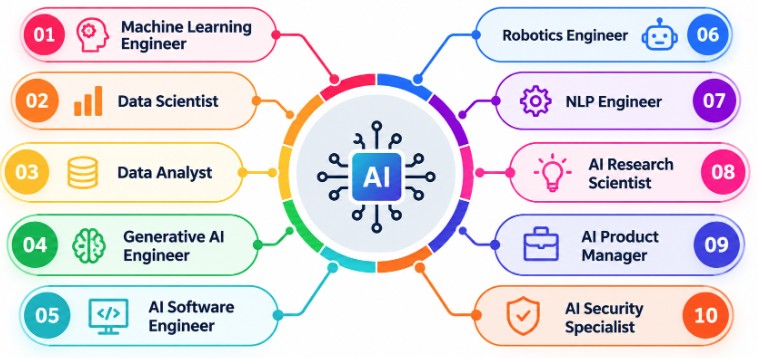
AI careers cover multiple roles based on model development, data analysis, deployment, and business requirements. AI Engineers develop intelligent applications by combining machine learning models and software components. Machine Learning Engineers focus on training, evaluating, optimizing, and deploying predictive models, while Data Scientists use statistics, programming, and analytical techniques to discover patterns and solve business problems. Freshers exploring these opportunities can follow an AI Career Roadmap for Beginners to understand the essential skills and learning steps required to enter the field. Generative AI Engineers can build applications using large language models, prompt engineering, embeddings, vector databases, retrieval-augmented generation, and AI agents. NLP Engineers specialize in language-based applications, while Computer Vision Engineers work with images and video. MLOps Engineers concentrate on model deployment, monitoring, versioning, pipelines, and production infrastructure. As professionals gain broader technical and architecture experience, they can progress toward Senior AI Engineer, AI Consultant, Technical Lead, AI Architect, or AI Engineering Manager roles.
Popular AI, Machine Learning, and Generative AI Job Roles
AI careers cover multiple roles based on model development, data analysis, deployment, and business requirements. AI Engineers develop intelligent applications by combining machine learning models and software components. Machine Learning Engineers focus on training, evaluating, optimizing, and deploying predictive models, while Data Scientists use statistics, programming, and analytical techniques to discover patterns and solve business problems. Freshers exploring these opportunities can follow an AI Career Roadmap for Beginners to understand the essential skills and learning steps required to enter the field. Generative AI Engineers can build applications using large language models, prompt engineering, embeddings, vector databases, retrieval-augmented generation, and AI agents. NLP Engineers specialize in language-based applications, while Computer Vision Engineers work with images and video. MLOps Engineers concentrate on model deployment, monitoring, versioning, pipelines, and production infrastructure. As professionals gain broader technical and architecture experience, they can progress toward Senior AI Engineer, AI Consultant, Technical Lead, AI Architect, or AI Engineering Manager roles.
Get Your Artificial Intelligence Certification by Learning from Industry-Leading Experts and Advancing Your Career with ACTE’s Artificial Intelligence Course.
Top MNCs Hiring AI Professionals in Chennai
Chennai has a strong presence of multinational technology, consulting, engineering, financial services, and enterprise organizations where AI-related career opportunities can emerge. Companies with substantial operations in Chennai include TCS, Cognizant, Infosys, Wipro, Capgemini, and HCLTech. Professionals looking to improve their technical expertise and explore industry-relevant AI skills can consider Artificial Intelligence Training to build practical knowledge of AI concepts and applications. Depending on current hiring requirements, opportunities can span machine learning, generative AI, data science, intelligent automation, cloud AI, NLP, computer vision, and MLOps. Candidates should check current openings because hiring demand changes across companies, projects, and experience levels. Strong Python, machine learning, deep learning, GenAI, cloud, data engineering, and deployment skills can prepare professionals for a broader range of AI-related positions.
Eligibility and Qualifications for AI Jobs in Chennai
- Educational Background: Candidates from Computer Science, Information Technology, Data Science, Artificial Intelligence, Mathematics, Statistics, Electronics, and related disciplines can pursue AI careers. Professionals from other backgrounds can also transition by developing strong programming and analytical skills.
- Programming and Data Fundamentals: A solid understanding of Python and data preprocessing helps candidates prepare for AI development roles. Learning Essential Programming Languages for AI can help aspiring professionals identify the languages and technical foundations needed to build machine learning applications.
- Mathematics and Statistics Knowledge: AI professionals should understand probability, statistics, linear algebra, calculus fundamentals, and optimization concepts. Mathematical knowledge helps candidates understand how machine learning algorithms operate and how models are evaluated.
- Practical AI Project Experience: Hands-on projects demonstrate the ability to apply theoretical concepts to practical problems. Candidates can develop recommendation systems, prediction models, chatbots, image classifiers, RAG applications, or other AI solutions.
- Analytical and Problem-Solving Skills: AI professionals need strong analytical thinking to understand business problems, select appropriate techniques, evaluate results, and improve solutions. Communication skills are also valuable for explaining technical findings to stakeholders.

Learn Artificial Intelligence Training Course to Build Your Skills
Weekday / Weekend BatchesSee Batch DetailsEssential Python, Machine Learning, and Deep Learning Skills
- Python Programming for AI: Candidates should develop proficiency in Python fundamentals, functions, object-oriented programming, data structures, exception handling, and libraries commonly used for data manipulation and machine learning.
- Machine Learning Algorithms: Understanding regression, classification, clustering, decision trees, ensemble methods, feature engineering, and model evaluation helps professionals build predictive solutions for different business problems.
- Data Processing and Feature Engineering: AI professionals should know how to clean datasets, handle missing values, transform variables, select useful features, and prepare information before training machine learning models.
- Deep Learning and Neural Networks: Knowledge of neural networks, backpropagation, CNNs, transformers, embeddings, and deep learning frameworks can prepare candidates for advanced AI, NLP and generative AI projects. Beginners can strengthen these skills through Easy AI Projects for Freshers that provide practical experience with AI concepts and applications.
- Model Evaluation and Optimization: Professionals should understand evaluation metrics, cross-validation, hyperparameter tuning, overfitting, underfitting, and model optimization to develop accurate and reliable machine learning solutions.

Get JOB Oriented Artificial Intelligence Training for Beginners By MNC Experts
- Instructor-led Sessions
- Real-life Case Studies
- Assignments
Generative AI, LLM, RAG, and Agentic AI Skills to Learn
- Prompt Engineering: Prompt engineering involves designing clear instructions and contextual inputs that help AI models generate useful responses. Candidates should practice structured prompting, evaluation, and output refinement.
- Retrieval-Augmented Generation: RAG combines information retrieval with generative models to produce responses grounded in relevant data. Important concepts include document processing, chunking, embeddings, vector search, retrieval, and response generation.
- Large Language Model Fundamentals: Professionals should understand transformers, tokens, embeddings, context windows, inference, prompting, and other LLM concepts to build applications around modern generative AI models. Exploring Top AI Tools Every Developer Should Know can also help candidates identify useful tools for developing and testing generative AI applications.
- Vector Databases and Embeddings: Understanding embeddings and vector databases helps developers build semantic search, knowledge assistants, recommendation systems, and RAG applications that retrieve contextually relevant information.
- Agentic AI and AI Agents: Agentic AI skills involve building systems capable of using tools, managing workflows, maintaining context, and completing multi-step tasks. Developers should understand orchestration, tool calling, memory patterns, evaluation, and safety controls.
Cloud, MLOps, and AI Deployment Technologies
- Cloud AI Platforms: Knowledge of AWS or Google Cloud can help professionals develop and manage AI workloads using scalable cloud infrastructure and managed services. Candidates can strengthen their understanding of these technologies through Artificial Intelligence Training and practical learning activities.
- Docker and Containerization: Docker allows AI applications and their dependencies to be packaged into portable containers, helping teams maintain consistent development, testing, and production environments.
- MLOps Pipelines: MLOps combines machine learning development with operational practices. Professionals should understand automated training, testing, deployment, model versioning, monitoring, and lifecycle management.
- APIs and Model Deployment: AI Engineers should know how to expose models through APIs and integrate them with applications. Understanding REST APIs, backend frameworks, authentication, scalability, and inference workflows is valuable.
- Monitoring and Model Maintenance: Production AI systems require monitoring for performance, errors, latency, data changes, and model degradation. Professionals should understand logging, observability, evaluation, retraining, and responsible model maintenance.
Want to Master Artificial Intelligence? Explore the Artificial Intelligence Master Program Offered at ACTE Today!
AI Salary and Compensation Factors in Chennai
- AI Specialization: Expertise in machine learning, deep learning, generative AI, NLP, computer vision, MLOps, or AI architecture can influence the types of opportunities and compensation available to candidates.
- Technical Skill Depth: Strong Python, machine learning, cloud, data engineering, deployment, and software engineering capabilities can expand the range of AI positions for which professionals are qualified.
- Professional Experience: AI compensation can vary considerably between entry-level, mid-level, senior, and leadership positions. Professionals who successfully handle production AI systems and complex projects can qualify for higher-responsibility roles. Exploring Highest Paying AI Jobs in India can help candidates understand specialized career paths and the factors that may influence earning potential.
- Project and Production Experience: Candidates with experience building and deploying real AI applications can demonstrate stronger practical capabilities. Production experience with model monitoring, scalability, security, and optimization can further strengthen a professional profile.
- Employer and Job Responsibilities: Compensation varies according to employer, industry, job level, team responsibilities, project complexity, and current market conditions in Chennai. Leadership, architecture, and specialized technical responsibilities can also influence overall earning potential.
Want to Learn About AI? Explore Our Artificial Intelligence Interview Questions and Answers Featuring the Most Frequently Asked Questions in Job Interviews.
Career Growth from AI Engineer to AI Architect and Leadership Roles
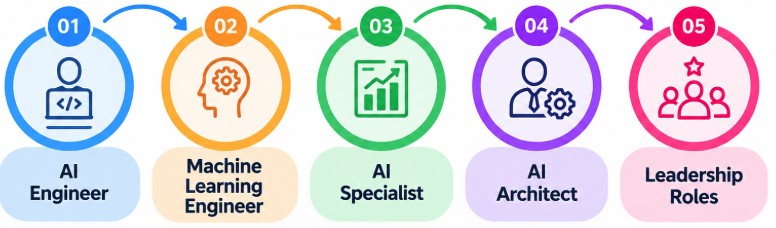
Career growth from AI Engineer to AI Architect and leadership positions requires professionals to expand beyond model development into system design, deployment, scalability, governance, and business strategy. AI Engineers may begin by developing machine learning models, generative AI applications, RAG systems, APIs, and data pipelines using Python and modern AI frameworks. With experience, they can progress toward Senior AI Engineer, Machine Learning Lead, Generative AI Specialist, or MLOps Lead roles where they manage complex solutions and guide technical teams. Understanding The Impact of AI on the Future of IT Careers can help professionals explore how evolving technologies influence career paths and workplace opportunities.
Conclusion: Future Career Scope of Artificial Intelligence in Chennai
The future career scope of Artificial Intelligence in Chennai can extend across IT services, SaaS, financial services, healthcare, automotive, manufacturing, consulting, and other technology-driven industries as organizations continue adopting intelligent automation and data-driven solutions. Professionals can explore careers in machine learning, generative AI, natural language processing, computer vision, data science, MLOps, cloud AI, and AI architecture. Emerging areas such as large language models, retrieval-augmented generation, multimodal AI, AI agents, and enterprise automation are also creating new skill requirements for technology professionals. Candidates who want to strengthen their technical expertise can explore Artificial Intelligence Training to develop relevant knowledge and practical skills. Combining strong Python and machine learning fundamentals with cloud, data engineering, deployment, and software development knowledge can help candidates prepare for a broader range of opportunities. Continuous learning will remain important because AI technologies and development practices evolve rapidly. Building practical projects, gaining production experience, and strengthening problem-solving and communication skills can help professionals develop sustainable long-term AI careers in Chennai.