LMS
Last updated on 01st Oct 2026| 13379

- Introduction to Artificial Intelligence Career Opportunities in Bangalore
- Why Bangalore Is a Major Hub for AI Jobs and Technology Careers
- Top MNCs, IT Companies, and Startups Hiring AI Professionals
- Most In-Demand AI Job Roles and Their Responsibilities
- Essential Python, Machine Learning, and Deep Learning Skills
- Generative AI, LLMs, RAG, and AI Agent Career Opportunities
- Cloud Computing, MLOps, and AI Application Development Skills
- AI Salary Trends, Experience Levels, and Career Growth in Bangalore
- AI Projects, Certifications, and Interview Preparation for Freshers
- Conclusion: Building a Successful Long-Term Career in Artificial Intelligence
Introduction to Artificial Intelligence Career Opportunities in Bangalore
Bangalore has become a significant destination for Artificial Intelligence professionals because of its technology ecosystem, multinational corporations, product-based companies, startups, and research organizations. Businesses across software development, healthcare, banking, e-commerce, manufacturing, and cybersecurity are exploring AI to automate processes, analyse large datasets, improve customer experiences, and support business decisions. Candidates looking to develop relevant skills can explore Artificial Intelligence Training to build a strong foundation in AI concepts and practical applications. This creates opportunities for candidates interested in Machine Learning Engineering, Data Science, Generative AI, Natural Language Processing, Computer Vision, and AI application development. Employers increasingly value practical skills in Python, SQL, machine learning algorithms, deep learning frameworks, cloud platforms, and model deployment. Knowledge of large language models, retrieval-augmented generation, and AI agents can also be beneficial for specialized positions. Freshers can begin by strengthening programming fundamentals and building practical projects, while experienced professionals can develop expertise in production AI systems and enterprise integration. Understanding job requirements and continuously upgrading technical skills can help candidates prepare for suitable AI career opportunities in Bangalore.
Why Bangalore Is a Major Hub for AI Jobs and Technology Careers
Bangalore is an important technology hub because it brings together global technology companies, IT services providers, research teams, engineering talent, startups, and enterprise innovation centres. These organizations work on areas such as cloud computing, intelligent automation, computer vision, natural language processing, and Generative AI. The city also supports collaboration between established businesses and emerging technology companies, creating opportunities across AI research, product engineering, consulting, and enterprise software development. Current recruitment listings demonstrate this breadth of activity, including AI and machine learning leadership positions and Generative AI engineering roles in Bangalore. Professionals can explore career paths involving model development, data engineering, AI infrastructure, application deployment, and AI-powered business solutions. Candidates who want to explore relevant career opportunities can refer to Highest Paying AI Jobs in India to learn about potential roles in this field. However, job availability depends on employer requirements, project demand, and experience level. Candidates who combine strong programming knowledge with analytical thinking, cloud skills, communication, and practical AI project experience can prepare for the evolving needs of Bangalore’s technology industry.
Get Your Artificial Intelligence Certification by Learning from Industry-Leading Experts and Advancing Your Career with ACTE’s Artificial Intelligence Course.
Top MNCs, IT Companies, and Startups Hiring AI Professionals
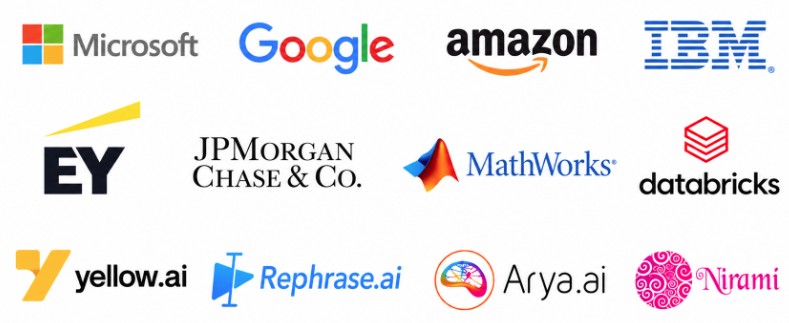
Bangalore offers AI career opportunities across multinational technology companies, IT consulting organizations, product businesses, and AI-focused startups. Global companies such as Google, Microsoft, Amazon, IBM, and NVIDIA have technology operations or AI-related activities in the city, while IT services companies such as Wipro, Accenture, Infosys, and TCS work on digital transformation and enterprise technology projects. Indian product companies, including Flipkart and Swiggy, also operate in data-intensive environments where machine learning may support recommendations and operational decision-making. AI-focused startups provide additional opportunities in conversational AI, intelligent automation, language models, and industry-specific AI applications.

Learn Artificial Intelligence Training Course to Build Your Skills
Weekday / Weekend BatchesSee Batch DetailsMost In-Demand AI Job Roles and Their Responsibilities
- Machine Learning Engineer: Machine Learning Engineers design, train, evaluate, and deploy machine learning models. They work with data pipelines, algorithms, model optimization, and monitoring to create reliable systems for prediction, classification, recommendation, and automation.
- Data Scientist: Data Scientists analyse structured and unstructured data to identify patterns, forecast outcomes, and solve business problems. Their work includes data cleaning, statistical analysis, model development, visualization, and communicating actionable findings to stakeholders.
- Artificial Intelligence Engineer: AI Engineers develop intelligent applications that automate tasks and support business decisions. Candidates can strengthen their knowledge through Artificial Intelligence Training. Their responsibilities may include integrating AI models, building application logic, testing system performance, and connecting AI capabilities with existing software.
- Generative AI Engineer: Generative AI Engineers build applications using large language models and other generative technologies. They may develop AI assistants, document-processing tools, chatbots, and knowledge retrieval systems using model APIs, prompt engineering, RAG, and application frameworks.
- Computer Vision and NLP Engineer: Computer Vision Engineers develop systems that interpret images and videos, while Natural Language Processing Engineers build applications that understand and process human language. These roles involve data preparation, model training, evaluation, and implementation for specialized business use cases.
Essential Python, Machine Learning, and Deep Learning Skills
- Python Programming Fundamentals: Python is widely used for AI development, data processing, experimentation, and automation. Candidates should understand functions, data structures, error handling, object-oriented programming, and commonly used libraries such as NumPy, Pandas, and Matplotlib.
- Machine Learning Algorithms: Understanding algorithms such as linear regression, logistic regression, decision trees, random forests, clustering, and gradient boosting helps candidates build predictive solutions. They should also know how to prepare datasets, select suitable features, and evaluate model performance. Beginners can strengthen their practical knowledge by exploring Easy AI Projects for Freshers and applying machine learning concepts to simple projects.
- Deep Learning and Neural Networks: Deep learning uses neural networks to identify complex patterns in data. Professionals can explore neural network architectures, backpropagation, and frameworks such as PyTorch or TensorFlow to develop applications involving image recognition, speech processing, and advanced language models.
- Statistics and Mathematical Foundations: Statistics, probability, linear algebra, and basic calculus help AI professionals understand model behavior and evaluate results. Knowledge of distributions, correlation, hypothesis testing, vectors, and matrices supports reliable analysis and a deeper understanding of machine learning techniques.
- Data Preparation and Model Evaluation: AI models depend on suitable data and reliable evaluation methods. Candidates should learn data cleaning, feature engineering, train-test splitting, cross-validation, and metrics such as precision, recall, F1-score, and mean absolute error. These skills help identify model limitations and reduce the risk of misleading predictions.

Get JOB Oriented Artificial Intelligence Training for Beginners By MNC Experts
- Instructor-led Sessions
- Real-life Case Studies
- Assignments
Generative AI, LLMs, RAG, and AI Agent Career Opportunities
- Large Language Models and Prompt Engineering: Large Language Models (LLMs) support applications such as text generation, conversational assistants, document summarization, and coding assistance. Professionals should understand tokens, context windows, model limitations, prompt design, structured outputs, and methods for evaluating generated responses.
- Retrieval-Augmented Generation (RAG): RAG combines information retrieval with language generation by supplying relevant information from documents or databases to an LLM. Developers should understand document chunking, embeddings, vector search, retrieval quality, and source-grounded responses when building enterprise knowledge assistants. Exploring Top 10 Real-Life Applications of AI can also help learners understand how AI technologies are applied to practical, everyday problems.
- AI Agent Development: AI agents can use language models, approved tools, APIs, and defined workflows to complete multi-step tasks. Developers need to understand tool calling, workflow state, permissions, error handling, and evaluation to ensure that agents perform reliably and do not execute unauthorized actions.
- LLM Frameworks and Vector Databases: Frameworks such as LangChain, LangGraph, and LlamaIndex can help developers build LLM applications and retrieval workflows. Knowledge of vector search tools and databases, including FAISS, Chroma, and other suitable platforms, can support semantic search and document-based applications.
- Emerging Generative AI Career Paths: Professionals can explore roles such as RAG Engineer, LLM Application Developer, AI Agent Developer, Generative AI Engineer, and AI Solutions Architect. Requirements differ by employer, but programming, API integration, evaluation, data security, and practical project experience are useful foundations.
Want to Master Artificial Intelligence? Explore the Artificial Intelligence Master Program Offered at ACTE Today!
Cloud Computing, MLOps, and AI Application Development Skills
- Cloud Platforms for AI Deployment: Cloud services from AWS, Microsoft Azure, and Google Cloud help organizations store data, access computing resources, deploy models, and scale AI applications. Candidates should learn at least one cloud platform along with identity management, storage, networking, monitoring, and cost management.
- MLOps and Model Lifecycle Management: MLOps covers the development, testing, deployment, monitoring, and maintenance of machine learning systems. Skills in experiment tracking, model versioning, automated pipelines, and performance monitoring help teams maintain reproducible workflows and identify issues after deployment. Candidates can also explore Emerging AI Trends in the IT Industry to understand how evolving technologies influence AI development and deployment practices.
- AI Application and API Development: AI applications often connect models with web interfaces, databases, enterprise software, and external services. Knowledge of Python backend development, REST APIs, JSON, authentication, and testing helps professionals integrate AI features into practical business applications.
- Containerization and Deployment: Docker and related deployment technologies help package applications with their dependencies and support consistent execution across environments. Familiarity with containers, CI/CD pipelines, and basic orchestration concepts can benefit professionals working on scalable AI services.
- Security, Monitoring, and Responsible AI: Production AI systems require safeguards for confidential information, access permissions, output quality, and system reliability. Professionals should understand data protection, prompt-injection risks, logging, evaluation, and human review for sensitive decisions. These practices are important when implementing AI in enterprise environments.
AI Salary Trends, Experience Levels, and Career Growth in Bangalore
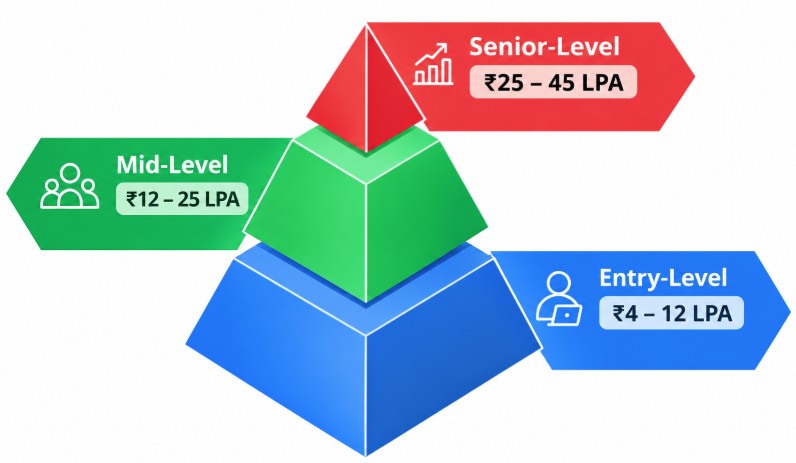
- Entry-Level AI and Machine Learning Opportunities: Freshers may begin as Junior AI Engineers, Data Analysts, Associate Machine Learning Engineers, or AI Application Developers. Employers commonly evaluate Python, SQL, basic statistics, machine learning fundamentals, problem-solving ability, and practical projects when assessing candidates for entry-level positions. Candidates can strengthen their foundational knowledge through Artificial Intelligence Training.
- Mid-Level AI Engineering Careers: Professionals with industry experience can progress into AI Engineer, Machine Learning Engineer, Data Scientist, or Generative AI Engineer positions. At this stage, employers may value independent project delivery, model evaluation, API integration, cloud deployment, and experience solving real business problems.
- Senior AI Specialist and Technical Leadership Roles: Experienced professionals can move toward Senior AI Engineer, Lead Machine Learning Engineer, AI Solutions Architect, or AI Engineering Manager roles. These positions may involve system architecture, performance optimization, technical mentoring, production reliability, security, and coordination with business stakeholders.
- Factors Influencing AI Salaries: Compensation in Bangalore varies according to experience, employer, technical specialization, industry, and the complexity of responsibilities. Expertise in LLMs, RAG, AI agents, cloud infrastructure, MLOps, and production deployment may be relevant for specialized roles, although no particular skill guarantees a higher salary.
- Long-Term Career Growth in Artificial Intelligence: AI professionals can build long-term careers by combining strong engineering fundamentals with applied machine learning, Generative AI, cloud computing, and responsible AI practices. Practical projects, continuous learning, collaboration, and the ability to demonstrate measurable business value can support progression into specialized and leadership positions.
Want to Learn About AI? Explore Our Artificial Intelligence Interview Questions and Answers Featuring the Most Frequently Asked Questions in Job Interviews.
AI Projects, Certifications, and Interview Preparation for Freshers
Practical AI projects, relevant certifications, and systematic interview preparation can help freshers develop the skills required for entry-level Artificial Intelligence jobs in Bangalore. Candidates should focus on building projects that demonstrate their understanding of Python, data processing, and AI application development. Examples include a customer churn prediction model, an image classification application, a sales forecasting system, a sentiment analysis tool, or a Generative AI chatbot using a large language model. Freshers can publish their projects on GitHub with clear documentation explaining the problem statement, dataset, tools, methodology, results, and limitations. Certifications in Python, machine learning, cloud computing, and Generative AI can support structured learning, but practical experience is equally important. Candidates can review Best AI Certifications to Get Hired Faster to explore relevant certification options that may complement their practical skills. During interview preparation, candidates should practise Python programming, SQL queries, statistics, machine learning algorithms, model evaluation, and basic deep learning concepts. They should also prepare to explain their project decisions, challenges, and outcomes clearly. Understanding AI ethics, data privacy, model accuracy, and responsible AI practices can further strengthen their technical readiness. A well-organized portfolio combined with consistent preparation can help freshers demonstrate their capabilities to potential employers.
Conclusion: Building a Successful Long-Term Career in Artificial Intelligence
Building a successful long-term career in Artificial Intelligence requires strong technical fundamentals, practical experience, adaptability, and continuous learning. Bangalore offers opportunities across multinational corporations, technology companies, IT services providers, startups, and research-oriented organizations, although job availability and eligibility requirements vary between employers. Developing practical projects can help candidates demonstrate their ability to solve real-world problems, evaluate models, and build useful AI applications. Aspiring professionals can strengthen their knowledge through Artificial Intelligence Training and begin with Python programming, SQL, statistics, and machine learning before progressing toward specialized areas such as deep learning, Generative AI, large language models, RAG, AI agents, and MLOps. Professionals should also develop communication, analytical thinking, teamwork, and problem-solving skills because successful AI projects often require collaboration with business and engineering teams. Staying familiar with emerging technologies and understanding data security, model evaluation, and responsible AI implementation can help professionals adapt to changing industry requirements. By combining a strong technical foundation with hands-on projects and a commitment to ongoing development, candidates can prepare for entry-level opportunities and progress toward specialized engineering, architecture, and leadership roles in Artificial Intelligence.