LMS
LMS
Last updated on 25th Jul 2026| 8165

- Introduction to Resume Mistakes and Their Impact
- Why Even Small Mistakes Can Cost Big Opportunities
- Formatting and Structural Mistakes to Avoid
- Content-Related Mistakes That Weaken Your Resume
- Common Mistakes in Highlighting Skills and Experience
- Comparison Table: Common Mistakes vs Better Alternatives
- Mistakes Related to Customization and Relevance
- Language, Grammar, and Presentation Errors
- How to Identify and Fix These Mistakes
- Conclusion: Turning Mistakes into Opportunities
Introduction to Resume Mistakes and Their Impact
A resume is often the only chance a candidate gets to make a first impression on a recruiter, and even a single overlooked mistake can be the difference between landing an interview and being silently rejected. Every year, thousands of talented students and fresh graduates lose valuable opportunities not because they lack skills, but because their resumes fail to communicate those skills effectively. Recruiters typically spend only a few seconds scanning a resume before deciding whether to move forward, which means there is very little room for confusion, clutter, or careless errors. Mistakes on a resume rarely announce themselves loudly; instead, they quietly work against the candidate, reducing clarity, weakening credibility, and creating doubts in the recruiter’s mind about attention to detail and professionalism. Many of these mistakes are unintentional and stem from a lack of awareness rather than a lack of effort, which is why understanding them is the first step toward correcting them. From formatting inconsistencies and vague descriptions to generic content that fails to stand out, resume mistakes can take many forms, and each one chips away at the overall impact of the document. Candidates should also focus on creating an ATS-Friendly Resume Format Tips to improve visibility during automated screening processes and increase their chances of reaching recruiters. This article explores the most common and costly resume mistakes that candidates make, explains why they matter so much in a competitive hiring environment, and provides practical guidance on how to identify and fix them before they cost another interview opportunity.
Why Even Small Mistakes Can Cost Big Opportunities
It is easy to underestimate how much a small error can influence a recruiter’s decision, but in a hiring process where hundreds of applications compete for a handful of positions, even minor issues can tip the balance against a candidate. Recruiters use resumes as a filtering mechanism, and any element that raises doubt, whether it is a spelling mistake, an inconsistent date, or an unclear job description, gives them a reason to move on to the next application rather than dig deeper into a candidate’s actual potential. Small mistakes are also interpreted as signals of larger habits; a recruiter who notices a typo may assume the candidate is careless in their work as well, even if that assumption is unfair. Because resumes are reviewed quickly and often compared side by side with dozens of others, anything that slows down comprehension or creates friction reduces the chances of the resume being read in full. Additionally, in industries where precision and attention to detail matter, such as engineering, data analysis, or finance, a poorly proofread resume can directly contradict the qualities the candidate claims to possess. Candidates pursuing technical career opportunities should also highlight relevant skills and practical knowledge, particularly when applying for emerging technology roles after completing Artificial Intelligence Training. Understanding that recruiters are not just evaluating qualifications but also forming an impression of professionalism helps candidates recognize why every section, sentence, and word choice on a resume carries weight in determining whether they receive a callback or are passed over entirely.
Get Your Gen AI Certification by Learning from Industry-Leading Experts and Advancing Your Career with ACTE’s Gen AI Course.
Formatting and Structural Mistakes to Avoid
- Inconsistent Fonts and Sizes: Using multiple fonts or varying text sizes across sections makes a resume look unprofessional and disorganized. Recruiters associate visual consistency with attention to detail, so mismatched formatting can create doubt about a candidate’s ability to present information clearly, even when the underlying content is strong.
- Overcrowded Layouts: Cramming too much information onto a single page without adequate spacing makes a resume difficult to scan quickly. Dense blocks of text discourage recruiters from reading closely, causing them to miss important achievements that could otherwise strengthen the candidate’s profile.
- Poor Use of Headings and Sections: Resumes without clear section headings force recruiters to search for information instead of finding it instantly. Proper headings such as Education, Skills, and Projects allow quick navigation and help recruiters locate relevant details within seconds.
- Incorrect Length: Resumes that are too short may appear incomplete, while resumes that are too long may overwhelm the reader with unnecessary detail. For freshers and interns, keeping the resume to a single well-organized page is generally the most effective approach. Following the right Resume Formats for Freshers helps candidates maintain proper structure, highlight essential details, and create a professional first impression.
- Unbalanced White Space: Too little white space makes a resume feel cluttered, while too much can make it look empty or unfinished. Striking the right balance improves readability and gives the document a polished, professional appearance.
- Non-Standard File Formats: Submitting a resume in an unusual file format can cause compatibility issues when opened by recruiters or automated systems. Saving and sending the resume as a standard PDF preserves formatting and ensures it displays correctly on any device.
Content-Related Mistakes That Weaken Your Resume
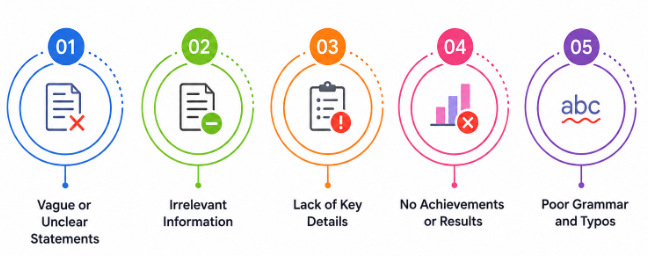
Beyond formatting, many resumes suffer from weak or misplaced content that fails to demonstrate a candidate’s true potential. One common mistake is listing responsibilities instead of achievements, which leaves recruiters unsure of what the candidate actually accomplished during a project or internship. Simply stating that a candidate “worked on a data analysis project” tells the reader very little compared to explaining what problem was solved, what tools were used, and what outcome was achieved. Candidates should focus on creating effective Project Descriptions In Resume to highlight their contributions, skills, and measurable results more effectively. Another frequent issue is including outdated or irrelevant information, such as unrelated hobbies, excessive personal details, or coursework that has no connection to the role being applied for, which dilutes the overall focus of the resume.

Common Mistakes in Highlighting Skills and Experience
- Listing Skills Without Context: Simply writing a list of tools and technologies without explaining how they were used fails to demonstrate real proficiency. Recruiters prefer to see skills connected to specific projects or outcomes rather than standalone keywords with no supporting evidence.
- Overstating Proficiency Levels: Claiming expert-level knowledge in a skill that was only briefly explored can backfire during technical interviews. Being honest about proficiency levels builds trust and prevents awkward situations when questions go beyond surface-level understanding.
- Ignoring Soft Skills Entirely: Focusing only on technical abilities while ignoring communication, teamwork, and adaptability gives an incomplete picture of the candidate. A balanced resume should demonstrate both technical capabilities and workplace qualities, especially for candidates building skills through Artificial Intelligence Training and preparing for technology-focused career opportunities.
- Failing to Quantify Experience: Describing experience without numbers or measurable outcomes makes achievements harder to evaluate. Adding details such as percentages, time saved, or accuracy improved gives recruiters a clearer sense of real impact.
- Copy-Pasting Generic Descriptions: Using the same generic skill descriptions found in templates online makes a resume blend in rather than stand out. Personalizing descriptions based on actual experience makes the resume more authentic and memorable.

Get JOB Oriented Gen AI Training for Beginners By MNC Experts
- Instructor-led Sessions
- Real-life Case Studies
- Assignments
Comparison Table: Common Mistakes vs Better Alternatives
| Common Mistake | Better Alternative |
|---|---|
| Listing duties without outcomes | Describing measurable achievements and results |
| Using a generic, one-size-fits-all resume | Customizing content for each specific role |
| Vague statements like “hardworking” | Specific examples that demonstrate the trait |
| Inconsistent formatting and fonts | Clean, consistent, and professional formatting |
| Overloading with irrelevant details | Including only role-relevant information |
| Skipping proofreading before submission | Careful proofreading and error checking |
| Using outdated contact information | Verifying all contact details are current |
| Ignoring keyword alignment with job description | Matching relevant keywords naturally within content |
Mistakes Related to Customization and Relevance
One of the most overlooked yet damaging mistakes candidates make is sending the exact same resume to every job application without adjusting it for the specific role or company. While it may seem efficient to reuse one document repeatedly, this approach often results in a resume that fails to highlight the most relevant skills and experiences for a particular position. Recruiters can easily identify generic resumes because they lack specific references to the job description, industry terminology, or role-specific requirements. For example, a candidate applying for a data analytics internship should emphasize analytical tools, statistical concepts, and relevant coursework, while a candidate applying for an embedded systems role should highlight programming languages, hardware experience, and project work related to electronics. Failing to make these adjustments signals to recruiters that the candidate has not taken the time to understand what the role actually requires, which can be interpreted as a lack of genuine interest. Candidates preparing for technology-focused roles can also strengthen their technical knowledge through Artificial Intelligence Training and highlight relevant skills and projects when tailoring their resumes. Customization does not mean rewriting the entire resume for every application; rather, it involves strategically reordering sections, adjusting the summary, and emphasizing the most relevant projects and skills based on the specific opportunity. Candidates who invest a small amount of additional time in tailoring their resumes consistently see better response rates because their applications feel intentional, relevant, and directly aligned with what the recruiter is searching for in an ideal candidate.
Want to Master Gen AI? Explore the Gen AI Master Program Offered at ACTE Today!
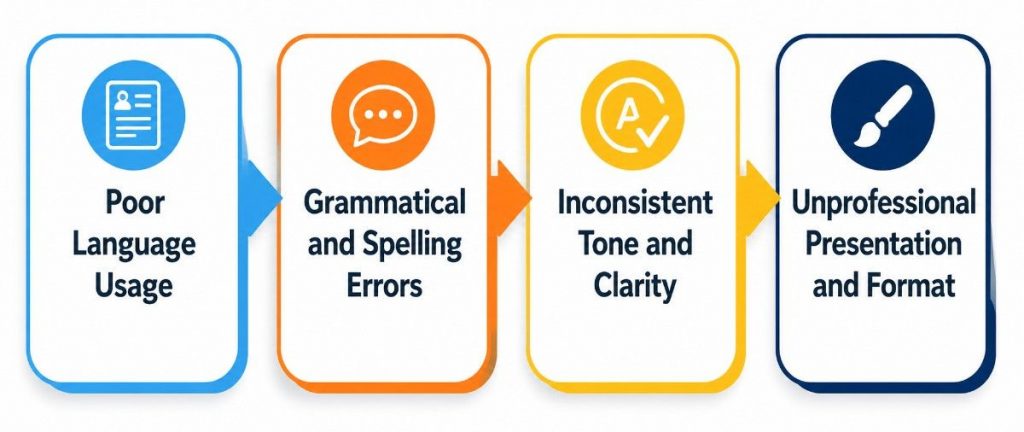
Language, Grammar, and Presentation Errors
- Spelling and Typing Errors: Even a single typo can create a negative impression, especially in roles where precision matters. Careful proofreading, ideally by another person, helps catch mistakes that are easy to overlook after repeated self-review.
- Inconsistent Verb Tenses: Mixing past and present tense within the same section creates confusion and looks unpolished. Current roles should generally use present tense, while completed projects or past experiences should consistently use past tense.
- Overly Complex Sentences: Long, complicated sentences make it harder for recruiters to quickly understand achievements. Short, direct, and action-oriented sentences communicate accomplishments far more effectively within limited reading time.
- Passive Voice Overuse: Sentences written in passive voice often sound weaker and less confident than active voice alternatives. Rewriting statements to start with strong action verbs makes achievements sound more direct and impactful. Following effective Resume Writing Tips can help candidates improve their resume language, structure, and overall professional presentation.
- Unprofessional Email Addresses: Using casual or outdated email addresses on a professional document can undermine credibility instantly. A simple, name-based professional email address is always the safer and more polished choice.
Want to Learn About AI? Explore Our Artificial Intalligence Interview Questions and Answers Featuring the Most Frequently Asked Questions in Job Interviews.
How to Identify and Fix These Mistakes
Identifying mistakes in one’s own resume can be surprisingly difficult because candidates often become too familiar with their own writing to notice errors or gaps objectively. One effective approach is to step away from the resume for a day or two before reviewing it again with fresh eyes, as this distance often reveals awkward phrasing or missing details that were previously overlooked. Reading the resume aloud can also help identify sentences that sound unnatural or overly complicated, since spoken language tends to expose issues that silent reading may miss. Seeking feedback from mentors, professors, or professionals already working in the target industry provides valuable outside perspective, as they can point out gaps between what recruiters expect and what the resume currently communicates. Candidates can also follow a structured approach through resources like Resume for Freshers to understand essential improvements and create a stronger application document. Comparing the resume against actual job descriptions helps candidates identify missing keywords, skills, or experiences that should be emphasized more clearly. Using online resume checking tools can also help catch formatting inconsistencies, grammar issues, and readability problems that might otherwise go unnoticed. Finally, treating resume writing as an ongoing process rather than a one-time task allows candidates to continuously refine their document as they gain new skills, complete new projects, and better understand what recruiters in their field are looking for, ensuring the resume keeps improving alongside their growing capabilities.
Conclusion: Turning Mistakes into Opportunities
Resume mistakes, while common, are almost always fixable once a candidate becomes aware of them, and correcting these issues can significantly improve the number of interview opportunities they receive. Rather than viewing mistakes as failures, candidates should treat them as valuable learning points that guide continuous improvement in how they present their skills, experiences, and achievements. A resume free of formatting inconsistencies, vague content, and language errors immediately signals professionalism and attention to detail, qualities that recruiters value highly regardless of the specific role being applied for. Equally important is the willingness to customize and update the resume regularly, ensuring it always reflects the candidate’s most relevant and current capabilities. By systematically reviewing formatting, content, skills presentation, customization, and language, candidates can transform a mediocre resume into a compelling document that clearly communicates their value. Candidates preparing for technology-focused careers can also strengthen their technical capabilities through Artificial Intelligence Training and showcase relevant skills and projects on their resumes. In a competitive job market where recruiters often make quick decisions, avoiding these common mistakes can be the deciding factor between being overlooked and being invited for an interview. Ultimately, the effort invested in identifying and fixing resume mistakes pays off far beyond a single application, building a stronger personal brand and a more confident approach to every future opportunity a candidate pursues.