LMS
LMS
Last updated on 24th Jul 2026| 13288

- Introduction to AI Careers for Freshers
- Why Artificial Intelligence is a Promising Career Choice
- AI Engineer: Roles, Responsibilities, and Career Growth
- Machine Learning Engineer: Skills and Job Opportunities
- Data Scientist: Responsibilities and Career Path
- Generative AI Engineer: Skills, Tools, and Future Scope
- Natural Language Processing (NLP) Engineer: Roles and Applications
- Computer Vision Engineer: Career Opportunities and Required Skills
- Essential Skills, Certifications, and Salary Expectations for AI Jobs
- Conclusion: Choosing the Right AI Career After Graduation
Introduction to AI Careers for Freshers
Artificial Intelligence (AI) is one of the fastest-growing and most innovative technologies in the modern world, creating exciting career opportunities for fresh graduates. It enables computers and machines to perform tasks that normally require human intelligence, such as learning, reasoning, problem-solving, and decision-making. AI is being widely adopted across industries including healthcare, banking, finance, retail, education, manufacturing, transportation, and cybersecurity. Companies use AI to automate repetitive tasks, improve customer experiences, analyze large volumes of data, and make accurate business decisions. This growing adoption has significantly increased the demand for skilled AI professionals in both startups and multinational companies. Fresh graduates can begin their careers in various AI-related roles depending on their interests and technical skills. Learning programming languages such as Python, along with machine learning, deep learning, and data analysis, provides a strong foundation for entering this field. Enrolling in Artificial Intelligence Training can further strengthen your practical knowledge of AI concepts, machine learning techniques, and industry tools. Knowledge of AI frameworks like TensorFlow, PyTorch, and Hugging Face further enhances career opportunities. Practical experience through projects, internships, hackathons, and certifications helps candidates stand out during recruitment. Building a strong portfolio on platforms like GitHub demonstrates technical expertise and problem-solving abilities. AI careers also encourage continuous learning because new technologies and research are introduced regularly. Professionals in this field get opportunities to work on innovative solutions that solve real-world problems. With excellent salary packages, global job opportunities, and long-term career growth, Artificial Intelligence has become one of the most attractive career choices for fresh graduates after graduation.
Why Artificial Intelligence is a Promising Career Choice
Artificial Intelligence is considered one of the most promising career choices because of its rapid growth and increasing adoption across almost every industry. Organizations are investing heavily in AI to automate business operations, improve productivity, and enhance customer satisfaction. This has created a strong demand for AI professionals with skills in machine learning, deep learning, natural language processing, computer vision, and Generative AI. Fresh graduates entering this field have access to diverse job roles, competitive salary packages, and excellent career advancement opportunities. AI professionals work on cutting-edge technologies such as intelligent chatbots, recommendation systems, autonomous vehicles, virtual assistants, fraud detection systems, and medical diagnosis applications. The field encourages innovation, creativity, and continuous learning as new AI tools and frameworks are introduced frequently. Professionals also gain experience in cloud computing, data engineering, software development, and AI deployment, making their skills valuable across multiple industries. Building real-world projects, including Easy AI Projects for Freshers to Build Practical Experience, participating in internships, and maintaining a strong portfolio further enhance practical expertise and improve career prospects. AI careers offer opportunities to collaborate with global teams and contribute to impactful projects that improve people’s lives. With the rise of Large Language Models, AI agents, and Generative AI applications, the scope of AI careers continues to expand rapidly. Graduates who develop strong technical skills and practical experience can build successful long-term careers in this field. AI also provides flexibility through remote work opportunities and international employment options. As businesses continue their digital transformation journey, Artificial Intelligence will remain one of the most stable and future-ready career paths for fresh graduates.
Ready to Get Certified in Artificial Intelligence ? Explore the Program Now Artificial Intelligence Online Training Offered By ACTE Right Now!
AI Engineer: Roles, Responsibilities, and Career Growth
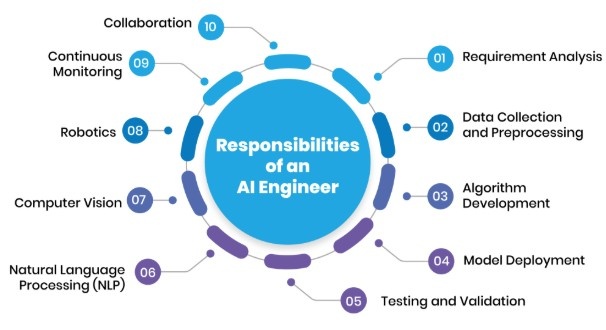
An AI Engineer is a technology professional responsible for designing, developing, deploying, and maintaining intelligent systems that can learn from data and perform complex tasks. Their primary responsibility is to build machine learning and deep learning models that solve real-world business problems efficiently. AI Engineers collect, clean, and preprocess large datasets before training AI models to improve prediction accuracy and performance. They work with programming languages such as Python and use frameworks like TensorFlow, PyTorch, and Scikit-learn to develop intelligent applications. Building these skills through Artificial Intelligence Training can help aspiring professionals gain practical experience with machine learning, deep learning, and the latest AI tools and technologies.

Develop Your Skills with Artificial Intelligence Training
Weekday / Weekend BatchesSee Batch DetailsMachine Learning Engineer: Skills and Job Opportunities
- Core Programming Skills: A Machine Learning Engineer should have strong knowledge of Python, SQL, and data structures. These programming skills are essential for developing machine learning models, processing data, and building scalable AI applications used in real-world projects.
- Machine Learning and Deep Learning: Understanding supervised learning, unsupervised learning, neural networks, and deep learning frameworks is essential. These concepts help engineers build intelligent systems capable of making accurate predictions, classifications, and recommendations while solving complex business and real-world challenges.
- Data Processing and Model Development: Machine Learning Engineers collect, clean, preprocess, and analyze large datasets before training AI models. They continuously optimize model performance, evaluate accuracy, and improve predictions using appropriate algorithms and techniques.
- Career Opportunities: Freshers can start as Junior Machine Learning Engineers, AI Developers, or Data Analysts. Those interested in understanding long-term growth opportunities can explore Exploring Career Paths in Artificial Intelligence for Freshers. With experience, they can progress to Senior ML Engineer, AI Engineer, Data Scientist, AI Architect, or Machine Learning Consultant roles.
Data Scientist: Responsibilities and Career Path
A Data Scientist is a professional who collects, analyzes, and interprets large volumes of structured and unstructured data to help organizations make informed business decisions. They use programming languages such as Python and SQL along with statistical techniques, machine learning algorithms, and data visualization tools to identify meaningful patterns and trends. Their responsibilities include data collection, cleaning, feature engineering, model building, predictive analysis, and presenting insights through dashboards and reports. Those comparing career options can explore AI vs Data Science: Which Career Should You Choose? to better understand the differences between these fast-growing fields. Data Scientists work across industries such as healthcare, banking, finance, e-commerce, manufacturing, education, and telecommunications to solve business problems using data-driven approaches. Fresh graduates can strengthen their practical skills by working on real-world projects, participating in internships, building a GitHub portfolio, and applying machine learning techniques to solve business challenges. As they gain experience and technical expertise, they can advance to roles such as Senior Data Scientist, Lead Data Scientist, AI Engineer, Machine Learning Engineer, or Data Science Manager. The profession offers excellent salary packages, continuous learning opportunities, global career prospects, and long-term growth due to the increasing importance of data-driven decision-making in modern organizations.
To ExploreArtificial Intelligence in Depth, Check Out Our Comprehensive Artificial Intelligence Online Training To Gain Insights From Our Experts!
Generative AI Engineer: Skills, Tools, and Future Scope
- Essential Technical Skills: A Generative AI Engineer should have strong knowledge of Python, machine learning, deep learning, natural language processing, and transformer architectures. These skills are fundamental for developing intelligent AI applications using Large Language Models.
- AI Tools and Frameworks: Engineers should be familiar with TensorFlow, PyTorch, Hugging Face, LangChain, OpenAI APIs, vector databases, and cloud platforms. These technologies are widely used to build, deploy, and manage Generative AI applications efficiently while enabling the development of scalable and production-ready AI solutions.
- Roles and Responsibilities: Generative AI Engineers design, develop, fine-tune, and deploy AI models capable of generating text, images, code, and other digital content. Those interested in entering this field can learn more through How to Become a Generative AI Engineer After Graduation. They also optimize model performance and integrate AI solutions into real-world software applications.
- Future Scope: The demand for Generative AI Engineers is growing rapidly across industries such as healthcare, finance, education, e-commerce, entertainment, and software development. This career offers excellent salary packages, global job opportunities, and significant long-term growth potential.
Natural Language Processing (NLP) Engineer: Roles and Applications
A Natural Language Processing (NLP) Engineer is an AI professional who develops intelligent systems capable of understanding, interpreting, processing, and generating human language. They combine Artificial Intelligence, Machine Learning, Deep Learning, and computational linguistics to create applications that enable seamless communication between humans and computers. NLP Engineers work with large text datasets to build models for language translation, text summarization, sentiment analysis, speech recognition, chatbots, virtual assistants, question-answering systems, and content generation platforms. They use programming languages such as Python and frameworks including TensorFlow, PyTorch, Hugging Face Transformers, SpaCy, and NLTK to design and optimize language models. Aspiring professionals can strengthen these in-demand skills through Artificial Intelligence Training, which provides practical exposure to machine learning, NLP concepts, and modern AI technologies. Their responsibilities include collecting and preprocessing text data, training machine learning models, fine-tuning Large Language Models (LLMs), evaluating model accuracy, and integrating NLP solutions into software applications. NLP Engineers collaborate with data scientists, AI engineers, software developers, and business teams to build scalable and efficient AI-powered products. Industries such as healthcare, banking, finance, e-commerce, education, legal services, customer support, and social media rely heavily on NLP applications to improve customer experiences and automate language-based tasks. Fresh graduates with strong programming, machine learning, and natural language processing skills can begin their careers as Junior NLP Engineers or AI Developers and later advance to Senior NLP Engineer, AI Research Scientist, Generative AI Engineer, or AI Solutions Architect. As the adoption of conversational AI, intelligent chatbots, and Large Language Models continues to grow, NLP Engineering has become one of the most promising and future-ready career options for AI professionals.
Looking to Master Machine Learning? Discover the Artificial Intelligence Expert Masters Program Training Course Available at ACTE Now!
Computer Vision Engineer: Career Opportunities and Required Skills
- Understanding Computer Vision Fundamentals: A Computer Vision Engineer should understand image processing, feature extraction, object detection, image classification, and pattern recognition. These concepts enable AI systems to analyze and interpret visual information accurately for real-world applications.
- Programming and AI Frameworks: Strong knowledge of Python, OpenCV, TensorFlow, PyTorch, and deep learning frameworks is essential for developing computer vision applications. Engineers also use CNN architectures to build accurate image recognition and object detection models, enabling intelligent systems to perform complex visual analysis across various industries. Learning Top AI Tools Every Developer Should Know can further strengthen their technical expertise.
- Roles and Responsibilities: Computer Vision Engineers design, train, and deploy AI models that process images and videos for applications such as facial recognition, medical imaging, autonomous vehicles, industrial automation, and surveillance systems. They continuously optimize models for higher accuracy and performance.
- Career Opportunities: Fresh graduates can begin as Junior Computer Vision Engineers or AI Developers and progress to Senior AI Engineer, Computer Vision Specialist, AI Research Scientist, or Robotics Engineer. The demand for computer vision professionals continues to grow across multiple industries.
Essential Skills, Certifications, and Salary Expectations for AI Jobs
- Technical Skills Required: Freshers should develop strong knowledge of Python, SQL, Machine Learning, Deep Learning, Data Structures, Statistics, and Cloud Computing. These skills form the foundation for building intelligent AI applications and solving real-world business problems.
- AI Tools and Frameworks: Learning TensorFlow, PyTorch, Scikit-learn, Hugging Face, LangChain, Git, Docker, and cloud platforms like AWS or Azure improves employability. Practical experience with these technologies helps candidates meet industry requirements.
- Certifications and Practical Experience: Completing Best AI Certifications to Get Hired Faster, participating in internships, contributing to open-source projects, and building real-world applications significantly strengthen a candidate’s resume. Developing these skills early helps build technical confidence, improve problem-solving abilities, and increase employability. A strong GitHub portfolio also increases the chances of securing AI job opportunities.
- Salary Expectations and Career Growth: Fresh AI professionals generally receive competitive salary packages depending on their skills, projects, certifications, and interview performance. With experience, they can advance to senior engineering, research, architecture, and leadership roles with significantly higher compensation.
Preparing for Artificial Intelligence Job Interviews? Have a Look at Our Blog on Artificial Intelligence Interview Questions and Answers To Ace Your Interview!
Conclusion: Choosing the Right AI Career After Graduation
Artificial Intelligence has transformed from an emerging technology into one of the most influential fields shaping the future of industries across the world. For fresh graduates, AI offers diverse career opportunities in roles such as AI Engineer, Machine Learning Engineer, Data Scientist, Generative AI Engineer, NLP Engineer, and Computer Vision Engineer, each providing unique responsibilities and excellent growth potential. Success in the AI industry requires a strong foundation in programming, mathematics, machine learning, deep learning, and cloud technologies, along with continuous learning to keep pace with rapidly evolving innovations. Building hands-on projects, earning recognized certifications, participating in internships, and maintaining a professional portfolio significantly improve employability and prepare graduates for real-world challenges. Enrolling in Artificial Intelligence Training is an excellent way to gain practical experience with machine learning, deep learning, industry projects, and the latest AI technologies. As organizations continue investing in AI-powered solutions to automate processes, improve decision-making, and deliver innovative products, the demand for skilled AI professionals is expected to increase further in the coming years. Graduates who consistently enhance their technical expertise, stay updated with the latest AI frameworks and research, and develop practical problem-solving skills will have access to excellent salary packages, global career opportunities, remote work options, and long-term job security. Choosing the right AI career based on personal interests and strengths is the first step toward building a successful and rewarding future in one of the world’s fastest-growing technology domains. With dedication, continuous practice, and a passion for innovation, fresh graduates can establish themselves as highly skilled AI professionals and contribute to developing intelligent technologies that transform businesses, industries, and society.