LMS
Last updated on 05th Sep 2026| 8341

- Exploring Cloud Computing Careers at Amazon AWS
- AWS Cloud Engineer and Cloud Support Job Roles
- AWS Solutions Architect Career Opportunities
- Cloud DevOps, SRE, and Automation Engineering Roles
- AWS Security, Networking, and Infrastructure Careers
- Cloud Data Engineering, AI, and Machine Learning Opportunities
- Essential AWS Technical Skills and Cloud Services to Learn
- AWS Cloud Salary Expectations and Factors Affecting Pay
- Certifications, Projects, and Experience for AWS Cloud Jobs
- Career Progression and Long-Term Opportunities in AWS Cloud
Exploring Cloud Computing Careers at Amazon AWS
Cloud computing careers at Amazon Web Services (AWS) offer opportunities for professionals interested in cloud infrastructure, application development, networking, security, databases, DevOps, data engineering, artificial intelligence, and machine learning. AWS professionals help organizations design, deploy, manage, secure, and optimize applications and infrastructure in cloud environments. Candidates looking to build practical expertise can consider AWS Training to strengthen their understanding of cloud technologies and services. Depending on the role, responsibilities may include configuring cloud resources, monitoring systems, troubleshooting technical issues, automating deployments, managing databases, implementing security controls, and improving application performance. Candidates should develop knowledge of core AWS services, Linux, networking, databases, scripting, security, and cloud architecture fundamentals. Practical projects and relevant AWS certifications can further demonstrate cloud knowledge. As professionals gain experience, they can specialize in areas such as cloud architecture, DevOps, security, data, AI, or infrastructure and pursue increasingly advanced technical and leadership responsibilities.
AWS Cloud Engineer and Cloud Support Job Roles
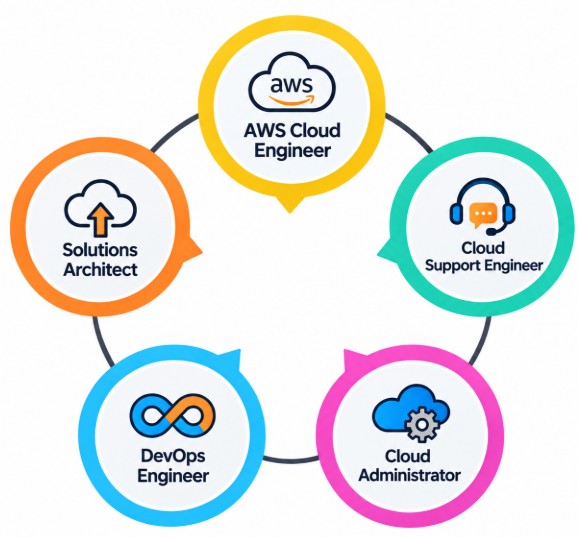
AWS Cloud Engineers and Cloud Support professionals focus on building, operating, maintaining, and troubleshooting cloud-based environments. Cloud Engineers may work with compute, storage, networking, databases, monitoring, identity management, and automation services to create reliable cloud infrastructure. Cloud Support professionals help investigate technical issues, analyze system behavior, troubleshoot configurations, and guide customers or internal teams toward appropriate solutions. Candidates should develop strong knowledge of operating systems, Linux, networking concepts, DNS, HTTP, databases, security, and scripting languages such as Python or Bash.
Get Your AWS Certification by Learning from Industry-Leading Experts and Advancing Your Career with ACTE’s AWS Course.
AWS Solutions Architect Career Opportunities
AWS Solutions Architects focus on designing cloud architectures that address technical requirements while considering security, scalability, reliability, performance, and cost. They may work with customers, developers, engineers, and business stakeholders to understand application requirements and recommend suitable cloud services and architectural approaches. Solutions Architects need broad knowledge of compute, storage, databases, networking, security, serverless technologies, containers, monitoring, migration, and disaster recovery. They should also understand architectural concepts such as high availability, fault tolerance, scalability, and cost optimization. Professionals seeking structured learning can also explore AWS Training to develop practical knowledge of AWS services and cloud architecture concepts. Technical knowledge alone is not sufficient because architects frequently need to communicate complex cloud concepts to both technical and non-technical audiences. Professionals can begin by developing experience in cloud engineering, infrastructure, development, networking, or support before progressing toward architecture-focused responsibilities. Building end-to-end AWS projects and studying cloud architecture best practices can strengthen preparation for Solutions Architect career opportunities.
Cloud DevOps, SRE, and Automation Engineering Roles
- AWS DevOps Engineering DevOps Engineers help automate software development, deployment, and infrastructure operations. They work with CI/CD pipelines, Infrastructure as Code, monitoring, containers, and automation to improve deployment speed and system reliability. Professionals can also explore the master AWS DevOps Certification to understand certification pathways and relevant cloud DevOps skills.
- Site Reliability Engineering SRE professionals focus on application availability, performance, scalability, and reliability. They monitor systems, respond to incidents, automate repetitive operational tasks, and help engineering teams build resilient cloud applications.
- CI/CD Pipeline Development Professionals create automated workflows for building, testing, and deploying applications. Understanding continuous integration and continuous delivery helps teams release software more frequently while maintaining quality and consistency.
- Infrastructure as Code and Automation Cloud engineers use Infrastructure as Code to provision and manage cloud resources consistently. Learning AWS CloudFormation, Terraform concepts, Python, Bash, and automation practices can strengthen preparation for infrastructure-focused roles.
- Containers and Kubernetes Knowledge of Docker, Kubernetes, Amazon ECS, and Amazon EKS can help professionals deploy and manage containerized applications. These technologies are valuable for building scalable and portable cloud environments.

AWS Security, Networking, and Infrastructure Careers
- AWS Cloud Security Cloud Security professionals protect applications, infrastructure, identities, and data in AWS environments. They work with access controls, encryption, monitoring, security policies, threat detection, and cloud security best practices. Understanding the Top AWS Services can also help candidates identify the cloud technologies commonly used across security and infrastructure environments.
- Identity and Access Management AWS IAM helps organizations control access to cloud resources. Professionals should understand users, roles, policies, permissions, authentication, and least-privilege principles to maintain secure cloud environments.
- AWS Networking Cloud networking professionals work with Amazon VPC, subnets, routing, security groups, load balancing, DNS, and connectivity. Strong networking fundamentals are important for designing secure and highly available cloud architectures.
- Cloud Infrastructure Management Infrastructure professionals manage compute, storage, networking, databases, and monitoring resources. Knowledge of services such as Amazon EC2, Amazon S3, Elastic Load Balancing, and Amazon CloudWatch can support infrastructure careers.
- Cloud Monitoring and Incident Response Professionals monitor cloud environments to identify performance, availability, and security problems. They investigate alerts, troubleshoot incidents, analyze logs, and implement improvements to reduce future operational risks.
Cloud Data Engineering, AI, and Machine Learning Opportunities
- AWS Data Engineering Data Engineers build systems for collecting, transforming, storing, and processing large datasets. Skills in SQL, Python, ETL concepts, data pipelines, data lakes, and cloud-based data services can support these roles. Candidates can also explore AWS Database Services to understand cloud database technologies relevant to data engineering environments.
- Cloud Data Warehousing Professionals design analytical environments that enable organizations to store and analyze business data efficiently. Understanding data modeling, warehousing, SQL, scalability, and performance optimization is valuable.
- AWS Machine Learning Engineering Machine Learning Engineers develop, train, deploy, and monitor machine learning solutions. Candidates should strengthen Python, statistics, machine learning algorithms, data preprocessing, model evaluation, and cloud deployment skills.
- Generative AI and Cloud AI Generative AI opportunities involve developing applications that use foundation models and related AI capabilities. Professionals can benefit from understanding prompt engineering, APIs, responsible AI, model evaluation, and application integration.
- Data Analytics and Business Intelligence Cloud analytics professionals transform data into dashboards, reports, and actionable insights. SQL, data visualization, analytics, data modeling, and business intelligence skills can complement AWS cloud expertise.

Get JOB Oriented AWS Training for Beginners By MNC Experts
- Instructor-led Sessions
- Real-life Case Studies
- Assignments
Essential AWS Technical Skills and Cloud Services to Learn
- Compute and Storage Services Candidates should understand core compute and storage concepts and services such as Amazon EC2 and Amazon S3. Learn how cloud resources are provisioned, configured, scaled, secured, and monitored.
- Networking and Content Delivery Develop knowledge of Amazon VPC, subnets, routing, security groups, Elastic Load Balancing, Route 53, and related networking concepts. These skills help professionals design connected and reliable cloud architectures.
- Databases and Data Management Learn relational and NoSQL database fundamentals along with services such as Amazon RDS and DynamoDB. Understanding backups, availability, scalability, security, and database selection is also important.
- Security and Identity Management Develop practical knowledge of AWS IAM, permissions, encryption, security controls, logging, and the shared responsibility model. Security fundamentals are valuable across almost every AWS cloud role.
- Serverless and Application Development Understanding AWS Lambda, APIs, event-driven architecture, and serverless application concepts can help candidates develop scalable cloud applications without directly managing traditional server infrastructure.
- Monitoring and Cloud Operations Learn how monitoring, logging, alerts, and operational tools help maintain cloud environments. Candidates should understand Amazon CloudWatch and develop troubleshooting skills for identifying performance and availability issues.
Want to Master AWS? Explore the AWS Master Program Offered at ACTE Today!
AWS Cloud Salary Expectations and Factors Affecting Pay
AWS cloud salaries can vary significantly depending on job role, experience, location, technical specialization, certifications, and the complexity of responsibilities. Entry-level professionals working in cloud support, operations, or junior engineering positions may have different compensation from experienced Cloud Engineers, DevOps Engineers, Security Specialists, Data Engineers, or Solutions Architects. Specialized knowledge in cloud security, DevOps, Kubernetes, data engineering, artificial intelligence, machine learning, and cloud architecture can strengthen earning potential as professionals develop deeper expertise. Salary growth can also be influenced by practical experience with AWS services, automation, Infrastructure as Code, networking, databases, and large-scale cloud environments. Professionals who demonstrate the ability to design secure, reliable, scalable, and cost-efficient solutions may progress toward higher-level technical responsibilities. For additional career insights, candidates can explore Average AWS Architect Salary to understand the role and salary factors associated with AWS architecture careers. Leadership capabilities, business understanding, communication skills, and measurable project contributions can further influence career advancement and long-term compensation.
Want to Learn About AWS? Explore Our AWS Interview Questions and Answers Featuring the Most Frequently Asked Questions in Job Interviews.
Certifications, Projects, and Experience for AWS Cloud Jobs
Certifications, hands-on projects, and practical experience can help candidates demonstrate their readiness for AWS cloud careers. Beginners can develop foundational knowledge before progressing toward certifications aligned with areas such as cloud architecture, development, operations, security, data, or machine learning. Certifications are most valuable when supported by practical skills rather than used as a replacement for hands-on experience. Candidates can also review the Top AWS Certifications to understand certification options that align with different cloud career paths.

Career Progression and Long-Term Opportunities in AWS Cloud
AWS cloud careers offer multiple progression paths based on a professional’s interests, technical strengths, and experience. Candidates may begin in roles such as Cloud Support Associate, Junior Cloud Engineer, Systems Engineer, or DevOps Engineer before moving into more specialized positions. With experience, professionals can develop careers in cloud architecture, DevOps, site reliability engineering, cybersecurity, networking, data engineering, machine learning, and cloud infrastructure. Technical specialists may progress toward Senior Cloud Engineer, DevOps Lead, Security Engineer, Solutions Architect, Cloud Architect, or similar advanced responsibilities. Others may move toward engineering management, technical program management, consulting, or cloud strategy roles. Continuous learning is important because cloud platforms continue to evolve alongside developments in containers, serverless computing, automation, generative AI, security, and data technologies. Professionals seeking to strengthen their cloud knowledge can also consider AWS Training to build practical skills relevant to different AWS career paths. Professionals who combine strong AWS expertise with programming, architecture, problem-solving, communication, and business knowledge can build flexible career paths and pursue long-term opportunities across cloud-focused industries.