LMS
LMS
Last updated on 23rd May 2026| 13216

- Introduction Top AI Tools Every Developer Should Know
- GitHub Copilot for Code Generation
- ChatGPT for Debugging and Documentation
- TensorFlow for Machine Learning Models
- Hugging Face for Natural Language Processing
- Midjourney for Design and Prototyping
- Jupyter Notebooks for Interactive Development
- Docker for AI Model Deployment
- Conclusion
Introduction Top AI Tools Every Developer Should Know
In this tech-world, data is everywhere from your social media activities to how much money you have spent and even how much food you’ve thrown into your compost bin! The great thing about top AI tools every developer should know is that it allows you to take all of that raw data, and turn it, literally, into usable and logical information that will help solve many issues we have today. If you are just getting started with Data Science at this point, just learning algorithms and tools will not be enough. The only way to truly understand Data Science is to use the tools and algorithms, on real-world problems. This provides you with the confidence you need to be an analytical thinker and the skills required to become an industry-ready professional to join our Artificial Intaligence Training. Below are some great examples of beginner-friendly and industry-relevant AI tools that you can master, that also have real-world applications. Not only will these tools help you understand how data science can be used in different industries; they will also give you the strong foundation that you will need in order to move from being a theoretical analyst to a pragmatic analyst solving real-world problems.
GitHub Copilot for Code Generation
GitHub Copilot for Code Generation is an AI tool that focuses on determining whether or not code can be written automatically through machine learning methods. Manual coding is a big problem in this day and age of digital information and there are so many ways to access complex codebases extremely rapidly. Most of this code is repetitive which makes the issue of slow development a serious one. GitHub Copilot aims to aid in solving the speed issue by creating a method of predicting similar attributes of code automatically by analyzing text prompts and Learn in our Artificial Intaligence Training. The GitHub Copilot system uses large language models to analyze coding context and extract relationships and patterns associated with the syntax. The tool is initially trained on datasets containing both simple and complex examples so there will be a distinction between useful and flawed code when the suggestion is completed. The tool uses neural networks to convert text to code along with a decision algorithm such as autocompletion. Once trained, the system can classify incoming text as either codeable or invalid by using the learned pattern. Less Manual Typing = More Efficient Development. The tool provides exposure to AI Pair Programming and Code Generation Concepts. The emphasis on Developer Productivity will increase.
Ready to Get Certified in Artificial Intelligence ? Explore the Program Now Artificial Intelligence Online Training Offered By ACTE Right Now!
“`htmlChatGPT for Debugging and Documentation
- Data Collection and Code Sources: ChatGPT for debugging begins with collecting large amounts of erroneous code data. This information is gathered from IDEs, repositories, and error logs, including syntax errors and logic flaws. The collected data forms the foundation for building accurate debugging tools that support modern AI applications in software development.
- Pattern Identification in Error Logs: After collecting data, the next step is identifying patterns in code errors. Developers analyze exception types, stack traces, and line numbers to understand how bugs recur over time. Recognizing these patterns makes future debugging more reliable, efficient, and structured.
- Machine Learning for Bug Prediction: ChatGPT models use machine learning to predict code fixes based on historical debugging data. Large language models learn the relationship between buggy code and corrected syntax, enabling developers to receive accurate, context-aware suggestions that improve debugging efficiency.
- Real-World Applications in Documentation: ChatGPT also plays an important role in generating and maintaining technical documentation. It helps developers create code comments, API documentation, and user guides while reducing the effort required to keep documentation up to date. This improves productivity and enhances collaboration across development teams.
- Importance in Onboarding and Learning: ChatGPT supports new developers by explaining complex programming concepts, suggesting best practices, and simplifying difficult code logic. These capabilities align with emerging AI trends in the IT industry, making onboarding faster, improving learning outcomes, and helping teams adapt to modern software development practices.

Develop Your Skills with Artificial Intelligence Training
Weekday / Weekend BatchesSee Batch DetailsTensorFlow for Machine Learning Models
TensorFlow for Machine Learning Models is an AI tool that focuses on determining whether or not neural networks can be built effectively through open-source methods. Building from scratch is a big problem in this day and age of digital information and there are so many ways to access deep learning frameworks extremely rapidly.
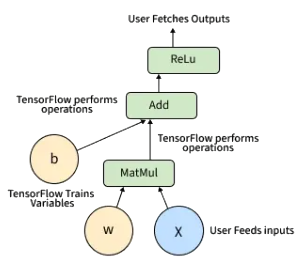
Building deep learning models often involves complex mathematical concepts, making model creation a challenging process for many developers. TensorFlow simplifies this complexity by providing tools that automatically analyze data structures and determine whether a model is trainable. These capabilities are valuable for professionals pursuing the top 5 jobs in AI, where expertise in machine learning frameworks is highly sought after. TensorFlow uses computational graphs to process data, identify relationships, and extract meaningful patterns from tensors. The framework is trained on large image and text datasets, enabling it to distinguish between different neural network layers during model development. It applies backpropagation and optimization algorithms such as gradient descent to improve prediction accuracy. Once training is complete, TensorFlow can evaluate model performance based on learned patterns, helping developers identify accurate or underperforming models. By reducing the need for extensive mathematical coding, TensorFlow makes deep learning more accessible while providing practical exposure to neural network and deep learning concepts.
To ExploreArtificial Intelligence in Depth, Check Out Our Comprehensive Artificial Intelligence Online Training To Gain Insights From Our Experts!
Hugging Face for Natural Language Processing
- Model Collection and NLP Sources: Hugging Face provides access to a vast collection of pre-trained language models developed by researchers and the open-source community. These models include transformers, text classifiers, and language generation models that serve as the foundation for a wide range of natural language processing (NLP) applications.
- Pattern Identification in Text Data: Hugging Face models analyze token sequences, word embeddings, and attention mechanisms to identify patterns in language. By understanding context and relationships between words, these models improve the accuracy of tasks such as sentiment analysis, translation, summarization, and text classification.
- Machine Learning for Text Prediction: Hugging Face supports advanced transformer models such as BERT and GPT that learn contextual relationships within text to generate accurate predictions. Understanding these models also helps developers explore the advantages and disadvantages of AI, including improved automation, scalability, and the challenges associated with computational resources and bias.
- Real-World Applications in Chatbots: Businesses use Hugging Face to build intelligent chatbots, virtual assistants, and customer support systems. Its pre-trained models enable organizations to deliver more natural conversations, improve customer experiences, and reduce the effort required to develop language-based applications.
- Importance in Accessibility and Scaling: Hugging Face promotes collaboration by making powerful NLP models openly available to developers worldwide. Model sharing, reusable pipelines, and community contributions reduce development time, lower project costs, and make advanced NLP technologies more accessible for organizations of all sizes.
Looking to Master Machine Learning? Discover the Artificial Intelligence Expert Masters Program Training Course Available at ACTE Now!
Midjourney for Design and Prototyping
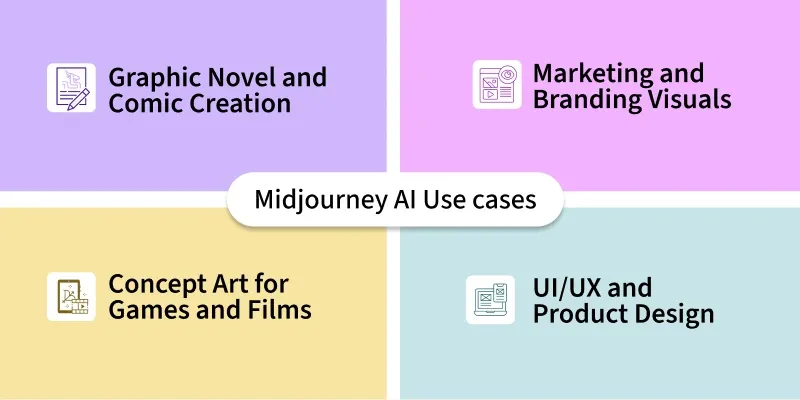
Midjourney is an AI-powered image generation tool that transforms text prompts into high-quality visuals, making it a valuable platform for design and rapid prototyping. It helps designers, marketers, and content creators produce concept art, illustrations, product mockups, and creative assets without extensive manual effort. As one of the top AI tools every developer should know, Midjourney demonstrates how generative AI can streamline creative workflows and accelerate project development. The platform uses advanced diffusion models to interpret text prompts, understand context, and generate visually appealing images by learning patterns from large datasets of artistic and realistic examples. During image creation, it refines outputs through iterative denoising techniques to produce detailed and accurate visuals. By reducing the time spent on manual design, Midjourney enables faster prototyping, enhances visual creativity, and provides hands-on exposure to generative AI and modern design concepts.
Jupyter Notebooks for Interactive Development
- Data Collection and Code Sources: Jupyter Notebooks begins with collecting large amounts of interactive code data. This data is gathered from local servers and cloud environments. It includes Python scripts and markdown text. This raw data is the foundation for accurate data exploration.
- Pattern Identification in Execution Flow: After collecting code, the next step is finding patterns in cell execution. Developers analyze variable states like memory usage and output trends. These patterns help understand how data changes over time. This makes future development more reliable and structured.
- Machine Learning for Interactive Prediction: Jupyter Notebooks support interactive machine learning by allowing developers and data scientists to build, test, and refine models in real time. Users can execute code cell by cell, visualize results instantly, and experiment with different algorithms to improve prediction accuracy. These practical workflows demonstrate The Impact of AI on the Future of IT Careers , where hands-on experience with AI tools has become an essential skill.
- Real-World Applications in Data Cleaning: Jupyter Notebooks are widely used for data cleaning, preprocessing, and exploratory data analysis. Data scientists can efficiently transform raw datasets, remove inconsistencies, and visualize trends before building machine learning models. This improves productivity, enhances data quality, and supports more informed business decisions.
- Importance in Collaboration and Sharing: Jupyter Notebooks simplify collaboration by combining code, visualizations, and documentation in a single interactive environment. Teams can easily share experiments, reproduce results, and work together on AI and data science projects. For those interested in the broader influence of artificial intelligence, exploring an AI Movie List offers an engaging way to see how AI concepts are represented in popular culture while complementing technical learning.
Preparing for Artificial Intelligence Job Interviews? Have a Look at Our Blog on Artificial Intelligence Interview Questions and Answers To Ace Your Interview!
Docker for AI Model Deployment
Docker for AI Model Deployment is an AI tool that focuses on determining whether or not models can be shipped effectively through containerization methods. Environment setup is a big problem in this day and age of digital information and there are so many ways to access server environments extremely rapidly. Most of this information is dependent on local setups which makes the issue of deployment a serious one. Docker aims to aid in solving the environment issue by creating a method of predicting similar attributes of servers automatically by analyzing dependencies and determining if it is compatible and Artificial Intaligence Training. The Docker system uses container images to analyze system requirements and extract context, relationships and patterns associated with the software libraries. The tool is initially trained on datasets containing both development and production examples so there will be a distinction between working and failing environments when the container is built. The tool uses isolation to convert local code to portable images along with a decision algorithm such as image layering. Once built, the system can classify environments as either stable or broken by using the learned pattern. Less Setup Time = More Reliable Deployment. The tool provides exposure to MLOps and Containerization Concepts. The emphasis on Scalable Infrastructure will increase.
Conclusion
AI tools for beginners learning generating code, building models, and deploying apps show how useful it is to use data to solve real-life problems. They’re great for helping people understand how raw data is collected, processed, and turned into useful information. By using these tools, data science beginners gain hands-on experience with machine learning, data analysis, and solving problems using those skills. Each tool develops a different set of skills: some with text generation, others with deep learning, some with design, and still others with deployment – all of which are extremely valuable in today’s tech-driven workplaces in our Artificial Intaligence Training. Working on real-world AI tools is also a great way for a beginner to build a good portfolio of work that they can use to apply for jobs in data science. Completing these projects bridges the gap between theory and practice. When a learner uses multiple tools, they increase their confidence in and ability to use technology. Overall, tool-based learning is probably the best way for someone just getting into data science to grow as a new learner.