LMS
LMS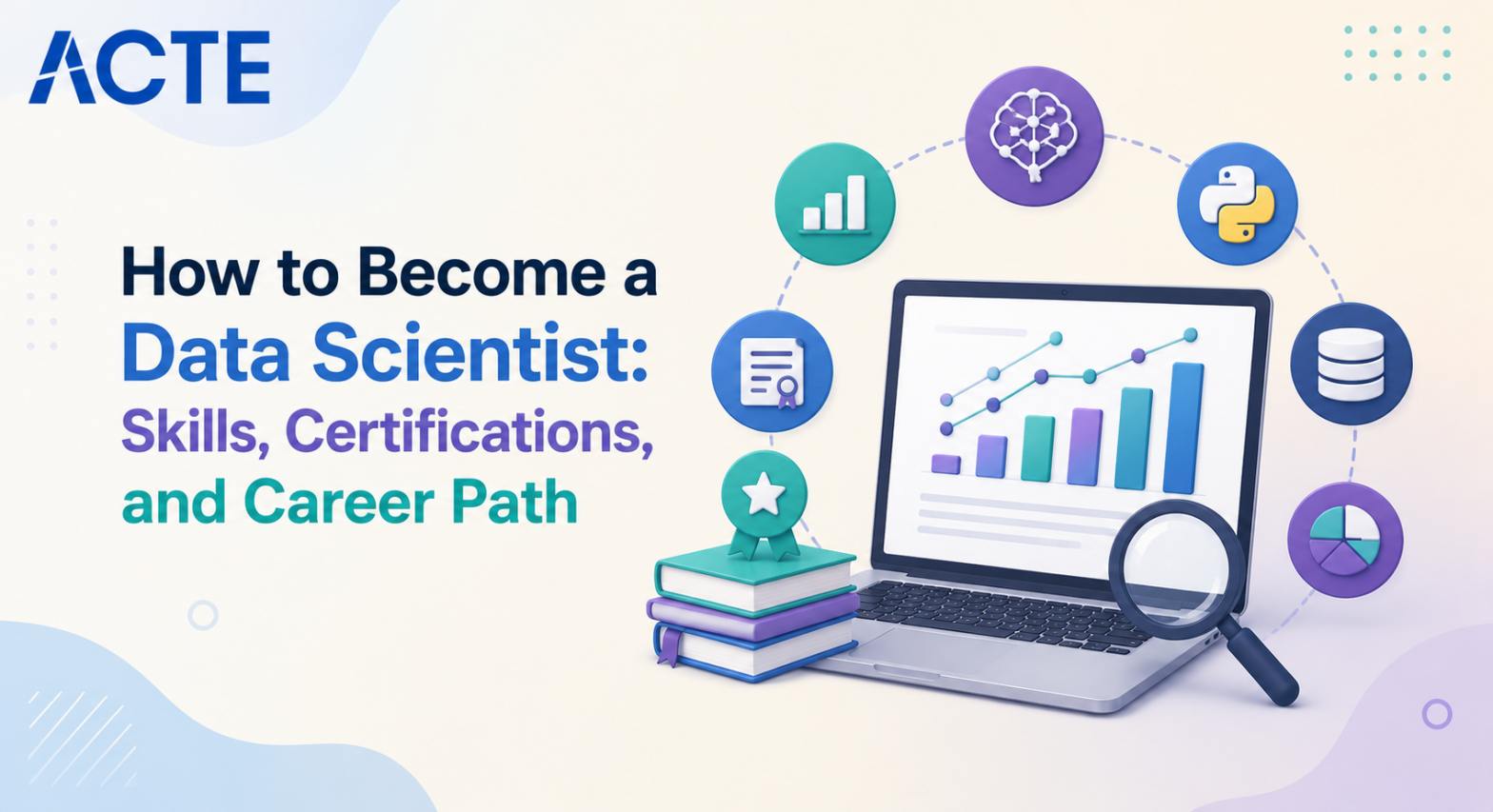
Last updated on 21st Jul 2026| 11463

- Introduction to Becoming a Data Scientist
- Who is a Data Scientist? Roles and Responsibilities
- Essential Skills Required to Become a Data Scientist
- Educational Qualifications and Learning Path for Data Science
- Programming Languages, Tools, and Technologies Every Data Scientist Should Learn
- Top Data Science Certifications to Boost Your Career
- Building a Strong Data Science Portfolio with Real-World Projects
- Step-by-Step Career Path to Become a Data Scientist
- Career Opportunities and Salary Growth in Data Science
- Tips for Freshers to Land Their First Data Scientist Job
- Conclusion: Starting Your Journey as a Successful Data Scientist
Introduction to Becoming a Data Scientist
Data Science has become one of the fastest-growing and most in-demand career fields in today’s digital world. Organizations across industries generate massive volumes of data every day from websites, mobile applications, social media, IoT devices, customer interactions, financial transactions, healthcare systems, and business operations. However, raw data has little value unless it is analyzed and transformed into meaningful insights that support business decisions. This is where Data Scientists play a crucial role by combining programming, statistics, mathematics, machine learning, and business knowledge to extract valuable information from complex datasets. Their work helps organizations understand customer behavior, predict future trends, improve operational efficiency, reduce costs, detect fraud, personalize user experiences, and make informed strategic decisions. As technologies such as Artificial Intelligence (AI), Machine Learning (ML), cloud computing, and big data continue to evolve, the demand for skilled Data Scientists has increased significantly across industries including healthcare, banking, finance, retail, manufacturing, education, telecommunications, and e-commerce. For freshers who enjoy problem-solving, logical thinking, and working with technology, Data Science offers excellent career opportunities, attractive salary packages, continuous learning, and long-term professional growth. Learners looking to build a strong foundation can enroll in a Data Analytics Course to develop practical skills in data analysis, visualization, SQL, and machine learning that are highly valuable for aspiring Data Scientists. Building a successful career in Data Science requires mastering programming languages, statistics, machine learning, data visualization, and practical project development while continuously updating technical skills to stay competitive in the rapidly evolving technology landscape.
Who is a Data Scientist? Roles and Responsibilities
A Data Scientist is a technology professional who collects, processes, analyzes, and interprets large volumes of structured and unstructured data to solve business problems and support data-driven decision-making. They combine expertise in computer science, statistics, mathematics, machine learning, artificial intelligence, and business analytics to identify patterns, build predictive models, and generate valuable insights from complex datasets. Data Scientists work with information collected from databases, websites, cloud platforms, mobile applications, IoT devices, financial systems, and enterprise software to help organizations improve efficiency and make smarter decisions. Their responsibilities include understanding business requirements, collecting relevant data, cleaning and preprocessing datasets, performing exploratory data analysis, developing machine learning models, evaluating model performance, and deploying analytical solutions into production environments. Professionals looking to develop these essential skills can benefit from a Data Analytics Course, which provides practical training in data analysis, visualization, SQL, and machine learning concepts. They also create dashboards, reports, and visualizations using modern business intelligence tools to communicate findings effectively to managers and stakeholders. Data Scientists collaborate closely with data engineers, software developers, business analysts, and domain experts to develop scalable data-driven solutions while ensuring data quality, security, and privacy. Their expertise enables organizations to optimize operations, detect fraud, forecast future trends, personalize customer experiences, automate business processes, and gain a competitive advantage. As businesses increasingly adopt AI and advanced analytics, Data Scientists continue to play one of the most valuable roles in the modern technology industry.
Essential Skills Required to Become a Data Scientist
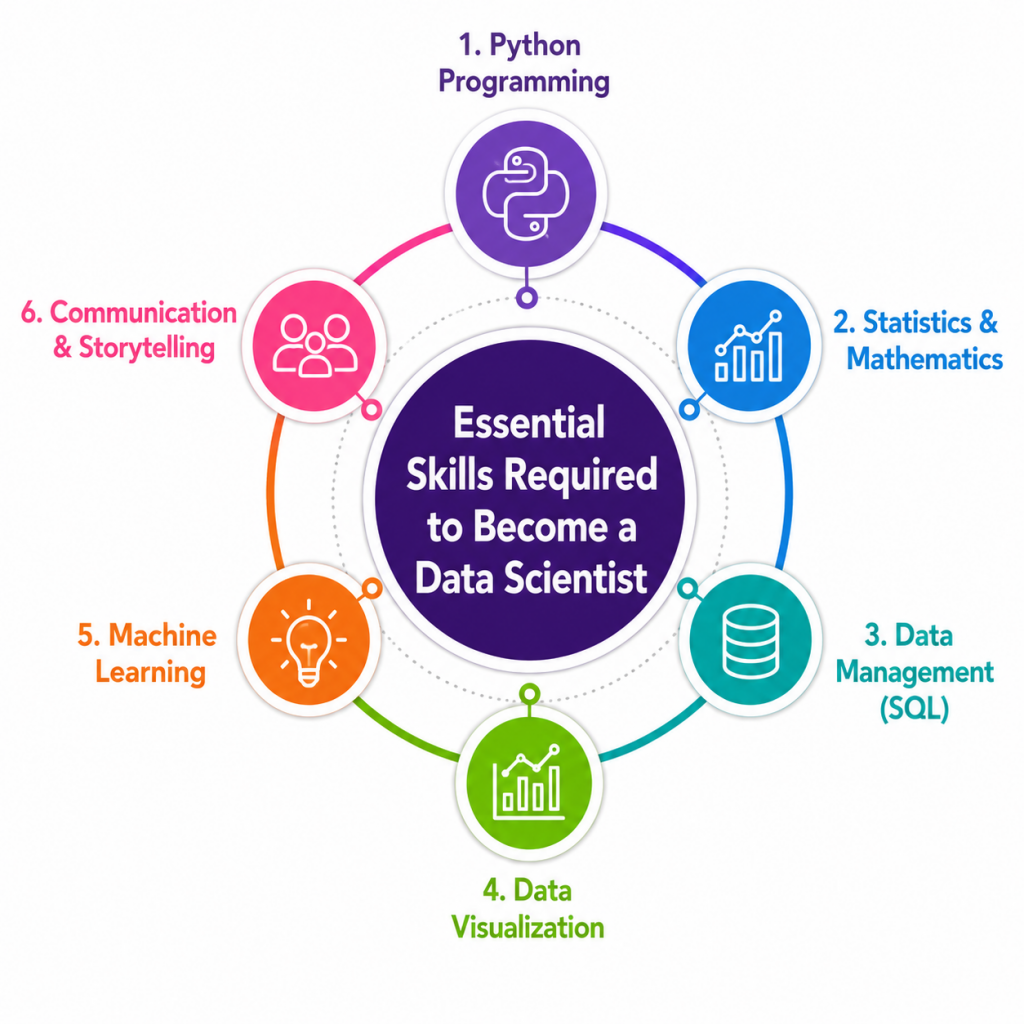
Building a successful career as a Data Scientist requires mastering a combination of technical and non-technical skills that help solve complex business problems using data. Programming is one of the most important skills, with Python being the most widely used language due to its powerful libraries for data analysis, machine learning, and artificial intelligence. Knowledge of SQL is essential for retrieving and managing data stored in relational databases, while R is useful for statistical computing and advanced analytics. A strong foundation in mathematics, probability, statistics, linear algebra, and calculus helps Data Scientists understand algorithms and evaluate predictive models accurately. Machine learning is another critical skill that enables professionals to build models for classification, prediction, recommendation systems, and clustering. Data visualization using tools such as Power BI, Tableau, Matplotlib, and Plotly helps present complex analytical results in a clear and meaningful way for decision-makers. To strengthen these practical skills, working on Data Analytics Projects for Freshers can provide valuable hands-on experience. Data preprocessing, feature engineering, and data cleaning skills are equally important for improving data quality before analysis.
Get Your Data Analytics Certification by Learning from Industry-Leading Experts and Advancing Your Career with ACTE’s Data Analytics Course.
Educational Qualifications and Learning Path for Data Science
- Earn a Relevant Bachelor’s Degree: Begin with a degree in Computer Science, Information Technology, Data Science, Artificial Intelligence, Statistics, Mathematics, Engineering, or a related discipline. A strong academic foundation provides essential knowledge in programming, algorithms, databases, and analytical thinking.
- Build Strong Programming Skills: Learn programming languages such as Python, SQL, and R to perform data analysis, database management, and machine learning tasks. Regular coding practice through exercises and projects improves technical proficiency.
- Master Mathematics and Statistics: Develop a solid understanding of probability, statistics, linear algebra, and calculus because these subjects form the foundation of predictive analytics and machine learning. Strong mathematical skills improve model selection and result interpretation.
- Learn Data Analysis and Visualization: Gain experience with tools such as Pandas, NumPy, Excel, Power BI, and Tableau to collect, clean, analyze, and visualize data. Effective visualization helps communicate business insights clearly. Learning Master Excel Formulas for Smarter Data Analysis can further improve your data analysis capabilities.
- Study Machine Learning and Artificial Intelligence: Learn supervised learning, unsupervised learning, deep learning, natural language processing, and computer vision using frameworks like Scikit-learn, TensorFlow, and PyTorch. These technologies enable the development of intelligent predictive models.
- Work on Real-World Projects: Build practical projects using public datasets from Kaggle, GitHub, or government portals to apply theoretical concepts. Hands-on experience strengthens technical skills and enhances your professional portfolio.
- Gain Industry Experience Through Internships: Participate in internships, live projects, hackathons, or research activities to understand industry workflows and real business challenges. Practical exposure improves both technical and communication skills.
- Continue Learning and Stay Updated: Keep learning through certifications, online courses, webinars, research papers, and continuous practice as Data Science technologies evolve rapidly. Lifelong learning is essential for long-term career success.

Learn Advanced Data Analytics Certification Training Course to Build Your Skills
Weekday / Weekend BatchesSee Batch DetailsProgramming Languages, Tools, and Technologies Every Data Scientist Should Learn
Programming languages, tools, and technologies form the foundation of every Data Scientist’s daily work by enabling them to collect, process, analyze, visualize, and deploy data-driven solutions efficiently. Python is the most widely used programming language because of its simplicity and extensive ecosystem of libraries such as NumPy, Pandas, Matplotlib, Scikit-learn, TensorFlow, Keras, and PyTorch for data manipulation, machine learning, deep learning, and visualization. SQL is another essential language that allows professionals to retrieve, manage, and manipulate structured data stored in relational databases, while R is commonly used for statistical computing and advanced analytics. Interactive development environments such as Jupyter Notebook, Visual Studio Code, and PyCharm simplify coding, experimentation, and project management. Data visualization tools including Power BI, Tableau, Plotly, and Matplotlib help convert complex datasets into meaningful dashboards and reports for decision-makers. To stay competitive and understand where the industry is heading, it is also beneficial to explore Future Trends in Data Analytics. Big data technologies such as Apache Spark, Hadoop, Hive, and Kafka enable efficient processing of massive datasets, while cloud platforms including Amazon Web Services (AWS), Microsoft Azure, and Google Cloud Platform provide scalable infrastructure for machine learning and AI applications. Version control tools like Git and GitHub support collaboration and code management, whereas Docker and Kubernetes help deploy applications consistently across different environments. Mastering these programming languages, tools, and technologies enables aspiring Data Scientists to build scalable analytical solutions, improve productivity, and remain competitive in the rapidly evolving field of Data Science.
Top Data Science Certifications to Boost Your Career
- Google Professional Data Analytics Certificate: This certification builds a strong foundation in SQL, spreadsheets, Tableau, data visualization, and analytical thinking. It is highly suitable for beginners preparing for entry-level data analytics and Data Science roles.
- IBM Data Science Professional Certificate: This program covers Python, SQL, machine learning, data visualization, and real-world Data Science projects. It emphasizes hands-on learning and helps learners develop an industry-ready portfolio. Before pursuing advanced certifications, understanding the benefits of Data Analytics Training Reasons to Learn can help you choose the right learning path.
- Microsoft Certified: Azure Data Scientist Associate: This certification focuses on building, training, and deploying machine learning models using Microsoft Azure cloud services. It is valuable for professionals interested in enterprise AI and cloud-based analytics.
- AWS Certified Machine Learning – Specialty: Designed for professionals working with machine learning on Amazon Web Services, this certification validates skills in model development, optimization, deployment, and scalable cloud-based AI solutions.
- Google Professional Machine Learning Engineer: This certification demonstrates the ability to design, build, deploy, and maintain machine learning models using Google Cloud technologies. It is widely recognized by organizations adopting AI-driven applications.
- SAS Certified Data Scientist: This certification focuses on predictive analytics, advanced statistics, machine learning, and big data technologies using SAS. It is particularly useful in industries such as banking, healthcare, finance, and research.
- Databricks Certified Data Scientist Associate: This certification validates expertise in data preparation, feature engineering, machine learning workflows, and model development using the Databricks platform for large-scale data processing.
- TensorFlow Developer Certificate: This certification demonstrates practical skills in developing deep learning and neural network applications using TensorFlow. It is beneficial for professionals pursuing careers in artificial intelligence and advanced machine learning.

Get JOB Oriented Data Analytics Training for Beginners By MNC Experts
- Instructor-led Sessions
- Real-life Case Studies
- Assignments
Building a Strong Data Science Portfolio with Real-World Projects
- Work on Diverse Data Science Projects: Build projects in domains such as customer segmentation, fraud detection, sales forecasting, recommendation systems, healthcare analytics, predictive maintenance, and sentiment analysis. Working across different industries demonstrates your versatility, technical skills, and problem-solving abilities.
- Use Publicly Available Datasets: Practice using datasets from Kaggle, UCI Machine Learning Repository, government open-data portals, and other trusted sources. Real-world datasets help you understand data cleaning, preprocessing, feature engineering, and model development.
- Create End-to-End Machine Learning Solutions: Develop complete projects that include data collection, preprocessing, exploratory data analysis, feature engineering, model building, evaluation, deployment, and visualization. Building a portfolio with Data Analytics Portfolio as a Fresher can further strengthen your job readiness and practical experience.
- Publish Projects on GitHub: Upload source code, documentation, datasets, and project reports to GitHub with clear README files and proper version control. A well-maintained GitHub profile serves as an impressive portfolio for recruiters and hiring managers.
- Build Interactive Dashboards: Create dashboards using Power BI, Tableau, or Streamlit to present insights through interactive charts and visualizations. These dashboards demonstrate your ability to communicate complex analytical findings effectively.
- Participate in Kaggle Competitions: Join Kaggle competitions to solve real-world business problems and learn from experienced Data Scientists. Competition experience improves technical knowledge, ranking, and exposure to industry-standard machine learning practices.
- Document Every Project Clearly: Explain the business problem, dataset, methodology, algorithms used, evaluation metrics, and final outcomes for each project. Well-documented projects help recruiters understand your technical approach and problem-solving process.
- Continuously Improve Your Portfolio: Regularly update your portfolio by adding new projects, improving existing models, learning new technologies, and following industry best practices. An updated portfolio reflects continuous learning and professional growth.
Step-by-Step Career Path to Become a Data Scientist
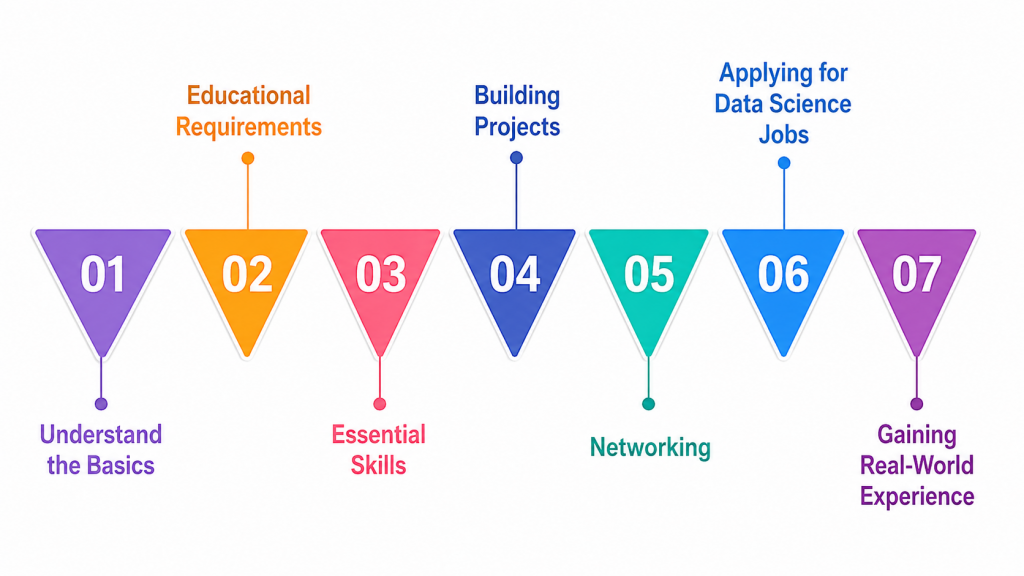
- Learn the Fundamentals of Programming and Mathematics: Build a strong foundation in Python, SQL, statistics, probability, and linear algebra because these subjects form the core of Data Science. Strong fundamentals make advanced concepts easier to understand.
- Develop Data Analysis Skills: Learn how to collect, clean, preprocess, analyze, and visualize datasets using tools such as Pandas, NumPy, Excel, Power BI, and Tableau. These skills help convert raw data into meaningful business insights.
- Study Machine Learning and Artificial Intelligence: Understand supervised learning, unsupervised learning, deep learning, and model evaluation using Scikit-learn, TensorFlow, and PyTorch. These concepts enable you to build predictive and intelligent applications.
- Work on Practical Projects: Apply your knowledge by solving real-world business problems using publicly available datasets. Hands-on project experience strengthens technical skills and builds a professional portfolio.
- Earn Industry-Recognized Certifications: Complete certifications from organizations such as Google, IBM, Microsoft, AWS, or Databricks to validate your technical knowledge. Certifications also provide structured learning and improve your resume.
- Gain Internship or Freelance Experience: Participate in internships, freelance projects, research work, or hackathons to understand industry workflows and business requirements. Practical experience enhances both technical expertise and confidence. You can also explore Freelancing Opportunities in Data Analytics to gain real-world exposure while building your career.
- Build a Strong Professional Portfolio: Showcase your projects on GitHub and create a well-structured resume highlighting your technical skills, certifications, internships, and achievements. A strong portfolio significantly improves your chances of getting shortlisted.
- Apply for Entry-Level Data Science Roles: Start your career by applying for roles such as Junior Data Scientist, Data Analyst, Machine Learning Engineer, or Business Intelligence Analyst. Continue learning new technologies and improving your skills for long-term career growth.
Want to Master Data Analytics? Explore the Data Analytics Master Program Offered at ACTE Today!
Career Opportunities and Salary Growth in Data Science
Data Science has become one of the most promising and rewarding career fields due to the increasing importance of data-driven decision-making across industries. Organizations of all sizes, including startups, multinational corporations, research institutions, healthcare organizations, financial institutions, government agencies, manufacturing companies, retail businesses, e-commerce platforms, telecommunications firms, and consulting companies actively hire Data Science professionals to analyze data, develop predictive models, automate business processes, and improve strategic decision-making. Fresh graduates often begin their careers as Junior Data Scientists, Data Analysts, Business Intelligence Analysts, Machine Learning Associates, AI Engineers, or Research Analysts before progressing to senior positions such as Senior Data Scientist, Lead Data Scientist, Machine Learning Engineer, Data Architect, AI Specialist, Analytics Manager, or Chief Data Officer. Career growth in Data Science depends on technical expertise, practical experience, certifications, project portfolios, communication skills, and the ability to solve complex business problems using analytical techniques. Professionals who continuously upgrade their knowledge in artificial intelligence, deep learning, cloud computing, big data technologies, and advanced analytics can further strengthen their skills through a professional Data Analytics Course, helping them achieve faster career progression and higher salary growth. Apart from attractive salaries, Data Science also offers opportunities to work on cutting-edge technologies, flexible work environments, remote job options, global career opportunities, continuous learning, and the chance to contribute to impactful projects across multiple industries. As organizations continue investing in AI, automation, and digital transformation, the demand for skilled Data Scientists is expected to grow steadily, making it an excellent long-term career choice for freshers.
Want to Learn About Data Analytics? Explore Our Data Analytics Interview Questions and Answers Featuring the Most Frequently Asked Questions in Job Interviews.
Tips for Freshers to Land Their First Data Scientist Job
Getting your first Data Scientist job can be challenging, but the right preparation and consistent practice can significantly improve your chances of success. Freshers should begin by building a strong foundation in programming languages such as Python and SQL, along with mathematics, statistics, probability, and machine learning concepts. Employers value practical skills more than theoretical knowledge, so developing real-world projects in areas such as customer segmentation, sales prediction, recommendation systems, fraud detection, sentiment analysis, and predictive analytics is highly beneficial. Publishing these projects on GitHub with proper documentation and creating interactive dashboards using Power BI or Tableau further strengthens your portfolio. Completing internships, freelance projects, hackathons, Kaggle competitions, and research activities provides valuable practical experience and helps you stand out during recruitment. To improve your chances of securing an entry-level role, you can also learn How to Get Your Data Analytics as a Fresher. Earning industry-recognized certifications from organizations such as Google, IBM, Microsoft, AWS, and Databricks validates your technical expertise and demonstrates your commitment to continuous learning. Freshers should also practice SQL queries, Python coding, machine learning interview questions, and data structures while preparing a professional resume that highlights technical skills, projects, certifications, internships, and achievements. Networking through LinkedIn, attending webinars, joining Data Science communities, and connecting with industry professionals can open doors to valuable career opportunities. Along with technical expertise, strong communication, analytical thinking, teamwork, adaptability, and problem-solving skills are essential because Data Scientists frequently collaborate with cross-functional teams and present technical insights to business stakeholders. Staying consistent, continuously learning new technologies, and keeping up with industry trends will help freshers successfully launch a rewarding career in Data Science.
Conclusion: Starting Your Journey as a Successful Data Scientist
Data Science has emerged as one of the most exciting, innovative, and rewarding career paths in the modern technology industry, offering outstanding opportunities for individuals who enjoy solving problems using data and technology. Becoming a successful Data Scientist requires dedication, continuous learning, and a balanced combination of programming skills, statistical knowledge, machine learning expertise, analytical thinking, and business understanding. By following a structured learning path, mastering programming languages such as Python and SQL, developing a strong foundation in mathematics and statistics, learning machine learning algorithms, working on real-world projects, and building an impressive professional portfolio through a comprehensive Data Analytics Course, aspiring Data Scientists can significantly improve their employability and career prospects. Practical experience gained through internships, hackathons, research projects, and open-source contributions further strengthens technical capabilities and prepares candidates for real-world business challenges. As organizations across healthcare, finance, banking, manufacturing, retail, education, telecommunications, logistics, and many other industries continue to invest in artificial intelligence, cloud computing, and advanced analytics, the demand for skilled Data Scientists is expected to grow rapidly in the coming years. This growing demand is accompanied by attractive salary packages, excellent career advancement opportunities, flexible work environments, global job prospects, and the chance to contribute to innovative solutions that create a meaningful impact. Although the journey requires patience, persistence, and continuous skill development, individuals who remain committed to learning and adapting to emerging technologies can build a successful and fulfilling career in Data Science. For freshers, starting early, practicing consistently, developing practical projects, and maintaining curiosity about solving business problems through data are the key steps toward becoming a highly skilled and successful Data Scientist in today’s data-driven world.