LMS
LMS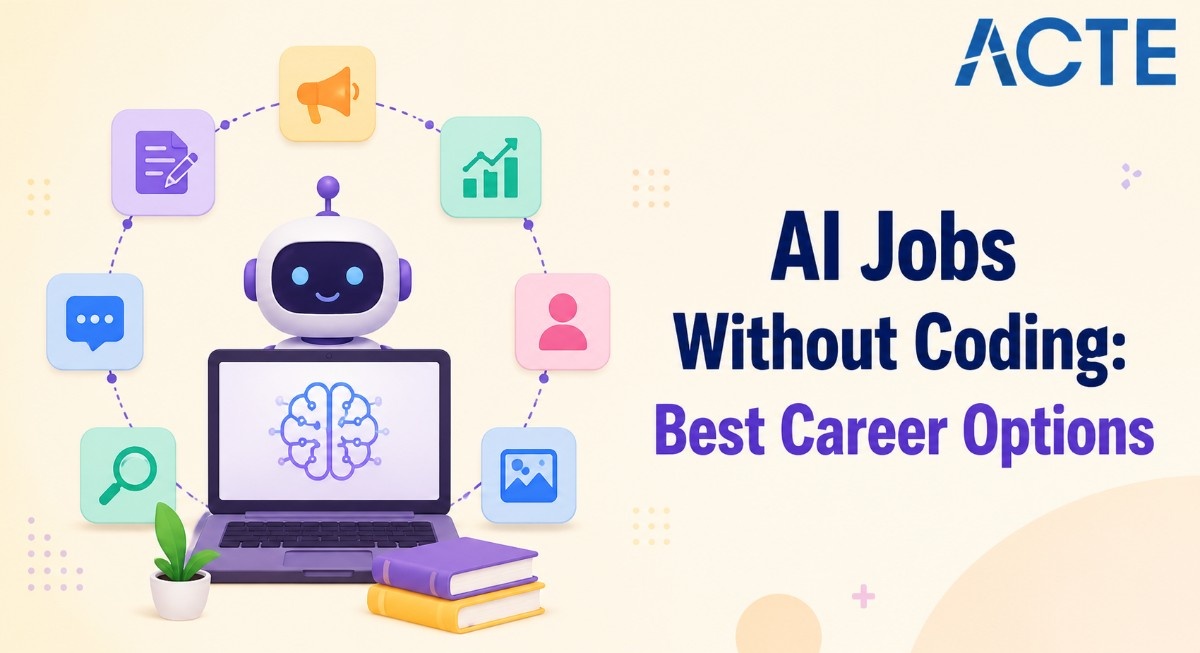
Last updated on 24th Jul 2026| 13274

- Introduction to AI Careers Without Coding
- Can You Build a Career in AI Without Coding?
- Why Non-Coding AI Jobs Are Growing Rapidly
- AI Prompt Engineer: Roles, Skills, and Responsibilities
- AI Product Manager: Career Path and Responsibilities
- AI Business Analyst: Roles and Required Skills
- AI Trainer and Data Annotation Specialist
- AI Consultant, AI Sales Specialist, and AI Content Strategist
- Essential Skills, Certifications, and Career Growth for Non-Coding AI Jobs
- Conclusion: Choosing the Right AI Career Without Coding
Introduction to AI Careers Without Coding
Artificial Intelligence (AI) is transforming industries across the world and creating numerous career opportunities, not only for programmers but also for individuals with non-technical backgrounds. While many people believe that coding is mandatory to work in AI, the reality is that several AI-related roles focus on business strategy, communication, content creation, project management, data labeling, and product development rather than software programming. The rapid growth of AI tools, no-code platforms, and Generative AI technologies has made it possible for professionals from diverse educational backgrounds to build successful careers in Artificial Intelligence. Professionals looking to strengthen their practical knowledge can also benefit from Artificial Intelligence Training to understand real-world AI concepts, industry tools, and career opportunities. Industries such as healthcare, finance, education, marketing, e-commerce, human resources, media, customer service, and consulting are actively adopting AI to improve productivity, automate workflows, and enhance customer experiences. As a result, organizations are hiring professionals who can effectively manage AI projects, create high-quality prompts, train AI models using labeled data, analyze business requirements, develop AI-driven marketing strategies, and bridge the gap between technical teams and business stakeholders. These roles require strong analytical thinking, communication, creativity, domain expertise, and problem-solving abilities rather than advanced programming knowledge. Fresh graduates, business professionals, marketers, designers, teachers, and individuals from non-engineering backgrounds can enter the AI industry by learning AI fundamentals, understanding how AI tools work, and gaining practical experience with no-code AI platforms. Certifications, internships, portfolio development, and continuous learning further improve employability in these roles. As Artificial Intelligence continues to expand into every industry, non-coding AI careers are becoming increasingly valuable, offering competitive salaries, global job opportunities, flexible work environments, and excellent long-term career growth for individuals who want to be part of the AI revolution without becoming software developers.
Can You Build a Career in AI Without Coding?
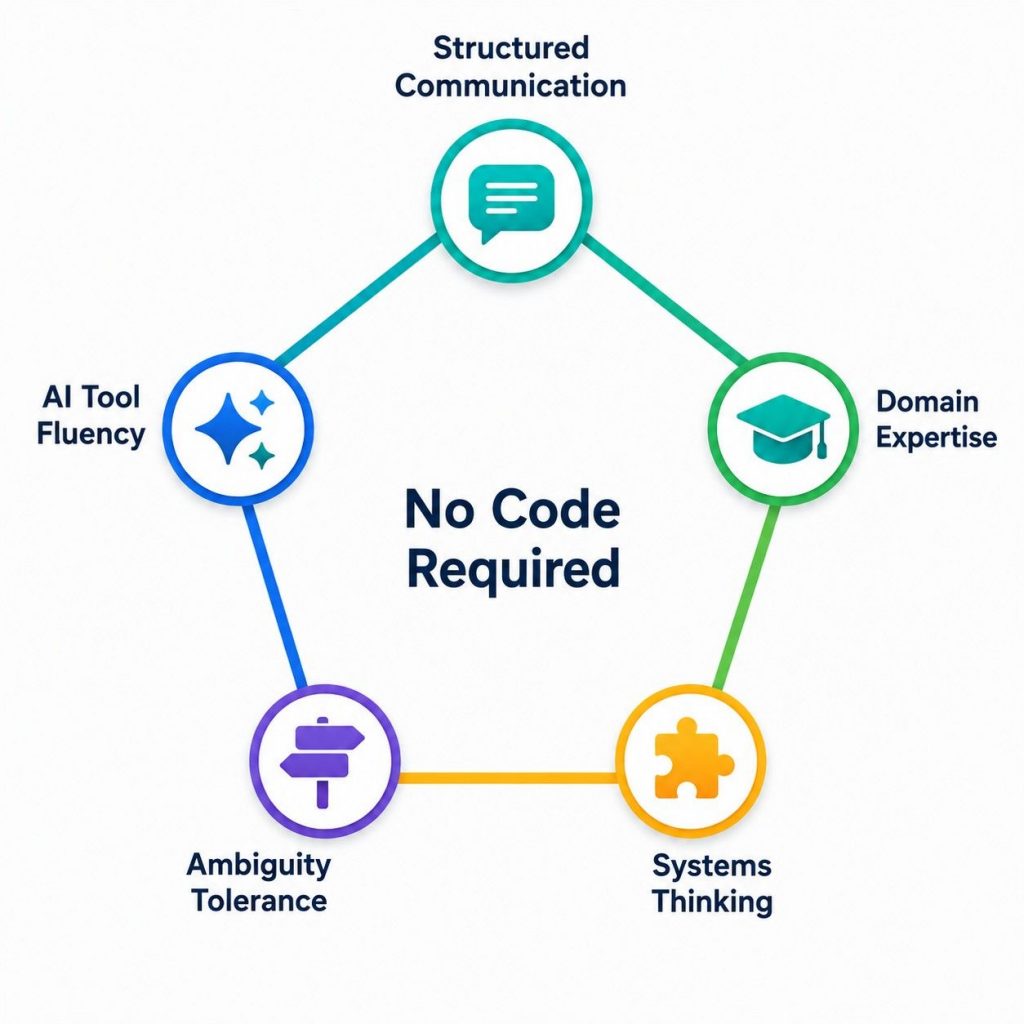
Yes, building a successful career in Artificial Intelligence without coding is entirely possible, especially as AI technologies become more accessible through no-code and low-code platforms. Many organizations require professionals who can understand business problems, communicate effectively with technical teams, design AI workflows, evaluate AI-generated outputs, manage AI-powered products, and help organizations implement AI solutions. These responsibilities do not always require programming expertise but instead focus on strategic thinking, creativity, domain knowledge, communication, and analytical skills. To gain practical industry knowledge and improve career prospects, many aspiring professionals also choose Artificial Intelligence Training to develop hands-on experience with AI tools and business applications. Roles such as AI Prompt Engineer, AI Product Manager, AI Business Analyst, AI Trainer, Data Annotation Specialist, AI Consultant, AI Sales Specialist, AI Content Strategist, and AI Project Coordinator primarily involve working with AI tools rather than developing AI models from scratch. Professionals in these positions use advanced AI platforms to create prompts, improve AI responses, organize datasets, evaluate model performance, support AI implementation, and ensure that AI solutions meet business objectives. Learning how Large Language Models (LLMs), Generative AI tools, AI automation platforms, and business applications function is often more important than writing complex code. Fresh graduates can begin by understanding AI concepts, practicing with popular AI tools, completing certifications, working on real-world case studies, and developing problem-solving abilities relevant to their chosen industry. As AI adoption continues to grow across healthcare, banking, retail, education, marketing, customer support, and finance, organizations are increasingly recognizing the importance of professionals who can successfully integrate AI into business operations without necessarily having software development expertise. Therefore, individuals with strong communication, leadership, creativity, and business analysis skills can build rewarding, stable, and future-ready careers in Artificial Intelligence without becoming programmers.
Ready to Get Certified in Artificial Intelligence ? Explore the Program Now Artificial Intelligence Online Training Offered By ACTE Right Now!
Why Non-Coding AI Jobs Are Growing Rapidly
The demand for non-coding AI jobs has increased significantly because businesses require professionals who can successfully implement Artificial Intelligence solutions beyond software development. As AI becomes an essential part of business operations, organizations need experts who understand customer requirements, business strategies, user experience, content creation, product management, AI ethics, workflow automation, and digital transformation. Modern AI platforms have simplified many technical processes through no-code and low-code solutions, allowing professionals from marketing, business, finance, education, human resources, healthcare, and consulting backgrounds to use AI effectively without writing complex programs. Companies now require AI Prompt Engineers to improve AI-generated responses, AI Product Managers to oversee AI-powered products, AI Trainers to prepare datasets and evaluate model outputs, Business Analysts to identify AI implementation opportunities, and AI Consultants to guide organizations through AI adoption. The rapid growth of Generative AI, Large Language Models, intelligent automation, AI assistants, and enterprise AI applications has created entirely new job roles focused on planning, communication, content optimization, customer engagement, and business value creation.

Develop Your Skills with Artificial Intelligence Training
Weekday / Weekend BatchesSee Batch DetailsAI Prompt Engineer: Roles, Skills, and Responsibilities
- Creating Effective AI Prompts: AI Prompt Engineers design clear, detailed, and structured prompts that help AI models generate accurate, relevant, and high-quality responses. They continuously refine prompts to improve the consistency, reliability, and usefulness of AI-generated outputs for different business applications.
- Testing and Optimizing AI Responses: Prompt Engineers evaluate AI-generated content, identify inaccuracies, reduce hallucinations, and improve response quality through prompt optimization techniques. They experiment with different prompting strategies to achieve better performance across multiple AI tools and use cases.
- Essential Skills Required: Strong communication skills, creativity, logical thinking, research abilities, problem-solving, and a good understanding of Generative AI and Large Language Models are essential. Familiarity with AI platforms, business workflows, and prompt engineering techniques further improves career opportunities. Beginners can strengthen their knowledge by following How to Start an AI Career with No Experience.
- Roles and Career Opportunities: AI Prompt Engineers work in technology companies, marketing agencies, healthcare organizations, educational platforms, customer support, finance, and content creation industries. With experience, they can advance to roles such as AI Consultant, Generative AI Specialist, AI Product Manager, or AI Solutions Strategist.
AI Product Manager: Career Path and Responsibilities
An AI Product Manager is a professional who bridges the gap between business objectives, customer needs, and Artificial Intelligence solutions without necessarily writing code. Their primary responsibility is to identify business problems that can be solved using AI, define product goals, create development roadmaps, and coordinate with AI engineers, data scientists, designers, and stakeholders throughout the product lifecycle. They analyze market trends, understand customer requirements, prioritize product features, and ensure that AI-powered products deliver real business value. AI Product Managers also monitor product performance, gather user feedback, improve AI features, and make strategic decisions that enhance user experience and business growth. Unlike software developers, they focus on product planning, communication, leadership, project management, and decision-making rather than building AI models. They should have a good understanding of Artificial Intelligence concepts, Machine Learning, Generative AI, Large Language Models (LLMs), data analytics, and AI ethics to communicate effectively with technical teams. Building these skills through Artificial Intelligence Training can help aspiring professionals gain practical knowledge of AI technologies and product management practices. Strong analytical thinking, problem-solving abilities, business knowledge, presentation skills, stakeholder management, and leadership qualities are essential for success in this role. AI Product Managers are employed in technology companies, healthcare organizations, financial institutions, e-commerce platforms, educational technology firms, and AI startups. Fresh graduates with backgrounds in business, management, engineering, marketing, or information technology can enter this field by learning AI fundamentals, completing certifications, participating in internships, and gaining product management experience. As they build expertise, they can progress to Senior AI Product Manager, Head of AI Products, Director of Product Management, or Chief Product Officer positions. With the rapid adoption of AI-powered products across industries, AI Product Management has become one of the most rewarding non-coding careers, offering excellent salaries, leadership opportunities, global career growth, and the chance to shape innovative AI solutions that impact millions of users.
AI Business Analyst: Roles and Required Skills
- Business Requirement Analysis: AI Business Analysts identify business challenges and determine where Artificial Intelligence can improve efficiency, reduce costs, and enhance decision-making. They gather requirements from stakeholders and translate business needs into clear AI project objectives for technical teams.
- Communication and Stakeholder Management: They act as a bridge between business executives, AI engineers, data scientists, and project managers by ensuring everyone understands project goals. Strong communication, presentation, documentation, and collaboration skills are essential for successful AI implementation.
- Data Interpretation and AI Knowledge: AI Business Analysts understand business data, analyze trends, prepare reports, and evaluate AI-generated insights to support strategic decisions. Although coding is not required, knowledge of AI concepts, Machine Learning, Generative AI, and analytics tools greatly improves their effectiveness. Learning about AI vs Data Science: Which Career Should You Choose? can also help aspiring professionals select the right career path.
- Career Opportunities and Growth: Fresh graduates can begin as Junior Business Analysts or AI Business Analysts and gradually progress to Senior Business Analyst, AI Consultant, Product Manager, Business Strategy Manager, or Digital Transformation Consultant. This role offers excellent career stability across multiple industries.
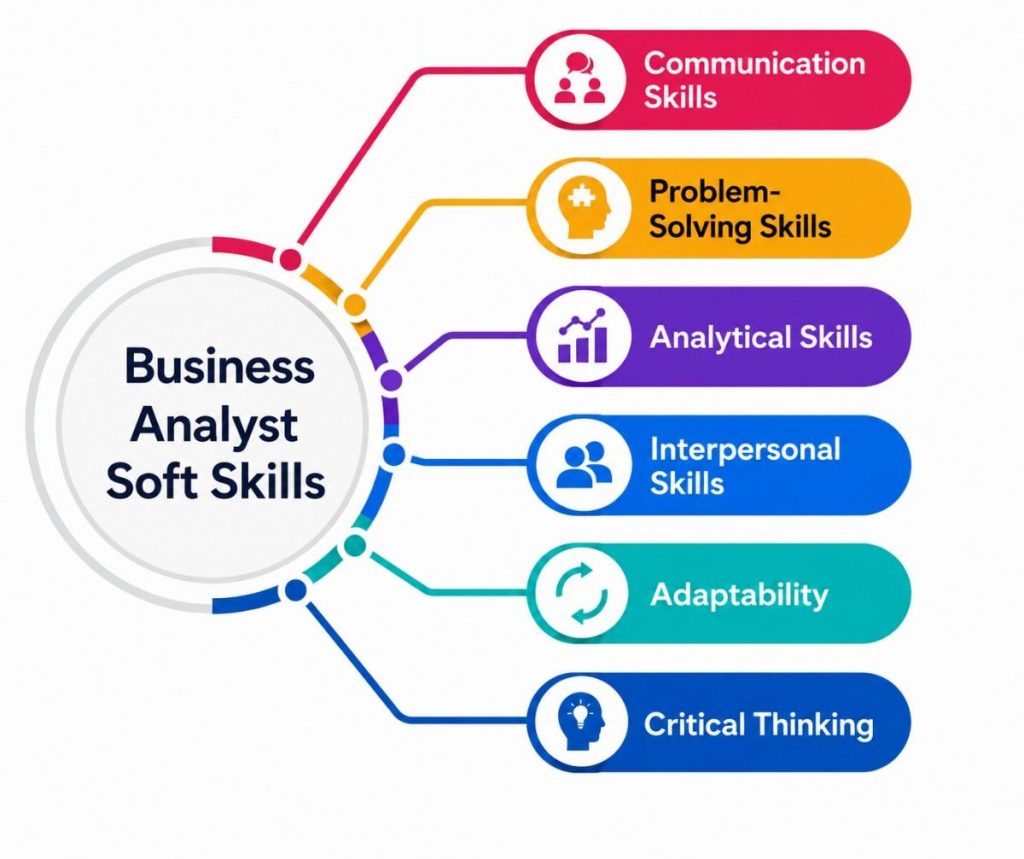
- Develop Strong AI Fundamentals: Professionals should understand the basics of Artificial Intelligence, Machine Learning, Generative AI, Large Language Models (LLMs), and AI ethics. This knowledge helps them communicate effectively with technical teams and contribute to AI-driven business projects without requiring programming expertise.
- Build Communication and Business Skills: Excellent communication, analytical thinking, presentation, leadership, problem-solving, and stakeholder management skills are essential for non-coding AI roles. These abilities help professionals identify business needs, manage AI projects, and ensure successful collaboration across different teams.
- Earn Certifications and Gain Practical Experience: Completing AI certifications, attending workshops, participating in internships, and working on real-world AI case studies significantly improve professional credibility. Learning to use popular AI tools and no-code platforms also enhances employability and career readiness. Pursuing Best AI Certifications to Get Hired Faster can further strengthen your resume and career prospects.
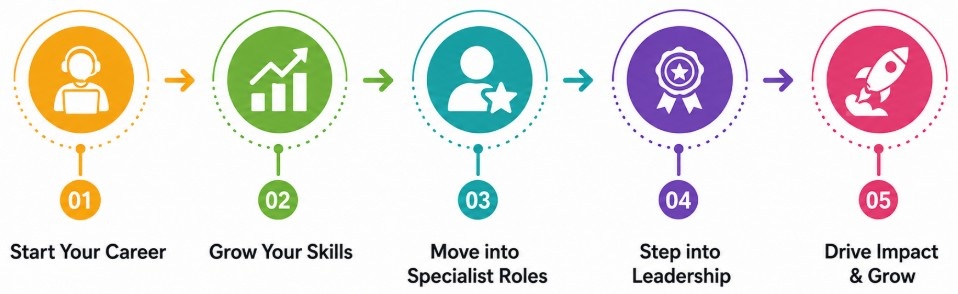
- Career Growth and Future Opportunities: Non-coding AI professionals can progress to senior positions such as AI Consultant, AI Product Manager, AI Strategy Manager, Digital Transformation Consultant, or AI Program Manager. As AI adoption continues to increase across industries, these roles offer excellent salary packages, global opportunities, and long-term career stability.
To ExploreArtificial Intelligence in Depth, Check Out Our Comprehensive Artificial Intelligence Online Training To Gain Insights From Our Experts!
AI Trainer and Data Annotation Specialist
AI Trainers and Data Annotation Specialists play a crucial role in the development of Artificial Intelligence systems by preparing, organizing, labeling, and validating the data used to train machine learning and Generative AI models. Unlike AI Engineers, these professionals are not responsible for developing algorithms or writing complex code; instead, they ensure that AI models receive high-quality, accurate, and well-structured training data that improves their learning capabilities. Data Annotation Specialists label images, videos, text, speech, and other forms of data by identifying objects, emotions, keywords, categories, and patterns according to predefined guidelines. AI Trainers evaluate AI-generated responses, correct inaccurate outputs, provide human feedback, and continuously improve model performance by helping AI systems learn from high-quality examples. Professionals seeking practical exposure to AI concepts and industry-standard tools can strengthen their expertise through Artificial Intelligence Training. Their responsibilities also include quality assurance, dataset verification, documentation, and maintaining consistency across large-scale annotation projects. These professionals commonly work in industries such as healthcare, autonomous vehicles, e-commerce, finance, education, customer support, robotics, and social media, where accurate AI training data is essential for building reliable intelligent systems. Strong attention to detail, communication skills, analytical thinking, patience, research abilities, and domain knowledge are more important than programming expertise in these roles. Fresh graduates from various educational backgrounds can enter this field by learning AI fundamentals, understanding data annotation techniques, and becoming familiar with AI platforms and quality evaluation methods. With experience, professionals can advance to roles such as Senior AI Trainer, Annotation Team Lead, AI Quality Analyst, AI Operations Specialist, AI Project Coordinator, or AI Consultant. As organizations continue developing more advanced AI models and Large Language Models, the demand for skilled AI Trainers and Data Annotation Specialists is expected to grow significantly, making it one of the most accessible and future-ready non-coding careers in the Artificial Intelligence industry.
AI Consultant, AI Sales Specialist, and AI Content Strategist
| Job Role | Primary Responsibilities | Essential Skills | Career Opportunities |
|---|---|---|---|
| AI Consultant | Advises organizations on AI adoption, identifies business problems, recommends suitable AI solutions, and guides companies through AI implementation strategies without developing AI models directly. | Business analysis, AI fundamentals, communication, consulting, strategic planning, problem-solving, and stakeholder management. | AI Consultant, Senior Consultant, Digital Transformation Consultant, AI Strategy Manager, Enterprise AI Advisor. |
| AI Sales Specialist | Promotes AI products and services, explains AI solutions to clients, understands customer requirements, prepares product demonstrations, and helps businesses choose suitable AI technologies. | Sales techniques, communication, presentation, customer relationship management, AI product knowledge, and negotiation skills. | AI Sales Executive, Enterprise Sales Manager, AI Solutions Consultant, Business Development Manager, Regional Sales Manager. |
| AI Content Strategist | Creates AI-driven content strategies, manages AI-generated content, develops marketing campaigns, optimizes prompts, and ensures content quality across multiple digital platforms. | Content writing, SEO, prompt engineering, creativity, digital marketing, branding, and Generative AI tools. | AI Content Strategist, Content Marketing Manager, Digital Marketing Specialist, AI Content Consultant, Brand Strategy Manager. |
Looking to Master Machine Learning? Discover the Artificial Intelligence Expert Masters Program Training Course Available at ACTE Now!
Essential Skills, Certifications, and Career Growth for Non-Coding AI Jobs
Conclusion: Choosing the Right AI Career Without Coding
Artificial Intelligence is no longer limited to software developers and programmers, as the rapid growth of no-code AI platforms and Generative AI technologies has opened numerous career opportunities for individuals from diverse educational and professional backgrounds. Today, organizations require professionals who can manage AI products, analyze business requirements, create effective AI prompts, train AI systems, develop content strategies, consult businesses on AI adoption, and support digital transformation initiatives without writing complex code. Careers such as AI Prompt Engineer, AI Product Manager, AI Business Analyst, AI Trainer, Data Annotation Specialist, AI Consultant, AI Sales Specialist, and AI Content Strategist demonstrate that communication, creativity, analytical thinking, business knowledge, leadership, and problem-solving skills are equally valuable in the AI industry. By understanding AI fundamentals, gaining practical experience with modern AI tools, earning industry-recognized certifications, participating in internships, and continuously learning about emerging AI technologies, fresh graduates can build rewarding and future-ready careers in this rapidly expanding field. As organizations across healthcare, finance, education, retail, manufacturing, marketing, and other industries continue investing in Artificial Intelligence, the demand for skilled non-coding AI professionals will continue to grow significantly. Choosing the right career based on individual interests, strengths, and long-term goals allows professionals to contribute meaningfully to AI-driven innovation while enjoying excellent salary packages, global career opportunities, job security, and continuous professional growth. To explore more opportunities, read Exploring Career Paths in Artificial Intelligence for Freshers. With dedication, curiosity, and a willingness to adapt to new technologies, anyone can successfully build a fulfilling career in Artificial Intelligence without becoming a software programmer.
Preparing for Artificial Intelligence Job Interviews? Have a Look at Our Blog on Artificial Intelligence Interview Questions and Answers To Ace Your Interview!