LMS
LMS
Last updated on 10th Aug 2026| 6573

- Introduction to Google Cloud Careers for Freshers
- Understanding Google Cloud and Its Career Opportunities
- Building Essential Cloud Computing Knowledge
- Learning Core Google Cloud Services and Tools
- Understanding Google Cloud Infrastructure and Networking
- Exploring Big Data, AI, and Machine Learning on Google Cloud
- Developing DevOps, Kubernetes, and Cloud Automation Skills
- Building Hands-On Google Cloud Projects and a Portfolio
- Earning Google Cloud Certifications and Preparing for Jobs
- Conclusion: Starting a Successful Google Cloud Career as a Fresher
Introduction to Google Cloud Careers for Freshers
Google Cloud offers exciting career opportunities for freshers interested in cloud computing, data engineering, DevOps, cybersecurity, artificial intelligence, and software development. As businesses increasingly move applications, databases, and infrastructure to cloud platforms, professionals with cloud skills are becoming highly valuable across industries. Fresh graduates can begin their careers by developing a strong understanding of cloud concepts and gaining hands-on experience with Google Cloud services. Candidates looking to build their skills can explore a Google Cloud Course to gain structured knowledge and practical exposure to essential cloud technologies. Learning through practical projects, labs, certifications, and internships can help candidates understand how cloud technologies are used in real business environments. Google Cloud careers can include roles such as Cloud Engineer, Cloud Developer, Data Engineer, DevOps Engineer, Cloud Security Engineer, and Machine Learning Engineer. Freshers do not need to master every cloud service at the beginning. Instead, they should build strong fundamentals and gradually specialize in an area that matches their interests and career goals. Developing technical knowledge along with problem-solving, communication, and teamwork skills can help aspiring professionals prepare for competitive cloud opportunities and establish a strong foundation for long-term career growth.
Understanding Google Cloud and Its Career Opportunities
Google Cloud is a cloud computing platform that provides infrastructure, storage, databases, networking, data analytics, artificial intelligence, machine learning, security, and application development services. Organizations use Google Cloud to build and deploy applications, manage large amounts of data, improve business operations, and scale digital services efficiently. For freshers, understanding the Google Cloud ecosystem is important because it provides multiple career pathways rather than limiting candidates to a single technical role. Those interested in infrastructure can explore Cloud Engineering, while candidates passionate about data can pursue Data Engineering or Cloud Analytics. Developers can focus on cloud application development, whereas professionals interested in automation can explore DevOps and Kubernetes. AI enthusiasts can learn machine learning and generative AI services available through Google Cloud. Security-focused candidates can develop skills in identity management, access control, monitoring, and cloud security. Exploring these career paths helps freshers identify a specialization and create a focused learning roadmap. Gaining hands-on experience through projects and certifications can further improve their readiness for entry-level Google Cloud roles.
Building Essential Cloud Computing Knowledge
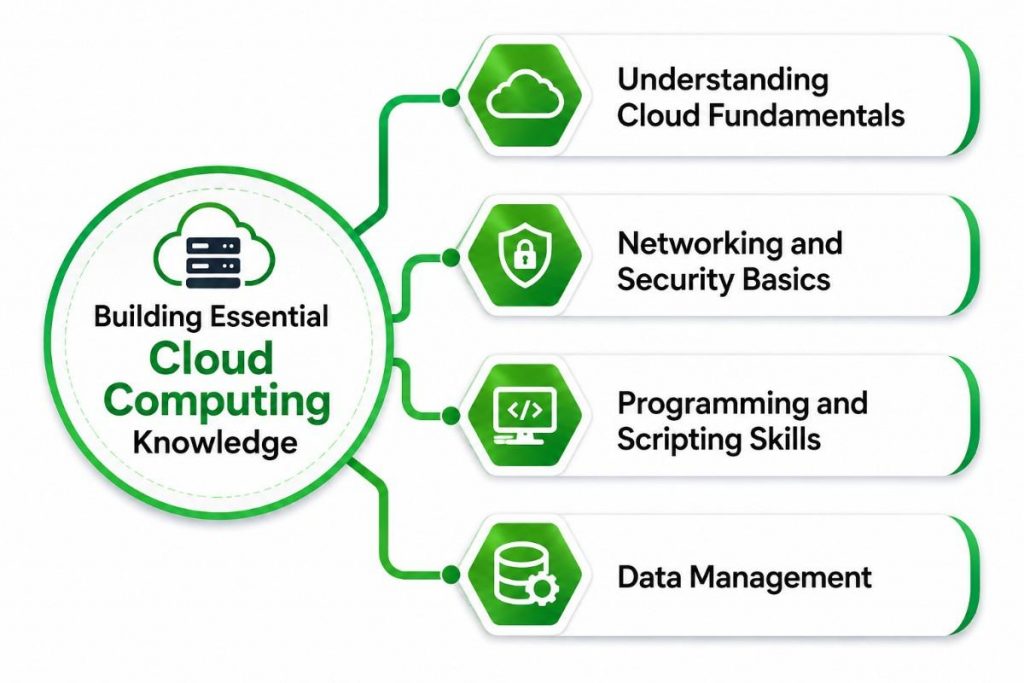
Before learning advanced Google Cloud services, freshers should develop a strong foundation in cloud computing concepts. Understanding the differences between Infrastructure as a Service, Platform as a Service, and Software as a Service helps candidates recognize how cloud solutions are designed and delivered. Students should also learn virtualization, containers, cloud storage, databases, networking, scalability, availability, and basic cloud security concepts. Familiarity with operating systems, Linux commands, command-line tools, and basic scripting can make it easier to work with cloud environments. Networking fundamentals such as IP addresses, DNS, HTTP, firewalls, load balancing, and virtual networks are particularly valuable for aspiring Cloud and DevOps professionals.
Learning Core Google Cloud Services and Tools
- Exploring Compute Engine: Learn how Google Compute Engine provides scalable virtual machines for hosting applications, running workloads, and managing cloud-based computing resources.
- Understanding Cloud Storage: Explore Google Cloud Storage for storing and retrieving files, backups, media, datasets, and application resources securely and efficiently.
- Working with BigQuery: Learn how BigQuery enables large-scale data analysis using SQL and supports business intelligence, reporting, and data-driven decision-making.
- Exploring Cloud Run and App Engine: Understand how Cloud Run and App Engine simplify application deployment by allowing developers to run applications without managing traditional server infrastructure.
- Using Google Cloud Console and CLI: Practice using the Google Cloud Console and command-line tools to create resources, configure services, monitor workloads, and manage cloud environments.

Understanding Google Cloud Infrastructure and Networking
- Learning Google Cloud Regions and Zones: Understand how regions and zones organize Google Cloud resources and support application availability, performance, and geographic distribution.
- Exploring Virtual Private Cloud: Learn how Virtual Private Cloud networks connect cloud resources while providing control over IP addresses, subnets, routes, and network access.
- Understanding Cloud Load Balancing: Explore load balancing concepts and learn how traffic can be distributed across applications to improve availability, reliability, and performance.
- Learning DNS and Network Connectivity: Understand DNS, IP addressing, routing, firewalls, and connectivity concepts required to design and manage reliable cloud applications.
- Practicing Cloud Security Basics: Learn how network security controls, firewall rules, access permissions, and monitoring help protect applications and infrastructure from unauthorized access. Candidates who want structured practical learning can explore Google Cloud Training to strengthen their understanding of cloud infrastructure and networking.
Google Cloud vs AWS vs Azure
While Google Cloud competes directly with AWS (Amazon Web Services) and Microsoft Azure , each platform has strengths. Here’s a comparison of the three:
| Feature | Google Cloud Platform (GCP) | Amazon Web Services (AWS) |
|---|---|---|
| Compute Services | Compute Engine, Kubernetes Engine, App Engine | EC2, ECS, Lambda |
| Storage | Cloud Storage, Bigtable, Firestore | S3, RDS, DynamoDB |
| Machine Learning | AutoML, AI Platform, TensorFlow | SageMaker, Rekognition |
| Big Data | BigQuery, Dataflow, Dataproc | Redshift, EMR, Athena |
| Networking | Cloud VPC, Cloud CDN, Interconnect | VPC, CloudFront, Direct Connect |
Exploring Big Data, AI, and Machine Learning on Google Cloud
- Working with BigQuery Analytics: Use BigQuery to query and analyze large datasets efficiently while developing practical skills in cloud-based data analytics and reporting.
- Understanding Data Processing: Learn how cloud data can be collected, transformed, processed, and prepared for analytics using scalable data processing services.
- Exploring Vertex AI: Gain an understanding of Vertex AI for developing, training, evaluating, deploying, and managing machine learning models and AI applications. Building a strong foundation in cloud technologies through Google Cloud Training can help freshers develop the practical skills needed to work with these services.
- Learning Generative AI Concepts: Explore generative AI, large language models, embeddings, prompt engineering, and AI application development using Google Cloud technologies.
- Building Data and AI Projects: Create practical projects such as sales forecasting, customer analysis, recommendation systems, sentiment analysis, or AI-powered applications.
Developing DevOps, Kubernetes, and Cloud Automation Skills
- Learning Continuous Integration and Deployment: Understand CI/CD concepts and learn how automated pipelines can build, test, and deploy applications efficiently in cloud environments.
- Exploring Google Kubernetes Engine: Learn how Google Kubernetes Engine helps deploy, manage, scale, and monitor containerized applications using Kubernetes.
- Working with Docker Containers: Understand how Docker packages applications and dependencies into portable containers that can run consistently across different environments.
- Practicing Infrastructure Automation: Explore infrastructure-as-code concepts and automation tools to create, configure, and manage cloud resources efficiently.
- Monitoring Cloud Applications: Learn how logging, monitoring, alerts, and performance metrics help teams identify issues and maintain reliable cloud applications.
Building Hands-On Google Cloud Projects and a Portfolio
- Creating Beginner-Friendly Cloud Projects: Start with projects such as hosting websites, deploying applications, creating cloud storage solutions, or building basic data analytics systems.
- Developing Data Analytics Projects: Use BigQuery and visualization tools to analyze real-world datasets and create dashboards that demonstrate practical cloud analytics skills.
- Building Cloud-Based AI Applications: Develop simple AI or machine learning applications using appropriate Google Cloud services to demonstrate knowledge of modern cloud technologies. Gaining practical knowledge through Google Cloud Training can help freshers build a stronger foundation for developing and deploying these applications.
- Deploying Projects to Google Cloud: Practice deploying applications and services to the cloud rather than keeping projects only in local development environments.
- Documenting Projects on GitHub: Maintain organized repositories with project descriptions, technologies used, architecture details, setup instructions, screenshots, and key outcomes to create a professional portfolio.
Earning Google Cloud Certifications and Preparing for Jobs
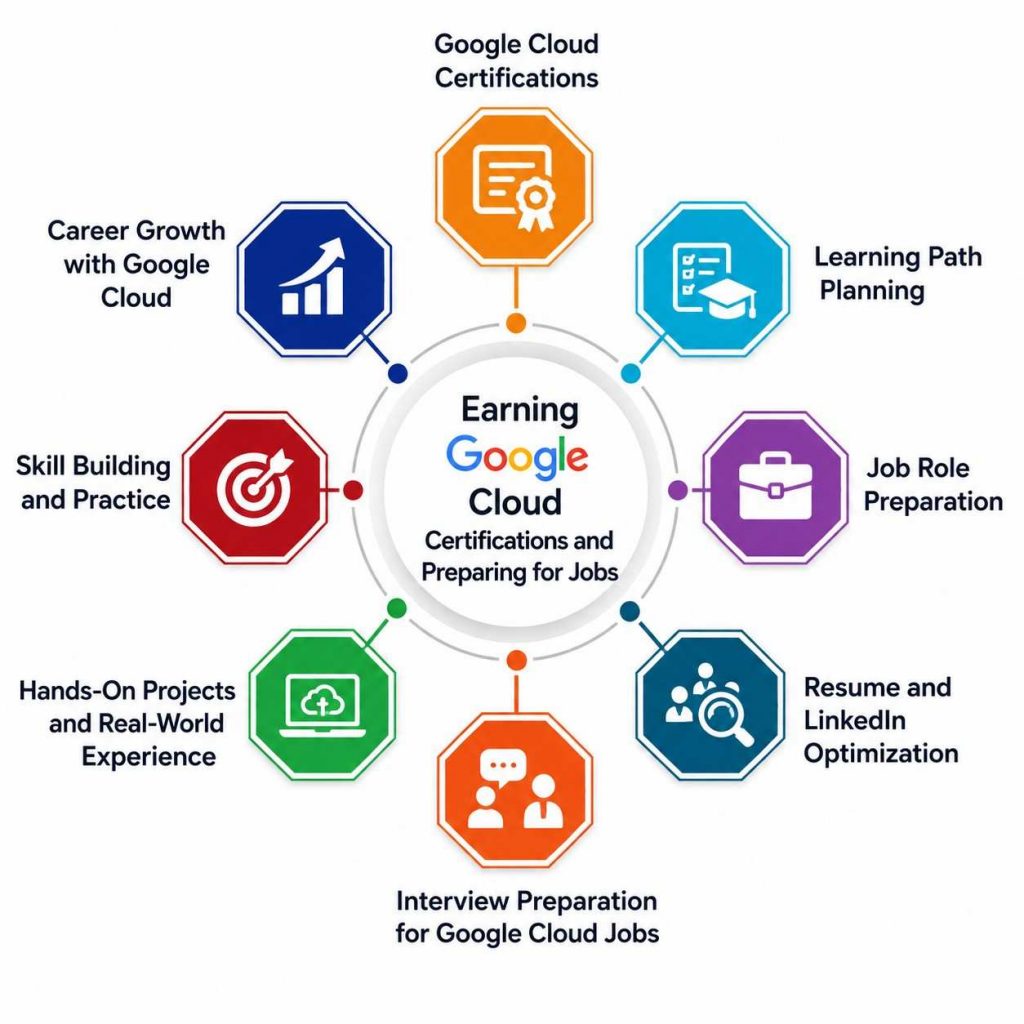
Earning relevant Google Cloud certifications can help freshers validate their cloud knowledge and demonstrate their commitment to developing industry-ready skills. Beginners can start by understanding fundamental cloud concepts before progressing toward certifications aligned with their desired career path, such as cloud engineering, data engineering, or cloud development. However, certification preparation should be combined with practical experience because employers value the ability to apply concepts in real-world situations. Freshers should practice using Google Cloud services, complete hands-on labs, build projects, and become comfortable with tools such as Compute Engine, Cloud Storage, BigQuery, Cloud Run, Kubernetes, and other services relevant to their chosen specialization.
Conclusion: Starting a Successful Google Cloud Career as a Fresher
Starting a successful Google Cloud career as a fresher requires a combination of strong fundamentals, practical experience, continuous learning, and focused career preparation. Candidates should begin by understanding cloud computing concepts and gradually develop expertise in Google Cloud services, infrastructure, networking, data analytics, Artificial Intelligence, DevOps, Kubernetes, and security based on their career interests. Hands-on projects are especially valuable because they allow freshers to apply theoretical concepts while building confidence with real cloud environments. Relevant Google Cloud certifications can further strengthen a candidate’s profile, but they should complement practical skills rather than replace them. A well-prepared resume, professional online presence, and organized technical portfolio can help candidates showcase their capabilities to potential employers. Freshers should also regularly practice technical and scenario-based interview questions while improving their communication and problem-solving abilities. Since cloud technologies continue to evolve, staying updated with new services and industry practices is essential for long-term growth. With consistent practice, meaningful projects, relevant certifications, and a willingness to learn, aspiring cloud professionals can build a strong foundation and pursue rewarding career opportunities in the Google Cloud ecosystem.