LMS
Last updated on 07th Oct 2026| 13417

- Introduction to AI Coding Tools and Their Impact on the Tech Industry
- How AI Coding Assistants Are Transforming Software Development
- Top AI Coding Tools Developers and AI Professionals Should Know
- AI-Powered Code Generation, Debugging, and Testing
- Impact of AI Coding Tools on Software Developer Job Roles
- How AI Coding Tools Are Changing Artificial Intelligence Careers
- Essential Programming and AI Skills for the Future Workforce
- Benefits and Challenges of Using AI Coding Assistants
- Future Career Opportunities in AI-Assisted Software Engineering
- Conclusion: Preparing for the Future of Software and AI Careers
Introduction to AI Coding Tools and Their Impact on the Tech Industry
AI coding tools are transforming the technology industry by helping developers write code, identify errors, automate repetitive tasks, and improve software development workflows. Tools powered by large language models can generate code snippets, explain complex programming concepts, suggest improvements, and assist with debugging across multiple programming languages. Professionals looking to strengthen their understanding of these technologies can explore Artificial Intelligence Training to build relevant AI skills. These capabilities are changing how software teams plan, build, test, and maintain applications. Developers can use AI assistants to accelerate routine tasks while focusing more on system design, problem-solving, security, and business requirements. AI coding tools are also influencing careers in software engineering, data science, machine learning, and application development. However, generated code still requires human review because it may contain bugs, security vulnerabilities, outdated patterns, or incorrect assumptions. Professionals who combine programming fundamentals with effective AI tool usage, critical thinking, and code validation can adapt to evolving industry expectations and emerging technology opportunities.
How AI Coding Assistants Are Transforming Software Development
AI coding assistants are changing software development by supporting programmers throughout the development lifecycle, from planning and code generation to testing, documentation, and maintenance. They can suggest code completions, explain unfamiliar functions, generate unit tests, convert code between languages, and help developers understand existing codebases. Integrated development environments and AI-powered editors can also assist with multi-file changes, refactoring, and project navigation. These capabilities may reduce time spent on repetitive coding tasks and help teams explore solutions more efficiently. Developers looking to strengthen their technical knowledge can explore Top AI Tools Every Developer Should Know to discover tools that support coding and productivity. Junior developers can use AI tools to learn programming concepts, while experienced engineers can use them to review alternatives and speed up routine implementation. Nevertheless, developers must verify outputs, understand the code they accept, and ensure that applications meet performance, security, and quality requirements. AI assistance works best when combined with sound engineering practices and human judgment.
Get Your Artificial Intelligence Certification by Learning from Industry-Leading Experts and Advancing Your Career with ACTE’s Artificial Intelligence Course.
Top AI Coding Tools Developers and AI Professionals Should Know
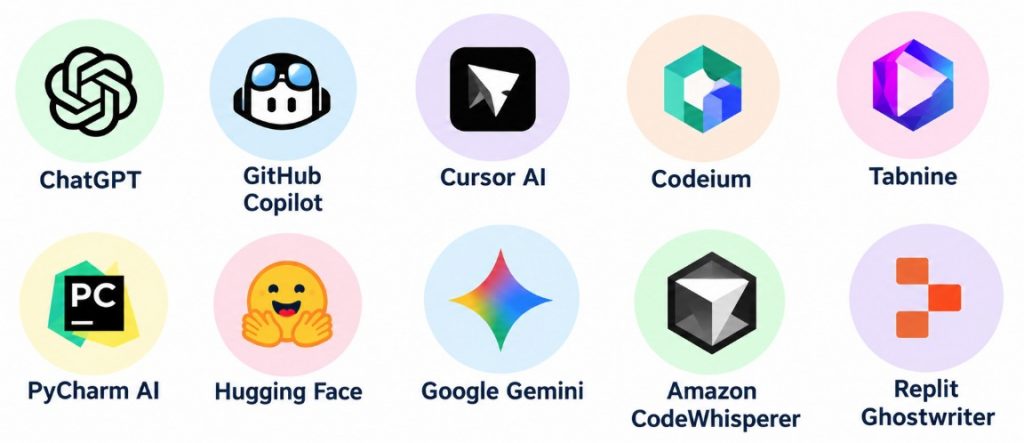
Several AI coding tools support different development workflows and professional requirements. GitHub Copilot offers code suggestions, explanations, and AI-assisted development features within supported environments. Cursor provides an AI-focused code editor designed to help developers work with codebases and make contextual changes. ChatGPT can assist with coding questions, debugging approaches, algorithm explanations, code reviews, and prototyping. Google Gemini offers coding assistance and integration with Google’s developer ecosystem, while Amazon Q Developer supports development workflows associated with AWS and other programming tasks.
AI-Powered Code Generation, Debugging, and Testing
AI-powered coding tools can generate functions, suggest implementation patterns, explain error messages, and help developers investigate software defects. By describing a requirement in natural language, developers can obtain an initial code draft and refine it to meet project specifications. Professionals seeking to strengthen their knowledge of AI technologies can explore Artificial Intelligence Training to develop relevant technical skills. AI assistants can also suggest unit tests, identify potential edge cases, explain stack traces, and recommend refactoring opportunities. In testing workflows, they may help create test cases, generate test data, and summarize failures. These capabilities can improve productivity, but generated code is not guaranteed to be correct, secure, efficient, or compatible with an existing system. Developers should run tests, inspect dependencies, validate input handling, and review performance and security implications before accepting changes. Human oversight remains essential for production software, especially in financial, healthcare, and other sensitive applications. Combining AI assistance with automated testing, code reviews, and established quality standards helps teams build more reliable applications.

Learn Artificial Intelligence Training Course to Build Your Skills
Weekday / Weekend BatchesSee Batch DetailsImpact of AI Coding Tools on Software Developer Job Roles
AI coding tools are changing software developer responsibilities by automating portions of routine implementation and shifting more attention toward architecture, requirements analysis, validation, and system-level problem-solving. Developers may spend less time writing repetitive boilerplate code and more time reviewing generated solutions, integrating services, improving application performance, and maintaining code quality. Full-stack developers can use AI assistance for frontend components, backend logic, API integration, and testing. Developers preparing for these evolving opportunities can explore How to Start an AI Career with No Experience to understand practical steps for building relevant skills and entering the AI field. QA engineers can explore AI-assisted test generation and defect analysis, while DevOps professionals may use AI features to interpret logs and improve automation workflows. These changes do not mean every software development role will disappear; their effects depend on the employer, project, technology, and level of responsibility. Strong programming fundamentals, debugging ability, system design, cybersecurity awareness, and communication remain valuable. Developers who learn to use AI tools responsibly while understanding the systems they build can adapt to changing engineering workflows.

Get JOB Oriented Artificial Intelligence Training for Beginners By MNC Experts
- Instructor-led Sessions
- Real-life Case Studies
- Assignments
How AI Coding Tools Are Changing Artificial Intelligence Careers
AI coding tools are influencing Artificial Intelligence careers by helping professionals prototype models, build data pipelines, develop APIs, and experiment with machine learning applications more efficiently. Professionals looking to build expertise in these technologies can explore Artificial Intelligence Training to strengthen their technical knowledge and practical skills. Data Scientists can use coding assistants to draft data-cleaning scripts, explore analysis methods, and understand unfamiliar libraries. Machine Learning Engineers may use them to develop training workflows, prepare tests, and troubleshoot deployment code. Generative AI Engineers can apply coding assistance when building LLM-powered applications, retrieval-augmented generation systems, and AI agents. These tools can lower the effort required for some implementation tasks, but they do not replace the need to understand mathematics, statistics, data quality, model evaluation, and responsible AI. AI professionals must verify generated code, assess model behavior, protect sensitive information, and test systems against real requirements. Expertise in machine learning, cloud infrastructure, data engineering, evaluation, and production deployment remains important for developing dependable AI solutions.
Want to Master Artificial Intelligence? Explore the Artificial Intelligence Master Program Offered at ACTE Today!
Essential Programming and AI Skills for the Future Workforce
The growing use of AI coding tools makes strong technical foundations more important, not less. Developers should understand programming concepts, data structures, algorithms, debugging, version control, databases, APIs, testing, and software design. Python, JavaScript, Java, C#, or other languages may be useful depending on a person’s career path. AI-focused professionals should also learn statistics, machine learning, data processing, model evaluation, and the principles behind generative AI. Prompting skills can help users provide clear requirements and context, but effective AI-assisted development also requires checking assumptions and identifying errors. Knowledge of Git, CI/CD, cloud platforms, cybersecurity, and deployment practices helps professionals integrate generated code into real projects. Developers interested in applying these capabilities can explore Becoming an AI Engineer to understand the skills and learning stages involved in pursuing an AI engineering career. Communication, critical thinking, adaptability, and domain knowledge are equally valuable because developers must translate business needs into reliable technical solutions. A combination of coding ability and responsible AI usage can support long-term career development.
Want to Learn About AI? Explore Our Artificial Intelligence Interview Questions and Answers Featuring the Most Frequently Asked Questions in Job Interviews.
Benefits and Challenges of Using AI Coding Assistants
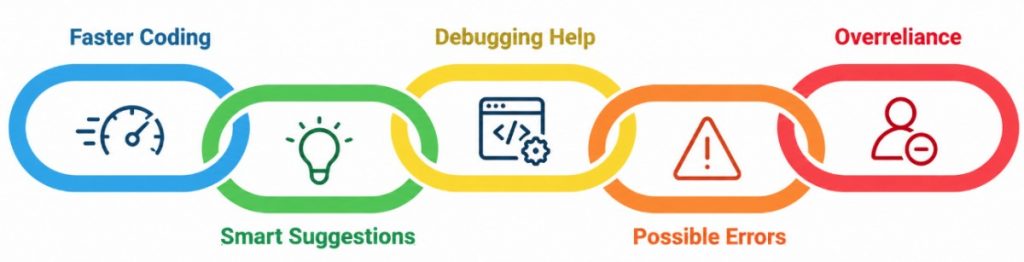
AI coding assistants can improve productivity by suggesting code, explaining programming concepts, generating documentation, supporting debugging, and helping developers explore alternative implementations. They can also make learning more interactive by providing examples and explanations for unfamiliar technologies. However, these tools have limitations. They may generate incorrect code, overlook edge cases, recommend insecure approaches, or misunderstand a project’s architecture. Developers can strengthen their understanding of practical AI applications by exploring Top 10 Real-Life Applications of AI and learning how AI technologies are applied across different industries.
Future Career Opportunities in AI-Assisted Software Engineering
AI-assisted software engineering is likely to create evolving opportunities for professionals who combine software development expertise with AI-enabled workflows. Developers can specialize in AI-integrated applications, intelligent automation, developer tools, cloud-native systems, AI testing, and software platform engineering. Professionals interested in developing these capabilities can explore Artificial Intelligence Training to strengthen their understanding of AI technologies and practical applications. Organizations may also need engineers who can evaluate AI-generated code, design secure development workflows, integrate models into business systems, and monitor the quality of AI-assisted applications. Generative AI development, MLOps, AI infrastructure, data engineering, and AI security offer additional pathways for professionals with relevant technical foundations. Career opportunities will vary according to market demand, business investment, and technological change, so no particular role or salary is guaranteed. Building projects that demonstrate programming, testing, API integration, deployment, and responsible AI usage can help candidates showcase practical skills. Continuous learning and strong engineering judgment will remain important as AI capabilities and software development practices evolve.