LMS
Last updated on 07th Oct 2026| 11596

- Introduction to the Future Demand for Data Scientists
- Why Data Science Careers Are Growing Across Industries
- Impact of Artificial Intelligence and Machine Learning on Data Science Jobs
- Emerging Data Science Job Roles and Career Opportunities
- Essential Python, SQL, Statistics, and Machine Learning Skills
- Generative AI, Deep Learning, and Predictive Analytics Career Paths
- Cloud Computing, Big Data, and MLOps Technologies
- Data Scientist Salary Trends and Future Compensation Factors
- Future Career Growth and Industry Demand for Data Science Professionals
- Conclusion: Preparing for Long-Term Success in Data Science Careers
Introduction to the Future Demand for Data Scientists
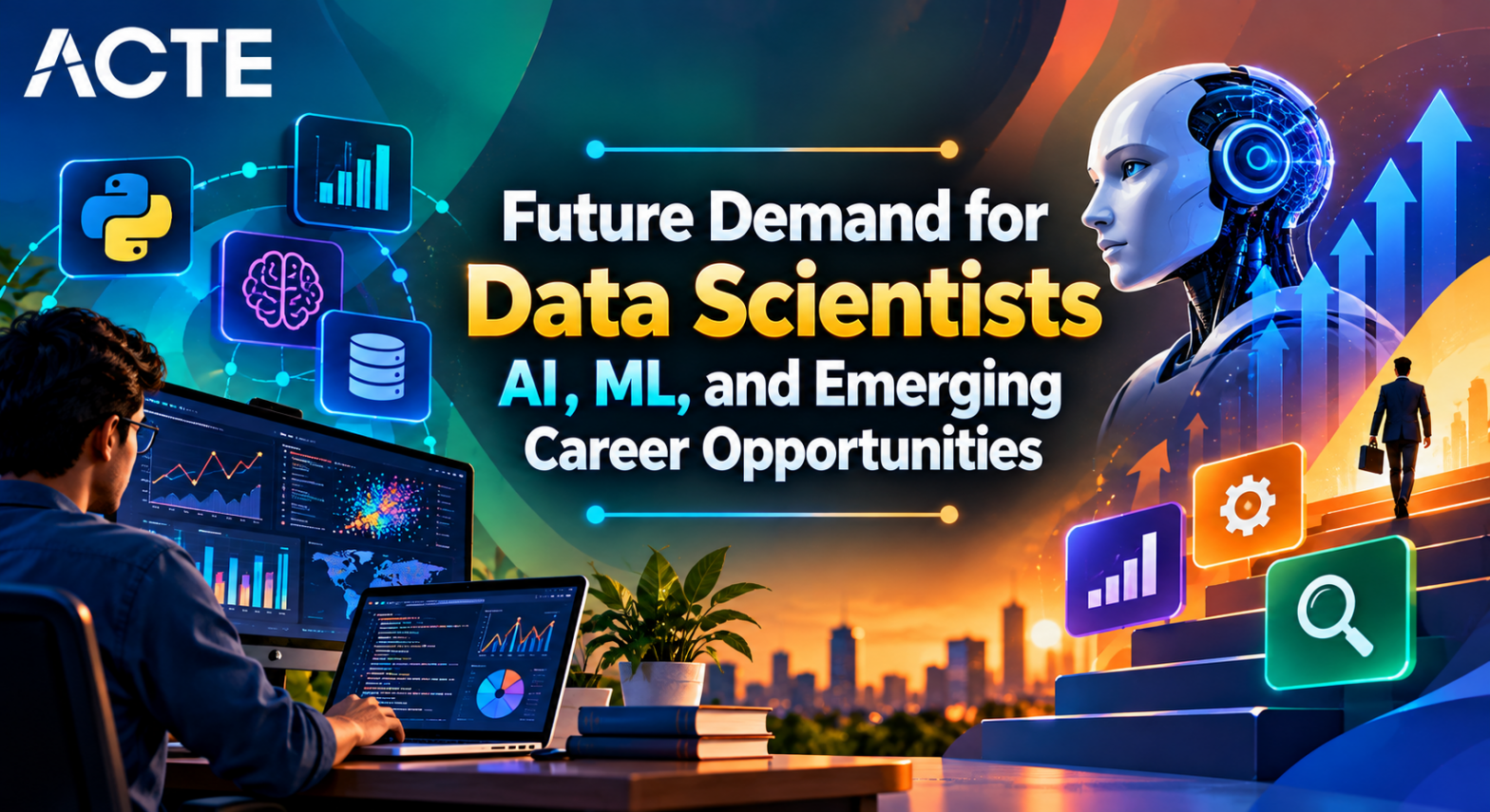
The future demand for Data Scientists is being influenced by the growing adoption of artificial intelligence, machine learning, advanced analytics, and data-driven decision-making across industries. Organizations increasingly rely on data professionals to analyze complex datasets, identify business trends, develop predictive models, and support strategic planning. Data Scientists can explore opportunities in IT, healthcare, banking, finance, retail, manufacturing, telecommunications, and consulting. Emerging technologies such as generative AI, deep learning, cloud computing, and intelligent automation are also changing the skills required for data science careers. Professionals should develop strong foundations in Python, SQL, statistics, machine learning, and data visualization. Aspiring candidates can strengthen these skills through Data Science Training while gaining practical experience through real-world projects. Continuous learning and the ability to solve real business problems can help candidates prepare for long-term opportunities in this evolving field.
Why Data Science Careers Are Growing Across Industries
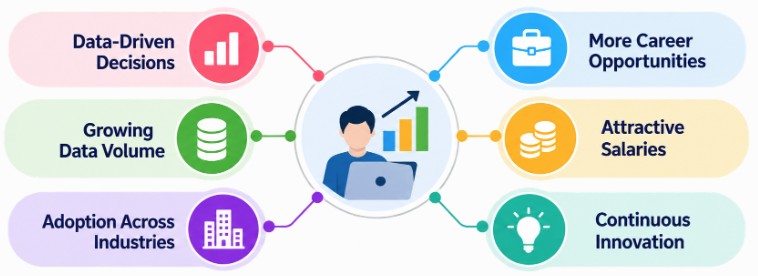
- Expansion of Artificial Intelligence: Businesses are integrating AI and machine learning into products and operations. Data Scientists contribute by preparing datasets, developing predictive models, evaluating algorithms, and supporting intelligent applications.
- Growth of Cloud-Based Analytics: Cloud platforms provide scalable environments for storing, processing, and analyzing large datasets. This creates opportunities for professionals familiar with cloud analytics, distributed processing, and machine learning services.
- Increasing Adoption of Data-Driven Decisions: Organizations use data analytics to understand customer behavior, monitor performance, improve operations, and identify business opportunities. Data Scientists help convert complex information into meaningful insights that support strategic decisions. Developing practical expertise through Top Trending Skills in Data Science for Jobs can help aspiring professionals prepare for these opportunities.
- Demand for Predictive Analytics: Companies use predictive models to forecast sales, identify risks, anticipate customer needs, and optimize resources. Data Scientists with forecasting and statistical modeling expertise can support these initiatives.
- Digital Transformation Across Industries: Banking, healthcare, manufacturing, retail, and technology organizations are modernizing their digital systems. Data Science professionals help these businesses improve efficiency through analytics, automation, and intelligent solutions.
Get Your Data Science Certification by Learning from Industry-Leading Experts and Advancing Your Career with ACTE’s Data Science Training.
Impact of Artificial Intelligence and Machine Learning on Data Science Jobs
Artificial Intelligence and Machine Learning are reshaping Data Science careers by expanding the types of problems professionals can solve and automating portions of traditional analytical workflows. Machine learning enables organizations to develop predictive models, recommendation engines, fraud detection systems, and intelligent business applications. Generative AI introduces additional opportunities involving large language models, document intelligence, semantic search, and automated information processing. Data Scientists increasingly need to understand model evaluation, feature engineering, deep learning, cloud infrastructure, and responsible AI practices. Candidates looking to build expertise in these areas can explore Data Science Training to develop relevant technical knowledge and practical skills. Although AI tools can automate some routine data preparation, coding, and reporting activities, professionals remain important for defining business problems, validating results, identifying data limitations, and evaluating model reliability. Candidates who combine statistical reasoning with modern AI technologies, software development, and business knowledge can prepare for specialized positions in machine learning engineering, applied AI, advanced analytics, and AI solution development.
Emerging Data Science Job Roles and Career Opportunities
| Job Role | Key Responsibilities | Essential Skills |
|---|---|---|
| Data Scientist | Analyzes datasets, develops predictive models, and generates business insights. | Python, SQL, Statistics, Machine Learning |
| Machine Learning Engineer | Builds, optimizes, and deploys machine learning models. | Scikit-learn, PyTorch, TensorFlow |
| Generative AI Engineer | Develops intelligent applications using generative models and LLMs. | LLMs, RAG, Prompt Engineering, APIs |
| AI Research Scientist | Investigates new algorithms, modeling approaches, and AI techniques. | Mathematics, Deep Learning, Research |
| MLOps Engineer | Automates model deployment, monitoring, and machine learning pipelines. | Docker, Kubernetes, CI/CD, Cloud |
| NLP Engineer | Develops language-processing applications and intelligent text systems. | NLP, Transformers, Embeddings |
| Computer Vision Engineer | Creates AI applications for image and video analysis. | OpenCV, CNNs, PyTorch |
| Data Science Consultant | Applies analytics and predictive modeling to business challenges. | Analytics, Communication, Domain Knowledge |
| AI Solutions Architect | Designs scalable AI systems and enterprise machine learning solutions. | Cloud AI, Architecture, MLOps |

Essential Python, SQL, Statistics, and Machine Learning Skills
- SQL and Database Management: SQL helps Data Scientists retrieve, filter, join, and analyze information stored in relational databases. Important concepts include joins, aggregations, subqueries, Common Table Expressions, and window functions.
- Statistics and Probability: Statistical knowledge supports data interpretation and reliable analytical conclusions. Professionals should understand probability distributions, hypothesis testing, sampling, correlation, regression, and confidence intervals.
- Python Programming for Data Science: Python is widely used for data manipulation, statistical analysis, automation, and machine learning. Professionals should understand programming fundamentals, functions, data structures, and libraries such as pandas, NumPy, and Scikit-learn. Beginners can strengthen these foundations by exploring Getting Started with Python for Data Science.
- Machine Learning Algorithms: Candidates should learn supervised and unsupervised learning, classification, regression, clustering, decision trees, ensemble methods, and model evaluation to develop predictive analytical solutions.
- Data Cleaning and Feature Engineering: Data Scientists must prepare datasets by handling missing values, duplicates, inconsistent formats, and outliers. Feature engineering helps transform raw information into useful inputs for machine learning models.

Get JOB Oriented Data Science Training for Beginners By MNC Experts
- Instructor-led Sessions
- Real-life Case Studies
- Assignments
Generative AI, Deep Learning, and Predictive Analytics Career Paths
- Deep Learning Development: Deep Learning professionals design neural networks for complex analytical problems. They work with architectures such as CNNs and transformers using frameworks including TensorFlow and PyTorch.
- Predictive Analytics Specialization: Predictive Analytics Specialists develop statistical and machine learning models to forecast business outcomes. Applications include demand forecasting, customer churn prediction, financial risk analysis, and maintenance planning.
- Generative AI Engineering: Generative AI Engineers develop applications using foundation models, and prompt engineering. Their work includes conversational assistants and content-generation systems. Professionals interested in expanding their expertise can explore the Role of Machine Learning in Data Science to understand how intelligent models support modern AI applications.
- Natural Language Processing Careers: NLP professionals develop systems for text classification, information extraction, sentiment analysis, summarization, semantic search, and language understanding using modern AI techniques.
- AI Research and Applied Machine Learning: Research-oriented professionals investigate new algorithms, evaluate model performance, and develop advanced approaches to complex problems. These roles may require deeper mathematical knowledge and specialized research experience.
Want to Master Gen AI? Explore the Data Science Master Program Offered at ACTE Today!
Cloud Computing, Big Data, and MLOps Technologies
| Technology | Importance in Data Science | Key Tools and Platforms |
|---|---|---|
| Cloud Computing | Provides scalable infrastructure for data processing, machine learning, and deployment. | AWS, Microsoft Azure, Google Cloud |
| Big Data Processing | Supports analysis of large datasets across distributed computing environments. | Apache Spark, Hadoop |
| Cloud Data Warehousing | Enables structured storage, querying, and analysis of enterprise datasets. | BigQuery, Snowflake, Amazon Redshift |
| MLOps | Supports model lifecycle management, automated workflows, and production reliability. | MLflow, Kubeflow |
| Containerization | Packages applications and dependencies for consistent deployment. | Docker, Kubernetes |
| Data Pipelines | Automates data extraction, transformation, processing, and delivery. | Apache Airflow, Spark |
| Model Deployment | Makes machine learning models available to business applications. | FastAPI, Cloud Model Endpoints |
| Monitoring and Governance | Helps maintain model performance, data quality, security, and operational reliability. | Monitoring Tools, Model Registries |
Data Scientist Salary Trends and Future Compensation Factors
Data Scientist salaries vary according to professional experience, employer, technical specialization, geographic location, and the complexity of project responsibilities. Entry-level professionals may begin with data preparation, exploratory analysis, reporting, and basic predictive modeling, while experienced Data Scientists can manage advanced machine learning solutions, model deployment, experimentation, and enterprise analytics initiatives. Expertise in generative AI, deep learning, cloud computing, MLOps, natural language processing, and large-scale data engineering can expand access to specialized positions. Professionals who want to strengthen their technical foundation can explore Data Science Training to develop relevant skills for evolving industry requirements. Professionals who demonstrate strong Python, SQL, statistics, software engineering, and business problem-solving abilities may qualify for broader technical responsibilities. Compensation can also differ between IT service companies, consulting organizations, product companies, startups, and global capability centers. As professionals progress toward Senior Data Scientist, Machine Learning Lead, AI Architect, or Analytics Manager positions, leadership and solution-design responsibilities become increasingly important. Actual salary growth depends on individual performance, market conditions, employer requirements, and demonstrated expertise.
Want to Learn About Data Science? Explore Our Data Science Interview Questions and Answers Featuring the Most Frequently Asked Questions in Job Interviews.
Future Career Growth and Industry Demand for Data Science Professionals
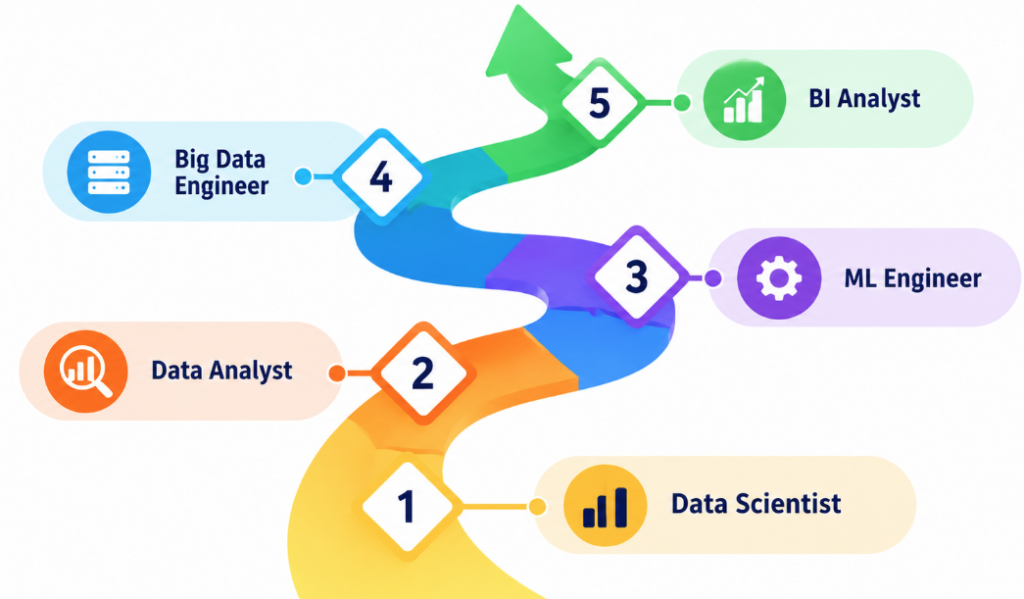
- Machine Learning and AI Architecture: Professionals with strong model development, deployment, cloud, and system-design expertise can pursue Machine Learning Architect or AI Solutions Architect roles involving enterprise-scale intelligent systems.
- Generative AI and LLM Specialization: Growing interest in generative AI creates opportunities for professionals skilled in LLM applications, RAG, vector databases, model evaluation, agentic workflows, and enterprise AI integration.
- Senior Data Scientist and Analytics Lead: Experienced Data Scientists can progress into senior analytical positions involving complex modeling, project ownership, technical mentoring, and strategic decision support across business functions. Understanding Data Science Roles Explained can help professionals identify suitable career progression opportunities.
- Data Science Management and Leadership: Professionals who combine technical expertise with communication, project management, and stakeholder coordination can move toward Analytics Manager, Data Science Manager, or AI Engineering leadership roles.
- Industry-Specific Data Science Careers: Domain specialization in healthcare, finance, manufacturing, retail, or telecommunications can help professionals solve industry-specific problems and develop differentiated career expertise.
Conclusion: Preparing for Long-Term Success in Data Science Careers
Preparing for long-term success in Data Science requires professionals to continuously strengthen their technical foundations while adapting to emerging technologies and industry requirements. Candidates should begin with Python, SQL, statistics, data cleaning, visualization, and machine learning before advancing toward deep learning, generative AI, predictive analytics, cloud computing, and MLOps. Practical projects involving forecasting, recommendation systems, classification, NLP, and AI applications can demonstrate the ability to solve real-world problems. Candidates can build these capabilities through Data Science Training alongside hands-on projects and continuous practice. Certifications, internships, research activities, and professional experience can further support career development. As organizations increasingly integrate analytics and AI into business processes, Data Scientists who understand both technical methods and business objectives can explore diverse career opportunities. Developing strong problem-solving, communication, model evaluation, responsible AI, and deployment skills can help professionals remain competitive and pursue sustainable careers across data science, machine learning, and artificial intelligence.