LMS
Last updated on 01st Oct 2026| 8342

- Introduction to Data Science Skills Required by Leading MNCs
- Why MNCs Prefer Freshers with Strong Data Science Fundamentals
- Essential Python Programming and Data Manipulation Skills
- SQL, Database Management, and Data Querying Skills
- Statistics, Probability, and Mathematical Skills for Data Science
- Machine Learning Algorithms and Model Evaluation Techniques
- Data Visualization, Power BI, Tableau, and Reporting Skills
- Generative AI, Cloud Computing, and Emerging Data Science Tools
- Real-World Projects, Certifications, Communication, and Interview Preparation
- Conclusion: Building Job-Ready Data Science Skills for MNC Careers
Introduction to Data Science Skills Required by Leading MNCs
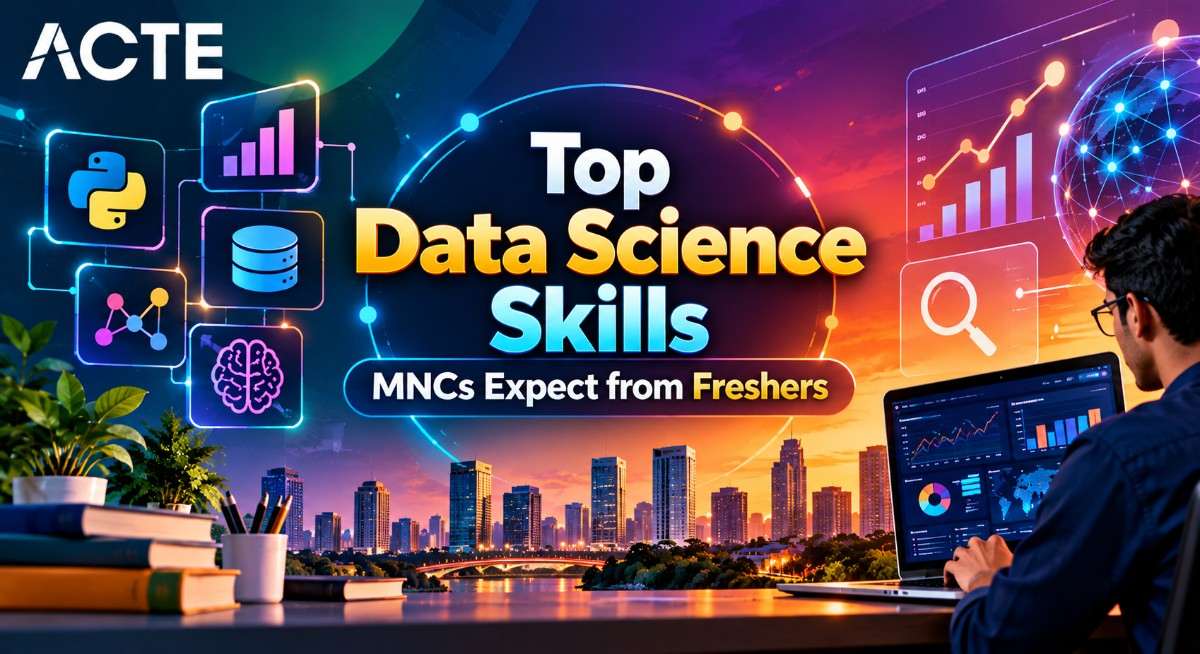
Data Science has become an important business function across technology, banking, healthcare, retail, manufacturing, consulting, and e-commerce industries. Multinational companies use data to understand customer behavior, improve operational efficiency, identify business opportunities, and support strategic decisions. As a result, freshers applying for entry-level Data Science positions need a combination of programming knowledge, statistical understanding, analytical thinking, and practical problem-solving skills. Python, SQL, machine learning, data visualization, and data cleaning are among the essential areas candidates should develop. Employers also value the ability to explain technical findings in simple business language. Freshers looking to strengthen their technical knowledge can explore Data Science Training to build practical skills and gain exposure to industry-relevant tools. Familiarity with cloud platforms, generative AI, and modern data tools can provide additional advantages, depending on the role. Freshers do not need to master every technology before applying, but they should demonstrate strong fundamentals through practical projects, internships, and well-documented portfolios. Understanding these expectations helps candidates prepare for technical assessments, interviews, and real-world Data Science responsibilities.
Why MNCs Prefer Freshers with Strong Data Science Fundamentals
Leading companies seek freshers who can understand business problems, work with data, and learn new technologies quickly. Strong fundamentals help employees clean datasets, identify patterns, develop analytical solutions, and interpret results without depending entirely on ready-made tools. Employers may assess a candidate’s logical reasoning, programming ability, statistical knowledge, and understanding of machine learning concepts during recruitment. They also look for curiosity, attention to detail, teamwork, and communication skills because Data Science projects often involve collaboration with engineers, analysts, managers, and business stakeholders. Freshers can strengthen these abilities by learning the Data Science for jobs and internships and applying them through practical projects.
- Problem-Solving and Analytical Thinking: Freshers should be able to break complex business questions into smaller steps, identify relevant data, test assumptions, and explain conclusions supported by evidence.
- Adaptability and Continuous Learning: Data Science tools evolve rapidly. Candidates who can learn new libraries, understand unfamiliar datasets, and adapt to changing project requirements are better prepared for professional environments.
- Business Understanding: Technical results become more useful when candidates understand the business objective behind an analysis, such as reducing customer churn, improving sales forecasts, or identifying operational inefficiencies.
Essential Python Programming and Data Manipulation Skills
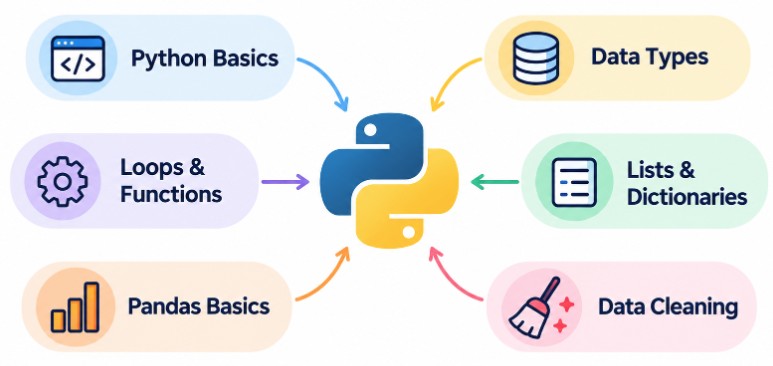
Python is a fundamental programming language for Data Science, enabling freshers to analyse datasets, automate tasks, and develop data-driven solutions. Candidates should understand variables, data types, loops, functions, conditional statements, and error handling. Familiarity with libraries such as Pandas and NumPy is equally important for processing numerical data, cleaning datasets, handling missing values, filtering records, merging tables, and calculating summary statistics.
SQL, Database Management, and Data Querying Skills
SQL is an essential skill for Data Science freshers because business information is frequently stored in relational databases. Candidates should know how to retrieve relevant records, combine tables and organize query results for analysis. Understanding database structure also helps them work with real-world datasets that contain multiple related tables. Freshers can strengthen these technical abilities through Data Science Training, which can help them develop practical knowledge of databases, analytical tools, and industry-relevant techniques.
Core SQL Concepts for Freshers
- SELECT, WHERE, and ORDER BY: Retrieve, filter, and sort records based on specific requirements.
- GROUP BY and aggregate functions: Calculate totals, averages, counts, minimums, and maximums.
- JOIN operations: Combine information from related tables using appropriate keys.
- Subqueries and Common Table Expressions: Break complex queries into manageable steps.
- Window functions: Calculate rankings, running totals, and comparisons across groups of records.
Freshers should practise writing queries using realistic business questions, such as finding monthly revenue, identifying repeat customers, comparing product performance, and measuring customer retention. Knowledge of primary keys, foreign keys, indexes, and basic database normalization is also useful. These capabilities help candidates prepare for SQL assessments and perform data extraction tasks in professional projects.
Statistics, Probability, and Mathematical Skills for Data Science
Statistics and mathematics help Data Scientists understand patterns, measure uncertainty, and make evidence-based conclusions. Freshers should learn descriptive statistics, probability, distributions, correlation, sampling, hypothesis testing, and confidence intervals. Basic linear algebra and calculus also support understanding of machine learning algorithms as candidates progress toward advanced modelling techniques. A strong mathematical foundation helps professionals distinguish meaningful patterns from random variation and interpret model results appropriately. Exploring the role of machine learning in Data Science can further help freshers understand how these mathematical concepts contribute to predictive models and data-driven decisions.
Key Statistical Concepts
- Descriptive statistics: Mean, median, mode, variance, and standard deviation summarize and describe datasets.
- Probability distributions: Normal, binomial, and other distributions help explain uncertainty and data behavior.
- Hypothesis testing: Supports structured investigation of questions using sample data.
- Correlation and regression: Help examine relationships between variables and estimate outcomes.
- Sampling and confidence intervals: Help evaluate how well sample-based findings may represent a larger population.
Machine Learning Algorithms and Model Evaluation Techniques
Machine learning is a major component of many Data Science roles. Freshers should understand how models learn from data, how training and testing datasets are used, and why model performance must be evaluated before deployment. They should begin with fundamental supervised and unsupervised learning methods before exploring advanced deep learning or generative AI techniques. Employers may expect candidates to explain the purpose of an algorithm, its assumptions, and the situations in which it is useful. Understanding Data Science skills to learn can help aspiring professionals build a stronger foundation in algorithm selection and predictive modelling.
Important Machine Learning Algorithms
- Linear and logistic regression: Used for predicting numerical outcomes and classifying categories.
- Decision trees and random forests: Support prediction through decision rules and combinations of trees.
- K-means clustering: Groups similar observations based on selected features.
- Support Vector Machines: Can classify data by identifying separating boundaries.
- Gradient boosting: Combines models to improve predictive performance on many structured-data problems.
Model Evaluation Metrics
Candidates should understand accuracy, precision, recall, F1-score, confusion matrices, and ROC-AUC for classification tasks. For regression, useful metrics include mean absolute error, mean squared error, and root mean squared error. They should also learn train-test splitting, cross-validation, overfitting, underfitting, and data leakage. Choosing a suitable metric depends on the problem; for example, fraud detection may require careful attention to recall and false positives rather than accuracy alone.
Data Visualization, Power BI, Tableau, and Reporting Skills
Data visualization helps transform complex datasets into clear information that business teams can understand and act upon. Freshers should know how to select suitable charts, identify trends, compare categories, and communicate findings through dashboards and reports. Python visualization libraries are useful for exploratory analysis, while Power BI and Tableau are commonly used for interactive business reporting. Excel remains valuable for quick calculations, data checks, and spreadsheet-based analysis. Practising Data Science tools and technologies can help aspiring professionals develop practical reporting skills and prepare for data-driven roles in MNCs.
Common Visualization Tools and Their Uses
| Tool | Key Skills | Practical Application |
|---|---|---|
| Microsoft Excel | Formulas, PivotTables, charts, data cleaning | Quick analysis and reporting |
| Power BI | Data modelling, DAX, interactive dashboards | Business performance monitoring |
| Tableau | Visual analytics, filters, dashboards | Exploring trends and comparisons |
| Matplotlib | Custom Python charts | Exploratory data analysis |
| Seaborn | Statistical visualizations | Distribution and relationship analysis |
Generative AI, Cloud Computing, and Emerging Data Science Tools
Modern Data Science increasingly involves cloud infrastructure, AI-assisted development, scalable data processing, and generative AI applications. Freshers can strengthen their profiles by understanding the basics of cloud platforms such as AWS, Microsoft Azure, and Google Cloud. They should also explore how data pipelines, storage systems, notebooks, and model deployment services fit into a typical workflow. To develop practical knowledge of these technologies and industry-relevant skills, candidates can explore Data Science Training. Familiarity with generative AI concepts can be useful for roles involving intelligent applications, document analysis, and natural-language interfaces.
Emerging Technologies to Explore
- Generative AI and large language models: Understand common use cases, limitations, and output evaluation.
- Retrieval-Augmented Generation (RAG): Learn how applications retrieve relevant documents to ground AI-generated responses.
- Cloud computing: Explore data storage, managed databases, analytics services, and model deployment.
- Apache Spark: Understand distributed data processing for large datasets.
- Git and GitHub: Track code changes, collaborate with teammates, and maintain project repositories.
- MLflow and related MLOps tools: Explore experiment tracking, model management, and reproducible workflows.
Real-World Projects, Certifications, Communication, and Interview Preparation
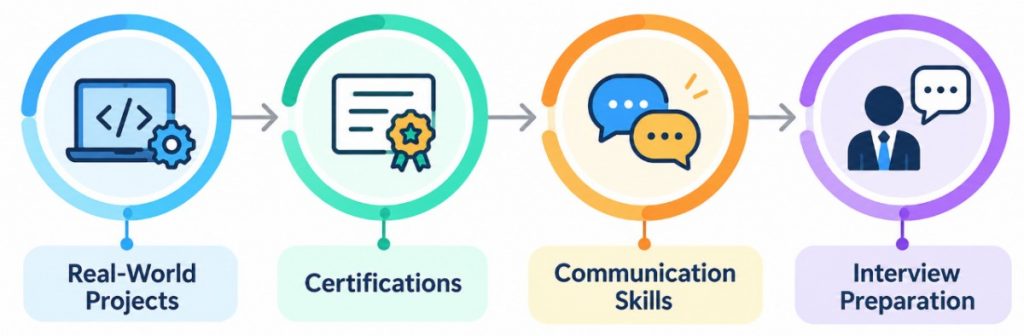
Practical experience helps freshers demonstrate that they can apply technical concepts to real problems. Academic assignments and online courses can provide a foundation, but employers may also look for independent projects that show data preparation, analysis, model development, evaluation, and communication. A portfolio on GitHub or a personal website can help recruiters review the candidate’s work. Certifications can demonstrate structured learning, but they are most valuable when supported by practical skills. Following a Data Science internship guide can help candidates organise their projects, strengthen their resumes, and improve their readiness for entry-level opportunities.
Recommended Data Science Projects
- Sales Analysis: Clean transaction data, identify revenue trends, and create a business dashboard.
- Customer Churn Prediction: Train a classification model and evaluate its performance using appropriate metrics.
- House Price Prediction: Apply regression techniques and compare prediction errors.
- Customer Segmentation: Use clustering to identify groups with similar purchasing behavior.
- Sentiment Analysis: Analyse text reviews and classify their sentiment using suitable NLP methods.
Communication and Interview Readiness
Freshers should be able to explain the problem, data, methods, assumptions, limitations, and findings for each project. Interview preparation should include Python coding, SQL queries, statistics, machine learning concepts, case-study questions, and project discussions. Candidates should also practise explaining technical results to non-technical audiences. A practical preparation plan is to build one complete project, document the workflow, publish the code, and prepare a short explanation of its business value. This gives interviewers evidence of both technical understanding and problem-solving ability.
Conclusion: Building Job-Ready Data Science Skills for MNC Careers
Preparing for Data Science roles at multinational companies requires a balanced combination of programming, database querying, visualization, and communication. Freshers should focus on mastering Python and SQL, understanding core statistics, and learning how to evaluate models before moving into advanced areas such as generative AI and MLOps. Practical projects are especially important because they demonstrate the ability to work with imperfect data, select appropriate methods and explain findings clearly. Candidates can strengthen their technical foundation and gain practical exposure through Data Science Training. Certifications can support learning, but they should not replace hands-on practice or a strong technical foundation. Candidates should also prepare for coding assessments, technical interviews, and business-oriented problem-solving exercises. By building a portfolio, practising consistently, and learning technologies aligned with their target roles, freshers can improve their readiness for entry-level Data Science opportunities and continue developing their skills as industry requirements evolve.