LMS
Last updated on 30th Sep 2026| 13317

- Introduction to the Future Demand for AI Professionals
- Growing Demand for AI Professionals Across Industries
- Emerging AI Job Roles and Career Opportunities
- Essential Technical Skills for AI Professionals
- AI Technologies Shaping Future Career Opportunities
- Industries Creating Demand for AI Talent
- Importance of Projects, Certifications, and Practical Experience
- Career Growth and Specialization in Artificial Intelligence
- Challenges and Changing Expectations for AI Professionals
- How to Prepare for a Career in the Growing AI Job Market
- Conclusion: Building a Future-Ready AI Career
Introduction to the Future Demand for AI Professionals
Artificial intelligence is becoming an important part of software development, business operations, data analysis, automation, cybersecurity, healthcare, finance, manufacturing, and other industries. As organizations adopt AI-powered applications and intelligent automation, demand is growing for professionals who can design, develop, deploy, monitor, and manage AI solutions. Aspiring professionals can strengthen their foundational knowledge through Artificial Intelligence Training while building practical skills for emerging career opportunities. The future AI job market includes opportunities across roles such as Machine Learning Engineer, AI Engineer, Data Scientist, NLP Engineer, Computer Vision Engineer, Generative AI Developer, and AI Researcher. Along with technical knowledge, employers increasingly look for skills in programming, mathematics, statistics, machine learning, deep learning, data handling, cloud platforms, and responsible AI practices. Professionals who combine these capabilities with practical project experience can explore opportunities across multiple sectors. At the same time, AI technologies continue to evolve, making continuous learning important for people entering or advancing in this field. Understanding emerging job roles, required skills, industry applications, and career development paths can help aspiring professionals prepare for the changing AI employment landscape.
Growing Demand for AI Professionals Across Industries
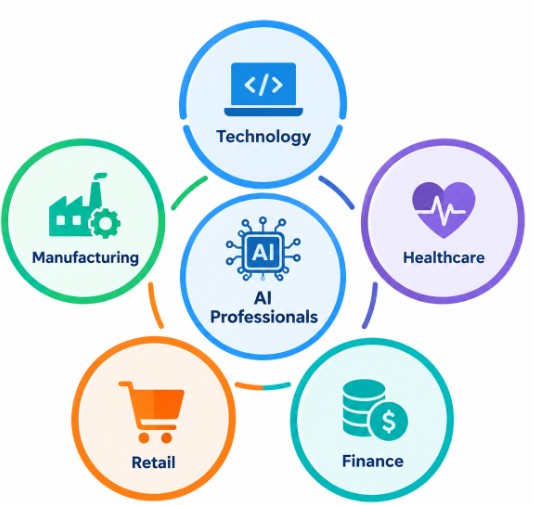
The demand for AI professionals is expanding as organizations increasingly use artificial intelligence to automate processes, analyze large datasets, improve customer experiences, detect patterns, and support business decision-making. Technology companies are developing AI-powered software, while industries such as healthcare, banking, finance, retail, manufacturing, telecommunications, logistics, and automotive are applying machine learning and automation to different business functions. Generative AI is also creating new requirements for professionals who can develop intelligent applications, work with large language models, build AI agents, manage model workflows, and integrate AI capabilities into existing systems. Organizations may require talent across development, data engineering, AI operations, research, security, and governance.
Get Your Artificial Intelligence Certification by Learning from Industry-Leading Experts and Advancing Your Career with ACTE’s Artificial Intelligence Course.
Emerging AI Job Roles and Career Opportunities
- AI Engineer: AI Engineers develop and integrate artificial intelligence solutions into applications and business systems. Their work can involve machine learning models, APIs, automation, and AI-powered features.
- Machine Learning Engineer: These professionals build, train, test, and deploy machine learning models. They may work with structured and unstructured data while improving model performance for practical applications.
- AI Researcher and Specialist: AI Researchers and specialized professionals explore new algorithms, model architectures, optimization methods, and applications while contributing to advancements in artificial intelligence. Beginners exploring these roles can use an AI Career Roadmap for Beginners to understand the skills, learning stages, and practical areas associated with different AI career paths.
- Data Scientist: Data Scientists use statistics, programming, data analysis, and machine learning techniques to identify patterns, generate insights, and support data-driven decision-making.
- Generative AI Developer: Generative AI Developers work with technologies such as large language models, retrieval-augmented generation, prompt engineering, AI agents, and model APIs to create intelligent applications.
- NLP and Computer Vision Engineer: NLP professionals develop systems that process and understand human language, while Computer Vision Engineers build solutions that analyze images, videos, and visual information.

Learn Artificial Intelligence Training Course to Build Your Skills
Weekday / Weekend BatchesSee Batch DetailsEssential Technical Skills for AI Professionals
- Mathematics and Statistics: Understanding probability, statistics, linear algebra, and basic calculus helps professionals understand machine learning algorithms, model evaluation, optimization, and data patterns.
- Machine Learning: Professionals should understand supervised and unsupervised learning, classification, regression, clustering, feature engineering, model evaluation, and common machine learning algorithms.
- Deep Learning: Knowledge of neural networks, convolutional neural networks, recurrent architectures, transformers, and frameworks such as TensorFlow or PyTorch can support advanced AI development.
- Programming: Strong programming fundamentals are important for AI development. Python is widely used for machine learning and AI application development, while knowledge of languages such as Java or C++ can also be useful for specific applications. Beginners can explore Essential Programming Languages for AI to understand which languages are commonly applied in AI development.
- Data Handling: Skills in SQL, data cleaning, preprocessing, exploratory analysis, data visualization, and working with structured and unstructured datasets are valuable for AI projects.
- Cloud and AI Tools: Familiarity with cloud platforms, model APIs, development environments, version control, MLOps tools, and AI libraries can help professionals build, deploy, monitor, and maintain AI solutions.
AI Technologies Shaping Future Career Opportunities
Advances in artificial intelligence are creating new areas of specialization and changing how professionals build their technical careers. Machine learning continues to support predictive analytics, recommendation systems and intelligent automation, while deep learning enables applications involving complex data such as images, audio, and text. Generative AI and large language models are expanding opportunities in content generation, conversational applications, document processing, and enterprise automation. Professionals looking to build practical knowledge across these areas can strengthen their foundation through Artificial Intelligence Training. AI agents are also being developed to perform multi-step tasks by connecting models with tools, data sources, and business applications. Natural language processing remains important for search, translation, sentiment analysis, and language-based applications, while computer vision supports areas such as medical imaging, quality inspection, security, and autonomous systems. Edge AI enables models to operate closer to devices and users, reducing the need to send all data to centralized systems. Professionals who understand these technologies, their practical applications, limitations, and deployment requirements can prepare for specialized roles as organizations continue to adopt AI across different business functions.

Get JOB Oriented Artificial Intelligence Training for Beginners By MNC Experts
- Instructor-led Sessions
- Real-life Case Studies
- Assignments
Industries Creating Demand for AI Talent
- Technology and Software: Software companies use AI for intelligent applications, automation, search, recommendation systems, developer tools, cybersecurity, and cloud-based services, creating opportunities for AI and machine learning professionals.
- Healthcare: AI is being applied to medical imaging, clinical data analysis, drug discovery, patient support, and administrative automation, requiring professionals with knowledge of AI, data, and healthcare applications.
- Banking and Finance: Financial organizations use AI for fraud detection, risk analysis, customer service, credit assessment, and transaction monitoring, creating demand for professionals who understand machine learning and data analytics.
- Telecommunications and Logistics: AI can support network optimization, customer service, demand forecasting, route planning, and operational automation, creating opportunities for professionals who can develop and deploy data-driven solutions. Exploring Top 10 Real-Life Applications of AI can also help learners understand how AI technologies are being applied across practical use cases and industries.
- Retail and E-Commerce: AI supports product recommendations, demand forecasting, customer personalization, inventory management, and conversational services, opening opportunities across data and AI development roles.
- Manufacturing and Automotive: Manufacturers use computer vision, predictive maintenance, robotics, quality inspection, and intelligent automation. Professionals with AI, IoT, robotics, and data skills can contribute to these applications.
Want to Master Artificial Intelligence? Explore the Artificial Intelligence Master Program Offered at ACTE Today!
Importance of Projects, Certifications, and Practical Experience
- Practical AI Projects: Building projects helps professionals apply concepts such as machine learning, deep learning, NLP, computer vision, or generative AI to practical problems. Projects can demonstrate coding ability, model development, data handling, and problem-solving skills.
- Industry-Relevant Experience: Internships, freelance assignments, research work, and professional projects can provide exposure to real datasets, development workflows, collaboration, testing, deployment, and business requirements.
- AI Certifications: Relevant certifications can provide structured learning and demonstrate knowledge of specific AI, machine learning, cloud, data, or generative AI technologies. Candidates can explore AI Certifications to Get Hired Faster to understand certification options that may align with different AI career directions.
- Portfolio Development: Maintaining a portfolio with project descriptions, source code, documentation, datasets, model results, and deployment details can help demonstrate practical capabilities beyond academic qualifications.
- Open-Source Contributions: Contributing to open-source AI libraries, tools, documentation, or community projects can provide experience with collaborative development, version control, code reviews, and real-world software practices.
- Continuous Learning: Since AI technologies evolve rapidly, professionals should regularly update their knowledge through technical courses, research papers, workshops, hands-on experimentation, and new AI development tools.
Career Growth and Specialization in Artificial Intelligence
Career development in artificial intelligence can take different directions as professionals gain technical knowledge, practical experience, and exposure to real-world projects. Beginners may start with roles involving data analysis, software development, machine learning support, or AI application development before moving into more specialized responsibilities. Professionals looking to strengthen their foundational and practical knowledge can consider Artificial Intelligence Training as part of their learning journey. With experience, professionals can focus on areas such as machine learning engineering, deep learning, natural language processing, computer vision, generative AI, AI agents, MLOps, AI security, or research. Specialization often depends on individual interests, existing programming and mathematical skills, project experience, and industry requirements. Professionals can also expand their responsibilities by learning cloud deployment, model monitoring, data engineering, system architecture, and responsible AI practices. Over time, experienced AI professionals may take on technical leadership, architecture, research, consulting, or specialized engineering responsibilities. Because AI technologies continue to develop, career growth also involves continuous learning and adapting to new frameworks, models, development methods, and industry applications.
Want to Learn About AI? Explore Our Artificial Intelligence Interview Questions and Answers Featuring the Most Frequently Asked Questions in Job Interviews.
Challenges and Changing Expectations for AI Professionals
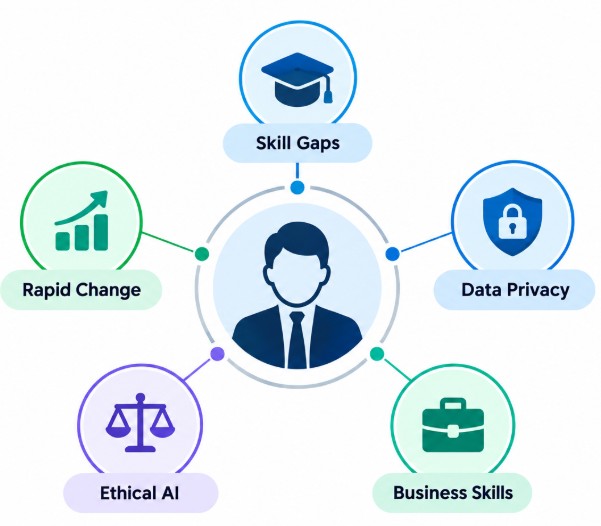
- Strong Technical Foundations: AI roles can require knowledge across programming, mathematics, statistics, data processing, machine learning, and software engineering. Building these fundamentals can take consistent practice and hands-on learning.
- Practical Implementation: Understanding AI concepts alone may not be sufficient for real-world projects. Professionals may need to work with imperfect datasets, deployment constraints, model performance issues, scalability requirements, and application integration.
- Rapid Technology Changes: AI frameworks, models, tools, and development practices evolve quickly. Professionals need to continuously update their technical knowledge to remain familiar with relevant technologies. Following Emerging AI Trends in the IT Industry can help learners understand how technologies and professional requirements are developing.
- Responsible AI: AI systems can raise concerns involving privacy, security, bias, transparency, data quality, and responsible use. Professionals increasingly need awareness of these considerations when designing and deploying AI solutions.
- Business Understanding: Organizations often expect AI solutions to address practical business requirements. Professionals may therefore need to understand domain problems, communicate technical findings, and connect AI capabilities with measurable objectives.
- Continuous Skill Development: As AI adoption expands, expectations can change across different roles. Learning new tools, experimenting with emerging technologies, building projects, and following industry developments can help professionals adapt to evolving requirements.
How to Prepare for a Career in the Growing AI Job Market
Preparing for a career in the growing AI job market requires a combination of technical knowledge, practical experience, and continuous learning. Aspiring professionals can begin by developing strong programming fundamentals, particularly in Python, along with data structures, algorithms, mathematics, and statistics. Building a solid understanding of machine learning, deep learning and model evaluation can provide a foundation for advanced AI work. Practical projects using real-world or publicly available datasets can help demonstrate skills in areas such as predictive modeling, natural language processing, computer vision and automation. Professionals can also strengthen their practical understanding through Artificial Intelligence Training while developing relevant technical and project-based skills. Professionals should also become familiar with relevant AI libraries, frameworks, cloud platforms, model APIs, version control, and deployment practices. Creating a portfolio with well-documented projects can help showcase technical capabilities and problem-solving approaches. Alongside technical development, improving communication, understanding business requirements, following AI research and industry developments, and regularly learning new tools can help professionals adapt to changing opportunities in the AI job market.