LMS
LMS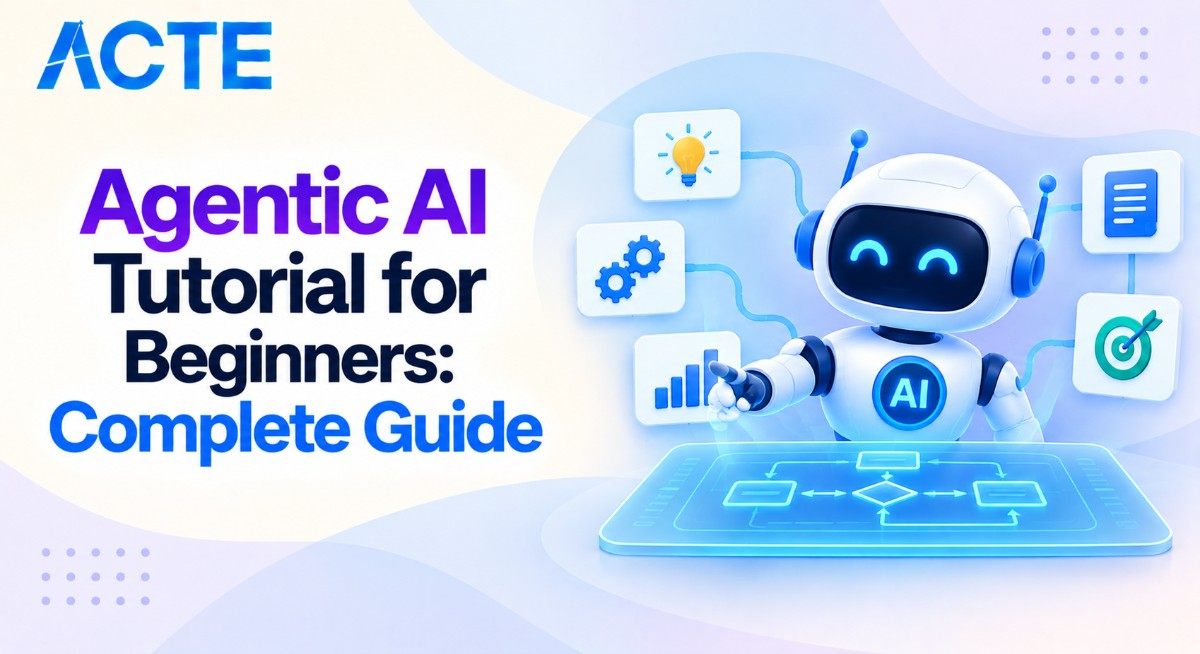
Last updated on 24th Sep 2026| 4628

- Introduction to Building a Lead Generation AI Agent Using Astra AI
- Understanding Astra AI and Its Role in Lead Generation
- Key Components of a Lead Generation AI Agent
- How a Lead Generation AI Agent Works with Astra AI
- Setting Up Astra AI for Lead Generation
- Step-by-Step Guide to Building a Lead Generation AI Agent
- Configuring Lead Research, Qualification, and Data Collection
- Testing, Optimizing, and Automating the AI Lead Generation Agent
- Conclusion and Next Steps for Building AI Lead Generation Agents
Introduction to Agentic AI Tutorial for Beginners
Agentic AI is an advanced approach to artificial intelligence where AI systems can understand goals, make decisions, create plans, use external tools, and perform actions with limited human intervention. Unlike traditional AI systems that mainly respond to individual prompts, AI agents can manage multiple connected steps and adjust their actions to achieve a specific objective. Agentic AI combines large language models, machine learning, reasoning, memory, planning, automation, APIs, and tool usage to handle complex tasks and workflows. These agents can collect information, analyze situations, select suitable actions, execute tasks, evaluate results, and refine their approach when required. For beginners, understanding these capabilities provides a strong foundation for learning how autonomous AI systems operate. Those who want to strengthen their broader AI fundamentals can also explore Artificial Intelligence Training to build relevant knowledge before progressing into advanced Agentic AI concepts. This tutorial explores Agentic AI concepts, architectures, workflows, tools, applications, development methods, real-world use cases, and responsible AI practices for building reliable and practical AI agents.
Foundations of Agentic AI
- AI Agents: AI agents are systems designed to understand goals, process information, make decisions, and perform actions to complete assigned tasks.
- Large Language Models: LLMs provide language understanding and reasoning capabilities that allow AI agents to interpret instructions and generate meaningful responses.
- Planning and Reasoning: Agentic AI can break complex goals into smaller steps, evaluate possible actions, and select suitable approaches to complete tasks effectively.
- Artificial Intelligence: AI enables machines to perform tasks that normally require human intelligence, including learning, reasoning, problem-solving, and decision-making. Beginners can strengthen their understanding of these concepts through an AI Tutorial for Beginners before exploring advanced agentic systems.
- Memory: Memory allows AI agents to retain relevant information from previous interactions, helping them maintain context and provide more consistent results.
- Tool Usage: AI agents can interact with external tools, APIs, databases, and applications to retrieve information or perform actions beyond basic text generation.
- Autonomous Actions: Agentic systems can execute multiple tasks with limited human intervention while evaluating progress and adjusting actions when necessary.
- Feedback and Learning: Agents can use task results and feedback to evaluate their performance, improve decision-making, and produce better outcomes over repeated workflows.
Understanding AI Agents and Their Core Components
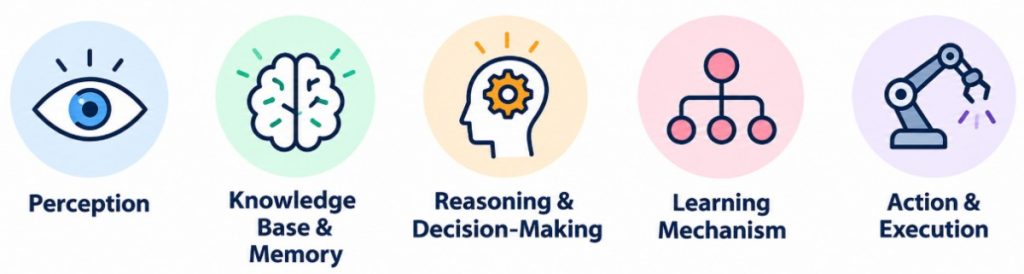
AI agents are intelligent systems designed to understand objectives, process information, make decisions, and perform actions to complete specific tasks. Their operation begins with perception, where they collect input from users, documents, applications, sensors, databases, or external systems. Reasoning enables agents to analyze this information and determine suitable solutions, while planning helps divide complex goals into smaller, manageable steps. Memory allows agents to retain useful context from previous interactions and maintain consistency throughout a workflow.
Get Your Artificial Intelligence Certification by Learning from Industry-Leading Experts and Advancing Your Career with ACTE’s Artificial Intelligence Course.
Agentic AI Architecture and Working Process
- Goal Identification: The system identifies the expected outcome and determines what needs to be accomplished before selecting suitable actions or strategies.
- Reasoning Engine: The reasoning component analyzes information, evaluates possible approaches, and determines the logical steps required to achieve the defined objective.
- Task Planning: Complex objectives are divided into smaller tasks, allowing the agent to create an organized workflow and determine the sequence in which actions should be performed.
- Memory Management: Memory components store relevant information, previous interactions, and task results so the agent can maintain context and make better decisions during execution.
- Input Processing: The agent receives user instructions, data, or environmental information and processes the input to understand the goal, requirements, and context. A detailed Artificial Intelligence Tutorial can help learners understand the AI concepts that support these processing capabilities.
- Tool Integration: Agents connect with APIs, databases, search engines, applications, and external services to access information or complete actions that cannot be handled independently.
- Action Execution: The agent performs planned actions, observes the results, and compares them with the intended outcome to determine whether additional steps are required.
- Feedback and Adaptation: After execution, the agent evaluates results and uses feedback to correct errors, modify its plan, and continue the workflow until the desired objective is achieved.
Agentic AI Tools and Frameworks
- LangChain: LangChain helps developers build AI agents by connecting language models with tools, memory, APIs, and workflows for completing multi-step tasks.
- LangGraph: LangGraph supports the development of stateful and multi-step agent workflows, allowing developers to manage decisions, execution paths, and interactions.
- AutoGen: AutoGen enables multiple AI agents to collaborate, communicate, and divide tasks to solve complex problems through coordinated workflows.
- CrewAI: CrewAI allows developers to create teams of specialized AI agents with defined roles, responsibilities, and tasks for completing collaborative workflows. Developers looking to apply these frameworks in practical solutions can explore an AI Project Development Tutorial for project implementation guidance.
- OpenAI APIs: OpenAI APIs can provide language, reasoning, and tool-calling capabilities that developers can integrate into applications and autonomous AI agent systems.
- Google ADK: Google Agent Development Kit provides development capabilities for creating, testing, and deploying AI agents that can interact with tools and external services.
- Semantic Kernel: Semantic Kernel helps integrate AI models with business applications by supporting plugins, memory, planning, and structured agent-based workflows.
- Model Context Protocol: MCP provides a standardized approach for connecting AI applications with external tools and data sources, making agent integrations easier to manage.

Learn Artificial Intelligence Training Course to Build Your Skills
Weekday / Weekend BatchesSee Batch DetailsApplications and Use Cases of Agentic AI
Agentic AI has practical applications across industries because it can coordinate multiple tasks, make decisions, use tools, and automate complex workflows.In customer support, AI agents can understand queries, retrieve information, resolve common issues, and escalate difficult cases to human teams. Software developers can use agents for coding, debugging, testing, documentation, and task planning. Businesses can automate data processing, emails, reports, documents, and repetitive operations. A strong understanding of AI fundamentals through Artificial Intelligence Training can help learners understand how these intelligent systems are applied in real-world environments. In research, agents can collect information, compare sources, summarize findings, and organize results. Marketing teams can use Agentic AI for audience research, content planning, personalization, campaign analysis, and automation. Finance applications include reporting, document processing, transaction monitoring, and analysis. Agentic systems can also assist healthcare administration and appointment coordination, while personal productivity agents can manage schedules, summarize documents, organize information, and coordinate routine tasks efficiently.

Get JOB Oriented Artificial Intelligence Training for Beginners By MNC Experts
- Instructor-led Sessions
- Real-life Case Studies
- Assignments
How to Build and Deploy AI Agents
- Define the Objective: Start by identifying the problem, expected outcome, users, and tasks the AI agent must handle to create a clear and measurable development goal.
- Select an AI Model: Choose a suitable language or reasoning model based on the agent’s requirements, complexity, performance needs, context handling, and expected response quality.
- Design the Agent Workflow: Create the agent’s workflow by defining how it will understand inputs, reason about tasks, plan actions, use tools, and respond to completed objectives.
- Connect Tools and APIs: Integrate databases, APIs, search systems, applications, and external services so the agent can access information and perform useful actions.
- Monitor and Improve: Track agent performance, user feedback, errors, and task outcomes after deployment to continuously optimize workflows, prompts, tools, and overall effectiveness. Professionals planning their AI learning journey can also explore an AI Career Roadmap for Freshers to understand relevant skills and career preparation areas.
- Add Memory and Context: Implement suitable memory mechanisms that allow the agent to retain important information, previous interactions, and task-related context when required.
- Test Agent Performance: Evaluate the agent using different scenarios to identify incorrect responses, workflow failures, tool errors, security issues, and unexpected behavior.
- Deploy the AI Agent: Deploy the tested agent through suitable cloud platforms, applications, APIs, or enterprise systems while ensuring reliability, scalability, and secure access.
Want to Master Artificial Intelligence? Explore the Artificial Intelligence Master Program Offered at ACTE Today!
Skills and Career Opportunities in Agentic AI
- Python Programming: Python is widely used for developing AI agents, integrating models, connecting APIs, managing data, and building automation workflows.
- AI and Machine Learning: Understanding machine learning, deep learning, LLMs, and natural language processing helps professionals develop intelligent and context-aware agentic systems.
- Prompt Engineering: Prompt engineering helps professionals design clear instructions that improve how AI agents understand goals, reason through tasks, and generate useful outputs.
- Agent Frameworks: Knowledge of frameworks such as LangChain, LangGraph, CrewAI, and AutoGen helps developers create, coordinate, test, and manage AI agent workflows.
- API and Tool Integration: Professionals should understand APIs, databases, external tools, and software integrations to enable AI agents to retrieve information and perform actions.
- Problem-Solving: Strong analytical and problem-solving skills help professionals design efficient workflows, identify agent failures, evaluate results, and improve autonomous task execution.
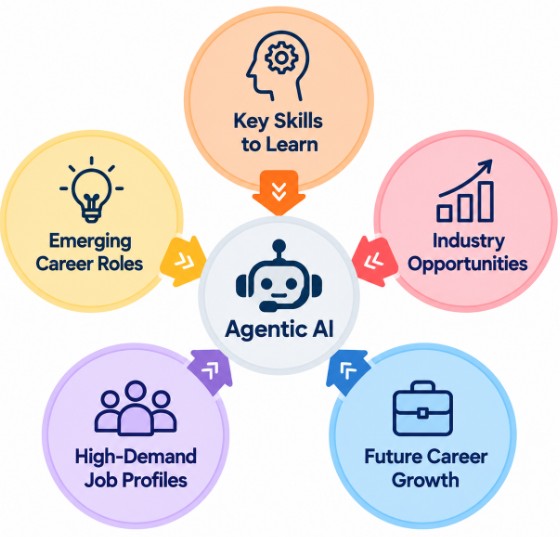
- AI Agent Developer: AI Agent Developers design, build, integrate, and maintain intelligent agents that automate tasks, interact with tools, and support business processes.
- Career Growth: Agentic AI skills can support roles such as AI Engineer, Generative AI Engineer, Machine Learning Engineer, AI Automation Specialist, and AI Solutions Architect.
Want to Learn About AI? Explore Our Artificial Intelligence Interview Questions and Answers Featuring the Most Frequently Asked Questions in Job Interviews.
Ethics, Security, and Responsible Agentic AI
Ethics, security, and responsible practices are essential when developing and deploying Agentic AI systems because agents can make decisions and perform actions with limited human involvement. Data privacy should be protected through secure storage, access controls, and careful handling of personal and business information. Strong security measures are also needed to reduce risks from unauthorized access, prompt injection, malicious inputs, data leakage, and unsafe tool usage. Understanding how AI systems process different types of information can also be supported through a Multimodal AI Tutorial, particularly when responsible AI practices extend across text, image, audio, and video applications. Human oversight should remain available for critical decisions to review actions and prevent harmful outcomes. Transparency helps users understand when agents are used, along with their capabilities and limitations. Developers should test systems for bias and fairness while establishing clear accountability for failures or incorrect decisions. Responsible automation requires defined permissions, safeguards, and business rules. Continuous testing, logging, auditing, and monitoring can identify security threats, unexpected behavior, performance issues, and ethical concerns throughout the AI agent lifecycle.
Conclusion and Next Steps in Learning Agentic AI
Agentic AI is changing how intelligent systems understand goals, reason through problems, make decisions, use external tools, and complete complex multi-step tasks with greater autonomy. Beginners can build a strong foundation by learning artificial intelligence concepts, large language models, prompt engineering, Python, APIs, agent frameworks, memory systems, planning techniques, and workflow design. Learners who want to strengthen their core AI knowledge can explore Artificial Intelligence Training before progressing toward advanced Agentic AI development. Creating practical projects is an effective way to understand how AI agents are designed, connected with tools, tested, evaluated, deployed, monitored, and improved for real-world applications. Learners should begin with simple agents and gradually explore advanced workflows involving multiple tools and specialized agents. Understanding responsible AI, data privacy, security, human oversight, and performance evaluation is equally important. As Agentic AI continues to develop, consistent learning, practical experimentation, and project building can prepare learners for growing opportunities in AI engineering, intelligent automation, software development, and AI-focused careers.