LMS
LMS
Last updated on 18th Jun 2026| 4603

- End-to-End Data Science Project
- Problem Statement Definition
- Data Collection
- Data Cleaning & Preprocessing
- Exploratory Data Analysis (EDA)
- Feature Engineering
- Model Selection
- Model Training
- Evaluation Metrics
- Deployment Basics
- Project Presentation Tips
End-to-End Data Science Project
An end-to-end data science project represents the complete journey of solving a real-world problem using data, covering every stage from understanding the business requirement to delivering a final, usable solution. It is not limited to building a machine learning model; instead, it involves defining objectives, gathering data, preparing it, analyzing patterns, selecting appropriate algorithms, and deploying the solution for real-time use. Learners can strengthen these practical skills through Data Science Training, which provides hands-on experience with real-world projects and industry tools. This holistic approach ensures that the solution is both technically effective and aligned with business goals. End-to-end projects are highly valued in the industry because they demonstrate a candidate’s ability to think critically, work independently, and handle real-world complexities. They also help in understanding how different components of data science such as data engineering, analysis, modeling, and deployment work together to create impactful solutions.
Problem Statement Definition
- Defining the problem statement is the most critical step in any data science project, as it sets the direction for the entire workflow.
- This step involves clearly identifying the business challenge, understanding stakeholder requirements, and translating them into a data-driven objective. A well-defined problem statement should be specific, measurable, and actionable.
- For instance, instead of a vague goal like “improve sales,” a better problem statement would be “predict monthly sales for the next quarter to optimize inventory management.”
- This step requires collaboration with domain experts and a deep understanding of the business context. It also involves defining key performance indicators (KPIs) that will be used to measure success.
- A strong problem definition ensures that the project remains focused and avoids unnecessary deviations during later stages. Applying these concepts while working on real-world projects becomes easier with the Data Science Projects Tutorial to Get Internships, which demonstrates how clearly defined objectives lead to successful project outcomes.
Get Your Data Science Certification by Learning from Industry-Leading Experts and Advancing Your Career with ACTE’s Data Science Training.
Data Collection
Data collection involves gathering all the necessary data required to address the defined problem. This data can come from internal sources such as company databases and CRM systems, or external sources such as APIs, public datasets, and web scraping. The process requires careful consideration of data relevance, accuracy, and completeness. In many cases, data needs to be collected from multiple sources and combined to form a unified dataset. Professionals can develop these practical skills through Data Science Training, where they gain hands-on experience working with real-world datasets and data collection techniques. Challenges such as data privacy, accessibility, and data consistency must also be addressed during this stage. Proper documentation of data sources and understanding their structure is essential for ensuring transparency and reproducibility. High-quality data collection forms the backbone of any successful data science project, as poor data quality can lead to inaccurate results and unreliable models.
Data Cleaning & Preprocessing
- Data cleaning and preprocessing is one of the most critical stages in a Data Science project because the quality of data directly affects the accuracy and reliability of the final analysis or machine learning model. Although it is often time-consuming, this step ensures that raw data is transformed into a structured and meaningful format.
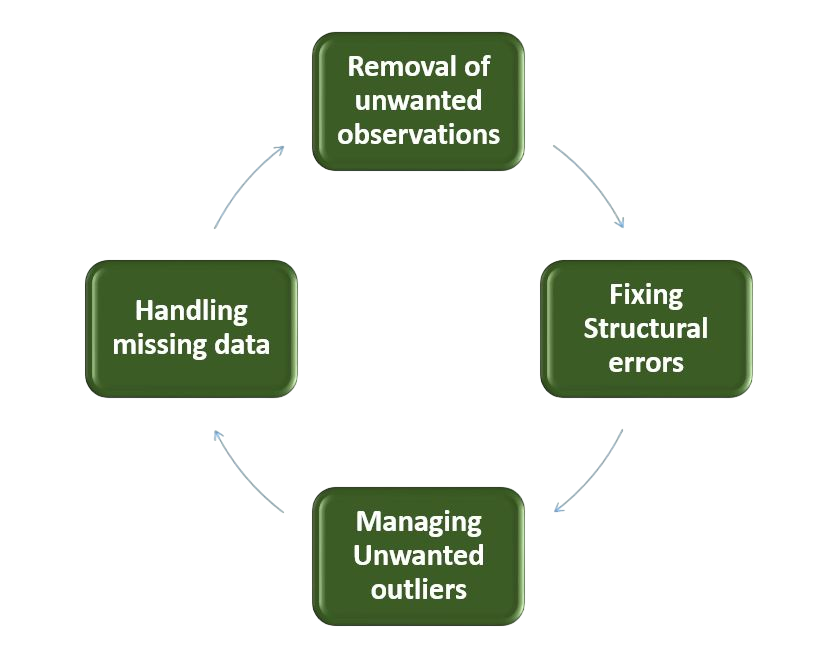
- Real-world datasets are rarely perfect and usually contain missing values, duplicate records, inconsistent entries, incorrect formats, noise, and errors. Identifying these issues early helps prevent inaccurate analysis and reduces the chances of developing models that produce unreliable or biased predictions.
- Handling missing data is an essential part of preprocessing. Depending on the situation, missing values can be removed or replaced using techniques such as mean, median, mode imputation, interpolation, or advanced machine learning-based methods. Correcting data types and eliminating duplicate records also improves overall data quality.
- Outlier detection and treatment are important to ensure that unusual values do not negatively impact analysis or model performance. Techniques such as statistical methods, visualization, and machine learning approaches can be used to identify and manage extreme values effectively.
- Data transformation prepares information for machine learning algorithms by converting raw data into a suitable format. This includes encoding categorical variables using methods like Label Encoding and One-Hot Encoding, scaling numerical features, and normalizing data distributions to maintain consistency.
- Feature engineering is another important part of preprocessing that involves selecting relevant features, creating new variables, and improving existing attributes. Well-prepared features help machine learning models identify important patterns and improve prediction accuracy.
- Exploratory Data Analysis (EDA) is often performed during preprocessing to understand data patterns, relationships, trends, and anomalies. Using statistical analysis and visualization techniques helps data scientists make better decisions before moving to the modeling stage.
- Proper data cleaning and preprocessing ensure that datasets are accurate, consistent, and ready for analysis. Without effective preprocessing, even advanced machine learning algorithms may generate misleading results. Building a strong foundation with the Machine Learning Basics Tutorial for Data Science Interns can further improve your understanding of these essential preprocessing techniques.

Exploratory Data Analysis (EDA)
Exploratory Data Analysis (EDA) is the process of examining and visualizing data to uncover patterns, trends, and relationships. It serves as a bridge between data preparation and model building. During EDA, data scientists use statistical summaries and visualization techniques such as histograms, box plots, scatter plots, and correlation heatmaps to understand the structure of the data. This step helps in identifying important features, detecting anomalies, and understanding the distribution of variables. EDA also aids in validating assumptions and forming hypotheses about the data. By gaining a deeper understanding of the dataset, data scientists can make informed decisions about feature selection, model choice, and further preprocessing steps. Learning Data Analytics Concepts and Importance provides additional insights into analyzing datasets effectively and making data-driven decisions.

Get JOB Oriented Data Science Training for Beginners By MNC Experts
- Instructor-led Sessions
- Real-life Case Studies
- Assignments
Feature
- Feature engineering is the art of transforming raw data into meaningful inputs that improve the performance of machine learning models.
- It involves selecting the most relevant features, creating new variables, and modifying existing ones to better represent the underlying patterns in the data.
- Techniques include encoding categorical variables, scaling numerical features, creating interaction terms, and extracting information from dates or text.
- Effective feature engineering requires both technical expertise and domain knowledge, as it involves understanding which aspects of the data are most important for prediction.
- Well-engineered features can significantly enhance model accuracy and reduce complexity, making this step one of the most impactful in the entire pipeline. To strengthen these practical skills, refer to the Google Colab Tutorial, which demonstrates feature engineering concepts in a hands-on environment.
Want to Master Gen AI? Explore the Data Science Master Program Offered at ACTE Today!
Model Selection
Model selection involves choosing the most suitable machine learning algorithm based on the nature of the problem and the characteristics of the data. Different types of problems require different approaches—for example, regression models for predicting continuous values, classification models for categorical outcomes, and clustering algorithms for grouping similar data points. Common algorithms include linear regression, logistic regression, decision trees, random forests, support vector machines, and neural networks. Learners can gain practical experience in selecting and evaluating these algorithms through Data Science Training, where real-world projects help strengthen model-building skills. The selection process involves comparing multiple models based on their performance, interpretability, and computational efficiency. Choosing the right model ensures that the solution is both accurate and practical for real-world implementation.
Want to Learn About Data Science? Explore Our Data Science Interview Questions and Answers Featuring the Most Frequently Asked Questions in Job Interviews.
Model Training
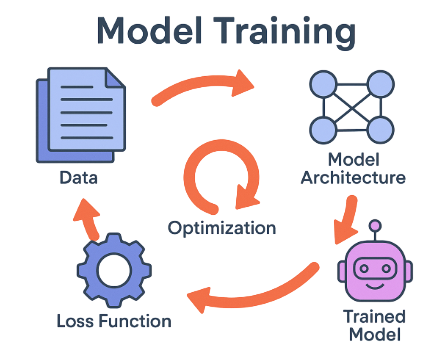
- Model training is the process of teaching a machine learning algorithm to recognize patterns, relationships, and trends within a dataset. During this stage, the model learns from historical data by identifying meaningful features that can be used to make accurate predictions or classifications on new, unseen data.
- During training, the algorithm continuously adjusts its internal parameters and weights to minimize prediction errors. This optimization process relies on loss functions and optimization algorithms such as Gradient Descent, helping the model improve its accuracy with each training iteration or epoch.
- To evaluate performance effectively, the dataset is usually divided into training, validation, and testing sets. The training set is used to learn patterns, the validation set helps tune model parameters, and the testing set measures how well the model performs on completely unseen data.
- Cross-validation techniques, such as k-fold cross-validation, are commonly used to improve model reliability and reduce the risk of overfitting. These techniques evaluate the model across multiple subsets of the dataset, providing a more accurate estimate of its real-world performance.
- Hyperparameter tuning is an important part of model training because it helps identify the best configuration for parameters such as learning rate, batch size, number of estimators, maximum tree depth, and regularization strength. Proper tuning significantly improves model accuracy and overall performance.
- Regularization techniques such as L1, L2, and Dropout are often applied during training to prevent overfitting and improve the model’s ability to generalize. These methods reduce unnecessary model complexity and help produce more reliable predictions on unseen datasets.
- Performance metrics such as accuracy, precision, recall, F1-score, Mean Squared Error (MSE), Root Mean Squared Error (RMSE), and ROC-AUC are used to evaluate the effectiveness of the trained model. Selecting appropriate evaluation metrics depends on the specific machine learning problem being solved.
- After successful training and evaluation, the final model is deployed for real-world applications where it can analyze new data and generate predictions. Continuous monitoring, retraining with updated datasets, and performance optimization ensure that the model remains accurate and effective over time. Learning how to present model results through the Power BI Tutoril can help transform machine learning insights into interactive business reports.
Evaluation Metrics
Evaluation metrics are used to measure how well a model performs and whether it meets the project objectives. The choice of metrics depends on the type of problem being solved. For regression tasks, metrics such as Mean Absolute Error (MAE), Mean Squared Error (MSE), and Root Mean Squared Error (RMSE) are commonly used. For classification tasks, metrics like accuracy, precision, recall, and F1-score provide insights into model performance. In some cases, additional metrics such as ROC-AUC are used for a more detailed evaluation. Proper evaluation helps in comparing different models, identifying weaknesses, and making improvements. It ensures that the final model is reliable and suitable for deployment. Visualizing evaluation results with the Ultimate Tableau Tutorial can make model performance easier to interpret and communicate.
Deployment Basics
- Deployment is the final stage of a Data Science and Machine Learning project where a trained model is converted into a practical solution that can be used in real-world applications. During deployment, the model is integrated into an existing system so it can process new data, generate predictions, and provide valuable insights to users or businesses.
- A deployed machine learning model can be integrated through APIs, web applications, mobile applications, enterprise software, or automated systems. Developers commonly create REST APIs that allow applications to communicate with the model and send input data while receiving prediction results in real time.
- Cloud platforms such as Amazon Web Services (AWS), Microsoft Azure, and Google Cloud Platform (GCP) are widely used for deploying and scaling machine learning applications. These platforms provide computing resources, storage, security, and monitoring tools required for reliable model operation.
- Deployment frameworks and tools such as Flask, FastAPI, Streamlit, Docker, Kubernetes, and MLflow help simplify the process of packaging, serving, and managing machine learning models. Docker containers ensure that applications run consistently across different environments.
- Before making a model available to users, it is important to perform testing and validation to ensure accuracy, reliability, security, and proper functionality. Deployment also involves managing dependencies, optimizing response time, and ensuring the system can handle increasing numbers of users or requests.
- Continuous monitoring is an essential part of the deployment lifecycle. Data scientists track model performance, detect changes in data patterns, identify model drift, and retrain models when necessary to maintain accuracy and effectiveness over time.
- Model versioning and update management help organizations maintain different versions of models, compare performance, and safely introduce improvements without disrupting existing applications. Tools like MLflow and cloud-based ML platforms are commonly used for managing the complete machine learning lifecycle. Building a strong understanding of AI technologies through the Artificial Intelligence and Future Technology of AI can help you better understand how deployed machine learning models support intelligent applications.
- A successful deployment transforms a machine learning model from a research experiment into a valuable business solution. By ensuring scalability, reliability, and continuous improvement, deployment allows organizations to use AI-driven insights effectively in real-world scenarios.
Project Presentation Tips
Presenting a data science project effectively is essential for communicating results and demonstrating value to stakeholders. A strong presentation should clearly outline the problem statement, methodology, key findings, and business impact. It should focus on storytelling, explaining how the problem was approached, what challenges were faced, and how they were resolved. Learners can build these practical presentation and communication skills through Data Science Training, which includes hands-on projects and real-world case studies. Visualizations such as charts, graphs, and dashboards play a crucial role in making insights easy to understand. It is important to tailor the presentation to the audience, avoiding technical jargon when addressing non-technical stakeholders. Confidence, clarity, and structure are key elements of a successful presentation, as they help in leaving a lasting impression.