LMS
LMS
Last updated on 27th Jun 2026| 4702

- Introduction to House Price Prediction Using Machine Learning
- Understanding the House Price Prediction Problem
- Prerequisites and Tools Required for the Project
- Collecting and Exploring the House Price Dataset
- Data Cleaning and Feature Engineering Techniques
- Exploratory Data Analysis (EDA) for House Price Prediction
- Building a House Price Prediction Model
- Evaluating and Improving Model Performance
- Deploying the House Price Prediction Application
- Conclusion: Showcasing Your House Price Prediction Project in Your Portfolio
Introduction to House Price Prediction Using Machine Learning
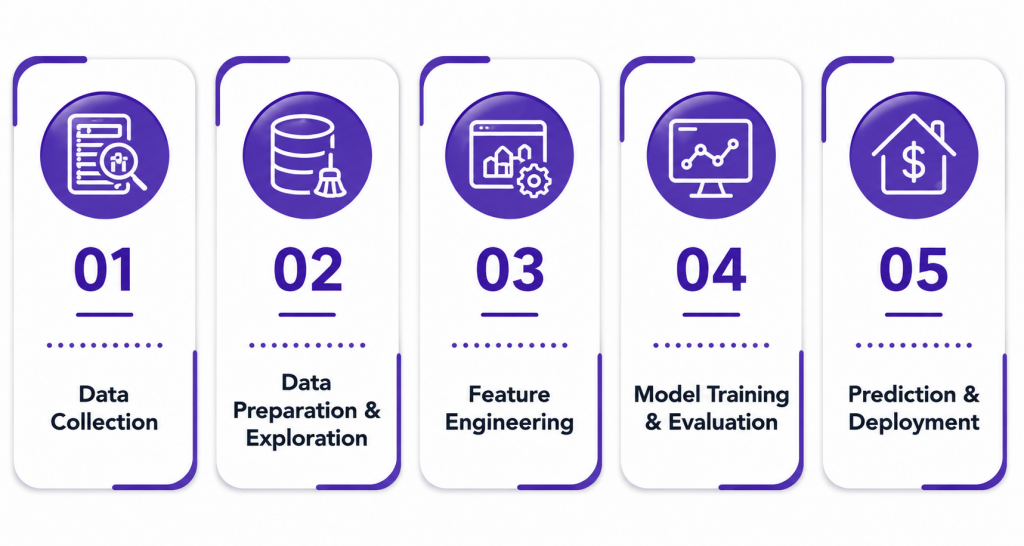
House price prediction is one of the most popular beginner-friendly machine learning projects because it demonstrates how predictive analytics can solve real-world business problems. The objective of this project is to develop a machine learning model that estimates the selling price of a house based on various features such as location, size, number of bedrooms, bathrooms, square footage, age of the property, nearby amenities, and other important factors. By analyzing historical housing data, machine learning algorithms identify relationships between property characteristics and market prices to generate accurate predictions for new properties. This project introduces learners to the complete machine learning workflow, including data collection, preprocessing, exploratory data analysis, feature engineering, model training, evaluation, and deployment. Python libraries such as Pandas, NumPy, Matplotlib, Seaborn, and Scikit-learn are commonly used throughout the project. Learners can strengthen these practical skills through Data Science Training, gaining hands-on experience with machine learning concepts and real-world projects. Building a house price prediction system helps beginners strengthen their skills in data analysis, regression algorithms, feature selection, model optimization, and business problem-solving. It is also an excellent portfolio project for students and freshers because it demonstrates practical experience with real-world datasets and industry-standard machine learning techniques.
Understanding the House Price Prediction Problem
House price prediction is a supervised machine learning regression problem where the goal is to predict a continuous numerical value rather than classify data into categories. The model learns from historical housing datasets containing property features and their corresponding selling prices. Important attributes such as property location, land area, built-up area, number of bedrooms, bathrooms, parking spaces, age of the house, neighborhood quality, and accessibility to schools, hospitals, and transportation significantly influence the final price. Before training the model, the dataset must be cleaned by handling missing values, correcting inconsistent data, and encoding categorical variables. Learners can build a strong foundation in these concepts through Data Science Training, where they gain hands-on experience with data preprocessing and predictive modeling techniques. Feature engineering and exploratory data analysis help identify relationships between different variables and improve prediction accuracy. Regression algorithms such as Linear Regression, Decision Tree Regressor, Random Forest Regressor, Gradient Boosting, and XGBoost are commonly used to build predictive models. The model’s performance is evaluated using metrics such as Mean Absolute Error (MAE), Mean Squared Error (MSE), Root Mean Squared Error (RMSE), and R² Score. Understanding this problem helps learners apply machine learning concepts to practical business scenarios while developing analytical and predictive modeling skills.
Get Your Data Science Certification by Learning from Industry-Leading Experts and Advancing Your Career with ACTE’s Data Science Course.
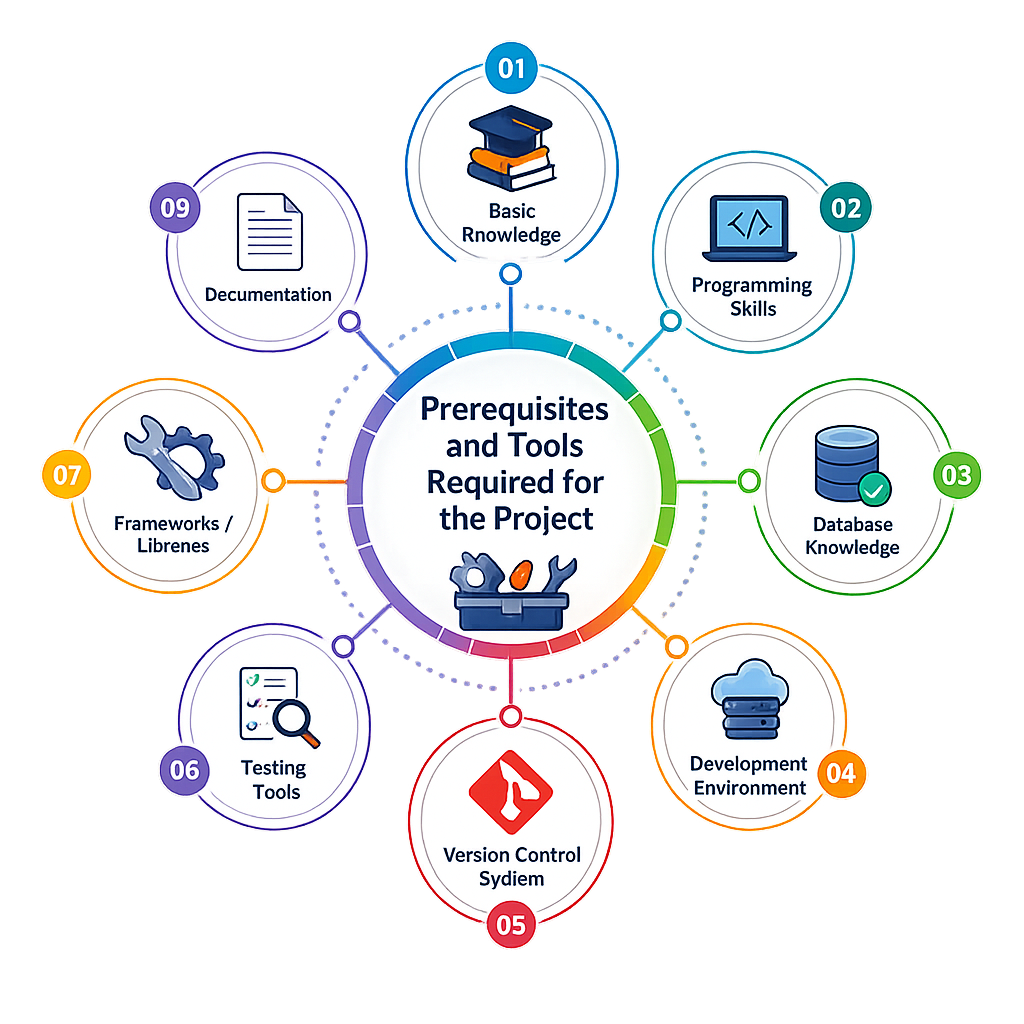
Prerequisites and Tools Required for the Project
- Python Programming Environment: Install Python along with Jupyter Notebook or Visual Studio Code to develop and test the project. A properly configured environment allows you to write, execute, debug, and manage machine learning code efficiently throughout the project.
- Essential Python Libraries: Install libraries such as Pandas, NumPy, Matplotlib, Seaborn, and Scikit-learn. These libraries support data preprocessing, visualization, feature engineering, regression modeling, and performance evaluation for house price prediction.
- House Price Dataset: Obtain a reliable housing dataset containing features such as location, area, bedrooms, bathrooms, parking, and property price. A clean and well-structured dataset is essential for training an accurate machine learning model.
- Basic Machine Learning Knowledge: Understand fundamental concepts such as regression algorithms, data preprocessing, feature selection, train-test splitting, and evaluation metrics. Beginners can strengthen these concepts by following the Machine Learning Basics Tutorial for Data Science Interns, which provides a solid foundation for building reliable predictive models for estimating house prices.
- Version Control and Project Documentation: Use Git and GitHub to manage project versions, store source code, and showcase your work. Prepare clear documentation explaining the dataset, workflow, algorithms used, and project results to make your portfolio more professional.
Collecting and Exploring the House Price Dataset
The first step in developing a house price prediction project is collecting a reliable and well-structured dataset. Public datasets from platforms such as Kaggle, government open data portals, or real estate websites are commonly used for learning and experimentation. A typical housing dataset contains features such as property location, square footage, number of bedrooms, bathrooms, parking spaces, year built, lot size, neighborhood, and selling price. After collecting the dataset, it is important to explore its structure using Python libraries like Pandas. Exploratory tasks include checking the number of records, identifying data types, examining missing values, detecting duplicate entries, and generating summary statistics. Understanding these concepts becomes easier with the Data Analytics Concepts and Importance, which explains the fundamentals of data exploration and analysis. Visualizing the distribution of features helps understand data quality and identify potential issues before preprocessing. A thorough exploration of the dataset provides valuable insights into the relationships between different variables and establishes a strong foundation for feature engineering, model development, and accurate house price prediction.
Data Cleaning and Feature Engineering Techniques
Data cleaning is an essential step that ensures the dataset is accurate, consistent, and suitable for machine learning. Common preprocessing tasks include handling missing values, removing duplicate records, correcting inconsistent formats and converting categorical variables into numerical values using techniques such as one-hot encoding or label encoding. Numerical features may also be standardized or normalized to improve model performance. Understanding statistical distributions through the Probability Density Function in Statistics Tutorial can help identify feature patterns and detect anomalies before preprocessing. Feature engineering further enhances the dataset by creating new meaningful variables from existing information, such as calculating house age, total living area, or price per square foot. Feature selection techniques help identify the most influential variables while eliminating irrelevant or highly correlated features. Python libraries such as Pandas and Scikit-learn provide efficient tools for performing these preprocessing tasks. Proper data cleaning and feature engineering significantly improve prediction accuracy and help machine learning algorithms learn meaningful patterns from housing data.

Exploratory Data Analysis (EDA) for House Price Prediction
Exploratory Data Analysis (EDA) helps understand the characteristics of the housing dataset before building predictive models. Using visualization libraries such as Matplotlib and Seaborn, data scientists create histograms, scatter plots, box plots, correlation heatmaps, and distribution charts to identify trends, relationships, and anomalies. EDA helps determine how factors like location, house size, number of bedrooms, and neighborhood influence property prices. It also reveals missing values and outliers that may negatively affect model performance. Learning the fundamentals through the Tutorial on Statistics and Probability for Data Science helps interpret these patterns more effectively during data analysis. Correlation analysis identifies the strongest predictors of house prices and supports effective feature selection. Statistical summaries provide additional insights into data distribution, averages, and variability. Performing comprehensive EDA enables better understanding of the dataset, improves feature engineering decisions, and contributes to building a more accurate and reliable house price prediction model.

Get JOB Oriented Data Science Training for Beginners By MNC Experts
- Instructor-led Sessions
- Real-life Case Studies
- Assignments
Building a House Price Prediction Model
After preprocessing and exploring the dataset, the next step is developing a machine learning model capable of predicting house prices accurately. The dataset is first divided into training and testing sets to evaluate model performance on unseen data. Popular regression algorithms include Linear Regression, Decision Tree Regressor, Random Forest Regressor, Gradient Boosting Regressor, and XGBoost, each offering different levels of accuracy and complexity. Professionals who enroll in Data Science Training gain hands-on experience in building and optimizing predictive models using these algorithms. During training, the model learns relationships between property features and selling prices using historical data.
Want to Master Data Science? Explore the Data Science Master Program Offered at ACTE Today!
Evaluating and Improving Model Performance
- Using Regression Evaluation Metrics: Evaluate the model using metrics such as Mean Absolute Error (MAE), Mean Squared Error (MSE), Root Mean Squared Error (RMSE), and R² Score. These metrics measure prediction accuracy and help compare the performance of different regression algorithms.
- Hyperparameter Tuning: Improve model performance by optimizing algorithm parameters using techniques like Grid Search and Random Search. Proper tuning helps reduce prediction errors, prevent overfitting, and achieve better generalization on unseen housing data.
- Feature Selection and Engineering: Select the most relevant features and create meaningful new variables to improve prediction accuracy. These practical techniques are commonly applied in real-world projects covered in the Data Science Internship Complete Tutorial. Removing unnecessary or highly correlated features simplifies the model and enhances overall performance.
- Cross-Validation Techniques: Apply cross-validation to test the model on multiple data splits instead of a single train-test split. This provides a more reliable estimate of model performance and ensures better stability across different datasets.
- Comparing Multiple Regression Models: Train and compare algorithms such as Linear Regression, Decision Tree, Random Forest, Gradient Boosting, and XGBoost. Selecting the model with the best evaluation scores helps build a more accurate house price prediction system.
Want to Learn About DevOps? Explore Our Data Science Interview Questions and Answers Featuring the Most Frequently Asked Questions in Job Interviews.
Deploying the House Price Prediction Application
- Building a User-Friendly Interface: Create an interactive web application using Streamlit or Flask where users can enter house details such as location, area, bedrooms, and bathrooms to receive predicted house prices instantly.
- Integrating the Trained Machine Learning Model: Save the trained regression model using Pickle or Joblib and integrate it with the web application. This allows the application to generate real-time predictions based on user input.
- Deploying on Cloud Platforms: Host the application on platforms such as Streamlit Community Cloud, Render, Hugging Face Spaces, or Heroku. Cloud deployment makes the project accessible online for recruiters and portfolio visitors.
- Testing Application Functionality: Test the application with different property details and datasets to verify prediction accuracy, user input validation, interface responsiveness, and overall system reliability before public deployment.
- Project Documentation and GitHub Repository: Publish the complete source code, documentation and deployment link on GitHub. Following the Data Science Internship Portfolio helps you present your projects professionally, demonstrating technical skills and strengthening your portfolio for internships and job opportunities.
Conclusion: Showcasing Your House Price Prediction Project in Your Portfolio
A house price prediction project is an excellent addition to a data science portfolio because it demonstrates practical knowledge of data preprocessing, exploratory data analysis, feature engineering and application deployment. By completing this project, you showcase your ability to solve a real-world business problem using machine learning and industry-standard tools such as Python, Pandas, NumPy, Scikit-learn, Matplotlib, Seaborn, and Streamlit or Flask. To further strengthen your practical skills, consider enrolling in Data Science Training, which provides hands-on experience with industry-relevant projects and tools. To make your portfolio more impressive, include a well-organized GitHub repository containing the source code, dataset details, project documentation, screenshots, and a live deployment link. Clearly explain each stage of the project, including data collection, preprocessing, model selection, evaluation metrics, and deployment strategy, so recruiters can understand your technical approach. Highlight the challenges you encountered, the improvements you implemented, and the final model performance to demonstrate your analytical and problem-solving skills. A professionally presented house price prediction project reflects your ability to build end-to-end machine learning solutions and significantly improves your chances of securing internships and entry-level roles in data science, machine learning, artificial intelligence, and business analytics.