LMS
LMS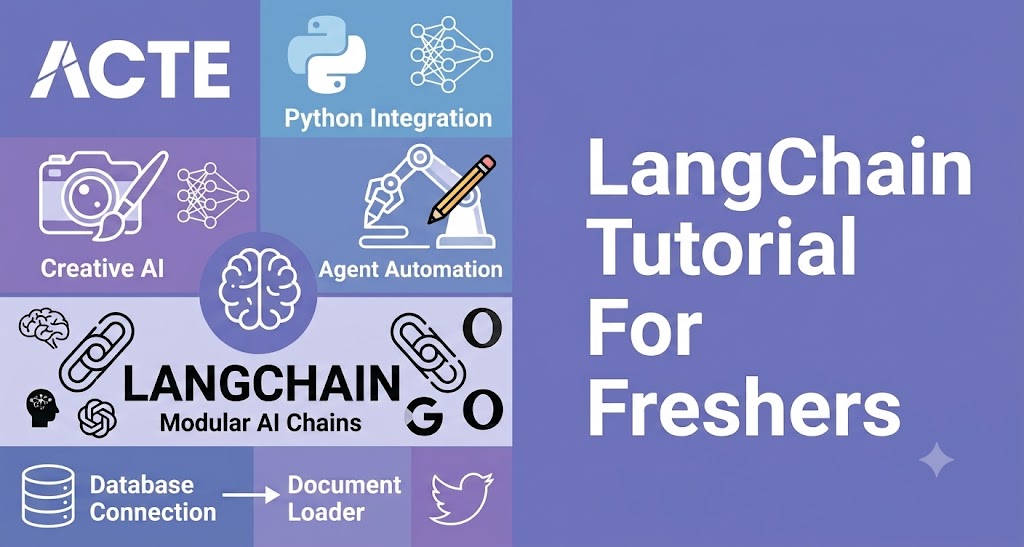
Last updated on 19th May 2026| 4607

- Introduction to LangChain Tutorial For Freshers
- Getting Started with Setup
- Core Concepts of LangChain
- Working with Large Language Models
- Prompt Templates and Chains
- Memory in LangChain
- Tools and Agents
- Integration with External Data
- Real‑World Use Cases
Introduction to LangChain Tutorial For Freshers
LangChain Tutorial For Freshers is a powerful framework designed to simplify the development of applications that use large language models (LLMs). It provides modular components that allow developers to connect models with external data, memory, and tools. For freshers, LangChain is an entry point into building intelligent applications without reinventing the wheel. It supports both prototyping and production-level systems, making it versatile. LangChain emphasizes composability, meaning developers can combine chains, prompts, and agents to create complex workflows in our Gen AI Course. Its integration with popular LLMs like GPT and Claude makes it widely accessible. Beginners benefit from its structured approach, which reduces complexity in handling prompts and responses. LangChain also supports advanced features like memory persistence and tool usage. By learning LangChain, freshers gain practical skills in building chatbots, Q&A systems, and AI-driven applications. It is a bridge between theoretical AI knowledge and real-world implementation.
Getting Started with Setup
- Installation: LangChain can be installed easily using pip in a Python environment and works seamlessly with Jupyter Notebook and Google Colab. Beginners can quickly start building AI applications by following the Beginner Gen AI Projects Tutorial, which provides practical guidance for hands-on learning.
- Dependencies: LangChain integrates with popular AI frameworks and providers such as OpenAI, Hugging Face, Anthropic, and other large language models. Installing the required libraries and keeping dependencies updated ensures compatibility and stable application performance.
- Configuration: Configure API keys securely using environment variables or configuration files before connecting LangChain to LLM providers. Following secure credential management practices helps protect sensitive information and supports professional development workflows.
- Testing Setup: After installation, run sample chains, prompts, and basic workflows to verify that models and integrations are functioning correctly. For additional practical learning, explore the AI Image Generation Tutorial for Freshers.
- Best Practices: Use virtual environments, document installation steps, maintain updated dependencies, organize project configurations, and create reproducible notebooks to build reliable, scalable, and maintainable LangChain applications.
Get Your Gen AI Certification by Learning from Industry-Leading Experts and Advancing Your Career with ACTE’s Gen AI Course.
Core Concepts of LangChain
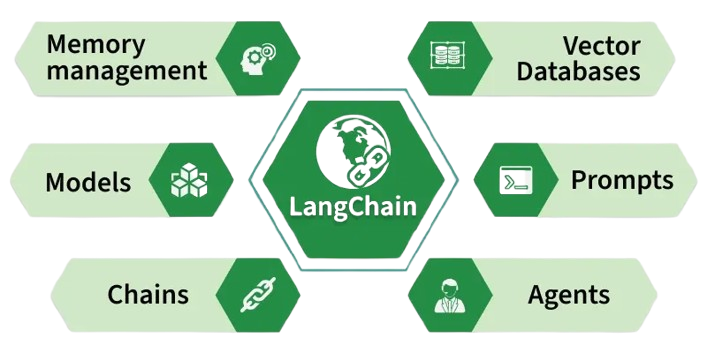
LangChain is built around several core concepts that freshers must understand. Chains are sequences of calls to LLMs or other components, enabling structured workflows. Prompts define the input given to models, guiding their responses. Memory allows applications to retain context across interactions, making conversations coherent. Agents are dynamic decision-makers that select tools or actions based on user queries. Tools are external functions or APIs that extend model capabilities in Gen AI Course . These concepts work together to create flexible and intelligent applications. For beginners, mastering chains and prompts is the first step. Memory and agents add complexity but also realism to applications. Tools connect LangChain systems to external data sources, enhancing utility. Understanding these concepts ensures freshers can design scalable and interactive AI solutions.
Working with Large Language Models
- Integration: LangChain integrates with leading Large Language Models (LLMs) such as GPT, Claude, Gemini, Hugging Face models, and other AI providers through APIs. Its modular architecture makes it easy to switch between models while building scalable AI applications.
- Prompting: Prompt engineering is a core LangChain capability that helps developers create structured prompts, reusable templates, and context-aware workflows to generate accurate and relevant responses. Learn more through the Gen AI Engineer Internship Tutorial.
- Evaluation: Evaluate LLM responses by measuring accuracy, relevance, consistency, and factual correctness using automated testing, human feedback, and performance metrics to continuously improve AI application quality.
- Scaling: LangChain applications can be deployed on cloud platforms to support larger workloads, optimize API usage, manage operational costs, and deliver reliable performance for enterprise-grade AI solutions.
- Applications: LangChain is widely used to develop AI chatbots, virtual assistants, question-answering systems, document summarization tools, retrieval-augmented generation (RAG) applications, content generation platforms, and intelligent workflow automation solutions.

Prompt Templates and Chains
Prompt templates and chains are core components of LangChain that simplify the development of scalable AI applications. Prompt templates allow developers to create reusable prompts with dynamic placeholders, ensuring consistency, maintainability, and efficient prompt engineering across different use cases. Chains connect multiple AI operations into a single workflow, such as retrieving information, formatting prompts, invoking a large language model, and processing the generated response. Beginners can start by building simple sequential chains before progressing to advanced workflows involving conditional logic, document retrieval, and Retrieval-Augmented Generation (RAG). To explore practical AI implementation, visit the Claude Tutorial . Understanding prompt templates and chains helps learners develop modular, reusable, and production-ready LangChain applications for chatbots, virtual assistants, document processing, and enterprise AI automation.

Get JOB Oriented Gen AI Training for Beginners By MNC Experts
- Instructor-led Sessions
- Real-life Case Studies
- Assignments
Memory in LangChain
- Definition: Memory in LangChain enables applications to retain previous interactions, maintain conversational context, and generate more relevant responses across multiple user exchanges. It is a key feature for building intelligent chatbots, virtual assistants, and conversational AI systems. Learn more about modern AI assistants in the Google Gemini Tutorial.
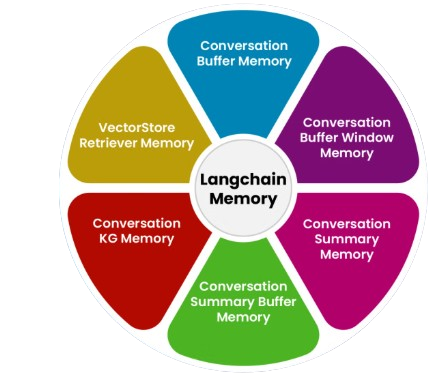
- Types: LangChain supports different memory strategies, including short-term memory for recent conversations, long-term memory for persistent user information, and vector database memory for semantic search and contextual retrieval. Understanding these memory types helps developers build more personalized, context-aware, and scalable AI applications.
- Implementation: LangChain provides built-in memory modules that allow developers to store and retrieve conversation history with simple APIs. These memory components can be customized and integrated into AI applications to maintain context, enabling beginners to build more intelligent and interactive conversational systems.
- Benefits: Memory improves user experience by maintaining conversation continuity, reducing repetitive interactions, enabling personalized responses, and supporting context-aware AI applications. Learn more through the Generative AI Step-by-Step Tutorial for Beginners, which explains practical AI development workflows.
- Challenges: Managing memory effectively requires addressing challenges such as increasing storage requirements, higher operational costs, privacy and security concerns, and maintaining accurate long-term context. Implementing proper memory management strategies helps build reliable, scalable, and responsible AI applications.
Want to Master Gen AI? Explore the Gen AI Master Program Offered at ACTE Today!
Tools and Agents
Tools and agents extend LangChain’s capabilities beyond simple text generation. Tools are external functions or APIs that models can call, such as search engines or calculators. Agents act as orchestrators, deciding which tools to use based on user queries. For freshers, this introduces dynamic decision-making into applications. Agents make systems more autonomous, handling complex tasks without explicit instructions. Tools expand functionality, connecting models to external data sources in our Gen AI Course. Together, they enable applications like intelligent assistants and automated workflows. Beginners should start with simple tools before exploring agent frameworks. Agents require careful design to avoid errors or inefficiency. Tools and agents showcase LangChain’s flexibility in building advanced AI systems. They are essential for creating real-world applications that go beyond static responses.
Want to Learn About DevOps? Explore Our DevOps Interview Questions and Answers Featuring the Most Frequently Asked Questions in Job Interviews.
Integration with External Data
- Data Sources: LangChain integrates with external APIs, SQL and NoSQL databases, cloud storage services, documents, PDFs, spreadsheets, and web applications, enabling AI systems to access real-time information and build intelligent, data-driven solutions.
- Retrieval: LangChain supports Retrieval-Augmented Generation (RAG) by integrating with vector databases such as FAISS, Pinecone, Chroma, and Weaviate. These databases store embeddings and retrieve relevant information to improve the accuracy and context of large language model responses.
- Processing: Before using external data, documents should be cleaned, preprocessed, chunked, and converted into embeddings for efficient retrieval. LangChain provides built-in workflows to automate these processes. Learn more through the Generative AI Basics to Advanced Tutorial.
- Applications: External data integration enables AI-powered knowledge bases, document question-answering systems, enterprise search, customer support assistants, research tools, and business intelligence applications that deliver accurate, context-aware responses.
- Challenges: Developers should address challenges such as API changes, data quality, integration complexity, privacy regulations, security requirements, and infrastructure costs to build reliable, scalable, and secure AI applications.
Real‑World Use Cases
LangChain Tutorial For Freshers is applied in diverse real-world scenarios. Businesses use it to build customer support chatbots that retain context and provide accurate answers. Researchers employ it for document summarization and knowledge retrieval. Developers create personal assistants that integrate with calendars and emails. In education, LangChain powers tutoring systems that adapt to student needs. Healthcare applications include summarizing patient records and supporting diagnostics. Entertainment industries leverage LangChain for interactive storytelling and game design in Gen AI Course . Finance benefits from automated reporting and fraud detection systems. Startups use LangChain to prototype AI-driven products quickly. These use cases highlight LangChain’s versatility across industries. For freshers, exploring them provides motivation and practical exposure to real-world AI applications.