LMS
Last updated on 03rd Sep 2026| 4688

- Introduction to AIOps and AI for IT Operations
- Understanding the Foundations of AIOps
- AIOps Architecture and Core Components
- How AI and Machine Learning Power IT Operations
- AI-Driven Monitoring, Observability, and Incident Detection
- Automated Incident Management and Root Cause Analysis
- Steps to Implement and Test an AIOps Solution
- Best AIOps Tools, Frameworks, and Platforms
- AIOps Best Practices, Security, and Performance Optimization
- Conclusion and Next Steps for Adopting AIOps
Introduction to AIOps Tutorial for Beginners
AIOps (Artificial Intelligence for IT Operations) is an innovative approach that combines artificial intelligence, machine learning, automation, and data analytics to improve modern IT operations. Unlike traditional IT monitoring methods that rely heavily on manual analysis, AIOps platforms can collect and analyze large volumes of data from applications, servers, networks, and cloud environments to identify issues automatically. These systems use machine learning techniques to detect anomalies, predict potential failures, reduce alert noise, and support faster incident resolution. AIOps is widely used across industries to improve system reliability, performance, and operational efficiency. Beginners can explore AIOps using modern monitoring tools and platforms without requiring advanced AI expertise. Learning the fundamentals of AI through Artificial Intelligence Training can also help learners understand the concepts behind intelligent IT operations. Learning AIOps helps freshers understand how AI is transforming IT operations and opens career opportunities in cloud computing, DevOps, site reliability engineering, automation, and IT infrastructure management.
Understanding the Foundations of AIOps
AIOps, or Artificial Intelligence for IT Operations, combines artificial intelligence, machine learning, automation, and data analytics to improve the efficiency of modern IT operations. It enables organizations to monitor infrastructure, analyze large volumes of operational data, detect anomalies, reduce unnecessary alerts, predict potential failures, and automate routine tasks. Beginners can start learning AIOps by understanding IT infrastructure, networking, cloud computing, system monitoring, artificial intelligence, machine learning, and data analytics. They can then learn how to collect and analyze logs, metrics, and events using monitoring and AIOps platforms. Those new to AI concepts can also refer to an AI Tutorial for Beginners to build a foundation before exploring advanced AIOps concepts. AIOps has evolved from traditional rule-based monitoring and manual incident management into intelligent and automated IT operations using predictive analytics and anomaly detection. It is commonly applied in infrastructure monitoring, application performance management, root cause analysis, predictive maintenance, cloud operations, incident detection, and automated remediation. Learning AIOps can help freshers build valuable skills in AI, DevOps, cloud operations, monitoring, automation, and IT service management while preparing for careers in AIOps, DevOps, site reliability engineering, and IT infrastructure management.
AIOps Architecture and Core Components
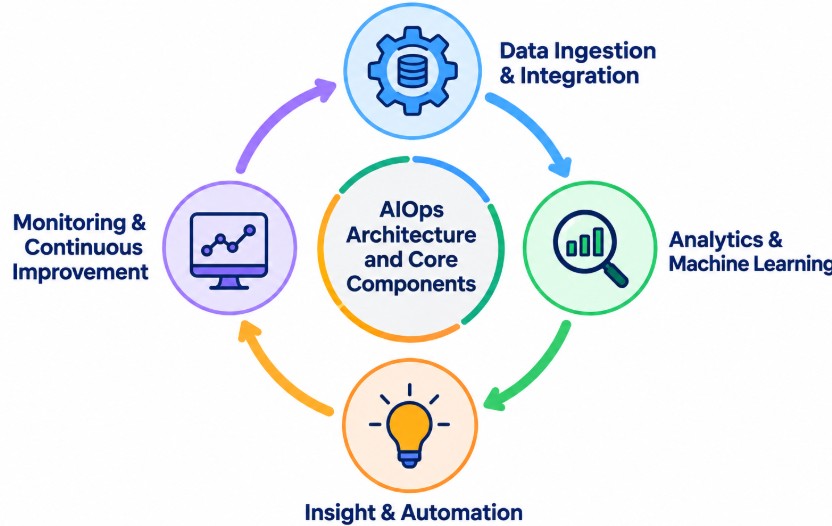
AIOps architecture combines data collection, artificial intelligence, machine learning, analytics, monitoring, and automation to create an intelligent IT operations environment. AIOps platforms collect large volumes of operational data from servers, applications, networks, databases, cloud environments, logs, metrics, and events to provide a foundation for analysis. The collected data is processed, normalized, and correlated to identify relationships between events, remove duplicate alerts, and highlight important incidents. AI and machine learning algorithms analyze historical and real-time information to recognize patterns, detect unusual behavior, identify anomalies, and predict potential system failures.
Get Your Artificial Intelligence Certification by Learning from Industry-Leading Experts and Advancing Your Career with ACTE’s Artificial Intelligence Course.
How AI and Machine Learning Power IT Operations
- Intelligent Monitoring: AI analyzes metrics, logs, events, and performance data from IT environments to identify unusual behavior and provide real-time insights into system health.
- Anomaly Detection: Machine learning models establish normal performance patterns and detect deviations that may indicate infrastructure failures, application issues, security events, or other operational problems.
- Automated Remediation: AIOps uses AI-driven workflows to automate repetitive operational tasks, such as restarting services, scaling resources, triggering scripts, and resolving predefined issues. Professionals interested in applying AI concepts to practical solutions can explore an AI Project Development Tutorial to understand how AI-based projects can be designed and implemented, reducing manual intervention and improving operational efficiency.
- Predictive Analytics: AI can analyze historical and real-time data to identify trends and predict potential failures, capacity issues, and performance degradation before they affect users.
- Incident Management: AI helps correlate related alerts, prioritize incidents based on their impact, and provide relevant insights to IT teams. This allows organizations to reduce alert fatigue and accelerate incident resolution.

Learn Artificial Intelligence Training Course to Build Your Skills
Weekday / Weekend BatchesSee Batch DetailsAI-Driven Monitoring, Observability, and Incident Detection
- Intelligent Monitoring: AI continuously analyzes infrastructure, applications, networks, databases, and cloud environments to identify performance changes and unusual system behavior in real time.
- Observability: AIOps brings together logs, metrics, traces, and events to provide a unified view of system health. This helps IT teams understand how different components interact and identify the source of operational problems.
- Anomaly Detection: Machine learning models learn normal system behavior and identify deviations that may indicate application failures, infrastructure problems, performance degradation, or other operational issues.
- Event Correlation: AIOps correlates related alerts and events across multiple systems to eliminate duplicate notifications and provide a clearer picture of the underlying incident. Professionals can also explore a Multimodal AI Tutorial to understand how AI can work with different types of data and inputs.
- Incident Detection: AI-driven analysis helps identify potential incidents at an early stage and prioritize them based on their severity and business impact, enabling IT teams to respond quickly and reduce downtime.

Get JOB Oriented Artificial Intelligence Training for Beginners By MNC Experts
- Instructor-led Sessions
- Real-life Case Studies
- Assignments
Automated Incident Management and Root Cause Analysis
Automated incident management and root cause analysis are essential AIOps capabilities that help IT teams detect, investigate, prioritize, and resolve operational issues more efficiently. AIOps platforms continuously analyze logs, metrics, events, alerts, application data, and infrastructure information using artificial intelligence and machine learning. Event correlation techniques group related alerts, remove duplicate notifications, and help teams focus on incidents that may significantly affect system performance. By analyzing historical and real-time data, AIOps can identify unusual behavior, recognize recurring patterns, determine possible root causes, and predict the impact of technical problems. Understanding the AI concepts behind these intelligent capabilities can be strengthened through Artificial Intelligence Training. The platform can also recommend corrective actions or automatically trigger predefined workflows, such as restarting services, creating tickets, or notifying support teams. These capabilities reduce manual troubleshooting, shorten incident resolution time, minimize downtime, prevent repeated failures, and help organizations maintain reliable, secure, and high-performing IT environments.
Steps to Implement and Test an AIOps Solution
Implementing an AIOps solution requires a structured approach that combines IT data collection, intelligent analytics, machine learning, automation, testing, and continuous monitoring. Organizations should begin by defining clear IT operations goals and identifying challenges such as excessive alerts, application downtime, slow incident resolution, performance problems, or repetitive manual tasks. Relevant operational data from logs, metrics, events, traces, applications, servers, networks, databases, and cloud platforms should then be collected and integrated into the AIOps platform. AI and analytics capabilities, including anomaly detection, event correlation, predictive analytics, and machine learning, can be configured to identify unusual behavior and meaningful patterns. Organizations exploring intelligent automation can also refer to an Agentic AI Tutorial for Beginners to understand how AI-driven agents can support automated workflows and decision-making. Automated workflows should initially focus on low-risk operational tasks before expanding to more complex processes. Finally, the solution should be tested using controlled or real-world scenarios while measuring alert accuracy, incident response time, automation success, system performance, and reliability. Continuous monitoring and optimization help improve the effectiveness of AIOps over time.
Want to Master Artificial Intelligence? Explore the Artificial Intelligence Master Program Offered at ACTE Today!
Best AIOps Tools, Frameworks, and Platforms
- Splunk: Splunk provides data analytics, observability, monitoring, and automation capabilities that help IT teams analyze operational data, detect issues, investigate incidents, and improve system performance.
- Dynatrace: Dynatrace combines application and infrastructure observability with AI-powered analytics to help organizations detect anomalies, understand dependencies, identify root causes, and optimize IT environments.
- ServiceNow: ServiceNow provides IT service management and AIOps capabilities for event management, incident management, service mapping, automation, and operational workflows. Professionals interested in how AI technologies are evolving can explore the Future Technology of AI to understand emerging AI applications that can influence modern IT operations and automation.
- Datadog: Datadog provides monitoring and observability across applications, infrastructure, cloud platforms, logs, and services. Its AI-powered capabilities support anomaly detection, incident investigation, and operational automation.
- New Relic: New Relic offers application performance monitoring, infrastructure monitoring, log management, and observability features that help IT teams identify performance problems and troubleshoot incidents.
Want to Learn About AI? Explore Our Artificial Intelligence Interview Questions and Answers Featuring the Most Frequently Asked Questions in Job Interviews.
AIOps Best Practices, Security, and Performance Optimization
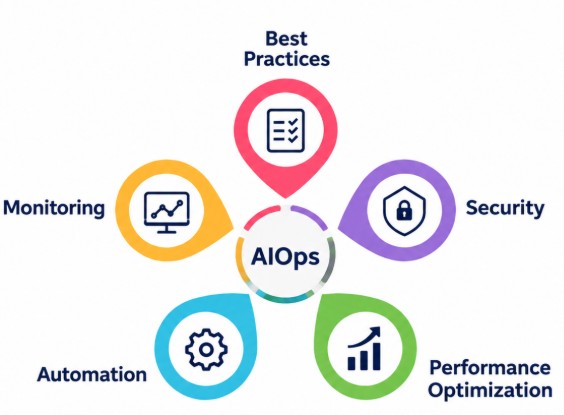
- Ensure Data Quality: AIOps depends on accurate and consistent logs, metrics, events, and traces. Clean, normalized, and relevant data helps AI and machine learning models produce more reliable insights and reduce false alerts.
- Prioritize Security: Protect operational data, credentials, APIs, and connected systems using access controls, encryption, authentication, and secure integrations. Regularly review AIOps workflows to prevent unauthorized actions or excessive automation privileges.
- Start with Low-Risk Automation: Begin by automating repetitive and well-defined tasks, such as ticket creation, notifications, and standard remediation procedures. Gradually expand automation after validating its reliability and impact.
- Measure and Optimize: Track important metrics such as incident resolution time, alert reduction, system availability, automation success rates, and operational efficiency. Professionals starting an AI career can also explore an AI Career Roadmap for Freshers to understand the skills and learning areas relevant to AI-based roles. Use these insights to continuously improve AIOps processes and performance.
- Monitor AI Performance: Continuously evaluate anomaly detection, alert correlation, incident prioritization, and predictive models. Regular monitoring helps identify inaccurate results, model drift, false positives, and changing operational patterns.
Conclusion and Next Steps for Adopting AIOps
AIOps is transforming traditional IT operations by combining artificial intelligence, machine learning, automation, monitoring, and advanced analytics to create smarter, faster, and more proactive IT environments. It enables organizations to analyze large volumes of operational data, detect anomalies, correlate related events, reduce unnecessary alerts and automate incident resolution. These capabilities can help IT teams reduce manual effort, minimize downtime, improve response times, and maintain reliable application and infrastructure performance. For beginners, learning AIOps provides a strong foundation in modern IT operations while developing practical knowledge of cloud computing, DevOps, monitoring, data analytics, automation, and machine learning. Building a strong foundation in AI concepts through Artificial Intelligence Training can further support learners exploring intelligent IT operations. The next step is to practice with monitoring tools, explore AIOps platforms, work with logs and metrics, create automation workflows, and build practical projects. Continuous learning can prepare professionals for growing opportunities in AIOps, DevOps, cloud operations, and site reliability engineering.