LMS
LMS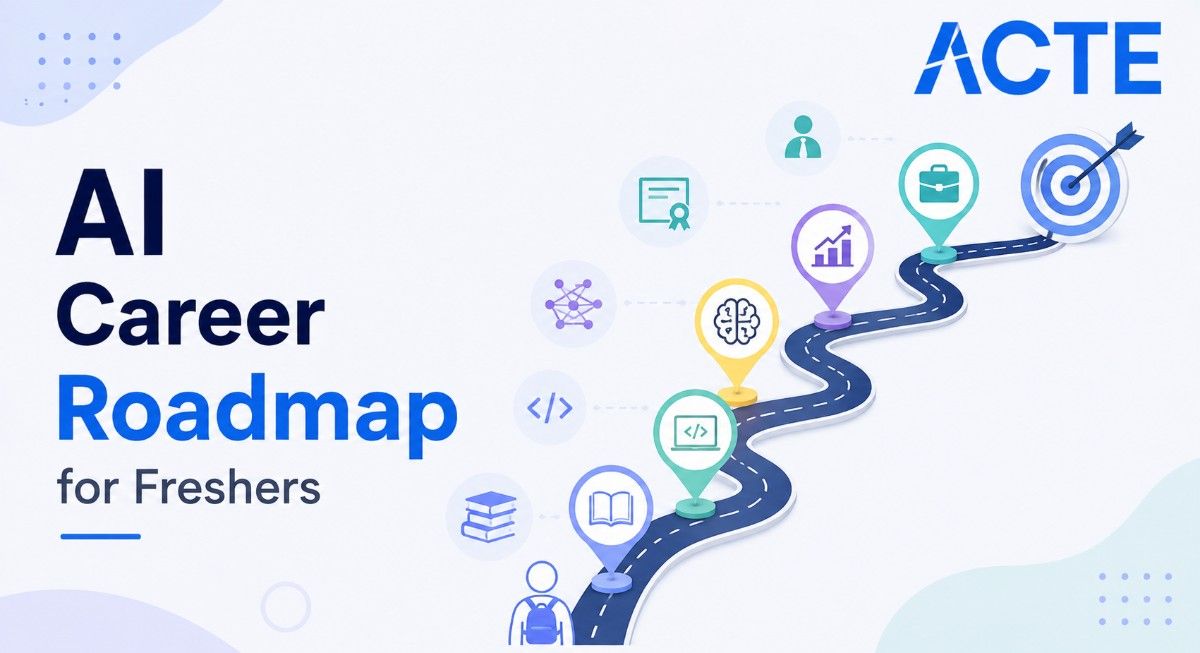
Last updated on 18th Aug 2026| 4656

- Introduction to the AI Career Roadmap for Freshers
- Learn the Fundamentals of Artificial Intelligence
- Develop Python and Programming Skills for AI
- Build Mathematics and Statistics Skills for AI
- Learn Machine Learning and Deep Learning
- Explore AI Tools, Frameworks, and Technologies
- Build Practical AI Projects and a Strong Portfolio
- Develop Job-Ready AI Skills and Prepare for Interviews
- Conclusion: Starting an AI Career as a Fresher
Introduction to the AI Career Roadmap for Freshers
Starting a career in Artificial Intelligence can be an exciting opportunity for freshers interested in technology, programming, data analysis, and problem-solving. AI professionals work with intelligent systems that can learn from data, recognize patterns, make predictions, understand human language, automate tasks, and support business decisions. A structured AI career roadmap helps beginners understand which skills to learn, how to practice them, and how to progress from basic concepts to advanced technologies. Freshers can begin by learning Artificial Intelligence fundamentals, Python programming, mathematics, statistics, data handling, machine learning, and deep learning. Enrolling in Artificial Intelligence Training can help beginners develop these foundational skills through structured learning. After developing these core skills, they can explore specialized areas such as Natural Language Processing, computer vision, Generative AI, and robotics. Building practical projects, completing internships, participating in competitions, and developing a strong portfolio can help beginners demonstrate their abilities and prepare for entry-level AI roles.
Learn the Fundamentals of Artificial Intelligence
- Understand AI Basics: Learn how Artificial Intelligence enables machines to perform tasks that normally require human intelligence, including learning, reasoning, prediction, decision-making, pattern recognition, language understanding, and problem-solving. Understanding these fundamentals helps freshers build a strong foundation. Beginners can strengthen their knowledge through this Artificial Intelligence Tutorial.
- Explore AI Branches: Understand major AI areas such as machine learning, deep learning, Natural Language Processing, computer vision, robotics, and Generative AI. Learning how these branches work and where they are applied helps beginners identify suitable AI specializations and career paths.
- Learn AI Workflows: Understand how data collection, preprocessing, feature selection, model training, testing, evaluation, deployment, and monitoring contribute to AI solutions. Learning this complete workflow helps freshers understand how theoretical AI concepts are converted into practical applications.
- Study Real-World Applications: Explore how AI is used in healthcare, finance, e-commerce, cybersecurity, education, manufacturing, marketing, transportation, and software development. Studying these applications helps beginners understand how AI solves business problems and improves efficiency across different industries.
Get Your Artificial Intelligence Certification by Learning from Industry-Leading Experts and Advancing Your Career with ACTE’s Artificial Intelligence Course.
Develop Python and Programming Skills for AI
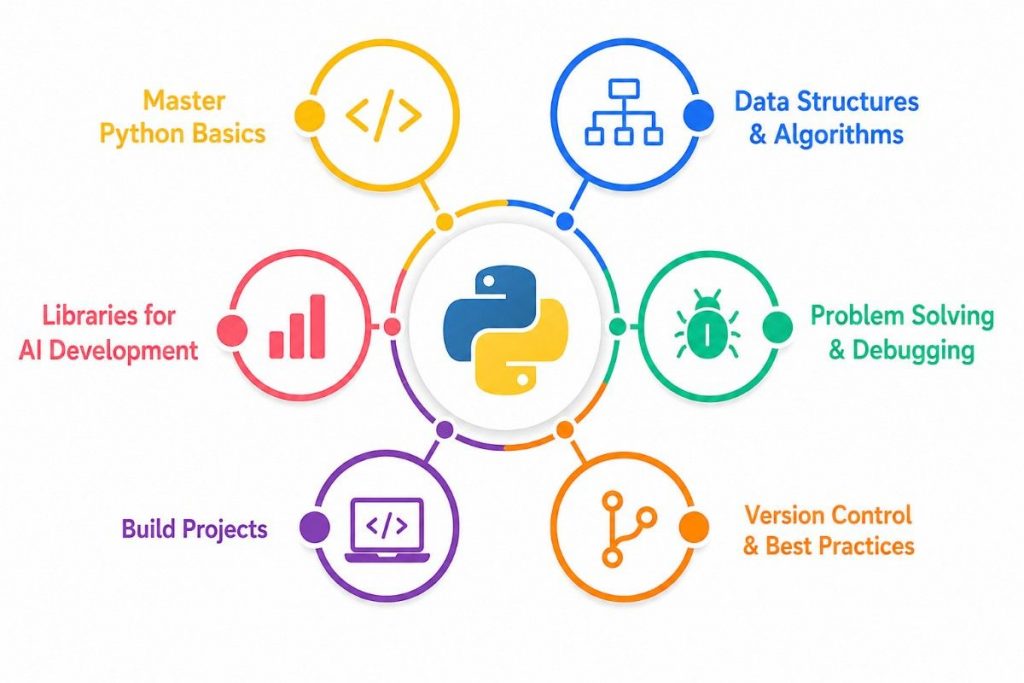
Python is one of the most widely used programming languages in Artificial Intelligence because of its simple syntax, flexibility, and extensive ecosystem of libraries and frameworks. Freshers should begin by learning programming fundamentals such as variables, data types, operators, conditional statements, loops, functions, modules, classes, and object-oriented programming.
Build Mathematics and Statistics Skills for AI
Mathematics and statistics provide an important foundation for understanding how Artificial Intelligence and machine learning algorithms process data and produce results. Freshers do not need to become advanced mathematicians at the beginning, but they should develop a practical understanding of important concepts. Linear algebra helps learners understand vectors, matrices, dimensions, and mathematical representations commonly used in machine learning models. Probability and statistics support data analysis, probability distributions, sampling, correlation, variance, uncertainty, and model evaluation. Basic calculus helps beginners understand optimization, gradients, and how machine learning models adjust parameters during training. Learners should also become familiar with descriptive statistics and basic statistical measures. For structured learning and practical exposure, freshers can consider Artificial Intelligence Training in Bangalore. Studying these concepts alongside Python exercises and machine learning projects makes complex algorithms easier to understand and helps freshers interpret model performance, analyze datasets, and make informed AI development decisions.
Learn Artificial Intelligence Training Course to Build Your Skills
Weekday / Weekend BatchesSee Batch DetailsLearn Machine Learning and Deep Learning
- Supervised Learning: Learn algorithms for classification and regression using labeled datasets. Practice techniques such as linear regression, decision trees, and logistic regression to make predictions and solve real-world problems.
- Unsupervised Learning: Understand techniques such as clustering and dimensionality reduction that identify hidden patterns in unlabeled data. Explore methods like K-Means and PCA to analyze datasets and discover useful relationships.
- Practical Frameworks: Gain hands-on experience with Scikit-learn, TensorFlow, and PyTorch to build, train, test, and evaluate AI models. Practicing with these frameworks helps freshers develop practical machine learning and deep learning skills. To understand how AI projects are developed using these concepts, explore this AI Project Development Tutorial.
- Model Evaluation: Learn evaluation metrics such as accuracy, precision, recall, F1-score, and mean squared error. Understanding these measures helps freshers compare models, identify errors, and select suitable algorithms for specific problems.
- Deep Learning: Explore neural networks, layers, activation functions, weights, biases, backpropagation, and optimization techniques. These concepts help beginners understand how deep learning models solve complex image, language, and prediction tasks.

Get JOB Oriented Artificial Intelligence Training for Beginners By MNC Experts
- Instructor-led Sessions
- Real-life Case Studies
- Assignments
Explore AI Tools, Frameworks, and Technologies
Learning modern AI tools and frameworks helps freshers transform theoretical knowledge into practical Artificial Intelligence solutions and gain confidence in real-world development. Python libraries such as NumPy and Pandas are useful for numerical calculations, data manipulation, cleaning, and preprocessing, while Scikit-learn supports traditional machine learning algorithms, model training, and evaluation. Beginners interested in deep learning can explore TensorFlow and PyTorch to develop and train neural network models. They can also learn Generative AI platforms, large language models, prompt engineering, vector databases, embeddings, and AI APIs to understand modern AI application development. Version control tools such as Git and GitHub help learners manage code, track changes, showcase projects, and collaborate effectively. For a broader understanding of emerging AI technologies and their future applications, learners can explore Artificial Intelligence Tutorial. Hands-on practice with these technologies enables freshers to identify suitable AI specializations and build skills aligned with their career goals.
Want to Master Artificial Intelligence? Explore the Artificial Intelligence Master Program Offered at ACTE Today!
Build Practical AI Projects and a Strong Portfolio
- Beginner Projects: Start with simple projects such as house price prediction, spam detection, sentiment analysis, student performance prediction, or recommendation systems. These projects help freshers practice data preprocessing, model training, testing, and evaluation.
- Intermediate Projects: Build practical applications such as chatbots, image classification systems, customer churn prediction models, resume screening tools, or document classification systems. These projects help develop stronger machine learning and application development skills.
- Create an Online Portfolio: Publish completed projects on platforms such as GitHub and create clear case studies describing your approach and results. A structured Artificial Intelligence Training program can also help freshers strengthen their practical skills while building portfolio projects. A strong portfolio helps demonstrate programming, AI knowledge, practical skills, and project experience.
- Generative AI Projects: Create AI assistants, question-answering applications, content generation tools, document summarizers, or retrieval-based applications. These projects help freshers understand large language models, prompts, embeddings, and modern AI application development.
- Document Your Work: Clearly explain the problem statement, dataset, technologies, implementation process, algorithms, model performance, challenges, solutions, and final results for every project. Good documentation demonstrates technical understanding and problem-solving ability.
Want to Learn About AI? Explore Our Artificial Intelligence Interview Questions and Answers Featuring the Most Frequently Asked Questions in Job Interviews.
Develop Job-Ready AI Skills and Prepare for Interviews
Freshers should combine technical knowledge with communication, analytical thinking, and problem-solving skills to become job-ready for AI roles. A strong foundation in Python, data structures, machine learning, statistics, SQL, data preprocessing, model training, and model evaluation can help candidates prepare for technical assessments and practical assignments. Learners should also practice explaining their projects, algorithms, design decisions, challenges, and model results clearly during interviews.
Conclusion: Starting an AI Career as a Fresher
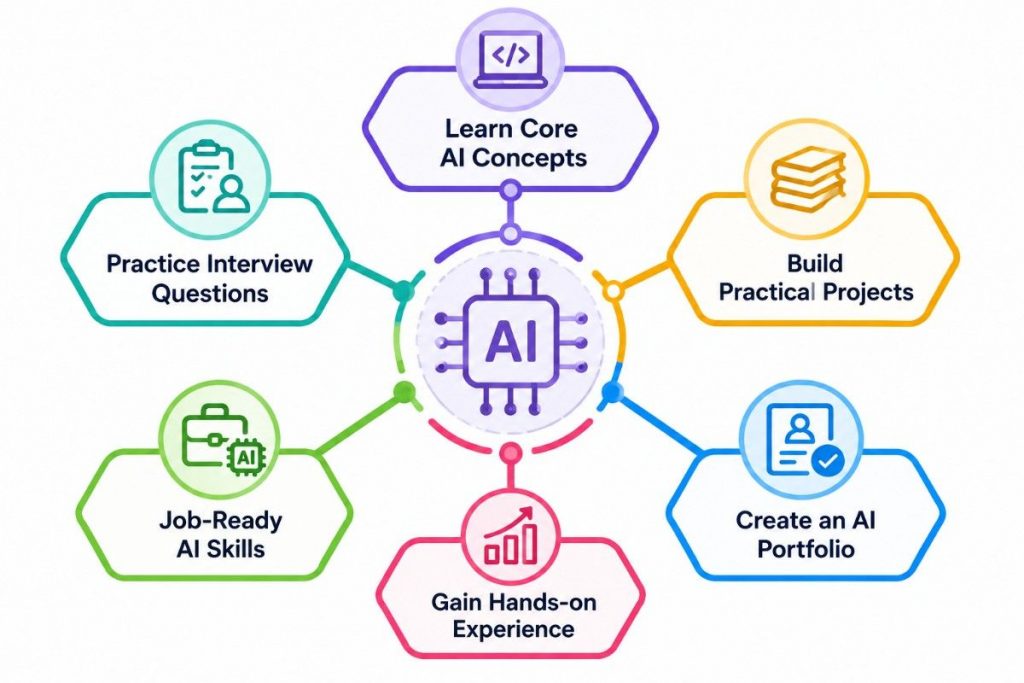
Building an AI career as a fresher requires consistent learning, practical experience, and a structured approach to developing technical and professional skills. Beginners can start with Artificial Intelligence fundamentals and gradually learn Python programming, mathematics, statistics, data analysis, machine learning, deep learning, and modern AI tools and frameworks. Practical projects provide valuable opportunities to apply concepts to real-world problems, experiment with different algorithms, and understand how AI solutions are developed and evaluated. A well-organized portfolio can demonstrate technical knowledge, creativity, and problem-solving abilities to potential employers. Freshers can strengthen their practical knowledge through Artificial Intelligence Training in Pune while developing relevant industry skills. Freshers should also develop communication, analytical thinking, teamwork, and interview skills alongside their technical expertise. Exploring areas such as Generative AI, NLP, computer vision, and machine learning can help learners identify suitable career paths. With regular practice, continuous learning, project development, internships, and industry awareness, freshers can build a strong foundation for long-term growth in Artificial Intelligence.