LMS
Last updated on 01st Oct 2026| 4758

- Introduction to Astra AI
- How to Get Started with Astra AI
- Understanding Astra AI Features and Capabilities
- Understanding Basic Prompting Techniques in Astra AI
- Using Astra AI for Content Creation and Automation
- Using Astra AI for Coding and Problem-Solving
- Exploring Learning, Research, and Productivity with Astra AI
- Best Practices, Limitations, and Common Mistakes in Astra AI
- Conclusion
Introduction to Astra AI
Artificial intelligence is transforming how people learn, work, create content, automate tasks, and solve everyday problems. Astra AI provides users with AI-powered capabilities that can support research, content creation, productivity, problem-solving, and other digital tasks. Beginners can explore Astra AI by understanding its core features, learning how to provide clear instructions, and experimenting with simple prompts and tasks. Those who want to build a stronger foundation in AI concepts can also explore Artificial Intelligence Training to develop practical knowledge of AI technologies and applications. Astra AI can help users generate ideas, summarize information, improve written content, analyze data, answer questions, and support various professional activities. To get useful results, users should provide specific instructions, explain their requirements clearly, and review AI-generated responses before using them. As beginners become more familiar with Astra AI, they can explore advanced prompting techniques, automation capabilities, research workflows, and productivity-focused use cases. Understanding how Astra AI works, what it can do, and where its limitations apply is important for using it effectively and responsibly. This guide explains the essential steps beginners can follow to get started with Astra AI and confidently use its features for learning, creativity, productivity, and professional tasks.
How to Get Started with Astra AI
Getting started with Astra AI can be simple for beginners, even without prior experience using artificial intelligence tools. Begin by accessing Astra AI and exploring its interface, available features, and supported capabilities. Start with basic tasks such as asking questions, generating ideas, summarizing information, or improving written content to understand how Astra AI responds to different instructions. As you become more comfortable, provide clear context, define your objective, and specify the expected format, tone, or level of detail in your prompts. Well-structured instructions can help Astra AI produce more relevant and useful responses. Beginners who want to build a stronger foundation can also explore an AI Tutorial for Beginners to understand fundamental AI concepts before moving into more advanced applications. Astra AI can gradually be explored for content creation, research, productivity, problem-solving, data-related tasks, and other professional workflows. Reviewing the generated output is also important because AI responses may occasionally contain inaccurate, incomplete, or outdated information. Users can improve results by refining their prompts, adding relevant details, and providing additional context when necessary. Experimenting with different types of requests helps beginners understand Astra AI’s capabilities and limitations. By starting with simple tasks and gradually exploring more advanced features, users can develop practical skills and confidently integrate Astra AI into their personal, learning, and professional activities.
Get Your Artificial Intelligence Certification by Learning from Industry-Leading Experts and Advancing Your Career with ACTE’s Artificial Intelligence Course.
Understanding Astra AI Features and Capabilities
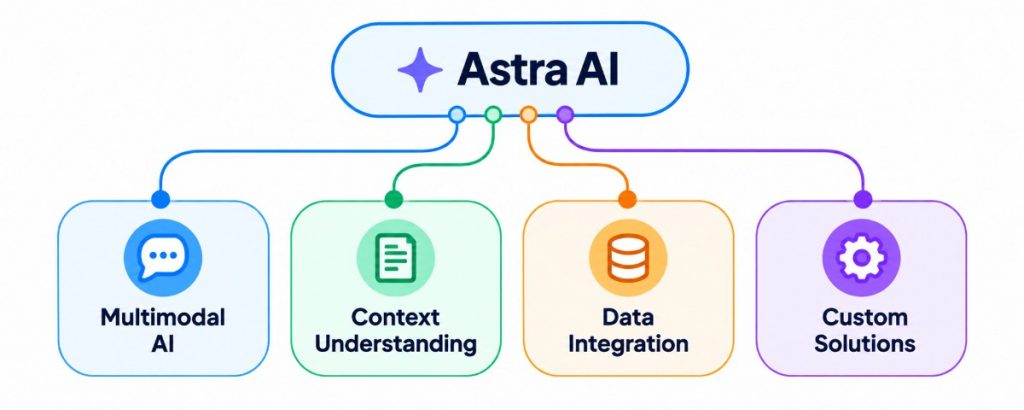
- Understand Astra AI Capabilities: Identify the tasks you want Astra AI to support, such as content creation, research, productivity, problem-solving, automation, or general questions, and explore the features relevant to your requirements.
- Explore AI-Powered Responses: Use Astra AI to handle questions, analyze information, generate ideas, summarize content, and provide explanations. Understanding how it responds to different instructions helps beginners use it more effectively. Learning about Future Technology of AI can also help users understand how AI capabilities may evolve and support different industries.
- Check Available Tools and Features: Explore the tools and capabilities available within Astra AI, such as content generation, information analysis, task assistance, research support, and other features that can improve everyday workflows.
- Match Features to Your Workflow: Choose Astra AI features based on your specific goals, whether you are learning a new topic, creating content, completing professional tasks, solving problems, or improving productivity.
- Test and Compare Results: Experiment with different prompts and tasks to understand how Astra AI performs. Compare responses based on accuracy, relevance, clarity, and usefulness, and refine your instructions when better results are needed.

Learn Artificial Intelligence Training Course to Build Your Skills
Weekday / Weekend BatchesSee Batch DetailsUnderstanding Basic Prompting Techniques in Astra AI
- Write Clear Instructions: Clearly explain what you want Astra AI to accomplish. Avoid vague requests and provide specific details about the task, topic, objective, and expected result to receive more relevant responses.
- Provide Useful Context: Give Astra AI sufficient background information about your requirements. Details such as the target audience, purpose, industry, or specific situation can help generate responses that better match your expectations.
- Specify the Output Format: Tell Astra AI how you want the information presented. You can request paragraphs, tables, summaries, step-by-step instructions, or other formats based on the type of task you are completing. Learning broader prompting concepts through Artificial Intelligence Training can also help beginners understand how structured instructions influence AI-generated results.
- Use Examples When Needed: Include examples when you want Astra AI to follow a particular structure, writing style, tone, or level of detail. Examples can make your instructions clearer and help guide the expected output.
- Refine Your Prompts: Review the response and improve your prompt if the result does not meet your expectations. Adding missing information, adjusting instructions, or providing additional context can help Astra AI deliver more accurate and consistent results.

Get JOB Oriented Artificial Intelligence Training for Beginners By MNC Experts
- Instructor-led Sessions
- Real-life Case Studies
- Assignments
Using Astra AI for Content Creation and Automation
Astra AI can help beginners, professionals, marketers, students, and content creators make the content development process faster and more organized. Users can provide a topic, target audience, preferred tone, content length, keywords, and required format to guide Astra AI toward relevant results. It can support various content tasks, including blog articles, social media posts, email drafts, product descriptions, website copy, summaries, and creative ideas. Astra AI can also generate content outlines before creating a complete piece, helping users organize information into logical sections and maintain a clear structure. For larger projects, users can develop content step by step, review each section, and provide additional instructions to improve consistency and quality. Astra AI can also assist with rewriting sentences, simplifying complex information, correcting grammar, improving readability, and generating alternative versions of content. Users interested in expanding their practical knowledge can explore the AI Project Development Tutorial to understand how AI concepts can be applied to real-world projects and workflows. However, AI-generated content should always be reviewed before publication or professional use. Users should verify important facts, remove repetitive information, add original insights, and ensure the final content follows the required brand voice and guidelines. When used thoughtfully, Astra AI can streamline content workflows while allowing users to maintain control over accuracy, originality, quality, and creativity.
Using Astra AI for Coding and Problem-Solving
Astra AI can serve as a useful coding assistant for beginners, students, and experienced developers by supporting programming, debugging, and technical problem-solving activities. Users can describe a programming requirement and ask Astra AI to generate code examples, explain programming concepts, identify potential errors, or suggest improvements to existing code. It can assist with common programming languages and technologies such as Python, Java, JavaScript, SQL, and more. Astra AI can also explain unfamiliar code step by step, help convert code between programming languages, create functions, suggest test cases, and troubleshoot common development issues. For better results, users should provide the programming language, project requirements, relevant code, error messages, and expected output so Astra AI has sufficient context to understand the problem. Developers interested in building a stronger foundation in AI-assisted development can explore Artificial Intelligence Training to understand practical AI concepts and applications. Developers can also use Astra AI to learn algorithms, improve code readability, generate documentation, and explore alternative approaches to solving technical challenges. However, AI-generated code should always be reviewed and tested before being implemented in real applications. Users should verify the logic, dependencies, performance, security, and compatibility of suggested solutions. When used responsibly, Astra AI can improve coding productivity while helping users strengthen their programming knowledge and problem-solving abilities.
Want to Master Artificial Intelligence? Explore the Artificial Intelligence Master Program Offered at ACTE Today!
Exploring Learning, Research, and Productivity with Astra AI
- Simplifying Difficult Concepts: Astra AI can explain complex subjects in simple language. Beginners can request easy explanations, practical examples, analogies, or step-by-step breakdowns to understand unfamiliar topics more effectively.
- Creating Personalized Learning Plans: Users can ask Astra AI to create structured learning plans based on their goals, current knowledge, available time, and preferred approach. This can make self-learning more organized and manageable. Beginners can also follow an AI Career Roadmap for Freshers to understand the skills and learning areas that can support their career development.
- Practicing With Questions: Astra AI can generate quizzes, practice questions, exercises, and study activities based on a specific subject. Learners can use these resources to test their understanding and identify areas that require additional practice.
- Asking Follow-Up Questions: Learning with Astra AI can be interactive because users can continue asking questions whenever they need clarification. They can request additional examples, simpler explanations, comparisons, or alternative approaches to understand a concept better.
- Exploring Different Perspectives: Astra AI can help users examine topics from different perspectives and understand connections between related concepts. This encourages deeper exploration and helps learners develop a broader understanding beyond basic definitions.
Want to Learn About AI? Explore Our Artificial Intelligence Interview Questions and Answers Featuring the Most Frequently Asked Questions in Job Interviews.
Best Practices, Limitations, and Common Mistakes in Astra AI
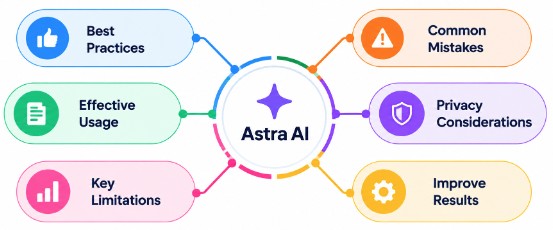
Using Astra AI effectively requires an understanding of its capabilities, limitations, and the importance of human judgment. Although Astra AI can generate useful responses and support a variety of tasks, its outputs may sometimes contain inaccurate, incomplete, outdated, or misleading information. Users should review important responses carefully instead of assuming that every result is automatically correct. For sensitive areas such as healthcare, finance, legal matters, academic research, and business decisions, information should be verified through reliable and authoritative sources. Providing clear instructions, relevant context, and specific requirements can improve the quality and usefulness of generated responses. Users should also refine prompts and ask follow-up questions when information is unclear or incomplete.
Conclusion
Getting started with Astra AI can create new opportunities for learning, productivity, creativity, research, automation, coding, and everyday problem-solving. Beginners can start by understanding Astra AI’s core features, exploring simple tasks, and learning how to write clear and specific prompts. As users gain experience, they can explore more advanced applications such as content creation, coding assistance, information analysis, personalized learning, research support, and productivity workflows. However, effective use of Astra AI also requires awareness of its limitations. AI-generated responses may sometimes contain inaccurate, incomplete, or outdated information, so important details should be verified using reliable sources. Users who want to strengthen their understanding of AI concepts and practical applications can also explore Artificial Intelligence Training to build relevant skills. Users should also protect sensitive information and carefully review AI-generated content before using or publishing it. With regular practice, thoughtful prompting, critical thinking, and responsible usage, Astra AI can become a valuable assistant for both personal and professional tasks. As AI technology continues to evolve, developing practical skills with tools such as Astra AI can help users improve efficiency, adapt to emerging technologies, and explore new opportunities in an increasingly AI-driven digital environment.