LMS
LMS
Last updated on 18th Aug 2026| 4662

- Introduction to Artificial Intelligence for Beginners
- Understanding the Fundamentals of Artificial Intelligence
- Introduction to Machine Learning and Its Role in AI
- Understanding Deep Learning and Neural Networks
- Natural Language Processing and Generative AI
- How Artificial Intelligence Works: Data, Training, and Prediction
- Popular Artificial Intelligence Tools and Technologies
- Artificial Intelligence Applications, Skills, and Career Opportunities
- Conclusion: Starting Your Artificial Intelligence Journey
Introduction to Artificial Intelligence for Beginners
Artificial Intelligence (AI) is a technology that enables computers and machines to perform tasks that normally require human intelligence, such as learning, reasoning, decision-making, language understanding, pattern recognition, and problem-solving. For beginners, learning AI starts with understanding how computers use data, algorithms, and models to identify patterns and generate useful predictions or results. AI is widely used in healthcare for diagnosis support, finance for fraud detection, education for personalized learning, e-commerce for recommendations, manufacturing for automation, transportation for intelligent systems, and customer service through chatbots. Beginners can gradually build their knowledge by learning basic AI concepts before progressing to machine learning, deep learning, natural language processing, computer vision, and generative AI. Those who want structured guidance can explore Artificial Intelligence Training to develop foundational and practical AI skills. Understanding these foundations helps learners build AI projects and explore career opportunities in the rapidly growing artificial intelligence field.
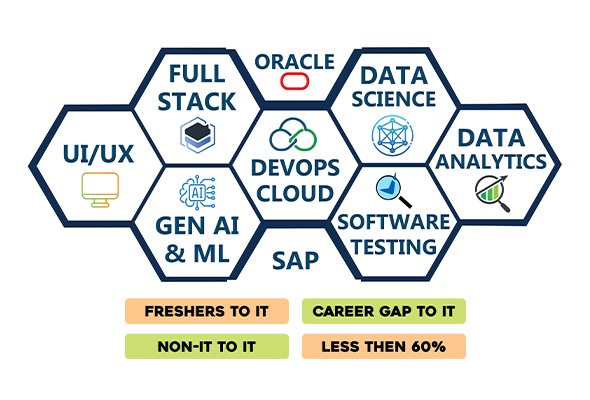
Understanding the Fundamentals of Artificial Intelligence
- Artificial Intelligence: AI refers to computer systems designed to perform tasks that require human-like intelligence, including reasoning, learning, prediction, and decision-making. Beginners can explore the concepts in this Artificial Intelligence Tutorial to build a strong foundation.
- Data: Data provides the information required to train and evaluate many AI systems. Beginners should understand how data is collected, cleaned, organized, and prepared for analysis.
- Algorithms: AI algorithms provide instructions that allow computers to process information, identify patterns, and produce predictions or decisions based on available data.
- Models: AI models learn patterns from data and use those patterns to perform tasks such as classification, prediction, recommendation, and content generation.
- Training and Testing: AI models are trained using data and then evaluated with separate data to determine how effectively they perform on new or unseen information.
Get Your Artificial Intelligence Certification by Learning from Industry-Leading Experts and Advancing Your Career with ACTE’s Artificial Intelligence Course.
Introduction to Machine Learning and Its Role in AI
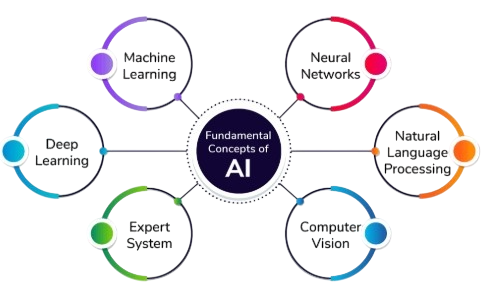
- Machine Learning: Machine Learning is a branch of AI that enables computers to learn from data, identify patterns, and make predictions or decisions without being explicitly programmed for every task. To understand how AI continues to evolve, explore Artificial Intelligence and Future Technology of AI.
- Data: Data is the foundation of Machine Learning. It is collected, cleaned, organized, and prepared to help algorithms learn meaningful patterns.
- Algorithms: Machine Learning algorithms analyze data and identify relationships that can be used for prediction, classification, recommendation, and other AI applications.
- Models: Machine Learning models are trained on data to recognize patterns and perform tasks such as forecasting, classification, and decision-making.
- Role in AI: Machine Learning plays a key role in AI by helping systems improve their performance through experience and data, making intelligent applications more accurate and adaptable.
Understanding Deep Learning and Neural Networks
Deep Learning is a specialized branch of machine learning that uses artificial neural networks with multiple layers to learn complex patterns and relationships from large amounts of structured and unstructured data. These neural networks are inspired by the basic working principles of biological neurons and contain interconnected nodes that process information and generate useful outputs. Deep Learning is widely used in image recognition, speech processing, natural language understanding, recommendation systems, autonomous vehicles, medical analysis, and generative AI applications. Those who want to strengthen their practical AI knowledge can explore Artificial Intelligence Training to learn AI concepts and related technologies. Working on practical projects can help beginners understand how Deep Learning solves real-world problems. Beginners can start by learning fundamental concepts such as neurons, input and output layers, hidden layers, activation functions, weights, biases, forward propagation, loss functions, and backpropagation. Popular frameworks such as TensorFlow and PyTorch allow learners to build, train, test, and experiment with neural network models.

Learn Artificial Intelligence Training Course to Build Your Skills
Weekday / Weekend BatchesSee Batch DetailsNatural Language Processing and Generative AI
- Natural Language Processing: NLP enables computers to understand, process, analyze, and generate human language. It is used in chatbots, translation systems, sentiment analysis, search engines, and text classification. Beginners can build their knowledge through this Artificial Intelligence Tutorial.
- Text Generation: Generative AI models can create new text based on user instructions. Beginners can explore applications such as content generation, summarization, question answering, and document assistance.
- Conversational AI: AI-powered assistants can understand user queries and generate responses in natural language. These systems are commonly used in customer support and productivity applications.
- Image and Multimedia Generation: Generative AI can also create or transform images, audio, video, and other types of content based on prompts and learned patterns.
- Prompt Engineering: Writing clear and structured instructions helps generative AI systems produce more relevant and useful outputs. Beginners can practice prompts for different tasks and applications.

Get JOB Oriented Artificial Intelligence Training for Beginners By MNC Experts
- Instructor-led Sessions
- Real-life Case Studies
- Assignments
How Artificial Intelligence Works: Data, Training, and Prediction
Artificial Intelligence systems generally follow a structured process that begins with collecting relevant and reliable data from different sources. The collected data is then cleaned, organized, and prepared to remove errors, duplicates, or missing values before being used by an AI algorithm or model. During the training stage, the model analyzes the prepared data and learns patterns, relationships, and features that can support specific tasks. The trained model is evaluated using separate test data to measure accuracy, identify errors, and understand its performance on new information. Beginners looking to develop practical knowledge of these AI concepts can explore Artificial Intelligence Training to build a stronger understanding of AI technologies and workflows. Understanding this complete workflow helps beginners see how data, algorithms, training, testing, deployment, and continuous improvement work together. Once the model achieves acceptable results, it can be deployed within an application to generate predictions, classifications, recommendations, or AI-generated content. After deployment, the system can be monitored and improved using new data, user feedback, and performance analysis.
Want to Master Artificial Intelligence? Explore the Artificial Intelligence Master Program Offered at ACTE Today!
Popular Artificial Intelligence Tools and Technologies
- Python: Python is one of the most widely used programming languages for AI and machine learning because of its extensive libraries and beginner-friendly syntax. Learners can also explore Internship Effective Strategies to understand how to gain practical experience while developing AI skills.
- TensorFlow and PyTorch: These frameworks are commonly used for developing, training, and deploying deep learning and neural network models.
- Scikit-learn: Scikit-learn provides tools for implementing common machine learning algorithms, data preprocessing, model evaluation, and experimentation.
- Pandas and NumPy: These Python libraries help beginners work with datasets, perform numerical calculations, clean data, and prepare information for machine learning workflows.
- Generative AI Platforms: Modern AI platforms provide models and APIs for applications involving text generation, image generation, conversational assistants, coding, and other AI-powered tasks.
Want to Learn About AI? Explore Our Artificial Intelligence Interview Questions and Answers Featuring the Most Frequently Asked Questions in Job Interviews.
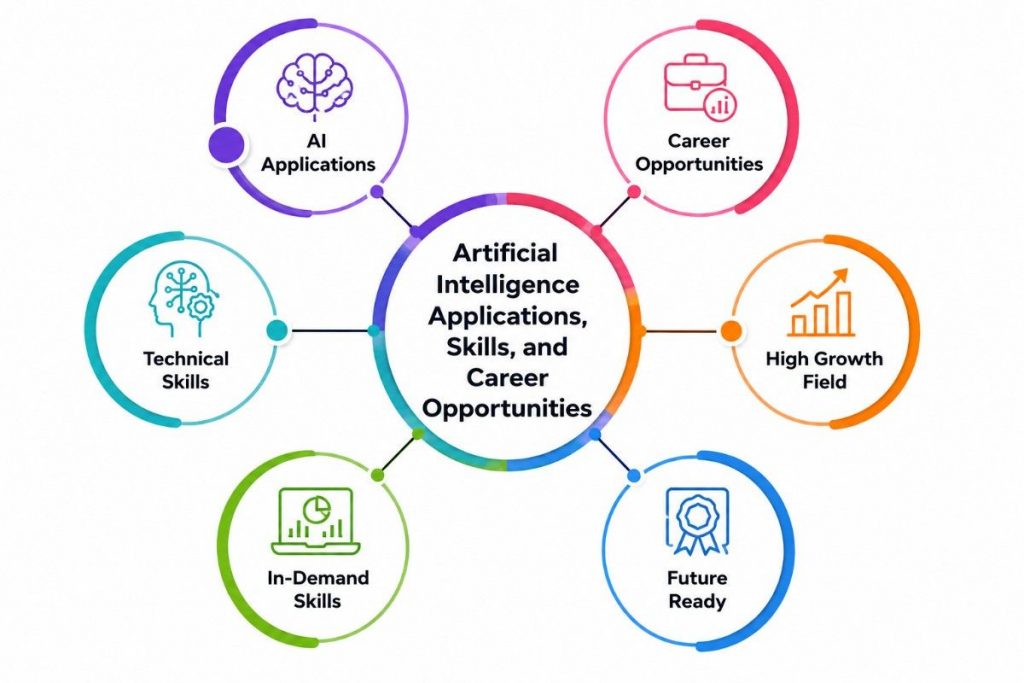
Artificial Intelligence Applications, Skills, and Career Opportunities
Artificial Intelligence is being applied across many industries to automate repetitive tasks, analyze large volumes of information, improve decision-making, increase efficiency, and create innovative digital experiences. In healthcare, AI can support medical image analysis, patient monitoring, and personalized care. Banking and finance organizations use AI for fraud detection, risk analysis, and customer support, while retail businesses use it for recommendations, demand forecasting, and customer insights.
Conclusion: Starting Your Artificial Intelligence Journey
Artificial Intelligence offers beginners a wide range of opportunities to understand how machines can process information, identify patterns, make predictions, understand human language, recognize images, and generate new content. Starting with fundamental AI concepts provides a strong foundation before progressing into machine learning, deep learning, Natural Language Processing (NLP), computer vision, and generative AI. Beginners can strengthen their knowledge by learning Python, exploring popular AI libraries and frameworks, and building practical projects based on real-world problems. Those who want to develop structured knowledge and practical skills can explore Artificial Intelligence Training for additional learning support. Developing skills in data preparation, algorithm selection, model training, testing, evaluation, programming, and problem-solving can help learners become more confident when working with AI technologies. Creating projects such as chatbots, prediction systems, recommendation applications, or image classification models can provide valuable hands-on experience. As AI continues to evolve, consistent practice, continuous learning, and portfolio development can help beginners prepare for diverse AI career opportunities and long-term professional growth.