LMS
LMS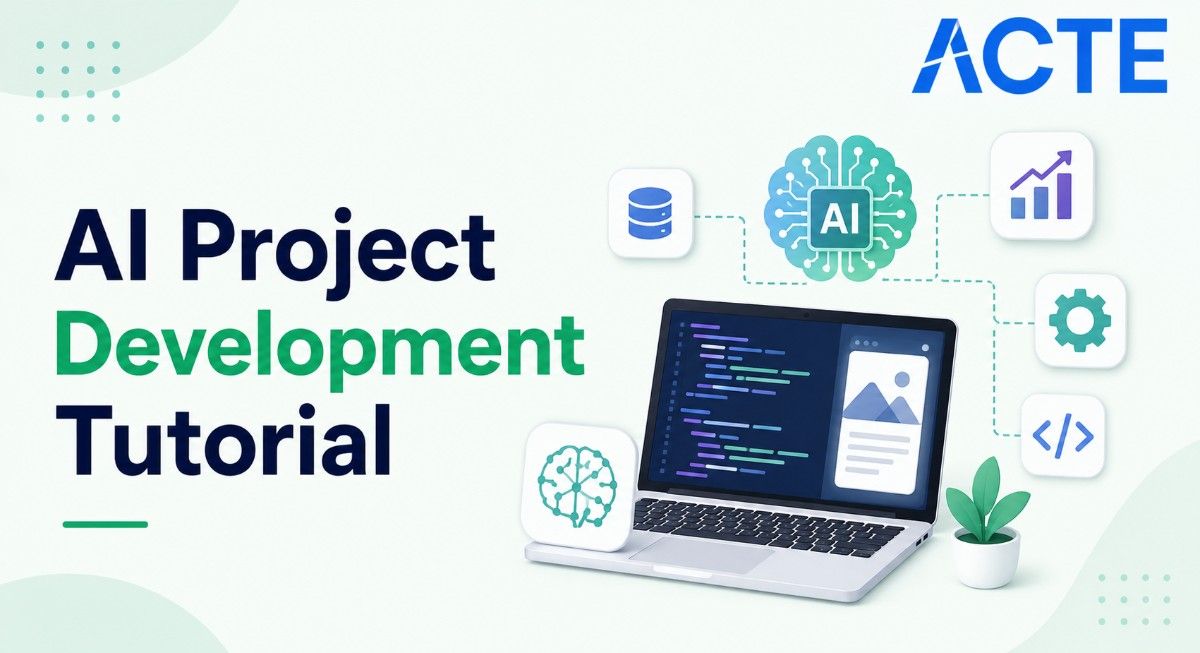
Last updated on 18th Aug 2026| 4651

- Introduction to AI Project Development
- AI Project Planning and Problem Definition
- Data Collection, Preparation, and Preprocessing
- AI Model Selection and Development
- AI Model Training and Evaluation
- AI Tools, Frameworks, and Technologies
- AI Project Deployment and Integration
- AI Project Testing, Monitoring, and Optimization
- Conclusion: Building and Improving AI Projects
Introduction to AI Project Development
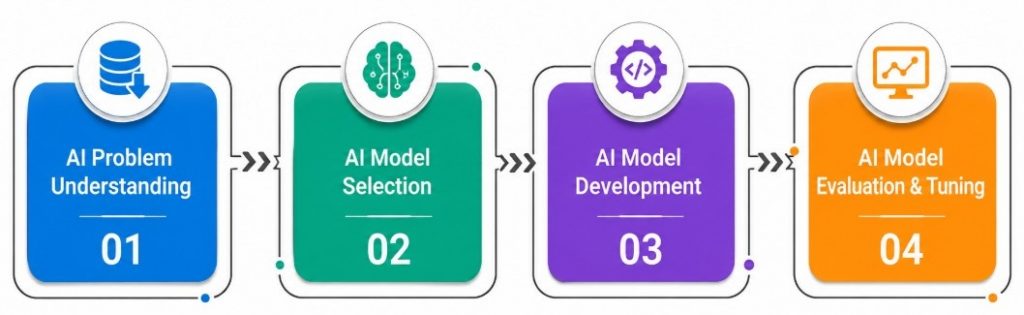
AI project development involves applying Artificial Intelligence concepts, data, algorithms, programming skills, and software tools to solve real-world problems and create intelligent applications. Beginners can start by identifying a specific problem, understanding user requirements, defining project objectives, and determining whether AI is an appropriate solution. A typical AI project moves through several stages, including problem definition, data collection, data preprocessing, feature selection, model selection, training, testing, evaluation, deployment, and monitoring. Depending on project requirements, developers may work with machine learning, deep learning, Natural Language Processing, computer vision, recommendation systems, or Generative AI technologies. Freshers can strengthen their practical knowledge through Artificial Intelligence Training while learning how to apply AI concepts to real-world projects. Learning this complete development lifecycle helps freshers understand how theoretical AI concepts are transformed into practical solutions. Building projects also provides valuable hands-on experience, improves programming and problem-solving skills, and helps learners create a strong portfolio that demonstrates their technical abilities to potential employers.
AI Project Planning and Problem Definition
- Identify the Problem: Clearly define the real-world problem the AI project should solve by understanding user needs, business requirements, available data, and expected outcomes. Determine whether AI is the right technology for addressing the problem. For beginners who want to understand AI fundamentals before starting a project, explore the Artificial Intelligence Tutorial.
- Define Objectives: Establish clear and measurable project goals, expected outcomes, target users, performance requirements, and success criteria. Well-defined objectives help developers track progress and evaluate whether the completed AI solution meets expectations.
- Choose the AI Approach: Select an appropriate AI technique based on the project requirements, data type, and expected output. Consider classification, regression, clustering, recommendation systems, Natural Language Processing, computer vision, or Generative AI.
- Plan Resources: Identify the datasets, programming languages, libraries, frameworks, APIs, development tools, computing infrastructure, and team responsibilities required for the project. Proper resource planning helps ensure efficient development and successful project execution.
Get Your Artificial Intelligence Certification by Learning from Industry-Leading Experts and Advancing Your Career with ACTE’s Artificial Intelligence Course.
Data Collection, Preparation, and Preprocessing
Data is one of the most important components of an AI project because machine learning models depend on relevant, accurate, and reliable information to learn patterns and produce useful results. Developers may collect data from databases, APIs, public datasets, sensors, business systems, surveys, or other trustworthy sources. After collection, the data must be cleaned by handling missing values, duplicate records, incorrect entries, inconsistent formats, and unwanted information. Developers may also perform feature selection, transformation, normalization, encoding, and data visualization to prepare the dataset for model development. For freshers looking to strengthen their practical understanding of AI and data workflows, Artificial Intelligence Training can provide structured learning. The processed data is commonly divided into training, validation, and testing sets to support effective model development and evaluation. Proper data preprocessing can improve model performance and reduce inaccurate predictions. Beginners should also consider data privacy, security, quality, bias, and ethical requirements when collecting and using real-world datasets.
AI Model Selection and Development
Selecting the right AI model depends on the project objective, available data, expected output, performance requirements, and available computing resources. Beginners can experiment with algorithms such as linear regression, logistic regression, decision trees, random forests, support vector machines, and clustering techniques for traditional machine learning problems. For classification and prediction tasks, developers should compare different algorithms based on their accuracy and suitability for the dataset.

Learn Artificial Intelligence Training Course to Build Your Skills
Weekday / Weekend BatchesSee Batch DetailsAI Model Training and Evaluation
- Model Training: Provide the prepared training dataset to the selected algorithm so it can learn patterns, relationships, and important features related to the target problem. Training allows the model to identify useful patterns for making predictions.
- Validation: Use validation data to adjust model parameters, compare different approaches, and identify issues such as overfitting or underfitting. This helps developers select a model that performs consistently on unseen data.
- Performance Evaluation: Measure model performance using suitable metrics such as accuracy, precision, recall, F1-score, mean squared error, or other task-specific measures. Evaluation helps determine whether the model meets project requirements.
- Model Improvement: Improve model results by adjusting hyperparameters, selecting relevant features, improving data quality, increasing training data, or testing alternative algorithms. Repeated experimentation can help achieve better accuracy and reliability. Understanding how AI is evolving across modern applications can provide additional context through Artificial Intelligence and Future of AI.
- Final Testing: Evaluate the selected model using previously unseen test data to understand how effectively it performs on new inputs. Final testing provides a realistic measure of model performance before deployment.

Get JOB Oriented Artificial Intelligence Training for Beginners By MNC Experts
- Instructor-led Sessions
- Real-life Case Studies
- Assignments
AI Tools, Frameworks, and Technologies
AI project development involves a variety of programming languages, libraries, frameworks, platforms, and development tools that help developers build, test, deploy, and maintain intelligent applications. Python is widely used because it offers a large ecosystem for data science, machine learning, and Artificial Intelligence. Libraries such as NumPy and Pandas support numerical operations, data manipulation, cleaning, and preprocessing, while Scikit-learn provides algorithms and utilities for traditional machine learning tasks. TensorFlow and PyTorch are commonly used for developing and training deep learning models. Developers can also explore Natural Language Processing libraries, computer vision frameworks, Generative AI platforms, and AI APIs based on project requirements. For learners seeking structured guidance in applying these technologies, Artificial Intelligence Training can help build practical AI development skills. Tools such as Jupyter Notebook and VS Code support coding and experimentation, while Git and GitHub help with version control and collaboration. Selecting suitable technologies based on project objectives, scalability, performance, and resources helps create efficient and maintainable AI applications.
Want to Master Artificial Intelligence? Explore the Artificial Intelligence Master Program Offered at ACTE Today!
AI Project Deployment and Integration
After an AI model has been trained, tested, and evaluated, it can be deployed so that users or other applications can access its predictions, recommendations, classifications, or generated results. Developers may integrate AI models into websites, mobile applications, enterprise systems, APIs, or cloud-based services depending on project requirements. Deployment can involve packaging the trained model, creating API endpoints, configuring servers or cloud infrastructure, and connecting the model with the application interface. Cloud platforms can provide scalable computing resources for handling AI workloads, while containerization tools can help maintain consistent environments across development and production. Beginners who want to understand the career opportunities and skills involved in building AI solutions can explore the AI Career Roadmap for Freshers. Beginners should also consider security, scalability, response time, resource usage, maintenance costs, and data privacy during deployment. A well-planned deployment process ensures that the AI application performs reliably, responds efficiently to user requests, and can be updated or scaled as project requirements grow.
Want to Learn About AI? Explore Our Artificial Intelligence Interview Questions and Answers Featuring the Most Frequently Asked Questions in Job Interviews.
AI Project Testing, Monitoring, and Optimization
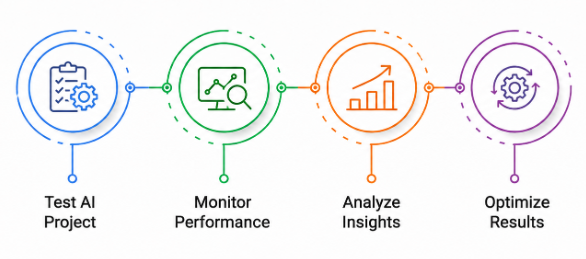
- Model Training: Provide the prepared training dataset to the selected algorithm so it can learn patterns, relationships, and important features related to the target problem. Training allows the model to identify useful patterns for making predictions.
- Validation: Use validation data to adjust model parameters, compare different approaches, and identify issues such as overfitting or underfitting. This helps developers select a model that performs consistently on unseen data.
- Performance Evaluation: Measure model performance using suitable metrics such as accuracy, precision, recall, F1-score, mean squared error, or other task-specific measures. Evaluation helps determine whether the model meets project requirements.
- Model Improvement: Improve model results by adjusting hyperparameters, selecting relevant features, improving data quality, increasing training data, or testing alternative algorithms. Repeated experimentation can help achieve better accuracy and reliability. For additional guidance on building an AI career and developing practical skills, learners can explore this Internship Strategies and Tips.
- Final Testing: Evaluate the selected model using previously unseen test data to understand how effectively it performs on new inputs. Final testing provides a realistic measure of model performance before deployment.
Conclusion: Building and Improving AI Projects
AI project development provides beginners with an opportunity to apply Artificial Intelligence concepts to practical problems and gain valuable technical experience. A successful project typically begins with clearly defining the problem, understanding user requirements, and setting measurable objectives before moving through data collection, preprocessing, model selection, training, evaluation, and deployment. Developers should choose suitable programming languages, tools, libraries, and frameworks based on project requirements while continuously testing and monitoring the final solution. Practical AI projects can help freshers improve programming, data analysis, machine learning, problem-solving, model evaluation, and deployment skills while creating valuable portfolio examples for job applications. Learners can strengthen their practical knowledge through Artificial Intelligence Training in Pune while working toward real-world AI development skills. As AI technologies continue to evolve, developers should experiment with new models, frameworks, Generative AI tools, and development approaches. Consistent practice, clear project documentation, performance optimization, regular testing, and continuous learning can help beginners build reliable AI applications and progress toward professional AI development roles.