LMS
Last updated on 01st Oct 2026| 13423

- Introduction to AI Career Opportunities in Top MNCs in India
- Leading MNCs Hiring AI and Machine Learning Professionals
- Popular AI, Machine Learning, and Data Science Job Roles
- Generative AI, LLM, RAG, and Agentic AI Career Opportunities
- Essential Python, SQL, and Machine Learning Skills for AI Jobs
- Deep Learning, NLP, and Computer Vision Skills Required
- Cloud AI, MLOps, and Model Deployment Technologies
- Qualifications, Certifications, and Project Experience for MNC AI Jobs
- AI Salary, Career Growth, and Opportunities Across Top Companies
- Conclusion: Building a Successful AI Career in India
Introduction to AI Career Opportunities in Top MNCs in India
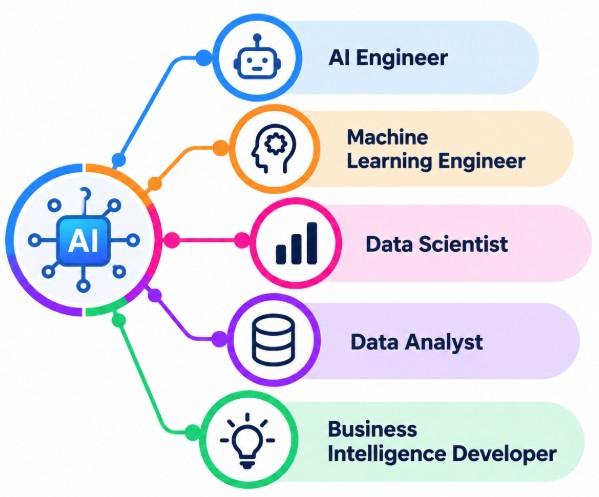
Artificial Intelligence is creating diverse career opportunities across multinational companies in India as businesses expand their use of machine learning, generative AI and cloud-based AI solutions. Professionals can explore positions such as AI Engineer, Machine Learning Engineer, Generative AI Developer, Data Scientist, NLP Engineer, Computer Vision Engineer, MLOps Engineer, and AI Solutions Architect. These opportunities are available across IT services, consulting, banking, healthcare, telecommunications, manufacturing, retail, automotive, and software industries. Candidates should develop strong foundations in Python, SQL, statistics, machine learning, deep learning, data processing, and software development. Enrolling in Artificial Intelligence Training can help learners strengthen their AI knowledge and develop practical skills for industry requirements. Knowledge of large language models, RAG, AI agents, cloud platforms, APIs, vector databases, and MLOps can further strengthen career readiness. Practical AI projects, internships, certifications, and experience deploying models can help candidates demonstrate their abilities and compete for AI-focused positions in leading organizations.
Leading MNCs Hiring AI and Machine Learning Professionals
Leading multinational and technology companies operating in India continue to build capabilities around artificial intelligence, machine learning, generative AI, cloud, and data-driven transformation. Employers such as TCS, Accenture, Infosys, Cognizant, Wipro and Capgemini offer career paths connected to AI and advanced technology, although specific vacancies vary over time. Opportunities can include AI/ML engineering, data science, generative AI development, intelligent automation, NLP, computer vision, MLOps, cloud AI, and solution architecture. Freshers can also explore Top AI Jobs for Freshers to understand entry-level opportunities and prepare for relevant career paths. Candidates with strong programming, mathematical, data, cloud, and deployment skills can target these positions while developing specialization in emerging areas such as LLMs, RAG systems, and agentic AI.
Popular AI, Machine Learning, and Data Science Job Roles
- Machine Learning Engineer: Machine Learning Engineers build, train, evaluate, optimize, and deploy predictive models. They work with algorithms, feature engineering, model evaluation, data pipelines, and production systems to solve practical business problems.
- Data Scientist: Data Scientists analyze complex datasets using Python, SQL, statistics, machine learning, and visualization techniques. They identify patterns, build predictive models, conduct experiments, and translate analytical findings into business insights.
- AI Engineer: AI Engineers design and develop intelligent applications using machine learning, deep learning, generative AI, and automation technologies. They combine models, APIs and software components to create scalable AI solutions. Candidates interested in this career can explore Becoming an AI Engineer to understand the skills and preparation required for this role.
- NLP Engineer: NLP Engineers develop applications that process and understand human language. Their work can include text classification, information extraction, semantic search, chatbots, summarization, embeddings, and language-model applications.
- MLOps Engineer: MLOps Engineers manage the operational lifecycle of machine learning systems. They focus on automated pipelines, deployment, model versioning, monitoring, infrastructure, scalability, and reliable production environments.
Get Your Artificial Intelligence Certification by Learning from Industry-Leading Experts and Advancing Your Career with ACTE’s Artificial Intelligence Course.
Generative AI, LLM, RAG, and Agentic AI Career Opportunities
- LLM Application Developer: LLM Developers build applications around large language models using prompts, structured outputs, embeddings, APIs, context management, and model orchestration techniques.
- RAG Engineer: RAG Engineers create systems that retrieve relevant information before generating responses. Their skills include document processing, chunking, embeddings, vector search, retrieval strategies, reranking, and response evaluation.
- Generative AI Engineer: Generative AI Engineers develop applications that generate and process text, images, code, and other content. They work with foundation models, prompting, APIs, evaluation methods, and application integration. Pursuing Artificial Intelligence Training can help aspiring professionals build practical AI knowledge and prepare for emerging Generative AI opportunities.
- Agentic AI Developer: Agentic AI Developers build AI systems capable of using tools and executing multi-step workflows. They work with model orchestration, tool calling, state management, planning, evaluation, and safety controls.
- Generative AI Solutions Architect: AI Solutions Architects design enterprise-scale generative AI systems by combining models, data sources, cloud infrastructure, security, APIs, RAG pipelines, agents, monitoring, and governance requirements.

Learn Artificial Intelligence Training Course to Build Your Skills
Weekday / Weekend BatchesSee Batch DetailsEssential Python, SQL, and Machine Learning Skills for AI Jobs
- SQL and Database Skills: SQL helps professionals retrieve and analyze information stored in databases. Important concepts include joins, subqueries, aggregations, CTEs, window functions, filtering, and database fundamentals.
- Data Processing and Feature Engineering: Candidates should know how to clean datasets, manage missing values, transform variables, identify useful features, handle outliers, and prepare reliable datasets for machine learning models.
- Python Programming: AI professionals should understand Python syntax, functions, object-oriented programming and commonly used libraries for data processing and machine learning. Beginners can strengthen these foundations by exploring Essential Programming Languages for AI Development.
- Machine Learning Algorithms: Knowledge of regression, classification, clustering, decision trees, ensemble methods, dimensionality reduction, and other machine learning techniques helps professionals solve different analytical problems.
- Model Evaluation and Optimization: AI professionals should understand training and validation, cross-validation, evaluation metrics, hyperparameter tuning, overfitting, underfitting, and optimization techniques for improving model performance.
Deep Learning, NLP, and Computer Vision Skills Required
- Natural Language Processing: NLP knowledge helps professionals build applications for classification, extraction, semantic search, summarization, question answering, conversational AI, and other language-related tasks.
- Transformers and Embeddings: Understanding transformer architectures and embeddings is increasingly valuable for NLP and generative AI. These concepts support LLM applications, semantic retrieval, RAG, and modern language-processing systems.
- Neural Networks and Deep Learning: Professionals should understand neural networks, activation functions, loss functions, optimization, backpropagation, and modern deep-learning architectures used for complex AI applications. Beginners can explore AI Tutorials for Beginners to build a foundation in artificial intelligence concepts and applications.
- Computer Vision: Computer Vision professionals work with image classification, object detection, segmentation, image processing, and visual recognition to develop AI solutions involving images and video.
- Deep Learning Frameworks: Practical experience with frameworks such as PyTorch or TensorFlow helps professionals develop, train, evaluate, and deploy neural networks for NLP, computer vision, and other AI applications.

Get JOB Oriented Artificial Intelligence Training for Beginners By MNC Experts
- Instructor-led Sessions
- Real-life Case Studies
- Assignments
Cloud AI, MLOps, and Model Deployment Technologies
Cloud AI, MLOps, and deployment technologies are important for professionals who want to move machine learning solutions from development environments into reliable production systems. AI professionals can develop skills across AWS, Microsoft Azure, or Google Cloud for scalable computing, data storage, model training, and deployment. Enrolling in Artificial Intelligence Training can help aspiring professionals strengthen their understanding of AI concepts and gain practical exposure to industry-relevant technologies. MLOps knowledge should include experiment tracking, model versioning, automated pipelines, CI/CD, monitoring, and retraining workflows. Docker and Kubernetes are useful for packaging and managing AI applications across different environments. Professionals should also understand REST APIs, model serving, Git, Infrastructure as Code, logging, observability, and cloud security. Modern AI deployments may involve LLM APIs, vector databases, RAG pipelines, model gateways, and agent-based applications. Combining machine learning expertise with cloud infrastructure and software engineering skills can prepare candidates for AI Engineer, MLOps Engineer, ML Platform Engineer, Cloud AI Engineer, and AI Solutions Architect positions.
Want to Master Artificial Intelligence? Explore the Artificial Intelligence Master Program Offered at ACTE Today!
Qualifications, Certifications, and Project Experience for MNC AI Jobs
Qualifications for AI positions at multinational companies can vary according to the role, employer, experience level, and technical requirements. Candidates from Computer Science, IT, AI, Data Science, Mathematics, Statistics, Engineering, and related disciplines commonly develop relevant foundations, while professionals from other backgrounds can transition by building strong programming and analytical skills. Certifications in cloud computing, machine learning, data engineering, or AI can strengthen a candidate’s profile when supported by practical abilities. Project experience is particularly valuable for demonstrating how theoretical concepts are applied to real problems. Candidates can also explore Easy AI Projects for Freshers to identify practical project ideas that demonstrate technical knowledge and strengthen their portfolios. Candidates can develop projects involving predictive analytics, recommendation systems, computer vision, NLP, generative AI, RAG, AI agents, or MLOps pipelines. Maintaining source code, documentation, evaluation results, and deployment examples can make portfolios more convincing. Internships and real-world implementation experience can further demonstrate teamwork, troubleshooting, and production-level AI capabilities.
Want to Learn About AI? Explore Our Artificial Intelligence Interview Questions and Answers Featuring the Most Frequently Asked Questions in Job Interviews.
AI Salary, Career Growth, and Opportunities Across Top Companies
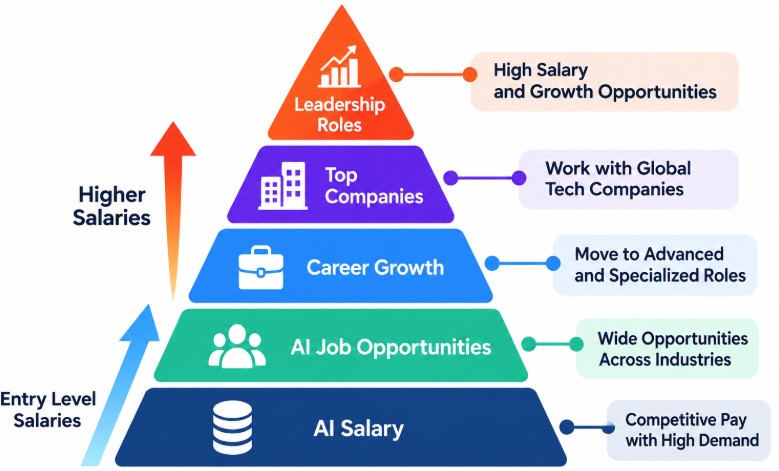
AI salaries in India can vary significantly based on experience, specialization, employer, location, technical expertise, and the complexity of responsibilities. Entry-level professionals may begin in Junior AI Engineer, Data Analyst, Associate Data Scientist, or Machine Learning roles before progressing toward AI Engineer, Data Scientist, ML Engineer, or Generative AI Engineer positions. Professionals with deeper expertise in LLMs, RAG, agentic AI, MLOps, cloud architecture, NLP, computer vision, or enterprise AI systems can pursue more specialized opportunities. Aspiring professionals can explore Highest Paying AI Jobs in India to understand specialized career paths and the factors that influence earning potential.
Conclusion: Building a Successful AI Career in India
Building a successful AI career in India requires continuous learning across programming, mathematics, machine learning, deep learning, data engineering, cloud computing, and production deployment. Beginners can establish strong foundations in Python, SQL, statistics, and machine learning before advancing into generative AI, LLMs, RAG, agentic AI, computer vision, NLP, or MLOps. Enrolling in Artificial Intelligence Training can help aspiring professionals develop relevant technical knowledge and gain practical exposure to AI technologies. Practical experience is equally important, so candidates should build end-to-end projects that demonstrate data preparation, model development, evaluation, deployment, and monitoring. As AI adoption expands across technology, finance, healthcare, manufacturing, consulting, retail, and other industries, professionals who can connect AI capabilities with practical business problems can develop broader career opportunities. Certifications and academic qualifications can strengthen a profile, but demonstrable technical skills, projects, problem-solving ability, and production experience remain valuable differentiators. Consistently updating technical knowledge can help professionals progress from entry-level AI positions toward specialist, architecture, and leadership careers.