LMS
Last updated on 03rd Sep 2026| 4884

- Introduction to Becoming a Data Scientist at Google
- Essential Skills and Qualifications for Google Data Scientists
- Building Strong Python and Programming Skills
- Learning SQL, Statistics, and Data Analysis
- Developing Data Science and Machine Learning Skills
- Building Data Science Projects and a Strong Portfolio
- Preparing for Google Data Science Interviews
- Resume, Application, and Career Preparation Tips
- Conclusion and Next Steps to Become a Data Scientist at Google
Introduction to Becoming a Data Scientist at Google
Becoming a Data Scientist at Google is an exciting career opportunity for professionals interested in data analysis, machine learning, artificial intelligence, statistics, and solving complex business and technical problems. Google uses data-driven approaches across products, services, and business operations, creating opportunities for data scientists to work on challenging real-world problems. To pursue a Data Science Career at Google, candidates should develop strong skills in Python, SQL, statistics, probability, machine learning, data analysis, and data visualization. Practical experience with real-world datasets and machine learning projects can help candidates demonstrate their technical and analytical abilities. Candidates looking to build a strong foundation can consider Data Science Training to develop relevant technical and practical skills. A strong educational background, relevant work experience, internships, certifications, and a well-developed project portfolio can further strengthen a candidate’s profile. The Google recruitment process may involve resume screening, technical assessments, coding interviews, data science interviews, and behavioral discussions, depending on the role. Candidates should also develop problem-solving, communication, and analytical thinking skills to effectively explain their approach to complex problems. Understanding the required qualifications, building relevant technical skills, preparing for interviews, and gaining practical experience can help aspiring professionals take the right steps toward becoming a Data Scientist at Google.
Essential Skills and Qualifications for Google Data Scientists
- Python Programming: Develop strong Python programming skills to clean, manipulate, analyze, and process datasets while building automation scripts, statistical models, and machine learning solutions.
- Statistics and Probability: Build knowledge of probability, distributions, hypothesis testing, regression, sampling, and statistical methods to analyze data and support accurate data-driven decisions.
- SQL and Data Management: Learn SQL to query, filter, join, aggregate, organize, and analyze large datasets efficiently while understanding databases, data structures, and data management practices.
- Machine Learning: Understand supervised and unsupervised learning, model training, selection, evaluation, optimization, and commonly used machine learning algorithms. Strengthening these fundamentals through Machine Learning Basics can help build a stronger foundation for practical data science projects.
- Data Analysis: Gain practical experience in collecting, cleaning, transforming, exploring, and interpreting complex datasets to discover meaningful patterns, trends, relationships, and insights.
- Data Visualization: Develop skills to present complex analytical findings through clear charts, dashboards, reports, and visualizations that help technical and business teams understand insights.
- Problem-Solving: Strengthen analytical and logical thinking to break complex technical and business challenges into manageable problems and develop practical solutions using data and evidence.
- Communication Skills: Develop strong written, verbal, and presentation skills to clearly explain technical concepts, analytical findings, model results, and recommendations to different audiences.
- Educational Background: Build relevant academic knowledge through computer science, statistics, mathematics, engineering, data science, economics, or other quantitative and technical disciplines.
- Practical Experience: Gain hands-on data science experience through internships, research, professional work, competitions, and real-world projects that demonstrate technical and analytical abilities.
Get Your Data Science Certification by Learning from Industry-Leading Experts and Advancing Your Career with ACTE’s Data Science Course.
Building Strong Python and Programming Skills for Data Science
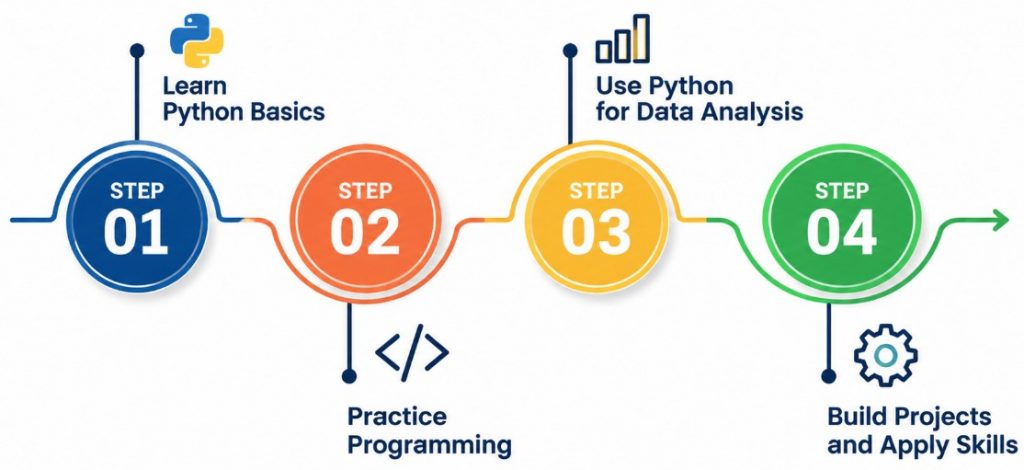
Strong Python and programming skills are essential for building a successful career in data science because professionals regularly use code to collect, clean, transform, analyze, and visualize large datasets. Python is widely used in data science because of its simple syntax and extensive ecosystem of libraries for statistical analysis, machine learning, automation, and visualization. Candidates who want to strengthen their practical foundation can explore Data Science Training to develop relevant programming and data science skills. Candidates should understand programming fundamentals such as variables, data types, loops, conditional statements, functions, classes, exception handling, and file operations.
Learning SQL, Statistics, and Data Analysis
Strong knowledge of SQL, statistics, and data analysis is essential for aspiring Data Scientists at Google. SQL helps candidates efficiently retrieve, filter, join, aggregate, and analyze large datasets stored in relational databases. A solid understanding of statistics enables data scientists to interpret data accurately, identify trends, measure relationships, test assumptions, and make reliable conclusions. Important concepts include probability, distributions, descriptive statistics, hypothesis testing, confidence intervals, correlation, and regression. Data analysis skills help transform raw and unstructured information into meaningful insights through data cleaning, preprocessing, exploratory data analysis, and interpretation. Candidates should also learn how to identify missing values, detect outliers, compare datasets, and select appropriate analytical methods for different problems. Exploring Data Analytics Importance can further strengthen their understanding of analytical approaches and practical data interpretation. Combining SQL with statistical knowledge allows professionals to investigate business questions and support data-driven decision-making. Practicing these skills with real-world datasets and projects can improve analytical thinking and prepare candidates for technical interviews. Building a strong foundation in SQL, statistics, and data analysis is therefore an important step toward developing the expertise required for a successful Data Science Career at Google.

Developing Data Science and Machine Learning Skills
- Data Preprocessing: Learn how to clean and transform datasets by handling missing values, duplicates, outliers, inconsistent formats, and categorical variables.
- Exploratory Data Analysis: Analyze datasets to identify patterns, trends, relationships, distributions, and anomalies before building machine learning models.
- Feature Engineering: Understand how to select, transform, and create relevant features that can improve the performance and interpretability of machine learning models.
- Supervised Learning: Learn algorithms such as linear regression, logistic regression, decision trees, random forests, and other techniques used for prediction and classification tasks.
- Unsupervised Learning: Understand clustering, dimensionality reduction, and other techniques used to discover hidden patterns and structures within datasets.
- Model Evaluation: Learn how to evaluate machine learning models using appropriate metrics such as accuracy, precision, recall, F1-score, ROC-AUC, and regression evaluation measures.
- Model Optimization: Develop knowledge of cross-validation, hyperparameter tuning, feature selection, and methods for improving model performance.
- Machine Learning Projects: Build practical projects using real-world datasets to demonstrate your ability to apply data science and machine learning techniques to meaningful problems. Reviewing a Data Science Projects can provide additional ideas for developing practical project experience.
- Continuous Learning: Stay updated with modern data science techniques, machine learning developments, tools, and industry practices to continuously strengthen your technical expertise.

Get JOB Oriented Data Science Training for Beginners By MNC Experts
- Instructor-led Sessions
- Real-life Case Studies
- Assignments
Building Data Science Projects and a Strong Portfolio
Building practical data science projects is an effective way to demonstrate technical knowledge, analytical thinking, and problem-solving abilities when preparing for a Data Scientist role at Google. Candidates should select real-world problems involving recommendation systems, forecasting, classification, customer analytics, natural language processing, or product analysis and work with reliable datasets. Each project should demonstrate skills in data collection, cleaning, transformation, exploratory analysis, feature engineering, Python, SQL, statistics, and machine learning. Candidates should build suitable models, evaluate their performance, and clearly explain the algorithms, features, and metrics selected. Charts, dashboards, and visual storytelling can help communicate important patterns and insights effectively. Candidates can also explore a Power BI Tutorial to strengthen their understanding of dashboard development and data visualization. Projects should also explain the business problem, potential impact, methodology, challenges, results, limitations, and possible improvements. Maintaining well-documented projects in a professional portfolio or code repository allows recruiters to review practical abilities. Candidates should continuously improve their portfolio and be prepared to discuss technical decisions, challenges, model performance, and lessons learned during interviews.
Want to Master Data Science? Explore the Data Science Master Program Offered at ACTE Today!
Preparing for Google Data Science Interviews
Preparing for a Google Data Science interview requires strong technical knowledge, analytical thinking, programming ability, product understanding, and communication skills. Candidates should revise core data science concepts such as statistics, probability, machine learning, data analysis, experimentation, hypothesis testing, confidence intervals, and evaluation metrics. Regular Python practice can strengthen knowledge of data structures, algorithms, functions, data manipulation, and problem-solving, while SQL preparation should include joins, aggregations, subqueries, filtering, and window functions. Candidates can strengthen their overall foundation through Data Science Training while developing the technical skills required for interview preparation. Candidates should also understand machine learning algorithms, feature engineering, model selection, overfitting, underfitting, optimization, and performance evaluation. Practicing product and business scenarios can improve the ability to select suitable metrics, identify trends, and make data-driven recommendations. Data science case studies and mock interviews can strengthen structured thinking and communication. Candidates should also thoroughly understand every project on their resume and be prepared to explain methodologies, technical decisions, challenges, results, limitations, and lessons learned clearly during interviews.
Want to Learn About Data Science? Explore Our Data Science Interview Questions and Answers Featuring the Most Frequently Asked Questions in Job Interviews.
Resume, Application, and Career Preparation Tips
- Customize Your Application: Review the specific job description and tailor your resume and application to emphasize skills, experience, and projects relevant to the position.
- Highlight Achievements: Include measurable results from projects, internships, research, or professional experience to demonstrate the impact of your work.
- Build a Strong Resume: Create a clear and concise resume that highlights Python, SQL, statistics, machine learning, data analysis and other relevant technical skills. Reviewing a Data Science Resume Tutorial can help candidates structure their technical skills, projects, and achievements effectively.
- Showcase Data Science Projects: Include relevant projects that demonstrate your ability to solve real-world problems using data analysis, statistics, and machine learning.
- Develop a Portfolio: Maintain a professional portfolio or code repository that showcases selected projects, technical skills, analytical approaches, and project outcomes.
- Prepare for Interviews: Regularly practice Python, SQL, statistics, probability, machine learning, case studies, and behavioral questions relevant to data science roles.
- Gain Practical Experience: Pursue internships, research opportunities, freelance projects, or professional experience to develop real-world data science skills.
- Stay Updated: Keep learning about new data science techniques, machine learning developments, analytical tools, and industry trends to remain competitive.
- Network Professionally: Connect with data science professionals, participate in technical communities, attend industry events, and learn from experienced practitioners.
Conclusion and Next Steps to Become a Data Scientist at Google
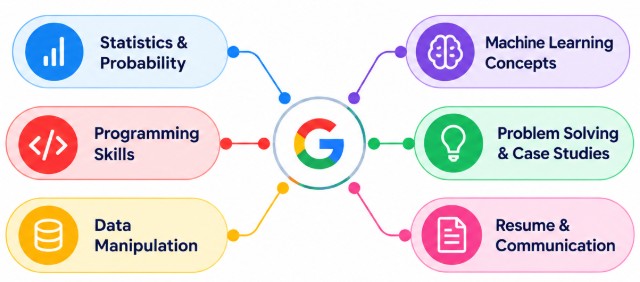
Becoming a Data Scientist at Google requires a balanced combination of technical expertise, analytical thinking, practical experience, business understanding, and consistent preparation. Candidates should develop strong skills in Python, SQL, statistics, probability, experimentation, and data visualization while applying these concepts through real-world projects. Building a professional portfolio with well-documented projects can demonstrate the ability to clean data, identify patterns, develop predictive models, evaluate results, and communicate meaningful insights. Candidates can strengthen their practical knowledge through Data Science Training while continuing to build relevant technical skills. A clear resume highlighting relevant skills, internships, projects, certifications, and achievements can further strengthen a candidate’s profile. Interview preparation should include Python coding, SQL queries, statistics, machine learning concepts, case studies, product-related questions, and behavioral discussions. Candidates should also improve communication, problem-solving, and decision-making skills. Continuous learning and regular practice can help aspiring professionals stay current with evolving technologies and take meaningful steps toward pursuing a Data Scientist career at Google.