LMS
Last updated on 06th Oct 2026| 7831

The Must-Know Software Test Engineer Interview Questions for Freshers at TCS guide helps candidates prepare for technical interviews and understand the fundamentals of software testing. It covers important topics such as manual testing, automation testing, SDLC, STLC, test case design, defect life cycle, regression testing, retesting, and performance testing. The guide also includes questions on Selenium, SQL, Agile methodology, and real-time testing scenarios frequently relevant to entry-level software testing roles. Each answer is presented in a simple paragraph format to support easy understanding and revision. Practicing these questions helps freshers strengthen technical knowledge, improve problem-solving skills, and build confidence for Software Test Engineer interviews at TCS.
1. What Is Software Testing?
Ans:
Software Testing Is The Process Of Evaluating An Application To Identify Defects And Verify That It Meets Specified Requirements. It Helps Ensure That The Software Works Correctly Under Different Conditions. Testing Can Be Performed Manually Or With Automation Tools. It Improves Software Quality, Reliability, Security, And Performance. The Main Goal Is To Deliver A Stable Product That Meets User Expectations.
2. Why Is Software Testing Important?
Ans:
Software Testing Is Important Because It Helps Identify Defects Before Software Reaches End Users. It Reduces The Cost Of Fixing Problems After Deployment And Improves Application Reliability. Testing Also Verifies Whether The Software Meets Business And Technical Requirements. It Helps Protect User Data And Provides A Better User Experience. Effective Testing Supports The Delivery Of High-Quality Software.
3. What Is The Role Of A Software Test Engineer?
Ans:
- A Software Test Engineer Checks Whether An Application Meets Its Functional And Non-Functional Requirements.
- The Role Includes Understanding Requirements, Preparing Test Cases, Executing Tests, And Reporting Defects.
- Test Engineers Work With Developers, Business Analysts, And Other Team Members To Resolve Issues
4. What Is Manual Testing?
Ans:
Manual Testing Is A Software Testing Method In Which Testers Execute Test Cases Without Using Automation Scripts. Testers interact with the application, enter inputs, and compare actual results with expected results. It is useful for exploratory testing, usability testing, and applications that change frequently. Manual testing requires analytical thinking, attention to detail, and knowledge of requirements. It helps identify functional issues and user experience problems.
5. What Is Automation Testing?
Ans:
Automation Testing Uses Tools And Scripts To Execute Test Cases With Minimal Manual Intervention. It is particularly useful for repetitive tests, regression testing, and frequent software releases. Automation can improve execution speed, consistency, and test coverage when designed properly. Common tools include Selenium, Cypress, Playwright, and JUnit.
6. What Is The Difference Between Manual Testing And Automation Testing?
Ans:
Manual Testing Involves Human Execution Of Test Cases, While Automation Testing Uses Scripts And Tools To Perform Test Activities. Manual Testing Is Often Suitable For Exploratory And Usability Testing. Automation Testing Is More Effective For Repetitive Tests And Frequent Regression Cycles. Manual Testing Usually Requires Less Initial Tool Development, Whereas Automation Requires Setup And Maintenance.
7. What Is SDLC?
Ans:
SDLC Stands For Software Development Life Cycle, Which Defines The Stages Involved In Building And Maintaining Software. Its Common Phases Include Requirement Analysis, Planning, Design, Development, Testing, Deployment, And Maintenance. Each Phase Has Specific Activities And Deliverables. A Defined SDLC Helps Teams Manage Time, Cost, Quality, And Project Risks.
8. What Is STLC?
Ans:
STLC Stands For Software Testing Life Cycle, Which Describes The Activities Performed During The Testing Process. Its Phases Commonly Include Requirement Analysis, Test Planning, Test Case Development, Test Environment Setup, Test Execution, And Test Closure. Each Phase has defined entry criteria, activities, and exit criteria. STLC helps organize testing work and maintain traceability. It supports systematic defect identification and quality evaluation.
9. What Is The Difference Between SDLC And STLC?
Ans:
| Aspect | SDLC | STLC |
|---|---|---|
| Definition | SDLC Stands For Software Development Life Cycle And Covers The Entire Software Development Process. | STLC Stands For Software Testing Life Cycle And Focuses On Testing Activities. |
| Purpose | Ensures Software Is Designed, Developed, Tested, And Delivered According To Requirements. | Ensures Software Quality By Identifying Defects And Verifying Requirements. |
| Phases | Includes Requirement Analysis, Design, Development, Testing, Deployment, And Maintenance. | Includes Requirement Analysis, Test Planning, Test Case Development, Test Execution, And Test Closure. |
| Focus | Focuses On Building And Maintaining The Complete Software Product. | Focuses On Planning, Executing, And Evaluating Software Testing Activities. |
10. What Is Verification In Software Testing?
Ans:
Verification Is The Process Of Checking Whether Software Work Products Meet Specified Requirements And Design Standards. It commonly involves reviews, inspections, walkthroughs, and static analysis. Verification can identify issues before executing the application. It focuses on whether the product is being built according to its specifications. This activity helps prevent defects early in the development lifecycle.
11. What Is Validation In Software Testing?
Ans:
- Validation Checks Whether The Developed Software Meets User Needs And Intended Business Requirements.
- It generally involves executing the software and evaluating its behavior against expected results. Functional testing, system testing, and user acceptance testing can support validation.
- Validation helps confirm that the application solves the intended problem. It complements verification by evaluating the actual product’s suitability for use.
12. What Is The Difference Between Verification And Validation?
Ans:
Verification Checks Whether Work Products Conform To Specifications, While Validation Checks Whether The Software Meets User Needs. Verification often uses reviews, inspections, and other static techniques. Validation commonly uses dynamic testing by executing the application. Verification can detect problems before code execution, whereas validation evaluates actual software behavior.
13. What Is Black Box Testing?
Ans:
Sanity Testing Is A Focused Testing Approach Used To Verify Specific Black Box Testing Evaluates Software Functionality Without Requiring Knowledge Of Its Internal Code Or Implementation. Testers provide inputs and compare the observed outputs with expected results. Common techniques include equivalence partitioning, boundary value analysis, and decision table testing. This approach is useful for validating requirements from a user’s perspective.
14. What Is White Box Testing?
Ans:
IWhite Box Testing Examines The Internal Structure, Logic, And Code Paths Of An Application. It requires knowledge of programming and implementation details. Testers may evaluate statement coverage, branch coverage, conditions, and execution paths. Developers and testers use it to identify logical errors and untested code. White Box Testing Complements Black Box Testing By Examining Internal Behavior.
15. What Is Grey Box Testing?
Ans:
Grey Box Testing Combines Elements Of Black Box And White Box Testing. Testers have partial knowledge of the application’s internal design, database structure, or architecture. This knowledge helps create tests that examine both external functionality and selected internal interactions. Grey Box Testing is useful for web applications, integrations, and database-driven systems. It can reveal issues that may be difficult to identify through external behavior alone.
16. What Is A Test Case?
Ans:
- A Test Case Is A Set Of Conditions, Inputs, Steps, And Expected Results Used To Verify A Specific Application Feature.
- It Usually Includes A Test Case ID, Description, Preconditions, Test Steps, Test Data, And Expected Outcome.
- Test Cases Help Ensure That Testing Is Consistent And Repeatable. They also provide evidence that requirements have been checked. Well-written test cases improve test coverage and defect detection.
17. What Is A Test Scenario?
Ans:
A Test Scenario Describes A High-Level Functionality Or Situation That Needs To Be Tested. For Example, A Login Test Scenario May Cover Successful Login, Invalid Credentials, And Password Recovery. Each Scenario Can Contain Multiple Detailed Test Cases. Test Scenarios help testers identify important business workflows before writing individual test cases. They are useful for organizing testing activities and improving requirement coverage.
18. What Is The Difference Between A Test Case And A Test Scenario?
Ans:
Ad-Hoc Testing Is An Informal Testing Approach Performed Without A Test Scenario Describes What Functionality Needs To Be Tested, While A Test Case Explains How To Test That Functionality. One Scenario Can Include Multiple Test Cases With Different Inputs And Expected Results. For Example, Login Functionality Is A Scenario, While Testing Valid And Invalid Passwords Are Separate Test Cases. Scenarios Support High-Level Planning, Whereas Test Cases Guide Detailed Execution. Both Help Ensure Systematic Test Coverage.
19. What Is A Test Plan?
Ans:
A Test Plan Is A Document That Describes The Scope, Objectives, Strategy, Resources, Schedule, And Risks Of Testing. It Defines The Features To Be Tested And Those Excluded From Testing. It also identifies responsibilities, testing tools, environments, and entry and exit criteria. The Test Plan Guides The Team Throughout The Testing Process. It Helps Ensure That Testing Activities Remain Organized And Aligned With Project Goal
20. What Is Test Data?
Ans:
- Test Data Is The Information Used As Input During Software Testing. It May Include Valid Values, Invalid Values, Boundary Values, Empty Fields, And Special Characters.
- For Example, A Registration Form Can Be Tested Using Valid Email Addresses And Incorrect Passwords.
- Appropriate test data helps verify different application behaviors and error-handling conditions.
21. What Is A Test Environment?
Ans:
Severity Indicates The Technical Impact Of A Defect On The A Test Environment Is The Setup In Which Software Testing Is Performed. It May Include Hardware, Operating Systems, Databases, Servers, Browsers, Networks, And Testing Tools. A Properly Configured Environment helps testers reproduce real-world conditions and identify defects. Environment differences can sometimes cause inconsistent results between testing and production.
22. What Is A Test Script?
Ans:
A Test Script Is A Set Of Instructions Used To Execute A Testing Procedure. In Manual Testing, It May Contain Step-By-Step Actions For A Tester To Follow. In Automation Testing, It Usually Contains Executable Code That Performs Actions And Verifies Results. Test Scripts Improve Repeatability And Reduce Ambiguity During Testing. They Must Be Updated When Requirements Or Application Behavior Changes.
23. What Is Positive Testing?
Ans:
A Defect Report Is A Documented Record Of An Issue Identified Positive Testing Checks Whether An Application Works Correctly When Valid Inputs And Expected User Actions Are Provided. For Example, Entering A Registered Email Address And The Correct Password Should Allow A User To Log In. This Testing Verifies That Normal Business Operations Work As Intended. Testers Compare Actual Results With Expected Results. Positive Testing Is Essential For Confirming Core Application Functionality.
24. What Is Negative Testing?
Ans:
- Negative Testing Checks How An Application Responds To Invalid Inputs, Unexpected Actions, Or Incorrect Conditions.
- For Example, A Login Page Can Be Tested With An Incorrect Password Or An Empty Username.
- The Application Should Handle Such Inputs Gracefully And Display Appropriate Error Messages.
25. What Is Exploratory Testing?
Ans:
Negative Testing Is A Testing Approach Used To Verify How An Application Behaves When Invalid, Unexpected, Or Incorrect Inputs Exploratory Testing Is An Approach In Which Testers Learn About The Application, Design Tests, And Execute Them While Exploring Its Behavior. It Relies On Observation, Experience, And Analytical Thinking Rather Than Only Following Prewritten Test Cases. Testers may discover unexpected defects and usability issues. It is especially useful when documentation is limited or requirements change frequently…
26. What Is Ad Hoc Testing?
Ans:
Ad Hoc Testing Is An Informal Testing Approach Performed Without Detailed Test Documentation Or A Structured Test Plan. Testers interact with the application based on experience and intuition to discover defects. It can help identify unexpected issues that planned tests may overlook. However, coverage and repeatability can be limited. Recording discovered defects and their reproduction steps makes the results more useful.
27. What Is Usability Testing?
Ans:
Usability Testing Evaluates How Easily Users Can Understand And Operate An Application. It examines navigation, readability, accessibility, consistency, and the clarity of user interactions. Testers may observe users completing common tasks and identify areas of confusion. For Example, A Shopping Website Should Allow Users To Find Products And Complete Purchases Easily. Usability Testing Helps Improve Customer Satisfaction And Overall User Experience
28. What Is Compatibility Testing?
Compatibility Testing Verifies That Software Works Correctly Across Different Browsers, Operating Systems, Devices, Screen Sizes, And Configurations. For Example, A Web Application May Need Testing In Chrome, Firefox, And Edge. Testers check whether layouts, functionality, and performance remain acceptable across supported environments. This testing helps identify platform-specific defects.
29. What Is Smoke Testing?
Ans:
- Smoke Testing Is A Preliminary Check That Verifies Whether The Main Functions Of A New Software Build Work.
- It helps determine whether the build is stable enough for more detailed testing. Typical checks include application launch, login, navigation, and access to essential features.
- Smoke testing usually covers a broad set of critical functions with limited depth. If major functions fail, the build may be rejected for further testing.
30. What Is Sanity Testing?
Ans:
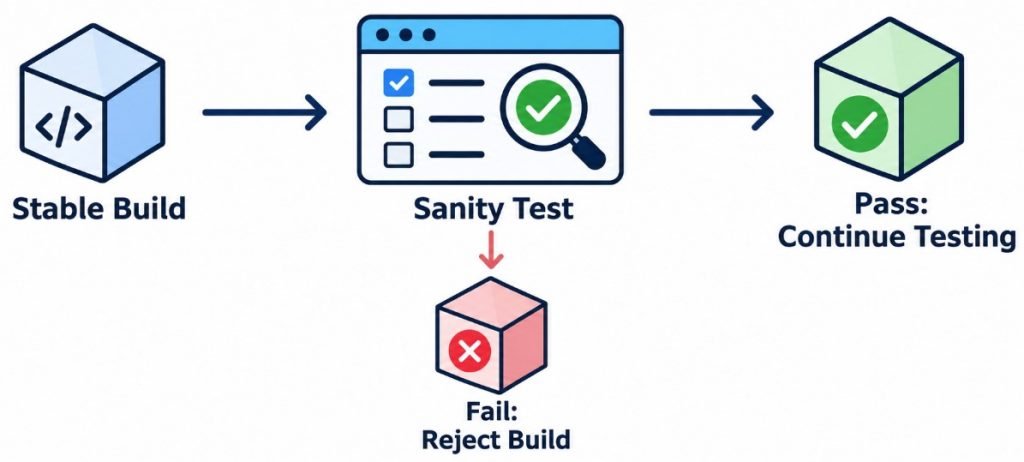
Sanity Testing Is A Focused Check Performed After A Small Change Or Bug Fix To Verify That The Affected Functionality Works As Expected. It helps determine whether further testing of that area is worthwhile. For example, after fixing a password reset defect, testers may verify the password reset workflow. Sanity Testing Is Narrower Than Broad Build-Level Smoke Testing. Its exact scope depends on the change and the project’s testing practices.
31. What Is Regression Testing?
Ans:
Regression Testing Checks Whether Recent Code Changes Have Affected Previously Working Functionality. It is performed after bug fixes, enhancements, integrations, and configuration changes. Testers rerun selected existing test cases to identify unintended side effects. Automation is often useful when regression tests must be repeated frequently. Effective regression testing helps maintain software stability throughout developmen
32. What Is Retesting?
Ans:
Retesting Is The Process Of Executing A Previously Failed Test Case Again After A Defect Has Been Fixed. Its Purpose Is To Confirm That The Specific Defect Has Been Resolved. For Example, If Login Fails With Valid Credentials Because Of A Bug, The Same Test Case Is Executed After The Fix. Retesting focuses on the original failure conditions. Regression Testing May Also Be Required To Check Related Functionality.
33. What Is The Difference Between Retesting And Regression Testing?
Ans:
| Aspect | Retesting | Regression Testing |
|---|---|---|
| Definition | Verifies Whether A Specific Defect Has Been Fixed. | Checks Whether Recent Changes Have Affected Existing Functionality. |
| Purpose | Confirms That The Previously Failed Test Case Now Passes. | Ensures That Previously Working Features Still Work Correctly. |
| Scope | Focuses On The Specific Defect And Its Related Test Cases. | Covers Selected Existing Features That Could Be Affected By Changes. |
| Execution | Performed After A Defect Is Fixed By Repeating The Failed Test. | Performed After Code Changes, Bug Fixes, Or Enhancements To Detect Side Effects. |
34. What Is Boundary Value Analysis?
Ans:
- Boundary Value Analysis Is A Black Box Testing Technique That Focuses On Values At The Edges Of An Allowed Range. Defects often occur near minimum and maximum limits.
- For example, if an age field accepts values from 18 to 60, testers may check 17, 18, 19, 59, 60, and 61.
- These values help verify both valid boundaries and invalid neighboring values. The technique reduces test effort while targeting common boundary-related errors.
35. What Is Equivalence Partitioning?
Ans:
Equivalence Partitioning Divides Input Data Into Groups Expected To Behave Similarly. Testers select representative values from valid and invalid groups instead of testing every possible input. For Example, If A Field Accepts Numbers From 1 To 100, Values Within That Range Form A Valid Partition. Values Below 1 And Above 100 Form Invalid Partitions. This technique reduces the number of test cases while maintaining meaningful input coverage.
36. What Is Decision Table Testing?
Ans:
Decision Table Testing Is A Technique Used To Test Functionality That Depends On Multiple Conditions And Their Combinations. It organizes conditions, rules, and expected actions into a table. For example, an online transaction may depend on account status, available balance, and transaction limits. Each relevant combination can be checked against the expected result. This technique is useful for business rules with complex conditional logic.
37. What Is State Transition Testing?
Ans:
State Transition Testing Verifies How An Application Moves From One State To Another Based On Events Or Actions. For Example, An Account May Become Locked After A Defined Number Of Consecutive Failed Login Attempts. Testers examine valid transitions, invalid transitions, and the conditions that trigger them. This approach is useful for workflows, authentication systems, and order processing. It helps identify defects in state-dependent behavior.
38. What Is Pairwise Testing?
Ans:
Pairwise Testing Is A Test Design Technique That Selects Cases So That Every Pair Of Values Across Selected Parameters Is Covered. It helps reduce the number of combinations needed when an application has many configuration options. For Example, A Website May Need Testing Across Browsers, Operating Systems, And Language Settings. Pairwise coverage can identify many interaction defects efficiently
39. What Is Error Guessing?
Ans:
- Error Guessing Is A Testing Technique That Uses Experience And Knowledge Of Common Mistakes To Identify Potential Defects.
- Testers may check empty fields, duplicate submissions, invalid formats, special characters, and unexpected navigation.
- The technique does not depend on a strict mathematical model. It is often used alongside formal test design techniques.
40. What Is Requirement Traceability?
Ans:
Requirement Traceability Is The Process Of Linking Requirements To Test Cases And Their Execution Results. A Requirements Traceability Matrix, Or RTM, Helps Verify That Each Requirement Has Appropriate Test Coverage. It can also connect requirements with identified defects. This approach makes it easier to assess the impact of requirement changes. Traceability supports coverage analysis, audit activities, and more organized test management.
41. What Is A Bug In Software Testing?
Ans:
A Bug Is A Defect In Software That Causes The Application To Behave Differently From The Expected Result. It may occur because of coding errors, incorrect requirements, design problems, or integration issues. For Example, A Shopping Application May Calculate The Wrong Total After Applying A Discount. Testers identify bugs by executing test cases and observing unexpected behavior. Clear defect reports help developers reproduce and fix the problems.

Enroll in Software Testing Course and UPGRADE Your Skills
Weekday / Weekend BatchesSee Batch Details42. What Is The Defect Life Cycle?
Ans:
The Defect Life Cycle Describes The Different Stages A Defect Passes Through From Identification To Closure. Common States Include New, Assigned, Open, Fixed, Retest, Verified, And Closed. Other statuses, such as Reopened, Rejected, or Deferred, may be used depending on the team’s workflow. Testers track each defect until its resolution is confirmed or an agreed decision is made. A defined lifecycle improves communication and defect management.
43. What Is Severity In Software Testing?
Ans:
Severity Describes The Impact Of A Defect On The Application’s Functionality Or Operation. Critical Severity May Involve System Crashes, data corruption, or major failures in essential business functions. Medium Severity May Affect A Specific Feature, While Low Severity May Involve Minor Visual Issues. Severity is generally assessed based on technical and functional impact. It helps teams understand the seriousness of a defect.
44. What Is Priority In Software Testing?
Ans:
Priority Indicates How Urgently A Defect Should Be Fixed. High-priority defects may affect critical business operations, important releases, or many users. Low-priority defects may involve minor issues that can be addressed later. Priority is often decided collaboratively by project managers, product owners, developers, and testers. It considers business impact, deadlines, customer needs, and release requirements.
45. What Is The Difference Between Severity And Priority?
Ans:
Severity Measures How Seriously A Defect Affects The Software, While Priority Indicates How Soon It Should Be Fixed. A Critical Payment Failure May Have Both High Severity And High Priority. A Minor Logo Misalignment On A Major Product Launch Page May Have Low Severity But High Priority. A Less Visible Error In A Rarely Used feature may have lower priority. The final classification depends on technical impact and business needs.
46. What Is A Defect Report?
Ans:
A Defect Report Documents An Identified Problem So That The Development Team Can Investigate And Resolve It. It usually includes a defect ID, summary, environment, reproduction steps, expected result, actual result, and supporting evidence. Severity and priority may also be recorded. Screenshots, logs, and test data can help reproduce the issue. A clear defect report reduces misunderstandings and speeds up resolution.
47. What Is Defect Leakage?
Ans:
- Defect Leakage Occurs When Defects Are Not Detected During One Testing Stage And Are Discovered In A Later Stage Or After Release.
- It may happen because of incomplete test coverage, missing requirements, or insufficient test data. Teams analyze leaked defects to identify gaps in their testing process.
- Improving test design, environment coverage, and regression testing can reduce leakage. Some defects may still escape despite careful testing.
48. What Is Defect Density?
Ans:
Defect Density Measures The Number Of Identified Defects Relative To A Defined Size Of Software. The denominator may be measured in thousands of lines of code, function points, or another agreed size metric. For example, 20 Defects In 10,000 Lines Of Code Equal Two Defects Per Thousand Lines. The metric helps compare quality trends when measurements are consistent. It should be interpreted alongside complexity, severity, and testing coverage.
49. What Is Defect Triage?
Ans:
Defect Triage Is The Process Of Reviewing Reported Defects To Determine Their Validity, Severity, Priority, And Resolution Plan. Team Members may include testers, developers, product owners, and project managers. They decide which issues need immediate attention and which can be deferred. Triage helps allocate development resources efficiently. It also ensures that important defects are addressed according to business and release needs.
50. What Is Unit Testing?
Ans:
Unit Testing Verifies Individual Units Of Code, Such As Functions, Methods, Or Classes, In Isolation. It is commonly performed by developers using frameworks such as JUnit, NUnit, or pytest. Unit tests check expected outputs, boundary conditions, and error handling. They help detect defects early, before components are integrated. Small and focused unit tests also make code changes safer and easier to maintain.
51. What Is Integration Testing?
Ans:
Integration Testing Checks Whether Multiple Modules Or Components Work Correctly When Connected. It focuses on interactions, data exchange, interfaces, and dependencies between components. For Example, An E-Commerce Application May Need Testing Between The Shopping Cart, Payment Service, And Order Management System. Integration defects may occur even when individual modules pass unit tests.
52. What Is System Testing?
Ans:
System Testing Evaluates The Complete Integrated Application Against Its Specified Requirements. It checks end-to-end functionality, including major workflows and interactions across components. Depending on the project, it may include functional, performance, security, and compatibility testing. Testers generally use a representative test environment and defined test data. System testing helps determine whether the complete application is ready for acceptance testing.
53. What Is User Acceptance Testing?
Ans:
User Acceptance Testing, Or UAT, Verifies Whether Software Meets Business Needs And Is Suitable For Its Intended Use. It is commonly performed by business users, customers, or designated representatives. Typical tests cover realistic business workflows and acceptance criteria. For Example, Users May Verify Whether An Order Can Be Created, Paid For, And Tracked Correctly
54. What Is Alpha Testing?
Ans:
Alpha Testing Is A Form Of Acceptance Testing Conducted In A Controlled Environment Before Wider External Release. It is often performed by internal testers, employees, or selected users. The goal is to identify defects and usability issues before the software reaches a broader audience. Alpha testing may involve realistic workflows and exploratory activities. Its findings help the development team improve the product before subsequent testing or release stages.
55. What Is Beta Testing?
Ans:
Black Box Testing Is A Testing Approach In Which The Tester Beta Testing Involves Releasing Software To A Selected Group Of External Users Before A wider public launch. Participants use the application in real-world conditions and provide feedback about defects, usability, and compatibility. Beta testing can reveal issues that are difficult to reproduce in controlled environments. Teams collect feedback and prioritize necessary fixes
56. What Is End-To-End Testing?
Ans:
End-To-End Testing Verifies A Complete Business Workflow Across All Relevant Application Components And External Systems. For Example, An Online Shopping Test May Cover Login, Product Search, Cart Updates, Payment, And Order Confirmation. It checks whether information flows correctly between connected services. End-to-end tests can reveal integration and configuration problems.
57. What Is Functional Testing?
Ans:
- Functional Testing Verifies Whether Application Features Behave According To Their Functional Requirements.
- It checks inputs, processing, outputs, business rules, and user interactions. For Example, A Banking Application May Be Tested To Confirm That Transfers Update Account Balances Correctly.
- Functional testing can be performed at multiple testing levels. Its primary goal is to confirm that the application performs the required operations accurately.
58. What Is Non-Functional Testing?
Ans:
Non-Functional Testing Evaluates Quality Attributes Such As Performance, Security, Usability, Reliability, And Compatibility. It focuses on how well the application operates rather than only what functions it provides. For Example, Performance Testing Checks Whether A Website Handles Expected User Traffic. Security Testing Examines Potential Vulnerabilities And Unauthorized Access.
59. What Is Performance Testing?
Ans:
Performance Testing Measures How An Application Behaves Under Different Workloads. It can evaluate response time, throughput, resource usage, stability, and scalability. Common types include load testing, stress testing, endurance testing, and spike testing. Testers use suitable tools to simulate users and monitor application behavior. Performance testing helps identify bottlenecks before they significantly affect real users
60. What Is Load Testing?
Ans:
- Load Testing Evaluates Application Performance Under An Expected Or Specified Level Of User Traffic And Workload.
- It measures indicators such as response time, throughput, error rate, and resource consumption.
- For Example, An E-Commerce Website May Be Tested With Thousands Of Simulated Users During A Sale.

Learn Software Testing Training Course with Advanced Concepts By Industry Experts
- Instructor-led Sessions
- Real-life Case Studies
- Assignments
61. What Is Stress Testing?
Ans:
- Stress Testing Evaluates How An Application Behaves When Workloads Exceed Its Normal Or Expected Operating Capacity.
- It helps identify breaking points, resource limitations, and failure behavior. Testers may gradually increase concurrent users or transaction volume beyond normal levels.
- They also examine whether the system recovers safely after excessive load is removed. Stress testing helps assess robustness and operational resilience.
62. What Is Security Testing?
Ans:
Security Testing Identifies Weaknesses That Could Allow Unauthorized Access, Data Exposure, Or Other Security Violations. It examines authentication, authorization, session management, input validation, and data protection. Testers may use approved security tools and techniques to assess vulnerabilities. Sensitive systems often require additional specialist security reviews. Security testing helps protect users, business information, and application infrastructure.
63. What Is API Testing?
Ans:
API Testing Verifies That Application Programming Interfaces Exchange Data And Behave According To Their Specifications. It checks request methods, headers, authentication, parameters, response bodies, status codes, and error handling. For Example, A Login API May Be Tested With Valid Credentials, Invalid Credentials, And Missing Fields. Tools such as Postman and automated test frameworks can support API testing
64. What Is Database Testing?
Ans:
Database Testing Verifies The Accuracy, Integrity, And Reliability Of Data Stored And Retrieved By An Application. It checks data insertion, updates, deletion, constraints, relationships, and transaction behavior. Testers may use SQL queries to compare application results with database records. They also verify that invalid operations are handled correctly. Database testing is important for systems that process financial, customer, or business information.
65. What Is Localization Testing?
Ans:
Localization Testing Checks Whether An Application Works Correctly For A Specific Language, Region, Or Local Market. It verifies translated text, date formats, currency formats, number formats, and region-specific settings. For Example, A Global Application May Need To Display Indian Currency And Appropriate Local Date Formats
66. What Is Selenium?
Ans:
Selenium Is An Open-Source Suite Of Tools Used To Automate Web Browser Interactions. Selenium WebDriver Allows Testers To Control Browsers Through Programming Languages Such As Java, Python, And C#. It can automate actions such as clicking buttons, entering text, and verifying page content. Selenium is commonly used for web application regression testing.
67. What Is Selenium WebDriver?
Ans:
Selenium WebDriver Is An Automation Interface That Controls Web Browsers Through Browser-Specific Drivers Or Supported Browser Automation Mechanisms. It allows test scripts to locate elements, perform user actions, and inspect application behavior. WebDriver supports several programming languages and major browsers. It is commonly integrated with testing frameworks and build pipelines.
68. What Are Locators In Selenium?
Ans:
Locators Identify Web Elements That Automation Scripts Need To Interact With. Common Selenium Locator Strategies Include ID, Name, Class Name, Tag Name, Link Text, Partial Link Text, CSS Selector, And XPath. For Example, An ID Locator Can Target A Login Button With A Unique Identifier. Stable and unique locators make test scripts more reliable. Testers should avoid fragile locators that frequently change with page layout or styling.
69. What Is XPath In Selenium?
Ans:
- XPath Is A Query Language Used To Locate Elements In An HTML Or XML Document Structure. Selenium supports XPath expressions for identifying elements based on attributes, text, hierarchy, and relationships.
- For Example, //input[@id=’username’] can locate an input element with the specified ID.
- Absolute XPath follows a specific document path, while relative XPath can target elements based on useful attributes or relationships
70. What Is An Assertion In Automation Testing?
Ans:
An Assertion Checks Whether An Actual Result Matches An Expected Condition During Test Execution. For Example, An Automation Test May Assert That A Successful Login Displays The Dashboard. If the assertion fails, the test framework records the failure and reports useful information. Assertions can verify text, element visibility, response codes, values, and other conditions.
71. What Is Test Automation Framework?
Ans:
A Test Automation Framework Provides A Structured Way To Develop, Organize, Execute, And Maintain Automated Tests. It may include reusable functions, test data management, configuration, reporting, logging, and assertion libraries. Common approaches include data-driven, keyword-driven, modular, and behavior-driven frameworks. A well-designed framework reduces duplication and improves maintainability.
72. What Is Data-Driven Testing?
Ans:
Data-Driven Testing Executes The Same Test Logic With Multiple Sets Of Input Data And Expected Results. The data may be stored in spreadsheets, CSV files, JSON files, databases, or test framework providers. For Example, A Login Test Can Run With Multiple Valid And Invalid Credential Combinations. This approach improves coverage without duplicating the entire test script. It also makes it easier to update test data independently of test logic.
73. What Is Keyword-Driven Testing?
Ans:
Keyword-Driven Testing Uses Readable Keywords To Represent Testing Actions Such As Click, Enter Text, Open Page, And Verify Result. The framework maps each keyword to an implementation that performs the corresponding action. Test steps can often be maintained separately from the underlying code. This approach can make test cases easier for team members with limited programming experience to understand.
74. What Is Behavior-Driven Development?
Ans:
- Behavior-Driven Development, Or BDD, Is A Collaborative Approach That Describes Expected Software Behavior Using Examples Understandable To Business And Technical Teams.
- It commonly uses a Given-When-Then format to express scenarios. For Example, Given A Registered User, When Valid Credentials Are Entered, Then The Dashboard Should Appear.
- Tools such as Cucumber can connect these scenarios to executable automation steps. BDD helps improve communication and align tests with business expectations.
75. What Is The Difference Between Selenium And Postman?
Ans:
Selenium Is Primarily Used To Automate Browser-Based User Interface Testing, While Postman Is Commonly Used To Send Requests And Test APIs. Selenium can verify web page behavior, form interactions, and visible results. Postman can check HTTP methods, request parameters, response bodies, authentication, and status codes. Both tools can be integrated into automated testing workflows.
76. What Is JUnit?
Ans:
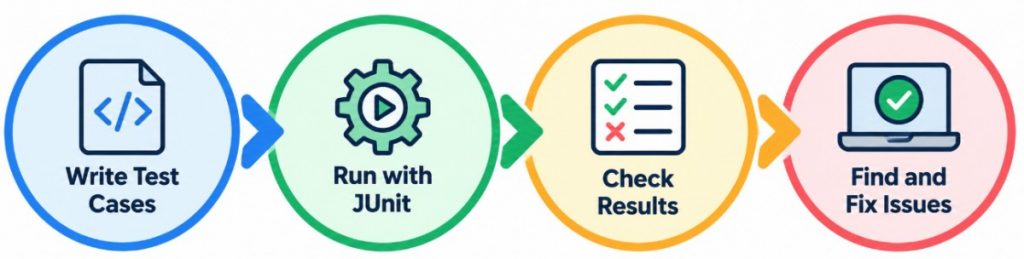
JUnit Is A Testing Framework For Java Applications That Supports Writing And Executing Automated Tests. It provides annotations, assertions, and test lifecycle methods to organize test cases. Developers and test engineers use JUnit to verify methods, classes, and application components. It can be integrated with build tools and continuous integration pipelines. JUnit helps detect defects early and makes repeated testing more efficient.
77. What Is TestNG?
Ans:
TestNG Is A Testing Framework Commonly Used For Java-Based Test Automation. It supports annotations, test grouping, parameterization, dependencies, parallel execution, and reporting. TestNG is frequently combined with Selenium to automate web applications. It allows teams to organize test suites and execute selected test groups. Its configuration and execution features help manage larger automation projects efficiently.
78. What Is Continuous Integration In Testing?
Ans:
Continuous Integration Is A Development Practice In Which Code Changes Are Frequently Integrated Into A Shared Repository. Automated Builds And Tests Can Run Whenever Changes Are Submitted. This helps identify defects and integration problems early in the development process. Tools such as Jenkins and GitHub Actions can execute testing pipelines.
79. What Is A Test Automation Report?
Ans:
- A Test Automation Report Summarizes The Results Of An Automated Test Execution. It typically includes passed tests, failed tests, skipped tests, execution duration, error details, and relevant logs.
- Screenshots or request-response details may be attached when useful. Reports help teams identify failures and investigate their causes.
- Clear reporting improves communication and supports informed release decisions.
80. What Are The Limitations Of Automation Testing?
Ans:
Automation Testing Requires Initial Development Time, Appropriate Tools, Programming Knowledge, And Ongoing Maintenance. Scripts may fail when application interfaces or workflows change frequently. Automation may also struggle to evaluate subjective qualities such as visual appeal or user satisfaction without specialized techniques. Not Every Test Case Provides Enough Repeated Value To Justify Automation
81. What Is SQL And Why Is It Useful For Test Engineers?
Ans:
SQL Stands For Structured Query Language And Is Used To Manage And Retrieve Data From Relational Databases. Test Engineers Use SQL To Verify Records, Compare Expected And Actual Data, And Check Data Integrity. Queries can identify missing records, duplicate values, and incorrect updates. Common commands include SELECT, INSERT, UPDATE, DELETE, and JOIN operations.
82. What Is The Difference Between DELETE, DROP, And TRUNCATE?
Ans:
- DELETE Removes Selected Rows From A Table And Can Use A WHERE Clause To Limit The Records Affected.
- TRUNCATE Removes All Rows From A Table Using Database-Specific Behavior And Restrictions. DROP Removes The Table Object And Its Definition From The Database.
- Transaction, rollback, identity-reset, and permission behavior can differ by database system
83. What Is A SQL JOIN?
Ans:
A SQL JOIN Combines Data From Two Or More Tables Based On A Related Column Or Join Condition. INNER JOIN Returns Matching Rows, While LEFT JOIN Preserves All Rows From The Left Table And Adds Matching Data When Available. RIGHT JOIN Preserves All Rows From The Right Table, And FULL OUTER JOIN Returns Matches And Unmatched Rows From Both Tables Where Supported
84. What Is Agile Testing?
Ans:
Agile Testing Is A Testing Approach Integrated Into Iterative And Incremental Software Development. Testers Collaborate With Developers, Product Owners, And Other Team Members Throughout Each Sprint. Testing begins early and continues as requirements and functionality evolve. Frequent feedback helps identify defects before they become more expensive to fix.
85. What Is Scrum In Software Testing?
Ans:
- Scrum Is An Agile Framework That Organizes Work Into Short Iterations Called Sprints. The Scrum Team typically includes a Product Owner, Scrum Master, and Developers, with testing responsibilities shared across the team.
- Activities include sprint planning, daily Scrum meetings, sprint reviews, and retrospectives.
- Testers help clarify acceptance criteria, prepare test cases, and validate completed work. Scrum supports frequent feedback and incremental delivery of usable software.
86. What Is A Test Case For A Login Page?
Ans:
A Login Page Test Case Verifies Whether Users Can Access An Application With Valid Credentials And Whether Invalid Attempts Are Handled Correctly. Testing should include valid credentials, an incorrect password, an unregistered username, and empty input fields. Additional checks may cover password masking, error messages, account lockout rules, and session behavior
87. How Does Test An ATM Machine?
Ans:
ATM Testing Should Cover Card Reading, PIN Validation, Balance Inquiry, Cash Withdrawal, Deposits Where Supported, And Transaction Receipts. Testers should verify correct balance updates and appropriate handling of insufficient funds or invalid PINs. Additional scenarios include network interruptions, cash shortages, session timeouts, and card retention rules.
88. How Does Test An E-Commerce Website?
Ans:
E-Commerce Testing Should Cover User Registration, Login, Product Search, Filters, Cart Operations, Checkout, Payments, And Order Tracking. Testers should verify pricing calculations, discount application, shipping charges, and inventory updates. Negative scenarios include invalid payment details, unavailable products, duplicate submissions, and interrupted transactions
89. What Does Do If A Developer Rejects A Reported Bug?
Ans:
- If A Developer Rejects A Reported Bug, The First Step Is To Review The Requirement And Reproduce The Issue Using The Recorded Test Steps.
- The Tester Should Provide Supporting Evidence Such As Screenshots, Logs, Test Data, And Actual Results.
- A Discussion With The Developer Can Clarify Whether The Behavior Is Expected Or Defective. If Necessary, The Team Can Consult The Business Analyst Or Product Owner
90. Why Should TCS Hire A Software Test Engineer?
Ans:
A Suitable Fresher Candidate Can Highlight Analytical Thinking, Attention To Detail, Problem-Solving Ability, And A Strong Interest In Software Quality. Knowledge Of Testing Fundamentals, SDLC, STLC, test case design, defect reporting, and basic SQL demonstrates readiness for an entry-level testing role. Practical projects and familiarity with tools such as Selenium or Postman can strengthen the profile.