LMS

Last updated on 07th Oct 2026| 13431

- Introduction to Claude AI and Its Growing Enterprise Adoption
- Why Multinational Companies Are Adopting Claude AI
- Top MNCs and Industries Using Claude AI for Business Operations
- Enterprise Applications of Claude AI in Software Development and Coding
- Claude AI for Business Automation, Customer Support, and Content Generation
- Claude AI in Data Analysis, Research, and Decision-Making
- Essential Skills Required for Claude AI and Enterprise AI Jobs
- Claude AI Career Opportunities, Job Roles, and Salary Factors
- Certifications, Practical Projects, and Career Growth with Claude AI
- Conclusion: Building a Career in Claude AI and Enterprise AI Solutions
Introduction to Claude AI and Its Growing Enterprise Adoption
Claude AI, developed by Anthropic, is transforming the technology industry by helping professionals write code, analyze documents, automate workflows, generate content, and solve complex business problems. Its capabilities support software development, data analysis, research, customer service, and enterprise knowledge management. Organizations can use Claude through supported applications, APIs, and integrations to improve selected workflows and assist employees with everyday tasks. Developers can also explore Claude for code generation, debugging, documentation, testing, and application development. As businesses adopt generative AI, Claude is becoming a relevant technology for professionals interested in software engineering, artificial intelligence, automation, and enterprise solutions. Building a strong foundation through Artificial Intelligence Training can help aspiring professionals understand AI concepts and prepare for emerging technology opportunities. However, Claude’s outputs require human verification because they may contain errors, inaccurate assumptions, or security risks. Understanding Claude AI alongside programming fundamentals, critical thinking, data protection, and responsible AI practices can help professionals prepare for evolving technology requirements and emerging career opportunities.
Why Multinational Companies Are Adopting Claude AI
Multinational companies are exploring Claude AI to improve productivity, simplify information-intensive tasks, and support business operations across different departments. Its capabilities can help employees summarize lengthy reports, prepare business documents, analyze technical information, generate code, and organize research findings. Software development teams may use Claude-powered tools to accelerate selected coding and debugging activities, while business teams can explore content creation, customer support, and internal knowledge retrieval. Organizations operating across multiple locations may also investigate AI-assisted workflows to make information easier to access and process. However, enterprise adoption depends on factors such as data privacy, security, accuracy, regulatory requirements, integration complexity, and operational costs. Companies must establish appropriate governance and human review procedures before using AI for important business activities. Claude AI is best understood as a productivity and decision-support tool that complements employee expertise. Professionals looking to strengthen their technical knowledge can explore Top AI Tools Every Developer Should Know to understand how AI-powered tools support modern development workflows. Professionals who understand enterprise AI applications and responsible implementation can develop skills relevant to changing business and technology environments.
Get Your Artificial Intelligence Certification by Learning from Industry-Leading Experts and Advancing Your Career with ACTE’s Artificial Intelligence Course.
Top MNCs and Industries Exploring Claude AI for Business Operations
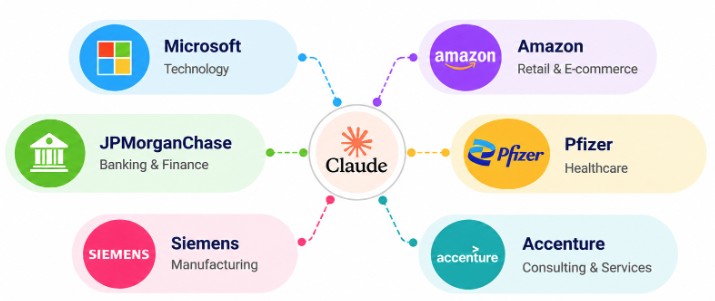
Claude AI offers potential applications across industries that depend on software development, research, document processing, and knowledge management. Technology companies can explore AI-assisted coding, application development, and technical documentation, while consulting organizations may use generative AI to support research and report preparation. Financial services businesses can investigate document analysis and internal knowledge workflows under appropriate compliance and security controls. Healthcare and life sciences organizations may explore approved administrative and research applications while protecting sensitive information. Retail, telecommunications, and customer service teams can also evaluate conversational assistance, content generation, and information retrieval.

Learn Artificial Intelligence Training Course to Build Your Skills
Weekday / Weekend BatchesSee Batch DetailsEnterprise Applications of Claude AI in Software Development and Coding
Claude AI can support software development by helping programmers understand existing code, generate implementation drafts, investigate errors, and prepare technical documentation. Developers can use it to explore programming concepts, suggest refactoring approaches, create unit tests, and evaluate alternative solutions for specific requirements. Depending on the available product and integration, Claude-powered coding tools may also assist with multi-file changes, codebase analysis, API development, and software maintenance. Engineering teams can investigate these capabilities to reduce repetitive work and improve development workflows. Professionals interested in expanding their technical knowledge can explore AI Career Roadmap for Beginners to understand the foundational skills and learning steps involved in building an AI-focused career. However, AI-generated code is not automatically correct, secure, or compatible with existing systems. Developers must review suggestions, run automated tests, inspect dependencies, and evaluate performance and security implications before accepting changes. Organizations should also follow appropriate licensing, privacy, and source-code handling policies. Strong programming fundamentals, debugging, version control, software architecture, and secure coding remain essential for reliable applications. Professionals who combine these skills with practical experience using Claude AI can prepare for evolving opportunities in enterprise software engineering and AI-assisted development.
Claude AI for Business Automation, Customer Support, and Content Generation
Claude AI can help organizations improve selected business processes by summarizing information, drafting responses, extracting details from documents, and organizing customer requests. When connected to approved tools and business systems, AI-powered workflows can assist with support-ticket classification, knowledge-base updates, report preparation, and information routing. Customer service teams may use AI assistance to locate relevant information and prepare responses for human review. Marketing and communications professionals can explore Claude for brainstorming campaign ideas, creating initial content drafts, summarizing customer feedback, and adapting messages for different audiences. Business operations teams may also investigate document processing and repetitive administrative tasks that benefit from language understanding. Professionals interested in developing practical AI solutions can explore Easy AI Projects for Freshers to discover project ideas that help build foundational skills in AI application development. These applications require suitable safeguards because AI-generated content can be inaccurate, incomplete, or inappropriate for a particular situation. Organizations should establish approval procedures, protect confidential information, and monitor workflow quality. Professionals with knowledge of prompt design, APIs, workflow automation, and business process analysis can use Claude AI to develop practical solutions that support productivity while maintaining accountability and service quality.

Get JOB Oriented Artificial Intelligence Training for Beginners By MNC Experts
- Instructor-led Sessions
- Real-life Case Studies
- Assignments
Claude AI in Data Analysis, Research, and Decision-Making
Claude AI can support data analysis and research by helping professionals summarize reports, interpret documentation, organize findings, and explore analytical approaches. Data analysts may use it to draft SQL queries, prepare Python scripts, explain unfamiliar code, and develop preliminary summaries from available information. Researchers can investigate its usefulness for comparing documents and organizing findings, while business teams may apply it to report preparation and internal knowledge discovery. Depending on the available tools and integrations, Claude can also assist with structured data workflows and analytical coding tasks. Professionals looking to expand their understanding of these applications can explore Artificial Intelligence Training to build foundational AI knowledge and understand practical industry applications. However, AI-generated calculations, statistical interpretations, and business recommendations must be independently verified before they influence important decisions. Professionals should examine source data, validate assumptions, and distinguish confirmed evidence from generated explanations. Organizations must also follow data privacy and access-control requirements when using AI systems. Knowledge of Excel, SQL, Python, statistics, data visualization, and analytical reasoning remains important. Combining these skills with Claude AI can help professionals improve research efficiency while maintaining accuracy, transparency, and responsibility for their conclusions.
Essential Skills Required for Claude AI and Enterprise AI Jobs
Building a career involving Claude AI requires a combination of technical knowledge, practical AI skills, and an understanding of business requirements. Professionals should learn programming languages such as Python or JavaScript, along with REST APIs, JSON, databases, authentication, and software testing. Understanding generative AI concepts, model limitations, hallucinations, context windows, and output evaluation helps candidates use AI systems effectively. Prompt design, retrieval-augmented generation (RAG), document retrieval, tool integration, and workflow orchestration can support the development of more advanced AI applications. Cloud computing, cybersecurity, data governance, and application deployment are also valuable for enterprise projects. Candidates can strengthen their foundational knowledge by exploring Programming Languages for AI Development, which highlights programming skills relevant to building AI-powered solutions. Candidates should develop critical thinking and communication skills to translate business requirements into reliable technical solutions. Practical projects can demonstrate their ability to integrate AI models, validate outputs, manage data securely, and measure results. Rather than focusing exclusively on one AI platform, professionals should develop transferable skills that apply across different models and enterprise environments. This combination can support career growth in AI application development, automation, consulting, and software engineering.
Want to Master Artificial Intelligence? Explore the Artificial Intelligence Master Program Offered at ACTE Today!
Benefits and Challenges of Using Claude AI in Enterprise Workflows
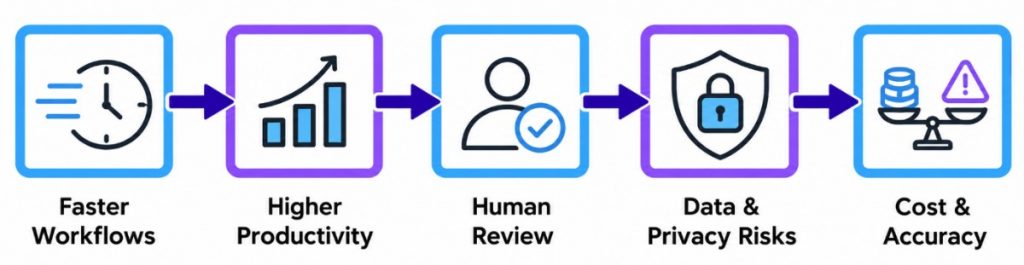
Claude AI can offer several benefits to organizations, including faster document analysis, coding assistance, content drafting, research support, and automation of selected repetitive tasks. It can help employees explore unfamiliar concepts, summarize complex information, and develop initial solutions that can be refined through human review. Developers may use it to understand code and investigate defects, while business teams can explore ways to improve information processing and communication. Professionals seeking to understand broader career opportunities can explore Highest Paying AI Jobs in India to learn about potential roles in the evolving artificial intelligence industry. However, Claude AI also presents challenges.
Want to Learn About AI? Explore Our Artificial Intelligence Interview Questions and Answers Featuring the Most Frequently Asked Questions in Job Interviews.
Claude AI Career Opportunities, Job Roles, and Future Growth
The expanding adoption of generative AI across industries is creating career opportunities for professionals who can develop and implement intelligent business solutions. Knowledge of Claude AI can support career paths such as Generative AI Engineer, AI Application Developer, AI Automation Specialist, Machine Learning Engineer, AI Consultant, and AI Solutions Architect. Software developers may build AI-powered applications, while automation specialists can connect language models with business tools to streamline operations. Data professionals can use AI assistance for reporting and analysis, and consultants can guide organizations in selecting suitable AI applications. Beginners can also explore Becoming an AI Engineer to understand the learning path and technical foundations needed for an AI career. Career progression depends on technical capabilities, industry requirements, practical experience, and employer expectations. Understanding Claude AI alone may not qualify candidates for advanced positions, as many employers also value programming, API integration, retrieval-augmented generation (RAG), cloud platforms, software testing, security, and deployment expertise. Developing practical solutions, such as intelligent document assistants, automated customer service systems, and report-generation tools, can help demonstrate these abilities. By continuously improving their skills and applying responsible AI practices, professionals can prepare for emerging opportunities as enterprise technologies and business requirements evolve.
Conclusion: Building a Career in Claude AI and Enterprise AI Solutions
Preparing for a career involving Claude AI requires more than familiarity with an individual AI tool. Professionals should develop programming fundamentals, understand generative AI concepts, and learn how to integrate AI models into practical applications. Skills in Python, APIs, data analysis, cloud platforms, workflow automation, testing, and cybersecurity can help candidates build solutions that address real business needs. Aspiring professionals can strengthen their foundational knowledge through Artificial Intelligence Training while exploring practical AI applications and industry requirements. Practical projects should demonstrate how AI outputs are validated, sensitive information is protected, and system performance is evaluated. Candidates should also research employer requirements carefully because enterprise adoption and job responsibilities differ across industries and organizations. Claude AI can support software development, research, customer service, content generation, and business automation, but reliable results still depend on human judgment and appropriate safeguards. Building a portfolio, gaining hands-on experience, and keeping technical knowledge current can strengthen professional development. By combining responsible AI usage with strong engineering skills, analytical thinking, and business understanding, professionals can prepare for evolving opportunities in enterprise AI development, consulting, automation, and implementation.