LMS
Last updated on 07th Oct 2026| 13413

- Overview of the Artificial Intelligence Job Market in India
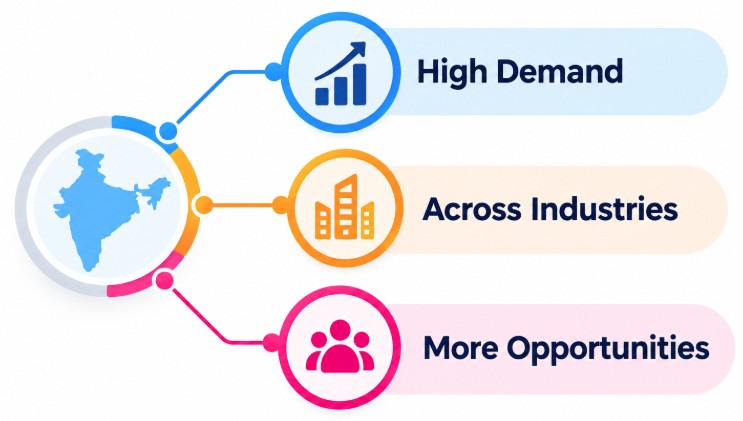
- Growing Demand for AI Professionals Across Indian Industries
- Top Companies and MNCs Recruiting AI Talent in India
- Most In-Demand AI, Machine Learning, and Generative AI Job Roles
- Essential Technical Skills Required for AI Careers in India
- Generative AI, LLM, RAG, and Agentic AI Career Opportunities
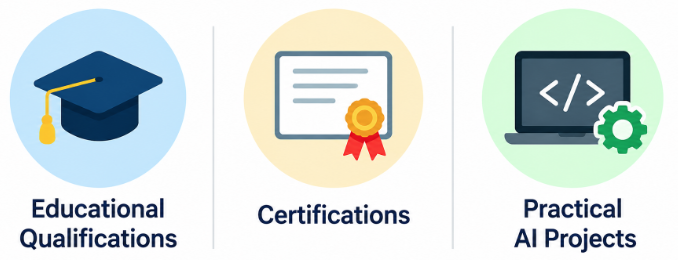
- Educational Qualifications, Certifications, and Practical AI Projects
- AI Salary Trends and Compensation Factors Across India
- Emerging AI Technologies and Future Employment Opportunities
- Conclusion: Building a Successful Long-Term AI Career in India
Overview of the Artificial Intelligence Job Market in India
The Artificial Intelligence job market in India is evolving as organizations increasingly adopt machine learning, generative AI, intelligent automation, predictive analytics, and cloud-based AI technologies. Businesses across IT services, banking, healthcare, manufacturing, retail, telecommunications, and consulting are exploring AI solutions to improve productivity, customer experiences, and operational efficiency. This transformation is creating opportunities for AI Engineers, Machine Learning Engineers, Data Scientists, Generative AI Developers, NLP Engineers, MLOps Specialists, and AI Architects. Employers increasingly value professionals who combine Python, SQL, statistics, machine learning, deep learning, and software engineering knowledge with practical implementation experience. Candidates looking to build these skills can explore Artificial Intelligence Training to strengthen their technical foundations and gain relevant knowledge. Emerging technologies such as large language models, retrieval-augmented generation, AI agents, and cloud AI platforms are expanding specialization options. Candidates who develop strong technical foundations, complete industry-relevant projects, and continuously update their skills can prepare for opportunities in India’s evolving AI employment market.
Growing Demand for AI Professionals Across Indian Industries
Demand for AI professionals in India is being influenced by the growing adoption of data-driven decision-making, automation, intelligent applications, and digital transformation initiatives. IT companies and consulting organizations require AI specialists to develop enterprise solutions and integrate intelligent capabilities into business applications. Professionals looking to explore these opportunities can follow an Artificial Intelligence for Freshers career path to understand potential roles and required skills. Banking and financial institutions use AI for fraud detection, risk assessment, customer analytics, and operational improvement.
Top Companies and MNCs Recruiting AI Talent in India
India’s technology ecosystem includes multinational corporations, IT service providers, consulting firms, product companies, and global capability centers that develop and implement Artificial Intelligence solutions. Major organizations such as TCS, Infosys, Accenture, Cognizant, Wipro, HCLTech, Capgemini, IBM, Microsoft, Google, Amazon, and Deloitte have AI-related business operations and career pathways in India. Depending on current vacancies and project requirements, these companies may recruit professionals for AI Engineering, Machine Learning, Data Science, NLP, Computer Vision, MLOps, Cloud AI, and AI Architecture positions. Candidates interested in developing the technical skills required for these roles can explore Artificial Intelligence Training to strengthen their understanding of AI concepts and practical applications. Candidates should understand that recruitment requirements vary by organization, experience level, specialization, and location. Employers may evaluate Python programming, SQL, machine learning algorithms, deep learning frameworks, LLM applications, cloud platforms, API development, and deployment knowledge. Building practical projects, gaining internship experience, and developing strong problem-solving abilities can help applicants demonstrate their readiness for AI-related opportunities at leading companies.
Get Your Artificial Intelligence Certification by Learning from Industry-Leading Experts and Advancing Your Career with ACTE’s Artificial Intelligence Course.
Most In-Demand AI, Machine Learning, and Generative AI Job Roles
- Machine Learning Engineer: Machine Learning Engineers build, train, evaluate, and deploy predictive models using Python, Scikit-learn, TensorFlow, and PyTorch. They focus on improving model accuracy, optimizing algorithms, and maintaining reliable machine learning systems.
- Generative AI Developer: Generative AI Developers create applications using large language models, prompt engineering, embeddings, and generative AI APIs. They develop chatbots, virtual assistants, document-processing systems, and enterprise AI applications.
- Artificial Intelligence Engineer: AI Engineers develop intelligent applications using machine learning, deep learning, automation, and AI frameworks. They design solutions that analyze information, automate processes, and support business operations across industries. Beginners can explore an AI Engineer Career Path to understand the skills and practical experience required for this role.
- Data Scientist: Data Scientists use statistical analysis, programming, machine learning, and data visualization to identify patterns and generate insights. They work on predictive analytics, forecasting, customer segmentation, and business decision-making.
- MLOps Engineer: MLOps Engineers manage machine learning deployment, automation, monitoring, and maintenance. They work with CI/CD pipelines, Docker, Kubernetes, cloud infrastructure, and model versioning to support production AI systems.

Learn Artificial Intelligence Training Course to Build Your Skills
Weekday / Weekend BatchesSee Batch DetailsEssential Technical Skills Required for AI Careers in India
- Machine Learning and Statistical Analysis: Candidates should learn regression, classification, clustering, decision trees, probability, hypothesis testing, and model evaluation. These concepts help professionals develop predictive solutions and interpret analytical results.
- Deep Learning Frameworks: Knowledge of TensorFlow, PyTorch, neural networks, CNNs, transformers, and optimization techniques helps professionals develop advanced applications involving natural language processing, images, and complex datasets.
- Python Programming and SQL: Python and SQL are foundational skills for many AI positions. Professionals should understand programming concepts,joins, data manipulation, and libraries such as pandas and NumPy. Beginners can strengthen their foundations by exploring Programming Languages for AI Development.
- Cloud Computing and AI Deployment: Understanding AWS, Microsoft Azure, Google Cloud, Docker, APIs, and cloud infrastructure can help AI professionals deploy scalable applications and manage machine learning workloads.
- Data Engineering and Problem-Solving: AI professionals should understand data preprocessing, feature engineering, ETL pipelines, data quality, and analytical problem-solving. These skills help transform raw information into reliable inputs for AI applications.
Generative AI, LLM, RAG, and Agentic AI Career Opportunities
- Retrieval-Augmented Generation Engineering: RAG Engineers develop applications that combine information retrieval with generative AI. They work with document processing, vector databases, embeddings, semantic search, retrieval pipelines, and response evaluation.
- Prompt Engineering and AI Optimization: Prompt Engineering Specialists design and evaluate instructions that improve the usefulness and consistency of generative AI outputs. They focus on prompt structure, contextual information, testing, and response quality.
- Large Language Model Development: LLM-focused professionals develop applications using transformer-based models, tokenization, embeddings and model APIs. They can work on conversational assistants and intelligent enterprise applications. Beginners can explore Generative AI Engineer Career Guide to understand the learning path for this career.
- Agentic AI Application Development: Agentic AI Developers create systems that use AI models, tools, and workflows to perform multi-step tasks. They work with orchestration frameworks, tool calling, state management, automation, and safety mechanisms.
- Generative AI Solutions Architecture: AI Solutions Architects design scalable generative AI applications by combining LLMs, RAG pipelines, cloud infrastructure, APIs, databases, security controls, and monitoring technologies for enterprise requirements.

Get JOB Oriented Artificial Intelligence Training for Beginners By MNC Experts
- Instructor-led Sessions
- Real-life Case Studies
- Assignments
Educational Qualifications, Certifications, and Practical AI Projects
- Educational Background for AI Careers: Graduates from Computer Science, Information Technology, Artificial Intelligence, Data Science, Mathematics, Statistics, and related engineering disciplines can pursue AI opportunities. Candidates from other backgrounds can also enter through relevant technical skills.
- AI and Machine Learning Certifications: Certifications in machine learning, artificial intelligence, cloud AI, and data science can demonstrate structured learning. Candidates can explore Artificial Intelligence Training to build foundational knowledge and develop practical AI skills. Credentials from Microsoft, AWS, Google Cloud, and other recognized providers may further strengthen professional profiles.
- Python and Machine Learning Projects: Candidates can develop prediction systems, recommendation engines, sentiment analysis applications, fraud detection models, and customer segmentation projects to demonstrate programming and analytical abilities.
- Generative AI and RAG Portfolio Projects: Practical projects involving AI chatbots, document question-answering, semantic search, RAG applications, and AI agents can help candidates demonstrate knowledge of LLMs, embeddings, vector databases, and APIs.
- Internships and Real-World Experience: Internships, collaborative projects, open-source contributions, and practical AI implementations can help candidates develop teamwork, debugging, deployment, and problem-solving skills while strengthening their resumes for AI positions.
Want to Master Artificial Intelligence? Explore the Artificial Intelligence Master Program Offered at ACTE Today!
AI Salary Trends and Compensation Factors Across India
| Salary Factor | Impact on AI Professional Salaries | Career Opportunities |
|---|---|---|
| Experience Level | Entry-level professionals generally earn less than experienced specialists who manage complex AI projects and production systems. | Junior AI Engineer, Senior AI Engineer |
| Technical Expertise | Strong Python, SQL, machine learning, deep learning, and software engineering skills can improve access to higher-paying positions. | AI Developer, Machine Learning Engineer |
| Generative AI Specialization | Expertise in LLMs, RAG, prompt engineering, vector databases, and agentic AI can support specialized career opportunities. | Generative AI Engineer, LLM Developer |
| Cloud and MLOps Skills | Knowledge of AWS, Azure, Google Cloud, Docker, Kubernetes, and model deployment can strengthen compensation potential. | MLOps Engineer, Cloud AI Engineer |
| Company and Industry | Compensation varies across IT services, product companies, consulting firms, startups, and global capability centers. | AI Consultant, Data Scientist |
| Job Location | Salaries may differ across Bengaluru, Hyderabad, Chennai, Pune, Mumbai, Delhi NCR, and other Indian technology hubs. | AI Engineer, ML Specialist |
| Educational Qualifications | Relevant degrees and advanced technical education may help candidates qualify for specialized or research-focused positions. | AI Researcher, Data Scientist |
| Certifications and Projects | Industry certifications and practical AI projects can strengthen employability when supported by demonstrated technical abilities. | ML Developer, AI Application Engineer |
| Production AI Experience | Experience deploying, monitoring, optimizing, and maintaining AI applications can increase eligibility for senior technical roles. | Senior ML Engineer, MLOps Lead |
| Leadership Responsibilities | Professionals responsible for architecture, technical strategy, mentoring, and project delivery may qualify for higher compensation. | AI Architect, AI Engineering Manager |
Want to Learn About AI? Explore Our Artificial Intelligence Interview Questions and Answers Featuring the Most Frequently Asked Questions in Job Interviews.
Emerging AI Technologies and Future Employment Opportunities
Emerging Artificial Intelligence technologies are creating new career possibilities across India’s rapidly evolving digital economy. Innovations in generative AI, large language models, agentic AI, multimodal AI, autonomous systems, computer vision, and intelligent automation are influencing how organizations develop products and manage business operations. Professionals can explore opportunities in AI application development, LLM engineering, RAG architecture, AI agent development, robotics, MLOps, cloud AI, and responsible AI governance. Businesses across healthcare, banking, manufacturing, retail, education, automotive, and IT services are increasingly exploring AI-powered solutions to improve efficiency and decision-making. Knowledge of Python, cloud platforms, vector databases, APIs, and deployment technologies can help candidates prepare for emerging positions. Freshers interested in understanding these developments can explore emerging AI trends in the IT industry to learn about evolving technologies and their potential applications. As AI capabilities advance, professionals who combine technical expertise with domain knowledge, problem-solving abilities, security awareness, and continuous learning can pursue specialized engineering, consulting, research, and leadership opportunities.
Conclusion: Building a Successful Long-Term AI Career in India
Building a successful long-term Artificial Intelligence career in India requires a combination of technical knowledge, practical experience, adaptability, and continuous professional development. Candidates should begin with strong foundations in Python, SQL, mathematics, statistics, machine learning, and data processing before progressing toward deep learning, generative AI, LLMs, RAG, agentic AI, and cloud-based technologies. Candidates who want to strengthen their technical foundations can explore Artificial Intelligence Training to develop relevant knowledge and practical skills. Practical projects involving predictive analytics, recommendation systems, AI chatbots, intelligent document processing, and model deployment can help demonstrate real-world capabilities. Certifications, internships, collaborative projects, and industry experience can further strengthen professional profiles. As organizations continue investing in AI-driven transformation, career opportunities may expand across AI engineering, data science, MLOps, solution architecture, research, and technical leadership. Professionals who regularly update their skills, understand business requirements, and develop reliable AI solutions can improve their career prospects and prepare for evolving employment opportunities in India’s competitive technology industry.