LMS
LMS
Last updated on 27th Jun 2026| 4650
 (5.0) | 21173 Ratings
E-mail this post
(5.0) | 21173 Ratings
E-mail this post
- Introduction to Resume Screening Using Machine Learning
- Understanding the Resume Screening Process
- Prerequisites and Tools Required for the Project
- Collecting and Preparing Resume Datasets
- Text Preprocessing and Feature Extraction Techniques
- Building a Resume Classification Model
- Evaluating and Improving Model Performance
- Developing a Simple Resume Screening Application
- Testing, Deployment, and Project Presentation Tips
- Conclusion: Showcasing Your Resume Screening Project in Your Portfolio
Introduction to Resume Screening Using Machine Learning
Resume screening is one of the most common applications of machine learning and natural language processing (NLP) in recruitment. Instead of manually reviewing hundreds of resumes, organizations use intelligent systems to automatically analyze candidate profiles, identify relevant skills, and match applicants with suitable job roles. A machine learning-based resume screening tool processes resume text, extracts important information such as education, technical skills, certifications, work experience, and keywords, and then classifies or ranks candidates based on predefined criteria. Freshers can build this project using Python along with libraries such as Pandas, NumPy, Scikit-learn, NLTK, spaCy, and Streamlit or Flask for creating a simple user interface. Learning these technologies through Data Science Training helps strengthen practical knowledge while developing industry-ready skills. Developing this project helps learners understand text preprocessing, feature extraction, classification algorithms, and model evaluation while gaining practical experience in solving real-world HR challenges. It also strengthens programming, machine learning, and NLP skills, making it an excellent portfolio project for students seeking internships or entry-level data science and artificial intelligence roles.
Understanding the Resume Screening Process
The resume screening process involves several structured steps that transform unstructured resume documents into meaningful insights for recruitment. First, resumes are collected in formats such as PDF, DOCX, or TXT and converted into machine-readable text using document processing techniques. The extracted text then undergoes preprocessing, which includes removing unnecessary symbols, converting text to lowercase, eliminating stop words, and performing tokenization and lemmatization to improve data quality. Next, important features such as technical skills, educational qualifications, certifications, programming languages, and years of experience are extracted using natural language processing techniques. These features are converted into numerical representations using methods like TF-IDF or word embeddings before being used to train machine learning classification models. Learners can strengthen these practical skills through Data Science Training, gaining hands-on experience with real-world machine learning and NLP applications. The trained model predicts the most suitable job category or ranks candidates according to predefined requirements. Finally, the results are presented through a simple dashboard or application, enabling recruiters to shortlist qualified candidates quickly and efficiently while reducing manual effort and improving hiring accuracy.
Get Your Data Science Certification by Learning from Industry-Leading Experts and Advancing Your Career with ACTE’s Data Science Course.
Prerequisites and Tools Required for the Project
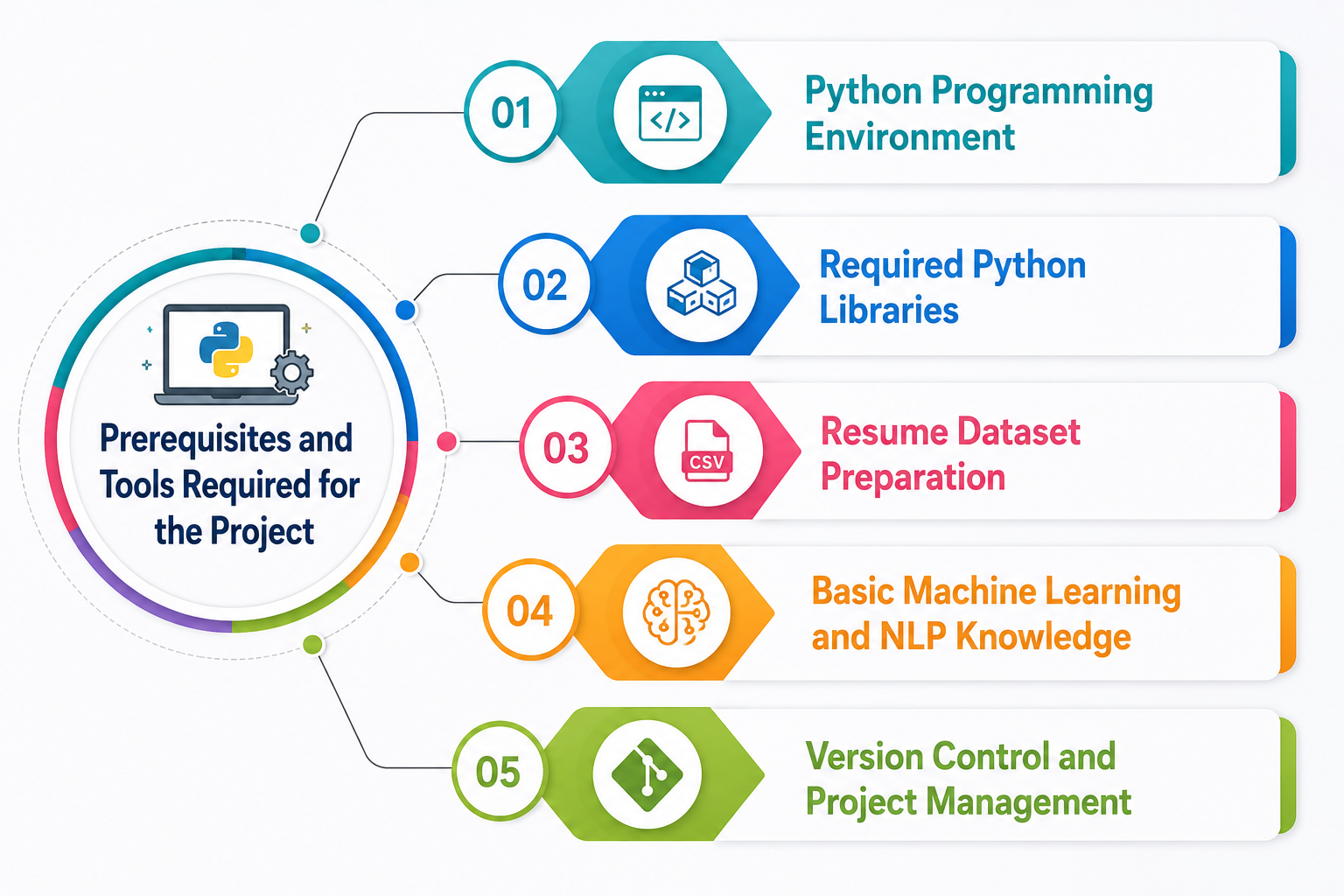
- Python Programming Environment: Install Python along with Jupyter Notebook or Visual Studio Code to write, test, and execute code efficiently. A properly configured development environment ensures smooth project development and debugging.
- Required Python Libraries: Install essential libraries such as Pandas, NumPy, Scikit-learn, NLTK, spaCy, Matplotlib, and Streamlit. These libraries support data processing, machine learning, natural language processing, visualization, and application development. Beginners can strengthen their fundamentals by exploring the Machine Learning Basics Tutorial for Data Science Interns before implementing this project.
- Resume Dataset Preparation: Collect resumes in PDF, DOCX, or TXT format and organize them into labeled categories. A clean, well-structured dataset improves model training, classification accuracy, and overall project performance.
- Basic Machine Learning and NLP Knowledge: Understand concepts such as text preprocessing, tokenization, TF-IDF, classification algorithms, and model evaluation. These fundamentals help build an effective resume screening system using machine learning.
- Version Control and Project Management: Use Git and GitHub to manage source code, track project changes, and maintain version history. These tools support collaboration, improve project organization, and showcase your work to recruiters.
Collecting and Preparing Resume Datasets
The first step in building a resume screening tool is collecting and preparing a high-quality dataset. Resumes can be gathered from publicly available datasets, sample resumes, or manually created documents in PDF, DOCX, or TXT formats. These resumes should be categorized into different job roles such as Data Scientist, Software Developer, Data Analyst, Web Developer, or Business Analyst to support supervised machine learning. After collection, the documents are converted into plain text using document parsing libraries. The dataset is then cleaned by removing duplicate files, correcting formatting issues, handling missing information, and ensuring consistent labels across all records. Building a strong understanding of statistical concepts through the Probability Density Function in Statistics Tutorial can help learners analyze and prepare datasets more effectively for machine learning applications. Organizing the dataset into structured folders or CSV files makes it easier to train and evaluate machine learning models. A well-prepared dataset significantly improves classification accuracy and creates a strong foundation for the resume screening system.

Text Preprocessing and Feature Extraction Techniques
Resume data is unstructured, making preprocessing an essential step before applying machine learning algorithms. Text preprocessing begins by converting all text to lowercase, removing punctuation, special characters, numbers, and unnecessary spaces. Stop words such as “the,” “is,” and “and” are eliminated to retain meaningful information. Tokenization divides text into individual words, while lemmatization or stemming reduces words to their root forms. After preprocessing, important information such as technical skills, educational qualifications, certifications, programming languages, and work experience is extracted. Learning these concepts through Data Science Training helps professionals build a strong foundation in text analytics and machine learning. Feature extraction techniques like TF-IDF (Term Frequency-Inverse Document Frequency), Bag of Words, or Word Embeddings convert textual information into numerical vectors suitable for machine learning models. Effective preprocessing and feature engineering improve classification accuracy and enable the model to identify relevant resume patterns efficiently.

Get JOB Oriented Data Science Training for Beginners By MNC Experts
- Instructor-led Sessions
- Real-life Case Studies
- Assignments
Building a Resume Classification Model
Once the dataset has been preprocessed and transformed into numerical features, the next step is building a machine learning classification model. Popular algorithms such as Naïve Bayes, Logistic Regression, Decision Tree, Random Forest, Support Vector Machine (SVM), and Gradient Boosting can be used to classify resumes into different job categories. The dataset is divided into training and testing sets to evaluate the model’s performance objectively. During training, the algorithm learns patterns from resume features and corresponding job labels. Hyperparameter tuning and cross-validation techniques help optimize model performance and reduce overfitting. Learners interested in understanding how intelligent systems power such applications can explore Artificial Intelligence and Future Technology of AI for broader AI concepts. Selecting the appropriate classification algorithm depends on dataset size, complexity, and desired accuracy. A well-trained model forms the core of the resume screening application by automatically categorizing resumes based on their content.
Want to Master Data Science? Explore the Data Science Master Program Offered at ACTE Today!
Evaluating and Improving Model Performance
After training the machine learning model, it is important to evaluate its effectiveness using appropriate performance metrics. Common evaluation measures include accuracy, precision, recall, F1-score, and confusion matrix analysis. These metrics help determine how well the model classifies resumes into the correct job categories. Building a strong foundation through the Tutorial on Statistics and Probability for Data Science can help learners better understand model evaluation techniques and performance analysis. If performance is unsatisfactory, improvements can be made by increasing dataset size, balancing class distributions, enhancing text preprocessing, selecting better features, or experimenting with different classification algorithms. Hyperparameter optimization and cross-validation also contribute to better model generalization. Continuous testing and refinement ensure that the resume screening system delivers reliable predictions while minimizing classification errors. A well-evaluated model provides greater confidence when deployed in real-world recruitment scenarios.
Want to Learn About DevOps? Explore Our Data Science Interview Questions and Answers Featuring the Most Frequently Asked Questions in Job Interviews.
Developing a Simple Resume Screening Application
The final stage of the project involves creating a user-friendly application that allows recruiters to upload resumes and receive automated classification results. Frameworks such as Streamlit or Flask can be used to build a simple web-based interface where users upload PDF or DOCX resumes. The application extracts text, preprocesses the content, generates features, and passes them to the trained machine learning model for prediction. The output displays the predicted job category, relevant skills identified, and confidence score, enabling quick candidate evaluation. Additional features such as keyword highlighting, resume ranking, and downloadable reports can further enhance usability. Deploying the application on cloud platforms or GitHub demonstrates practical implementation skills and makes the project an impressive addition to a fresher’s portfolio. Learners can also explore Data Science Internship Portfolio to showcase projects effectively and improve their career opportunities.
Testing, Deployment, and Project Presentation Tips
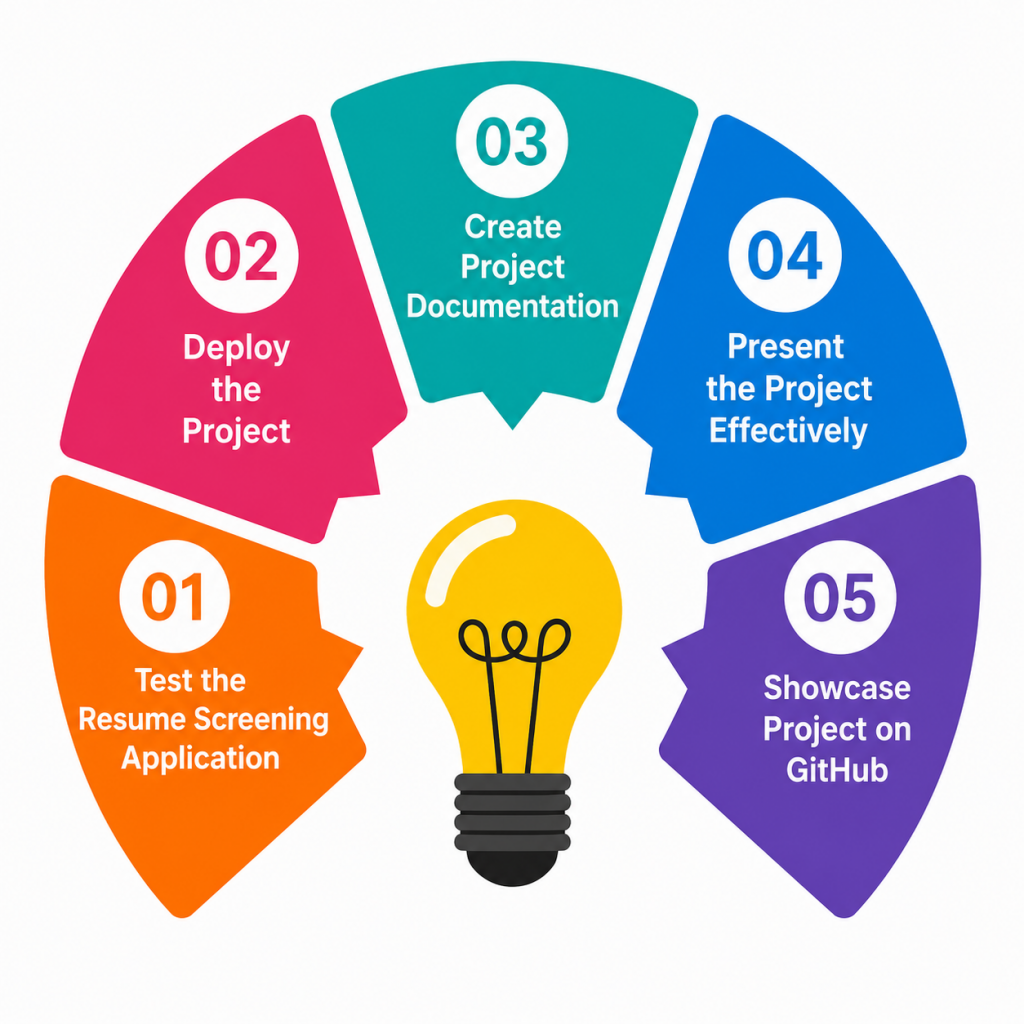
- Testing the Resume Screening Application: Test the application using different resume formats and job categories to verify prediction accuracy and functionality. Check for errors, validate outputs, and ensure the application performs consistently under various input conditions.
- Deploying the Project: Deploy the application using platforms such as Streamlit Community Cloud, Render, or Hugging Face Spaces. A live project demonstrates practical implementation skills and allows recruiters to interact with your application.
- Creating Professional Project Documentation: Prepare a detailed README file explaining the project objective, tools used, installation steps, dataset information, workflow, and sample outputs. Good documentation makes the project easy to understand and use.
- Presenting the Project Effectively: Explain the complete workflow, including data collection, preprocessing, feature extraction, model training, evaluation, and deployment. Highlight challenges faced, solutions implemented, and the project’s practical business value. Along with presenting projects, learners can refer to the Data Science Resume Tutorial to showcase their technical skills effectively to recruiters.
- Showcasing the Project on GitHub: Upload the source code, dataset links, documentation, screenshots, and deployment URL to GitHub. A well-organized repository demonstrates professionalism, coding skills, and practical experience to recruiters and hiring managers.
Conclusion: Showcasing Your Resume Screening Project in Your Portfolio
A resume screening tool is an excellent portfolio project for freshers because it demonstrates practical knowledge of machine learning, natural language processing, data preprocessing, model development, and application deployment. By completing this project, you showcase your ability to solve a real-world recruitment challenge using modern data science technologies. Building these skills through Data Science Training can further strengthen your understanding of industry-standard tools and real-world project implementation. Including the project in your portfolio with a well-documented GitHub repository, project report, screenshots, and a live deployment link highlights both your technical and problem-solving abilities. Clearly explaining the project workflow—from data collection and text preprocessing to feature extraction, model training, evaluation, and deployment—helps recruiters understand your practical expertise. You can further strengthen your portfolio by describing the challenges you encountered, the improvements you implemented, and the technologies used, such as Python, Scikit-learn, NLTK, spaCy, Streamlit, and GitHub. A professionally presented resume screening project not only enhances your resume but also increases your credibility during technical interviews, making you a stronger candidate for internships and entry-level roles in data science, machine learning, artificial intelligence, and software development.