LMS
LMS
Last updated on 19th May 2026| 4601

- Introduction to AI Image Generation Tutorial
- Basics of Artificial Intelligence
- Neural Networks for Images
- Generative Models Overview
- GANs and Diffusion Models
- Popular Tools and Platforms
- Step‑by‑Step Image Creation
- Real‑World Use Cases
- Ethics and Responsible Use
- Conclusion
Introduction to AI Image Generation Tutorial
AI Image Generation Tutorial is a fascinating field where artificial intelligence models create new visual content from data or prompts. Unlike traditional image editing, these models learn patterns from massive datasets and generate realistic or artistic images. For freshers, this technology opens doors to creativity and innovation, allowing them to produce art, design prototypes, or synthetic datasets. The process relies on deep learning, particularly generative models like GANs and diffusion systems in Gen AI Course. AI image generation is widely used in entertainment, marketing, healthcare, and education. It can automate design tasks, create training data, and even assist in accessibility by generating alt-text visuals. The technology is interactive, responding to prompts or conditions to produce dynamic results. Beginners find it approachable because of user-friendly platforms and pre-trained models. AI image generation is not just technical but also artistic, blending logic with imagination. Learning it equips freshers with skills for modern AI careers.
Basics of Artificial Intelligence
- Definition: Artificial Intelligence (AI) enables machines to simulate human intelligence by learning, reasoning, and making decisions. Core areas include machine learning, natural language processing (NLP), computer vision, and robotics, powering applications such as virtual assistants, search engines, and recommendation systems.
- Learning Path: Beginners should start with mathematics, statistics, and programming fundamentals before exploring supervised, unsupervised, and reinforcement learning. Strengthen your AI knowledge with the Artificial Intelligence Tutorial, which provides a solid foundation for practical AI development.
- Evolution: Artificial Intelligence has evolved from rule-based systems to advanced deep learning models powered by neural networks. This evolution has enabled breakthroughs in automation, predictive analytics, speech recognition, and generative AI.
- Applications: AI is widely used across industries for healthcare diagnostics, fraud detection, personalized recommendations, predictive maintenance, autonomous vehicles, customer support, and business intelligence, demonstrating its broad real-world impact.
- Importance for Freshers: Learning AI builds a strong technical foundation, enhances problem-solving skills, prepares freshers for internships and industry projects, and creates career opportunities in machine learning, data science, automation, and generative AI.
Get Your Gen AI Certification by Learning from Industry-Leading Experts and Advancing Your Career with ACTE’s Gen AI Course.
Neural Networks for Images
Neural networks are the foundation of AI-powered image generation and computer vision, enabling machines to recognize, analyze, and create visual content. Convolutional Neural Networks (CNNs) are widely used to detect patterns such as edges, textures, shapes, and objects by learning hierarchical image features. During training, these networks optimize their parameters using backpropagation and gradient descent to improve prediction accuracy over time. CNNs play a vital role in applications such as image classification, object detection, facial recognition, medical imaging, and autonomous systems. To explore another exciting AI domain, visit the Robotics Tutorial for Beginners. Understanding neural networks provides a strong foundation for careers in artificial intelligence, deep learning, computer vision, and generative AI.
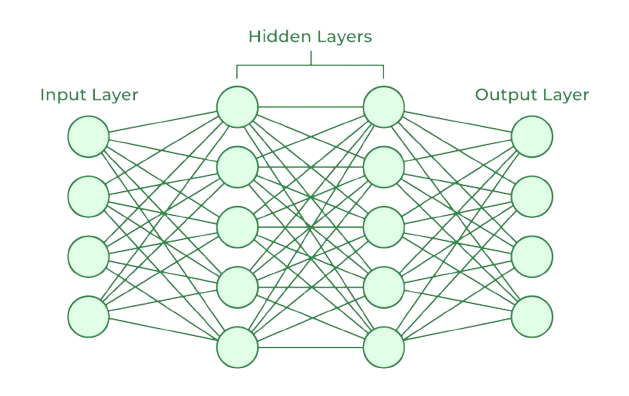
Activation functions such as ReLU introduce non-linearity, enabling neural networks to learn complex patterns and improve image recognition accuracy. Techniques such as dropout, batch normalization, and data augmentation help reduce overfitting and improve model generalization. Deep neural networks with multiple hidden layers form the foundation of advanced AI models, including Generative Adversarial Networks (GANs), Variational Autoencoders (VAEs), and diffusion models used for AI image generation. To gain practical experience with these technologies, explore the Gen AI Course. Learning Convolutional Neural Networks (CNNs) and deep learning concepts provides beginners with the essential skills needed for computer vision, image classification, object detection, and modern generative AI applications.
Generative Models Overview
- Types of Models: Generative AI includes Variational Autoencoders (VAEs), Generative Adversarial Networks (GANs), Diffusion Models, and Transformer-based architectures. Each model offers unique capabilities for generating text, images, audio, and other forms of content. To explore practical AI applications, visit the Intelligent Apps Tutorial for a Promising Future.
- Applications: Generative models are widely used for text-to-image generation, image editing, content creation, code generation, style transfer, synthetic data generation, drug discovery, and scientific simulations across multiple industries.
- Key Concepts: Understanding latent space, probability distributions, neural network optimization, attention mechanisms, and prompt engineering helps learners understand how generative AI models create realistic and meaningful outputs.
- Benefits for Freshers: Learning generative AI provides hands-on experience with modern AI technologies, strengthens deep learning skills, enhances creativity, and prepares beginners for real-world projects and emerging career opportunities.
- Challenges: Generative models require large datasets, significant computational resources, and careful handling of bias, hallucinations, and ethical concerns. Understanding these challenges helps developers build responsible and reliable AI applications.

GANs and Diffusion Models
Generative Adversarial Networks (GANs) and diffusion models are two of the most influential architectures used in modern AI image generation. GANs consist of a generator that creates synthetic images and a discriminator that evaluates their authenticity, enabling both networks to improve through adversarial learning. In contrast, diffusion models generate high-quality images by gradually removing noise from random data, resulting in highly realistic and detailed outputs. Today, diffusion models power many state-of-the-art text-to-image applications, while GANs remain popular for image synthesis, style transfer, and creative design. To understand the broader field of computer vision, explore the Object Detection Tutorial. Learning both GANs and diffusion models helps beginners build a strong foundation in deep learning, generative AI, computer vision, and advanced image generation techniques, preparing them for real-world AI development and research.

Get JOB Oriented Gen AI Training for Beginners By MNC Experts
- Instructor-led Sessions
- Real-life Case Studies
- Assignments
Popular Tools and Platforms
- Frameworks: Popular AI frameworks such as TensorFlow, PyTorch, Keras, and Hugging Face provide powerful tools for building, training, and deploying machine learning and deep learning models. Learning these frameworks helps beginners develop practical AI skills.
- Platforms: Google Colab, Jupyter Notebook, Kaggle, AWS, Microsoft Azure, and Google Cloud Platform (GCP) provide environments for developing, testing, and deploying AI applications. To strengthen your computer vision skills, explore the Object Detection TensorFlow: A Concise Tutorial.
- Utilities: AI development is supported by libraries for data preprocessing, visualization, model evaluation, and API integration, enabling developers to build efficient, scalable, and production-ready machine learning workflows.
- Learning Approach: Beginners can start with Google Colab and Jupyter Notebook for hands-on practice, use Hugging Face for pre-trained models, experiment with PyTorch and TensorFlow, and gradually move to cloud platforms for deploying real-world AI solutions.
- Best Practices: Use virtual environments, maintain updated dependencies, document project workflows, version control code with Git, and create reproducible notebooks to improve collaboration, reliability, and professional development.
Want to Master Gen AI? Explore the Gen AI Master Program Offered at ACTE Today!
Step-by-Step Image Creation
Creating images with AI follows a structured workflow that begins with defining the objective, such as text-to-image generation, image editing, style transfer, or synthetic data creation. The next step involves preparing high-quality prompts or datasets that guide the model toward the desired output. Beginners can accelerate development by using pre-trained models and learning the fundamentals through the Artificial Neural Network Tutorial. After configuring the model, images are generated by adjusting parameters such as prompts, sampling methods, resolution, and inference settings. The final stage involves evaluating image quality based on accuracy, realism, creativity, and prompt alignment, followed by refining inputs to achieve better results. Understanding this end-to-end workflow helps learners build practical skills in generative AI and AI-powered image creation.
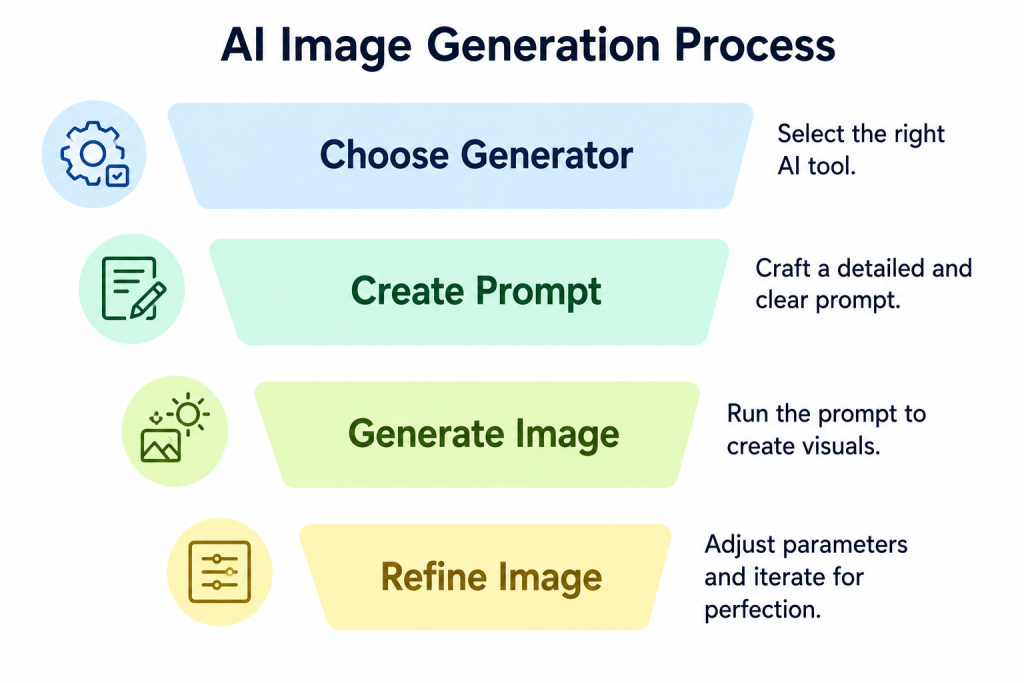
Iteration is an essential part of AI image generation, as prompts, model parameters, and training settings often require refinement to produce high-quality results. Visualization and evaluation tools help compare generated images, identify areas for improvement, and optimize model performance. Once the desired output is achieved, deployment platforms allow developers to share, integrate, or scale AI-generated images across web, mobile, and enterprise applications. For beginners, starting with simple prompts and gradually experimenting with advanced settings builds confidence and practical experience. By following a structured workflow, learners understand how generative AI transforms textual descriptions into realistic visuals, combining creativity, deep learning, and artificial intelligence to solve real-world image generation challenges.
Want to Learn About DevOps? Explore Our DevOps Interview Questions and Answers Featuring the Most Frequently Asked Questions in Job Interviews.
Real-World Use Cases
- Healthcare: Generative AI is used to create synthetic medical images, assist in disease diagnosis, support medical research, and improve healthcare training while protecting patient privacy through anonymized datasets.
- Finance: Financial institutions use generative AI for document automation, fraud detection, risk assessment, customer support, and report generation. Learn more about these applications in the Generative AI Tutorial.
- Education: AI generates personalized learning materials, educational visuals, quizzes, virtual tutors, and interactive content, making learning more engaging, accessible, and adaptive for students.
- Entertainment: Generative AI powers digital art creation, music composition, video generation, game development, animation, and visual effects, enabling creators to produce high-quality content more efficiently.
- Business: Organizations use generative AI to create marketing content, product designs, advertising visuals, customer communications, and business reports. Explore the Generative AI Tutorial for Beginners: Introduction and Basics to understand how AI is transforming modern business operations.
Ethics and Responsible Use
- Transparency in AI: AI systems should clearly explain how they generate predictions and content, allowing users to understand when they are interacting with AI and promoting trust, accountability, and responsible decision-making.
- Avoiding Bias and Discrimination: Developers should use diverse, high-quality datasets and regularly evaluate AI models to reduce bias, improve fairness, and ensure inclusive outcomes across different user groups.
- Data Privacy and Security: Organizations must protect sensitive user information by implementing strong security practices, complying with data protection regulations, and maintaining transparency about how data is collected, stored, and used.
- Preventing Misuse of AI: Responsible AI development includes preventing the creation of misleading content, deepfakes, misinformation, and other harmful applications. Learn ethical AI development practices through the Gen AI Course.
- Human Supervision and Accountability: Human oversight remains essential for AI systems, especially in critical fields such as healthcare, finance, education, and law. Organizations should ensure that important decisions are reviewed by qualified professionals and that responsibility for AI-generated outcomes remains with human decision-makers.
Conclusion
AI Image Generation Tutorial is transforming the modern world by enabling machines to create text, images, videos, and other intelligent content. Technologies such as neural networks, GANs, VAEs, and transformers have made AI systems more powerful and efficient. These advancements are improving industries like healthcare, education, entertainment, marketing, and software development in Gen AI Course. Although generative AI offers many benefits, it also creates challenges related to ethics, privacy, and misinformation. Responsible AI development and proper regulations are important to ensure safe and fair usage of this technology. With continuous learning and innovation, generative AI will continue to shape the future of digital transformation and human creativity.