LMS
LMS
Last updated on 20th Jul 2026| 7687

TCS Ninja Aptitude Questions are designed to assess a candidate’s numerical ability, logical reasoning, verbal skills, and problem-solving aptitude during the TCS Ninja hiring process. The aptitude section includes a variety of questions on Quantitative Aptitude, Logical Reasoning, and Verbal Ability, covering topics such as Percentages, Profit and Loss, Time and Work, Mixtures, Probability, Coding-Decoding, Seating Arrangements, Reading Comprehension, and Grammar. These questions evaluate analytical thinking, calculation speed, and decision-making skills under time constraints. Practicing the latest TCS Ninja aptitude questions with detailed answers helps candidates understand the exam pattern, improve accuracy, and build confidence. Regular preparation using previous and expected questions is one of the most effective ways to perform well in the TCS Ninja recruitment test and increase the chances of securing a job offer.
1. Find the HCF of 24 and 36.
Ans:
The HCF (Highest Common Factor) is the largest number that divides both numbers exactly. The factors of 24 are 1, 2, 3, 4, 6, 8, 12, and 24. The factors of 36 are 1, 2, 3, 4, 6, 9, 12, 18, and 36. The highest common factor is 12. HCF questions test divisibility and factorization skills. They are frequently asked in TCS Ninja Aptitude tests.
- Factors Of 24 = 1, 2, 3, 4, 6, 8, 12, 24
- Factors Of 36 = 1, 2, 3, 4, 6, 9, 12, 18, 36
- Highest Common Factor = 12
- Answer = 12
2. Find the LCM of 15 and 20..
Ans:
The LCM (Least Common Multiple) is the smallest number that is divisible by both numbers. The prime factors of 15 are 3 × 5, and the prime factors of 20 are 2 × 2 × 5. Multiply each prime factor using the highest power: 2 × 2 × 3 × 5 = 60. LCM questions check knowledge of multiples and prime factorization. These questions commonly appear in placement aptitude exams.
- 15 = 3 × 5
- 20 = 2 × 2 × 5
- LCM = 2 × 2 × 3 × 5
- Answer = 60
3. Find the Remainder When 125 Is Divided By 8.
Ans:
Divide 125 by 8 to find the remainder. Since 8 × 15 = 120, subtract 120 from 125. The remainder is 5. Remainder questions test basic division and numerical reasoning. They are frequently included in TCS Ninja and other placement aptitude exams. Practicing such questions improves calculation speed and accuracy.
- 125 ÷ 8 = 15 Remainder 5
- 8 × 15 = 120
- 125 − 120 = 5
- Answer = 5
4. A Shopkeeper Bought A Bag For ₹1,250 And Sold It For ₹1,500. Find The Profit Percentage.
Ans:
- The Cost Price Is ₹1,250 And The Selling Price Is ₹1,500. Since The Selling Price Is Higher Than The Cost Price, There Is A Profit. The Profit Is ₹250.
- Divide The Profit By The Cost Price And Multiply By 100 To Find The Profit Percentage.
- Profit And Loss Questions Test Business Mathematics Skills. They Frequently Appear In TCS Ninja Aptitude Tests
- Profit = ₹1,500 − ₹1,250 = ₹250
- Profit Percentage = (250 ÷ 1,250) × 100
- = 0.20 × 100
- = 20%
5. . A Trader Purchased An Item For ₹2,400 And Sold It For ₹2,160. Find The Loss Percentage.
Ans:
The Cost Price Is ₹2,400 And The Selling Price Is ₹2,160. Since The Selling Price Is Less Than The Cost Price, There Is A Loss. The Loss Is ₹240. Divide The Loss By The Cost Price And Multiply By 100. Profit And Loss Questions Improve Calculation Accuracy.
- Loss = ₹2,400 − ₹2,160 = ₹240
- Loss Percentage = (240 ÷ 2,400) × 100
- = 0.10 × 100
- = 10%
6. A Contractor Can Complete A Work In 12 Days. How Much Work Is Completed In One Day?
Ans:
If A Person Completes A Job In 12 Days, The Fraction Of Work Done Per Day Is One By Twelve. Time And Work Questions Test Work Efficiency Concepts. They Frequently Appear In Placement Exams. Understanding Daily Work Helps Solve Combined Work Problems..
- Total Days = 12
- One Day Work = 1 ÷ 12
- = 1/12
- Answer = 1/12 Of The Work
7. A Worker Finishes A Job In 15 Days. How Much Work Does The Worker Complete In 5 Days?
Ans:
The Worker Completes One-Fifteenth Of The Work In One Day. Multiply The One-Day Work By Five Days. Time And Work Problems Improve Logical Thinking And Calculation Speed. They Are Common In TCS Aptitude Tests.
- One Day Work = 1/15
- Work In 5 Days = 5 × 1/15
- = 5/15
- = 1/3
8. A Car Travels 240 Km In 4 Hours. Find Its Speed.
Ans:
Speed Is Calculated By Dividing Distance By Time. Divide 240 By 4 To Get The Speed. Time, Speed And Distance Questions Test Formula Application Skills. They Frequently Appear In TCS Ninja Exams.
- Distance = 240 Km
- Time = 4 Hours
- Speed = 240 ÷ 4
- = 60 Km/Hour
9. A Train Covers 360 Km In 6 Hours. Find Its Speed.
Ans:
Use The Formula Speed = Distance ÷ Time. Divide 360 By 6. Time, Speed And Distance Questions Measure Numerical Ability. They Improve Formula-Based Calculations
- Distance = 360 Km
- Time = 6 Hours
- Speed = 360 ÷ 6
- = 60 Km/Hour
10. Divide ₹1,800 In The Ratio 2 : 4.
Ans:
First Add The Ratio Parts. The Total Ratio Is Six. Divide ₹1,800 By Six To Find One Part. Multiply By Each Ratio Value. Ratio And Proportion Questions Test Distribution Skills
- Total Ratio = 2 + 4 = 6
- One Part = ₹1,800 ÷ 6 = ₹300
- 2 Parts = ₹600
- 4 Parts = ₹1,200
11. Divide ₹2,100 In The Ratio 3 : 4.
Ans:
The Total Ratio Is Seven. Divide The Amount By Seven To Find One Share. Multiply According To The Ratio. Ratio Questions Improve Logical Distribution Skills.
- Total Ratio = 3 + 4 = 7
- One Part = ₹2,100 ÷ 7 = ₹300
- 3 Parts = ₹900
- 4 Parts = ₹1,200
12. Find The Average Of 18, 22, 26 And 34.
Ans:
Add All The Numbers And Divide By The Total Number Of Values. Average Questions Test Basic Arithmetic Skills. They Frequently Appear In Placement Exams.
- Sum = 18 + 22 + 26 + 34 = 100
- Count = 4
- Average = 100 ÷ 4
- = 25
13. Find The Average Of 15, 25, 35, 45 And 55.
Ans:
Calculate The Sum Of All Numbers And Divide By Five. Average Questions Improve Numerical Accuracy And Speed. They Are Frequently Asked In TCS Ninja.
- Sum = 15 + 25 + 35 + 45 + 55 = 175
- Count = 5
- Average = 175 ÷ 5
- = 35
14. A Bicycle Cost ₹2,500 And Was Sold For ₹2,250. Find The Loss Percentage.
Ans:
- A Loss Occurs When The Selling Price Is Less Than The Cost Price.
- Calculate The Loss First, Then Divide It By The Cost Price And Multiply By 100. Loss Percentage Questions Measure Understanding Of Basic Business Calculations.
- These Problems Are Frequently Asked In Placement Exams
- Loss = ₹2500 − ₹2250 = ₹250
- Loss Percentage = (250 ÷ 2500) × 100
- = 0.1 × 100
- = 10%
15. A Worker Completes A Job In 12 Days. How Much Work Is Completed In One Day?
Ans:
Time And Work Questions Use The Concept Of Work Efficiency. If A Person Finishes A Job In 12 Days, Then One Day’s Work Is The Reciprocal Of Total Days. These Questions Test Logical Calculation Skills. They Are Common In TCS Ninja Exams
- Total Work = 1
- Days = 12
- One Day’s Work = 1 ÷ 12
- = 1/12
16. A Can Finish A Work In 8 Days. How Much Work Does A Complete In One Day?
Ans:
The Efficiency Of A Worker Is Calculated Using The Reciprocal Of The Number Of Days Required To Finish The Work. This Concept Is Widely Used In Time And Work Problems. Such Questions Frequently Appear In Aptitude Tests.
- Total Work = 1
- Days = 8
- One Day’s Work = 1 ÷ 8
- = 1/8
17. A Car Travels 180 Km In 3 Hours. Find Its Speed.
Ans:
Speed Is Calculated By Dividing Distance By Time. Divide The Total Distance Travelled By The Time Taken. Time, Speed And Distance Questions Test Practical Calculation Skills. They Are Frequently Asked In TCS Ninja Aptitude Tests.
- Distance = 180 Km
- Time = 3 Hours
- Speed = 180 ÷ 3
- = 60 Km/H
18. A Train Covers 360 Km In 6 Hours. Find Its Speed.
Ans:
Use The Formula Speed = Distance ÷ Time. Divide The Total Distance By The Time Taken To Obtain The Speed. These Questions Measure Numerical Accuracy And Formula Application. They Are Common In Placement Tests.
- Distance = 360 Km
- Time = 6 Hours
- Speed = 360 ÷ 6
- = 60 Km/H
19. Divide ₹840 Between A And B In The Ratio 5 : 7.
Ans:
Ratio Questions Require Dividing A Quantity Into Given Parts. First Add The Ratio Values To Find Total Parts. Then Calculate The Value Of One Part And Multiply Accordingly. These Questions Frequently Appear In TCS Ninja Aptitude Tests
- Total Parts = 5 + 7 = 12
- One Part = 840 ÷ 12 = ₹70
- A = 5 × 70 = ₹350
- B = 7 × 70 = ₹490
20. The Ratio Of Boys To Girls Is 4 : 5. If There Are 36 Girls, Find The Number Of Boys.
Ans:
Find The Value Of One Ratio Part Using The Given Number Of Girls. Then Multiply That Value By The Boys’ Ratio. Ratio And Proportion Problems Test Logical Division Skills. They Frequently Appear In Placement Exams
- Girls = 5 Parts = 36
- One Part = 36 ÷ 5 = 7.2
- Boys = 4 × 8 = 32
- Answer = 32
21. Find The Average Of 12, 18, 20, 25 And 30.
Ans:
Average Is Calculated By Dividing The Sum Of All Numbers By The Number Of Values. This Topic Tests Arithmetic Accuracy. Average Questions Are Frequently Asked In TCS Ninja And Other Placement Exams
- Sum = 12 + 18 + 20 + 25 + 30 = 105
- Number Of Values = 5
- Average = 105 ÷ 5
- = 21
22. Find The Average Of 40, 45, 50, 55 And 60.
Ans:
The Average Represents The Central Value Of A Group Of Numbers. Add All The Numbers And Divide By Their Count. These Questions Test Basic Arithmetic Skills. They Frequently Appear In Aptitude Tests.
- Sum = 40 + 45 + 50 + 55 + 60 = 250
- Average = 250 ÷ 5
- = 50
23. A Product Costs ₹1,200 And Is Sold At A Profit Of 25%. Find The Selling Price.
Ans:
Profit Percentage Is Calculated On The Cost Price. Multiply The Cost Price By The Profit Percentage And Add It To The Cost Price. These Questions Are Frequently Asked In Placement Exams
- Profit = (25 ÷ 100) × 1200 = ₹300
- Selling Price = 1200 + 300
- = ₹1500
24. A Man Walks At 5 Km/H. How Long Will He Take To Cover 20 Km?
Ans:
Time Is Calculated By Dividing Distance By Speed. This Formula Is Commonly Used In Time, Speed And Distance Problems. Such Questions Test Formula Application And Calculation Skills.
- Distance = 20 Km
- Speed = 5 Km/H
- Time = 20 ÷ 5
- = 4 Hours
25. Two Numbers Are In The Ratio 3 : 5 And Their Sum Is 64. Find The Numbers.
Ans:
Add The Ratio Parts To Find The Total Number Of Parts. Divide The Sum By Total Parts And Multiply By Each Ratio Value. Ratio Questions Frequently Appear In TCS Ninja Aptitude Tests.
- Total Parts = 3 + 5 = 8
- One Part = 64 ÷ 8 = 8
- Numbers = 3 × 8 = 24, 5 × 8 = 40
26. Find The Average Of The First 10 Natural Numbers
Ans:
The First Ten Natural Numbers Are 1 To 10. Add Them Together Or Use The Average Formula For Consecutive Numbers. Average Questions Improve Arithmetic Speed. They Frequently Appear In Placement Tests.
- Sum = 1 + 2 + … + 10 = 55
- Average = 55 ÷ 10
- = 5.5
27. A Shopkeeper Gives A 20% Discount On A ₹900 Shirt. Find The Selling Price.
Ans:
Discount Is Calculated On The Marked Price. Subtract The Discount Amount From The Marked Price To Find The Selling Price. Discount Questions Frequently Appear In Aptitude Exams.
- Discount = (20 ÷ 100) × 900 = ₹180
- Selling Price = 900 − 180
- = ₹720
28. A Bus Travels 240 Km In 4 Hours. Find The Speed.
Ans:
Speed Is Found By Dividing Distance By Time. This Formula Is One Of The Most Important Concepts In Aptitude. These Questions Frequently Appear In TCS Ninja Tests.
- Distance = 240 Km
- Time = 4 Hours
- Speed = 240 ÷ 4
- = 60 Km/H
29. A And B Can Complete A Work In 6 Days Together. Find Their One Day’s Work.
Ans:
When Two People Complete A Job Together In A Given Number Of Days, Their Combined One Day Work Is The Reciprocal Of Total Days. This Is A Fundamental Time And Work Concept.
- Total Work = 1
- Days = 6
- One Day’s Work = 1 ÷ 6
- = 1/6
30. The Average Of Five Numbers Is 48. Find Their Total Sum.
Ans:
The Total Sum Can Be Found By Multiplying The Average By The Number Of Values. Average Questions Test Understanding Of Basic Arithmetic Concepts. They Frequently Appear In TCS Ninja Aptitude Exams.
- Average = 48
- Number Of Values = 5
- Total Sum = 48 × 5
- = 240
31. Find The Next Number In The Series: 2, 4, 8, 16, 32, ?
Ans:
Each Number In The Series Is Obtained By Multiplying The Previous Number By Two. The Pattern Continues Throughout The Sequence Without Any Change. Number Series Questions Test Logical Thinking And Pattern Recognition Skills. They Frequently Appear In TCS Ninja Aptitude And Placement Exams. Identifying Multiplication Patterns Helps Solve Such Questions Faster. Regular Practice Improves Speed And Accuracy In Competitive Exams. Answer = 64.

32. Find The Next Number In The Series: 5, 10, 20, 40, 80, ?
Every Number In This Series Is Double The Previous Number. Multiplying Each Term By Two Produces The Next Value In The Sequence.
Such Questions Test The Ability To Identify Mathematical Patterns Quickly. These Questions Are Common In TCS Ninja Exams.
Observing The Relationship Between Consecutive Terms Is The Key To Finding The Answer. Pattern-Based Questions Improve Numerical Reasoning Skills. Answer: 160
33. Find The Next Number In The Series: 3, 6, 9, 12, 15, ?
Ans:
This Is An Arithmetic Progression Where Each Number Increases By Three. Add Three To The Previous Number To Obtain The Next Term. Arithmetic Series Questions Measure Observation And Calculation Skills. They Frequently Appear In Aptitude Tests. Recognizing A Common Difference Makes The Solution Easy. Arithmetic Progressions Are Frequently Asked In Placement Examinations. Answer = 18.
34. Find The Next Number In The Series: 7, 14, 21, 28, 35, ?
Ans:
Each Term Is Increased By Seven To Form The Next Number. Recognizing A Constant Difference Is The Key To Solving Such Series. Number Series Questions Improve Logical And Numerical Reasoning. These Questions Help Develop Quick Calculation Skills. Regular Practice Increases Confidence During Online Assessments. Answer = 42.
35. Find The Next Number In The Series: 1, 4, 9, 16, 25, ?
Ans:
The Numbers Are Perfect Squares Of Natural Numbers. They Represent 1², 2², 3², 4², And 5² Respectively. The Next Number Is 6² Which Equals Thirty-Six. Square Number Series Are Frequently Asked In Placement Exams. Remembering Square Numbers Saves Time During Exams. These Questions Test Mathematical Observation Skills. Answer = 36.
36. In A Certain Code, CAT Is Written As DBU. How Is DOG Written?
Ans:
Each Letter Is Replaced By The Next Alphabet Letter. C Becomes D, A Becomes B, And T Becomes U. Applying The Same Rule, D Becomes E, O Becomes P, And G Becomes H. Coding-Decoding Questions Test Logical Pattern Recognition. Understanding Alphabet Positions Makes Such Questions Easier. Regular Practice Helps Solve Coding Problems Quickly. Answer = EPH.
37. If BOOK Is Written As CPPL, How Is GAME Written?
Ans:
- Every Letter Is Shifted Forward By One Alphabet Position. B Becomes C, O Becomes P, And K Becomes L.
- Applying The Same Pattern, G Becomes H, A Becomes B, M Becomes N, And E Becomes F. Such Questions Frequently Appear In TCS Ninja Reasoning Tests.
- Identifying The Coding Rule Is More Important Than Memorization. Coding-Decoding Improves Logical Analysis Skills. Answer: HBNF
38. If PEN Is Written As QFO, How Is MAP Written?
Ans:
Each Letter Is Moved One Step Forward In The Alphabet Sequence. M Becomes N, A Becomes B, And P Becomes Q. Coding-Decoding Questions Measure Logical Thinking And Alphabet Knowledge. These Questions Are Common In Placement Examinations. Careful Observation Prevents Mistakes In Alphabet-Based Coding. Practice Enhances Speed And Accuracy. Answer = NBQ.
39. If SUN Is Written As TVO, How Is BAT Written?
Ans:
The Coding Rule Is To Shift Every Letter One Position Forward. B Changes To C, A Changes To B, And T Changes To U. Identifying The Common Rule Makes The Answer Simple. Coding-Decoding Is An Important Reasoning Topic In TCS Ninja. These Questions Test Logical Thinking Rather Than Memory. Consistent Practice Improves Performance In Competitive Exams. Answer = CBU
40. If CAR Is Written As DBS, How Is BUS Written?
Ans:
Each Letter Is Increased By One Alphabet Position. B Becomes C, U Becomes V, And S Becomes T. Alphabet-Based Coding Questions Test Observation And Logical Reasoning Skills. These Questions Frequently Appear In Placement Tests. Understanding Alphabet Order Helps Solve These Questions Easily. Regular Practice Builds Confidence In Reasoning Sections. Answer = CVT.
41. Pointing To A Woman, Rahul Said, “She Is My Mother’s Only Daughter.” Who Is The Woman?
Ans:
Rahul’s Mother Has Only One Daughter, Which Means The Woman Is Rahul’s Sister. Blood Relation Questions Require Careful Analysis Of Family Relationships. Identifying Direct Family Members Helps Solve These Questions Quickly. They Frequently Appear In TCS Ninja Aptitude Tests. Reading The Statement Carefully Prevents Confusion. Family Tree Practice Improves Accuracy In Blood Relation Problems. Answer = Rahul’s Sister.
42. A Man Said, “The Boy Is The Son Of My Father’s Only Son.” How Is The Boy Related To The Man?
Ans:
The Man’s Father’s Only Son Refers To The Man Himself. Therefore, The Boy Is The Son Of The Man. Blood Relation Questions Test Logical Interpretation Of Family Connections. These Questions Are Common In Placement Exams. Understanding The Family Hierarchy Is Essential For Correct Answers. Logical Thinking Helps Solve Such Questions Efficiently. Answer = Son.
43. Priya Said, “He Is The Brother Of My Mother.” How Is The Person Related To Priya?
Ans:
- The Brother Of One’s Mother Is Known As The Maternal Uncle. Understanding Basic Family Relationships Makes Blood Relation Problems Easier.
- Such Questions Frequently Appear In Reasoning Sections. They Test Logical Interpretation Rather Than General Knowledge.
- Regular Practice Improves Confidence In Family Relationship Questions.Answer: Maternal Uncle
44. Pointing To A Girl, Ravi Said, “She Is The Daughter Of My Father’s Brother.” Who Is The Girl?
Ans:
Ravi’s Father’s Brother Is His Uncle. The Daughter Of His Uncle Is Ravi’s Cousin. Blood Relation Questions Test The Ability To Understand Family Trees. These Questions Frequently Appear In TCS Ninja Exams. Drawing A Simple Family Diagram Can Help Solve Complex Questions. Careful Reading Ensures The Correct Relationship Is Identified. Answer = Cousin.
45. A Woman Said, “He Is The Son Of My Husband’s Father.” Who Is The Person?
Ans:
The Son Of The Woman’s Husband’s Father Can Be Either Her Husband Or Her Husband’s Brother. Since The Statement Does Not Specify Which Son, Both Possibilities Exist. Such Questions Test Logical Interpretation Skills. Reading Every Word Carefully Is Important Before Selecting An Answer. Blood Relation Questions Measure Analytical Thinking Skills. Answer = Husband Or Husband’s Brother.
46. Pointing To A Man, Anita Said, “He Is My Grandfather’s Only Son.” Who Is The Man?
A Grandfather’s Only Son Is Anita’s Father. Blood Relation Questions Require Careful Interpretation Of Generational Relationships. These Problems Frequently Appear In Competitive Aptitude Exams. Understanding Family Generations Helps Avoid Incorrect Assumptions. Such Questions Strengthen Logical Reasoning Abilities. Answer = Father.
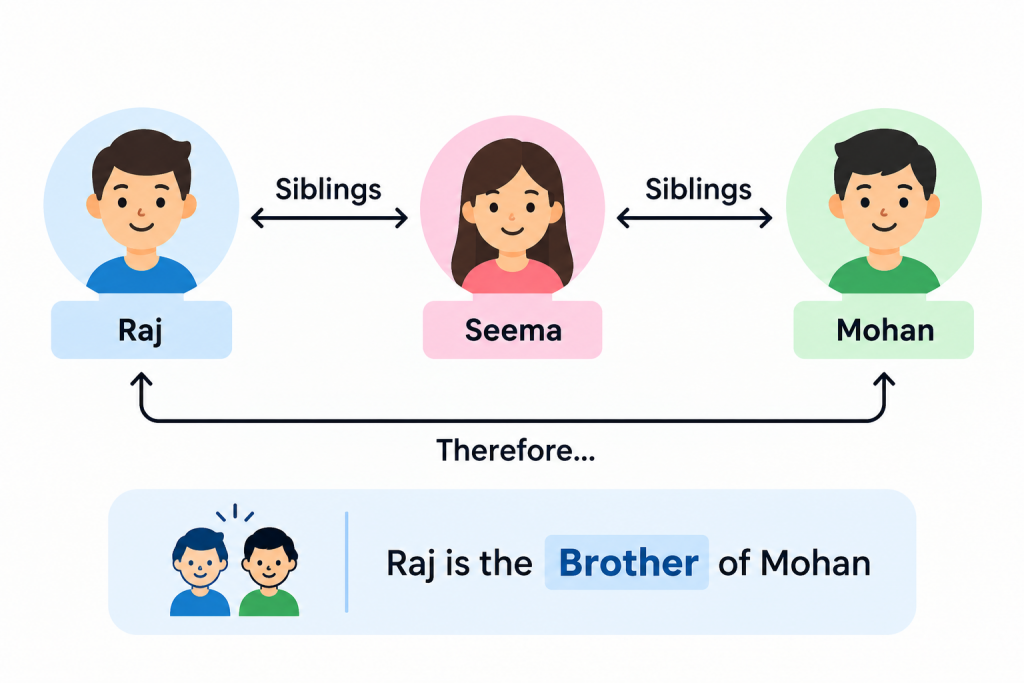
47. If Raj Is The Brother Of Seema And Seema Is The Sister Of Mohan, How Is Raj Related To Mohan?
Ans:
Raj And Seema Are Siblings, And Seema And Mohan Are Also Siblings. Therefore, Raj And Mohan Are Brothers. Blood Relation Questions Test Logical Connections Between Family Members. They Frequently Appear In Placement Tests. Identifying Common Relationships Simplifies The Solution. Regular Practice Improves Analytical Thinking Skills. Answer = Brother.
48. A Man Introduced A Woman Saying, “She Is The Wife Of My Mother’s Only Son.” Who Is The Woman
Ans:
The Mother’s Only Son Refers To The Speaker Himself. Therefore, The Woman Is The Speaker’s Wife. Blood Relation Questions Measure Analytical Thinking And Relationship Identification Skills. Reading The Statement Step By Step Helps Find The Correct Answer. Such Questions Are Common In TCS Ninja Reasoning Sections. Answer = Wife.
49. Pointing To A Boy, Sita Said, “He Is The Son Of My Sister.” How Is The Boy Related To Sita?
Ans:
- The Son Of A Sister Is Called A Nephew. Blood Relation Questions Often Test Knowledge Of Immediate Family Relationships.
- Such Questions Are Frequently Asked In TCS Ninja And Other Placement Exams.
- Understanding Common Family Terms Makes These Questions Easier. Logical Interpretation Is More Important Than Guessing.Answer: Nephew
50. If Arun Is The Father Of Kiran And Kiran Is The Mother Of Neha, How Is Arun Related To Neha?
Ans:
Arun Is The Father Of Kiran, And Kiran Is The Mother Of Neha. Therefore, Arun Is Neha’s Grandfather. Blood Relation Questions Test The Ability To Trace Family Generations Correctly. They Are Frequently Asked In TCS Ninja Aptitude And Reasoning Tests. Drawing A Family Tree Can Simplify Such Questions. These Problems Improve Logical And Analytical Reasoning Skills. Answer = Grandfather.
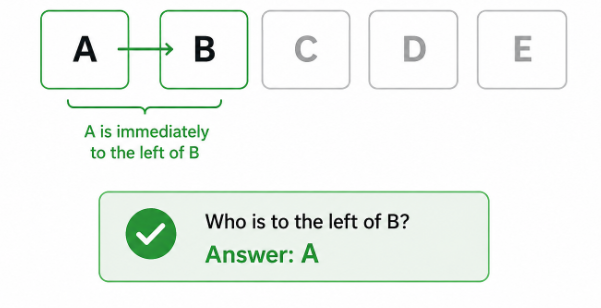
51. Five People A, B, C, D, And E Are Sitting In A Row. B Is To The Immediate Right Of A. Who Is To The Left Of B?
Ans:
Since B Is Sitting Immediately To The Right Of A, A Must Be Directly To The Left Of B. Seating Arrangement Questions Test Logical Thinking And Position Analysis Skills. Reading Every Condition Carefully Helps Avoid Mistakes. These Questions Frequently Appear In TCS Ninja Aptitude And Placement Exams. Drawing A Simple Seating Diagram Makes The Arrangement Easier To Understand. Regular Practice Improves Accuracy And Speed In Solving Position-Based Questions.Answer: A
52. P, Q, R, S, And T Are Sitting In A Row. Q Is Between P And R. Who Is To The Left Of R?
Ans:
If Q Is Between P And R, Then Q Must Be Immediately To The Left Of R In The Given Arrangement. Seating Arrangement Questions Measure Logical Observation And Reasoning Skills. Drawing A Simple Diagram Makes These Questions Easier To Solve. Such Questions Are Common In TCS Ninja Exams. Carefully Following Every Given Condition Prevents Logical Errors. These Questions Help Improve Analytical Thinking And Visualization Skills.Answer: Q
53. Six Friends Sit Around A Circular Table Facing The Center. Who Will Be Opposite A Person Sitting At Position 1?
Ans:
- In A Circular Arrangement Of Six People, The Person Sitting Three Seats Away Is Directly Opposite.
- Circular Seating Questions Test Visualization And Logical Thinking Skills. Careful Arrangement Helps Identify Opposite Positions Correctly.
- These Questions Frequently Appear In Placement Tests. Understanding Clockwise And Anticlockwise Directions Is Important. Regular Practice Makes Circular Arrangement Problems Easier To Solve.Answer: Position 4
54. In A Row Of Seven Students, R Is Third From The Left. What Is R’s Position From The Right?
Ans:
The Position From The Right Is Calculated As Total Students Minus Left Position Plus One. Therefore, 7 − 3 + 1 = 5. Position-Based Questions Test Numerical And Logical Reasoning Skills. They Are Frequently Asked In TCS Ninja Aptitude Tests. Applying The Standard Position Formula Ensures Accurate Results. Such Questions Improve Logical And Numerical Calculation Skills.Answer: Fifth
55. A, B, C, D, And E Are Sitting In A Row. D Is At The Extreme Right. Who Is Sitting At The Right End?
Ans:
The Statement Clearly Indicates That D Occupies The Extreme Right Position. No Additional Calculation Is Required To Determine The Answer. Such Questions Test The Ability To Understand Given Information Correctly. They Frequently Appear In Seating Arrangement Problems. Reading The Question Carefully Is Sufficient To Find The Correct Answer. These Questions Improve Observation And Interpretation Skills.Answer: D
56. All Cats Are Animals. All Animals Are Living Beings. Therefore, All Cats Are Living Beings.
Ans:
Since Every Cat Is An Animal And Every Animal Is A Living Being, Every Cat Must Also Be A Living Being. Syllogism Questions Test Logical Deduction Skills. The Conclusion Logically Follows From The Given Statements. These Questions Are Common In TCS Ninja Reasoning Tests. Always Verify Whether The Conclusion Is Fully Supported By The Statements. Logical Deduction Is Essential For Solving Syllogism Questions Correctly.Answer: Conclusion Follows
57. All Pens Are Stationery. Some Stationery Are Books. Therefore, Some Pens Are Books.
Ans:
- Answer: Conclusion Does Not Follow
- The Statements Do Not Establish Any Direct Relationship Between Pens And Books. Some Stationery Being Books Does Not Mean Pens Are Books.
- Syllogism Questions Require Careful Logical Analysis Rather Than Assumptions. These Questions Frequently Appear In Placement Exams.
- Never Assume Information That Is Not Explicitly Given In The Statements. Careful Reasoning Helps Avoid Incorrect Conclusions.
58. All Mangoes Are Fruits. Some Fruits Are Sweet. Therefore, Some Mangoes Are Sweet.
Ans:
The Statements Only Mention That Some Fruits Are Sweet Without Specifically Referring To Mangoes. Therefore, It Cannot Be Concluded That Some Mangoes Are Sweet. Syllogism Questions Test Logical Accuracy And Deduction Skills. Avoid Making Assumptions Beyond The Given Information. Every Conclusion Must Be Directly Supported By The Statements. Practicing Similar Questions Improves Logical Decision-Making Skills.Answer: Conclusion Does Not Follow
59. All Doctors Are Educated. Ravi Is A Doctor. Therefore, Ravi Is Educated.
Ans:
Since All Doctors Are Educated And Ravi Is A Doctor, Ravi Must Be Educated. This Conclusion Is Directly Supported By The Given Statements. Syllogism Questions Test The Ability To Draw Valid Logical Conclusions. They Frequently Appear In Competitive Aptitude Exams. Identify The Relationship Between The Statements Before Choosing The Answer. Logical Analysis Helps Solve Syllogism Questions Quickly And Correctly.Answer: Conclusion Follows
60. All Roses Are Flowers. No Flower Is A Tree. Therefore, No Rose Is A Tree.
Ans:
All Roses Belong To The Group Of Flowers, And No Flower Can Be A Tree. Therefore, No Rose Can Be A Tree. Syllogism Questions Measure Logical Reasoning And Analytical Thinking Skills. Such Questions Are Common In TCS Ninja And Other Placement Tests. Understanding Universal And Negative Statements Is Important In Syllogisms. Regular Practice Improves Accuracy In Identifying Valid Conclusions.Answer: Conclusion Follows
61. Cloze Test: The Sun _____ In The East Every Morning.
Ans:
- The Correct Word Is Rises Because It Describes A Universal Truth. Universal Facts Are Written In The Simple Present Tense. Cloze Test Questions Evaluate Grammar, Vocabulary, And Sentence Understanding Skills.
- These Questions Frequently Appear In TCS Ninja And Other Placement Exams. Understanding Tense Rules Helps Select The Correct Verb Form.
- Regular Practice Improves Accuracy In English Grammar Questions..
62. Cloze Test: She _____ To School By Bus Every Day
Ans:
The Correct Word Is Goes Because The Sentence Describes A Daily Habit. Simple Present Tense Is Used For Regular Actions. Cloze Test Questions Test Knowledge Of Grammar And Verb Usage. Regular Practice Improves Accuracy In Competitive Exams. Identifying Time Expressions Makes The Correct Tense Easy To Choose. These Questions Strengthen Basic English Language Skills..
63. Cloze Test: Water _____ At 100°C.
Ans:
The Correct Word Is Boils Because It Represents A Scientific Fact. General Truths Are Expressed Using The Simple Present Tense. Cloze Test Questions Improve Grammar And Language Skills. These Questions Frequently Appear In TCS Ninja Verbal Ability Tests. Scientific Facts Always Use The Simple Present Tense. Understanding Grammar Rules Helps Avoid Common Errors.
64. Cloze Test: The Teacher _____ The Lesson Clearly.
Ans:
- The Correct Word Is Explains Because It Matches The Singular Subject “Teacher.” Subject-Verb Agreement Is An Important Grammar Rule.
- Cloze Test Questions Measure Vocabulary And Grammar Knowledge. Regular Practice Improves English Communication Skills.
- Singular Subjects Usually Take Verbs Ending With “S” In The Present Tense. These Questions Improve Sentence Formation Skills.
65. Cloze Test: Birds _____ In The Sky.
Ans:
The Correct Word Is Fly Because It Describes The Natural Action Of Birds. The Sentence Expresses A General Fact Using The Simple Present Tense. Cloze Test Questions Test Basic Grammar And Vocabulary Skills. They Frequently Appear In Placement And Competitive Exams. Recognizing Universal Truths Helps Select The Correct Verb. Consistent Practice Improves Verbal Ability Scores.
66. Sentence Completion: Hard Work Always _____ Success.
Ans:
The Correct Word Is Brings Because It Completes The Sentence Logically And Grammatically. The Verb Agrees With The Singular Subject “Hard Work.” Sentence Completion Questions Test Vocabulary And Contextual Understanding. These Questions Frequently Appear In TCS Ninja Verbal Ability Tests. Reading The Entire Sentence Helps Identify The Correct Word. Vocabulary Practice Improves Performance In Placement Exams.
67. Sentence Completion: Honesty Is The Best _____.
Ans:
The Correct Word Is Policy Because It Completes A Well-Known English Proverb. Sentence Completion Questions Often Include Common Expressions And Idioms. These Questions Test Vocabulary And Language Skills. Regular Reading Helps Solve Such Questions Quickly. Learning Common Proverbs Improves English Communication Skills. Understanding Idioms Helps Answer Similar Questions Easily.
68. Sentence Completion: If It Rains, We _____ Stay At Home.
Ans:
The Correct Word Is Will Because The Sentence Expresses A Future Condition. The First Conditional Uses “If + Present Tense” Followed By “Will.” Sentence Completion Questions Test Grammar And Sentence Structure Skills. They Frequently Appear In Placement Exams. Understanding Conditional Sentences Is Essential For Grammar Accuracy. Regular Practice Helps Identify Correct Verb Forms.
69. Sentence Completion: He Is Known _____ His Honesty.
Ans:
- The Correct Preposition Is For Because The Correct Expression Is “Known For.” Sentence Completion Questions Frequently Test Prepositions And Common English Usage.
70. Sentence Completion: She Is One Of The _____ Students In The Class.
Ans:
The Correct Word Is Best Because The Phrase “One Of The” Requires A Superlative Adjective. Sentence Completion Questions Test Grammar And Appropriate Word Choice. Such Questions Frequently Appear In Competitive Exams. Superlative Adjectives Compare One Person With An Entire Group. Grammar Practice Helps Improve Sentence Accuracy
71. Grammar: Choose The Correct Sentence.
A) He Don’t Like Coffee.B) He Doesn’t Like Coffee.
Ans:
The Correct Sentence Is He Doesn’t Like Coffee Because Singular Subjects Take “Doesn’t” In The Simple Present Tense. Grammar Questions Test Subject-Verb Agreement And Sentence Formation Skills. These Questions Frequently Appear In TCS Ninja Verbal Ability Tests. Identifying Subject And Verb Agreement Is Important In Grammar. Careful Reading Helps Eliminate Incorrect Options. Answer = Option B.
72. Grammar: Fill In The Blank: She _____ Playing Tennis Now.
Ans:
The Correct Answer Is Is Because The Sentence Is In The Present Continuous Tense. Present Continuous Uses “Is/Am/Are + Verb-ing.” Grammar Questions Test Knowledge Of English Tenses And Sentence Structure. Regular Practice Improves Accuracy In Exams. Time Indicators Like “Now” Help Identify The Correct Tense. Understanding Tense Rules Improves Grammar Skills. Answer = Is.
73. Vocabulary: Choose The Synonym Of “Rapid.”?
Ans:
- The Word Fast Has The Same Meaning As Rapid, Which Means Moving Quickly. Vocabulary Questions Test Word Knowledge And Language Skills.
- Learning Synonyms Improves Reading And Communication Abilities. Such Questions Frequently Appear In Placement Tests.
- Building Vocabulary Helps Understand English Passages Better. Regular Reading Expands Knowledge Of Similar Words. Answer = Fast.
74. Vocabulary: Choose The Antonym Of “Ancient.”
Ans:
The Correct Antonym Is Modern Because It Means Current Or Present-Day, Which Is Opposite To Ancient. Vocabulary Questions Test Understanding Of Opposite Meanings. Regular Reading Helps Improve Vocabulary And Exam Performance. Learning Antonyms Enhances Language And Communication Skills. These Questions Frequently Appear In Competitive Examinations. Answer = Modern.
75. Grammar And Vocabulary: Fill In The Blank: Each Student _____ A Notebook.
Ans:
The Correct Word Is Has Because “Each Student” Is A Singular Subject. Singular Subjects Always Take Singular Verbs In English Grammar. Grammar And Vocabulary Questions Test Subject-Verb Agreement And Basic Language Skills. These Questions Frequently Appear In TCS Ninja And Other Placement Exams. Understanding Singular And Plural Subjects Improves Grammar Accuracy. Consistent Practice Helps Solve Similar Questions Confidently. Answer = Has.
76. A Mixture Contains Milk And Water In The Ratio 4:1. If 10 Litres Of Water Is Added, The Ratio Becomes 2:1. What Is The Original Quantity Of The Mixture?
Ans:
Let The Original Mixture Be 5x Litres. Milk = 4x And Water = x. After Adding 10 Litres Of Water, Water Becomes x + 10. The New Ratio Is 4x : (x + 10) = 2 : 1. Solving Gives x = 10. Therefore, The Original Quantity = 5 × 10 = 50 Litres. Mixture Questions Frequently Appear In TCS Ninja Aptitude Tests.
- Milk = 4x, Water = x
- 4x : (x + 10) = 2 : 1
- 4x = 2x + 20
- x = 10
- Original Mixture = 5 × 10 = 50 Litres
77. A Mixture Of 40 Litres Contains Milk And Water In The Ratio 3:2. How Much Water Is Present?
Ans:
The Total Parts Are 3 + 2 = 5. Water Occupies 2 Parts Out Of 5. Therefore, Water = (2/5) × 40 = 16 Litres. This Type Of Question Tests Ratio Application In Mixtures. Always Divide The Total Quantity According To The Given Ratio.
- Total Parts = 3 + 2 = 5
- Water = (2 ÷ 5) × 40
- = 16 Litres
78. Tea Worth ₹80 Per Kg Is Mixed With Tea Worth ₹120 Per Kg In Equal Quantities. Find The Cost Price Per Kg Of The Mixture.
Ans:
Equal Quantities Mean The Average Price Is Taken. Add Both Prices And Divide By Two. Therefore, (80 + 120) ÷ 2 = ₹100 Per Kg. Equal Quantity Mixture Questions Are Simple Average Problems. They Frequently Appear In Placement Tests.
- Average Price = (80 + 120) ÷ 2
- = 200 ÷ 2
- = ₹100 Per Kg
79. Rice Worth ₹40 Per Kg Is Mixed With Rice Worth ₹60 Per Kg In The Ratio 3:2. Find The Cost Of The Mixture.
Ans:
Use The Weighted Average Formula. Total Cost = (40 × 3) + (60 × 2) = 120 + 120 = 240. Divide By Total Parts 5. The Cost Of The Mixture = ₹48 Per Kg. Weighted Average Is Common In Mixture Problems.
- Total Cost = (40 × 3) + (60 × 2)
- = 120 + 120 = 240
- Mixture Price = 240 ÷ 5
- = ₹48 Per Kg
Ans:
Total Parts = 5 + 3 = 8. Acid Occupies 5 Parts. Therefore, Acid = (5/8) × 64 = 40 Litres. Ratio-Based Mixture Questions Require Dividing The Total Quantity According To The Given Ratio.
- Total Parts = 8
- Acid = (5 ÷ 8) × 64
- = 40 Litres
81. How Many Different Arrangements Can Be Made Using The Letters Of “CAT”?
Ans:
The Word CAT Has Three Different Letters. The Number Of Arrangements Is 3! = 3 × 2 × 1 = 6. Permutation Questions Test Arrangement Skills. Always Use Factorial For Distinct Objects.
- n = 3
- Permutation = 3!
- = 3 × 2 × 1
- = 6
82. In How Many Ways Can 4 Students Be Arranged In A Row?
Ans:
Four Different Students Can Be Arranged In 4! Ways. Therefore, 4 × 3 × 2 × 1 = 24 Ways. Arrangement Questions Frequently Use The Factorial Formula.
- Permutation = 4!
- = 4 × 3 × 2 × 1
- = 24 Ways
83. How Many Ways Can 2 Students Be Selected From 5 Students?
Ans:
- Combination = ⁵C₂
- = (5 × 4) ÷ (2 × 1)
- = 20 ÷ 2
- = 10 Ways
Selection Uses Combination. Apply ⁵C₂ = (5 × 4) ÷ (2 × 1) = 10 Ways. Combination Questions Focus On Selection Without Considering Order.
84. Find The Value Of ⁶P₂.
Ans:
Permutation Formula Is nPr = n! ÷ (n − r)!. Therefore, ⁶P₂ = 6 × 5 = 30. Order Matters In Permutation Problems.
- ⁶P₂ = 6! ÷ 4!
- = 6 × 5
- = 30
85. Find The Value Of ⁷C₃.
Ans:
Apply The Combination Formula. ⁷C₃ = (7 × 6 × 5) ÷ (3 × 2 × 1) = 35. Therefore, The Answer Is 35. Combinations Count Selections Without Order..
- ⁷C₃ = (7 × 6 × 5) ÷ (3 × 2 × 1)
- = 210 ÷ 6
- = 35
86. A Coin Is Tossed Once. Find The Probability Of Getting A Head.
Ans:
A Coin Has Two Equally Likely Outcomes. One Outcome Is Head. Therefore, Probability = 1 ÷ 2 = 1/2. Probability Questions Measure The Chance Of An Event.
- Total Outcomes = 2
- Favourable Outcomes = 1
- Probability = 1 ÷ 2
- = 1/2
87. A Die Is Rolled Once. Find The Probability Of Getting 4.
Ans:
A Standard Die Has Six Faces. Only One Face Shows Four. Therefore, Probability = 1/6. Always Divide Favourable Outcomes By Total Outcomes.
- Total Outcomes = 6
- Favourable Outcomes = 1
- Probability = 1 ÷ 6
88. What Is The Probability Of Getting An Even Number On A Die?
Ans:
Even Numbers Are 2, 4 And 6. There Are Three Favourable Outcomes Out Of Six Possible Outcomes. Therefore, Probability = 3 ÷ 6 = 1/2. Simplify The Fraction Whenever Possible.
- Even Numbers = 2, 4, 6
- Favourable Outcomes = 3
- Total Outcomes = 6
- Probability = 3 ÷ 6 = 1/2
89. A Card Is Drawn From A Deck. Find The Probability Of Drawing A King.
Ans:
A Deck Has 52 Cards And Four Kings. Therefore, Probability = 4 ÷ 52 = 1/13. Card Probability Questions Are Common In Aptitude Exams.
- Total Cards = 52
- Kings = 4
- Probability = 4 ÷ 52
- = 1/13
90. A Card Is Drawn From A Deck. Find The Probability Of Drawing A Heart.
Ans:
There Are Thirteen Hearts In A Deck Of Fifty-Two Cards. Therefore, Probability = 13 ÷ 52 = 1/4. Remember That Each Suit Contains Thirteen Cards.
- Total Cards = 52
- Hearts = 13
- Probability = 13 ÷ 52
- = 1/4
91. Two Coins Are Tossed. Find The Probability Of Getting Two Heads.
Ans:
The Possible Outcomes Are HH, HT, TH And TT. Only HH Gives Two Heads. Therefore, Probability = 1/4. List All Outcomes Before Calculating Probability.
- Total Outcomes = 4
- Favourable Outcome = HH
- Probability = 1 ÷ 4
92. Two Dice Are Rolled. Find The Probability That The Sum Is 7.
Ans:
There Are Thirty-Six Total Outcomes. Six Outcomes Produce A Sum Of Seven. Therefore, Probability = 6 ÷ 36 = 1/6. This Is A Frequently Asked Probability Question.
- Total Outcomes = 36
- Favourable Outcomes = 6
- Probability = 6 ÷ 36
- = 1/6
93. Prime Number Check
Ans:
- #include
- int main(){
- int n=13,i,prime=1;
- for(i=2;i
- if(n%i==0){
- prime=0;
- break;
- }
- }
- if(prime)
- printf(“Prime Number”);
- else
- printf(“Not Prime Number”);
- return 0;
- }
94. Reverse A Number
Ans:
- #include
- int main() {
- int n = 1234, rev = 0;
- while(n > 0) {
- rev = rev * 10 + n % 10;
- n /= 10;
- }
- printf(“%d”, rev);
- return 0;
- }
95. Sum Of Digits
Ans:
- #include
- int main(){
- int n=1234,sum=0;
- while(n>0){
- sum=sum+n%10;
- n=n/10;
- }
- printf(“Sum = %d”,sum);
- return 0;
- }
96. Array Rotation (Left Rotation By One)
Ans:
- #include
- int main(){
- int a[5]={1,2,3,4,5},i,temp;
- temp=a[0];
- for(i=0;i<4;i++)
- a[i]=a[i+1];
- a[4]=temp;
- for(i=0;i<5;i++)
- printf(“%d “,a[i]);
- return 0;
- }
97. Find Factorial Of A Number
Ans:
- #include
- int main() {
- int n = 5, i, fact = 1;
- for(i = 1; i <= n; i++)
- fact *= i;
- printf(“%d”, fact);
- return 0;
- }
98. Check Palindrome Number
Ans:
- #include
- int main() {
- int n = 121, temp, rev = 0;
- temp = n;
- while(n > 0) {
- rev = rev * 10 + n % 10;
- n /= 10;
- }
- if(temp == rev)
- printf(“Palindrome”);
- else
- printf(“Not Palindrome”);
- return 0;
- }
99.Print Patterning
Ans:
- #include
- int main(){
- int i,j;
- for(i=1;i<=5;i++){
- for(j=1;j<=i;j++)
- printf(“* “);
- printf(“n”);
- }
- return 0;
- }
100. Swap Two Numbers Without Using A Third Variable
Ans:
- #include
- int main() {
- int a = 10, b = 20;
- a = a + b;
- b = a – b;
- a = a – b;
- printf(“%d %d”, a, b);
- return 0;
- }

![Top Informatica Interview Questions & Answers – [UPDATED] Interview Question](https://www.acte.in/wp-content/uploads/2020/05/4-img-acte-1-400x218.jpeg)