LMS
LMS
Last updated on 09th May 2026| 4632

- Challenges in Generative AI Development
- Hallucinations and Factual Inaccuracies
- High Computational Costs
- Data Privacy and Security Risks
- Bias and Ethical Concerns
- Lack of Explainability and Transparency
- Model Drift and Maintenance
- Legal and Copyright Issues
- Conclusion
Challenges in Generative AI Development
Generative AI is reshaping industries at a rapid pace, but building these applications is far from a smooth ride. While it is easy to get excited about the output of large language models and image generators, developers face serious roadblocks behind the scenes. For anyone getting into generative AI development Join Gen AI Training and understanding these challenges is just as important as knowing how to write the code. If you ignore these issues, your application might work in a demo but fail completely in the real world. Problems like AI making things up, consuming massive amounts of computing power, or leaking private data can ruin a product. Below is a breakdown of the biggest hurdles developers face today when building with generative AI. Tackling these issues early will help you build safer, more reliable, and actually useful AI tools.
Hallucinations and Factual Inaccuracies
Tackling hallucinations and factual inaccuracies is one of the biggest challenges in generative AI development. A hallucination happens when the AI generates information that looks highly convincing but is actually false or made up. These occur because models predict the next most likely word based on patterns in training data rather than verifying facts from a trusted database. This becomes especially risky in fields like healthcare, finance, or legal tech, where incorrect outputs can lead to serious consequences. Developers often implement guardrails such as retrieval-augmented generation (RAG), validation layers, and strict fact-checking systems to reduce errors. However, completely eliminating hallucinations is still an ongoing challenge. Understanding how to minimize and control these issues is a key skill for anyone building real-world AI systems. Structured learning through Gen AI Training can help developers gain practical knowledge in building safer and more reliable AI applications.
Ready to Pursue Your Gen AI Certificate? View The Gen AI Course Offered By ACTE Right Now!
High Computational Costs
- Hardware Requirements for Training: Training a generative AI model from scratch requires massive clusters of specialized GPUs. These chips are expensive and often hard to find due to high global demand. This makes foundational model training impossible for small teams or individual developers.
- Cloud API Usage Expenses: Most developers rely on APIs like OpenAI or Anthropic to build apps. While this avoids training costs, processing thousands of prompts can become expensive quickly. A viral app may generate a huge cloud bill overnight. Learn more in ChatGPT and Generative AI.
- High Energy Consumption: Running large data centers for AI consumes a massive amount of electricity. This not only drives up the operational costs but also raises environmental concerns. Developers are constantly pressured to write more efficient code to reduce compute time.
- Memory Limitations: Generative models require huge amounts of RAM and VRAM to load into memory. If your hardware lacks sufficient memory, the model simply will not run. This forces developers to use smaller, less capable models or spend more on better machines.
- Financial Barriers for Startups: The high cost of computing power creates a major barrier to entry in AI development. Many talented creators cannot build or scale their ideas due to expensive infrastructure requirements, which limits innovation and keeps AI development largely dominated by big tech companies. Learn more through Getting Strated With Gen AI.

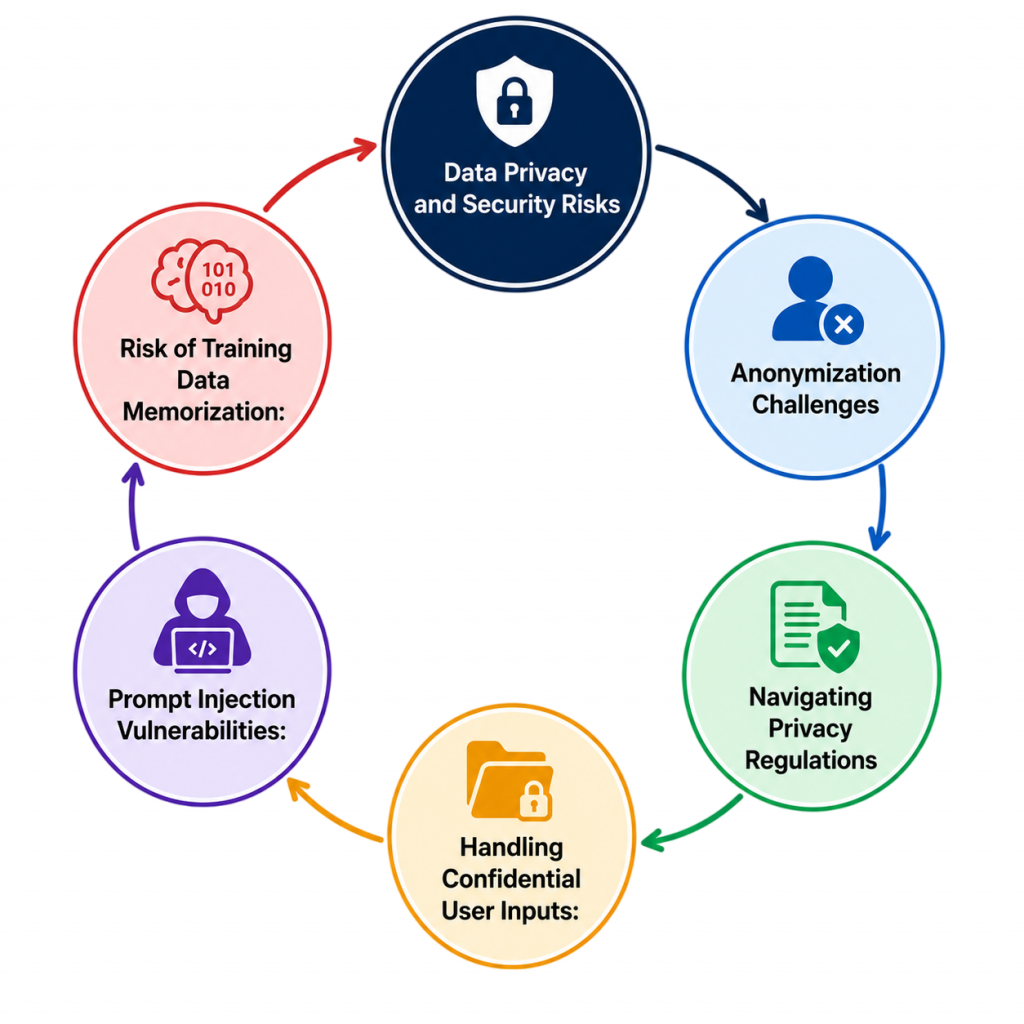
Data Privacy and Security Risks
- Risk of Training Data Memorization: Generative models sometimes memorize sensitive data from their training sets. If prompted correctly, the AI might accidentally spit out personal information like phone numbers or addresses. This is a major violation of user privacy.
- Prompt Injection Vulnerabilities: Malicious users can inject hidden instructions into prompts to bypass AI safety rules, leading to exposure of system prompts or sensitive data. Strong security practices and understanding through ChatGPT Basics help developers design safer systems. Developers must use strong input filtering and guardrails to reduce these risks and protect application integrity.
- Handling Confidential User Inputs: When employees use AI tools at work, they often paste sensitive company data into the chat. If that data is logged or used for future training, it becomes a massive security breach. Apps need strict data retention policies.
- Navigating Privacy Regulations: Laws like GDPR strictly control how personal data is used in AI systems. Mistakes in handling data can lead to heavy fines. Developers must ensure compliance through proper design and planning. Learn more in Advantages and Disadvantages Of AI
- Anonymization Challenges: Before feeding data into an AI model, developers try to strip out personally identifiable information. However, AI models are getting so smart that they can sometimes re-identify anonymized data by cross-referencing different clues. This makes true data privacy incredibly hard to guarantee.
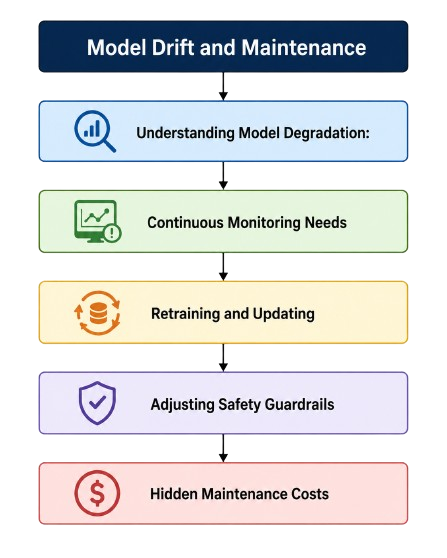
- Understanding Model Degradation: Over time, the real world changes, but the AI model stays frozen in the state it was trained in. This causes the model’s accuracy to slowly drop as new slang, trends, or facts emerge. This phenomenon is known as model drift.
- Continuous Monitoring Needs: You cannot just deploy an AI app and forget about it. Developers must set up dashboards to constantly monitor how the AI is performing. You need to track user feedback and error rates to catch drift before it ruins the user experience, and understanding core concepts through Artificial Intelligence helps in building and maintaining more reliable systems in production.
- Retraining and Updating: Fixing drift usually requires retraining the model on newer data or fine-tuning it again. This takes time, computational power, and money. It turns AI development into a continuous cycle rather than a one-time build.
- Adjusting Safety Guardrails: As models are updated, they may discover new ways to bypass existing safety filters. Understanding evolving systems through AI Image Tools helps developers better anticipate such behavior and improve safeguards. Developers must continuously test and refine the system to ensure it still refuses to generate harmful or unsafe content, making it an ongoing “cat and mouse” process.
- Hidden Maintenance Costs: Many companies fail to budget for the long-term upkeep of their AI tools. The cost of regularly updating models to prevent drift often ends up being higher than the initial development cost. This surprises many new developers entering the field.
Excited to Obtaining Your Gen AI Certificate? View The Gen AI Course Offered By ACTE Right Now!
Bias and Ethical Concerns
Addressing bias and ethical concerns is a massive challenge because AI models learn directly from the internet, which is full of human prejudices. If a model is trained on biased data, it will reproduce and often amplify those biases in its output. Gen AI Projects For Beginners can lead to AI tools that favor certain demographics in hiring scenarios, use offensive language, or generate stereotypical images. For developers, fixing this is not just a technical issue but a moral one. You cannot just “code away” bias. It requires carefully curating training data, testing the model across diverse scenarios, and constantly adjusting the safety filters. Building ethical AI means accepting that your model will have blind spots and putting in the hard work to minimize the damage those blind spots can cause to marginalized groups.
Are You Considering Pursuing a Gen AI Master’s Degree? Enroll For Gen AI Expert Masters Program Training Course Today!
Lack of Explainability and Transparency
The lack of explainability and transparency in generative AI makes it very hard to trust these systems in high-stakes environments. When a traditional software program makes a decision, you can look at the code and see exactly why it made that choice. With deep learning models, the decision-making process happens inside a massive “black box” of billions of mathematical weights. If an AI denies a user a loan or misdiagnoses a patient, developers often cannot clearly explain why the model produced that specific output. This lack of transparency becomes a major challenge for industries that require strict auditing, fairness, and accountability. Understanding these limitations is crucial for responsible AI development, and insights from Gen AI VS Treditional AI help developers address such real-world issues more effectively. Developers are actively researching techniques to make AI reasoning more visible, but for now, building a system that users and regulators can fully understand remains a tough puzzle to solve.
Set to Ace Your Gen AI Job Interview? Check Out Our Blog on Gen AI Interview Questions & Answer
Model Drift and Maintenance
Legal and Copyright Issues
Navigating legal and copyright issues is currently one of the messiest parts of generative AI development. These models are trained on millions of images, articles, and books scraped from the internet, often without the original creators’ permission.When an AI generates an image that looks heavily inspired by a living artist or produces text that closely mirrors a copyrighted book, determining liability becomes complex. Responsibility could potentially involve the developer, the user, or the AI company, and courts around the world are still working to establish clear legal frameworks. As a result, regulations are continuously evolving, and there is no universal agreement yet on accountability. This creates significant legal uncertainty, meaning that building commercial products on top of generative AI carries notable risk for developers. Proper understanding of compliance, ethics, and safe AI usage is essential in this space. Structured learning through Gen AI Training can help developers better understand these risks and build more responsible AI solutions. You have to be extremely careful about how you source your training data and what you allow your users to generate to avoid getting sued.
Conclusion
Navigating the challenges in generative AI development is what separates a fun side project from a reliable business product. Issues like hallucinations, hidden computing costs, and data privacy risks are not just minor bugs; they are fundamental challenges in current generative AI systems that developers must actively account for and mitigate. By understanding these limitations early, you can avoid building fragile applications that fail when exposed to real-world user behavior and production scale. Careful system design, proper validation, and responsible deployment strategies are essential for creating reliable AI-powered solutions. Strengthening your knowledge through Gen AI Training can help you better understand these challenges and build more robust, production-ready applications. Tackling bias, model drift, and legal grey areas forces you to think like a responsible engineer rather than just a coder. As the AI industry matures, the developers who know how to build safe, compliant, and efficient tools despite these challenges will be the ones who actually succeed in the long run.