LMS
LMS
Last updated on 23rd Jul 2026| 4827

- Introduction to Generative AI Engineering
- Who is a Generative AI Engineer? Roles and Responsibilities
- Why Choose a Career in Generative AI After Graduation?
- Essential Technical Skills Required to Become a Generative AI Engineer
- Programming Languages, Tools, and Frameworks You Should Learn
- Step-by-Step Roadmap to Become a Generative AI Engineer
- Hands-on Projects and Portfolio Development
- Certifications, Internships, and Learning Resources
- Career Opportunities, Job Roles, and Salary Expectations
- Conclusion: Start Your Journey as a Generative AI Engineer
Introduction to Generative AI Engineering
Generative AI Engineering is one of the fastest-growing and most exciting career paths in the technology industry, offering graduates the opportunity to build intelligent systems capable of generating human-like text, images, videos, audio, code, and other digital content. Unlike traditional Artificial Intelligence, which focuses on analyzing, classifying, or predicting data, Generative AI creates entirely new content by learning patterns from massive datasets using advanced deep learning models. Professionals looking to build these in-demand skills can benefit from Gen AI Training, which provides practical knowledge of modern AI technologies and development techniques. The rapid advancement of Large Language Models (LLMs), diffusion models, multimodal AI systems, and foundation models has transformed industries such as healthcare, finance, education, entertainment, e-commerce, manufacturing, marketing, cybersecurity, and software development. Organizations are increasingly integrating Generative AI into their products and services to automate repetitive tasks, improve customer experiences, enhance decision-making, accelerate innovation, and increase productivity. As a result, the demand for professionals who can design, develop, train, fine-tune, deploy, and maintain AI-powered applications has grown significantly across startups, multinational companies, research organizations, and technology firms. A Generative AI Engineer combines expertise in programming, machine learning, deep learning, natural language processing, cloud computing, data engineering, and AI deployment to create scalable and reliable AI solutions that solve real-world business problems. Graduates from computer science, information technology, electronics, artificial intelligence, data science, mathematics, and other engineering disciplines can pursue this career by developing strong technical foundations and gaining practical experience through projects and continuous learning. With the increasing adoption of AI-powered assistants, intelligent chatbots, code generation tools, automated content creation platforms, recommendation systems, virtual agents, and enterprise AI applications, Generative AI Engineering has become one of the most promising and future-ready career options for fresh graduates seeking high-growth opportunities in the evolving digital economy.
Who is a Generative AI Engineer? Roles and Responsibilities
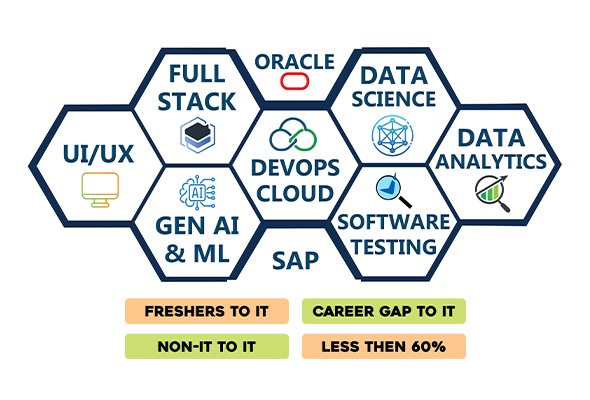
A Generative AI Engineer is a technology professional responsible for designing, developing, training, fine-tuning, evaluating, deploying, and optimizing artificial intelligence models that can generate high-quality content such as text, images, speech, videos, code, and other forms of digital information. These engineers work with advanced machine learning algorithms, neural networks, transformer architectures, Large Language Models (LLMs), multimodal AI models, and cloud-based AI platforms to build intelligent applications capable of understanding user inputs and generating accurate, context-aware responses. Their responsibilities include collecting and preprocessing large datasets, selecting appropriate AI models, implementing prompt engineering techniques, performing model fine-tuning using domain-specific data, integrating AI APIs into web and mobile applications, monitoring model performance, improving response quality, ensuring scalability, reducing latency, and maintaining system reliability. Professionals aspiring to enter this field can also explore How Freshers Can Start Career in Generative AI to understand the skills and career roadmap. Generative AI Engineers also collaborate with data scientists, machine learning engineers, software developers, DevOps teams, UI/UX designers, and business stakeholders to deliver AI-powered products that align with organizational goals and customer requirements. They are responsible for ensuring that AI systems are secure, ethical, transparent, and compliant with industry standards while minimizing issues such as hallucinations, bias, privacy risks, and inaccurate outputs. In addition to technical expertise, they continuously evaluate emerging AI frameworks, open-source models, research papers, and industry trends to improve existing solutions and adopt the latest innovations. Their work supports applications including intelligent chatbots, AI coding assistants, document summarization tools, recommendation engines, virtual assistants, automated content generation platforms, healthcare diagnosis support systems, financial analytics tools, educational assistants, and enterprise automation solutions. By combining strong programming skills, deep learning knowledge, problem-solving abilities, and practical experience with AI technologies, Generative AI Engineers play a crucial role in helping organizations leverage artificial intelligence to improve efficiency, innovation, and business growth.
Ready to Pursue Your Gen AI Certificate? View The Gen AI Course Offered By ACTE Right Now!
Why Choose a Career in Generative AI After Graduation?
Choosing a career in Generative AI after graduation offers exceptional opportunities for professional growth, continuous learning, and long-term career stability because it is one of the fastest-expanding domains in the global technology industry. Graduates who want to build practical AI skills can also enroll in Gen AI Training to gain hands-on experience with modern AI tools and technologies. Businesses across healthcare, banking, finance, education, manufacturing, retail, media, gaming, cybersecurity, logistics, and software development are rapidly adopting Generative AI solutions to automate workflows, improve customer engagement, generate personalized content, enhance decision-making, and optimize business operations. This widespread adoption has created a strong demand for skilled professionals who can develop and deploy intelligent AI applications, making Generative AI Engineering one of the most sought-after career paths for fresh graduates. The field offers competitive salaries, global employment opportunities, remote work options, and the chance to work on cutting-edge technologies that are transforming industries worldwide.
Essential Technical Skills Required to Become a Generative AI Engineer
- Programming Skills: Strong knowledge of Python is essential because it is the primary language used for AI and machine learning development. Understanding object-oriented programming, data structures, algorithms, and debugging helps engineers build efficient, scalable, and maintainable Generative AI applications.
- Machine Learning Fundamentals: A Generative AI Engineer should understand supervised learning, unsupervised learning, reinforcement learning, feature engineering, model evaluation, and optimization techniques. These concepts form the foundation for developing intelligent AI models and improving their performance.
- Deep Learning Knowledge: Learning neural networks, Convolutional Neural Networks (CNNs), Recurrent Neural Networks (RNNs), Transformers, and attention mechanisms is crucial. Beginners can strengthen these concepts by working on Top Generative AI Projects for Beginners, which provide practical experience with real-world AI applications.
- Natural Language Processing (NLP): Understanding tokenization, embeddings, text preprocessing, language modeling, sentiment analysis, text generation, and sequence-to-sequence learning is essential. NLP helps engineers develop AI chatbots, virtual assistants, translation systems, and content generation tools.
- Large Language Models (LLMs): Engineers should understand how models like GPT, Llama, Gemini, and Mistral work, including prompt engineering, fine-tuning, Retrieval-Augmented Generation (RAG), and inference optimization. These skills are critical for building modern AI-powered applications.
- Data Handling and Preprocessing: Working with structured and unstructured datasets, cleaning data, data augmentation, feature extraction, and preparing training datasets are important responsibilities. High-quality data significantly improves AI model accuracy and reliability.
- Cloud Computing and AI Deployment: Knowledge of cloud platforms, containerization, APIs, model deployment, serverless computing, and scalable infrastructure is valuable. These skills help engineers deploy AI solutions efficiently for real-world business applications.
- MLOps and Model Monitoring: Understanding model versioning, continuous integration, continuous deployment (CI/CD), performance monitoring, logging, and retraining pipelines ensures AI systems remain accurate, reliable, and scalable after deployment.
Programming Languages, Tools, and Frameworks You Should Learn
| Category | Technologies to Learn | Purpose |
|---|---|---|
| Programming Language | Python, SQL | Build AI applications, data processing, and database management. |
| Machine Learning Libraries | Scikit-learn, XGBoost | Develop, train, and evaluate machine learning models. |
| Deep Learning Frameworks | TensorFlow, PyTorch, Keras | Build and train deep learning and Generative AI models. |
| NLP Libraries | Hugging Face Transformers, SpaCy, NLTK | Text processing, language understanding, and AI chatbot development. |
| LLM Tools | LangChain, LlamaIndex, OpenAI SDK | Build AI assistants, RAG systems, and LLM-powered applications. |
| Data Analysis | Pandas, NumPy | Data cleaning, preprocessing, analysis, and numerical computation. |
| Vector Databases | FAISS, Pinecone, ChromaDB | Store and retrieve embeddings for Retrieval-Augmented Generation (RAG). |
| Cloud Platforms | AWS, Microsoft Azure, Google Cloud | Deploy, scale, and manage AI applications in the cloud. |
| Version Control | Git, GitHub | Manage source code, collaboration, and project versioning. |
| Development Tools | VS Code, Jupyter Notebook, Docker | Coding, experimentation, containerization, and application deployment. |

Step-by-Step Roadmap to Become a Generative AI Engineer
- Build Strong Programming and Mathematics Foundations: Begin by mastering Python programming along with data structures, algorithms, object-oriented programming, and SQL. Strengthen your understanding of linear algebra, probability, statistics, and calculus, as these mathematical concepts are fundamental for machine learning and deep learning.
- Learn Machine Learning and Deep Learning: Study core machine learning concepts such as regression, classification, clustering, and model evaluation before moving to deep learning. Gain practical experience with neural networks, transformers, attention mechanisms, and modern deep learning architectures using TensorFlow or PyTorch.
- Master Generative AI Technologies: Learn prompt engineering, Large Language Models (LLMs), Retrieval-Augmented Generation (RAG), embeddings, vector databases, AI agents, and multimodal AI systems. To build a stronger foundation, explore the ChatGPT and Generative AI Complete Learning Guide, which covers essential concepts and practical applications. Practice building chatbots, content generators, document summarizers, and intelligent assistants using industry-standard frameworks.
- Work on Real-World Projects: Develop practical applications such as AI chatbots, resume analyzers, document question-answering systems, recommendation engines, image generation tools, and AI-powered web applications. Publishing projects on GitHub demonstrates practical skills and enhances your portfolio.
- Gain Certifications and Internship Experience: Complete industry-recognized certifications in AI, machine learning, cloud computing, and Generative AI while participating in internships or open-source contributions. Practical industry exposure helps bridge the gap between theoretical knowledge and real-world implementation.
- Prepare for Job Interviews and Continuous Learning: Practice coding problems, machine learning concepts, system design, prompt engineering, and AI deployment techniques while staying updated with the latest research and AI tools. Continuous learning ensures you remain competitive in the rapidly evolving Generative AI industry.
Hands-on Projects and Portfolio Development
Building hands-on projects and creating a strong portfolio is one of the most important steps in becoming a successful Generative AI Engineer after graduation because employers value practical experience as much as technical knowledge. A well-designed portfolio demonstrates your ability to apply theoretical concepts to solve real-world business problems using modern AI technologies. Graduates can further strengthen these practical skills through Gen AI Training, which provides hands-on experience with industry-relevant AI tools, frameworks, and real-world projects. Instead of simply learning programming languages and AI frameworks, graduates should focus on developing complete end-to-end projects that showcase skills in data preprocessing, model selection, prompt engineering, Large Language Models (LLMs), Retrieval-Augmented Generation (RAG), vector databases, cloud deployment, API integration, and user interface development. Beginners can start with simple AI-powered applications such as text summarizers, grammar correction tools, AI chatbots, document question-answering systems, resume analyzers, language translators, image caption generators, sentiment analysis applications, and code generation assistants before progressing to more advanced enterprise-level projects. As technical skills improve, developers should build intelligent applications using frameworks such as LangChain, LlamaIndex, Hugging Face Transformers, TensorFlow, PyTorch, and OpenAI APIs while integrating cloud platforms like AWS, Microsoft Azure, or Google Cloud for scalable deployment. Every project should include a well-structured GitHub repository containing clean and documented source code, installation instructions, architecture diagrams, screenshots, API documentation, sample outputs, datasets, deployment links, and detailed explanations of the technologies used. Creating personal websites or portfolio pages to showcase completed projects further enhances professional visibility and demonstrates commitment to continuous learning. Participating in hackathons, open-source contributions, AI competitions, research projects, and collaborative development initiatives helps graduates gain practical exposure while improving teamwork and problem-solving abilities. Employers often evaluate portfolios to understand a candidate’s coding standards, software engineering practices, creativity, deployment experience, debugging skills, and ability to solve complex AI challenges. Regularly updating projects by incorporating the latest advancements in Generative AI, such as multimodal AI, AI agents, Retrieval-Augmented Generation (RAG), function calling, vector search, and fine-tuned Large Language Models, demonstrates adaptability to the rapidly evolving AI landscape. A strong portfolio not only increases the chances of securing internships and full-time roles but also establishes credibility as a skilled AI professional capable of building innovative, scalable, and production-ready Generative AI applications.
Excited to Obtaining Your Gen AI Certificate? View The Gen AI Course Offered By ACTE Right Now!
Certifications, Internships, and Learning Resources
- Complete Industry-Recognized AI Certifications: Earning certifications from reputable technology companies and online learning platforms validates your understanding of Artificial Intelligence, Machine Learning, Deep Learning, and Generative AI concepts. These certifications strengthen your resume, improve credibility, and demonstrate your commitment to continuous professional development.
- Participate in Generative AI Internships: Internships provide valuable real-world experience by allowing graduates to work on live AI projects, collaborate with experienced engineers, and understand software development workflows. Students looking for internship opportunities can explore Top Companies Hiring Generative AI Interns in India to identify leading organizations actively recruiting AI talent.
- Learn from Online Learning Platforms: Platforms such as Coursera, edX, Udemy, DeepLearning.AI, and Microsoft Learn offer structured courses covering Python, Machine Learning, Deep Learning, NLP, and Generative AI. Following guided learning paths ensures systematic skill development and practical implementation experience.
- Study Official Documentation Regularly: Reading the official documentation of TensorFlow, PyTorch, Hugging Face, LangChain, OpenAI APIs, and cloud platforms helps developers understand best practices, implementation methods, and newly released features. Official documentation is one of the most reliable resources for mastering modern AI technologies.
- Read Research Papers and AI Blogs: Keeping up with research publications from leading AI organizations and academic conferences helps engineers understand the latest innovations, model architectures, optimization techniques, and emerging trends. Continuous reading develops a deeper understanding of how advanced AI systems are designed and improved.
- Practice Coding and AI Challenges: Solving programming problems, machine learning exercises, prompt engineering tasks, and AI implementation challenges improves coding efficiency and logical thinking. Consistent practice strengthens problem-solving abilities and prepares candidates for technical interviews and coding assessments.
- Contribute to Open-Source AI Projects: Participating in open-source communities enables graduates to collaborate with experienced developers, improve coding standards, receive valuable feedback, and gain practical development experience. Open-source contributions also demonstrate teamwork, communication, and software engineering skills to recruiters.
- Build a Professional Learning Network: Connecting with AI professionals through LinkedIn, GitHub, developer communities, webinars, conferences, and technical meetups provides learning opportunities, career guidance, industry insights, and potential job referrals. Networking plays an important role in long-term career growth within the AI industry.
Career Opportunities, Job Roles, and Salary Expectations
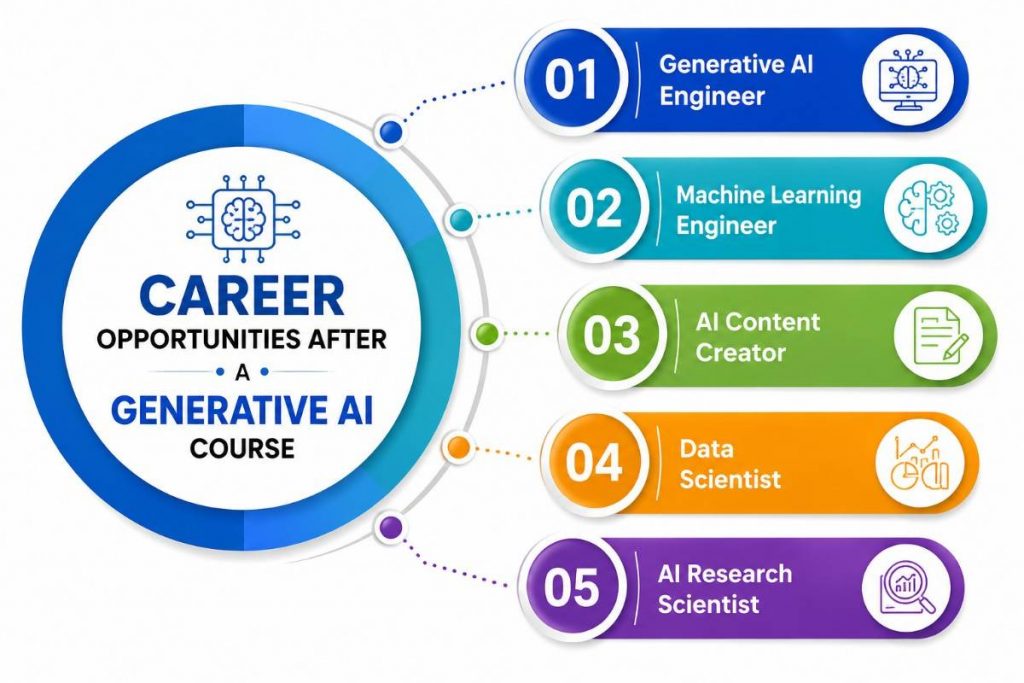
The rapid advancement of Artificial Intelligence has created an unprecedented demand for Generative AI professionals across industries, making it one of the most promising career paths for recent graduates. Organizations ranging from technology startups to multinational corporations are investing heavily in AI-driven automation, intelligent assistants, enterprise chatbots, recommendation systems, content generation platforms, healthcare diagnostics, financial analytics, cybersecurity, education technology, robotics, and software development. As a result, graduates with strong knowledge of Python, Machine Learning, Deep Learning, Large Language Models (LLMs), Natural Language Processing, cloud computing, and AI deployment can pursue a wide variety of specialized job roles. Those interested in specialized AI careers can also explore the What Does a Prompt Engineer Do? to better understand one of the fastest-growing roles in the Generative AI industry. Common career opportunities include Generative AI Engineer, AI Engineer, Machine Learning Engineer, NLP Engineer, LLM Engineer, AI Application Developer, Prompt Engineer, AI Research Engineer, Data Scientist, Deep Learning Engineer, AI Solutions Architect, MLOps Engineer, AI Product Engineer, Intelligent Automation Engineer, and Conversational AI Developer. These professionals are responsible for designing intelligent AI systems, building scalable machine learning pipelines, developing enterprise AI applications, integrating Large Language Models into software products, optimizing AI model performance, and ensuring reliable deployment in production environments. Career growth in this field is exceptionally fast because AI technologies continue to evolve rapidly, enabling professionals to specialize in emerging areas such as Retrieval-Augmented Generation (RAG), multimodal AI, AI agents, reinforcement learning, AI infrastructure, vector databases, AI security, and autonomous systems.
Are You Considering Pursuing a Gen AI Master’s Degree? Enroll For Gen AI Expert Masters Program Training Course Today!
Conclusion: Start Your Journey as a Generative AI Engineer
Generative AI has emerged as one of the most revolutionary technologies of the modern digital era, transforming the way businesses create content, automate processes, analyze information, and deliver intelligent user experiences. For graduates who aspire to build a future-ready career, becoming a Generative AI Engineer offers an exceptional combination of innovation, continuous learning, financial growth, and global career opportunities. Success in this field requires more than theoretical knowledge; it demands a strong foundation in programming, mathematics, machine learning, deep learning, natural language processing, cloud computing, software engineering, and modern AI frameworks. Learners can further strengthen these skills through Gen AI Training, which provides practical exposure to industry-standard tools, frameworks, and real-world AI projects. Developing practical expertise through real-world projects, internships, certifications, hackathons, research activities, and open-source contributions significantly enhances technical proficiency and employability. Building an impressive portfolio that demonstrates end-to-end AI application development, prompt engineering, Large Language Model integration, Retrieval-Augmented Generation (RAG), AI deployment, and scalable software solutions enables graduates to stand out in competitive recruitment processes. Since Generative AI continues to evolve at an extraordinary pace, successful engineers embrace lifelong learning by following research publications, experimenting with new frameworks, exploring emerging technologies, and continuously improving their technical and problem-solving abilities. Beyond technical excellence, professionals should also understand ethical AI practices, responsible model development, data privacy, fairness, transparency, and security to build trustworthy AI systems that benefit society. With organizations worldwide investing billions of dollars in Artificial Intelligence and digital transformation, the demand for skilled Generative AI Engineers will continue to grow across diverse industries for many years to come. Graduates who begin learning today, remain curious, practice consistently, build innovative AI solutions, and adapt to technological advancements will be well-positioned to secure rewarding careers, contribute to groundbreaking innovations, and become the next generation of AI professionals shaping the future of intelligent technology.
Set to Ace Your Gen AI Job Interview? Check Out Our Blog on Gen AI Interview Questions & Answer