LMS

Last updated on 31st Oct 2026| 13615

- Introduction to Data Analyst Career Opportunities in Chennai
- Popular Data Analyst Job Roles and Responsibilities
- Top Companies Hiring Data Analysts in Chennai
- Eligibility and Qualifications for Data Analyst Jobs
- Essential SQL, Excel, and Python Skills for Data Analysts
- Power BI, Tableau, and Data Visualization Skills
- Statistics, Data Cleaning, and Analytical Skills to Learn
- Data Analyst Salary and Compensation Factors in Chennai
- Career Growth from Data Analyst to Senior Analytics Roles
- Conclusion: Building a Successful Data Analytics Career in Chennai
Introduction to Data Analyst Career Opportunities in Chennai
Chennai offers growing career opportunities for Data Analysts across information technology, banking, healthcare, manufacturing, e-commerce, and consulting. Organizations rely on analysts to transform business data into meaningful insights that support planning, operational improvement, and strategic decision-making. Professionals can explore roles in business analytics, reporting, marketing analytics, financial analysis, and business intelligence. Aspiring candidates can strengthen their skills through a Data Analytics Course while learning Excel, SQL, statistics, data visualization, and basic Python. Practical projects and familiarity with Power BI or Tableau can further improve employability. With experience in analyzing datasets and solving business problems, professionals can advance into senior analytics, business intelligence, data science, and analytics leadership roles.
Popular Data Analyst Job Roles and Responsibilities
Data Analyst careers in Chennai include positions such as Junior Data Analyst, Business Data Analyst, Reporting Analyst, MIS Analyst, Business Intelligence Analyst, Operations Analyst, Marketing Analyst, and Financial Data Analyst. Professionals typically collect information from multiple sources, clean and organize datasets, identify trends, calculate performance metrics, and communicate findings through reports and dashboards. Freshers exploring the how to get Data Analyst jobs can focus on developing practical skills and preparing for entry-level opportunities. Daily responsibilities may involve writing SQL queries, working with spreadsheets, preparing Power BI or Tableau dashboards, validating data, performing statistical analysis, and presenting insights to business teams. Analysts may also automate recurring reports and investigate unusual patterns that affect organizational performance. The exact responsibilities depend on the industry and employer, but strong analytical thinking and the ability to explain complex information clearly are valuable across most positions.
Top Companies Hiring Data Analysts in Chennai
Chennai’s technology and business-services ecosystem creates Data Analyst opportunities across large IT companies, consulting organizations, financial institutions, product companies, manufacturing businesses, healthcare organizations, and growing technology firms. Major employers with a significant presence in Chennai include TCS, Infosys, Cognizant, Accenture, Wipro, and Capgemini, among others. Job availability varies over time, so candidates should evaluate current openings rather than assuming every company is actively recruiting for a particular role. Candidates can also explore top companies hiring Data Analytics interns to identify potential entry-level pathways and gain insights into internship opportunities. Developing SQL, Excel, visualization, statistics, and business-domain skills can help candidates prepare for analytics opportunities across different industries.
Get Your Data Analytics Certification by Learning from Industry-Leading Experts and Advancing Your Career with ACTE’s Data Analytics Course.
Eligibility and Qualifications for Data Analyst Jobs
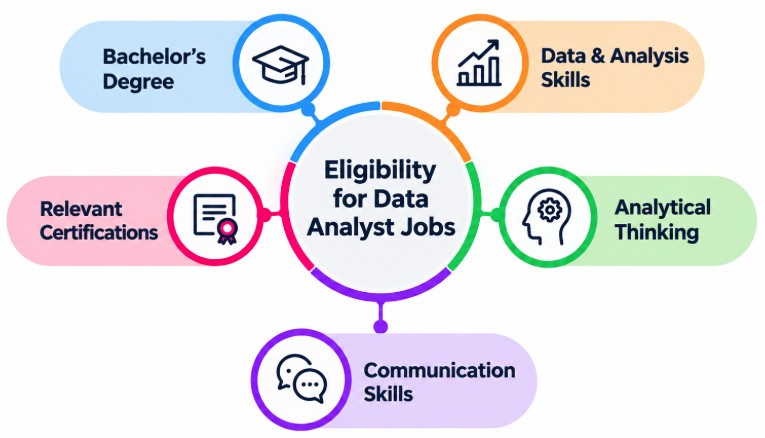
Eligibility requirements for Data Analyst positions vary according to the employer, industry, and complexity of the role. Graduates from computer science, information technology, mathematics, statistics, engineering, commerce, economics, and business disciplines can develop relevant analytics skills. Employers may prioritize practical abilities over a specific academic specialization for some entry-level positions. Candidates should understand data analysis fundamentals, spreadsheet operations, SQL queries, statistics, data cleaning, visualization, and business reporting.

Learn Advanced Data Analytics Certification Training Course to Build Your Skills
Weekday / Weekend BatchesSee Batch DetailsEssential SQL, Excel, and Python Skills for Data Analysts
SQL, Excel, and Python form a useful technical foundation for aspiring Data Analysts. SQL enables professionals to retrieve, filter, join, aggregate, and analyze information stored in relational databases. Candidates should understand SELECT statements, joins, subqueries, CTEs, and window functions as they progress. Excel remains valuable for quick analysis, data cleaning, calculations, PivotTables, lookup functions, charts, and business reporting. Candidates can strengthen their spreadsheet expertise by learning to master Excel formulas for smarter data analysis and apply them to practical business datasets. Python can support larger-scale data manipulation, automation, statistical analysis, and reusable analytical workflows. Libraries such as pandas and NumPy are commonly useful for working with structured datasets, while visualization libraries can support exploratory analysis. Rather than learning each technology separately, candidates can build projects that combine SQL for extracting data, Python or Excel for analysis, and visualization tools for communicating final insights.
Power BI, Tableau, and Data Visualization Skills
Data visualization skills help analysts transform complex datasets into understandable reports, dashboards, and business insights. Power BI and Tableau are widely recognized business intelligence platforms that allow professionals to build interactive visualizations and monitor performance indicators. Analysts should learn data connections, calculated measures, filtering, dashboard design, and visualization best practices. Power BI learners can develop knowledge of Power Query, data models, DAX, reports, dashboards, and publishing workflows. Tableau learners can practice calculated fields, filters, parameters, charts, dashboards, and interactive analysis. Technical knowledge alone is not enough; analysts should understand how to select suitable visualizations and avoid overcrowded dashboards. Exploring why Metabase is a powerful tool for Data Analysts can also introduce candidates to another business intelligence platform for creating accessible dashboards and exploring business data. Effective visualization focuses attention on important trends, comparisons, exceptions, and business metrics so decision-makers can quickly understand what the data indicates.

Get JOB Oriented Data Analytics Training for Beginners By MNC Experts
- Instructor-led Sessions
- Real-life Case Studies
- Assignments
Statistics, Data Cleaning, and Analytical Skills to Learn
Statistics and data-cleaning skills help Data Analysts produce accurate and meaningful conclusions from raw information. Candidates should understand descriptive statistics, averages, distributions, variance, correlation, probability, sampling, hypothesis testing, and other foundational analytical concepts. Data cleaning involves identifying missing values, duplicate records, inconsistent formats, incorrect entries, and outliers before analysis begins. Candidates can strengthen these essential skills through a Data Analytics Course that supports practical learning and industry-relevant knowledge. Analysts should also learn exploratory data analysis to identify patterns, relationships, anomalies, and potential business questions within datasets. Strong analytical thinking enables professionals to investigate why particular trends occur rather than simply creating reports. Knowledge of business metrics and domain context is equally valuable because technically correct analysis must address the underlying business problem. Combining statistical reasoning, clean data, and business understanding produces more reliable insights.
Want to Master Data Analytics? Explore the Data Analytics Master Program Offered at ACTE Today!
Data Analyst Salary and Compensation Factors in Chennai
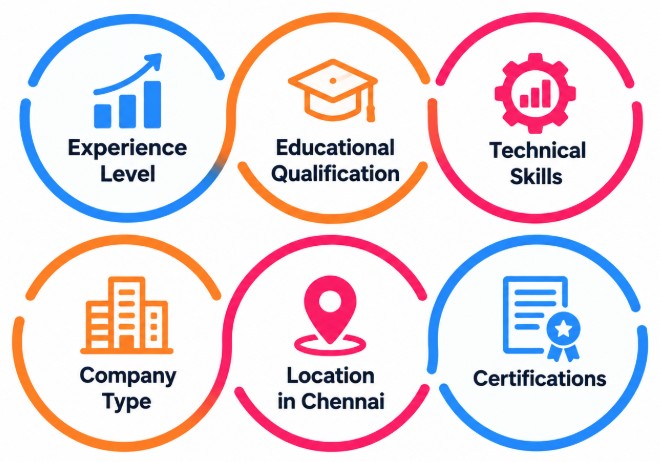
Data Analyst compensation in Chennai can vary based on experience, employer, industry, technical skills, educational background, specialization, and the complexity of responsibilities. Entry-level professionals generally begin with reporting, data preparation and basic analytical tasks, while experienced analysts may handle advanced analysis, automation, stakeholder management, and larger business initiatives. Strong expertise in SQL, Python, Power BI, Tableau, statistics, cloud platforms, and business intelligence can expand the range of roles for which a candidate is qualified. Professionals interested in long-term career growth can explore future trends in Data Analytics to understand emerging technologies and evolving industry requirements.
Want to Learn About Data Analytics? Explore Our Data Analytics Interview Questions and Answers Featuring the Most Frequently Asked Questions in Job Interviews.
Career Growth from Data Analyst to Senior Analytics Roles
A Data Analyst career can develop into several specialized and senior-level pathways. Professionals may begin as Junior Data Analysts or Reporting Analysts and progress toward Data Analyst, Senior Data Analyst, Business Intelligence Analyst, Analytics Consultant, or Analytics Lead positions. Analysts interested in visualization and reporting can move toward BI development, while those who strengthen Python, statistics, machine learning, and predictive modeling may explore Data Scientist opportunities. Professionals who want to understand the distinctions between related career paths can explore the Data Science, Data Analytics, and Big Data before choosing a specialization. Professionals with strong SQL, data modeling, ETL, cloud, and programming knowledge can also transition toward data engineering roles. Career advancement generally requires more than learning additional tools; professionals should develop stronger business understanding, stakeholder communication, project ownership, problem-solving, and decision-making abilities. Building expertise in a particular industry can further differentiate an analyst’s profile and prepare them for consulting, management, or specialized analytics responsibilities.
Conclusion: Building a Successful Data Analytics Career in Chennai
Building a successful Data Analytics career in Chennai requires a balanced combination of technical skills, practical experience, business understanding, and continuous learning. Beginners can establish a strong foundation by learning Excel, SQL, statistics, Power BI or Tableau, and Python before applying these skills to realistic projects. Enrolling in a Data Analytics Course can help aspiring professionals develop industry-relevant knowledge and strengthen their practical abilities. Creating dashboards, analyzing business datasets, documenting insights, and maintaining a portfolio can demonstrate practical skills during job applications and interviews. Candidates should also practice SQL problems, analytical case studies, data interpretation, and communicating recommendations clearly. As experience develops, professionals can specialize in business intelligence, advanced analytics, data science, data engineering, or domain-specific analytics. Sustainable career growth comes from converting raw information into reliable insights that help organizations solve problems and make better decisions.