LMS
Last updated on 05th Sep 2026| 6258

- Exploring ServiceNow Developer Careers at Accenture
- ServiceNow Developer Roles and Key Responsibilities
- ServiceNow Administrator and Platform Support Opportunities
- ServiceNow ITSM, ITOM, and CSM Developer Career Paths
- ServiceNow Integration and Application Development Roles
- Essential Technical Skills for Accenture ServiceNow Developers
- ServiceNow Developer Salary and Compensation Factors
- Certifications and Project Experience for ServiceNow Careers
- Career Progression from ServiceNow Developer to Architect
- Long-Term Career Growth and Opportunities at Accenture
Exploring ServiceNow Developer Careers at Accenture
ServiceNow Developer careers at Accenture can provide opportunities to work on enterprise workflow automation, IT service management, application development, integrations, and digital transformation projects. Developers may help organizations customize and enhance the ServiceNow platform to improve IT and business processes. Depending on the project, professionals can work with ITSM, ITOM, CSM, HRSD, Service Portal, integrations, workflows, and custom applications. Candidates should develop strong knowledge of JavaScript, ServiceNow scripting, Flow Designer, Business Rules, Client Scripts, UI Policies, APIs, and platform administration. Understanding databases, web technologies, REST/SOAP integrations, and enterprise IT processes can further strengthen technical capabilities. Candidates looking to build these platform skills can explore ServiceNow Training to develop structured knowledge and practical exposure. ServiceNow certifications and hands-on projects can help professionals demonstrate platform knowledge. As experience increases, developers can progress toward Senior Developer, Technical Consultant, Technical Lead, Implementation Specialist, and ServiceNow Architect roles.
ServiceNow Developer Roles and Key Responsibilities
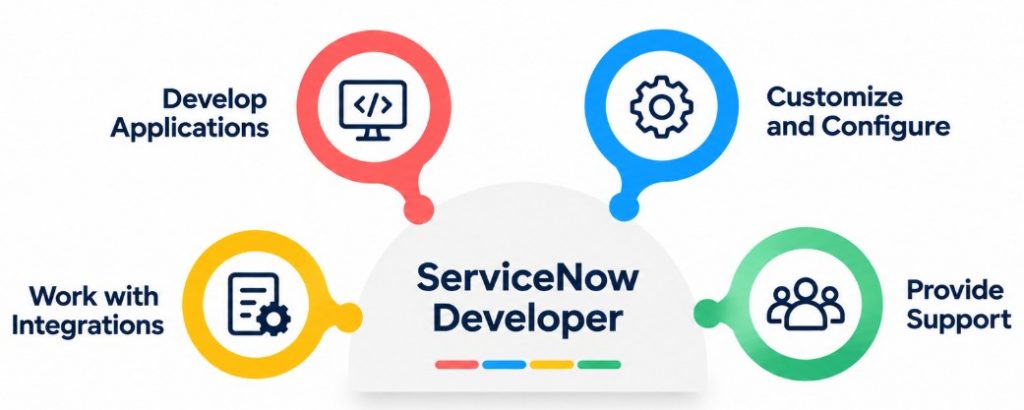
ServiceNow Developers design, configure, customize, test, and maintain applications and workflows built on the ServiceNow platform. Their responsibilities may include developing Business Rules, Client Scripts, Script Includes, UI Policies, workflows, Flow Designer automations, reports, dashboards, and custom applications. Developers can also integrate ServiceNow with external applications through REST APIs, SOAP services, IntegrationHub, and other integration technologies. They work with business analysts, administrators, architects, testers, and clients to understand requirements and translate them into technical solutions.
Get Your ServiceNow Certification by Learning from Industry-Leading Experts and Advancing Your Career with ACTE’s ServiceNow Training.
ServiceNow Administrator and Platform Support Opportunities
ServiceNow Administrator and Platform Support roles focus on maintaining reliable, secure, and efficient ServiceNow environments. Administrators may manage users, groups, roles, permissions, forms, tables, notifications, reports, dashboards, service catalogs, and platform configurations. They can also support incidents, troubleshoot user issues, coordinate upgrades, and maintain system documentation. Platform Support professionals investigate technical problems, identify root causes, resolve configuration issues, and work with development teams when advanced customization is required. Knowledge of ITSM processes such as incident, problem, change, request, and knowledge management can be particularly useful. Candidates should also understand access controls, data management, workflows, Service Catalog, platform security, and basic scripting. Professionals looking to strengthen these administration and platform support skills can explore ServiceNow Training for structured learning and practical exposure. Professionals can begin in administration or support and gradually develop stronger development, integration, and implementation skills, creating pathways toward ServiceNow Developer, Consultant, Platform Engineer, Technical Lead, and Architect opportunities.
ServiceNow ITSM, ITOM, and CSM Developer Career Paths
- ServiceNow ITOM Developer: ITOM Developers focus on improving visibility and management of IT infrastructure and services. They may work with Discovery, Service Mapping, Event Management, CMDB, and automation capabilities to monitor and manage enterprise technology environments.
- ServiceNow CSM Developer: CSM Developers create and customize customer service workflows using ServiceNow Customer Service Management. They work with case management, customer portals, knowledge management, routing, notifications, and integrations to improve service experiences.
- ServiceNow ITSM Developer: ITSM Developers build and customize solutions for managing IT services and support processes. They work with Incident, Problem, Change, Request and Service Catalog modules to automate workflows and improve service delivery. Understanding how the ServiceNow Ticketing Tool supports incident and service request management can also help developers understand common ITSM processes.
- ServiceNow Workflow and Automation Developer: Workflow Developers automate business and IT processes using Flow Designer, workflows, Business Rules, Script Includes, and related platform capabilities. Their goal is to reduce manual activities and create efficient end-to-end processes.
- ServiceNow Technical Consultant: Technical Consultants combine platform development skills with requirement analysis and client interaction. They help translate business requirements into ServiceNow configurations, customizations, integrations, and scalable technical solutions.
- ServiceNow Technical Lead: Experienced developers can progress toward Technical Lead roles where they guide development teams, review solutions, establish development standards, resolve complex technical issues, and coordinate with architects and project stakeholders.

ServiceNow Integration and Application Development Roles
| Job Role | Key Responsibilities | Important Skills |
|---|---|---|
| ServiceNow Integration Developer | Designs and maintains integrations between ServiceNow and external enterprise applications to automate data exchange and business workflows. | REST, SOAP, IntegrationHub, APIs, JavaScript |
| ServiceNow Application Developer | Develops custom ServiceNow applications based on business requirements using platform development and configuration capabilities. | JavaScript, App Engine, tables, forms, scripting |
| ServiceNow API Developer | Creates and manages API-based connections that allow ServiceNow to communicate securely with third-party systems and applications. | REST APIs, SOAP, JSON, XML, authentication |
| ServiceNow Workflow Developer | Builds automated processes for approvals, requests, notifications, tasks, and other business activities using ServiceNow automation capabilities. | Flow Designer, workflows, Business Rules, scripting |
| ServiceNow IntegrationHub Developer | Uses IntegrationHub and spokes to connect ServiceNow with external applications and automate cross-platform business processes. | IntegrationHub, spokes, Flow Designer, APIs |
| ServiceNow Custom Application Developer | Creates business-specific applications, data models, interfaces, security rules, and workflows to address unique organizational requirements. | App Engine, ACLs, scripting, data modeling |

Get JOB Oriented ServiceNow Training for Beginners By MNC Experts
- Instructor-led Sessions
- Real-life Case Studies
- Assignments
Essential Technical Skills for Accenture ServiceNow Developers
| Technical Skill | Description | Key Areas to Learn |
|---|---|---|
| JavaScript and ServiceNow Scripting | Strong scripting knowledge helps developers customize platform behavior and implement complex business requirements. | JavaScript, Glide APIs, Script Includes |
| Business Rules and Client Scripts | Developers use server-side and client-side scripts to automate processes, validate information, and control application behavior. | Business Rules, Client Scripts, UI Policies |
| Flow Designer and Automation | Flow Designer enables developers to create automated workflows for approvals, notifications, requests, and business processes. | Flows, actions, triggers, subflows |
| REST and SOAP Integrations | Integration skills enable ServiceNow to exchange information with external enterprise applications and cloud platforms. | REST, SOAP, JSON, XML, authentication |
| ServiceNow ITSM Knowledge | Understanding core ITSM processes helps developers build solutions for IT service operations and support activities. | Incident, Problem, Change, Request, Knowledge |
| CMDB and Data Management | Developers should understand configuration items, relationships, data models, and data quality to support reliable platform solutions. | CMDB, CIs, relationships, data imports |
| ServiceNow Security | Security knowledge helps developers control access to applications, records, and platform functionality. | ACLs, roles, users, groups, permissions |
| Debugging and Troubleshooting | Strong troubleshooting skills help developers identify scripting, workflow, integration, and configuration issues efficiently. | Logs, debugging, testing, error analysis |
ServiceNow Developer Salary and Compensation Factors
| Salary Factor | How It Influences Compensation | Career Focus |
|---|---|---|
| Experience Level | Developers with deeper implementation and platform experience can qualify for positions with greater technical responsibility and higher compensation. | Junior to Senior to Lead |
| ServiceNow Specialization | Expertise in areas such as ITSM, ITOM, CSM, HRSD, or custom application development can influence role opportunities and earning potential. | Module expertise |
| JavaScript and Scripting Skills | Strong JavaScript, Glide API, Business Rules, Client Scripts, and Script Include knowledge can strengthen a developer’s technical profile. | Advanced development |
| Integration Expertise | Experience with REST, SOAP, IntegrationHub, APIs, JSON, and external system integrations can support more specialized technical roles. | Integration development |
| ServiceNow Certifications | Relevant ServiceNow certifications can validate platform knowledge and strengthen career profiles when combined with practical experience. | CSA, CAD, CIS |
| Project Experience | Experience with real implementations, upgrades, migrations, integrations, and enterprise workflows can increase readiness for advanced responsibilities. | Enterprise projects |
| Technical Leadership | Professionals who review solutions, guide teams, handle complex issues, and make technical decisions can progress toward lead-level positions. | Technical Lead |
| Location and Job Level | Compensation can vary according to country, city, Accenture job level, project requirements, and local market conditions. | Role-specific salary |
| Performance and Business Impact | Consistently delivering reliable solutions, improving workflows, and contributing to successful projects can support career and compensation growth. | Performance growth |
| Architecture Skills | Knowledge of platform architecture, security, integrations, scalability, and solution design can support progression toward higher-level architect roles. | Architecture growth |
Want to Master Gen AI? Explore the ServiceNow Master Program Offered at ACTE Today!
Certifications and Project Experience for ServiceNow Careers
Certifications and practical project experience can help professionals strengthen their profiles for ServiceNow career opportunities. Candidates can begin with certifications such as the ServiceNow Certified System Administrator (CSA) before pursuing credentials aligned with application development or specialized modules. Certifications demonstrate structured platform knowledge, but hands-on experience is equally important for proving practical abilities. Professionals who want to build a structured foundation can explore ServiceNow Training to develop relevant platform knowledge and practical skills. Professionals should work on projects involving ITSM workflows, Service Catalog, Incident and Change Management, Flow Designer, Business Rules, Client Scripts, CMDB, dashboards, and platform security. Integration projects using REST APIs, SOAP services, IntegrationHub, JSON, and external applications can further demonstrate technical expertise. Candidates should also practice requirement analysis, application configuration, testing, debugging, documentation, and deployment activities. Real-world implementation, migration, upgrade, and support experience can provide deeper knowledge of enterprise ServiceNow environments. Combining certifications with practical projects allows professionals to demonstrate both theoretical understanding and the ability to solve real business problems using the ServiceNow platform.
Want to Learn About ServiceNow? Explore Our ServiceNow Interview Questions and Answers Featuring the Most Frequently Asked Questions in Job Interviews.
Career Progression from ServiceNow Developer to Architect
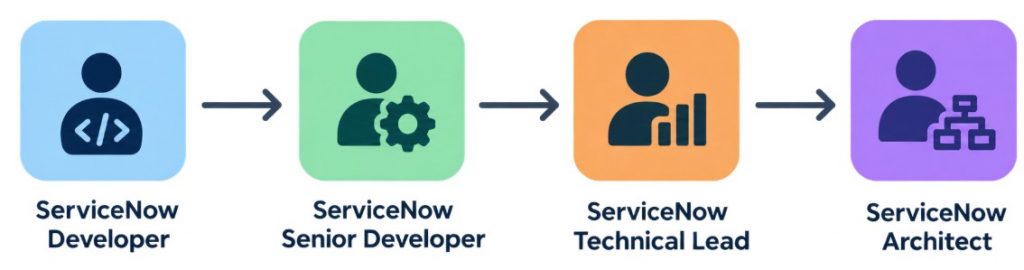
Career progression from ServiceNow Developer to Architect requires professionals to gradually expand their expertise from application development into platform architecture, integrations, security, scalability, and enterprise solution design. Developers may begin by working with JavaScript, Business Rules, Client Scripts, Flow Designer and custom applications. With experience, they can progress into Senior Developer or Technical Lead positions where they handle complex requirements, review code, establish development standards, mentor team members, and coordinate technical implementations. Exploring Infosys ServiceNow Job Opportunities can also provide context on ServiceNow developer roles and career opportunities in an enterprise environment.
Long-Term Career Growth and Opportunities at Accenture
A long-term ServiceNow career at Accenture can provide opportunities across platform development, administration, consulting, integrations, ITSM, ITOM, CSM, automation, technical leadership, and solution architecture. Professionals can begin by building strong ServiceNow fundamentals and gradually specialize according to their technical strengths and career interests. Developers with strong scripting and application development abilities can pursue advanced development roles, while professionals interested in enterprise connectivity can specialize in APIs, IntegrationHub, and integration architecture. Others can develop expertise in ITSM, ITOM, CSM, CMDB, HRSD, or workflow automation. For professionals looking to strengthen their platform knowledge before progressing into specialized roles, ServiceNow Training can provide structured learning across key platform concepts and practical areas. As professionals gain implementation and client-facing experience, they can progress toward Senior Developer, Technical Consultant, Technical Lead, Platform Architect, or Solution Architect responsibilities. Continuous learning is important because the ServiceNow platform continues to expand through automation, AI capabilities, workflow technologies, and enterprise solutions. Developing strong technical expertise alongside business-process understanding, communication, consulting, and leadership skills can help professionals take responsibility for increasingly complex projects and build sustainable long-term careers within Accenture’s ServiceNow ecosystem.